
The Fastest Way to Learn Airbnb Hosting in 2026
If you want to learn Airbnb hosting, here is the short answer: pick one learning path, study the business model for 2 to 4 weeks, then list your first property before you feel ready. Most people spend months consuming free content and never take action. The hosts who earn real income treat Airbnb like a business from day one, not a side project they will figure out later. The vacation rental industry has matured since 2020, and new hosts who skip structured learning often burn through months of trial and error that a focused Airbnb hosting education would have prevented.
I have watched over 1,600 students go through the 10XBNB program, and the pattern is always the same. The ones who succeed fast are not smarter or wealthier. They follow a structured learning path, get feedback from someone who has done it, and launch within 30 to 60 days. The ones who stall spend six months on YouTube trying to piece together a strategy from 50 different creators with 50 different opinions.
This guide breaks down every way to learn Airbnb hosting, from free self-study to paid courses to mentorship programs. I will tell you what each path actually looks like, how long it takes, what it costs, and which one fits your situation. No filler. Just the information you need to pick a path and start.
Three Paths to Learning Airbnb Hosting
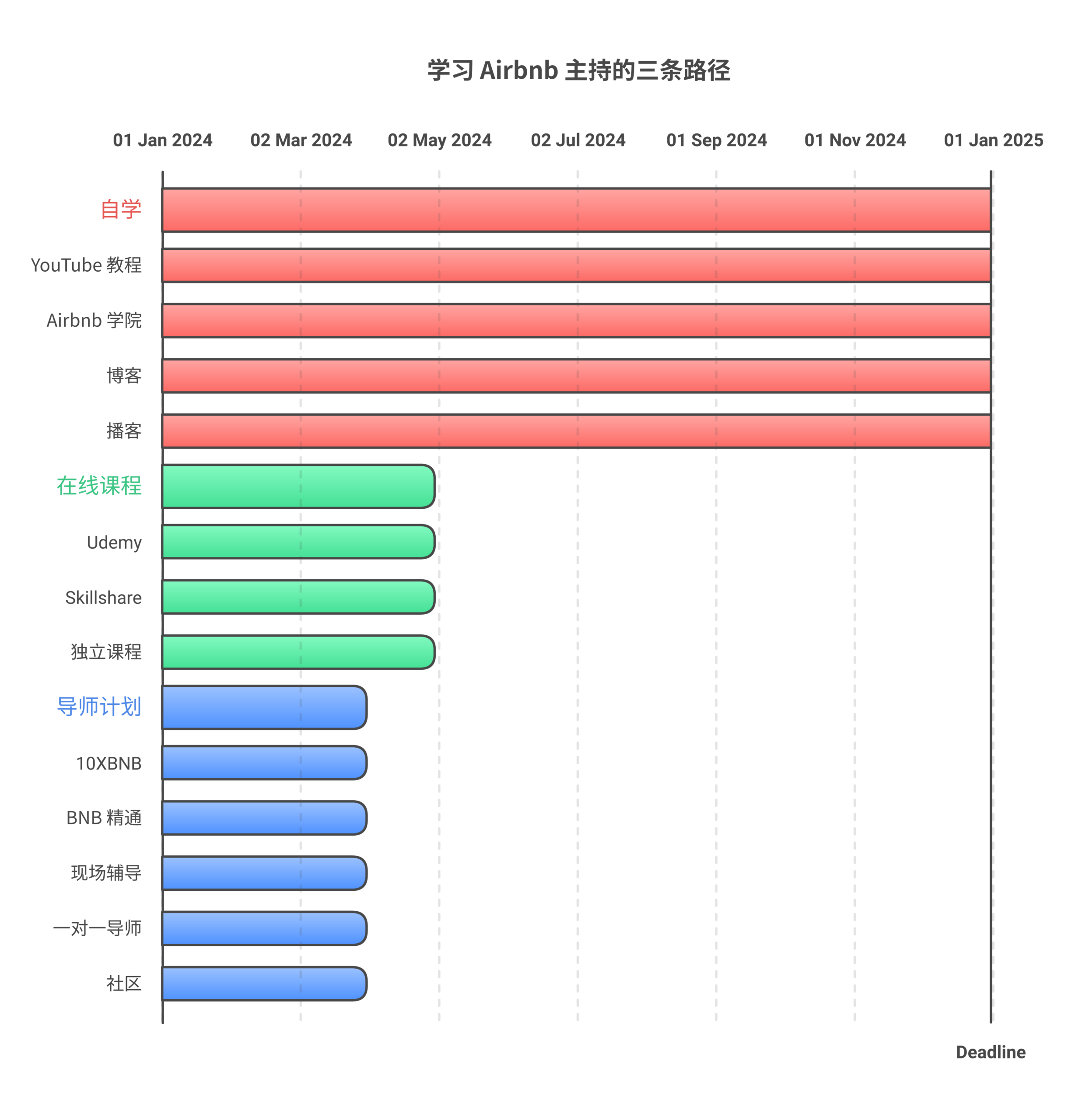
Every person who learns Airbnb hosting follows one of three paths. Each has trade-offs in cost, speed, and risk. Your target audience, budget, and timeline should drive which Airbnb hosting learning path you choose. Understanding these trade-offs before you start saves you from switching paths halfway through, which is the most common reason people quit.
Path 1: Self-Study (Free Resources)
Self-study means learning from free content: YouTube channels, podcasts, blog posts, Airbnb’s own help center, and community forums. This path costs nothing upfront, but it takes the longest because you have to filter good advice from bad advice on your own.
Best free resources for Airbnb hosting in 2026:
- Airbnb Resource Center is Airbnb’s official education hub with articles on listing setup, pricing basics, guest communication, and Superhost requirements. It is free and always current, but it only covers the platform itself, not the business strategy behind building a portfolio.
- YouTube channels from active hosts like Sean Rakidzich (300,000+ subscribers, 100+ active properties) offer real operational insights. The challenge is that YouTube rewards entertainment over education, so you get a lot of “day in the life” content mixed with actual strategy.
- BiggerPockets forums have thousands of threads on short-term rental investing, rental arbitrage deal analysis, and market selection. The quality varies wildly, but searching specific questions often surfaces detailed answers from experienced operators.
- Podcasts like “Get Paid for Your Pad” and “Short Term Rental Secrets” cover interviews with hosts at every level. Good for motivation and hearing different business models, but hard to build a step-by-step plan from.
Timeline: 6 to 12 months to first profitable property. You will spend 2 to 3 months just figuring out which information to trust, then another 2 to 4 months building confidence to take action.
Best for: People with zero budget who have patience and can self-direct their learning. Also good for anyone who already owns a property and just needs to learn how to list and manage it.
Biggest risk: Information overload. Free content is not organized into a curriculum. You will learn about pricing strategy before you understand market analysis, or study guest communication before you have a property to host in. The lack of sequence causes most self-learners to stall.
Path 2: Online Courses (Structured, Self-Paced)
Online courses on platforms like Udemy, Skillshare, and Coursera give you structured curriculum at a low cost. You get video lessons organized in order, often with downloadable templates, checklists, and community access.
What to expect from online Airbnb courses:
- Udemy courses range from $15 to $100 during sales (Udemy runs promotions constantly). Popular options cover hosting basics, rental arbitrage, listing optimization, and automation. Most are 4 to 12 hours of video content.
- Skillshare courses tend to be shorter (1 to 4 hours) and more focused on single topics like photography, pricing, or Airbnb Experiences. Access requires a monthly subscription around $14/month.
- Standalone courses from individual hosts or companies range from $200 to $1,000 and typically include more depth, templates, and sometimes a private community or Facebook group.
Timeline: 2 to 4 months to first property. The structure cuts your learning time roughly in half compared to self-study because someone has already organized the information in the right sequence.
Best for: People who learn well from video content and want a clear curriculum without spending thousands. Good for someone who already has a property in mind and needs the tactical knowledge to get it listed and earning.
Biggest risk: No accountability and no feedback. You can buy a course and never finish it. Udemy’s completion rate across all courses is below 15%, according to their own instructor data. And when you hit a problem specific to your market or property, there is no one to ask. You are back to searching YouTube and forums for answers.
Path 3: Mentorship Programs (Guided, Fast-Track)
Mentorship programs combine structured curriculum with live coaching, 1-on-1 guidance, and direct access to experienced operators. This is the most expensive path, but it compresses your timeline from months to weeks.
What mentorship programs typically include:
- Live group coaching calls (weekly or multiple times per week)
- A dedicated mentor or coach assigned to your specific situation
- Done-for-you templates: lease agreements, furnishing lists, SOPs, guest messaging sequences
- Market analysis tools or direct help selecting your first market
- A private community of active students sharing deals, wins, and lessons
Notable mentorship programs in 2026:
- 10XBNB focuses on the co-listing model (managing properties you do not own) with live coaching 5 times per week and a 1-on-1 mentor. Built by Shaun Ghavami, who runs a 155+ property portfolio. Over 1,600 students trained, with 73% reaching profitability within 90 days.
- BNB Mastery teaches rental arbitrage (leasing properties to list on Airbnb) and has a large YouTube following. Focus is on getting your first property up quickly.
- Airbnb Automated by Sean Rakidzich provides courses from $174 to $800 covering algorithm optimization, pricing strategy, and deal negotiation. Sean operates 100+ properties generating over $1M per month in revenue and has trained 5,000+ students across 76 countries.
Timeline: 30 to 90 days to first profitable property. The combination of structured content, live coaching, and accountability makes this the fastest path by a significant margin.
Best for: Anyone serious about building Airbnb hosting into a real business (not just listing a spare bedroom). Especially valuable if you are pursuing rental arbitrage or co-hosting, where having an experienced guide helps you avoid costly mistakes in lease negotiations and property selection.
Biggest risk: Cost. Premium mentorship programs range from $1,000 to $5,000+. The investment is justified if you actually follow through, but it is wasted money if you do not take action. Before enrolling in any program, ask yourself honestly: will I do the work within 90 days?
What You Need to Learn: The Airbnb Hosting Curriculum
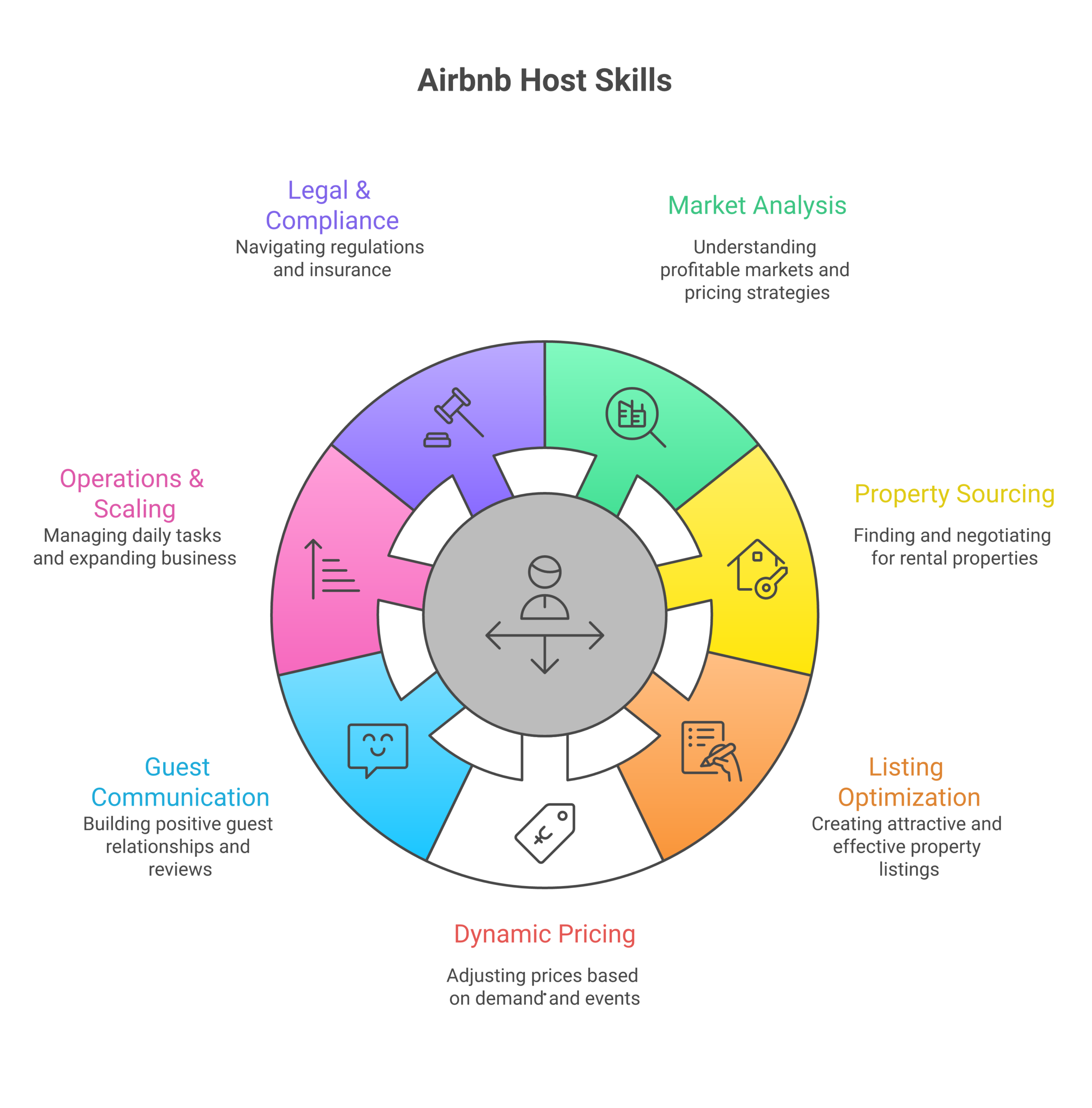
Regardless of which path you choose, you need to learn the same core skills. Here is the curriculum every successful Airbnb host covers, in the order that matters most.
1. Market Analysis and Property Selection
Before you spend a dollar on any property, you need to understand the local rental market. Market analysis means studying comparable Airbnb properties in your area: average nightly rates, occupancy rates, seasonal demand patterns, and the number of active listings competing for the same guests. Tools like AirDNA and Mashvisor pull real booking data so you can estimate revenue before you commit to a property.
Before you spend a dollar on a property, you need to know which markets actually support profitable short-term rentals. This means understanding:
- Average daily rate (ADR) in your target market. AirDNA, Mashvisor, and AllTheRooms provide market data starting around $20/month.
- Occupancy rates by season. A market with $200/night ADR but 40% occupancy earns less than a market with $120/night and 75% occupancy.
- Local regulations. Some cities ban short-term rentals entirely. Others require permits, business licenses, or limit the number of days you can rent per year. Check your city’s STR ordinances before committing.
- Supply saturation. A market with 500 active listings and steady demand is different from one with 5,000 listings and flat growth. Look at year-over-year listing growth versus demand growth.
If you are looking for markets with strong fundamentals, see our guide to profitable Airbnb cities for data on top-performing markets.
2. Property Sourcing
Property sourcing is how you find and secure properties to list on Airbnb. Rental arbitrage, where you lease a property long-term and list it as a short-term rental, is the most popular entry point because it requires no down payment. Other sourcing methods include co-hosting (managing someone else’s property for a percentage of income), purchasing an investment property, or listing a spare room in your primary residence. Each method has a different income ceiling and risk profile.
You do not need to buy a property to start hosting on Airbnb. There are three main sourcing models:
- Own and host: Buy or already own a property and list it. Highest profit margins but requires significant capital.
- Rental arbitrage: Lease a property with landlord permission, then list it on Airbnb. Lower capital requirement (typically $3,000 to $10,000 per property including first/last month rent, furnishing, and supplies). You earn the spread between your monthly lease and your Airbnb income.
- Co-hosting and co-listing: Manage someone else’s property on Airbnb for a percentage of revenue (typically 15% to 25%). This is the lowest-capital entry point because you do not pay rent or a mortgage. You provide the hosting expertise, the property owner provides the asset.
3. Furnishing and Design
Furnishing an Airbnb property goes beyond picking a couch. Guests in 2026 expect fast Wi-Fi (50 Mbps minimum), a smart TV, quality linens, and a fully stocked kitchen. The best Airbnb hosting courses teach you how to furnish a property for $3,000 to $8,000 while creating a space that photographs well and earns 5-star reviews. Your furnishing budget directly affects your cleaning fee structure, nightly rate, and occupancy rate, so these decisions connect to your overall pricing strategy.
Furnishing is where many new hosts overspend. A 2-bedroom rental arbitrage property can be fully furnished for $3,000 to $5,000 if you source strategically. The goal is not to create a magazine cover. It is to create a clean, comfortable, photo-ready space that photographs well and earns 5-star reviews.
Key furnishing principles:
- Neutral color palettes photograph better and appeal to more guests
- Invest in mattresses and linens first. Sleep quality drives reviews more than any other factor
- Buy in bulk from wholesale suppliers (IKEA, Wayfair commercial, Amazon Business) for 20% to 40% savings
- Every room needs good lighting. Replace builder-grade fixtures with warm, bright alternatives
4. Listing Optimization
Your Airbnb listing is the single asset that converts browsers into paying guests. Listing optimization covers your title (50-character limit), description, photography, amenity checkboxes, and house rules. Hosts who invest in professional listing photos earn up to 40% more revenue according to Airbnb data. A strong listing also improves your search ranking within the Airbnb platform, putting your property in front of more potential guests.
Your listing is your storefront. The Airbnb algorithm favors listings with high click-through rates, strong conversion rates, and positive reviews. Optimization covers:
- Title: Front-load the most compelling feature (location, view, amenity). “Downtown Loft, Walk to Everything” outperforms “Beautiful 1BR Apartment” every time.
- Photos: Professional photography is not optional. Listings with professional photos earn 40% more per night according to Airbnb’s own data. Minimum 20 photos covering every room, outdoor space, and neighborhood highlight.
- Description: Lead with what makes your property different. Skip the generic “Welcome to our lovely home” opener. State the value: “5-minute walk to the beach, king bed, fast WiFi, self check-in.”
- Amenities: Check every amenity that applies. Guests filter by amenities (WiFi, parking, washer/dryer, kitchen, pool) and listings with more checked amenities appear in more search results.
5. Dynamic Pricing Strategy
Dynamic pricing adjusts your nightly rate based on demand, seasonality, local events, and competitor pricing. Tools like PriceLabs, Beyond Pricing, and Wheelhouse automate this process. Hosts who use dynamic pricing consistently earn 10% to 40% more than those who set a flat rate. Any Airbnb hosting course should teach you how to read your market data and set pricing rules that maximize both occupancy rate and revenue per available night.
Static pricing (setting one price and forgetting it) leaves money on the table. Dynamic pricing tools adjust your rates based on demand, seasonality, local events, day of week, and competitor pricing.
The three most used pricing tools in 2026:
- PriceLabs (starts at $20/month per listing) offers the most customization and integrates with most property management software
- Beyond Pricing (1% of booking revenue) is simpler to set up but offers less control
- Wheelhouse (1% of revenue or flat fee) balances customization with ease of use
A properly configured pricing tool can increase revenue 15% to 40% compared to manual pricing, based on data from PriceLabs’ published case studies.
6. Guest Communication and Experience
Guest communication is the skill that separates 4-star hosts from Superhosts. The standard is fast response times (under 1 hour), clear check-in instructions, proactive problem-solving, and a personal touch that makes guests feel welcome without being intrusive.
Most experienced hosts automate 80% of guest communication using scheduled messages:
- Booking confirmation with property details
- Check-in instructions 24 hours before arrival
- Day-of-arrival welcome message
- Mid-stay check-in (“Everything going well?”)
- Pre-checkout reminder with instructions
- Post-checkout thank you with review request
Tools like Hospitable (formerly Smartbnb), Guesty, and Host Tools automate these sequences across multiple listings and platforms. For a deeper look at automating your Airbnb operations, see our complete automation guide.
7. Scaling: From One Property to a Portfolio
The jump from one property to five is where most hosts either build a real business or burn out. Scaling requires systems:
- Property management software (PMS) like Guesty, Hostaway, or Lodgify to manage multiple listings from one dashboard
- Cleaning teams with automated turnover scheduling (Turno, formerly TurnoverBnB, is the most popular option)
- Maintenance protocols with documented SOPs and a local handyman on call
- Financial tracking with separate accounts per property and monthly P&L reviews
The average U.S. Airbnb host earns about $15,000 per year according to Airbnb’s published host earnings data. Hosts who scale to 5+ properties and run professional operations typically earn $60,000 to $150,000+ in annual net income, depending on market and model.
Airbnb Property Management Course vs. Hosting Course: What is the Difference?
People searching for an “airbnb property management course” and an “airbnb hosting course” often think they are looking for the same thing. They are not.
An Airbnb hosting course teaches you how to list and manage your own property (or properties you control through arbitrage). The focus is on being a great host: listing optimization, pricing, guest experience, reviews, and Superhost status.
An Airbnb property management course teaches you how to manage properties for other owners as a business service. This includes everything in a hosting course plus client acquisition, property management agreements, owner communication, accounting for multiple owners, and building a property management company.
If your goal is to manage 1 to 5 of your own properties, a hosting course is what you need. If your goal is to build a property management business managing 20, 50, or 100+ properties for other owners, look for a property management specific program.
The co-hosting model sits between these two. As a co-host, you manage properties for owners but typically on a simpler revenue-share basis rather than a full property management contract. This is the entry point 10XBNB teaches because it requires no capital and lets you start earning while you learn the business.
Co-Hosting: The Lowest-Risk Way to Start
Before you sign your first hosting agreement, know what protection Airbnb provides. Airbnb AirCover gives hosts up to $3 million in damage protection and $1 million in liability coverage at no extra cost. This matters because standard homeowner insurance does not cover short-term rental activity. Any Airbnb hosting course worth your time should walk you through AirCover limits and when you need separate vacation rental insurance.
Co-hosting is the fastest way to learn Airbnb hosting with zero capital risk. Here is how it works:
- Find a property owner who either does not want to manage their Airbnb listing or is not getting good results
- Propose a co-hosting agreement where you manage the listing in exchange for 15% to 25% of booking revenue
- You handle everything: listing creation, pricing, guest communication, cleaning coordination, and reviews
- The owner keeps their property and earns more than they would on their own (or earns income from a property that was sitting idle)
This model works because there are millions of property owners who bought investment properties or vacation homes but do not have the time, skill, or interest to manage them as short-term rentals. Your expertise is the value you bring.
Where to find co-hosting clients:
- Search Airbnb for underperforming listings in your area (bad photos, generic descriptions, low review counts, stale pricing)
- Post in local real estate investor Facebook groups
- Network at local real estate meetups
- Contact property owners on Craigslist or Zillow who list furnished rentals
- Ask friends and family. Many people own second homes or guest houses they are not using
The 10XBNB co-listing model builds on this foundation. Instead of managing an existing Airbnb listing, you help property owners create new listings and optimize them from scratch, often taking a higher revenue share because you are building the business from zero.
The 10XBNB Approach: How We Teach Airbnb Hosting
I am biased here because I work with 10XBNB, so I will lay out exactly what the program includes and let you decide if it fits your situation.
The co-listing method: 10XBNB teaches a specific model where you partner with property owners to list their homes on Airbnb. You do not need to own property, sign leases, or put up significant capital. This makes it accessible to people who cannot afford rental arbitrage startup costs or a property purchase.
Live coaching 5 times per week: This is what separates 10XBNB from most online courses. Instead of pre-recorded videos you watch alone, you get live sessions where you can ask questions about your specific deals, markets, and challenges. Coaching covers deal analysis, listing reviews, pricing strategy, and troubleshooting.
1-on-1 mentorship: Every student is paired with a mentor who has active properties. Your mentor reviews your deals before you commit, helps you prepare property pitches, and guides you through your first listings.
The person behind the program: Shaun Ghavami founded 10XBNB after building a 155+ property portfolio using the co-listing model. He graduated from UBC Sauder School of Business with a degree in finance and spent the early part of his career in banking at BMO, RBC, and Scotiabank. He transitioned to full-time short-term rental operations after his Airbnb income exceeded his banking salary. The program is built from his operating playbook, not theory.
Student results: Over 1,600 students have gone through the 10XBNB program. 73% reach profitability within 90 days of completing the training. Results vary based on market, effort, and starting situation, but the structured coaching model produces more consistent outcomes than self-study or passive courses.
Want to see if 10XBNB is the right fit? Book a free strategy call to speak with the team about your goals and situation.
What Every Airbnb Business Course Should Cover
Whether you go with 10XBNB or any other program, here is what a quality Airbnb business course should include. Use this as a checklist when evaluating any training:
| Topic | Why It Matters | Red Flag If Missing |
|---|---|---|
| Market analysis framework | Prevents you from entering an oversaturated or unprofitable market | Yes. A course that skips market research teaches you to gamble |
| Property sourcing strategy | Finding the right property at the right terms is half the battle | Yes. “Just lease any apartment” advice is reckless |
| Financial modeling | You need to project revenue, costs, and breakeven before committing | Yes. If they do not teach numbers, run |
| Listing optimization | Your listing quality directly controls your booking rate and ADR | Moderate. This information is available for free |
| Pricing strategy | Dynamic pricing can increase revenue 15% to 40% | Moderate. Tool-specific training is usually free from pricing platforms |
| Legal and regulatory compliance | Ignoring regulations can result in fines or forced shutdown | Yes. Any course that ignores legality is irresponsible |
| Guest communication templates | Saves dozens of hours and ensures consistent 5-star service | Minor. Templates are easy to build or find |
| Scaling systems and SOPs | You cannot grow past 3 to 5 properties without systems | Depends. Only matters if your goal is a portfolio |
| Live coaching or Q&A access | Real-time feedback on your specific deals and challenges | Major differentiator. Pre-recorded only courses have high dropout rates |
| Community of active students | Peer support, deal sharing, and accountability | Important. Isolation kills motivation |
How Long Does It Take to Learn Airbnb Hosting?
The honest answer depends on your starting point and learning path:
| Starting Point | Learning Path | Time to First Property | Time to Profitability |
|---|---|---|---|
| Own a property, need to learn hosting | Self-study or basic course | 2 to 4 weeks | 1 to 2 months |
| No property, pursuing rental arbitrage | Online course | 2 to 4 months | 3 to 6 months |
| No property, pursuing co-hosting | Mentorship program | 30 to 60 days | 60 to 90 days |
| No property, self-teaching everything | Free resources only | 6 to 12 months | 8 to 14 months |
| Experienced host, want to scale | Mentorship or mastermind | Already have one | 30 to 60 days per new property |
These timelines assume you are putting in at least 10 to 15 hours per week. Part-time learners should roughly double these estimates.
Common Mistakes When Learning Airbnb Hosting
After working with hundreds of new hosts, I see the same mistakes repeat. Avoid these and you will be ahead of 80% of beginners:
1. Studying forever without launching. You will never feel 100% ready. The first listing teaches you more than 100 hours of content. Launch with a minimum viable listing and improve as you go.
2. Choosing a market based on where you live instead of where the numbers work. Your hometown might have terrible STR regulations or oversaturated supply. Run the numbers on 3 to 5 markets before committing. Virtual hosting and remote management tools make it possible to operate in any market.
3. Underestimating startup costs. First-time rental arbitrage operators often budget for rent and furniture but forget about supplies, photography, permits, insurance, initial cleaning, and the 1 to 2 months of expenses before bookings ramp up. See our full rental arbitrage startup cost breakdown for realistic numbers.
4. Skipping the financial model. If you cannot show on paper that a property will be profitable at 55% to 60% occupancy (not 80% to 90%), do not take the deal. Build in a margin of safety. Markets fluctuate, and you need to survive slow months.
5. Ignoring local regulations. Some cities require short-term rental permits, business licenses, hotel taxes, or have outright bans. Getting shut down after investing in furnishing and setup is the most expensive mistake a new host can make. Always verify regulations before signing a lease or listing a property.
6. Treating every market the same. A beach town with 70% summer occupancy and 20% winter occupancy requires a completely different pricing and financial strategy than a city market with steady 65% year-round occupancy. Learn your market’s seasonality before setting expectations.
Getting Started: Your First 30 Days Action Plan
Your first 30 days should follow a clear sequence. Week 1: research your local short-term rental regulations, including zoning laws, permit requirements, and any occupancy tax obligations. Week 2: build a simple business plan covering your target market, estimated startup costs, projected monthly income, and break-even timeline. Weeks 3 and 4: secure your property, furnish it, photograph it, and publish your Airbnb listing. This timeline works whether you are doing rental arbitrage, co-hosting, or listing your own home.
No matter which learning path you choose, here is what your first 30 days should look like:
Week 1: Foundation
- Choose your learning path (self-study, course, or mentorship)
- Research 3 to 5 potential markets using AirDNA or Mashvisor free trials
- Read your target city’s short-term rental regulations
- Set up an Airbnb host account (free, takes 10 minutes)
Week 2: Market Deep Dive
- Analyze 20+ listings in your target market (pricing, amenities, reviews, occupancy)
- Build a financial model for your first property (revenue projections, expenses, breakeven)
- Decide on your sourcing model: own property, rental arbitrage, or co-hosting
- If co-hosting: identify 10 underperforming listings in your area to pitch
Week 3: Property Acquisition
- If arbitrage: contact landlords and submit applications for 3 to 5 properties
- If co-hosting: send outreach to 5 to 10 property owners with a co-hosting proposal
- If own property: order furnishing essentials and schedule professional photography
- Set up business basics: separate bank account, basic bookkeeping, insurance
Week 4: Launch
- Complete furnishing and staging (if applicable)
- Take or schedule professional photos
- Create your Airbnb listing with optimized title, description, and amenities
- Set up dynamic pricing (PriceLabs, Beyond Pricing, or Wheelhouse)
- Configure automated guest messaging
- Publish your listing and set an introductory price 10% to 15% below market to get your first bookings and reviews
Frequently Asked Questions
Can I learn Airbnb hosting for free?
Yes. Airbnb’s Resource Center, YouTube channels from active hosts, BiggerPockets forums, and STR podcasts provide enough free information to learn the basics. The trade-off is time and organization. Free resources are scattered across dozens of sources, and you will need to build your own curriculum and learning sequence. Most free learners take 6 to 12 months to launch their first property, compared to 30 to 90 days with a structured course or mentorship.
How much does an Airbnb hosting course cost?
Courses range from $15 (Udemy sale prices) to $5,000+ (premium mentorship programs). Budget Udemy and Skillshare courses cost $15 to $100 and provide structured video content without live support. Mid-range courses from independent creators run $200 to $1,000 with community access. Premium programs with live coaching, mentorship, and templates cost more but deliver faster results. For 10XBNB specifically, book a strategy call for current program options.
Do I need to own property to start hosting on Airbnb?
No. Rental arbitrage (leasing properties) and co-hosting (managing other people’s properties) both allow you to host without ownership. Co-hosting requires the least capital since you do not pay rent or mortgage. Rental arbitrage requires $3,000 to $10,000 per property in startup capital. Both models are legitimate and widely practiced in the short-term rental industry.
What is the difference between co-hosting and property management?
Co-hosting typically involves managing 1 to 10 properties for individual owners on a simple revenue-share basis (15% to 25% of booking revenue). Property management is a formal business managing 10 to 100+ properties with management contracts, dedicated staff, and more operational overhead. Many co-hosts grow into property managers over time. Co-hosting is the easier entry point because it requires no formal company structure to get started.
How much can I earn as an Airbnb host?
The average U.S. Airbnb host earns about $15,000 per year according to Airbnb’s published data. Hosts who treat it as a business and scale to multiple properties earn significantly more. Rental arbitrage operators running 5 to 10 properties typically earn $60,000 to $150,000+ in annual net income. Co-hosts managing a portfolio can earn $40,000 to $100,000+ depending on the number and quality of properties. Results depend heavily on market selection, property quality, pricing strategy, and operational efficiency.
Is rental arbitrage legal?
Rental arbitrage is legal in most markets, but it requires landlord permission and compliance with local short-term rental regulations. You cannot sublease a property on Airbnb without your landlord’s written consent. Some leases explicitly prohibit subletting, and some cities restrict or require permits for short-term rentals. Always get written landlord approval and verify local STR regulations before pursuing arbitrage.
What tools do I need to manage an Airbnb?
At minimum, you need: a dynamic pricing tool (PriceLabs, Beyond Pricing, or Wheelhouse, $20 to $50/month), a guest communication tool (Hospitable or Host Tools, $25 to $50/month for basic plans), and a cleaning management tool (Turno, free for basic use). As you scale past 3 to 5 properties, add a property management system (Guesty, Hostaway, or Lodgify, $50 to $200/month) and a channel manager to list on Airbnb, VRBO, and Booking.com simultaneously.
How do I become a Superhost?
Airbnb Superhost status is a quarterly assessment. You need at least 10 completed trips in the past year, a 90% or higher response rate, less than 1% cancellation rate, and an overall rating of 4.8 or above. Superhosts earn an average of 22% more per booking and receive a badge on their listing and profile. Achieving Superhost status within your first year of Airbnb hosting is realistic if you focus on guest communication, cleanliness, and accurate listing descriptions.
Airbnb evaluates Superhost status every quarter based on four criteria: a minimum of 10 trips (or 3 reservations totaling 100+ nights), a 4.8+ overall rating, less than 1% cancellation rate, and a 90%+ response rate. New hosts typically reach Superhost status within 6 to 12 months if they focus on guest experience, fast response times, and consistent cleanliness. Superhost status increases your listing visibility and booking conversion rate.
Airbnb Hosting vs. Traditional Real Estate Investing
People learning Airbnb hosting often come from a traditional real estate background, or they are considering both paths at the same time. Here is how short-term rental hosting compares to conventional buy-and-hold investing:
Cash flow speed: A well-managed Airbnb property can generate positive cash flow within 30 to 60 days of listing. Traditional long-term rentals typically take 6 to 12 months to stabilize, and returns are lower per property but more predictable.
Active vs. passive income: Airbnb hosting is active income, at least initially. You are managing bookings, guest communication, cleaning schedules, and pricing. Long-term rentals are closer to passive once a tenant is placed. As you scale your Airbnb business and build systems, the active workload decreases significantly, but it never reaches zero.
Revenue potential: Short-term rentals typically earn 2x to 3x more gross revenue than long-term rentals in the same market. After expenses (higher turnover costs, supplies, platform fees, cleaning), net margins are still usually higher for STRs, but the operational load is greater.
Risk profile: Airbnb income fluctuates with seasonality, local events, and economic conditions. Long-term rental income is fixed by lease. Many experienced investors use a mix of both: long-term rentals for stability, short-term rentals for growth. An Airbnb business course that covers financial modeling should teach you how to evaluate both options for your specific market.
Start Learning Today
The best time to learn Airbnb hosting was last year. The second best time is right now. The short-term rental market continues to grow, with Airbnb surpassing 8 million active listings globally and over 5 million hosts as of late 2025. But growth also means more competition, which makes structured learning more valuable than ever.
Pick your path. If you have time but no budget, start with free resources and commit to launching within 6 months. If you want structure without a major investment, grab a well-reviewed Udemy or Skillshare course and set a 90-day launch deadline. If you want the fastest path with the most support, explore a mentorship program that matches your goals.
If the co-listing model sounds like the right fit, 10XBNB offers a free strategy call where you can talk through your situation with someone who has done it. No pressure, just a conversation about whether the program makes sense for where you are. Book a strategy call for current program options.