Rental arbitrage (also called airbnb arbitrage) is a short term rental business model where you lease a property long-term from a landlord, furnish it, and re-list it as a vacation rental on Airbnb and Vrbo. You pay a fixed monthly rent and keep the spread between nightly revenue and that rent plus operating costs. Most profitable airbnb rental arbitrage units run a 20% to 30% net margin and cost $3,000 to $15,000 to start. It is legal in most markets when three things line up: your lease permits subletting, you have written landlord approval, and you follow local short term rental regulations. The 10XBNB system has produced over $5 million in booking fees across 24 properties using this exact model.
Rental arbitrage and airbnb arbitrage are two names for the same idea: you rent a property the normal way, then list it for short stays at a higher nightly rate, and you pocket the difference. No mortgage. No down payment. No property ownership. You are running a hospitality business on a unit you do not own. New to the model? Walk through our step-by-step guide to starting a rental arbitrage business before your first deal.
This is the complete guide to rental arbitrage in 2026. I will cover what the model actually is, how the rent-to-rent spread works, whether it is legal, whether it is still profitable this year, the honest pros and cons, what it costs to start, the tools you need, how arbitrage compares to other short term rental models, and the best markets to operate in. I teach this exact system to more than 1,600 students inside 10XBNB. If you want it in a structured, step-by-step format, our rental arbitrage course walks through every stage in order.
What Is Rental Arbitrage? (And What Is Airbnb Arbitrage?)
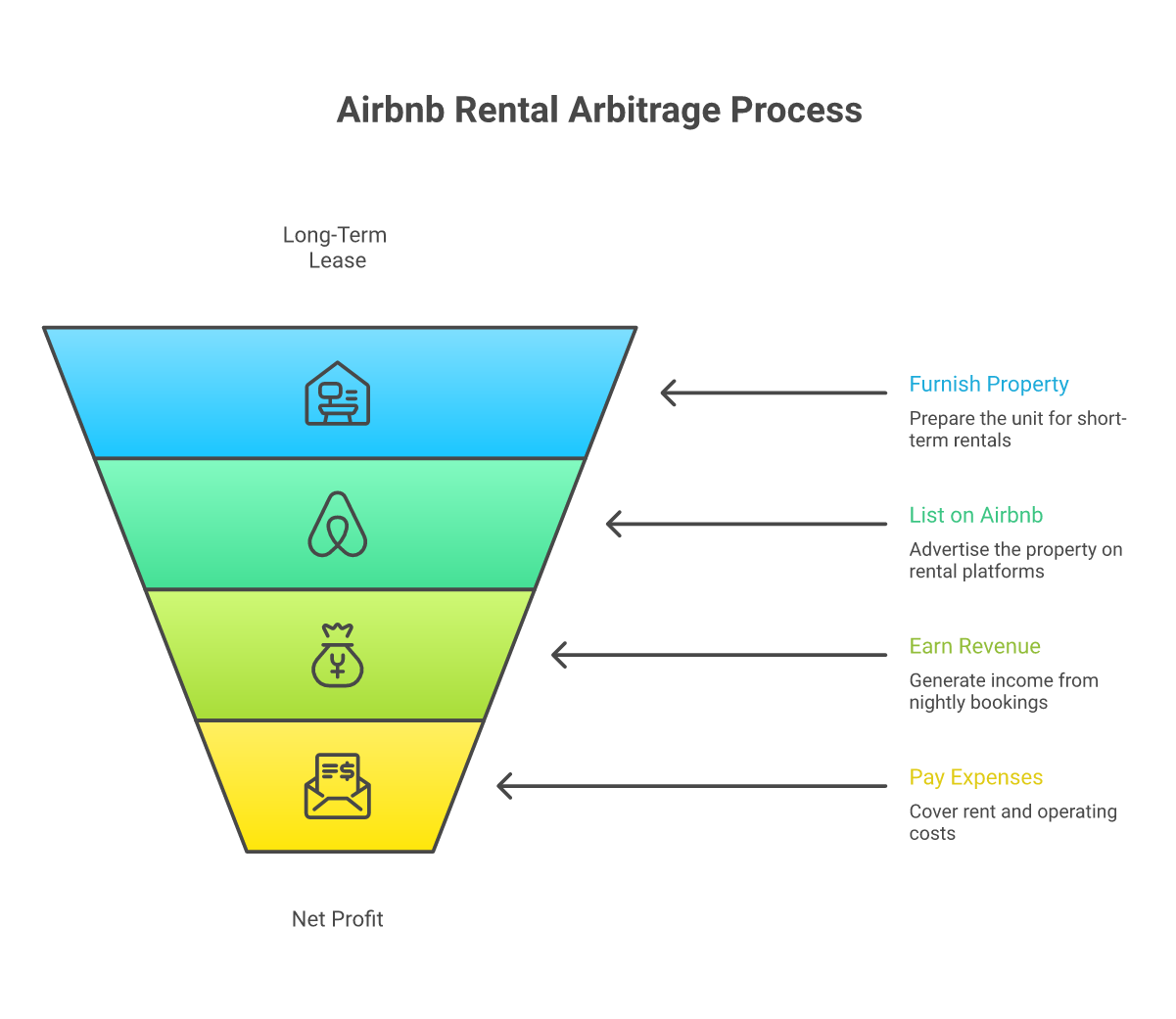
Rental arbitrage is a business model where you sign a long term lease on a property, usually an apartment, condo, or house, and then list that property on Airbnb, Vrbo, or other vacation rental platforms at nightly rates. You pay the landlord a fixed monthly rent. You collect higher nightly rates from short-stay guests. Your profit is the spread between what guests pay you and what you pay in rent plus operating costs.
The word “arbitrage” comes from finance and means buying low in one market and selling high in another at the same time. In a rental arbitrage deal, the two markets are the long term lease market, where rent is relatively low and fixed monthly, and the short term rental market, where the nightly rate is higher and variable. The rental arbitrage host captures that gap.
So what is airbnb arbitrage, and how is it different? It is not different at all. “Airbnb arbitrage” and “rental arbitrage” describe the same business model and the industry uses the two terms interchangeably. “Rental arbitrage” stresses the lease-versus-nightly spread. “Airbnb arbitrage” stresses the platform you list on. UK operators call it rent to rent. All three describe a no-ownership model where you profit from the rate difference between the long term lease and the vacation rental nightly rate, not from property appreciation. That is the plain-English definition, the meaning, and the mechanics in one breath.
The Three People in Every Rental Arbitrage Deal
Three actors sit inside every airbnb arbitrage deal. The property owner (your landlord) signs the master lease and collects guaranteed rent every month with no void periods. You (the rental arbitrage host) become the master tenant, furnish the unit, and run the listing. The short-term guest books the property through Airbnb or Vrbo for stays that usually run 2 to 14 nights. When the deal is structured right, all three win: the owner gets reliable rental income with no void periods, you generate short term rental income without buying anything, and the guest gets a furnished home for less than a hotel. That steady rental income for the owner is exactly what makes the landlord pitch work.
A Simple Example of How the Profit Is Made
Say you lease a 2-bedroom apartment for $1,800 a month on a standard 12-month lease. You furnish it, photograph it, and list it on Airbnb at $175 a night. At 65% occupancy you bring in roughly $3,400 a month in gross bookings. After rent ($1,800), cleaning ($600 for 8 turnovers), utilities ($200), insurance ($100), and supplies ($75), you net about $625 a month from that single property.
Now $625 on one unit is a modest return, and I will not pretend otherwise. But the rental arbitrage business model is built to scale. Five units at that level is $3,125 a month. Ten units is $6,250. The operators who do well in airbnb rental arbitrage do not lean on one property. They build a portfolio of 5, 10, even 20 units across one or more markets, and the cash flow compounds with each unit they add. The barrier to entry is far lower than buying property: no $50,000 down payment, no mortgage, no perfect credit. You need enough cash to cover first month’s rent, a security deposit, and basic furnishings.
The catch, which a lot of guides skip, is that you ARE signing a lease. You owe rent every month whether the property books or not. If demand drops, if you pick the wrong market, if a slow season runs long, you are still on the hook for that rent payment. This is a lower-cost entry into the vacation rental industry, not a zero-risk one. Airbnb rental arbitrage trades capital risk for lease risk, and you should plan for both.
Before you sign an arbitrage lease, know whether renters insurance covers Airbnb, because standard policies exclude paid guest stays.
How Rental Arbitrage Works, Step by Step
The mechanics break down into six predictable steps. Most 10XBNB students complete this cycle for their first unit within 60 to 90 days.
Step 1: Market research. Pick a city or neighborhood with strong short term rental demand. Use AirDNA, Rabbu, or Inside Airbnb to check average daily rate (ADR), occupancy, and seasonality. The rule of thumb: nightly rate times occupancy should produce 2.5x to 3.5x your projected monthly rent. If the math does not clear that bar at conservative occupancy, walk.
Step 2: Property sourcing. Search Zillow, Realtor.com, Apartments.com, or Craigslist for long term lease properties in your target area. Sort Craigslist by oldest listing first. Any unit sitting empty for 20+ days is a landlord losing money right now, and that is your opening. Filter for 1 to 2 bedroom units near tourist areas, business districts, or hospitals (medical travelers drive steady mid-term demand).
Step 3: Landlord pitch. Approach property owners with a structured proposal. Lead with guaranteed rent, zero void periods, professional cleaning, and a 12 to 24 month lease. You are not asking a favor; you are solving the owner’s vacancy problem. Most successful arbitrage hosts pitch 10 to 20 owners before their first yes. It is a numbers game.
Step 4: Master lease agreement. Sign a master lease with explicit short term rental subletting permission. Have a real estate attorney review it before you sign (typically $250 to $600). Skipping this step is the most common way rental arbitrage deals collapse later.
Step 5: Furnish and list. Budget $3,500 to $8,000 for furniture, kitchen, linens, and supplies on a 1-bedroom unit. Pay for professional photography ($150 to $500), because photos drive bookings more than any other listing element. List on Airbnb and Vrbo at the same time for maximum vacation rental channel coverage. New listings with zero reviews should price 15% to 20% below comparable units for the first 30 days to build bookings and reviews fast.
Step 6: Operate and track. Daily operations cover guest communication, cleaning schedule, supply restocks, maintenance, and review management. Track gross revenue, occupancy, ADR, and net margin weekly. Healthy airbnb rental arbitrage units run a 20% to 30% net margin. Below 15%, the deal is at risk and you need to fix pricing, cut costs, or exit.
For the full line-item budget at the $3K, $7K, and $15K tiers, see our rental arbitrage startup costs breakdown. To run a specific deal before you sign anything, use our free airbnb arbitrage calculator, grab the landlord pitch templates in our airbnb arbitrage script guide, and track your numbers in our rental arbitrage spreadsheet.
Is Rental Arbitrage Legal?
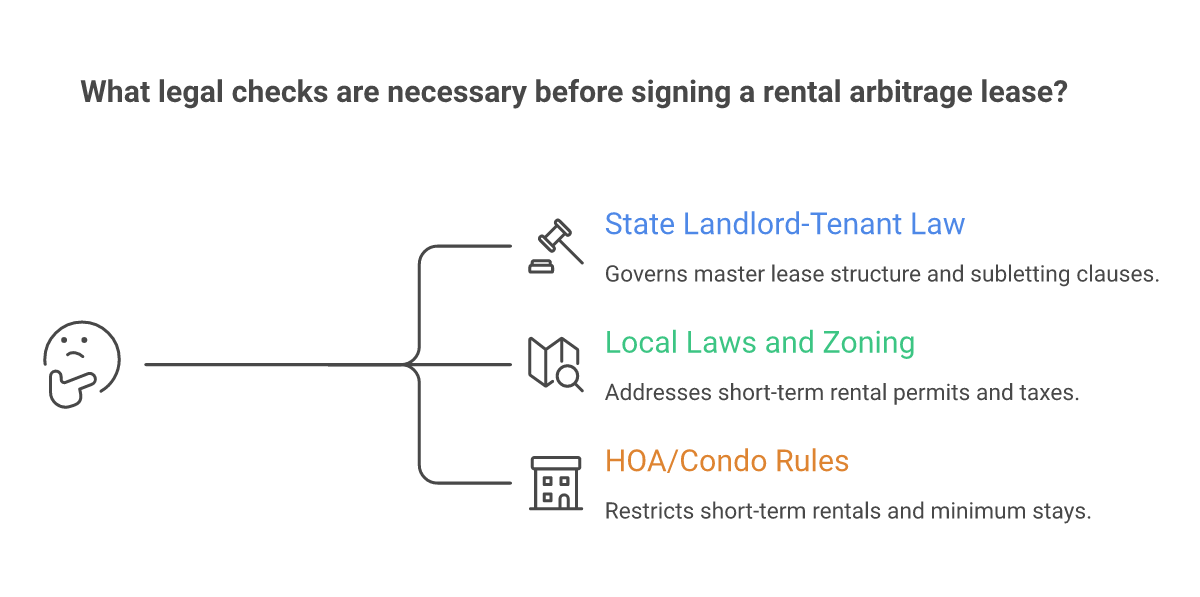
Airbnb rental arbitrage is legal in most U.S. cities and many international markets when three legal layers line up. Miss any one and the deal becomes a liability for both you and the property owner. Platform rules are not the same as local law, so you need all three working together.
Layer 1: Lease subletting clause. Most standard residential leases prohibit subletting by default. To run rental arbitrage legally you need either a lease that explicitly permits short term subletting or a master lease with a short term rental addendum. The master lease structure is the cleanest approach and protects both parties. If the owner has a conventional mortgage with an owner-occupancy clause, the lender may forbid short term rental use, so confirm that in writing first.
Layer 2: Local laws and short term rental regulations. These vary city by city. New York City requires hosts to be present for stays under 30 days. New Orleans charges roughly $1,000 a year for a commercial permit. Nashville charges $313 per year per the Metro Nashville Codes department. Some cities require nothing at all. Some buildings and HOAs ban short term rentals outright, which kills the deal before it starts even when the lease permits subletting on paper.
Layer 3: Written landlord approval. Verbal approval is worthless. Get explicit written permission embedded in the lease, signed by both parties. The standard pitch covers four points: guaranteed rent whether the unit books or not, zero void periods, full property care including regular cleaning, and a defined lease term.
Pull the local short term rental ordinance from your city’s website, cross-reference the building’s HOA bylaws, and only then negotiate the lease. Local regulations are the layer most beginners skip, and they are the fastest way to lose your startup investment. For an additional legal lens, the Nolo guide to legal restrictions on Airbnb and short-term rentals covers subletting clauses, master lease structure, and zoning. Forming an LLC separates your personal assets from business liability, which matters the first time a guest files a claim. For a deeper, jurisdiction-by-jurisdiction view, see our rental arbitrage legal guide by state and our market-specific Florida rental arbitrage legal guide.
Is Rental Arbitrage Still Profitable in 2026?
Short answer: yes, selectively. It is not the wide-open 2019 land grab anymore. The short term rental market has matured. There are more hosts, tighter regulations in many cities, and guests who expect more for their money. AirDNA projects U.S. short term rental supply growth of about 4.6% in 2026, slower than prior years, which means saturation is real in the obvious tourist markets. But demand keeps growing, and the operators who treat airbnb rental arbitrage like a real business are making better returns than ever while the lazy operators get filtered out.
The Current Regulatory Landscape
Short term rental regulations are a moving target. Cities that were friendly two years ago now require permits, cap operating days, or ban non-owner-occupied vacation rentals entirely. New York, San Francisco, and parts of Los Angeles have already made non-owner-occupied vacation rental operation extremely difficult. You often cannot predict these changes; a new city council or a single viral “party house” story can shift the political landscape overnight. The defense is to research local regulations before entering a market, diversify across two or three municipalities so one policy change does not wipe you out, and stay engaged with local short term rental advocacy groups so you see threats before they become law.
Realistic Margins
Healthy airbnb rental arbitrage units run a 20% to 30% net margin. The variables that drive it are simple: monthly rent below about 35% of projected gross revenue, occupancy of 60% to 70% minimum, and operating expenses under 30% of revenue. The math breaks fast, though. A small slip in either occupancy or ADR can cut profit by more than half, as this sensitivity table shows on a base-case unit.
| Scenario | ADR | Occupancy | Revenue | Net profit |
|---|---|---|---|---|
| Base case | $160 | 70% | $3,360 | $560 |
| Rent rises 10% | $160 | 70% | $3,360 | $370 |
| Occupancy drops to 63% | $160 | 63% | $3,024 | $224 |
| ADR and occupancy both drop 10% | $144 | 63% | $2,722 | -$78 |
The takeaway: protect your downside. Anchor part of your calendar with mid-term rentals (30+ day stays), negotiate early-out clauses into the lease, and run your numbers at 55% occupancy in projections, not 70%. If the deal still works at conservative estimates, you have a good property. If it only works at optimistic numbers, walk away. The highest-margin configuration available in 2026 is often the mid-term pivot, which can hit a 34% net margin because it slashes cleaning costs and platform fees. Our mid-term rental arbitrage guide covers the 30+ day strategy that sidesteps most short term rental rules.
The Honest Pros and Cons of Rental Arbitrage
Anyone who tells you rental arbitrage is all upside is either selling something or has not actually done it. Here is the balanced view after watching hundreds of students build portfolios through 10XBNB. Prefer a remote setup? Read how to launch an online Airbnb business.
The Pros
- Low startup capital. $3,000 to $15,000 per unit versus $40,000 or more for property ownership. That single difference is why so many people start here.
- Speed to cash flow. Buying a property takes 30 to 90 days to close, then months to ramp. With arbitrage you can sign, furnish in 5 to 10 days, list, and book your first guest inside a week. Most students see cash flow within 30 to 60 days.
- No mortgage debt. You carry a lease obligation, not a 25-year mortgage. The owner handles major maintenance and structural repairs.
- Rapid scalability. Each unit operates independently and is constrained by your operations, not your bank account. Veteran hosts often run 3 to 6 units within 18 months.
- Market flexibility. A 12-month lease lets you test a market without a 15 to 30 year commitment. If the numbers miss, you exit at lease end with minimal loss.
- Skill compounding. Each unit teaches market analysis, guest experience, and property management. Those skills transfer directly to a buy-and-hold career later.
The Cons
- Landlord dependency. This is the single biggest risk. The owner can decline to renew, sell the property, or raise rent. I have watched a strong operator lose two of four units in one quarter when two landlords chose not to renew. The defense is strong relationships and a constant pipeline of backup deals.
- No equity building. Your rent check builds the landlord’s equity, not yours. After five years you own no property and no appreciation. Treat arbitrage as a cash flow engine, not a wealth-building vehicle, and use the cash flow to fund property purchases later.
- Regulation risk. Cities can tighten the rules overnight, and you carry double exposure (your lease plus local law). Local laws are the biggest external threat to any rental arbitrage business.
- Seasonal income volatility. You might earn $8,300 in July and $3,200 in January while rent stays flat. Bank 2 to 3 months of operating costs as a reserve before you list, and never treat peak-season income as your baseline.
- Property damage liability. Guest damage is your responsibility, not the platform’s and not the landlord’s. A trashed weekend can run $3,000 in repairs. Carry dedicated vacation rental insurance and keep a damage reserve.
- It is not passive. Guest communication, turnovers, maintenance, pricing, and 2 a.m. emergencies are all on you until you hire a team or a co-host. Some people thrive on it; others burn out in six months. Be honest about your tolerance for the work.
For a full head-to-head on whether to lease or buy, read our rental arbitrage vs buying property comparison. And because landlord dependency is the top risk, plan your rental arbitrage exit strategy before you sign the first lease, not after a non-renewal notice lands.
How to Start Rental Arbitrage
If the pros outweigh the cons for your situation, here is the path forward in order. Do not rush it, but do not overthink it either.
- Check local laws. Pull your target city’s short term rental ordinance from the city website and confirm short term rentals are legal at the property type you want to lease. Call the permit office directly; do not rely on forum posts.
- Secure your finances. Plan for $9,000 to $13,000 all-in on a typical unit: first and last month plus deposit on a $1,500 unit, roughly $4,500 in furniture, $300 in photos, $500 for LLC and licenses, and a 30 to 60 day operating reserve.
- Pick a market. Use AirDNA or Rabbu to evaluate ADR, occupancy, and seasonality. Confirm nightly rate times occupancy produces 2.5x to 3.5x your projected rent.
- Find and pitch property owners. Focus on individual owners, not corporate management companies. Lead with guaranteed rent and zero void periods. Expect 10 to 20 pitches before your first yes, and bring your Airbnb dashboard to show real numbers when you have them.
- Sign the right lease. Use a master lease with explicit short term rental subletting permission, reviewed by a real estate attorney. Form your LLC, bind insurance, and separate your bank accounts before you furnish.
From there it is furnish, photograph, list, and operate. The first property is the hardest. Once one unit is generating consistent cash flow, you have real data to pitch the next landlord, and each additional unit gets easier because the operational systems are already built. For the complete launch-to-scale playbook, including market selection and pricing systems, our rental arbitrage course drills each skill in sequence.
The Tools You Need to Run Rental Arbitrage
The operators who make the most money are not the ones with the most properties. They are the ones with the best systems. A few tools do most of the heavy lifting and let you manage multiple properties from anywhere.
- Deal calculator. Before you contact a single landlord, run the numbers. Our free airbnb arbitrage calculator projects monthly cash flow and net margin in under a minute, including sensitivity for occupancy and ADR swings.
- Landlord pitch scripts. Data closes these deals, but so does the right framing. Our airbnb arbitrage script templates give you word-for-word outreach that leads with the owner’s vacancy problem.
- Tracking spreadsheet. Every unit needs a simple sheet tracking revenue, occupancy, ADR, expenses, and net profit so you can spot a sliding property early. Grab ours in the rental arbitrage spreadsheet guide.
- Dynamic pricing. Static pricing quietly kills profit. PriceLabs, Wheelhouse, or Beyond Pricing adjust rates automatically for weekends, events, and seasonality. Hosts using dynamic pricing typically earn meaningfully more than hosts who set a flat nightly rate.
- Property management software. Past two or three listings, a platform like Hospitable or Guesty automates guest messaging and syncs calendars across Airbnb, Vrbo, and Booking.com so you avoid double bookings.
- Smart locks and a reliable cleaning team. Keyless check-in enables remote operations, and a dependable cleaning crew with a photo-verified checklist protects your reviews, which are the backbone of occupancy.
Two more line items belong in every operator’s stack: dedicated insurance and a tax plan. Carry a short term rental policy from a provider like Proper or CBIZ ($80 to $150 a month per unit) rather than relying on AirCover alone. Airbnb’s AirCover provides up to $3 million in host damage protection and $1 million in liability per the Airbnb AirCover for Hosts help article, but it has gaps, including slow claims and no automatic coverage for lost income while the unit is down. Our arbitrage insurance guide and rental arbitrage tax guide cover both in depth.
Rental Arbitrage vs Other Short Term Rental Models
Rental arbitrage is one of three main short term rental business models. The others are property ownership and co-hosting. Each varies in startup capital, monthly obligation, and long-term equity. If equity is your priority, see our guide to Airbnb ownership and profitable hosting.
| Model | Startup capital | Monthly obligation | Long-term equity |
|---|---|---|---|
| Rental arbitrage | $3K to $15K | Fixed monthly rent | No (cash flow only) |
| Property ownership | $40K+ | Mortgage, tax, HOA | Yes (paydown plus appreciation) |
| Co-hosting | $0 to $500 | None (revenue share) | No (service income) |
Rental arbitrage sits in the middle: lower capital than ownership, higher cash flow potential than co-hosting, but you carry the rent obligation whether bookings come in or not. Co-hosting, where you manage someone else’s furnished vacation rental for a 20% to 25% fee, requires no lease, no rent, and no furnishing cost, which makes it the lowest-risk way to learn the airbnb rental arbitrage business before you take on lease liability. Many of our most successful students run the full progression: start with co-hosting to build cash flow and skills at zero risk, use that income to fund their first rental arbitrage unit, then eventually buy property once the business clears $40,000 or more in annual net profit.
For the detailed breakdowns with real student numbers, see our co-listing vs rental arbitrage comparison and our rental arbitrage vs buying property analysis.
Best Markets for Rental Arbitrage in 2026
Not every market works. Some are oversaturated, some have regulations that make operating impossible, and some are quietly excellent because operators chase the obvious tourist cities instead. The strongest rental arbitrage markets share four traits: a wide gap between long term rent and nightly rates (at least 2.5x), year-round market demand from a mix of tourists, business travelers, and medical professionals, manageable short term rental regulations with a clear permitting process, and reasonable lease and furnishing costs. Markets with thin or purely seasonal market demand leave you paying rent through dead months.
Per AirDNA’s 2026 outlook and what our students report, friendly markets right now skew toward the South and Midwest, where regulations are clearer and ADR-to-rent ratios stay above 2.5x. Avoid the heavily restricted markets (New York City, San Francisco, parts of Los Angeles) where the rules make arbitrage extremely difficult. Use the city directory below to dig into the markets we cover in depth, each with local demand drivers, regulations, and income data:
- Rental arbitrage in Austin
- Rental arbitrage in Denver
- Rental arbitrage in Nashville
- Rental arbitrage in Miami
- Rental arbitrage in Houston
- Rental arbitrage in Atlanta
- Rental arbitrage in Charleston
- Rental arbitrage in Scottsdale
Whatever market you choose, the same discipline applies: research the local rules first, run the numbers conservatively, and confirm there is a mid-term rental fallback (hospitals, universities, corporate demand) in case short term rules tighten.
Real Results From Rental Arbitrage Operators
What matters more than my own numbers is what normal people achieve. These are 10XBNB students who started from different situations and built real income. John in Vancouver landed 4 co-listing properties and generated $50,000 in bookings within 3 months, including a chalet in a non-prime market that still performed because the listing and pricing were dialed in. Javon in Arizona started with zero experience, no properties, and no account, then landed his first co-listing client within 60 days and built multiple cash-flowing properties within 6 months in a market that is not a major tourist destination.
I will not pretend every student makes $50,000 in 3 months. Some take longer to find their first deal, some struggle with the landlord pitch, and some never follow through. Across students who actually execute the system rather than just watch the content, most report profitability within their first 90 days, and the top performers reinvest that cash flow and reach $5,000 to $15,000 a month in net profit within their first year. (Source: 10XBNB 2026 internal student survey. Results are not typical and depend entirely on effort, market selection, and execution. Your results will vary.) The common thread among those who succeed is not talent or background; it is that they got landlord approval in writing, knew their market’s numbers cold, kept a cash reserve, and did not panic during their first slow month.
Frequently Asked Questions About Rental Arbitrage
What is the difference between rental arbitrage and airbnb arbitrage?
There is none. Rental arbitrage and airbnb arbitrage describe the same business model: leasing a property long-term from a landlord and re-listing it on platforms like Airbnb and Vrbo at nightly rates above your monthly rent. The two terms are used interchangeably. “Rental arbitrage” stresses the lease-versus-nightly spread, while “airbnb arbitrage” stresses the platform. UK operators call the same model rent to rent.
How much money do I need to start a rental arbitrage business?
Most operators invest $3,000 to $15,000 for their first unit, covering first month’s rent, security deposit, furnishings, supplies, insurance, and professional photography. If you want to start with essentially $0, the co-hosting model lets you build cash flow and learn the business before committing capital to a lease.
Is rental arbitrage legal?
Airbnb rental arbitrage is legal in most markets when three things line up: written landlord approval to sublet, a lease that explicitly allows short term rental use, and compliance with local short term rental regulations including permits, taxes, and zoning. Always verify the rules in your specific city and state before starting, and never operate on a verbal handshake.
Is rental arbitrage profitable in 2026?
Yes, when the deal is structured correctly. A well-selected unit generates $1,000 to $3,000 in monthly net profit at a 20% to 30% net margin. The drivers are monthly rent below 35% of projected gross revenue, occupancy of 60% to 70% minimum, and operating expenses under 30% of revenue. Below 15% margin the deal is at risk. The market is more competitive than it was in 2019, but disciplined operators are still doing well.
How much profit can you realistically make with rental arbitrage?
A single well-optimized airbnb rental arbitrage unit typically nets $500 to $3,000 a month after all operating costs, depending on market, property size, occupancy, and nightly rates. Operators running 5 to 10 units commonly generate $5,000 to $30,000 in monthly cash flow. Cash-on-cash returns on the startup investment often land in the 50% to 180% annual range for strong deals, though slow months can dip to break-even.
What are the biggest risks of rental arbitrage?
Landlord dependency (you lose the unit if the owner sells or declines to renew), regulatory change (a city can restrict short term rentals after you have signed), property damage that exceeds your coverage, seasonal demand swings against a fixed rent, and market saturation pushing down rates. Mitigate with 24-month leases where possible, dedicated short term rental insurance, a 2 to 3 month cash reserve per unit, conservative projections, and starting with co-hosting to learn before taking on lease liability.
What insurance do I need for rental arbitrage?
Get a dedicated short term rental policy (not standard renter’s insurance) from a provider like Proper, CBIZ, or Safely. It should cover guest-caused property damage, liability for guest injuries, and loss of rental income during repairs. Airbnb’s AirCover provides up to $3 million in damage protection and $1 million in liability but has real gaps. Budget $80 to $150 a month per unit.
Can I do rental arbitrage while working a full-time job?
Yes. Once you automate messaging, pricing, and cleaning coordination, each property takes roughly 2 to 3 hours a week. Many operators, myself included, built the business on the side before going full-time. Start it as a side business and scale from there.
Ready to Learn the Full System?
You now have the complete picture of rental arbitrage: what it is, how the rent-to-rent spread works, whether it is legal, whether it still pays in 2026, the honest pros and cons, how to start, the tools you need, and the best markets to operate in. The model works when three legal layers line up and the math clears a 20% to 30% net margin.
If you want the system that has produced over $5 million in booking fees across 24 properties without buying a single piece of real estate, drilled in order with templates, deal reviews, and landlord scripts, our rental arbitrage course is where it lives. Before you commit, you can compare programs in our 10XBNB vs Rental Arbitrage Academy breakdown, check our 10XBNB pricing, and read verified 10XBNB reviews from students who have run this model in real markets.