An Airbnb LLC is a limited liability company you form to hold and operate your short term rentals business. Most Airbnb hosts running a property owner or rental arbitrage business should form an LLC to protect personal assets from guest-injury lawsuits, property damage claims, and creditor exposure. LLC setup costs $50 in Kentucky to $500 in Massachusetts depending on state, plus $50 to $800 annual report fees. The LLC offers liability protection, pass-through taxation, professional credibility with landlords, and a clean business bank account separation from personal finances. The biggest exception: if you list a single spare room in your primary residence under $25,000 annual revenue, the LLC overhead may not be worth the protection. The 10XBNB system operates 24 properties through LLC structures across multiple states.
Why Airbnb Hosts Form an LLC
Running an Airbnb business as a sole proprietorship exposes your personal assets (home, car, savings, retirement accounts) to any lawsuit or claim against the business. If a guest slips on your stairs, breaks an ankle, and sues for $250,000, the judgment can come out of your personal net worth.
An Airbnb LLC (limited liability company) creates a legal wall between you and the business. Lawsuits, debts, and creditor claims against the LLC stop at the LLC’s assets. Your personal home, retirement accounts, and savings stay protected as long as you maintain proper LLC formalities.
This is the single most important reason most Airbnb hosts form an LLC. Beyond liability protection, the LLC also delivers tax flexibility, professional credibility with property owners (essential for rental arbitrage hosts pitching landlords), and a clean separation between personal and business finances. The IRS treats single-member LLCs as pass-through entities by default, meaning profits flow to your personal tax return without a separate corporate tax filing, per IRS Limited Liability Company guidance.
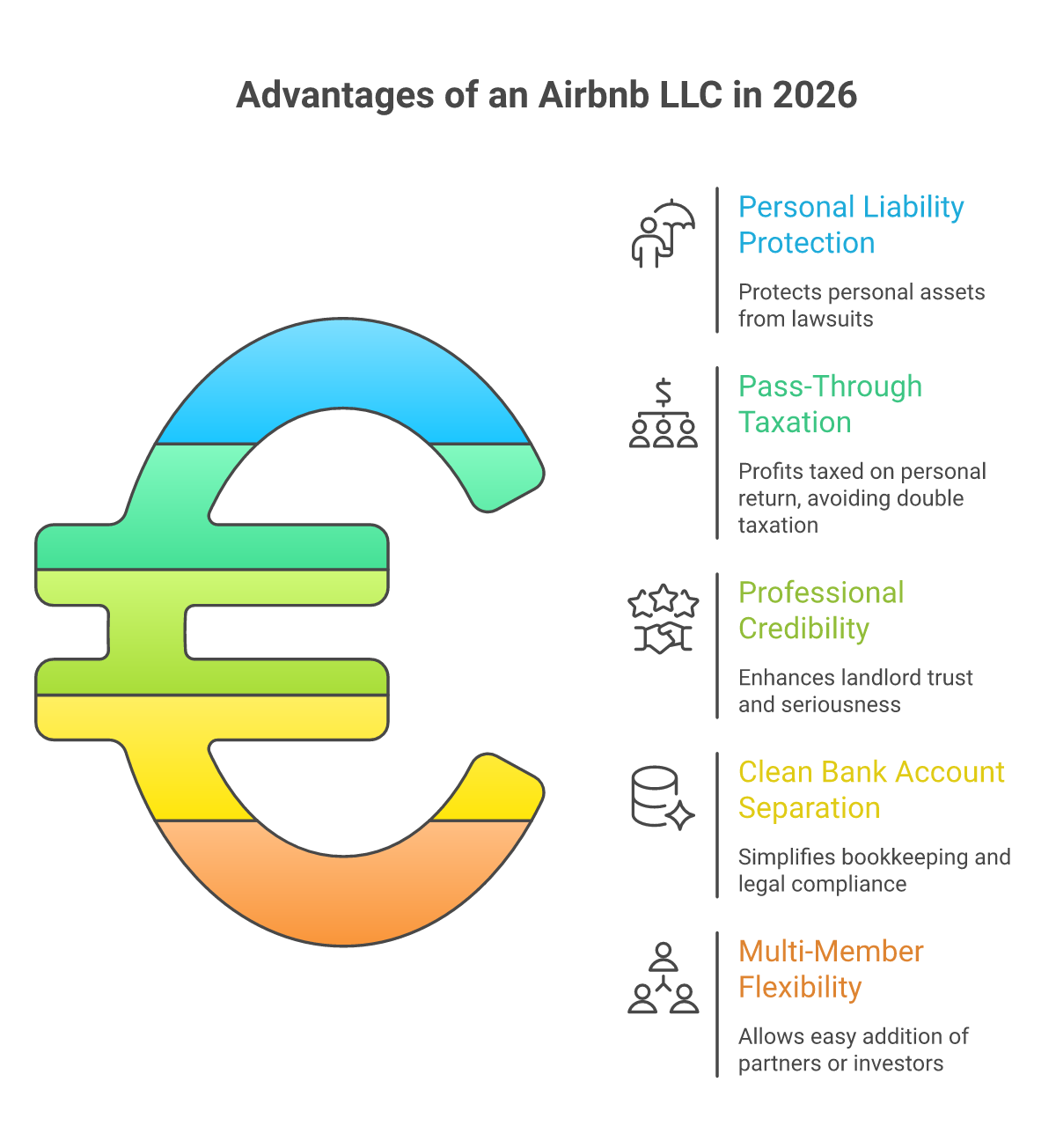
The 5 Benefits of an Airbnb LLC
Benefit 1: Personal Liability Protection
The headline benefit. An Airbnb LLC isolates the business from your personal assets. A guest injury, a property damage claim that exceeds AirCover limits, or a contract dispute with a landlord cannot reach your personal net worth as long as the LLC is properly maintained.
The protection is not absolute. Courts can “pierce the corporate veil” if you commingle personal and business funds, fail to maintain separate accounting, or use the LLC to commit fraud. Most piercing claims fail when the host maintains a separate business bank account, separate accounting records, and follows LLC formalities.
Benefit 2: Pass-Through Taxation
Single-member Airbnb LLCs default to pass-through taxation. Business income flows through to your personal tax return on Schedule C (for active operators) or Schedule E (for passive rental real estate). No separate corporate tax filing required. This avoids the double taxation that C-corporations face.
Multi-member LLCs file Form 1065 (partnership return) and issue K-1s to each member. Either way, profits get taxed at personal rates, not corporate rates. The IRS Tax Topic 415 on rental real estate income covers the reporting rules for rental income through an LLC.
Benefit 3: Professional Credibility With Landlords
For rental arbitrage hosts, the LLC is non-negotiable. Property owners take pitches from “Smith Hospitality LLC” more seriously than from “John Smith” personally. The LLC signals that you are running a legitimate business, not a side hustle that might vanish in 6 months.
Many landlords prefer to sign master lease agreements with an LLC as the tenant rather than an individual, because it makes the relationship cleaner from their perspective. Some landlords require an LLC structure as a condition of approval for short term rental subletting.
Benefit 4: Clean Bank Account Separation
Once the LLC exists, open a business bank account in the LLC’s name. All Airbnb revenue, all expenses, all furniture purchases, all cleaning payments flow through this single account. This makes bookkeeping trivial at tax time, qualifies you for business credit cards with better rewards, and reinforces the legal separation that protects personal assets.
The first piercing-the-veil mistake new hosts make: paying for personal expenses out of the business account, or paying for business expenses out of the personal account. Keep the wall clean from day one.
Benefit 5: Multi-Member Flexibility for Partners and Investors
If you run Airbnb properties with a business partner or pool money with investors to scale, a multi-member LLC structure lets you assign membership interests, distribute profits according to a written operating agreement, and add or remove members without restarting the business. For Airbnb hosts who plan to scale beyond 3 to 4 units, multi-member LLC flexibility becomes a competitive advantage.
Drawbacks of an Airbnb LLC
An LLC is the right structure for most Airbnb hosts, but it is not free or zero-effort. Three drawbacks matter.
1. Setup and annual fees. Filing fees range from $50 (Kentucky) to $500 (Massachusetts) depending on state. Annual report fees range from $20 (Mississippi) to $800 (California). California’s $800 annual franchise tax applies to every LLC operating in the state, even if the LLC has zero revenue. For a single-unit Airbnb host in California, the franchise tax alone can eat $800 of profit per year.
2. Mortgage and insurance complications. If you transfer a financed property into an LLC, your mortgage (see Airbnb loan options) lender may invoke the “due-on-sale” clause and demand full repayment. Most personal homeowners insurance policies do not cover properties held in an LLC, so you need commercial or specific short term rental insurance. Work with a real estate attorney before transferring any financed property.
3. Ongoing maintenance. The LLC requires annual filings, registered agent maintenance, separate accounting, and yearly compliance with state-specific rules. Most Airbnb hosts handle this themselves for $0 to $200 per year. Owners who hire CPAs or registered agent services pay $400 to $1,200 annually for the convenience.
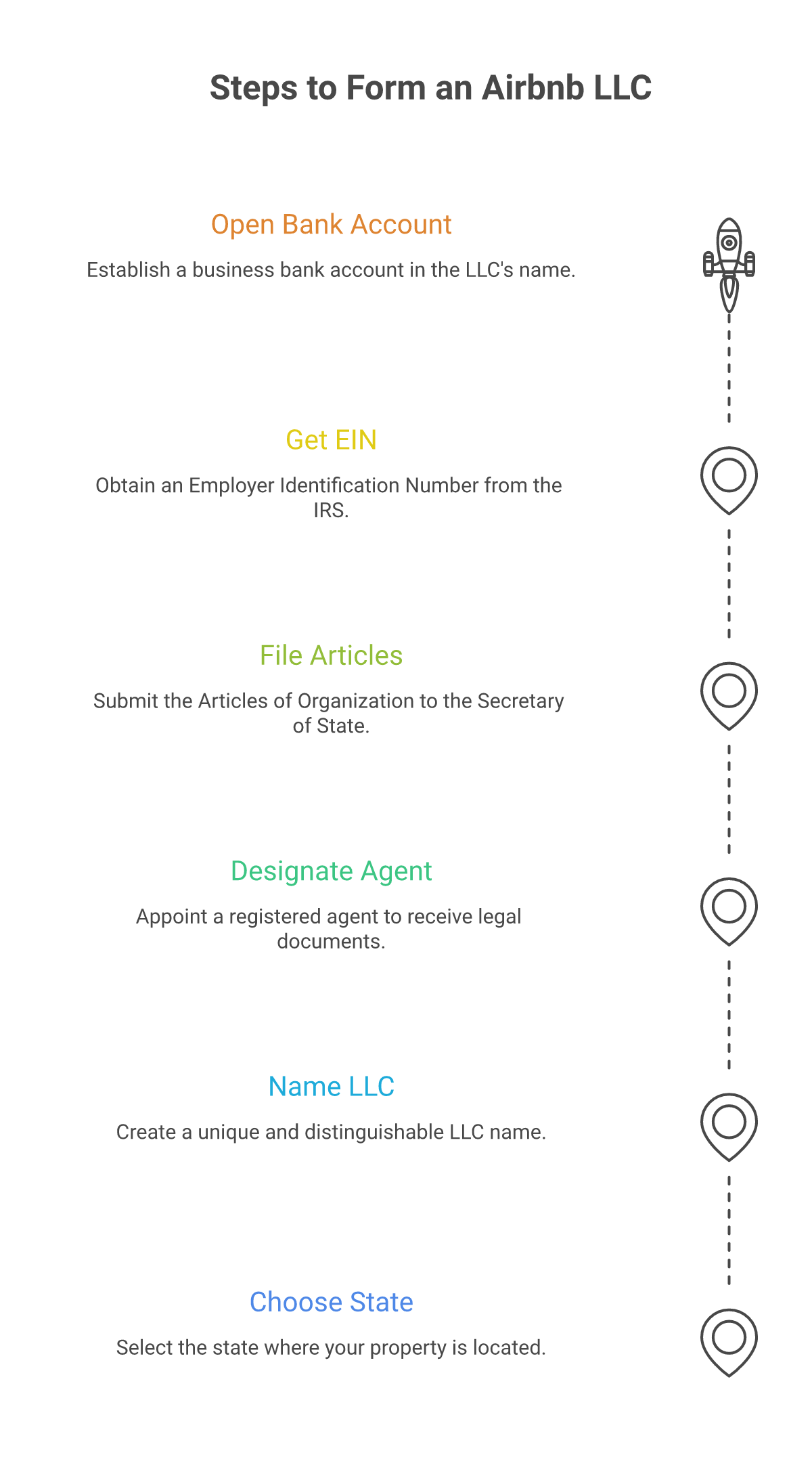
How to Form an LLC for Your Airbnb in 6 Steps
The full LLC formation process for an Airbnb business, from zero to operational, typically takes 1 to 4 weeks depending on state filing speed.
Step 1: Choose Your State of Formation
For most Airbnb hosts, the right state is the state where the property is located. Forming in Delaware or Wyoming to “save taxes” is a popular myth. If you operate a property in Texas through a Delaware LLC, Texas will still require you to register as a foreign LLC and pay Texas franchise tax. You end up paying both state fees instead of one.
The only exception: if you operate multi-state Airbnb portfolios or plan to raise outside investment, Delaware LLC formation may be worth the complexity. Most single-state Airbnb hosts should form in their home state.
Step 2: Choose Your LLC Name
The LLC name must be distinguishable from other registered businesses in the state, must include “LLC” or “Limited Liability Company” in the official name, and cannot include restricted words (Bank, Insurance, University) without special approval. Most states let you search availability for free through the Secretary of State website.
For Airbnb LLC names, hosts typically pick either a brand-style name (“Coastal Stays LLC”) or a holding-company name (“Smith Property Holdings LLC”). Avoid using “Airbnb” in the LLC name itself, as Airbnb’s trademark policy prohibits this.
Step 3: Designate a Registered Agent
Every LLC needs a registered agent: a person or service authorized to receive legal notices on behalf of the LLC. You can serve as your own registered agent in most states if you have a physical address in that state and are available during business hours. Alternatively, registered agent services charge $50 to $300 per year.
Most Airbnb hosts who form an LLC for a single property serve as their own registered agent. Hosts running multiple properties across multiple states typically use a registered agent service like Northwest Registered Agent or LegalZoom for the convenience.
Step 4: File Articles of Organization
Articles of Organization (sometimes called Certificate of Formation) is the foundational document that creates the LLC. File it with your Secretary of State. Most states accept online filing. Filing fees range from $50 to $500 depending on state. Approval typically takes 1 to 10 business days.
The articles include the LLC name, the registered agent’s name and address, the LLC’s principal business address, member names (in states that require disclosure), and the LLC’s purpose. Most Airbnb hosts use a general purpose statement like “any lawful business.”
Step 5: Get an EIN From the IRS
An Employer Identification Number (EIN) is the LLC’s federal tax ID. You can apply online through the IRS at no cost. Single-member LLCs technically can use the owner’s Social Security Number, but using an EIN is cleaner for banking and signals professionalism to landlords and vendors. The IRS EIN application takes about 15 minutes online.
Step 6: Open a Business Bank Account
Take the Articles of Organization, the EIN confirmation letter, and your photo ID to a bank to open a business checking account in the LLC’s name. Most national banks (Chase, Bank of America, Wells Fargo) charge $10 to $30 monthly for business checking. Online banks (Bluevine, Relay) often offer free business checking with better tech features.
Once the business bank account exists, route all Airbnb payouts and all business expenses through it. Never pay personal expenses from the business account. Never pay business expenses from a personal card. The wall must stay clean.
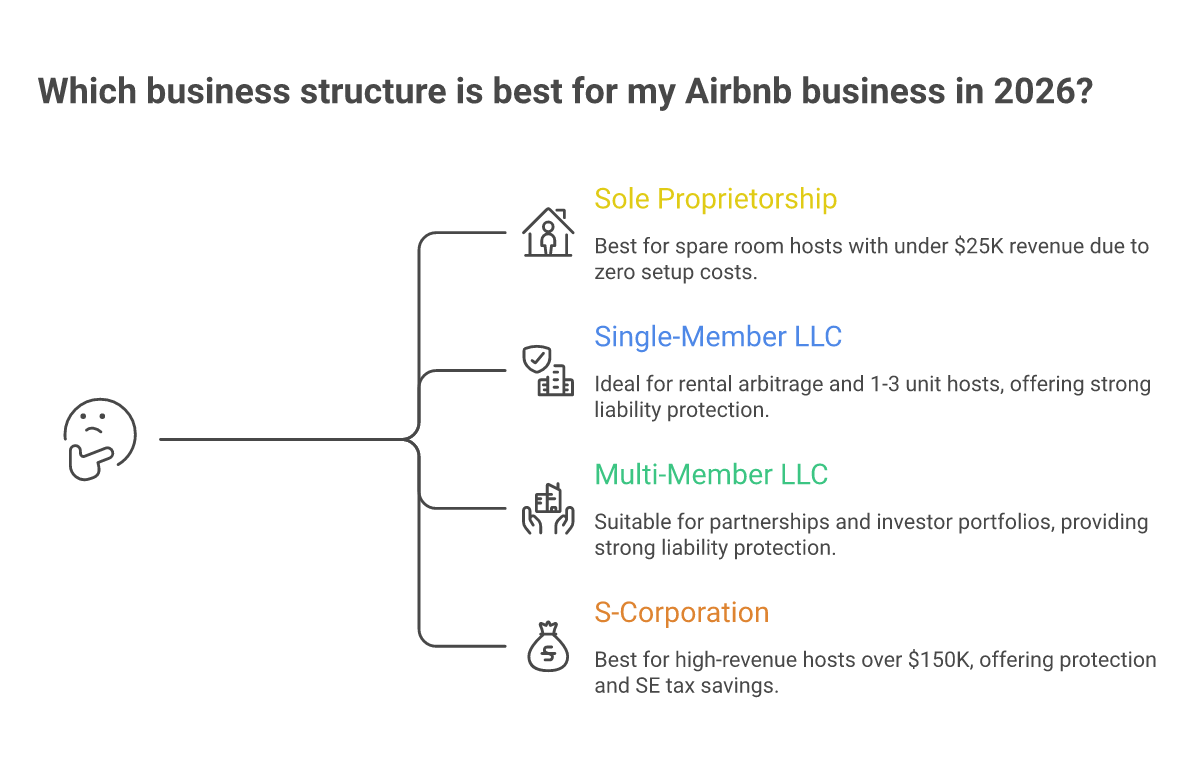
LLC vs Sole Proprietorship vs S-Corp for Airbnb
Three main business structures for Airbnb hosts. Each has trade-offs.
| Structure | Setup cost | Liability protection | Best for |
|---|---|---|---|
| Sole Proprietorship | $0 | None (personal assets exposed) | Spare-room hosts under $25K annual revenue |
| Single-Member LLC | $50 to $500 | Strong (with proper formalities) | Most rental arbitrage and 1-3 unit hosts |
| Multi-Member LLC | $50 to $500 | Strong (with proper formalities) | Partnerships, investor-funded portfolios |
| S-Corporation | $200 to $800 + payroll setup | Strong (with proper formalities) | High-revenue hosts ($150K+) seeking SE tax savings |
The sole proprietorship is the default if you do nothing. It is the cheapest option but offers zero liability protection. For most Airbnb hosts running an arbitrage business, owning property, or managing multiple units, the LLC is the right structure.
The S-Corp election (which is a tax election, not a separate business entity) can save self-employment tax for high-revenue hosts. But it requires running payroll, paying yourself a “reasonable salary,” and filing more complex tax returns. Most CPAs recommend the S-Corp election only when net business income consistently exceeds $80,000 to $100,000 annually.
Multi-Property Airbnb LLC Structures
Hosts running multiple Airbnb properties face a strategic decision: one LLC for all properties, or one LLC per property?
One LLC for all properties (simpler). Saves on filing fees, annual reports, and bookkeeping. The risk: a lawsuit against one property can drain assets from all properties held in the same LLC. Most Airbnb hosts with 1 to 3 units use this structure because the simplicity outweighs the marginal additional risk.
One LLC per property (asset protection). Each property sits in its own LLC. A lawsuit against unit A cannot reach the assets of unit B. The cost is much higher: separate filings, separate bank accounts, separate bookkeeping for each LLC. Most hosts adopt this structure once they own 4+ properties or operate properties in high-litigation states (California, New York, Florida).
Series LLC (advanced). Some states (Delaware, Texas, Nevada, Illinois, and others) allow a “Series LLC” where you create a parent LLC with multiple “series” underneath it. Each series provides liability isolation similar to separate LLCs but with lower setup and maintenance costs. Series LLCs are powerful for portfolio Airbnb investors but introduce complexity that requires a real estate attorney to structure correctly.
State-by-State Airbnb LLC Filing Costs and Annual Fees
Selected state LLC costs based on Secretary of State filings as of 2026.
| State | Filing fee | Annual fee | Notes |
|---|---|---|---|
| Kentucky | $50 | $15 | One of the cheapest LLC states |
| Texas | $300 | $0 (franchise tax may apply) | No annual report fee under $1.23M revenue |
| Florida | $125 | $138.75 | Annual report due May 1 |
| California | $70 | $800 franchise tax | $800 minimum franchise tax annually |
| Tennessee | $300 | $300 minimum | Annual report fee based on member count |
| New York | $200 | $9 biennial | Required publication after formation ($1K-$2K) |
| Wyoming | $100 | $60 minimum | No state income tax |
| Delaware | $110 | $300 franchise tax | Popular for multi-state investors |
Always verify current fees with the U.S. Small Business Administration’s state-by-state business registration guide or your Secretary of State website before filing. Fees change periodically.
Frequently Asked Questions About Airbnb LLCs
Do I really need an LLC for Airbnb?
Not strictly required. But for most Airbnb hosts running a rental arbitrage business, owning property, or managing multiple units, an LLC is the right structure. The liability protection alone justifies the $50 to $500 setup cost. Spare-room hosts in their primary residence under $25,000 annual revenue can sometimes skip the LLC if they carry strong short term rental insurance, but it is still recommended.
How much does it cost to form an LLC for Airbnb?
Setup costs range from $50 (Kentucky) to $500 (Massachusetts) for the initial filing, plus $20 to $800 in annual fees depending on state. California has the highest ongoing cost ($800 franchise tax annually). Optional services like registered agent ($50 to $300 per year) and operating agreement templates ($50 to $200) add to the total. Most Airbnb hosts spend $200 to $600 total in year one.
Can I put my primary residence in an LLC for Airbnb?
You can, but it triggers complications. Your homeowners mortgage may have a due-on-sale clause that invokes upon transfer to an LLC, forcing you to refinance or pay off the loan. Your homeowners insurance typically does not cover properties held in an LLC. The homestead exemption that protects equity in your primary residence may not apply to LLC-held property. Most accountants recommend leaving a primary residence in personal name and using the LLC only for dedicated Airbnb property.
What are the tax benefits of an Airbnb LLC?
Single-member LLCs default to pass-through taxation, which avoids double taxation. The LLC can deduct legitimate business expenses (mortgage interest, property tax, depreciation, utilities, cleaning, supplies, software, insurance, professional services). Owners running profitable LLCs may qualify for the 20% Qualified Business Income deduction under Section 199A. The S-Corp election can save self-employment tax for high-revenue hosts ($80K+ net annual income).
How do I name my Airbnb LLC?
Pick a name that is distinguishable from other registered LLCs in your state, includes “LLC” or “Limited Liability Company” in the official name, and avoids Airbnb’s trademark (do not use “Airbnb” in the LLC name itself). Most successful Airbnb hosts use either a brand name (“Coastal Stays LLC”) or a property-holding name (“Smith Property Holdings LLC”). Check name availability through your Secretary of State website before filing.
Should I form one LLC for all my Airbnb properties or one per property?
One LLC for all properties is simpler and cheaper but exposes all properties to a single lawsuit. One LLC per property provides better asset protection but increases setup and maintenance costs significantly. Most Airbnb hosts with 1 to 3 units use one LLC. Hosts with 4+ units, properties in high-litigation states, or significant equity at risk typically move to per-property LLC structures or a Series LLC where state law allows.
Can I use my Airbnb LLC to apply for landlord approval for rental arbitrage?
Yes. In fact, the LLC is one of the strongest signals you can show a property owner when pitching for rental arbitrage. Property owners take pitches from “Smith Hospitality LLC” more seriously than from an individual. Many landlords prefer to sign master lease agreements with an LLC as the tenant. Some landlords require an LLC structure as a condition of approval for short term rental subletting.
The Bottom Line on Airbnb LLCs
An LLC is the right business structure for most Airbnb hosts. The liability protection, tax flexibility, professional credibility with landlords, and clean bank account separation justify the $50 to $500 setup cost in nearly every scenario. The only common exception is a spare-room host in their primary residence with under $25,000 annual revenue, where the LLC overhead may exceed the marginal protection benefit.
Form the LLC in the state where your property is located. Serve as your own registered agent unless you operate across multiple states. Get an EIN from the IRS. Open a business bank account. Maintain the wall between personal and business finances. Hire a CPA when your net business income crosses $80,000 to consider the S-Corp election.
For the broader business setup picture, see our 14-step guide to starting an Airbnb business. For the rental arbitrage angle specifically, our rental arbitrage strategy guide covers how to use your LLC in landlord pitches. To run the deal math before signing any lease through your new LLC, our free Airbnb arbitrage calculator projects monthly cash flow in under 60 seconds.