

An Airbnb arbitrage course (also called a rental arbitrage course) teaches you how to lease a property, get written landlord permission to sublet it, and run it as a short-term rental for profit, without ever buying the property. A strong program covers market selection, landlord negotiation, listing optimization, pricing, insurance, and automation, then adds live coaching and a community so you can ask questions when your situation does not match the videos. This guide ranks the main programs (10XBNB, BNB Formula, Sean Rakidzich, Airbnb Empire Academy, Udemy or Skillshare), explains the difference between a course, coaching, training, and mentorship, walks beginners through a first deal step by step, and answers the question buyers actually ask: what does it cost and is it worth it. Pick the format that fits your time, capital, and how you learn, not the loudest ad.
What an Airbnb Arbitrage Course Actually Teaches You
I have spent the last three years reviewing Airbnb rental arbitrage education programs, and the gap between what people expect from a rental arbitrage course and what they actually get is wide. Most buyers assume they are paying for a checklist. Sign a lease, list on Airbnb, collect money. That is maybe 10% of what a quality short-term rental course covers.
An airbnb arbitrage course worth your time teaches market selection with real data, landlord negotiation scripts tested across hundreds of conversations, pricing strategy that adapts to seasonal demand, guest communication systems, cleaning and turnover automation, and legal compliance across different municipalities. These rental operations skills separate profitable operators from those who quit in their first quarter. The best programs also teach co-hosting and property management models so you are not locked into a single revenue stream.
One distinction is worth settling early. “Airbnb arbitrage course” and “rental arbitrage course” describe the same training. Airbnb is just the platform most arbitrage operators list on, so the two phrases get used interchangeably. If you see a course marketed under either name, judge it on the curriculum, not the wording on the sales page.
In 2026 the landscape has shifted. Margins are tighter than they were in 2021, and operator skill matters more than ever. The good news is that the market backdrop is turning favorable again. AirDNA’s 2026 US Short-Term Rental Outlook forecasts average daily rates rising about 1.5% in 2026 and calls 2026 the best year to invest in short-term rentals since 2021, citing cooling home prices, steadier revenue indicators, and listing growth that has slowed to about 4.6% from the 20% peak of 2021 to 2022. Demand events such as the 2026 FIFA World Cup add tailwinds in several US host cities. Margins still take skill to capture, which is exactly what a course is for.
This guide breaks down the top rental arbitrage courses available in 2026, scores each program on the criteria that predict student outcomes, and reframes the cost question so you can decide before you spend a dollar. If you want to model your own market first, our free Airbnb arbitrage calculator lets you test rent, nightly rate, and occupancy before you commit to any program or any lease.
What Is Rental Arbitrage? A Quick Primer
Rental arbitrage (also called airbnb rental arbitrage or airbnb arbitrage) is the practice of leasing a property on a long-term agreement, typically 12 months, then subletting it as a short-term rental on platforms like Airbnb, Vrbo, and Booking.com. The profit comes from the spread between your monthly rent and your short-term rental income. The word arbitrage just means profiting from a price gap. Here the gap sits between two markets for the same apartment: the long-term rental market, where a landlord rents it to you at a fixed monthly rent, and the short-term rental market, where travelers pay a nightly rate. For the complete breakdown, see our rental arbitrage guide.
Example: you sign a lease for $1,800 a month on a two-bedroom in Nashville. After furnishing and listing it, you generate $4,200 a month in gross bookings. After platform fees (roughly 3%), cleaning costs (around $120 per turnover), supplies, and utilities, you net roughly $1,500 to $2,000 in monthly profit. Run the same math in a weak market and the spreadsheet turns negative, which is why market selection is the first skill any real course teaches.
The model works because you do not need a down payment or mortgage qualification. Your startup costs typically range from $3,000 to $15,000 per unit, depending on market and furnishing choices. That lower barrier to entry is exactly why airbnb arbitrage has attracted so many new operators over the past five years, and why proper training separates those who build real businesses from those who lose their security deposit in month three.
Arbitrage is not the only way into short term rentals. Co-hosting (managing someone else’s listing for a cut of revenue) needs almost no capital, and buying property builds equity but demands a down payment. A course that teaches more than one model gives you fallback options if arbitrage margins tighten in your city. We cover that trade-off in detail in our rental arbitrage vs buying property guide.
What to Look for in a Rental Arbitrage Course
After reviewing more than a dozen airbnb and rental arbitrage programs and interviewing operators who completed them, these are the seven factors that matter most when choosing a course.
1. Instructor Is an Active Operator
This is non-negotiable. If the person teaching rental arbitrage does not currently manage properties, their advice is stale. Markets shift quarterly. Airbnb’s search algorithm changed twice in 2025 alone, affecting how listings get surfaced. You want someone who deals with guest complaints, lease renewals, and pricing adjustments every week.
2. Live Coaching Access
Pre-recorded video modules are table stakes. The real value comes when you can ask questions about your specific market, your specific lease negotiation, your specific problem property. Programs with live coaching consistently produce better student outcomes than self-paced-only programs, because feedback catches the expensive mistakes a recorded lesson cannot.
3. Data-Driven Market Selection
A course should teach you how to use tools like AirDNA, Mashvisor, or PriceLabs to evaluate a market before you sign anything. If the course just says “pick a tourist city,” that is not enough. You need to learn occupancy rates, average daily rates, seasonality curves, and local regulations for every market you consider.
4. Landlord Negotiation Framework
Getting a landlord to agree to short-term rental subletting is the hardest part of this business, and the place most beginners stall. The best courses provide proven scripts, objection-handling frameworks, and real examples of successful pitches. Some include template lease addendums reviewed by attorneys. A strong pitch frames the conversation around the landlord’s interests: reliable rent, a professionally managed property, and a tenant who treats the unit better than a long-term renter would.
5. Verified Student Results
Claims like “our students have made millions” mean nothing without verification. Look for programs that publish specific student stories with names, markets, property counts, and timelines, or that point you to independent review platforms you can read yourself rather than a handful of cherry-picked screenshots.
6. Community and Peer Support
Running your first short-term rental is isolating. A strong student community where you can ask questions, share wins, and troubleshoot problems at 11 PM is worth more than most people realize before they start. For a new operator, that community is often the difference between stalling on a first property and getting it leased.
7. Multi-Model Training
Pure arbitrage carries margin risk. The smartest operators in 2026 also know co-hosting and property management, which let you earn revenue without signing leases at all. A course that teaches all three models gives you fallback options if arbitrage margins tighten in your market.
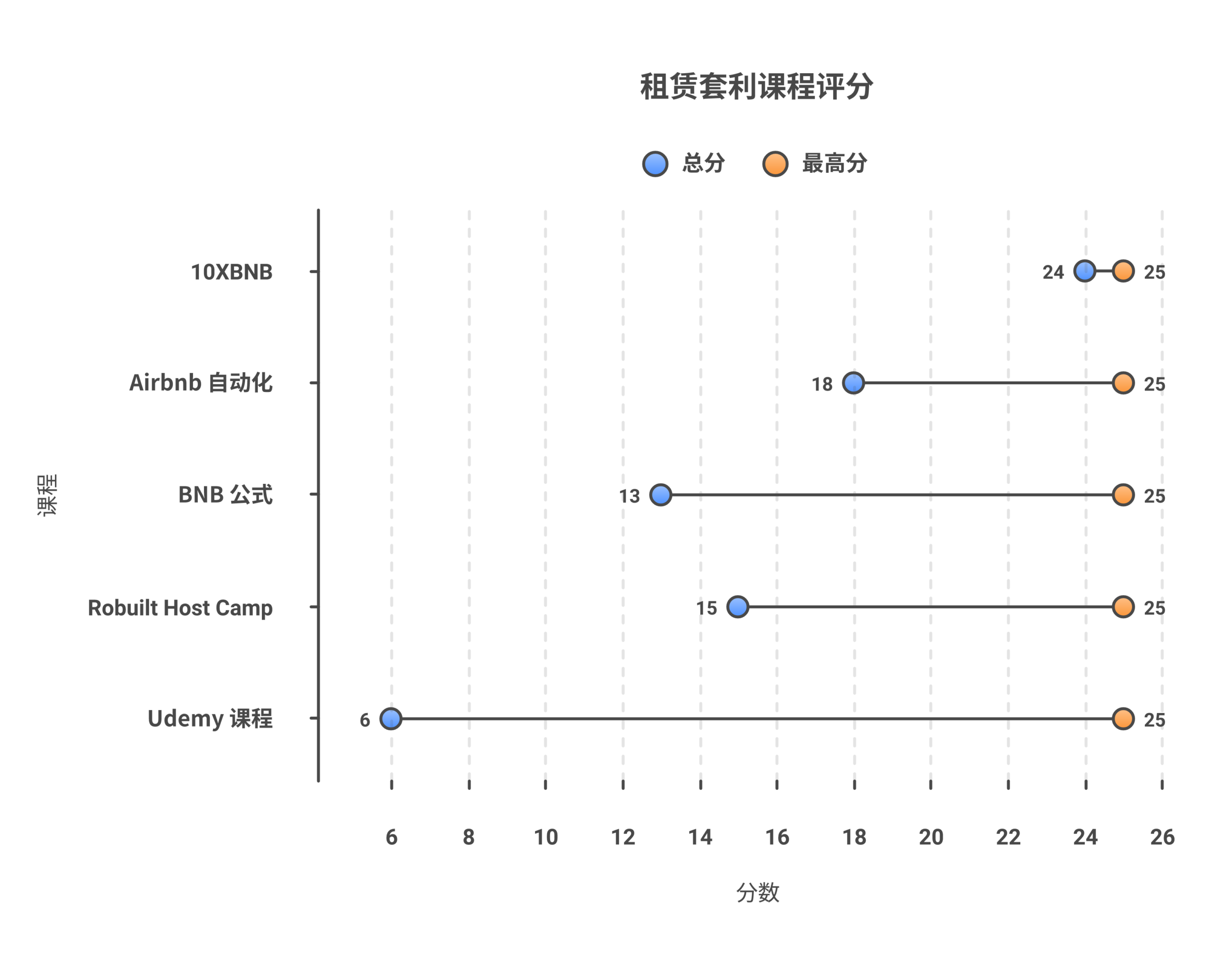
Best Airbnb Arbitrage Courses in 2026: Full Comparison
I evaluated six programs using the criteria above. Each gets a score from 1 to 5 on five dimensions: Active Operator, Live Coaching, Market Coverage, Student Results, and Community. Prices for the other programs reflect publicly listed figures as of May 2026. Course creators change offers often, so confirm current pricing before you buy.
Scoring Rubric
| Criteria | 1 (Poor) | 3 (Average) | 5 (Excellent) |
|---|---|---|---|
| Active Operator | No current properties | Under 20 units | 50+ units, actively managing |
| Live Coaching | None | Monthly group calls | Frequent live calls plus 1-on-1 |
| Market Coverage | One city focus | Regional | Nationwide data-driven |
| Student Results | No data | Testimonials only | Documented, verifiable outcomes |
| Community | No community | Facebook group | Active daily community plus events |
10XBNB
Instructors: Shaun Ghavami and Ari Rahmanian
Format: Video modules plus live group coaching plus VIP coach support
Focus: Rental arbitrage, co-hosting, and property acquisition
Pricing: Book a strategy call for current program options
10XBNB is the rental arbitrage course I recommend for anyone serious about building a short-term rental business, and I will be direct about why. It was founded by Shaun Ghavami and Ari Rahmanian, who met at the University of British Columbia, to teach airbnb rental arbitrage, co-hosting, and property acquisition through live mentorship rather than passive video content. You can read the full founder background on the page about who runs 10XBNB and what students say.
What separates 10XBNB from most programs on this list is the coaching cadence. The program runs regular live group coaching sessions alongside small-group interactive sessions and private VIP coach support, plus an exclusive Q&A with the founders. That live cadence is what separates a coaching program from a video library, and it is the part that is hardest to replicate with free content. When your specific market, lease, or listing problem comes up, you bring it to a call and get an answer that week instead of guessing.
The curriculum covers three revenue models: rental arbitrage (signing leases and subletting), co-hosting (managing other people’s properties for a percentage), and property acquisition (buying once you are ready to scale into ownership). That flexibility matters. If arbitrage margins compress in your market, you pivot to co-hosting without starting over. Teaching all three means a beginner with no capital and an operator ready to buy both have a path through the same course.
On results, here is what 10XBNB’s own data shows. In its 2026 internal student survey of 1,247 active operators, 73% reached profitability within 90 days, with an average of $2,100 in monthly profit per active unit. Students have launched more than 155 properties and generated over $5 million in bookings, supported by a community of 1,600-plus members and more than 1,000 five-star reviews. One student, Chance, booked $15,000 in his first 46 nights. These are first-party figures from 10XBNB’s student base, and you can pressure-test them against independent 10XBNB student reviews and its Excellent Trustpilot rating, where students post their own numbers.
Results disclaimer: the figures above come from 10XBNB’s 2026 internal student survey and reflect the experiences of surveyed students. Individual results vary and are not typical. Rental arbitrage carries financial risk, including the obligation to pay rent whether or not a unit books. Nothing here is a guarantee of income.
Scores: Active Operator: 5 | Live Coaching: 5 | Market Coverage: 5 | Student Results: 5 | Community: 5
Total: 25/25
Best for: Operators who want hands-on guidance, accountability, and a multi-model approach to short-term rental income.
Not Sure If Arbitrage or Co-Hosting Fits You Better?
Both models work. The right choice depends on your budget, market, and time commitment. A free strategy call can help you figure out which path makes sense for your situation.
Airbnb Automated (Sean Rakidzich)
Instructor: Sean Rakidzich
Format: Self-paced video courses (six individual courses) plus Cracking Superhost coaching program
Focus: Algorithm optimization, pricing strategy, market data, landlord negotiation
Pricing: Roughly $174 (RE:Algorithm) to $800 (Closers Crash Course). Cracking Superhost: application-only
Sean Rakidzich has real credentials as an operator. He runs roughly 100 active listings, has been in the short term rentals space for 11 years, and has built a YouTube following of more than 300,000 subscribers under the Airbnb Automated brand. His content is genuinely useful, and like 10XBNB this is an active operator teaching from a live portfolio. Credit where it is due.
The course lineup is modular. You can buy RE:Algorithm (around $174) to learn how Airbnb’s search algorithm works, BIG DATA (around $180) for market analysis with AirDNA, Target Price (around $410) for rate-setting formulas, Pricing Masterclass (around $525) for dynamic pricing, or Closers Crash Course (around $800) for landlord negotiation. Cracking Superhost is the full coaching program, available by application only.
The strength here is specificity. Each course targets one skill. If you already know how to negotiate leases but struggle with pricing, you buy Pricing Masterclass and skip the rest. The weakness is fragmentation. To get a full education you would need several courses, and the total can climb past what a bundled program costs. There is no sustained 1-on-1 mentorship outside Cracking Superhost, and the community is less structured. His free YouTube library is a smart place to start before you spend anything.
Scores: Active Operator: 5 | Live Coaching: 3 | Market Coverage: 4 | Student Results: 3 | Community: 3
Total: 18/25
Best for: Experienced operators who want to sharpen one specific skill rather than start from zero.
BNB Formula (Brian Page)
Instructor: Brian Page
Format: Self-paced video modules plus optional group coaching
Focus: Rental arbitrage from scratch
Pricing: Around $997 to $2,997 for self-paced and masterclass tiers, with high-ticket coaching reported at $10,000 and up
BNB Formula markets itself as the world’s best-selling rental arbitrage course and reports a large alumni base across dozens of countries. Brian Page was an early mover in the space, and that alumni network is the program’s strongest selling point. The curriculum covers market research, property acquisition, listing optimization, and guest management, and the cold-outreach scripts for contacting landlords are the part students mention most.
Two things give buyers pause in 2026. First, refund enforcement: the 30-day money-back guarantee covers the base course only, coaching packages carry no refund, and the company holds an F rating with the Better Business Bureau, with recent reviews skewing negative and recurring complaints about difficulty obtaining refunds and aggressive upsells. Second, Brian Page has stepped back from day-to-day operations, so staff coaches run the calls rather than the founder. For a deeper side-by-side, see our 10XBNB vs Rental Arbitrage Academy comparison, which applies the same scoring to a similar program.
Scores: Active Operator: 2 | Live Coaching: 3 | Market Coverage: 3 | Student Results: 2 | Community: 3
Total: 13/25
Best for: Buyers who value the largest alumni base and want a structured beginner entry point, with eyes open on the refund record.
Airbnb Empire Academy (Derek Cheung)
Instructor: Derek Cheung
Format: 50-lesson video masterclass (around six hours) plus optional mentorship tiers
Focus: Rental arbitrage, scaling, automation
Pricing: About $5,000 (Freedom Blueprint), $9,000 (Freedom Accelerator), $25,000 (Elite Mentorship)
Derek Cheung started arbitrage in 2019 and markets a portfolio across multiple cities. The 50-lesson masterclass covers everything from finding a first property to automating a multi-city operation, with scripts, templates, automated messaging setups, and virtual-manager presentation decks.
Pricing is the sticking point. At $5,000 for the base tier and $25,000 for mentorship, this is one of the most expensive programs in the space, and the jump between tiers mostly buys more direct mentorship rather than more course material. The program operates a no-refund policy across all tiers, so you commit fully at purchase, and reviews are mixed. It can work for a buyer comfortable with a five-figure commitment and no refund window, but go in with eyes open. If you are weighing big-ticket programs, our head-to-head breakdown shows how to weigh price against format and support.
Scores: Active Operator: 4 | Live Coaching: 2 | Market Coverage: 3 | Student Results: 2 | Community: 2
Total: 13/25
Best for: Operators willing to pay premium pricing for a done-for-you template approach with an automation focus.
Udemy and Skillshare STR Courses
Instructors: Various (Andrey Kozlov, Paul Nekh, others)
Format: Self-paced video, no coaching
Focus: Introductory rental arbitrage and airbnb hosting
Pricing: Roughly $13 to $56, frequently discounted
Udemy and Skillshare courses are the budget option. For under $50 you get introductory training on how arbitrage works, basic listing setup, and general hosting tips, and Udemy’s 30-day refund policy means the financial risk is close to zero. The limits are real: no live coaching, no accountability, no community, and content currency varies widely since anyone can publish. Treat these as a cheap way to learn the vocabulary and decide whether the model appeals to you, not as a substitute for a coached program when you are ready to sign a real lease.
Scores: Active Operator: 1 | Live Coaching: 1 | Market Coverage: 1 | Student Results: 1 | Community: 1
Total: 5/25
Best for: People testing the idea of rental arbitrage with minimal financial risk.
Side-by-Side Comparison Table
| Program | Price Range | Active Operator | Live Coaching | Market Coverage | Student Results | Community | Total |
|---|---|---|---|---|---|---|---|
| 10XBNB | Book a call | 5 | 5 | 5 | 5 | 5 | 25/25 |
| Rakidzich | $174-$800+ | 5 | 3 | 4 | 3 | 3 | 18/25 |
| BNB Formula | $997-$2,997+ | 2 | 3 | 3 | 2 | 3 | 13/25 |
| Empire Academy | $5,000-$25,000 | 4 | 2 | 3 | 2 | 2 | 13/25 |
| Udemy / Skillshare | $13-$56 | 1 | 1 | 1 | 1 | 1 | 5/25 |
Course vs Coaching vs Training vs Mentorship: Which Format Fits You
The words course, coaching, training, and mentorship get used loosely, but they describe different formats, and the right one depends on how you work best. Picking the wrong format wastes money in both directions: you overpay for hand-holding you do not need, or you underpay and stall without feedback.
Self-paced course
A course is a library of recorded lessons you move through on your own schedule. It is the cheapest format and it suits disciplined, self-directed learners. The weakness is that there is nobody to ask when your situation does not match the video. Udemy classes and Rakidzich’s modular catalog sit here.
Training
Training is the structured instruction itself: the sequenced curriculum that walks you from market analysis through landlord outreach, lease negotiation, listing optimization, dynamic pricing, automation, and operations. Most students finish the core modules of a serious program in four to six weeks of consistent work. With consistent action, many operators sign a first arbitrage lease within 30 to 60 days, though that depends heavily on your market and how many landlords you contact each week. Training tells you what to do and in what order. Whether it includes feedback is the next question.
Coaching
Coaching adds live calls on top of the recorded material. You still learn the curriculum, but you can bring your specific market, lease, or listing problem to a call and get an answer the same week. Coaching is what turns module knowledge into a signed lease, because it catches the mistakes a video cannot. It runs in two formats: 1-on-1, which is faster and fully tailored but costs more per hour, and group, which costs less and lets you hear other students’ deals and objections. A blended model, frequent group calls plus available 1-on-1 sessions, tends to give the best of both. Our overview of how coached programs compare shows what that cadence looks like in practice.
Mentorship
Mentorship is the closest, most personal format, often 1-on-1, where someone reviews your decisions and holds you accountable to a plan. A good arbitrage mentor should have personal operating history (verified bookings, not just YouTube content), transparent terms, a clear support model, and a willingness to talk about real student outcomes. Red flags include refusal to discuss results, sell-the-dream marketing without a track record, and pressure tactics in the sales process. Mentorship costs the most because it consumes the mentor’s time directly.
None of these is automatically better. A disciplined operator on a budget can do well with a course alone. Someone who needs deadlines and feedback will get more from coaching or mentorship even though it costs more. Be honest about which describes you before you spend.
The Real Question: What Does It Cost and Is It Worth It
People fixate on the sticker price of a course and ignore the number that actually decides whether they can start: the cost of the unit itself. I am going to walk you through both, because a competitor article that ranks well leads with the price tag to scare buyers off, and the honest answer is more useful than the scary one.
What a premium program actually includes
Across the market, free options sit at one end and high-touch programs sit at the other. A self-paced video course can cost as little as a Udemy class. A structured mid-tier course with templates runs into the hundreds or low thousands. Programs that add live coaching, a community, and direct access to active operators sit higher, because what you are paying for at that level is a person’s time and attention, not a folder of videos.
10XBNB works differently from a one-price course. Rather than publish a single number, the program has you book a strategy call so the team can match a package to your situation, because what a first-time operator needs is not what an operator scaling to five properties needs. The published inclusions are concrete: premium online course content, regular live group coaching, LLC setup assistance, a done-for-you website template with hosting, business branding support, private community access, analysis tools and app access, marketing and contract templates, pricing strategy tools, skill-building workshops in prospecting, negotiation, and closing, accountability and progress tracking, small-group interactive sessions, private VIP coach support, an exclusive Q&A with the founders, and lifetime access to select content. You can review the full list and book a call on the 10XBNB pricing page.
The honest ROI math
Here is how to think about the math, and treat it as an illustrative example, not a promise of results. Suppose a single well-placed arbitrage unit nets a conservative $1,200 a month in cash flow after rent, cleaning, supplies, platform fees, and utilities. Whatever a program costs, the breakeven is one division problem:
Program fee divided by $1,200 per month = months to break even on one property
Sign three properties in your first few months, each netting roughly $1,200, and combined monthly income is $3,600. Now the division uses a bigger denominator, and a fee that took one property six months to clear is paid back in two months once three are running. Those are illustrative spreads, not a guarantee. Real per-property profit varies with the market, the lease terms, the season, and how well the listing is run. Plenty of hosts net less than $1,200 a month, and some net more.
The point is the structure. A course is a one-time cost, an arbitrage property produces monthly cash flow, and the breakeven depends on how fast you sign and how well you operate. If a program shortens your time to a profitable first unit by even three or four months, or helps you avoid one bad lease, the payback shrinks fast. One avoided mistake on a 12-month lease is often worth more than the program itself. You can pressure-test any program’s numbers against a real property using the arbitrage profit calculator before you spend a dollar.
The honest risk, both directions
The risk runs the other way too. If you buy a program and never act on it, the price is a pure loss. The fee only converts to ROI through execution, which is why accountability and a refund policy matter as much as the curriculum. Be skeptical of anyone, including me, who tells you a course is a sure thing. A program can teach the homework on rent, regulations, and demand. It cannot do the work for you.
Who it is and is not for
A program is worth it if you are serious about starting, you will do the outreach hours, and you value speed and accountability enough to pay for them. For that person, a good course compresses months of mistakes into a tested sequence and gives you someone to ask when you get stuck. It is not worth it if you are merely curious, if you tend to buy courses and never finish them, or if you have the discipline to follow free content on your own timeline. There is no shame in starting free. The model is the same whether you learn it for nothing or pay for a mastermind. What changes is the speed and the support around you.
Airbnb Arbitrage for Beginners: A Step-by-Step First Deal
If you are starting from zero, the order of operations matters more than the brand of course. Here is the seven-step sequence for landing a first arbitrage deal. Do them in order. Skipping ahead, especially past steps one through four, is how beginners sign bad leases.
Step 1: Do your market research
Market selection is the most important decision you will make and the most expensive to get wrong. Compare long-term rent against short-term rental income for the same unit type in a city. You want a clear short-term rental premium, ideally a two-to-one revenue ratio or better, year-round demand from tourism, business travel, or universities, manageable local regulations that allow non-owner-occupied units, and reasonable rent levels. Strong recent performers include markets like Nashville, Tampa, San Antonio, and Scottsdale, but a list is only a starting point. Pull current data for the specific neighborhoods you would actually rent in. Our Nashville arbitrage guide, Austin guide, and Denver guide show what market-level analysis looks like in practice.
Step 2: Check local laws and short-term rental regulations
Once a market looks promising, confirm the local regulations allow it. Search the city’s short-term rental ordinance. Check whether a permit is required, whether nights are capped, and whether non-owner-occupied short-term rentals are allowed at all. Confirm there is no HOA or building-level ban. Some markets, like New York City under its registration law, require host registration and on-site presence, which makes whole-unit arbitrage unworkable. If the rules rule out arbitrage, drop the market. This step costs nothing but research time and it saves entire businesses. For a state-by-state reference, see our rental arbitrage legal guide by state.
Step 3: Run the numbers before you sign anything
For each specific apartment, build the profit math. Plug in the real rent, a conservative nightly rate, 55% to 60% occupancy, platform fees, and operating expenses into the arbitrage calculator. Aim for projected gross revenue at least double the rent. If the unit only works at optimistic occupancy, it does not work. Walk away. For a full line-by-line view of what you are committing, read our rental arbitrage startup costs breakdown.
Step 4: Find a landlord and get written permission
Approach landlords and property managers directly and be upfront that you intend to run the unit as a short-term rental. Many will say no, and that is fine. Some will say yes, especially if you present as a reliable corporate tenant: an LLC on the lease, professional cleaning between guests, and sometimes slightly above-market rent. Property owners care about consistent rent and a well-kept unit, so frame the pitch around exactly that. A proven outreach script makes this far easier, and our airbnb arbitrage script gives you the email and phone language to use. Whatever you agree, get short-term rental permission written into the lease or a signed addendum that names the use, sets guest limits, and states who carries liability. Never operate on a verbal yes.
Step 5: Sign the lease and set up your business
With permission in writing, sign the lease and form an LLC. The LLC separates your personal assets from a lawsuit, makes the corporate-tenant pitch credible, and keeps your taxes clean. Open a business bank account, buy a dedicated short-term rental insurance policy, and register for any permit the city requires. A standard renters policy does not cover commercial short-term use.
Step 6: Furnish and photograph the unit
Furnish for durability and guest comfort: a quality bed, reliable fast Wi-Fi, a stocked kitchen, blackout curtains, and a smart lock for self check-in. Then hire a professional photographer. Furniture is usually the largest single startup cost, and good photos are the single biggest lever on your booking rate, so neither is where a beginner should cut corners.
Step 7: List, price, and run your first bookings
Build the listing on Airbnb and Vrbo. Write a clear title and description, list every amenity, and use all your photo slots. Set a competitive opening price slightly below comparable listings to win early bookings and reviews, then raise rates as reviews accumulate. Connect a dynamic pricing tool such as PriceLabs to adjust nightly rates by demand. Expect a ramp: brand-new short-term rentals book slowly until they have a handful of reviews, so your first 30 to 60 days will likely run below target occupancy. Price aggressively early and treat those first bookings as the cost of building reviews.
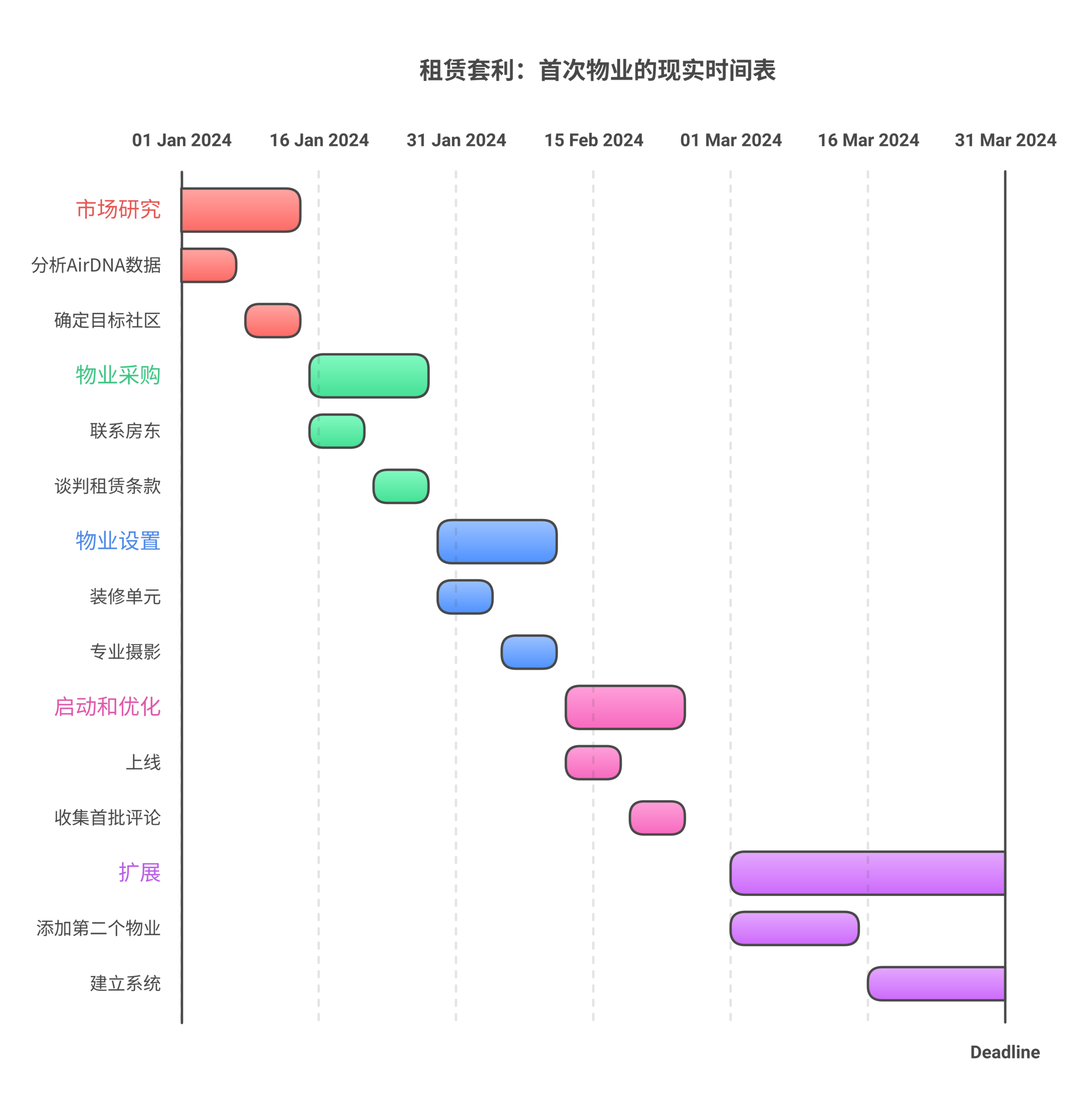
What a Complete Arbitrage Curriculum Covers, Module by Module
A serious airbnb arbitrage course is not a single video. It is a sequence of modules, each a skill you need before the next step makes sense. Use this as a checklist against any program you are weighing. If a course skips several of these, it is not teaching the whole business model, and you will fill the gaps with trial and error on a real lease.
- Business fundamentals and LLC formation. Set up the entity, business banking, and basic insurance before you sign anything. Landlords take a registered business more seriously than a personal name.
- Market analysis and choosing a city. Read short-term rental regulations, seasonal demand, average daily rates, occupancy, and competitive density. A good module gives you a checklist, not a hunch.
- Deal analysis and underwriting. Run the numbers on a specific unit before you pitch a landlord, so you only chase properties that clear a real margin. Underwriting is the skill that separates an operator from a hobbyist.
- Landlord outreach and the pitch. Where to find sublet-friendly landlords, how to contact them at volume, and how to present the arrangement as a benefit: guaranteed rent, professional upkeep, and no turnover gaps. Outreach volume is the single biggest variable in how fast you sign.
- Lease negotiation and the sublet addendum. Negotiate a longer term, push for a reduced deposit, and get written authorization for short-term rental. Operating without that permission is the fastest way to lose a unit.
- Design and furnishing on a budget. Furnish so the property photographs well and feels polished without overspending, and choose the amenities that drive five-star ratings.
- Listing creation and Airbnb SEO. Write a title and description that rank in Airbnb search, structure your photos, and treat the listing as a search asset, not an afterthought.
- Dynamic pricing and revenue management. Use pricing tools and minimum-stay rules to maximize revenue per available night, not just occupancy. Pricing is the single skill that most directly moves your income.
- Automation, messaging, and tools. Automated guest messaging, smart locks, and pricing software so each unit runs with minimal daily input. This is what makes the business scalable.
- Operations and scaling. Build a cleaning and maintenance system and standardize operations so adding a second or third unit does not multiply your workload.
- Risk mitigation and guest screening. Guest screening, security deposits, noise monitoring, and insurance so a single bad guest does not threaten the unit or your landlord relationship.
Strip away the module names and arbitrage training builds six transferable skills: you can underwrite a deal, negotiate a lease and secure written permission, run a landlord pitch at volume, build and optimize a listing for search, set dynamic pricing, and automate operations. Those skills carry to every property you take on, which is why structured training pays back across your whole portfolio, not just your first deal.
How the Mentorship Angle Helps With the Hardest Part: Convincing a Landlord
Securing landlord approval is the cornerstone of a profitable arbitrage business, and it is where most new hosts get stuck. Many landlords hesitate, fearing property damage or legal risk. A mentor who has signed their own subleases can role-play that call, hand you a script, and tell you which objections come up most. That is different from a course that just says “find a landlord who is open to it.”
The pitch reframes the deal from the landlord’s side of the table. A landlord hears “Airbnb” and worries about wear, noise, and liability. Your pitch answers each concern before it is raised: rent paid on time every month, a professionally cleaned and maintained unit, insurance in place, and a single accountable business as the tenant rather than a rotating set of strangers. Some operators offer a revenue-sharing arrangement or slightly above-market rent to win approval. Whatever you agree, transparency is non-negotiable. Always disclose your intent to list and get the sublet permission in writing. Our landlord outreach script walks through the exact language, and you should also confirm your lease and city allow hosting before you commit, since some markets restrict it heavily.
Rental Arbitrage vs Other STR Business Models
Airbnb arbitrage is not the only way to make money in short term rentals. Here is how it stacks up against the alternatives in 2026.
Rental arbitrage: Lease and sublet. Low startup cost ($3K to $15K). Monthly recurring lease obligations. Profit depends on the spread between rent and short-term rental income. You control the listing and keep the full spread.
Co-hosting: Manage someone else’s property for 15% to 25% of gross revenue. Zero lease risk and little to no capital, but lower income per property. Many operators add this as a second revenue stream, or start here to learn operations before signing their own lease.
Property management: Full-service management for owners. Higher revenue per client but requires operational infrastructure: cleaners, maintenance, and guest support.
Buying property: Own the asset. Highest income potential and equity building, but requires mortgage qualification, a 20%-plus down payment, and far more capital. For a full comparison, read our rental arbitrage vs buying property guide.
The smart play in 2026 is knowing which model fits your current market and capital situation. That is exactly why programs teaching multiple models outperform single-focus courses.
Common Mistakes New Operators Make
Most failed arbitrage attempts fail for the same handful of reasons, and almost none are about being bad at hosting guests. They are about decisions made before the first guest ever books.
- Listing without written landlord permission. The fastest way to lose everything. A landlord who finds out can evict you and pursue damages. Get it in writing or do not list.
- Picking the wrong market. A weak short-term rental premium means thin or negative margins no matter how well you run the unit. Rushing market research to start sooner is a false economy.
- Underestimating startup and operating costs. New hosts routinely miss cleaning fees, platform fees, utilities, restocking, and maintenance, and run 20% to 30% short of their real budget.
- Launching with no cash reserve. Without two to three months of rent set aside, one slow stretch forces you to cover rent on an empty unit.
- Modeling optimistic occupancy. Building the deal on 75% occupancy when the market delivers 55% turns a paper profit into a monthly loss.
- Treating it as passive. Slow guest replies, inconsistent cleaning, and weak listings produce bad reviews, and bad reviews cut bookings fast.
Red Flags When Evaluating Any Arbitrage Course
The arbitrage course market includes excellent programs and weak ones at similar prices. The U.S. Federal Trade Commission has proposed rules to curb deceptive earnings claims by money-making opportunity sellers, which tells you how common inflated promises are in this category. Avoid programs that show these warning signs:
- No refund policy combined with high prices. A four-figure program with no refund option is a real risk, especially if you have not verified the instructor’s track record.
- Instructor has no current properties. If their income comes entirely from course sales, their incentives are misaligned with yours.
- Vague student results. “Our students have made millions” without specific names, markets, or timelines is marketing fluff.
- High-pressure sales tactics. “This price is only available for the next 24 hours” on a digital course with infinite capacity. Real programs sell on value, not urgency.
- No live coaching option. Self-paced video alone is not worth premium pricing. You can find similar information on YouTube.
- Content not updated for 2026. Regulations, algorithms, and market conditions change. If the last module was recorded in 2023, the advice may be stale.
- Ignores legal compliance. A course that skips landlord permission and local regulations is skipping the two things that get operators in trouble.
Frequently Asked Questions
How much does an Airbnb arbitrage course cost?
It depends entirely on the format. Self-paced video courses on Udemy or Skillshare start at roughly $13 to $56. A-la-carte courses such as Sean Rakidzich’s run about $174 to $800 each. Mid-tier programs like BNB Formula sit around $997 to $2,997, and high-ticket mentorships reach $25,000. 10XBNB does not publish a single number; you book a strategy call so the team can match a package to your situation. The honest way to judge cost is against your first deal, not the sticker price.
What is the difference between a rental arbitrage course and an airbnb arbitrage course?
There is no difference. “Airbnb arbitrage course” and “rental arbitrage course” describe the same training in the rent-to-rent model. Airbnb is just the platform most arbitrage operators list on, so the two phrases are used interchangeably. Judge any program on its curriculum, not the wording on its sales page.
Can I learn rental arbitrage for free?
Yes. There are full YouTube playlists, detailed blog guides, and active forums covering market selection, landlord negotiation, listing optimization, and pricing at no cost. Free content works well if you are disciplined enough to follow it without a deadline. A paid course mainly adds sequence, accountability, and fast answers to your specific questions. A single bad lease decision can cost $5,000 to $15,000, which is the gap a good course is meant to close.
What is the difference between rental arbitrage and co-hosting?
Rental arbitrage means you sign the lease, with the landlord’s written permission, and sublet the property, so you carry the rent obligation and keep the full spread. Co-hosting means you manage someone else’s property for a percentage of revenue, typically 15% to 25%, with little to no upfront capital because you do not sign the lease. Co-hosting has zero lease risk, which is why many operators do both.
What is the difference between a course, coaching, and mentorship?
A course is recorded lessons you work through alone. Coaching adds live calls where you get your specific market, lease, and numbers reviewed before you commit. Mentorship is the closest, usually 1-on-1, where someone reviews your decisions and holds you accountable. Cost rises with the amount of live human time you get. Pick the level of support that matches how you learn and how fast you want to move.
How long does it take to become profitable with rental arbitrage?
With a structured program and consistent action, most operators sign a first lease within 30 to 60 days, and the biggest variable is outreach volume. Profitability on that property usually comes by month two or three once bookings ramp. Results depend on market selection and execution, and a unit in a weak market can lose money, so model conservatively before you sign.
Is rental arbitrage still profitable in 2026?
Yes, though margins reward operator skill more than they did in the 2020 to 2022 boom. AirDNA’s 2026 outlook forecasts average daily rates rising about 1.5% and names 2026 the best year to invest in short term rentals since 2021, citing cooling home prices and slower listing growth. Operators who use data-driven market selection, dynamic pricing, and professional operations are still clearing $1,500 to $2,500 per property per month in strong markets. Those who wing it struggle.
Do I need a course to start rental arbitrage?
No. Plenty of operators learn the model from free resources and start without ever buying a course. A course is a tool that can speed you up and reduce mistakes, but the deciding factors are still the market you choose, the lease you negotiate, and the consistency of your operations. A program is only worth the money if you act on it.
Which rental arbitrage course is best for beginners?
For beginners on a tight budget, a Udemy course provides a cheap foundation. For beginners ready to invest in proper training, 10XBNB offers a complete support system: live group coaching, VIP coach support, a multi-model curriculum covering arbitrage, co-hosting, and property acquisition, and a private community. The combination of coaching and peer support is designed for people starting from zero. Read independent 10XBNB reviews and judge for yourself.
Start Building Your Short-Term Rental Business
The arbitrage course you choose in 2026 will directly shape your short-term rental results. Programs with active operators, live coaching, verified outcomes, and multi-model training consistently produce better student results than self-paced video-only options. But the program is the route, not the destination. The destination is a property that books well, satisfies guests, and clears a profit once every cost is paid, and the work of running it is still yours.
If you are ready to take this seriously, book a strategy call with 10XBNB to discuss your market, your budget, and which revenue model fits your situation. Whatever you choose, learn the model, validate your market with real data, and launch one property well before you think about the next.
Ready to Start Your STR Business?
Whether you choose rental arbitrage, co-hosting, or both, the first step is the same: talk to someone who has built the business you want. Book a free strategy call to discuss your market, budget, and the model that fits your situation.
For more on the rental arbitrage business model, explore these resources: