
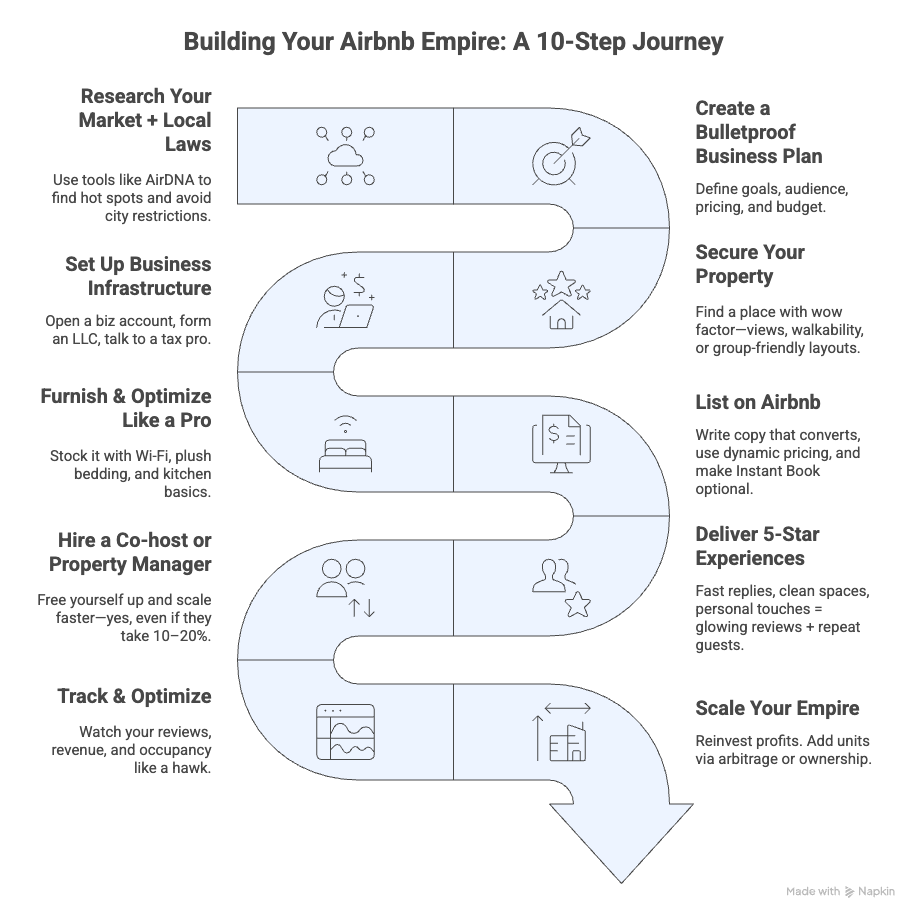
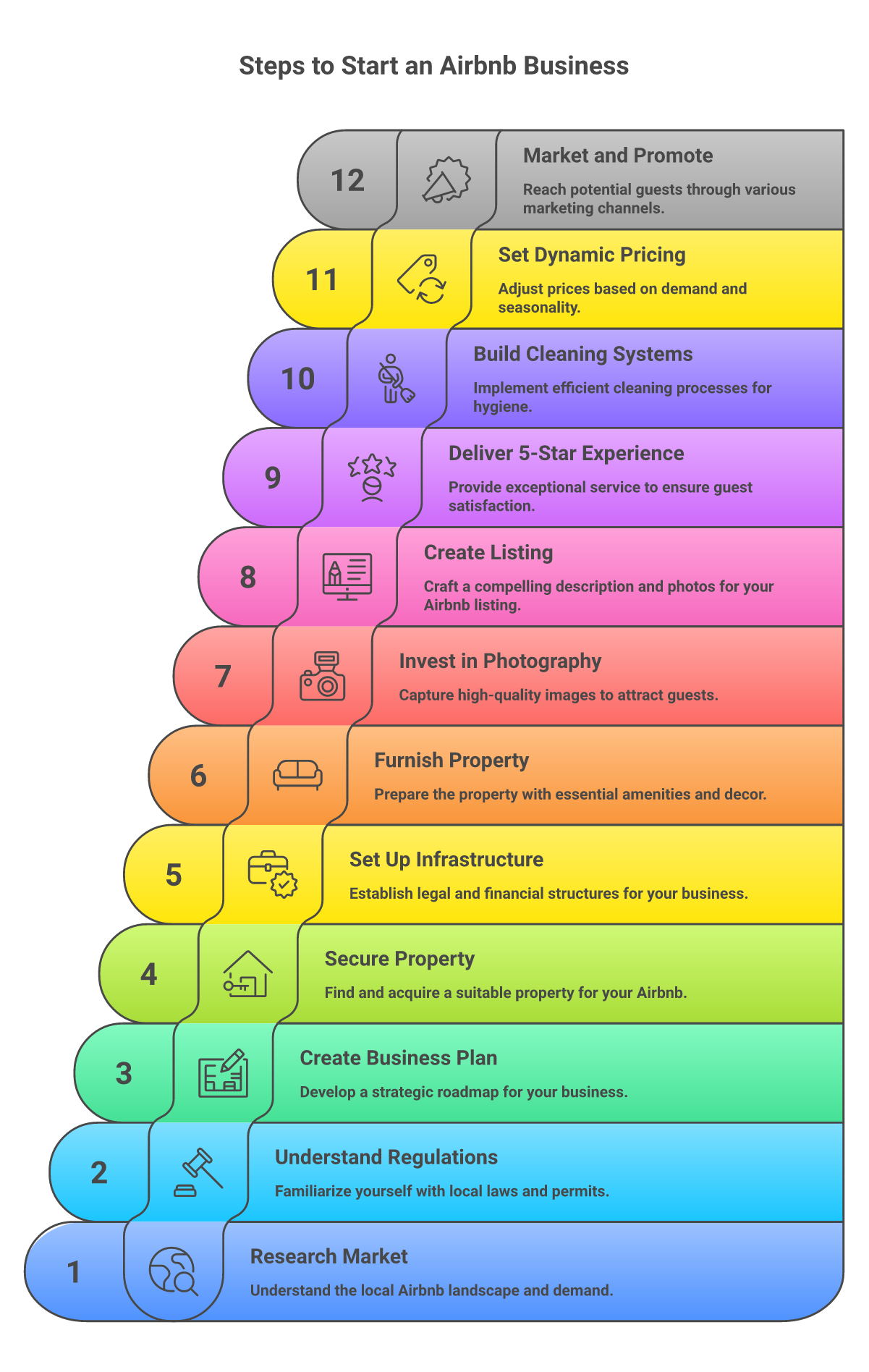
To start an Airbnb business in 2026, pick one of three business models: rental rent to rent Airbnb (rental arbitrage (definition guide)) (lease a property and re-list it as a short term rental, $7,000 to $15,000 startup (start with these no-money methods)), property ownership (buy a unit and host it, $20,000+ plus down payment), or co-hosting (manage someone else’s space for 10% to 25% of revenue, near-zero capital). Pick the model that matches your budget, research your local market, verify local short term rentals regulations, register an Airbnb LLC guide, furnish the space, list on platforms like Airbnb and Vrbo, and dial in the guest experience. The 10XBNB system has produced over $5 million in booking fees across 24 properties using these exact steps.
Why Start an Airbnb Business in 2026?

The Opportunity
-
- Typical U.S. Airbnb hosts earned $14,000 in 2024
-
- Top performers earn $36,678+ annually per property
-
- Short-term rental hosts can earn 3.5x more than traditional landlords
-
- Q1 2025 saw 143.1 million nights booked on Airbnb
-
- Remote work continues driving demand for “workation” properties
The Reality Check
-
- Competition has increased significantly in most markets
-
- Regulations are tightening in major cities
-
- Guest expectations have never been higher
-
- Success requires systems, not just a spare room
Who This Business Model Works For
-
- Real estate investors seeking higher yields
-
- Entrepreneurs who want location-independent income
-
- Property owners with underutilized space
-
- People willing to learn hospitality and operations
Understanding the Airbnb Business Model
Before diving into steps, understand the fundamentals of how Airbnb hosting generates revenue.Revenue Model
-
- Guests pay nightly rate + cleaning fee + Airbnb service fee
-
- Hosts receive nightly rate + cleaning fee minus Airbnb host fee (3%)
-
- Hosts typically earn 85-97% of the total booking amount
Profit Formula
Monthly Profit = (Avg Nightly Rate × Nights Booked) + (Cleaning Fee × Turnovers), Operating ExpensesTypical Operating Expenses
-
- Mortgage/rent
-
- Utilities (often higher with guests)
-
- Cleaning costs
-
- Supplies and restocking
-
- Maintenance and repairs
-
- Insurance
-
- Property management software
-
- Marketing and photography


Choosing Your Path: Three Business Models
There are three primary ways to start an Airbnb business, each with different capital requirements and risk profiles.Model 1: Rental Arbitrage (Low Capital)
Rental arbitrage means leasing properties long-term and subletting them as short-term rentals on Airbnb. Read our complete Airbnb Arbitrage 101 guide for the full breakdown, or follow a structured arbitrage course curriculum if you want the model taught step by step. How it works:-
- Find landlords willing to allow short-term rentals
-
- Sign a lease using a proper rental arbitrage contract
-
- Furnish the property
-
- List and manage on Airbnb
-
- Keep the difference between nightly revenue and monthly rent
-
- Low startup capital ($2,000-$10,000)
-
- No property ownership required
-
- Easy to test markets before buying
-
- Scalable, add properties without mortgages
-
- Landlord relationship risk
-
- No equity building
-
- Lease obligations continue even with low bookings
-
- Finding arbitrage-friendly landlords is challenging
Model 2: Property Ownership (High Capital, Long-Term Wealth)
The traditional approach: buy property specifically for short-term rental use. How it works:-
- Identify profitable markets with good STR fundamentals
-
- Purchase property (usually requires 20-25% down for investment properties)
-
- Furnish and list on Airbnb
-
- Build equity while generating rental income
-
- Build equity and long-term wealth
-
- Full control over property
-
- Potential appreciation gains
-
- More financing (Airbnb loan guide) options available
-
- Tax benefits (depreciation, mortgage interest deduction)
-
- High capital requirements ($50,000-$200,000+ to start)
-
- Market risk if property values decline
-
- Illiquid investment. Can’t exit quickly
-
- Responsible for all maintenance and repairs
Model 3: Co-Hosting (Zero Property Required)
Co-hosting means managing other people’s Airbnb properties for a percentage of revenue. Learn how to become an Airbnb co-host with our complete guide. How it works:-
- Partner with property owners who lack time or expertise
-
- Handle guest communication, cleaning coordination, pricing, etc.
-
- Earn competitive co-host salaries (10-30% of booking revenue)
-
- Scale by adding more properties under management
-
- Connects 10,000+ co-hosts across 10 countries
-
- Average co-host rating: 4.86 stars
-
- 73% of network co-hosts are Superhosts
-
- 84% manage Guest Favorite properties
-
- Zero capital required
-
- No lease or mortgage obligations
-
- Learn the business before investing your own money
-
- Scalable through reputation and referrals
-
- Lower profit margins (10-30% vs. 100%)
-
- Dependent on property owner relationships
-
- Less control over property decisions
-
- Must build reputation to attract clients
Can You Start an Airbnb Business Without Owning Property?
Yes. There are three paths to start an airbnb business with little or no capital, and they all bypass property ownership. The first is co-hosting: manage someone else’s airbnb space for 10% to 25% of revenue under a co-host agreement. Co-hosts handle listings, guest communication, pricing, and cleaning logistics, while the property owner keeps the lease or mortgage on their own books. Airbnb’s Co-Host Network (launched 2024) and Vrbo’s co-host platform (how the Airbnb business model works) make finding placements faster than ever before.
The second path is renting a spare room in your existing home and listing only that space as a short term rental. Spare room hosts trade lower nightly rate (typically $40 to $90 per night for a private room) for the lowest possible startup spend. No new lease, no full furniture load-out, no business loan.
The third is the partnership model: pair with someone who provides the capital for furniture and the security deposit, in exchange for a revenue split. Most 10XBNB students start with one of these three near-zero-capital models before scaling to full rental arbitrage or property ownership. Each lets you start an airbnb business with money you already have, not money you need to borrow.

How Much Does It Cost to Start an Airbnb Business?
Startup costs vary dramatically based on your chosen model:Rental Arbitrage Costs
| Expense Category | Low End | High End |
|---|---|---|
| Security deposit | $1,000 | $4,000 |
| First/last month rent | $2,000 | $6,000 |
| Furniture package | $2,000 | $8,000 |
| Linens and towels | $300 | $800 |
| Kitchen essentials | $300 | $1,000 |
| Decor and staging | $300 | $2,000 |
| Professional photos | $150 | $500 |
| Initial supplies | $200 | $500 |
| TOTAL | $6,250 | $22,800 |
Property Purchase Costs
| Expense Category | Low End | High End |
|---|---|---|
| Down payment (20-25%) | $40,000 | $150,000+ |
| Closing costs (2-5%) | $4,000 | $15,000 |
| Furniture package | $5,000 | $25,000 |
| Renovations/updates | $0 | $30,000 |
| Professional photos | $200 | $1,000 |
| Initial supplies | $500 | $1,500 |
| TOTAL | $49,700 | $222,500+ |
Co-Hosting Costs
| Expense Category | Low End | High End |
|---|---|---|
| Property management software | $0 | $100/mo |
| Business cards/marketing | $50 | $300 |
| Insurance (liability) | $300 | $1,000/yr |
| TOTAL | $350 | $1,400 |
Step 1: Research Your Market
Before committing any capital, analyze your target market thoroughly. Use our Airbnb arbitrage calculator to run the numbers, and explore the best states for Airbnb to find profitable markets. Read more about how to profit from Airbnb without owning real estate in our complete guide.
Key Metrics to Research
Occupancy Rate: The percentage of available nights that are booked. Healthy markets show 55-70% occupancy.-
- Below 50%: Oversaturated or weak demand
-
- 50-60%: Competitive but viable
-
- 60-70%: Strong market
-
- Above 70%: High demand (but verify seasonality)
Research Tools
-
- AirDNA: Complete STR market data
-
- Mashvisor: Investment property analysis
-
- AllTheRooms: Market analytics
-
- Airbnb search: Manual competitive analysis
-
- Check our Airbnb data and analytics guides
What to Look For
-
- Growing traveler demand (not declining)
-
- Reasonable competition (not oversaturated)
-
- Regulatory environment that permits STRs
-
- Economic stability in the area
-
- Multiple demand drivers (tourism, business, events)
Step 2: Understand Local Regulations
Two government resources are worth bookmarking before you research local regulations. The U.S. Small Business Administration’s business registration guide covers federal tax ID setup and LLC formation in every state. For the tax side of operating a short term rental, the IRS Tax Topic 415 spells out how rental real estate income is reported and what counts as a deductible operating expense. Always layer your local short term rentals ordinance research on top of these federal foundations.
Short-term rental regulations vary dramatically by location. What’s legal in one city may result in $10,000+ fines in another.Research These Requirements
Zoning Laws:-
- Is your property in a zone that permits STRs?
-
- Are there density limits (max STRs per building/area)?
-
- Is a short-term rental permit required?
-
- What’s the application process and cost?
-
- Are permits limited (lottery or cap)?
-
- Maximum rental days per year (90-day limits are common)
-
- Owner-occupancy requirements
-
- Minimum stay requirements
-
- Local occupancy/hotel tax rates
-
- Registration requirements
-
- Collection and remittance processes
-
- Does your HOA or condo association permit STRs?
-
- Are there specific HOA restrictions to follow?
-
- Is commercial liability insurance required?
-
- Does your landlord require specific coverage?
-
- Learn about Airbnb insurance requirements
How to Research
-
- Check your city’s official website for STR regulations
-
- Search “[Your City] short-term rental permit”
-
- Call your city’s planning/zoning department
-
- Consult a local real estate attorney for complex situations
-
- Join local host Facebook groups for practical insights
Step 3: Create a Business Plan
A business plan forces you to think through profitability before investing.Essential Components
Executive Summary:-
- Business concept (arbitrage, ownership, co-hosting)
-
- Target market and property type
-
- Revenue and profit projections
-
- Target market research (from Step 1)
-
- Competitor analysis
-
- Demand drivers and seasonality
-
- Conservative: 45% occupancy
-
- Moderate: 55% occupancy
-
- Optimistic: 65% occupancy
-
- Fixed: Rent/mortgage, insurance, subscriptions
-
- Variable: Cleaning, supplies, utilities, repairs
-
- What if occupancy drops 30%?
-
- What if a major expense arises?
-
- What’s your exit strategy?
Step 4: Secure Your Property
With research complete, it’s time to secure your property.For Rental Arbitrage
Finding Arbitrage-Friendly Landlords: Check out the best cities for Airbnb arbitrage, then:-
- Search “furnished rental” and “corporate housing” listings
-
- Contact property management companies directly
-
- Look for landlords advertising “flexible terms”
-
- Network with other arbitrage hosts for referrals
-
- Be upfront about your intentions, deception backfires
-
- Emphasize property care (more attention than long-term tenants)
-
- Offer higher rent (10-20% premium)
-
- Provide references from other properties
-
- Offer to add landlord as additional insured
-
- Propose a trial period with inspection rights
-
- Get explicit written permission for short-term rentals
-
- Clarify guest policies and any restrictions
-
- Understand your maintenance responsibilities
-
- Negotiate renewal terms upfront
For Property Purchase
Financing Options:-
- Conventional investment property loans (20-25% down)
-
- DSCR loans (debt service coverage ratio, based on rental income, not personal income)
-
- Portfolio loans (local banks, more flexibility)
-
- Hard money loans (short-term, higher rates)
-
- House hacking (owner-occupy while renting rooms)
-
- Run numbers on AirDNA before making offers
-
- Verify STR regulations for specific addresses
-
- Assess renovation needs and costs
-
- Consider property management accessibility
Step 5: Set Up Your Business Infrastructure
Treat this as a real business from day one.Legal Structure
Form an LLC for liability protection:-
- Separates personal assets from business
-
- Provides tax flexibility
-
- Creates professional credibility
-
- Costs $50-$500 depending on state
Business Banking
-
- Open a dedicated business checking account
-
- Keep all income and expenses separate
-
- Consider a business credit card for expense tracking
Insurance
Essential coverage:-
- Short-term rental insurance: Proper STR policy (not standard homeowners)
-
- Liability coverage: $1M minimum recommended
-
- Property protection: Covers damage to your furnishings
Tax Setup
-
- Get an EIN from the IRS (free)
-
- Register for local business license
-
- Set up occupancy tax collection (Airbnb handles this in most areas)
-
- Track all expenses for deductions
-
- Consider quarterly estimated tax payments
Step 6: Furnish and Prepare Your Property
Furnishing determines guest experience and photo quality, both critical to bookings. Use our complete furnishing Airbnb checklist to ensure nothing is missed.Furnishing Budget by Property Size
-
- Studio/1BR: $2,000-$5,000
-
- 2BR: $4,000-$10,000
-
- 3BR: $7,000-$15,000
-
- 4BR+: $12,000-$25,000
Essential Furniture
-
- Quality mattresses (don’t cheap out, guest sleep quality affects reviews)
-
- Comfortable sofa/seating
-
- Dining table with adequate seating
-
- Nightstands with lamps
-
- Dresser or closet storage
-
- Desk/workspace area
Essential Amenities (2026 Standards)
-
- Fast WiFi (100+ Mbps)
-
- Smart TV with streaming apps
-
- Coffee maker (Keurig or quality drip)
-
- Full kitchen essentials
-
- Quality linens (hotel-grade)
-
- Towel sets (2 per guest)
-
- Iron and ironing board
-
- Hair dryer
-
- Basic toiletries
High-Value Additions
-
- Dedicated workspace
-
- EV charger (increasingly important)
-
- Hot tub or pool access
-
- Outdoor seating area
-
- Game room/entertainment
-
- Pet-friendly accommodations
Sourcing Tips
-
- IKEA for functional basics
-
- Wayfair for good value furniture
-
- Amazon for linens, kitchen items, consumables
-
- Facebook Marketplace for secondhand finds
-
- HomeGoods/TJ Maxx for decor
Step 7: Invest in Professional Photography
Professional photos are the single highest-ROI investment for your listing.Why It Matters
-
- Listings with pro photos get 40% more bookings
-
- Better photos justify higher prices
-
- First photo determines if guests click or scroll past
What to Capture
-
- Hero shot (best angle of main living space)
-
- Every room from multiple angles
-
- Kitchen in detail
-
- Bathroom (clean and staged)
-
- Outdoor spaces
-
- Unique features (fireplace, view, hot tub)
-
- Neighborhood/location shots
Photography Tips
-
- Shoot during golden hour for warm light
-
- Stage every photo (made beds, set table, lit candles)
-
- Remove personal items and clutter
-
- Use wide-angle lens but avoid distortion
-
- Update photos seasonally
Step 8: Create Your Listing
Your listing converts browsers into bookers. Learn how to get more bookings on Airbnb and master Airbnb SEO to optimize every element.Title Formula
[Property Type] + [Unique Feature] + [Location Hint] Examples:-
- “Modern Downtown Loft | Rooftop Access | Walk to Everything”
-
- “Cozy Cabin with Hot Tub | Mountain Views | Near Skiing”
-
- “Family-Friendly Home | Pool & Game Room | Disney 10 Min”
Description Structure
Use our Airbnb description writing guide for detailed templates:-
- Opening hook (2-3 sentences): Lead with your best feature and the experience guests will have.
-
- Space overview (1 paragraph): Describe the property layout and what makes it special.
-
- Amenities (bullet list): Complete list of everything included.
-
- Location (1 paragraph): What’s nearby, how to get around, why guests choose this area.
-
- House rules summary (brief): High-level expectations.
-
- Call to action: Create urgency to book.
Pricing Strategy
For new listings:-
- Price 15-20% below comparable listings initially
-
- Turn on Instant Book
-
- Accept all reasonable guests to build reviews
-
- Raise prices after reaching 5+ reviews
-
- Use dynamic pricing tools (PriceLabs, Beyond Pricing, Wheelhouse)
-
- Adjust for seasonality, events, and day of week
-
- Set minimum stays strategically
Step 9: Deliver a 5-Star Guest Experience
Your first 10 reviews set your trajectory. Obsess over guest experience. Learn more about screening Airbnb guests to avoid problems.Before Arrival
-
- Send detailed check-in instructions 24-48 hours before
-
- Confirm arrival time
-
- Offer early check-in if possible
-
- Provide parking and access details
Check-In
-
- Ensure property is spotless
-
- Set comfortable temperature
-
- Leave welcome note or small gift in your guest welcome book
-
- Provide clear WiFi instructions
-
- Include emergency contacts
During Stay
-
- Send a Day 2 check-in message
-
- Respond to messages within 1 hour
-
- Resolve issues immediately
-
- Offer local recommendations
Check-Out
-
- Send reminder with checkout time
-
- Thank them for staying
-
- Request a review within 24 hours
Step 10: Build Your Cleaning Systems
Cleanliness is the #1 factor in reviews. Build bulletproof systems using our complete Airbnb cleaning checklist.Hiring Cleaners
-
- Ask other hosts for referrals
-
- Look for STR-experienced cleaners
-
- Start with a trial period
-
- Pay fairly ($100-200 per turnover)
-
- Provide detailed cleaning checklist
Quality Control
-
- Conduct surprise inspections
-
- Review every cleanliness mention in reviews
-
- Create a “Standard Property Appearance” guide
Coordination
-
- Use scheduling software (Turno, Properly)
-
- Confirm completions with photos
-
- Have backup cleaners identified
Step 11: Automate Operations
As you grow, automation prevents burnout.Guest Communication
-
- Set up automated message sequences
-
- Use saved replies for common questions
-
- Consider AI-powered guest messaging tools
Smart Home Technology
-
- Smart locks for remote access code management
-
- Smart thermostats for energy savings
-
- Noise monitors for party prevention
-
- Smart plugs for lighting automation
Software Stack
-
- Channel manager (if listing on multiple platforms)
-
- Dynamic pricing tool
-
- Property management software (for multiple properties)
-
- Accounting software (QuickBooks, Wave)
Step 12: Monitor Performance Metrics
Track these KPIs monthly:Revenue Metrics
-
- Total revenue
-
- Average daily rate (ADR)
-
- Occupancy rate
-
- Revenue per available night (RevPAN)
Guest Metrics
-
- Overall review rating
-
- Cleanliness rating specifically
-
- Response rate and time
-
- Repeat guest percentage
Profitability Metrics
-
- Net operating income
-
- Expense ratio (expenses / revenue)
-
- Return on investment
Benchmarking
Compare your metrics to market averages using AirDNA or similar tools. Identify gaps and prioritize improvements.Step 13: Scale Your Portfolio
Once your first property is profitable and systematized, consider scaling.When to Add Properties
-
- First property is consistently profitable (6+ months)
-
- Systems are documented and repeatable
-
- You have reliable team members (cleaners, maintenance)
-
- You have capital or financing for expansion
-
- You’ve identified profitable opportunities
Scaling Strategies
-
- Add similar properties in proven markets
-
- Expand to adjacent markets with similar dynamics
-
- Move from arbitrage to ownership for long-term wealth
-
- Partner with investors who have capital but lack expertise
Common Scaling Mistakes
-
- Expanding before first property is systemized
-
- Taking on too many properties at once
-
- Underestimating management complexity
-
- Neglecting existing properties while chasing new ones
Step 14: Stay Current with Platform Changes
Airbnb evolves constantly. Staying current protects your business.2026 Key Changes
-
- AI-powered search and personalization
-
- Dynamic cancellation policies (customize by date)
-
- 24-hour free cancellation is now universal
-
- Co-Host Network expansion
-
- Reserve Now Pay Later adding booking uncertainty
How to Stay Updated
-
- Follow Airbnb’s official announcements
-
- Join host communities (BiggerPockets, Facebook groups)
-
- Subscribe to industry newsletters
-
- Attend local host meetups
Is Starting an Airbnb Profitable in 2026?
Yes, but profitability requires:Realistic Expectations
-
- Most hosts earn $14,000-$36,000 annually
-
- Top performers can earn $50,000-$100,000+ per property
-
- First 3-6 months may be slower while building reviews
-
- Seasonality affects cash flow
Success Factors
-
- Right market selection
-
- Regulatory compliance
-
- Professional presentation
-
- Competitive pricing
-
- Excellent guest experience
-
- Efficient operations
Warning Signs of Unprofitable Markets
-
- Occupancy rates below 45%
-
- Oversupply of listings vs. Demand
-
- Strict regulations limiting rental days
-
- High operating costs eating margins
Pros and Cons of Starting an Airbnb Business
Pros
-
- Higher income potential than long-term rentals
-
- Flexibility in pricing and availability
-
- Multiple business models (arbitrage, ownership, co-hosting)
-
- Growing demand from travelers
-
- Scalable with systems
-
- Location-independent management
Cons
-
- More active management than long-term rentals
-
- Income variability and seasonality
-
- Regulatory risk in many markets
-
- Higher turnover costs
-
- Guest issues and difficult situations
-
- Platform dependency
Frequently Asked Questions
How much can I make with an Airbnb?
Earnings vary widely. The typical U.S. Host earned $14,000 in 2024, while top performers earn $36,678+ annually. Your specific earnings depend on location, property type, pricing strategy, and occupancy rates.Do I need a license to run an Airbnb?
Requirements vary by location. Many cities require short-term rental permits, business licenses, or both. Some have registration requirements. Always research your specific city’s regulations before starting.Can I start an Airbnb without owning property?
Yes. Rental arbitrage lets you lease properties and sublet on Airbnb. Co-hosting lets you manage others’ properties for a revenue share. Both models require zero property ownership.How long does it take to become profitable?
Most hosts achieve profitability within 3-6 months. The first few months often involve building reviews, optimizing listings, and learning operations. Expect slower bookings initially while establishing your reputation.What’s the best way to start with limited capital?
Consider co-hosting first to learn the business with minimal investment. Then move to rental arbitrage with 1-2 properties. Use profits to fund eventual property ownership if that’s your goal.Is Airbnb better than long-term renting?
Airbnb typically generates 2-3x higher gross revenue but requires more management and has higher operating costs. Net profitability depends on your market, property, and operational efficiency. Many investors do both.What if my city restricts Airbnb rentals?
Options include: operating within legal limits (90-day caps, for example), pivoting to mid-term rentals (30+ days, often exempt from STR rules), or investing in nearby markets without restrictions.Why 10XBNB Is Your Secret Weapon
At 10XBNB, we’ve helped thousands of entrepreneurs build profitable Airbnb businesses through our proven rental arbitrage system. Founded by Shaun Ghavami, we deliver real results.What Makes Us Different
-
- Founded by hosts who’ve earned $5M+ in booking fees
-
- Step-by-step systems for every aspect of the business
-
- Community of successful hosts sharing strategies
-
- Ongoing updates as the industry evolves
Our Students’ Results
See real student success stories:-
- Launch their first property within 30-60 days
-
- Build portfolios of 5-20+ properties
-
- Create location-independent income streams
-
- Scale from side hustle to full-time business
Final Thoughts: Your Airbnb Journey Starts Now
Starting an Airbnb business in 2026 offers genuine opportunity. But only for those who approach it strategically. The hosts who succeed treat this as a real business with proper planning, systems, and continuous improvement.Your Next Steps
-
- Choose your business model (arbitrage, ownership, or co-hosting)
-
- Research your target market thoroughly
-
- Verify local regulations
-
- Create your business plan with realistic projections
-
- Take action, analysis paralysis kills more businesses than mistakes do