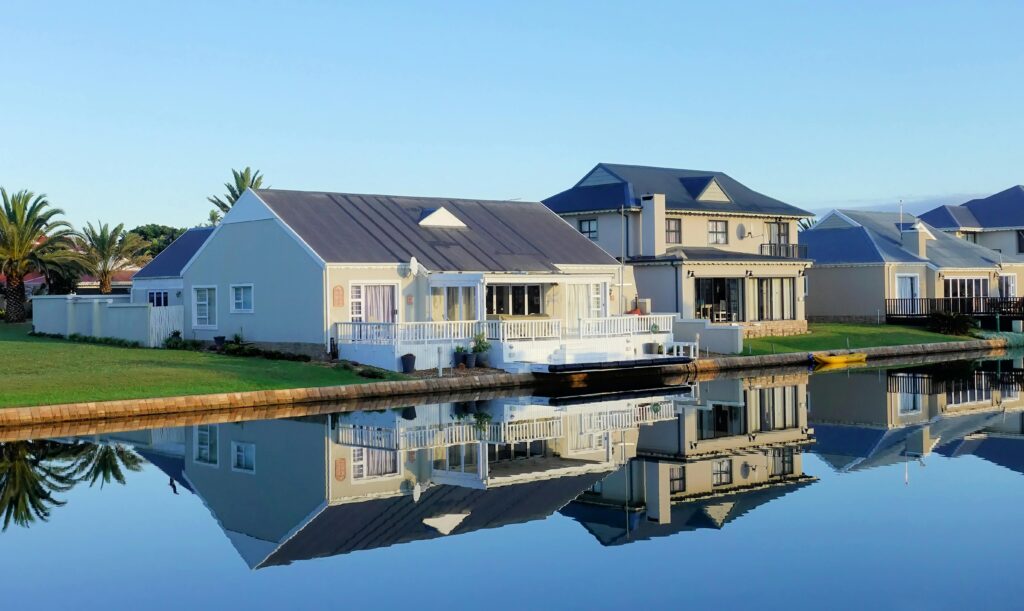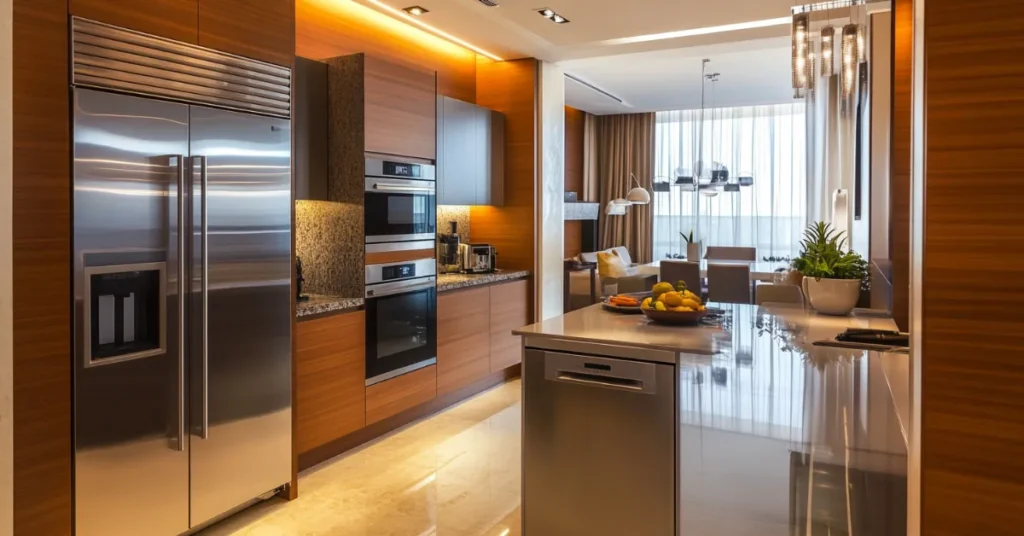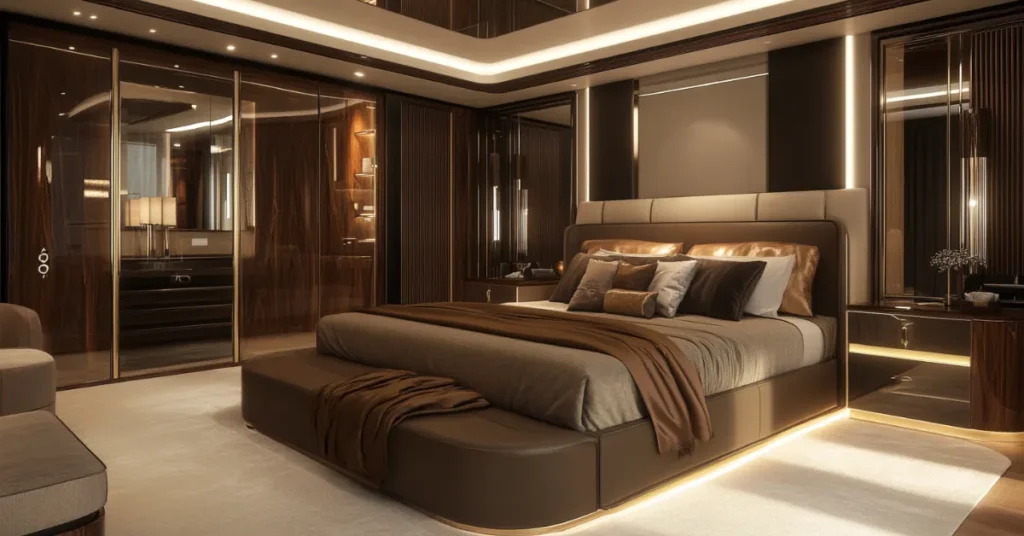
Airbnb startup cost in 2026 ranges from roughly $2,000 for a spare-bedroom host to $25,000 or more for a luxury furnished apartment. The biggest variables are the airbnb business model (more on Airbnb’s platform business model) you pick (spare room, rental arbitrage (what is it?) (called rent to rent Airbnb in the UK), or buying a property), local short term rentals regulations and licensing fees, furniture quality, and your insurance choice. Budget rental arbitrage hosts on the 10XBNB system regularly launch their first unit on $7,000 to $12,000 total, including initial lease payments, full furnishing, and a 60-day operating reserve. Costs scale with unit size and target nightly rate.
The Short Answer: Airbnb Startup Cost Range in 2026
The honest answer to “how much does it cost to start an Airbnb” is between $2,000 and $25,000 in 2026.
The realistic median for a furnished one-bedroom rental arbitrage unit lands near $9,500. The range is wide because the airbnb business model you pick changes the math more than any other factor.
Three main paths exist. Each has a different startup costs profile.
Renting a spare bedroom in your home can launch under $2,500. You skip the new lease, the deposit, and the bulk of the furniture spend. These airbnb hosts trade a higher nightly rate ceiling for the lowest possible launch risk.
Rental arbitrage, where you lease a property long-term and re-rent it short-term on platforms like Airbnb and Vrbo, sits between $7,000 and $15,000 in total startup costs. That figure includes first month’s rent, security deposit, full furniture and supply load-out, and a small operating reserve.
Buying a property and turning it into a short term rentals listing is the largest startup investment for new airbnb hosts. Plan for $20,000 to $50,000 in furnishing and setup costs sitting on top of the down payment.
I have walked over 1,000 students through this number across both rental arbitrage and direct purchase setups. The same pattern shows up every time: airbnb hosts underestimate one-time startup costs and overestimate ongoing airbnb expenses.
Two cost categories drive every airbnb startup cost calculation. Upfront one-time costs are the capital you spend before the first guest books. Recurring monthly expenses are rent or mortgage (6 Airbnb loan types), utilities, supplies, software, cleaning, and insurance. The table below summarizes both, then we go category by category.
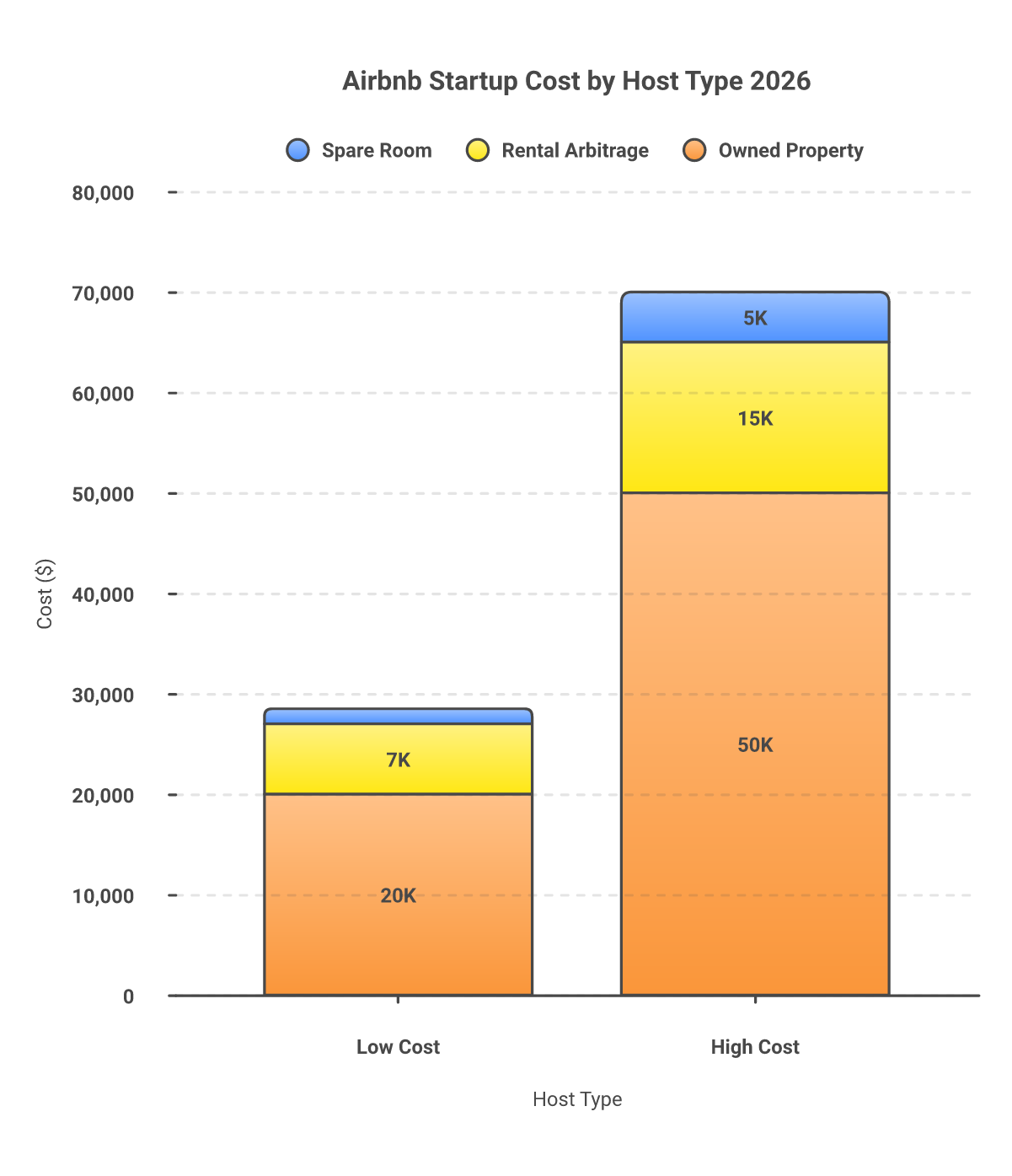
Quick comparison: Airbnb startup cost by host type, 2026
| Host model | Low-end | High-end | Best for |
|---|---|---|---|
| Spare room in your home | $1,500 | $5,000 | Test the model, sub-$200 cash flow risk |
| Rental arbitrage (1-bed) | $7,000 | $15,000 | Scale fast without a mortgage |
| Owned property (2-bed) | $20,000 | $50,000+ | Long-term equity + cash flow |
One-Time Airbnb Startup Costs: Your Initial Investment Checklist
One-time startup costs are the upfront capital you pay before the first booking lands. For an arbitrage host, the typical startup investment is $7,000 to $15,000. For an airbnb property owner who already owns the unit, the same checklist applies minus the property acquisition step.
Property Acquisition vs Initial Lease Payments
If you are starting an airbnb business through rental arbitrage, the property acquisition cost equals the first month plus last-month rent plus a security deposit. On a $1,800 monthly unit, that totals $5,400 sitting on day one, even before furniture arrives.
Some landlords waive the last-month requirement when you sign a 24-month lease, which can drop your upfront lease cost by $1,800.
If you are buying the property, your acquisition cost is the down payment (5% to 25% depending on loan type), plus closing costs (2% to 5% of the purchase price), plus inspection and appraisal fees. For a $300,000 single-family home with a 20% conventional loan, plan for $60,000 down plus $9,000 in closing costs. DSCR loans for Airbnb investors typically require 20% to 25% down with documented projected rental income.
Furniture and Decor
Furniture is the single largest fixed expenses line item for most arbitrage and owner hosts. Plan for $3,000 to $8,000 for a 1-bedroom unit, $5,000 to $12,000 for a 2-bedroom, and $8,000 to $18,000 for a 3-bedroom.
The split between budget-friendly and high-end matters. IKEA, Wayfair, and Facebook Marketplace can furnish a stylish 1-bedroom for under $4,000, while West Elm and CB2 push the same unit above $10,000.
The rooms that earn the most attention are the bedroom (bed quality, mattress, blackout curtains), the living room (sofa, coffee table, art, lighting), and the kitchen (stocked the way guests expect for cooking). Bathroom and dining cost less but cannot be skipped.
Kitchen Essentials
Budget $400 to $1,200 to fully stock a kitchen. The list: pots and pans set, knife block, cutting boards, mixing bowls, measuring cups, can opener, dishware for double the unit capacity (so a 4-guest unit gets dishes for 8), glassware, mugs, silverware, coffee maker (drip plus a pour-over option), toaster, blender, kettle.
Add a basic spice rack and pantry starter set with salt, pepper, oil, sugar, and a few staples.
Linens and Consumables
Plan $500 to $1,500 for linens at launch. The rule: three sets of sheets and three sets of towels per bed. One on the bed, one in the wash, one folded clean and ready.
Bath mats, hand towels, washcloths, and a backup duvet round out the soft-goods budget. Initial consumables (toilet paper, paper towels, shampoo, conditioner, body wash, hand soap, dish soap, cleaning supplies) run $150 to $300 on day one.
Safety, Security, and Smart Lock
This is not optional. Airbnb requires working smoke detectors and a carbon monoxide detector on every floor of your unit per the platform’s host responsibility policy.
Budget $200 to $600 for smoke and CO detectors, fire extinguisher, basic first-aid kit, and a smart lock for keyless guest entry. Smart lock options like Schlage Encode or August work without a hub and integrate with Airbnb’s instant check-in tools.
Professional Photography and Listing Optimization
Photos drive bookings more than any other airbnb listing element. A professional shoot runs $150 to $500 in most markets and pays for itself in the first month if it lifts your booking rate by even 10%.
Airbnb offers a free professional photography service in some metros, but availability is inconsistent. If you photograph yourself, use a wide-angle DSLR or a phone with HDR turned on, shoot in late-morning light, and stage every room before each frame.
Business Registration and Licensing Fees
Business licenses, short-term rental permits, and LLC (complete LLC setup walkthrough) formation fees vary by city. Nashville charges $313 per year for its STR permit per the Metro Nashville Codes department. New Orleans charges $1,000 annually for a Commercial STR permit, though that program has been under a new-application moratorium since June 2023. Some cities require nothing.
LLC formation costs $50 (Kentucky) to $500 (Massachusetts) depending on state, plus annual report fees. Always check local regulations before you sign a lease. Some buildings and HOAs prohibit STR use entirely, which kills the airbnb business before it starts.
The U.S. Small Business Administration provides a free state-by-state registration guide that covers the basics for LLC formation and federal tax ID setup.
Ongoing Monthly Expenses: Your Airbnb Operating Budget
Once the unit is live, operational costs become the day-to-day reality of running an airbnb business. The biggest mistake new airbnb hosts make is underestimating ongoing recurring monthly costs and treating gross revenue as profit.
A profitable unit typically runs 60% to 70% of gross revenue as monthly operating expenses, which leaves 30% to 40% as positive cash flow. Running below that range produces negative cash flow and a unit that bleeds money each month. Track every category of airbnb expenses against your revenue weekly, not monthly, so you catch problems early. Most new airbnb hosts who fail in year one fail because they treat top-line revenue as profit and ignore the true picture of airbnb expenses.
Rent or Mortgage Payment
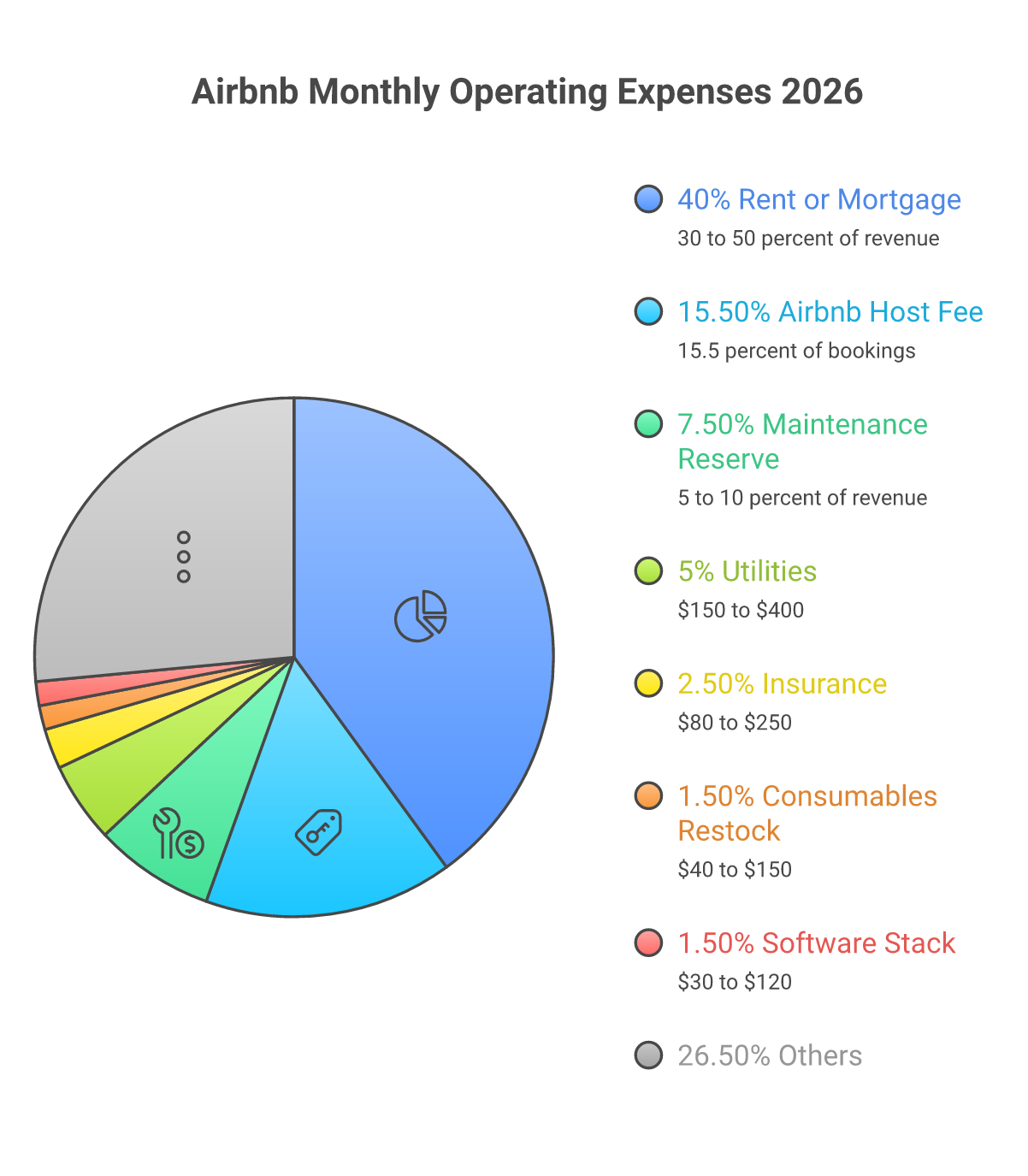
For arbitrage hosts, the monthly rent payment is the single biggest recurring cost, typically 30% to 50% of gross revenue. The math works when your nightly rate, occupancy, and stay length combine to produce 2.5x to 3.5x your monthly rent.
For property owners, the same logic applies to your mortgage payment plus property taxes and HOA fees. The single biggest piece of advice I give every airbnb property owner is to model the worst-case scenario (50% occupancy at your minimum acceptable rate) before signing the loan documents. Most STR underwriters will compare your projection to long term rentals income for the same unit and discount aggressively, so come prepared.
Utilities
Plan for $150 to $400 per month in utilities depending on unit size and climate. Wi-Fi is mandatory at $50 to $80 per month for guest-grade speeds. Electricity runs $60 to $200, higher in hot or cold climates because guests run AC and heat at lower thresholds than you would. Gas, water, and trash service add the rest.
Some buildings include water and trash in rent, which can save $40 to $80 per month in recurring monthly costs.
Consumable Supplies and Restocking
Once you are operating, consumable restock runs $40 to $150 per month per unit. This covers toilet paper, paper towels, shampoo, conditioner, soap, dish soap, laundry detergent, coffee, tea, snacks if you provide them, and trash bags.
The number scales with turnover frequency. A unit with twenty 2-night stays burns through more consumables than a unit with ten 4-night stays.
Cleaning Fees
You charge cleaning fees to guests as a separate line item on each booking, so technically this is a pass-through. The wrinkle is that cleaners cost more than what most hosts charge.
Professional cleaning for a 1-bedroom runs $60 to $120 per turn, while a 2-bedroom runs $100 to $200. If you charge a $75 cleaning fee but pay $100 for the turn, the difference comes out of your nightly rate.
Airbnb Host Service Fees
As of December 2025, Airbnb charges hosts a single 15.5% service fee on the booking subtotal under the host-only fee model. Per the Airbnb Help Center service fees article, the legacy split-fee model (3% host fee plus a guest-side fee) was deprecated for most markets in late 2025 and 2026 and is consolidating into the host-only fee structure.
The practical impact for new airbnb hosts: budget 15.5% of every booking subtotal as the host service fee before any other airbnb expenses are taken out.
Insurance
Airbnb provides AirCover for hosts, which includes up to $3 million in host damage protection and up to $1 million in host liability insurance per stay, per the Airbnb AirCover help article. AirCover is automatic and free, but it is not a substitute for proper short term rentals insurance.
A standalone STR policy from a carrier like Proper Insurance or Slice runs $80 to $250 per month per unit and covers gaps AirCover does not (loss of rental income during repairs, ordinance and law coverage, broader liability terms). For more on what you actually need, see our Airbnb insurance guide.
Maintenance and Repair Fund
Set aside 5% to 10% of gross revenue every month for maintenance and the unexpected expenses that every airbnb business hits in year one. A $4,000-revenue unit puts $200 to $400 monthly into the maintenance fund.
This pays for emergency repairs (plumbing, HVAC, broken appliances), wear-and-tear replacements (towels, sheets, glassware), and the inevitable furniture refresh every 18 to 36 months.
Software, Property Management Tools, and Variable Costs
The standard arbitrage tech stack costs $30 to $120 per month per unit. Dynamic pricing software like PriceLabs sits at $19.99 per listing, Wheelhouse at $19.99, AirDNA Smart Rates at $25.
A channel manager if you list on multiple platforms adds $30 to $50 per month. If you outsource operations to a property manager, expect 15% to 25% of gross revenue as the management fee. Automation and property management tools like Hospitable or Guesty run $25 to $50. If you bring in a property manager to handle operations end-to-end, plan for 18% to 25% of gross revenue on top of the tech stack costs.
For a single unit, PriceLabs plus a free messaging template inside Airbnb is usually enough. For three or more units, a channel manager pays for itself in time saved. These software costs are variable costs that scale with your portfolio.
Cost Scenarios: Budget vs Mid-Range vs Luxury Startup
The same three host paths from the summary table, broken down line by line. Use whichever scenario matches your situation as a starting budget for your airbnb business.
Scenario 1: Budget Host (Spare Room) | Target $2,000 to $5,000
You rent out a spare bedroom in your existing home. No new lease, no deposit, no full furniture load-out. The bedroom needs a quality bed and mattress ($600 to $1,200), basic linens ($200 to $400), bedside furniture ($150 to $300), smart lock for the bedroom door ($100 to $200), and a small spend on professional photos ($150 to $300).
Add safety equipment ($100), basic consumables ($100), and any required permits ($0 to $400). Total startup costs land at $1,400 to $2,900.
The upside is fast launch and tiny downside risk. The downside is a lower nightly rate (typically $40 to $90) and shared-space friction with guests.
Scenario 2: Mid-Range Arbitrage (1-Bedroom Apartment) | Target $7,000 to $15,000
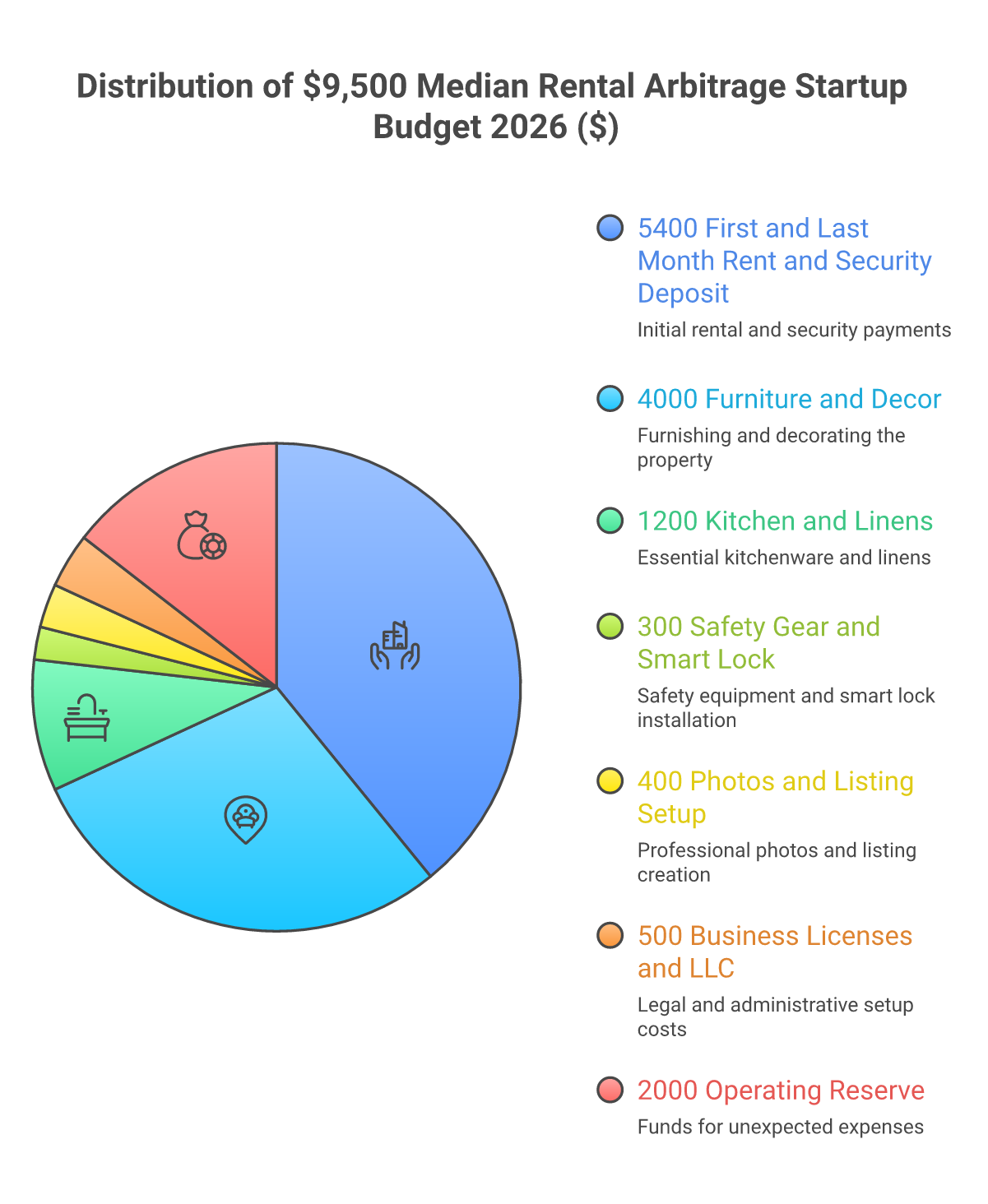
This is the bread-and-butter rental arbitrage setup that most 10XBNB students run. The line items: first and last month’s rent plus security deposit on a $1,800 unit ($5,400 in initial lease payments), full IKEA-tier furniture and decor ($3,500 to $7,000), kitchen and linen kit ($800 to $1,500), safety and security gear ($300), photos ($200 to $400), licenses and LLC ($300 to $600), and a 30-day operating reserve ($1,500 to $2,500).
Plan to launch with $9,000 to $12,000 in startup costs if your target nightly rate is $120 to $180. That total investment covers everything you need to start an airbnb business in this tier.
Scenario 3: Luxury Owned Property (2-Bedroom) | Target $20,000+
You own a 2-bedroom unit and want to position it in the top 20% of nightly rates in your market. Furniture and decor jump to $10,000 to $18,000, with West Elm or CB2 sofas, original art, and a fully styled outdoor area if applicable.
Kitchen upgrade ($1,500 to $3,000) for a stocked espresso setup, premium cookware, and a wine fridge. Premium linens ($1,000 to $2,500), professional design consultant ($800 to $2,500 if you hire one), high-end photography ($500 to $1,200), permits and LLC ($300 to $800), and a 60-day operating reserve.
Total furnishing and property setup costs land at $20,000 to $35,000+. That does not include purchase price or down payment on the property itself.
How to Reduce Startup Costs and Keep More Cash Flow
You can reduce startup costs by 30% to 50% without sacrificing quality. The tactics below are the same ones every 10XBNB student uses to keep monthly costs lean and positive cash flow strong.
Negotiate Initial Lease Payments
Ask the landlord to waive the last-month deposit in exchange for a 24-month lease commitment, which trims your upfront costs before furniture even arrives. That alone drops upfront costs by $1,500 to $3,000. Offer to handle minor repairs yourself in exchange for a small monthly rent reduction. Both tactics shift fixed expenses lower without touching guest-facing quality.
Use Facebook Marketplace and Estate Sales for Furniture
The single fastest way to reduce startup costs is to buy 40% to 60% of your furniture used. Sofas, dining tables, dressers, and side tables hold up fine when sourced from estate sales and Facebook Marketplace. Spend new money on mattresses, sheets, and towels where guest experience compounds.
Bundle Smart Home Hardware
Buy your smart lock, smoke detectors, CO detector, and noise sensor as a bundle from a single vendor. Most STR-specific hardware companies offer 15% to 25% off bundled orders. The bundle approach also reduces install time and the variable costs of multiple separate shipments.
Skip Premium Property Management Software at Launch
For your first unit, PriceLabs ($19.99) plus Airbnb’s built-in messaging templates handles 90% of what a $50 per month property management suite would do. Add software complexity only when you have a second unit live.
Self-Clean the First Three Turns
Cleaning a unit yourself for the first three guest turns teaches you exactly what needs to be cleaned, restocked, and reset. You save $180 to $360 in cleaning fees during launch and produce a cleaner SOP for the cleaner you eventually hire.
Time the Lease and Furniture Spend
Coordinate your lease start date with your IKEA delivery, photography appointment, and listing go-live date. A unit that sits unfurnished for 14 days is 14 days of negative cash flow on a unit you cannot yet rent. Tight coordination drops total startup costs by avoiding ghost rent.
File Taxes Properly From Day One
Track every receipt from launch. Furniture, photography, business licenses, software subscriptions, and a portion of your home office are tax deductible against your taxable income from the airbnb business. Per IRS Schedule E instructions, rental real estate income gets its own filing treatment with depreciation rules that benefit owned-property hosts specifically. Tracking startup costs from day one means a real expense ledger when it is time to file, which lowers your taxable income and recovers part of your initial spend through deductions. A tax professional pays for itself in deductions captured.
5 Hidden Costs That Surprise New Airbnb Hosts
The line items below show up on the second-month profit and loss of most new hosts. They are not in any startup budget template I have seen, but they always hit.
1. Higher utility bills than expected. Guests run AC and heat at temperatures you would not. A unit that costs you $90 in electricity as a long-term renter often costs $180 to $250 when it operates as a short term rentals listing, especially in summer in hot climates. Build the bigger number into your monthly expenses model.
2. Wear and tear replacement cycle. Towels stain. Glassware breaks. Sheets pill. Walls scuff. Plan to fully replace soft goods every 12 to 18 months and hard goods (glassware, dishware, small appliances) every 18 to 24 months. That is $300 to $800 per unit per year in unbudgeted spending.
3. Peak season restocking spikes. July and August in beach markets, December in ski markets, and major event windows in convention cities (CES, F1, Super Bowl) burn through consumable supplies and trigger emergency cleaner overtime fees. Build a peak-season reserve into your operating budget.
4. Professional services you did not plan for. Plan to budget for professional services like an accountant and an attorney. An accountant who understands short-term rental tax treatment is $300 to $1,200 at tax time. An attorney to review your arbitrage lease language is $250 to $600 once. These professional services become mandatory when you hit Schedule E or Schedule C territory, and the cost of professional services is far less than the deductions and depreciation you would miss filing on your own.
5. Vacancy cost and other unexpected expenses (the empty unit). The rent, mortgage, and utilities clock keeps ticking when nobody is booked. Per AirDNA’s 2026 outlook report, U.S. average occupancy is tracking around the mid-50% range, which means 40 to 50% of nights produce zero revenue but still cost you the unit’s daily fixed expenses. Build a minimum 60-day operating reserve at launch so you can survive a slow first month and absorb any unexpected expenses that hit before bookings stabilize. The minimum startup cost figures earlier in this guide assume you already have this reserve in cash.
Frequently Asked Questions
How much money do you need to start an airbnb?
You need between $2,000 and $25,000+ to start an airbnb in 2026, depending on the model. Spare-room hosts launch on $2,000 to $5,000. Rental arbitrage hosts target $7,000 to $15,000 per unit. Owned-property hosts spend $20,000+ on furnishing alone, not counting the property purchase. The single biggest variable is whether you are leasing, owning, or co-listing someone else’s property. To start an airbnb business at the lowest possible cost, co-listing is the entry point because you skip the lease deposit and furniture spend entirely.
Is starting an airbnb business profitable in 2026?
Yes, but profit margin depends on model and market. Per AirDNA’s 2026 Short-Term Rental Outlook Report, U.S. occupancy is expected to stabilize near pre-pandemic levels (around 54.9%) with average daily rates rising roughly 2.9% in 2025. Operating expenses typically eat 60% to 70% of gross revenue, which leaves 30% to 40% as positive cash flow for an average performer. Top-quartile operators in strong markets clear far more than that.
Can you start an airbnb with no money?
Yes, through three main paths: co-listing (managing someone else’s property for 10% to 25% of revenue), renting a spare room in your existing home (skip the new lease entirely), or finding a business partner who funds the initial investment. Our guide on how to start an airbnb with no money covers each model in depth.
What is the biggest expense for an Airbnb?
Rent or mortgage is the biggest recurring monthly expense (30% to 50% of gross revenue). Furniture and decor is the biggest one-time startup cost ($3,000 to $18,000 depending on unit size and style tier). For owned properties, the down payment dwarfs everything else in your initial investment.
How do I create a budget for my Airbnb?
Start with the cost scenarios above, then customize for your specific market. Get a rent quote (or mortgage estimate), pull a furniture budget from IKEA or your preferred retailer, add $1,500 for kitchen and linens, $300 for safety gear, $200 to $400 for photos, $300 to $800 for licenses and LLC, and a 30-day operating reserve. Add 15% padding for the costs you are not expecting yet. Our free Airbnb arbitrage calculator projects monthly cash flow once you have your rent and rate inputs.
What are the startup costs for Airbnb rental arbitrage vs owning?
Rental arbitrage typically requires $7,000 to $15,000 to launch a 1-bedroom unit, with no down payment but a recurring monthly rent obligation. Buying a property requires $20,000 to $80,000+ in down payment and closing costs plus a similar furnishing budget, but builds long-term equity and qualifies for depreciation under IRS rules. Arbitrage scales faster because you can launch a second unit while the first is still ramping. Ownership compounds wealth slower but more durably.
Putting Your Airbnb Startup Cost Plan Together
Pick the airbnb business model first (spare bedroom, arbitrage, or owned airbnb property). Pull a rent or mortgage quote for your target market. Most new airbnb hosts skip this step and end up forced into a unit that does not match their budget tier. Choose the cost scenario tier that matches your risk tolerance.
Build your initial investment line by line using the checklist above, then add a 60-day operating reserve so you can absorb a slow first month without panic. The unit type, not the city, drives most of the spread in airbnb startup costs. Your minimum startup cost is dictated by whether you are co-listing (lowest), running rental arbitrage (mid), or buying property (highest).
A budget-tier spare-bedroom listing launches under $5,000 anywhere in the U.S. A mid-range arbitrage unit lands between $9,000 and $13,000 in most markets. A luxury owned property never comes in under $20,000 in furnishing alone.
If you decide arbitrage is not for you, long term rentals (12-month leases without the short-stay regulations) are an alternative that requires lower total investment but produces lower per-unit cash flow. If you are stuck on the rental arbitrage side, see our rental arbitrage startup costs breakdown. For the bigger getting-started picture, our how to start an airbnb business guide covers everything from market selection to your first booking.
If you want the system that has produced over $5 million in booking fees and 24 active properties without buying real estate, our 2026 Airbnb course comparison is the right next step.