
Vacation rental copywriting is the skill of writing property descriptions, listing content, and marketing materials that turn browsers into paying guests. If you’re running a short term rental and your listing reads like a dictionary entry, you’re leaving money on the table. I’ve seen hosts double their booking rate just by rewriting their Airbnb description with better copy.
The vacation rental industry generated over $100 billion globally in 2024, and competition on platforms like Airbnb and Vrbo has never been fiercer. Your property could be spectacular, but if your listing description doesn’t hook potential guests in the first three seconds, they scroll right past. That’s where vacation rental copywriting comes in, and that’s what this guide covers: how to write rental copy that actually books nights.
What Is Vacation Rental Copywriting?
Vacation rental copywriting is the process of writing persuasive text for property listings, direct booking websites, email campaigns, and social media posts connected to your vacation rental business. It goes beyond describing rooms and amenities. Good rental copywriting makes a reader feel like they’re already on vacation before they click “Book Now.”
A vacation rental copywriter focuses on three things:
- Emotional triggers: Painting a scene the guest can picture themselves in
- Specific details: Mentioning the 8-foot soaking tub, the 180-degree ocean view, or the 5-minute walk to the boardwalk
- Clear calls to action: Telling the reader exactly what to do next
Compare these two listing descriptions:
- Generic: “Nice 3-bedroom house with pool and mountain views.”
- Effective: “Wake up in a king bed facing the Smoky Mountains, grab coffee on your private deck, then walk downstairs to a heated pool your kids won’t want to leave. This 3-bedroom cabin sleeps 8 and sits 10 minutes from Dollywood.”
The second version outsells the first every time. It gives potential guests a reason to keep reading and, more importantly, a reason to book.
Why Your Listing Description Matters More Than You Think
Most vacation rental owners spend thousands on professional photography but write their listing descriptions in five minutes. That’s backwards. In my experience, listings with detailed, well-written descriptions pull significantly more booking inquiries than those with a few generic sentences. Here’s why your words matter so much for your vacation rental business:
Photos Get Clicks, Copy Gets Bookings
Photography gets someone to your listing page. Your property descriptions determine whether they book or bounce. A strong listing description answers every question a potential guest has: sleeping arrangements, parking, distance to attractions, check-in process, and what makes your place different from the 200 other vacation rentals in the same zip code.
Platform Algorithms Reward Good Copy
Airbnb and Vrbo rank listings partly based on conversion rate. According to the Airbnb Help Center, the algorithm weighs listing quality, popularity, price, and location when deciding placement. When your vacation rental copywriting is sharp and your booking rate climbs, the algorithm pushes your listing higher in search results. Better copy leads to more bookings, which leads to better placement, which leads to even more bookings. It’s a flywheel. For a deeper look at how Airbnb rankings work, check out our Airbnb algorithm guide.
Direct Bookings Depend on Your Words
If you have your own vacation rental website, copywriting is everything. There’s no platform trust signal (like Airbnb’s review badges) to do the selling for you. Your website copy, from the headline to the booking button, needs to convince a stranger to hand over their credit card. Hosts who build direct booking websites typically save 15-20% in platform fees, but only if the copy converts.
9 Vacation Rental Copywriting Tips That Drive Bookings
I’ve written and reviewed hundreds of vacation rental listings across Airbnb, Vrbo, and independent booking sites. These are the tactics that consistently outperform.
1. Open With a Guest Hook
Your first sentence is your guest hook. It needs to create an immediate mental picture. Skip “Welcome to our beautiful home” and try something like: “Step off the back porch and your toes hit warm sand, the Gulf of Mexico stretching out fifty yards ahead.” Front-load the experience, not the logistics.
2. Write for Your Target Audience
A bachelorette party and a retired couple looking for a quiet week at the lake are not the same target audience. Your rental copywriting should speak directly to the guests you actually want. Families care about cribs, high chairs, and proximity to kid-friendly attractions. Couples care about privacy, hot tubs, and restaurants nearby. Business travelers want fast WiFi speed and a desk.
Figure out your ideal guest first, then write every sentence for that person.
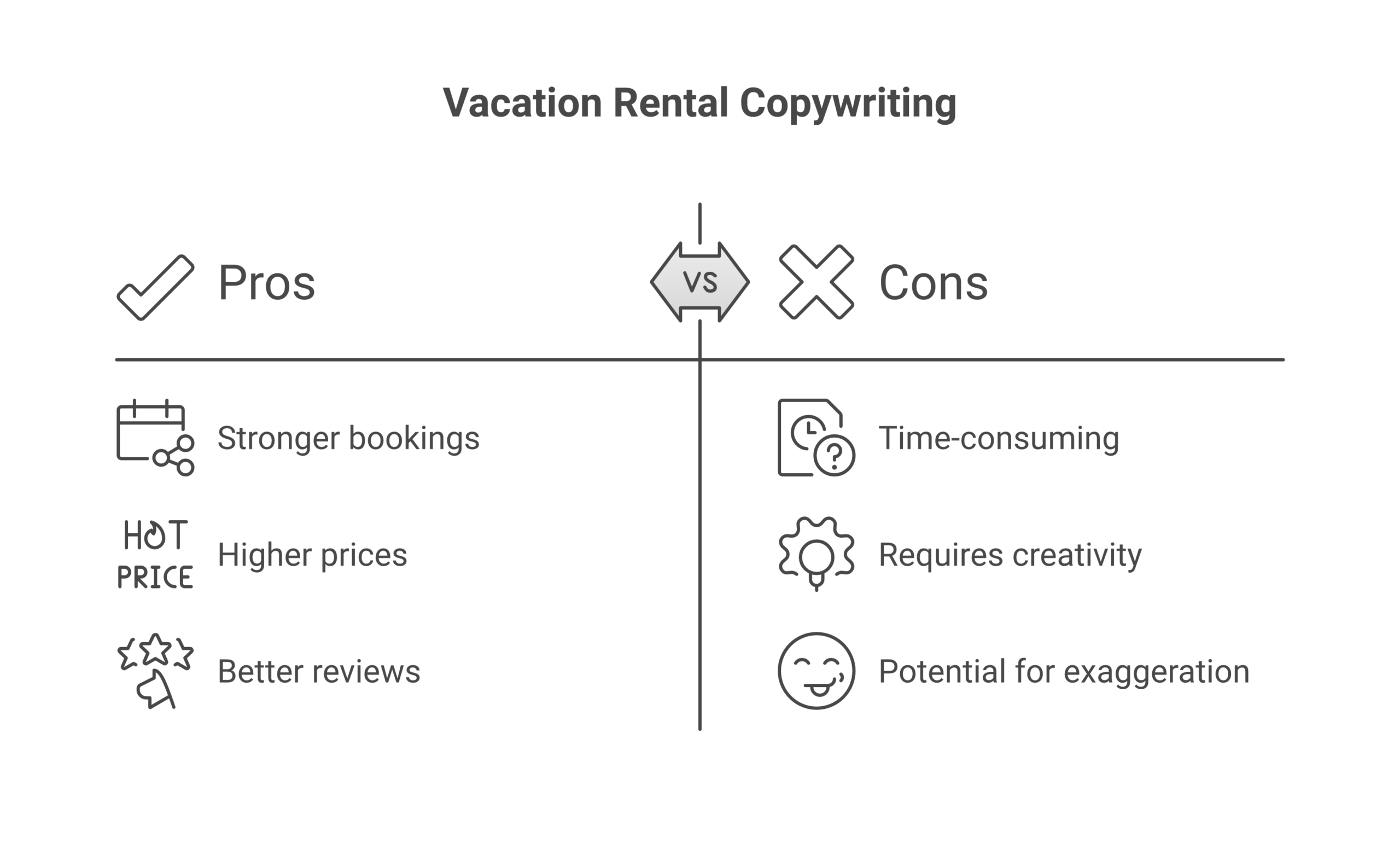
3. Lead With Benefits, Not Features
Features tell. Benefits sell. Here’s the difference:
| Feature (Weak) | Benefit (Strong) |
|---|---|
| King-size bed | Stretch out in a king bed after a long day hiking the Smokies |
| Fully equipped kitchen | Cook breakfast for the family without spending $80 at a restaurant |
| Smart TV | Stream your favorite shows on a 65-inch TV after the kids fall asleep |
| Close to downtown | Walk 5 minutes to restaurants, bars, and live music on Main Street |
Every feature in your property listing should answer the question: “So what? Why does the guest care?”
4. Use Sensory Language
The best vacation rental copywriting puts the reader inside the experience. Instead of “The balcony has nice views,” try “Sit on the balcony with your morning coffee and watch fishing boats head out at sunrise.” Sensory details (what you see, hear, smell, feel) outperform adjective-heavy descriptions because they help potential guests imagine actually being there.
5. Be Specific, Not Generic
Generic copy is forgettable. “Close to attractions” means nothing. “8-minute drive to Disney’s front gate” means everything. Specificity builds trust because it signals that you, the host, actually know the area and the property. Use exact distances, real restaurant names, and precise amenity counts.
6. Structure for Scanners
Most potential guests scan listings on their phones. They don’t read paragraphs line by line. Make your listing description easy to scan:
- Short paragraphs (2-3 sentences max)
- Bullet points for amenities and key selling points
- Bold text for the most important details
- Clear section headers so readers can jump to what matters
If your property descriptions run as a 500-word wall of text, you’ll lose 80% of your readers before they reach the second paragraph.
7. Address Objections Before They Come Up
Smart vacation rental copywriting anticipates hesitation. If your property is 20 minutes from the beach, don’t hide it. Say: “We’re a quick 20-minute drive from the coast, which means you get mountain tranquility at night and sand between your toes during the day.” Turning a perceived negative into a positive is one of the highest-value moves in rental copywriting.
8. Add Social Proof and Urgency
Mention your review count and rating if they’re strong. “Rated 4.9 by over 200 guests” carries weight. On your own booking website, add guest testimonials directly into the page. For urgency, try phrases like “Only 3 weekends left this summer” or “Booking up fast for fall foliage season.” These aren’t gimmicks. They’re honest scarcity signals that push guests to act.
9. End With a Clear Call to Action
Don’t let your listing description trail off. Tell the reader what to do: “Book now to lock in your dates” or “Send a message with your travel dates and I’ll confirm availability within an hour.” A direct, specific call to action can increase booking conversions by 15-20% compared to listings that just… stop.
Vacation Rental Copywriting for Different Platforms
The same property needs different copy depending on where you’re listing it. What works on Airbnb doesn’t always work on Vrbo, and neither format fits a direct booking site perfectly.
Airbnb Listing Copy
Airbnb gives you a title (50 characters), a summary section, and additional detail fields. Your title should include the biggest selling point and location: “Lakefront Cabin | Hot Tub | 5 Min to Asheville.” The summary section is where your guest hook lives. Airbnb’s search algorithm also indexes your text, so work in relevant keywords like “vacation rental” and your city name naturally. For more on writing Airbnb-specific descriptions, see our guide on how to write a killer Airbnb description.
Vrbo Listing Copy
Vrbo leans toward families and larger groups. Your rental copywriting here should emphasize space, kid-friendliness, and value for group travel. Vrbo also gives you a headline and description, but the character limits differ. Vrbo listings that mention specific family amenities (pack and play, gated pool, game room) tend to convert better on this platform.
Direct Booking Website Copy
Your own vacation rental website gives you unlimited space and no character restrictions. Use this to your advantage. Write long-form property descriptions, add an FAQ section, include an area guide, and create blog content targeting vacation rental SEO keywords. Direct booking websites need stronger copy because visitors lack the platform trust they get on Airbnb. If you’re considering building one, our guide on building a direct booking website walks through the entire process.
SEO and Vacation Rental Marketing
Vacation rental copywriting doesn’t stop at the listing. If you want organic traffic to your vacation rental website, your copy needs to work for search engines too. Vacation rental SEO means writing content that ranks on Google for terms your ideal guests are searching.
Here’s what that looks like in practice:
- Blog posts: Write about local attractions, seasonal events, and travel tips for your area. A post titled “12 Things to Do in Gatlinburg This Winter” can drive hundreds of monthly visitors who are already considering a trip.
- Location pages: Create dedicated pages for each property or area you serve. Include area-specific keywords, maps, and nearby activity lists.
- Social media posts: Share snippets of your property descriptions, guest testimonials, and behind-the-scenes content. Social media drives referral traffic and builds your brand outside listing platforms like Airbnb.
For more on optimizing your Airbnb presence specifically, read our Airbnb SEO guide.
How to Write Property Descriptions That Convert
Let me break down the actual structure of a high-converting property description. I use this framework when writing for 10XBNB students, and it works across platforms.
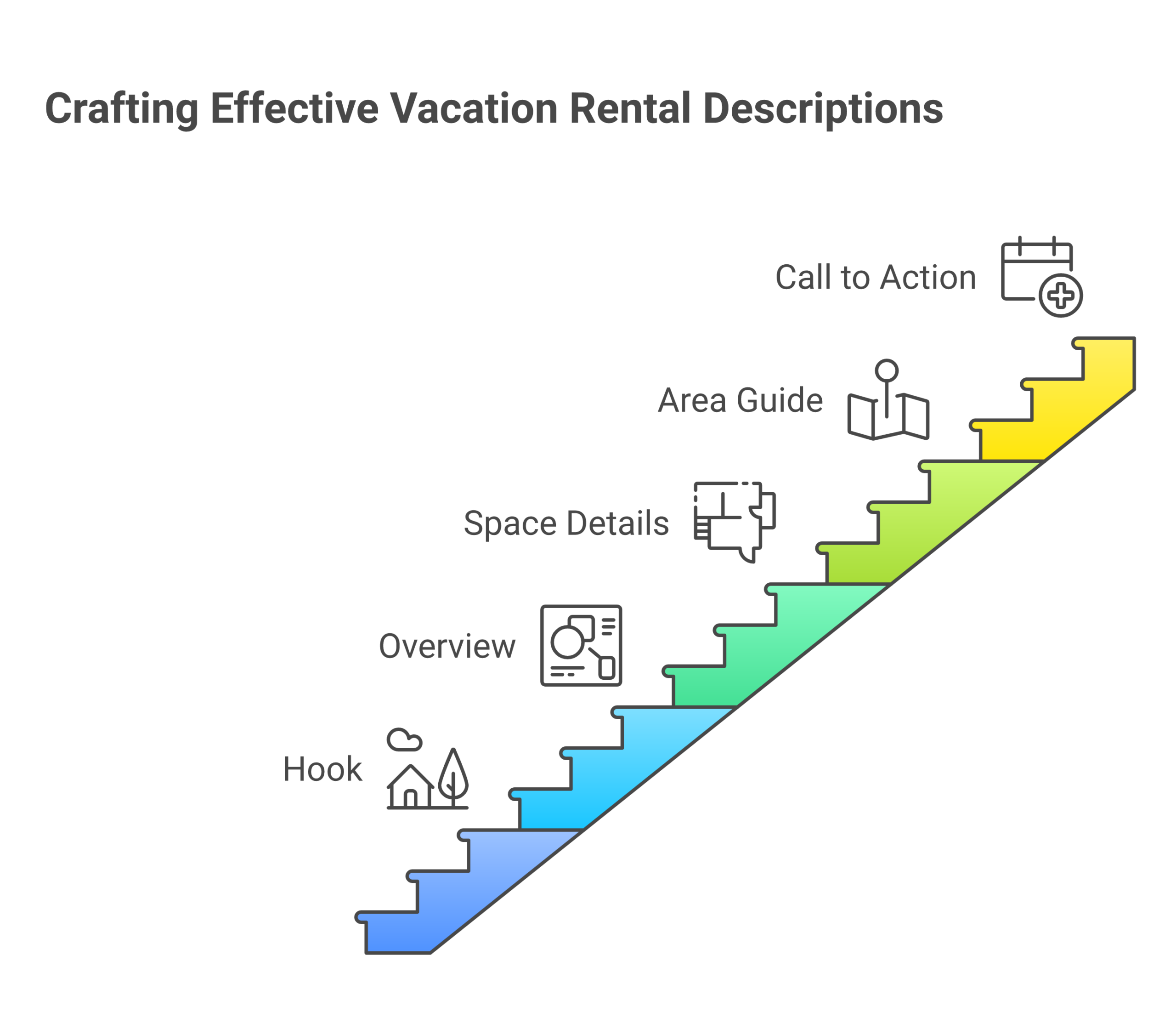
The 5-Part Property Description Framework
- Hook (1-2 sentences): The guest hook that paints an experience. “Fall asleep to the sound of the creek running behind your private deck.”
- Overview (2-3 sentences): Quick facts: bedrooms, bathrooms, guest count, location highlights.
- Space Details (3-5 paragraphs): Walk the reader through the property room by room. Lead with benefits for each space.
- Area Guide (1-2 paragraphs): What’s nearby? Restaurants, attractions, and distances. This is where you build the trip narrative.
- Call to Action (1 sentence): “Book your dates now, this cabin fills up fast during leaf season.”
This framework covers the selling points, addresses the target audience, and makes the listing description easy to read on mobile.
Common Vacation Rental Copywriting Mistakes
I see these errors on at least half the vacation rental listings I review. Avoid all of them.
Writing for Yourself Instead of the Guest
“We love our home and hope you will too” centers the host. Your potential guests don’t care about your feelings. They care about their experience. Flip every sentence to make the guest the subject: “You’ll love kicking back on the screened porch after a day at the lake.”
Keyword Stuffing Your Listing
Cramming “vacation rental” into every sentence hurts readability and can actually get your listing flagged on some platforms. Use your primary keywords (vacation rental, short term rental, your city name) naturally, 2-3 times across the full listing description. More than that and you sound like a robot.
Ignoring Your Competition
Before you write, look at the top 10 vacation rental listings in your area on Airbnb. What do they mention? What don’t they mention? Your rental copywriting should include everything competitors cover, plus at least 2-3 unique angles they miss. Maybe you’re the only property with a fenced yard for dogs. Maybe you’re the only one with a dedicated workspace. Own that.
Forgetting About Mobile
Over 60% of Airbnb bookings happen on mobile. If your property descriptions are dense, unformatted text blocks, mobile users will bounce. Keep paragraphs short, use bullets, and put your strongest selling points in the first 250 characters (that’s what shows before the “Read more” tap on Airbnb’s mobile app).
How AI Is Changing Vacation Rental Copywriting
AI tools like ChatGPT can help you brainstorm listing descriptions, draft social media posts, and generate ideas for your vacation rental marketing. But AI alone won’t produce copy that converts. Here’s why.
AI-written vacation rental descriptions tend to be generic. They use the same phrases (“perfect getaway,” “your home away from home”) because those patterns appear most frequently in training data. A human copywriter or a host who knows the property will always outperform AI on specificity, personality, and emotional connection.
Use AI as a starting point, not a finished product. Generate a draft, then rewrite it with your own voice, specific property details, and local knowledge. That hybrid approach gives you speed without sacrificing the quality that sets great vacation rental copywriting apart from average.
Building a Vacation Rental Business With Strong Copy
Copywriting isn’t just about one listing. If you’re scaling a vacation rental business, every piece of written content matters: your listing descriptions, your guest communication templates, your review responses, your social media posts, and your email marketing sequences.
Property managers running multiple vacation rentals need a system. Create template frameworks for each content type, then customize per property. For example, your guest hook formula might be: [Sensory detail] + [Location] + [Key amenity]. “Fall asleep to waves crashing in this Malibu beachhouse with private rooftop hot tub.” Rinse and repeat for each property, swapping the specifics.
Students in the 10XBNB program learn to build rental portfolios using rental arbitrage, a model where you lease properties and sublease them as short-term rentals. With 3, 5, or 10+ listings, having a repeatable copywriting system becomes the difference between a side hustle and a real business. The 10XBNB framework covers everything from finding properties to filling calendars, and copy is a core piece of that system.
Vacation Rental Photography and Copy Work Together
The best vacation rental marketing combines strong photography with strong rental copywriting. Photos grab attention. Copy answers questions and drives action. Neither works well alone.
A few practical tips for making them work together:
- Write your property description first, then shoot photos that match the scenes you described
- Use photo captions on your direct booking website (most hosts skip this)
- Reference specific photos in your listing description: “Check out photo #4 to see the view from the master bedroom”
For a complete breakdown of vacation rental photography, check our Airbnb photography guide.
Pricing Copy: How to Justify Your Nightly Rate
Your nightly rate isn’t just a number. It’s a positioning statement. If you charge $350/night, your vacation rental copywriting needs to justify that rate by communicating value.
Instead of listing “$350/night,” frame it as: “For about $44 per person per night (sleeps 8), your group gets a private pool, mountain views, and a fully stocked kitchen, a fraction of what you’d spend on hotel rooms and restaurants.”
Per-person pricing reframes the value. Comparison to alternatives (hotels, dining out) makes your rate feel like a deal. This pricing copy technique works on both listing descriptions and your direct booking site. For more on pricing strategies, read our Airbnb pricing strategy guide.
Vacation Rental Copywriting Checklist
Use this checklist every time you write or update a listing description:
- Does the first sentence create a mental picture (guest hook)?
- Is every feature framed as a benefit?
- Are distances and details specific (not vague)?
- Is the copy written for your target audience (families, couples, groups)?
- Are paragraphs short enough for mobile?
- Do you mention your top 3 selling points in the first 250 characters?
- Does the listing end with a clear call to action?
- Have you included relevant keywords naturally (vacation rental, your city, property type)?
- Is there social proof (review count, rating, guest quotes)?
- Does the copy sound like a real person wrote it?
Frequently Asked Questions
What Does a Vacation Rental Copywriter Charge?
Freelance vacation rental copywriters typically charge $100-$500 per listing description, depending on length and complexity. Some charge hourly ($50-$150/hour). For a full website with multiple pages, expect $1,000-$5,000. DIY is always an option if you follow a solid framework, and many 10XBNB students write their own copy using the templates and strategies taught in the program.
How Long Should a Vacation Rental Listing Be?
For Airbnb, aim for 500-800 words in your full description. For Vrbo, similar length works well. On your own direct booking website, 800-1,500 words per property page performs best for both SEO and conversion. The key is making every word useful. Length for the sake of length hurts more than it helps.
Can Good Copywriting Really Increase Bookings?
Yes. Airbnb hosts who optimize their listing descriptions typically see a 20-40% increase in booking inquiries. I’ve personally seen hosts go from 45% occupancy to 78% occupancy in 60 days by rewriting their listing copy, without changing their price or adding any new amenities.
Should I Hire a Copywriter or Use AI?
If you have the budget, hiring a professional vacation rental copywriter who knows the short term rental space will deliver the best results. If you’re bootstrapping, use AI for a first draft, then rewrite it with your own specific details, personality, and local expertise. The worst option is using raw AI output without editing. Guests and algorithms can both tell the difference.
How Often Should I Update My Listing Copy?
Update your listing description at least quarterly. Refresh seasonal references, add new amenities, update nearby attraction info, and incorporate language from your best guest reviews. Freshness signals matter to both platforms and potential guests. A listing that references “summer 2023” in February 2026 signals neglect.
What Is the Difference Between Copywriting and Content Writing for Vacation Rentals?
Copywriting is persuasion-focused. It’s your listing description, your booking page, your email subject lines. Content writing is information-focused: blog posts, area guides, FAQ pages. Both fall under vacation rental marketing, and both drive bookings in different ways. Copywriting converts visitors who are ready to book. Content writing brings in new visitors through vacation rental SEO.
Take Your Vacation Rental Business to the Next Level
Strong vacation rental copywriting separates full calendars from empty ones. It’s the difference between a listing that blends in and one that books out months in advance. Whether you’re writing your first Airbnb description or optimizing copy across a portfolio of 20 properties, the fundamentals stay the same: know your target audience, lead with benefits, be specific, and always close with a call to action.
If you’re serious about building a profitable vacation rental business, the 10XBNB program teaches the complete system for finding, launching, and scaling rental arbitrage properties, including how to write listing copy that fills calendars. Thousands of students have used the 10XBNB framework to build rental portfolios from scratch. Explore how 10XBNB students build rental portfolios and see if it’s the right fit for your goals.
For more strategies on growing your bookings, check out our guides on how to get more bookings on Airbnb, Airbnb staging ideas, and becoming an Airbnb Superhost.