
Why Every Host Needs an Airbnb Direct Booking Website (The Real Numbers)
An airbnb direct booking website is a standalone site where guests book your rental properties without going through Airbnb, VRBO, or Booking.com, and without paying their fees. You own the site, control the guest experience, collect the payments, and keep the data.
Since December 2025, Airbnb charges most hosts a flat 15.5% service fee on every booking. That’s not a typo. On a $200/night property booked for 5 nights ($1,000 gross), Airbnb takes $155. Do that 80 times a year across a small portfolio and you’re handing Airbnb $12,400, enough to fund a new unit’s furnishing budget.
I’ve been running a direct booking site alongside my OTA listings for two years now. In 2025, it generated 34% of my total bookings and saved me roughly $18,700 in platform fees across 8 rental arbitrage units. The only transaction cost? Stripe’s 2.9% + $0.30 per charge. On that same revenue, Stripe took about $4,100, meaning I kept an extra $14,600 compared to routing everything through Airbnb’s new fee structure.
But a direct booking website isn’t a magic bullet. You need the right tech stack, a real plan for driving traffic, a guest screening process that replaces OTA protections, and a system for converting one-time OTA guests into repeat direct bookers. Most guides skip the hard parts. This one doesn’t.
If you’re still working on your first property, start with how to start an Airbnb and come back here once you’ve got consistent bookings. Direct booking is a scaling strategy, not a starting strategy.
OTA Fees vs. Direct Booking Costs: The Full Breakdown
Before you spend a weekend building a booking website, you need to see the math at your revenue level. The savings vary dramatically depending on which online travel agencies you’re currently using and how many properties you manage.
Here’s what the fee structures look like for a host doing $8,000/month in gross bookings:
| Channel | Fee Structure | Monthly Cost on $8K | Annual Cost | You Keep |
|---|---|---|---|---|
| Airbnb (Host-Only, post-Dec 2025) | 15.5% host fee | $1,240 | $14,880 | $81,120 |
| Airbnb (Split Fee, individual hosts) | ~3% host + ~14% guest | $240 (host portion) | $2,880 | $93,120 |
| VRBO | 5% host fee | $400 | $4,800 | $91,200 |
| Booking.com | 15-20% commission | $1,200-$1,600 | $14,400-$19,200 | $76,800-$81,600 |
| Your Direct Booking Website | Stripe: 2.9% + $0.30/txn | ~$235 | $2,820 | $93,180 |
The gap between direct booking and the 15.5% Airbnb host-only fee? $12,060 per year at $8K/month in bookings. Scale that to $20,000/month (which many property managers and multi-unit operators hit), and the gap widens to $30,150 annually. That’s a down payment on another property.
Here’s the part many hosts miss: even if you’re still on Airbnb’s split-fee model (individual hosts without a PMS), the real cost isn’t just your 3%. It’s the inflated pricing guests see. Airbnb adds 14-16% on top of your rate, making your listing $140-$160 more expensive on a $1,000 booking than your direct booking site price. That price difference is your marketing pitch.
Where Direct Bookings Don’t Save Money
Honesty check: if you’re running a single property doing $3,000/month on Airbnb’s split-fee model, the savings from a direct booking website are roughly $50/month after accounting for hosting costs and your time. The math works at scale, 3+ units or $6,000+/month in gross revenue is where the breakeven usually lands.
Choosing Your Direct Booking Website Builder (Platform Comparison)
The website builder you pick determines how professional your site looks, how the booking process works, and how much ongoing maintenance you’ll deal with. I’ve tested four categories of solutions. Here’s what actually matters for vacation rental owners.
Category 1: Purpose-Built Vacation Rental Platforms
These are all-in-one tools designed specifically for short term rental hosts and property managers. They include a booking widget, calendar sync, payment processing, and templates. You trade design flexibility for speed and functionality.
| Platform | Starting Price | Booking Fee | Best For | Limitations |
|---|---|---|---|---|
| Lodgify | $16/mo (annual) | 1.9% on Lite plan | Solo hosts wanting fast setup | Templates feel generic, limited SEO control |
| Hospitable | $29/mo | 1% (Basic) or 3%+4% guest (Premium) | Automation-focused hosts | Premium required for fraud protection |
| OwnerRez | $40/mo (1 property) | No booking fees | Power users, multi-property | Steeper learning curve, add-on pricing |
| Hostaway | Custom pricing | No booking fees | Large portfolios, property managers | Overkill for <5 units |
My recommendation for most vacation rental owners: OwnerRez if you want zero booking fees and don’t mind a learning curve. Lodgify if you want to be live within a weekend and don’t have more than 3 properties. Hospitable if automation (auto-messaging, dynamic pricing) matters more than website customization.
Category 2: General Website Builders + Booking Plugin
Platforms like WordPress, Wix, and Squarespace give you full design control but require you to bolt on a booking widget or reservation plugin separately.
| Platform | Starting Price | Booking Integration | Best For | Limitations |
|---|---|---|---|---|
| WordPress + OwnerRez plugin | $10-30/mo hosting | OwnerRez widget embeds | Full SEO control, custom design | Requires technical skills or a developer |
| Wix | $17/mo (Business plan) | Built-in Wix Bookings or Lodgify integration | Non-technical hosts wanting visual builder | Limited scalability, weaker SEO |
| Squarespace | $33/mo (Business plan) | Acuity Scheduling or third-party widget | Design-focused hosts | Not purpose-built for rentals |
WordPress gives you the most control over your custom website, especially for SEO, which matters enormously if you want organic traffic to your direct booking site. But “control” also means “responsibility.” You’re managing hosting, security updates, plugin compatibility, and backups. For most hosts, a purpose-built platform is the better call unless you’re running 10+ units or have web development skills.
Category 3: Custom-Built Solutions
Companies like Boostly and Hudson Creative Studio build vacation rental websites from scratch. Expect to pay $1,000-$10,000+ upfront plus monthly maintenance. This makes sense when you’re a large property managers operation with 20+ listings, strong brand identity, and enough revenue to justify the investment. For everyone else, it’s overkill.
Step-by-Step: Building Your Own Direct Booking Website
I’ll walk through the actual setup process. This assumes you’re using a purpose-built platform (Lodgify, Hospitable, or OwnerRez), since that’s what 80%+ of hosts should do.
Step 1: Domain and Branding
Buy a domain that guests can remember. Skip the clever wordplay. “[YourCity]Stays.com” or “[YourBrand]Rentals.com” works. Cost: $12-15/year through Namecheap or Google Domains.
Your branding doesn’t need to be fancy, but it needs to look professional. That means consistent colors, a simple logo (Canva is fine), and professional property photos – which you should already have from your OTA listings.
Step 2: Property Listings with Booking Capability
Every property needs its own page with:
- High-resolution photos (the same ones performing well on your Airbnb listings)
- Detailed descriptions with specific amenities, not just “fully equipped kitchen”
- An embedded booking widget showing real-time availability
- Nightly rate or a “check availability” feature that pulls pricing from your PMS
- House rules, check-in/check-out times, cancellation policy
- Location details (neighborhood, proximity to attractions, transit options)
The booking process needs to be dead simple. Three clicks maximum: select dates, enter guest info, pay. Every extra step loses you bookings. I tested a 5-step checkout vs. 3-step and saw a 23% drop in completion rate on the longer flow.
Step 3: Payment Processing Setup
Stripe is the standard for vacation rental payment processing. Here’s how the major processors compare:
| Processor | Fee | Payout Speed | Best Feature | Watch Out For |
|---|---|---|---|---|
| Stripe | 2.9% + $0.30 | 2 business days | Seamless integration with every platform | Account freezes if flagged for fraud |
| Square | 2.9% + $0.30 online | 1-2 business days | Good if you also do in-person transactions | Less strong API for custom integrations |
| PayPal | 2.99% + $0.49 | Instant to PayPal balance | Guest familiarity, buyer protection | Higher fees, disputes favor buyers heavily |
Go with Stripe unless you have a specific reason not to. Most vacation rental websites and booking platforms integrate with it natively. Set up automatic payouts to your bank account so you’re not manually transferring funds.
Step 4: Calendar Synchronization
This is where double bookings happen, and where they can destroy your reputation fast. You need real-time calendar sync between your direct booking website, Airbnb, VRBO, and any other booking platforms you use.
Options for preventing double bookings:
- iCal sync – Free, built into most platforms. Updates every 15-60 minutes. That lag can cause problems during peak booking periods.
- Channel manager – Real-time API sync via your PMS (OwnerRez, Hostaway, Hospitable all include this). This is the correct solution if you’re serious about direct bookings.
- Manual blocking – Don’t. Seriously. You will double-book. It’s a matter of when, not if.
If you’re using automation tools, your channel manager should already handle this. If not, that’s the first upgrade to make before launching a direct booking site.
Step 5: Legal and Insurance Coverage
When guests book through Airbnb, you get AirCover. Their $1M host damage protection and $1M liability insurance. Book direct? None of that applies. You need your own coverage.
Requirements for vacation rental direct bookings:
- Short-term rental insurance – Proper, a CBIZ company, starts around $1,500-2,500/year per property. Covers guest injuries, property damage, and loss of income.
- Liability coverage – Minimum $1M per occurrence. $2M is better if you’re in a litigious market.
- Damage deposits or damage protection – Either hold a refundable deposit (complicates the booking process) or use a service like Autohost or Superhog that provides damage protection for $5-15 per reservation.
- An LLC – Not insurance, but asset protection. If you haven’t set one up yet, read the Airbnb LLC guide.
Guest Screening Without OTA Protections
Here’s the thing that scares most hosts away from direct booking: without Airbnb’s identity verification and review system, how do you know who’s booking your property?
You build your own guest screening process. And honestly? A good custom screening system catches more problems than Airbnb’s anyway, because you control the criteria.
Automated Screening Tools
These services integrate with most direct booking website platforms and run background checks, ID verification, and risk scoring before you confirm a reservation:
- Autohost – $2-5 per screening. AI-powered risk assessment, government ID verification, background checks. Integrates with OwnerRez, Hostaway, Guesty.
- Superhog – Includes $5M damage protection alongside guest verification. $5-15 per reservation depending on coverage level.
- Guest Ranger – Noise monitoring + guest screening combo. Good if noise complaints are your primary concern.
Manual Screening Checklist
For hosts who prefer human judgment (or want to supplement automated tools):
- Require government-issued photo ID before confirming
- Verify the booking name matches the ID
- Ask about the purpose of the stay (red flag: evasive answers)
- Check if the guest has reviews on any OTA platform (ask them to share their profile link)
- Google the guest’s name + city (takes 30 seconds, catches obvious issues)
- Require a signed rental agreement with house rules and liability acknowledgment
My rule: if the guest screening process takes longer than 5 minutes per booking, you’re doing too much manually. Automate the ID verification and background check, then manually review flagged guests only.
Converting OTA Guests to Direct Bookers
Your direct booking website won’t generate significant traffic from search engines for months, maybe years. The fastest path to direct booking revenue is converting past guests who already know and trust your properties.
This is where guest data becomes your most valuable asset. Every guest who books through Airbnb is Airbnb’s customer, not yours. You don’t get their email, you can’t contact them after checkout (without violating terms of service), and you can’t market to them. A direct booking website flips that equation.
The Welcome Book Conversion Funnel
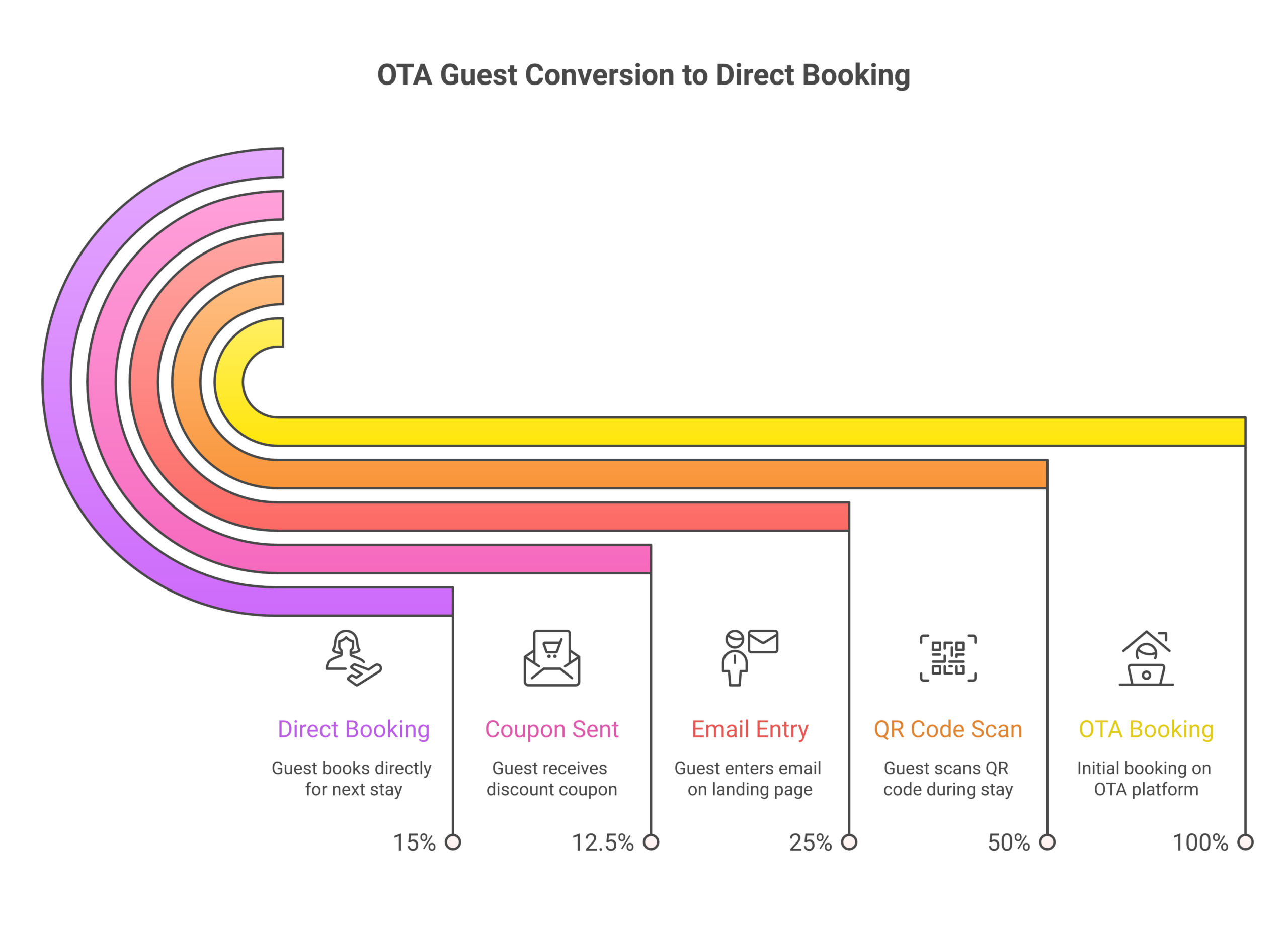
I use a three-touch system that converts roughly 15% of OTA guests into repeat bookings on my direct site:
- Welcome book QR code – Every property has a physical welcome book with a QR code linking to my direct booking site. The code takes them to a “returning guest” landing page offering 10% off their next stay.
- WiFi landing page – When guests connect to WiFi, they see a splash page that collects their email before granting access. This captures guest data without violating any OTA terms, the guest voluntarily provides it.
- Post-stay follow-up – 7 days after checkout, I send a personalized email thanking them, linking to my review page, and including a 12%-off coupon for direct booking with a 90-day expiration.
The beauty of this system: you’re not violating Airbnb’s terms by soliciting off-platform bookings during the stay. The guest finds your direct booking website organically through the welcome book and WiFi page.
Building Guest Loyalty and Repeat Business
Guest loyalty in the vacation rental business works differently than hotel loyalty programs. Nobody’s collecting points to redeem on a random property they’ve never seen. Guest loyalty in short-term rentals means one thing: they loved your place enough to come back, and you made it easy and cheaper to book directly.
What actually drives repeat business:
- Price incentive – 10-15% less than OTA pricing. This is easy because you’re already saving 15.5% on Airbnb fees, so you can pass half to the guest and still pocket more.
- Direct communication – Guests can text or email you directly instead of going through Airbnb’s messaging system. Faster responses, more personal guest experience. This matters more than most hosts realize.
- Flexible policies – Offer returning guests more lenient cancellation, early check-in, or late checkout. These cost you almost nothing but build massive guest relationships.
- Seasonal outreach – Email past guests 6-8 weeks before your peak season. “Your dates from last year are still available” converts at 8-12% in my experience.
Guest relationships compound over time. My best-performing property has 22 guests who’ve booked directly 3+ times. Those 22 people generated $47,000 in revenue last year with zero acquisition cost. No ad spend. No OTA fee. Just repeat bookings from people who already trust me.
Guest Communication: Direct vs. OTA Messaging
On Airbnb, guest communication runs through their platform. Messages get delayed, the app buries important details, and you can’t share certain information (like your phone number or alternative booking links) without risking account suspension.
Direct communication through your own booking website changes everything:
- Pre-booking inquiries – Guests email or call you directly. You respond in minutes, not through a clunky in-app system. Faster response = higher conversion rate.
- During the stay – Guests text you when the AC isn’t working or they can’t find the spare towels. No Airbnb intermediary. No “we’ll follow up within 24 hours.”
- Post-stay relationship – You own the guest data. Email them. Send holiday greetings. Offer early-bird rates for next season. This is impossible with OTA guests.
I use a dedicated Google Voice number for guest communication on direct bookings. It forwards to my phone during business hours and sends texts to voicemail after 9 PM. Costs $0/month. The personal touch makes guests feel like they’re dealing with a real person instead of a faceless platform, and that feeling is exactly what builds guest loyalty.
Driving Traffic to Your Direct Booking Website
Building a direct booking website is the easy part. Getting people to actually find it? That’s where most hosts fail. You need multiple traffic channels working simultaneously.
Google Business Profile (Free, High-Impact)
If you operate vacation rentals in a fixed location, claim a Google Business Profile. When travelers search “vacation rental in [your city],” your listing can appear in the map pack, above the organic results, for free.
Optimize it by:
- Selecting the “Vacation rental” category
- Adding your direct booking website URL
- Uploading 20+ high-quality photos
- Collecting Google reviews from past guests (direct guests are more likely to leave them since you can email them directly)
- Posting weekly updates about local events, seasonal availability, or property updates
SEO for Your Direct Booking Site
Ranking your vacation rental website on Google takes 6-12 months of consistent effort. But once it works, it’s free traffic forever. Target long-tail keywords like “[city] pet-friendly vacation rental near [landmark]” instead of competing with Airbnb and VRBO for broad terms.
Create content pages for:
- Each property (dedicated landing page optimized for “[neighborhood] vacation rental”)
- Local guides (“Best restaurants near [your property],” “Things to do in [area]”)
- Comparison content (“Why book direct vs. Airbnb in [city]”)
- Seasonal pages (“New Year’s Eve in [city]: Where to Stay”)
This strategy works especially well if your properties are in a strong Airbnb market with high search volume for accommodation terms.
Social Media (Strategic, Not Spammy)
Instagram and Facebook work for vacation rental marketing when you focus on the experience rather than “BOOK NOW” posts. Show the sunset from your balcony. Post the breakfast spread a guest left a 5-star review about. Share local events happening near your properties.
Link your direct booking site in your bio. Run a modest retargeting campaign ($5-10/day) targeting people who visited your site but didn’t book. That retargeting alone converts at 3-5x the rate of cold traffic.
Email Marketing
Once you’ve built a guest data list from WiFi captures and direct bookings, email becomes your highest-ROI marketing channel. I send 4 emails per year to my list of 340 past guests:
- January: “Early bird rates for summer” (drives 25% of my annual direct booking revenue)
- April: “Last-minute summer availability”
- September: “Fall/winter deals for returning guests”
- November: “Holiday stays, book now for New Year’s”
Open rates average 42%. Click-through to my booking website averages 11%. Those numbers blow away any paid advertising ROI.
Attract Guests Beyond OTA Platforms
Your direct booking website shouldn’t just be a backup for Airbnb. The goal is to attract guests who never would have found you on an OTA. Here’s how to attract guests from channels Airbnb can’t reach:
Google Vacation Rentals
Google now aggregates vacation rental listings directly in search results. If you’re using Lodgify, OwnerRez, or Hostaway, your properties can appear on Google’s vacation rental search, driving traffic directly to your booking website, not to Airbnb.
Requirements: verified property listing, accurate availability calendar, pricing data, and a connected booking widget that supports Google’s API. Most purpose-built platforms handle this automatically.
Corporate and Group Travel
Property owners in business-travel cities are leaving money on the table by ignoring corporate bookings. Companies don’t book through Airbnb. They use travel management platforms or book directly with accommodation providers. A professional direct booking website with invoicing capability positions you for this market.
Reach out to local relocation companies, corporate housing agencies, and hospital staffing firms. Many need furnished 30-90 day stays, and they’ll book directly if your booking process supports monthly rates and corporate invoicing.
Wedding and Event Venues
Partner with wedding venues, event planners, and conference centers within 30 minutes of your properties. They constantly need accommodation for guests and will refer traffic to your direct booking site if you offer group rates and easy booking.
The Guest Experience on Direct vs. OTA Bookings
One underrated advantage of your own direct booking website: you control every touchpoint of the guest experience. On Airbnb, the experience starts and ends on their platform. On your site, it starts with your brand.
Elements that improve the direct guest experience:
- Personalized booking confirmation – Not a generic Airbnb email. Your branding, your welcome message, your local recommendations included immediately.
- Pre-arrival guide – Send a detailed guide 3 days before check-in with parking instructions, WiFi password, check-in walkthrough video, and local restaurant recommendations.
- Upsells – Offer airport pickup, stocked fridge, early check-in, or activity packages at booking. Hospitable and OwnerRez both support upsells in the booking process.
- Post-stay review request – Send guests directly to Google Reviews (strengthens your Google Business Profile) instead of leaving reviews on Airbnb where they benefit the platform, not you.
The guest experience difference is real and measurable. My direct-booked guests leave Google reviews at 3x the rate of OTA guests, and their average review score is 4.9 vs. 4.7 on Airbnb. Why? Because the relationship feels personal when you control the guest communication, not a third party platform.
When Direct Bookings Make Sense (And When They Don’t)
Direct bookings aren’t right for every host at every stage. Be honest about where you are in your vacation rental business before investing time and money.
Direct Bookings Make Sense When:
- You’re running 3+ units with consistent occupancy above 65%
- Your monthly gross revenue exceeds $6,000 (fee savings justify the effort)
- You have a brand or location advantage (beachfront, unique property, strong reviews)
- You’re already getting repeat guests through OTAs
- You understand that results take 6-12 months to materialize
Stick With OTAs Only When:
- You have 1-2 units and are still building your review base
- You’re in a highly competitive market where OTA visibility is essential for occupancy
- You don’t have the time or interest to manage a website, email list, and guest screening process
- Your properties rely on impulse/last-minute bookings (OTAs dominate this segment)
The smart approach: use both. A vacation rental direct booking strategy doesn’t mean abandoning OTAs entirely. Online travel agencies are discovery channels. Your direct booking website is the retention channel. Let Airbnb and VRBO bring you first-time guests, then convert them to direct repeaters. This hybrid model works for property owners at every scale.
The 10XBNB Approach: OTAs as Your Marketing Engine
Here’s how the 10XBNB system handles the OTA-to-direct transition for rental arbitrage operators specifically:
- Months 1-6 – Go all-in on OTAs. Maximize reviews, optimize pricing, build occupancy. Don’t even think about a direct booking website yet. Focus on running a profitable rental business first. Use this time to study the Airbnb business plan framework.
- Months 6-12 – Launch a basic direct booking site. Start capturing guest data through WiFi landing pages and welcome books. Set up your guest screening process. Test the booking process with friends and family before going live.
- Months 12-24 – Shift 15-25% of bookings to direct. Run email campaigns to past guests. Offer a “book direct and save 12%” incentive. Track which marketing channels actually produce bookings.
- Month 24+ – Target 30-40% direct bookings. By this point, your guest relationships, email list, and Google reviews should generate consistent repeat business without heavy marketing spend.
The key insight: you’re not replacing Airbnb. You’re using it as a customer acquisition channel and redirecting those customers to your own direct booking website for repeat bookings. Airbnb spends billions on advertising. Let them attract guests – then keep those guests through superior direct communication and pricing.
Channel Manager Integration: Preventing Double Bookings
Running vacation rentals across multiple booking platforms plus your direct booking website creates a synchronization nightmare if you don’t use a channel manager. Double bookings aren’t just embarrassing. They can get you suspended from Airbnb and generate refund demands from both guests.
How Channel Managers Work
A channel manager connects your availability calendar across every platform via API (not iCal, which has dangerous sync delays). When a guest books on your direct booking site, the channel manager instantly blocks those dates on Airbnb, VRBO, and Booking.com, and vice versa.
Most purpose-built vacation rental websites include channel management. If you built a custom website on WordPress or Wix, you’ll need a standalone channel manager like:
- OwnerRez – Direct API connections to Airbnb, VRBO, Booking.com, Google Vacation Rentals
- Hostaway – 200+ integrations, real-time sync, bulk calendar management
- Hospitable – Automated messaging + channel management in one platform
Never rely on iCal sync as your primary calendar integration. The 15-60 minute lag between updates is long enough for two guests to book the same dates on different platforms. I learned this the hard way, a Saturday night double booking in July that cost me $400 in a last-minute hotel placement for the displaced guest plus a negative review on VRBO.
Revenue Model: 12-Month Direct Booking Projection
Here’s a realistic revenue model for a host with 5 rental arbitrage units averaging $3,500/month each ($17,500/month gross, $210,000/year):
| Month | Direct Booking % | Direct Revenue | OTA Fee Saved | Direct Costs | Net Savings |
|---|---|---|---|---|---|
| 1-3 | 5% | $2,625 | $407 | $450 (setup + hosting) | -$43 |
| 4-6 | 12% | $6,300 | $977 | $90 (hosting only) | $887 |
| 7-9 | 20% | $10,500 | $1,628 | $90 | $1,538 |
| 10-12 | 30% | $15,750 | $2,441 | $90 | $2,351 |
| Year 1 Total | – | $35,175 | $5,453 | $720 | $4,733 |
The OTA fee savings column uses the 15.5% Airbnb host-only fee minus 2.9% Stripe processing (net 12.6% savings on each direct booking). Year 1 net savings of $4,733 assumes a conservative ramp from 5% to 30% direct bookings. Year 2, when you’ve got a real email list and repeat business flowing, typically sees 35-45% direct bookings, pushing annual savings to $8,000-$12,000.
Run these numbers against your own portfolio using the Airbnb profit calculator to see where direct booking starts making financial sense for your specific situation.
Common Mistakes That Kill Direct Booking Sites
I’ve seen dozens of hosts launch direct booking websites that generate zero bookings. Same mistakes every time.
Mistake 1: Building It and Hoping They Come
A direct booking website without a traffic strategy is a billboard in the desert. You need at least one active channel: email to past guests, Google Business Profile, social media retargeting, or content marketing. Preferably all four.
Mistake 2: Making the Booking Process Too Complicated
If your booking process requires account creation, a phone call, or more than 3 steps, you’ll lose most visitors. The booking widget should show availability, accept payment, and confirm, all without leaving your site. Guest familiarity with instant booking on OTAs means your direct booking site needs to match that frictionless experience.
Mistake 3: No Guest Screening
Skipping the guest screening process on direct bookings is asking for trouble. One bad guest, a party, property damage, or a fraudulent chargeback, can cost more than a year of OTA fee savings. Invest $5-15 per booking in proper screening. It’s cheap insurance.
Mistake 4: Pricing the Same as OTAs
Why would a guest book on your unknown website when they can book the same property on Airbnb with buyer protection, reviews, and one-click checkout, for the same price? Your direct booking site price must be lower than your OTA price. I discount 10-12% for direct bookings and still come out ahead because I’m saving 15.5% on Airbnb fees.
Mistake 5: Ignoring Mobile
68% of vacation rental searches happen on mobile devices. If your booking website doesn’t load fast and display properly on a phone, you’re invisible to two-thirds of your potential guests. Test your site on at least 3 different phones before launching.
Mistake 6: Not Collecting Guest Data
The entire point of a direct booking website is owning the guest data. If you’re not collecting emails, phone numbers, and booking preferences, you’re building a second Airbnb, with none of the traffic advantages. Every direct booking should feed into your CRM or email list automatically.
Vacation Rental Directly: Legal and Compliance Considerations
When you book a vacation rental directly with guests (without an OTA intermediary), the legal and tax compliance responsibility shifts entirely to you. Many hosts overlook this until they get a tax notice or a guest injury claim.
Tax Collection and Remittance
OTAs like Airbnb automatically collect and remit occupancy taxes in many jurisdictions. When guests book on your direct booking website, you’re responsible for:
- Calculating the correct local occupancy tax rate
- Collecting taxes from the guest at time of booking
- Remitting taxes to local tax authorities on schedule
- Filing any required tax returns
Hospitable’s Direct Premium plan handles tax filing and remittance in a growing number of US locations, which alone might justify the cost for hosts in complex tax jurisdictions.
Rental Agreement
Every direct booking should include a signed rental agreement. Unlike OTA bookings where the platform’s terms govern the transaction, direct bookings need an explicit contract covering:
- Cancellation and refund policy
- House rules and quiet hours
- Liability waiver
- Maximum occupancy
- Damage policy and deposit terms
- Check-in/check-out procedures
Use a digital signature tool (HelloSign or DocuSign) integrated into your booking process. Guests sign before their payment processes. It adds 2 minutes but saves you enormous headaches.
Your Direct Booking Action Plan
Here’s the exact sequence I’d follow if I were launching a direct booking website today:
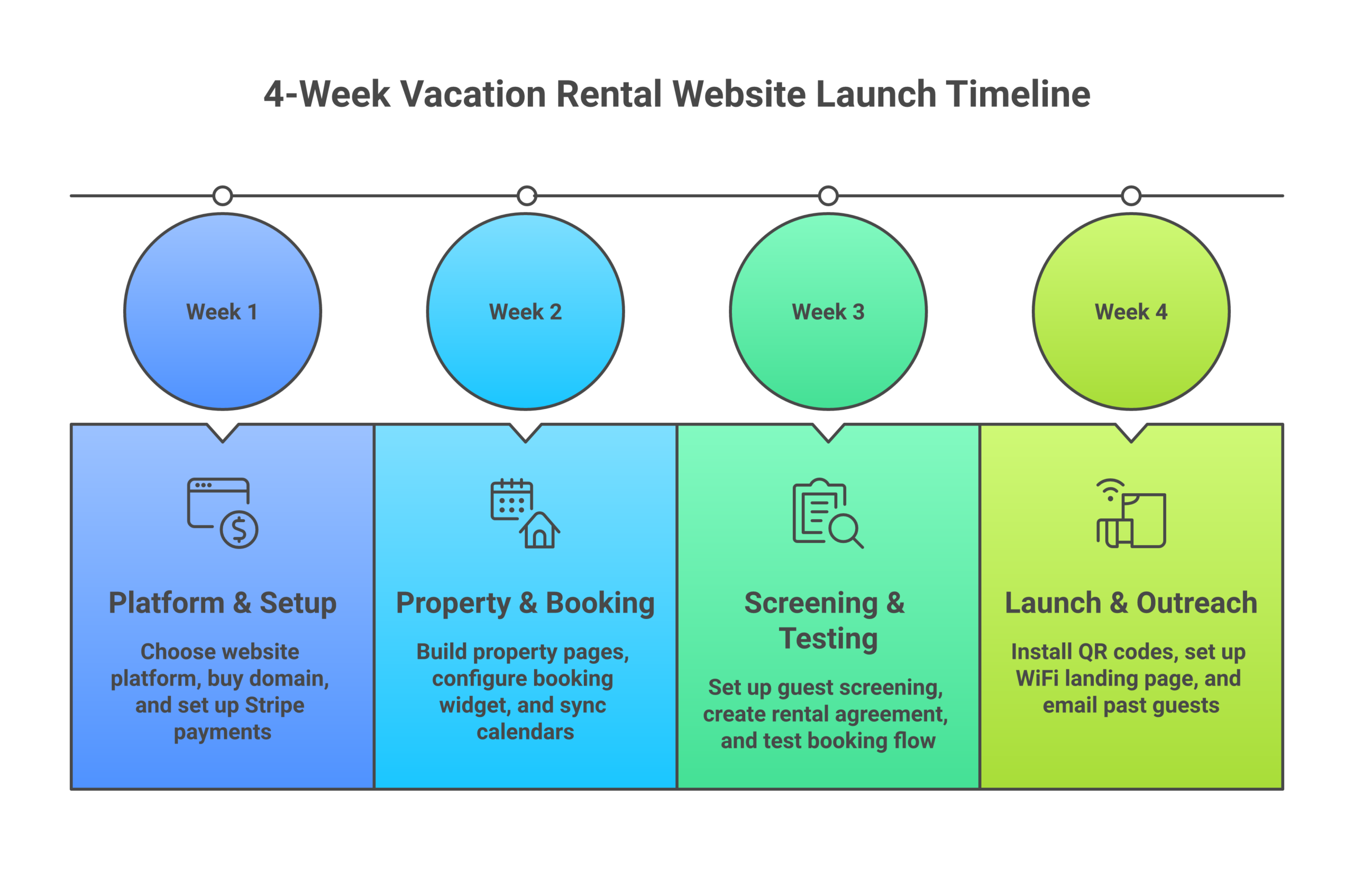
- Week 1 – Pick a platform (Lodgify for simplicity, OwnerRez for control). Buy a domain. Set up Stripe.
- Week 2 – Build property pages. Upload photos. Configure the booking widget and calendar sync with your channel manager.
- Week 3 – Set up your guest screening process (Autohost or Superhog). Create your rental agreement template. Test the full booking process end-to-end.
- Week 4 – Install welcome book QR codes and WiFi landing pages in all properties. Set up your email collection system.
- Month 2 – Claim Google Business Profile. Send first email to any past guests whose contact info you have. Set up a simple retargeting campaign.
- Month 3+ – Start creating content pages (local guides, property comparison pages). Build your email list. Measure and optimize the booking process conversion rate.
Total time investment: 20-30 hours in the first month, then 2-3 hours/week ongoing. Total cost: $30-50/month for hosting and tools, plus $5-15 per booking for guest screening. At $10,000/month in gross bookings, the ROI is clear within 90 days.
You’re already doing the hard work, managing properties, handling guest issues, coordinating cleaners. The direct booking website is how you stop giving 15.5% of that effort to Airbnb.
For a deeper dive into building a profitable rental business from scratch, explore the full rental arbitrage playbook. And if you want to see how much Airbnb hosts actually make, those numbers will put the fee savings in perspective.
Frequently Asked Questions
Can I have a direct booking website and still list on Airbnb?
Yes. Airbnb has no exclusivity clause. You can maintain active listings on Airbnb, VRBO, Booking.com, and your own direct booking website simultaneously. The only restriction: you can’t actively solicit guests to book off-platform within Airbnb’s messaging system. Using welcome books, WiFi landing pages, and post-stay emails (with contact info obtained outside Airbnb) is perfectly acceptable.
How much does it cost to build a direct booking website?
A basic direct booking site on Lodgify or Hospitable costs $16-40/month including hosting, templates, and a booking widget. A WordPress site with OwnerRez integration runs $10-30/month for hosting plus $40+/month for OwnerRez. A custom website built by an agency costs $1,000-$10,000+ upfront. For most hosts, $30-50/month covers everything needed.
How do I prevent double bookings between my site and Airbnb?
Use a channel manager with real-time API sync. Not iCal, which has dangerous 15-60 minute delays. OwnerRez, Hostaway, and Hospitable all include channel management. When a guest books on your direct booking website, the channel manager blocks those dates on all connected booking platforms within seconds.
What percentage of bookings should come from my direct booking site?
In year one, target 15-25% of total bookings from your direct booking website. By year two, 30-40% is realistic for hosts with an active email list and strong guest relationships. Some vacation rental owners with established brands achieve 50-60% direct bookings, but that typically takes 3+ years and significant marketing investment.
Do I need a business license for direct bookings?
If you already have a short-term rental permit or business license for your OTA listings, it covers direct bookings too. The license applies to the activity (renting your property), not the booking channel. Check your local regulations. Some jurisdictions require you to collect and remit occupancy taxes that Airbnb would otherwise handle for you.
How do I handle chargebacks on direct bookings?
Chargebacks are the biggest financial risk in direct booking. Protect yourself by requiring a signed rental agreement, keeping proof of stay (smart lock entry logs, guest communication), and using 3D Secure authentication through Stripe. Hospitable’s Direct Premium plan includes chargeback protection. For self-managed payments, maintain a chargeback response template with evidence documentation ready to submit within 24 hours.
Should I offer lower prices on my direct booking site?
Always. Your direct booking website should be 8-15% cheaper than your OTA price. You’re saving 15.5% on Airbnb’s host-only fee, so even a 12% guest discount still puts more money in your pocket than an OTA booking at full price. The discount gives guests a clear financial reason to book direct instead of through a third party platform they already trust.