
Airbnb co-listing is a business model where you manage someone else’s short-term rental property on Airbnb and earn a percentage of the booking revenue. You do not own the property. You do not lease it. You find homeowners who want passive income from their property, set up and manage the Airbnb listing, and split the profits. It differs from traditional co-hosting in several important ways, and this guide covers exactly how it works, what it pays, and how to get started in 2026. See also our comparison of co-listing vs real estate investing.
Co-listing has become one of the fastest-growing entry points into the short-term rental industry because it removes the two biggest barriers: property ownership and lease obligations. If you have been researching Airbnb business models and feel stuck between buying property you cannot afford and signing leases that carry real financial risk, co-listing is worth a serious look.
The model is straightforward. You find a homeowner. You pitch a partnership. You create and manage an Airbnb listing on their property. They keep ownership. You earn 10% to 25% of each booking. No mortgage. No rent checks. No furnishing costs. And if bookings slow down, you earn less but never go into the red.
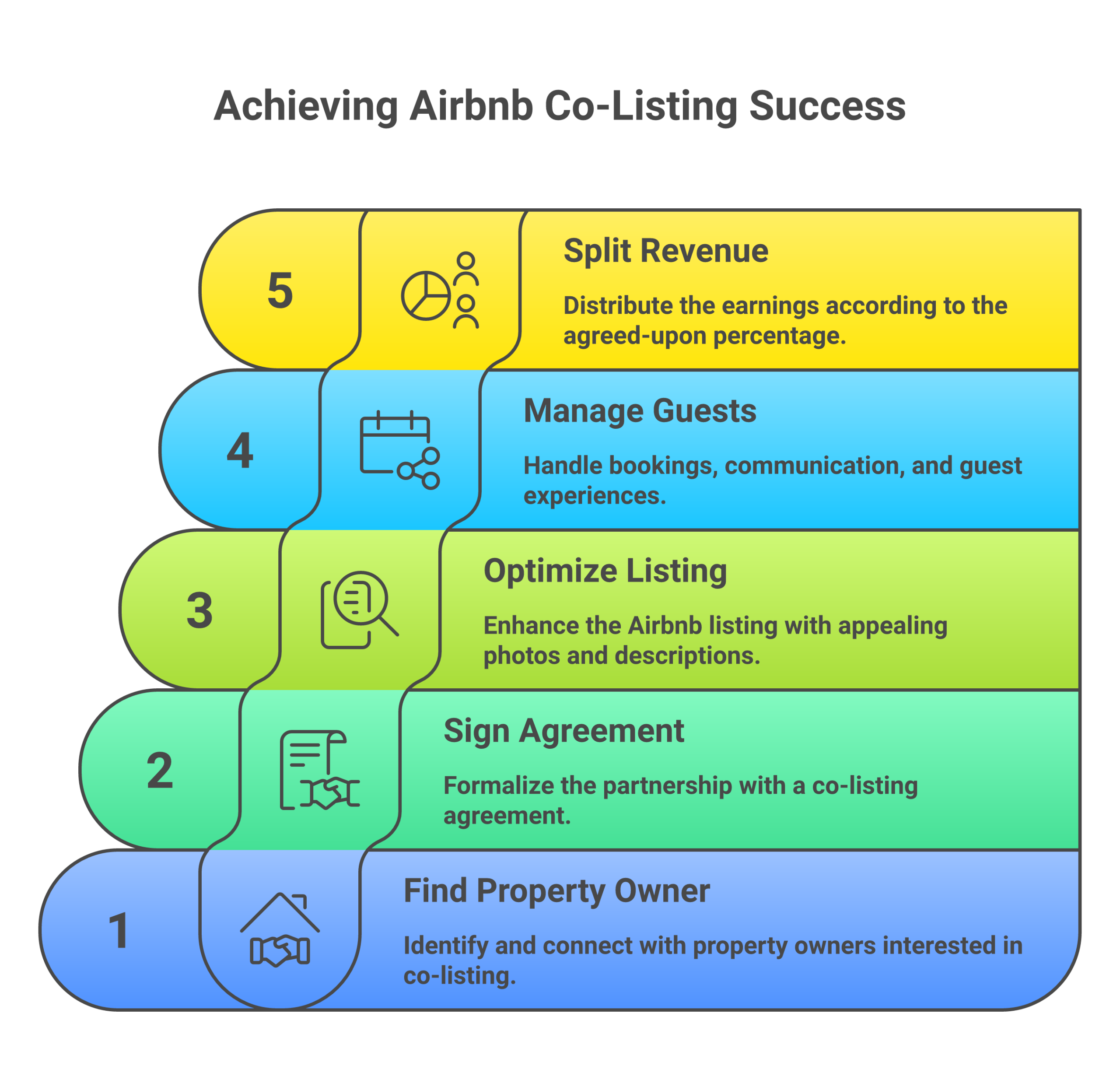
How Airbnb Co-Listing Works
The co-listing process follows a clear sequence. Here is how it works from the first conversation with a property owner to your first payout.
Related: See our guide on co-hosting agreement template for detailed templates and legal requirements.
Need a lease? Download our free mid term rental agreement template with all 12 clauses explained.
Step 1: Find a Property Owner
You identify homeowners who either have a vacant property or an underperforming Airbnb listing. These owners are everywhere: second-home owners who visit their lake house twice a year, landlords between tenants losing money on an empty unit, retirees with a guest house sitting unused, and real estate investors who bought property but do not want to manage it themselves.
See our ranked list of the top cities for mid term co-listing with demand drivers and income data for each market.
Most co-listers find their first property owner through their personal network. A family friend with a vacation condo. A coworker’s parents with an empty basement suite. From there, you expand to local real estate Facebook groups, Craigslist rental listings, and direct outreach to furnished properties sitting vacant on Zillow or Redfin.
Step 2: Pitch the Partnership
You present a clear proposal backed by market data. The owner keeps full ownership and final say on house rules. You handle every aspect of the Airbnb business: listing creation, professional photography, pricing strategy, guest communication, cleaning coordination, and maintenance scheduling. In exchange, you earn a commission on each booking. Most co-listing agreements set this at 10% to 25% of the gross booking revenue.
The pitch works because you are solving a real problem. The owner has a property that could generate income but does not have the time, knowledge, or desire to manage it on Airbnb. You bring the operational skills. They bring the asset. Both sides win.
Step 3: Sign a Co-Listing Agreement
Both parties sign a written agreement that spells out responsibilities, revenue split, termination clauses, and liability. This step is not optional. A handshake deal might feel easier, but it invites disputes down the road. The agreement protects you and the property owner equally.
Your agreement should cover at minimum: who pays for supplies and cleaning, how revenue gets split and when, a 30-day termination notice period, property damage liability, and guest screening standards. You can download a free co-listing agreement template to use as a starting point.
See our full breakdown of mid term rental income potential with city-by-city earnings and tenant demand analysis.
Step 4: Set Up the Listing
You create the Airbnb listing under the owner’s account (or your own, depending on the agreement structure). This includes writing the listing description, uploading professional photos, setting pricing with a dynamic pricing tool like PriceLabs or Wheelhouse, and configuring house rules, check-in instructions, and calendar availability.
The quality of your listing setup directly affects your income. Professional photos alone can increase bookings by 20% to 40% compared to phone snapshots. A well-written title and description targeting the right guest persona (business travelers, families, couples) makes the difference between a property that books 50% of available nights and one that books 80%.
Step 5: Manage the Property
Once the listing goes live, you handle day-to-day operations. Guest inquiries. Booking confirmations. Check-in coordination. Cleaning turnover between guests. Maintenance issues. Review responses. This is the work that earns your commission, and it is the reason property owners are willing to share revenue with you.
Most experienced co-listers automate 60% to 70% of this work within their first few months. Automated messaging tools handle guest check-in instructions. Dynamic pricing adjusts nightly rates based on demand. Cleaning teams receive automatic notifications when a guest checks out. Your job shifts from doing every task manually to managing systems that do the tasks for you.
Step 6: Split the Revenue
Revenue flows in after each guest stay. Depending on your agreement, the owner receives their share via Airbnb’s co-host payout split feature, or you invoice them separately. Many co-listers set up automatic payout splits directly through the Airbnb platform so there is no chasing payments.
Airbnb allows primary hosts to assign a percentage-based payout split to co-hosts directly on the platform. This means the money lands in each person’s bank account automatically after every reservation. No invoicing, no awkward money conversations, no delays.
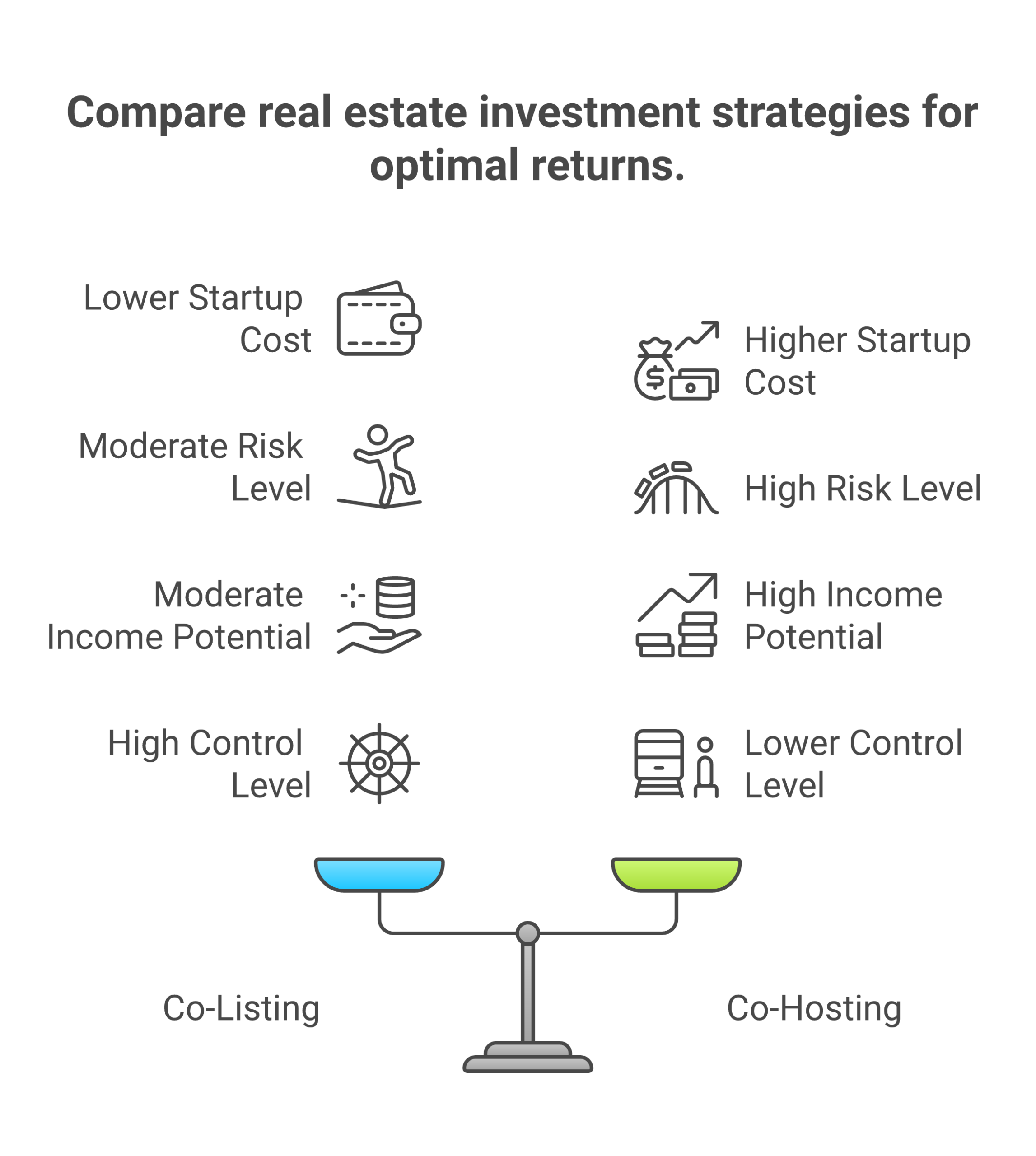
Co-Listing vs Co-Hosting: What’s the Difference?
These two terms get confused constantly, and the confusion is understandable. Airbnb uses “co-host” as its official platform term. But in the short-term rental industry, co-listing and co-hosting describe different business approaches with different risk profiles and income potential.
Here’s the key distinction: co-hosting typically means helping an existing host with specific tasks on their already-active listing. Co-listing means you find properties that are NOT yet on Airbnb, create the entire listing from scratch, and run the business end-to-end. You are the operator. The owner is the investor.
A co-host might handle guest messages for someone who already has a successful listing but is going on vacation. A co-lister finds a property owner who has never listed on Airbnb, builds the entire business from zero, and manages it ongoing for a share of the revenue.
| Factor | Co-Listing | Co-Hosting (Traditional) |
|---|---|---|
| Definition | You find properties, create Airbnb listings from scratch, and manage everything | You help an existing host manage their active listing |
| Who finds the property? | You actively source properties from owners not yet on Airbnb | The host already has an active Airbnb listing |
| Startup cost | $0 to $500 (pitch materials, photography) | $0 (you join an existing listing) |
| Financial risk | Near zero, no lease or mortgage | Near zero |
| Commission range | 15% to 25% (you built the business) | 10% to 20% (you support the business) |
| Control over operations | High, you make most decisions | Low to medium, the host sets direction |
| Scalability | High, add properties without capital | Medium, depends on host demand |
| Ideal for | Entrepreneurs building a rental portfolio without ownership | People who want part-time hosting income |
| Airbnb platform setup | Added as co-host with full access on the owner’s account, or listing under your own account | Added as co-host with limited or full access |
Think of it this way. A co-host is like a property manager who answers the phone when it rings. A co-lister is the person who built the business, installed the phone, and trained the team. Both are legitimate paths. But co-listing offers more upside because you control the entire guest experience and can command a higher commission for the value you create.
Co-Listing vs Rental Arbitrage vs Property Management
Co-listing is not the only way to run Airbnb properties you do not own. Rental arbitrage and property management are the other two common models. Each carries a different risk profile, and understanding the differences will help you choose the right path for your situation.
| Factor | Co-Listing | Rental Arbitrage | Property Management |
|---|---|---|---|
| You own the property? | No | No | No |
| You sign a lease? | No | Yes | No |
| Startup cost | $0 to $500 | $3,000 to $15,000+ (first/last rent, furnishing) | $1,000 to $5,000 (business setup, insurance) |
| Monthly financial obligation | None | Full rent payment regardless of bookings | None |
| Revenue model | 10% to 25% commission | Keep all profit above rent | 15% to 40% management fee |
| Risk if bookings drop | You earn less, but lose nothing | You still owe rent, potential loss | You earn less, but lose nothing |
| Scalability | High, no capital needed per property | Limited by capital and credit | High, but requires staff and systems |
| Best for | Beginners, risk-averse entrepreneurs | People with capital who want higher margins | Experienced operators with a team |
Rental arbitrage can be highly profitable, but it comes with real downside risk. If your bookings dry up during a slow season, you still owe rent. With co-listing, a slow month means smaller commissions. You do not go into the red.
That is why many people use co-listing as their entry point and add arbitrage properties later once they have cash flow and experience. You learn the business with zero financial risk, build relationships with property owners, and develop operational skills. Then, when you are ready to take on more risk for higher reward, you add arbitrage units to your portfolio. You can learn more in our rental arbitrage course comparison.
For a detailed side-by-side comparison of pricing, curriculum, and instructor credentials, see our best courses that teach Airbnb co-listing.
How Much Do Co-Listers Earn?
Income varies based on market, property type, and how many properties you manage. But the numbers are concrete enough to model with real math.
Per-Property Income
A single Airbnb property generating $3,000 per month in gross revenue at a 20% co-listing commission pays you $600 per month. A property in a high-demand market like Nashville, Scottsdale, or the Smoky Mountains generating $6,000 per month at the same rate pays $1,200 per month.
Most co-listers report earning between $400 and $1,500 per property per month, depending on the market and season. The wide range reflects the difference between a one-bedroom apartment in a secondary market and a luxury vacation home in a destination city. Properties with hot tubs, pools, or unique features like treehouses and A-frames tend to earn at the higher end of that range.
Scaling Economics
The math gets interesting when you manage multiple properties. Here is a realistic scaling scenario based on a mid-tier market (not luxury, not budget):
- 3 properties at $500/month each: $1,500/month ($18,000/year)
- 5 properties at $600/month each: $3,000/month ($36,000/year)
- 10 properties at $700/month each: $7,000/month ($84,000/year)
- 20 properties at $750/month each: $15,000/month ($180,000/year)
At the 10-property mark, most co-listers hire a virtual assistant ($500 to $800/month) or cleaning coordinator, which reduces per-property margins slightly but frees you to keep adding properties. The business becomes less about doing the work yourself and more about building systems that run without your constant involvement.
The per-property average tends to increase as you scale because you get better at selecting properties, optimizing pricing, and negotiating higher commission rates with owners. Your first deal might be 15%. Your tenth deal, backed by a track record and testimonials, might be 22% to 25%.
For detailed income data across different markets and experience levels, see our complete co-host income breakdown.
Who Is Co-Listing For?
Co-listing works for a specific type of person. Not everyone. But if you fit one of these profiles, the model aligns well with your situation.
W-2 Employees Who Want a Side Business
You have a full-time job and steady income but want to build something on the side. Co-listing does not require quitting your job. You can manage 2 to 3 properties in evenings and weekends, especially with automation tools handling guest messaging and pricing. Many co-listers keep their day job until their Airbnb income matches or exceeds their salary, then make the transition.
Career Changers
You are done with corporate life and want to transition into real estate or hospitality. Co-listing gives you hands-on experience running short-term rentals without the financial commitment of buying or leasing property. Many 10XBNB students started co-listing as a career transition and now run full-time rental businesses managing 10+ properties.
For a complete setup walkthrough, see our travel nurse housing through co-listing with platform comparisons and pricing data.
People Who Cannot Qualify for Airbnb’s Co-Host Network Yet
Airbnb’s official Co-Host Network requires a 4.8+ guest rating and at least 10 completed stays (or 3 stays totaling 100+ nights) in the past 12 months. If you are brand new to hosting, you do not meet those requirements. Co-listing is how you build that track record from scratch, outside the network, through direct relationships with property owners.
Real Estate Investors Testing a Market
Before buying an investment property in a new city, co-listing lets you learn the local short-term rental market firsthand. You see real occupancy rates, seasonal booking patterns, and guest expectations without putting capital at risk. If the market performs well, you buy with confidence. If it does not, you walk away with no financial loss.
Stay-at-Home Parents
The flexibility of co-listing, where most guest communication happens digitally and cleaning teams handle turnovers, makes it workable around childcare schedules. Several successful co-listers manage 5+ properties while raising young children. The work happens in small bursts throughout the day rather than requiring a 9-to-5 commitment.
The 10XBNB Co-Listing Method
10XBNB is a training program built specifically around Airbnb co-listing, founded by Shaun Ghavami. Shaun is a UBC Sauder School of Business finance graduate, former banker at BMO, RBC, and Scotiabank, current Airbnb Superhost, and manager of a portfolio exceeding $100M in short-term rental properties.
The 10XBNB system teaches a specific approach to co-listing that focuses on four core skills: finding property owners who are open to the arrangement, structuring agreements that protect both sides, setting up listings that outperform the competition, and scaling from 1 property to 10+ properties with repeatable systems. Over 1,600 students have gone through the program.
What makes the 10XBNB method different from general co-hosting advice you find on YouTube or blogs is the emphasis on building a real business rather than just “helping a friend with their Airbnb.” The curriculum covers owner acquisition scripts you can use on day one, pricing optimization frameworks for different market types, guest experience systems that drive 5-star reviews, and a clear path from your first property to a full portfolio.
If you want to see the full system, 10XBNB offers free co-listing training that walks through the business model in detail. You can also read real student reviews and results from people who have gone through the program.
How Airbnb’s Co-Host Network Relates to Co-Listing
In late 2024, Airbnb launched its official Co-Host Network. The network connects property owners who want help managing their listings with experienced co-hosts who have proven track records on the platform. As of early 2026, the network has grown from 10,000 co-hosts at launch to over 15,000 co-hosts managing more than 100,000 listings across 13 countries including the US, Canada, UK, Australia, France, Germany, and Japan.
Co-Host Network Requirements
Joining the network requires meeting specific criteria set by Airbnb:
- An active listing as a host or full-access co-host
- At least 10 completed stays (or 3 stays totaling 100+ nights) in the past 12 months
- A guest rating of 4.8 or higher across all listings
- Cancellation rate below 3%
- 90%+ response rate to new inquiries within 24 hours
- Verified identity and profile photo showing your face
If your rating drops below 4.7, Airbnb temporarily hides your profile from the network. Below 4.5, you risk removal entirely. The bar is high because Airbnb is staking its brand on the quality of co-hosts it recommends to property owners.
Where Co-Listing Fits In
Here is what most people miss: you need hosting experience to join the Co-Host Network, but you need properties to get hosting experience. Co-listing solves that chicken-and-egg problem.
By co-listing your first 2 to 3 properties outside the network (through direct outreach to property owners in your area), you build the track record Airbnb requires. Once you hit 10 completed stays with a 4.8+ average rating, the Co-Host Network becomes an additional lead source for finding new property owners who want help. Owners browse the network, find your profile, and reach out to you.
Think of co-listing as the on-ramp to the Co-Host Network, not a competitor to it. You start by finding your own clients. Then the network starts sending clients to you. Both channels work together as your business grows.
You can learn more about the opportunity landscape in our co-host market analysis.
How to Get Started with Co-Listing
If you are ready to try co-listing, here are five concrete steps to take this week. Not next month. This week.
Step 1: Learn the Business Model
Before approaching any property owner, understand how Airbnb works from the host side. Study pricing dynamics, guest communication best practices, and local short-term rental regulations in your city. Some municipalities require permits, others restrict the number of days per year a property can be rented, and a few ban short-term rentals outright. Know the rules before you pitch. Free co-listing training from 10XBNB covers the fundamentals in a structured format.
Step 2: Research Your Local Market
Use AirDNA or Mashvisor to pull occupancy rates, average daily rates, and revenue projections for your city or target area. You need this data to pitch property owners with real numbers, not enthusiasm. When you can say “three-bedroom homes in your neighborhood average $4,200 per month on Airbnb with 72% occupancy,” property owners listen.
Step 3: Identify Your First Property Owner
Start with your personal network. Ask family, friends, and coworkers if they know anyone with a second home, vacation property, or investment property sitting underused. Post in local real estate investor Facebook groups. Check Zillow for furnished rentals with long vacancy periods. Look for listings that have been on the market for 60+ days with no takers.
You only need one property owner to say yes to get started. Your first successful listing becomes the proof of concept you show to the second, third, and fourth owner.
Step 4: Prepare Your Pitch
Create a one-page proposal that includes: your market research data, projected monthly revenue for their specific property, your commission structure (start at 15% to 20% for your first deal), and a summary of what you handle vs. what they handle. Property owners respond to numbers, not enthusiasm.
Step 5: Draft Your Agreement
Use a proper co-listing agreement template that covers revenue split, responsibilities, termination notice period, insurance requirements, and dispute resolution. Have both parties sign before you spend a single hour on the property. A clear agreement prevents 90% of the problems that could come up later.
For a deeper walkthrough of the full process, read our complete guide to becoming an Airbnb co-host.
Frequently Asked Questions
What is Airbnb co-listing?
Airbnb co-listing is a business arrangement where you manage someone else’s property as a short-term rental on Airbnb. You create the listing, handle all operations (guest communication, cleaning, pricing, maintenance), and earn a commission of 10% to 25% on each booking. You do not own or lease the property.
Is co-listing the same as co-hosting?
Not exactly. Co-hosting typically means helping an existing host with tasks on their already-active listing. Co-listing means you find properties not yet on Airbnb, build the listing from scratch, and run the entire operation. Co-listing involves more responsibility and usually commands a higher commission.
How much money can you make co-listing on Airbnb?
Most co-listers earn $400 to $1,500 per property per month, depending on market, property type, and season. Managing 5 properties at an average of $600 each produces $3,000 per month. At 10 to 20 properties, full-time income of $7,000 to $15,000 per month is realistic.
Do you need money to start co-listing?
Startup costs range from $0 to $500. Your main expenses are professional photography for the listing (if the owner does not cover it) and any pitch materials you create. You do not pay rent, a mortgage, or furnishing costs.
Is co-listing legal?
Yes. Co-listing is a service agreement between you and a property owner. You are acting as their authorized representative to manage the Airbnb listing. Check your local short-term rental regulations, as some cities require permits or business licenses for anyone managing vacation rentals.
What is the difference between co-listing and rental arbitrage?
In rental arbitrage, you sign a lease on a property and pay rent monthly, then list it on Airbnb and keep the profit above your rent. In co-listing, you never sign a lease. You manage the owner’s property for a commission. Arbitrage has higher profit potential per property but carries the risk of owing rent even during slow booking months. Co-listing has zero downside financial risk.
Do I need experience to start co-listing?
Prior Airbnb hosting experience helps but is not required. Many successful co-listers started with zero hospitality background. What matters more is your ability to communicate clearly with property owners, manage logistics, and deliver a strong guest experience. Training programs like 10XBNB exist specifically to teach beginners the skills they need.
How do I find property owners who want a co-lister?
Start with your personal network (friends, family, coworkers with second homes). Expand to local real estate investor Facebook groups, Craigslist property listings, Zillow vacant properties, and direct outreach to underperforming Airbnb listings in your market. The 10XBNB program teaches specific owner acquisition strategies that students use to land their first property within weeks.
Can I co-list properties in any city?
You can co-list in any city where short-term rentals are legal. Some cities have strict regulations, permit requirements, or outright bans on Airbnb-style rentals. Research your local laws before starting. Popular co-listing markets include vacation destinations, college towns, and cities with strong business travel demand.
What happens if Airbnb bookings are slow?
During slow periods, your commission income decreases, but you do not lose money. This is the core advantage of co-listing over rental arbitrage. You have no fixed costs (rent, mortgage) to cover. Some co-listers offset seasonal dips by managing properties in multiple markets or by listing on additional platforms like Vrbo and Booking.com alongside Airbnb.
If you want to get started as a co-host, our step-by-step co-host guide covers everything from finding property owners to setting up your first listing.