A short term rental eviction is one of the most stressful situations any STR host can face, and most hosts are completely unprepared for it. I’ve seen firsthand how a single guest who refuses to leave can cost a property owner thousands of dollars in lost bookings, legal fees, and property damage. The good news: if you understand the legal framework before it happens, you can protect yourself and resolve the situation in days instead of months.
This guide covers the full eviction process for short-term rental hosts, including the critical guest-vs-tenant distinction, state-specific timelines, platform-specific procedures for Airbnb and Vrbo, and prevention strategies that actually work.
Disclaimer: This article is for educational purposes only and does not constitute legal advice. Laws vary by state, county, and city. Consult a licensed attorney in your jurisdiction before taking any legal action.
What Is a Short-Term Rental Eviction?
A short-term rental eviction is the legal process of removing a guest or occupant from a property they rented on a temporary basis. This can involve a booking through Airbnb, Vrbo, or a direct rental agreement.
The tricky part: depending on how long the guest has stayed and your state’s laws, you might be dealing with a simple trespass removal or a full-blown court eviction that takes weeks or months. The difference comes down to one question: is this person legally a “guest” or a “tenant”?
Common reasons hosts need to evict someone from a short-term rental include:
- Overstaying past the reservation checkout date
- Nonpayment of rent or additional fees
- Property damage beyond normal wear
- Violation of house rules (noise complaints, unauthorized parties, extra guests)
- Illegal activity on the premises
- Unauthorized subletting to third parties

Guest vs. Tenant: The Legal Distinction That Changes Everything
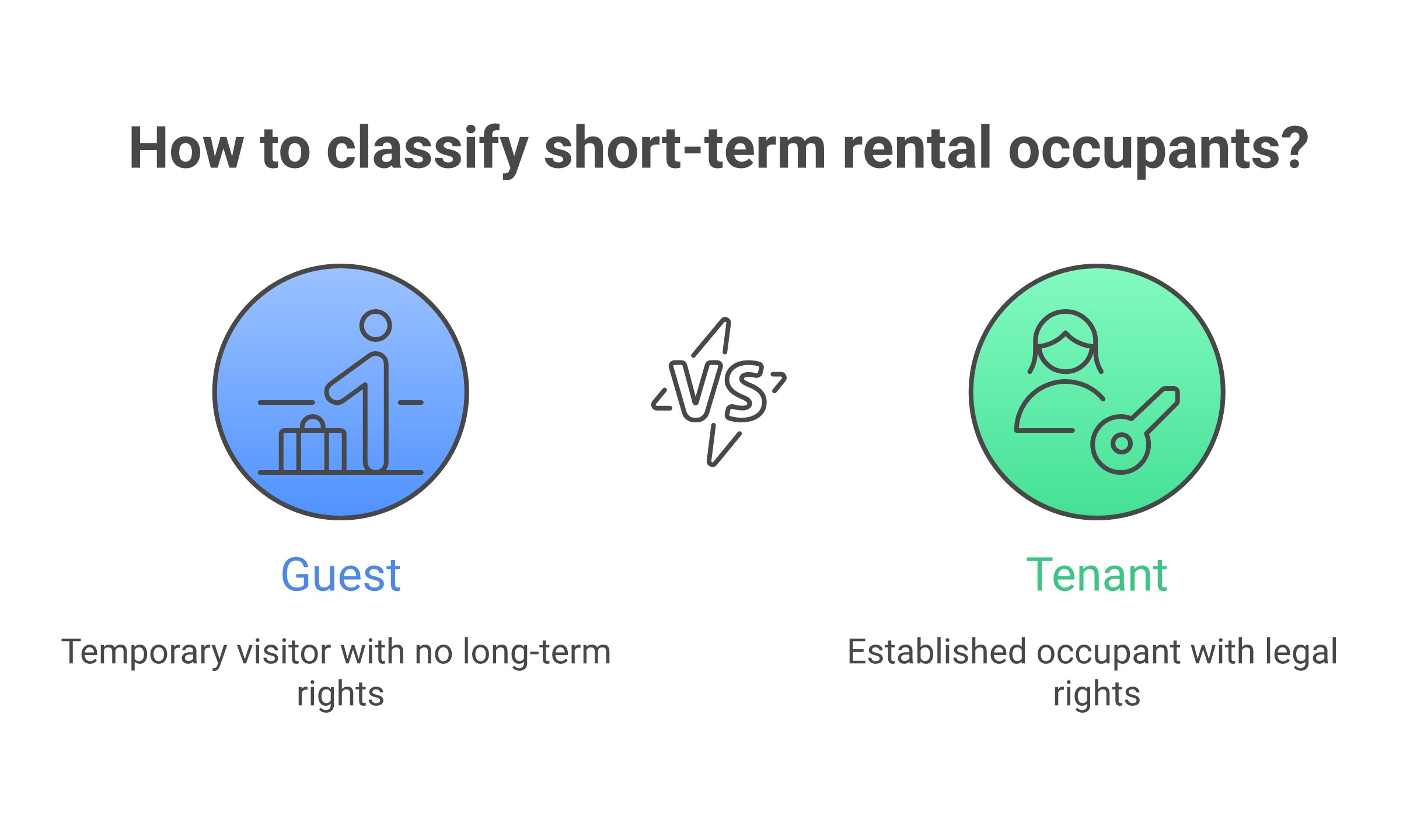
This is the single most important concept in short-term rental eviction law. If your occupant is legally classified as a “guest,” you can generally have them removed as a trespasser once their reservation ends. If they’ve crossed the threshold into “tenant” status, you’re looking at a formal eviction process through the courts.
What Makes Someone a Guest
A guest is a temporary visitor with no long-term occupancy rights. They booked a specific period, agreed to checkout by a set date, and their stay is governed by the booking platform’s terms or your short-term rental agreement. Guests typically:
- Stay fewer than 30 days (in most states)
- Don’t receive mail at the property
- Haven’t moved personal furniture or belongings into the unit
- Don’t contribute to utility bills or household expenses beyond the booking fee
What Makes Someone a Tenant
A tenant has established legal occupancy rights, either through a lease, by staying past a state-defined threshold, or through certain behaviors. Once someone becomes a tenant, removing them requires a court-ordered eviction, even if they never signed a lease.
State-by-State Guest-to-Tenant Thresholds
The point at which a guest becomes a tenant varies by state. Here are the thresholds for states with specific cutoffs, based on state landlord-tenant statutes:
| State | Threshold to Gain Tenant Rights |
|---|---|
| Alabama | 30 days |
| Arizona | 29 days |
| California | 14 days in 6 months OR 7 consecutive nights |
| Colorado | 14 days in 6 months |
| Connecticut | 14 days in 6 months |
| Florida | 14 days in 6 months OR 7 consecutive nights |
| Indiana | 14 days in 6 months |
| Kentucky | 30 days or per lease terms |
| Maine | 14 days in 6 months |
| Missouri | 14 days in a year |
| Montana | 7 consecutive days (if not specified in lease) |
| New York | 30 days |
| North Carolina | 14 days |
| Ohio | 30 days |
| Pennsylvania | 30 days or monetary contribution |
In 28 states (including Texas, Georgia, Illinois, and Washington), there is no specific day-count cutoff. Instead, tenant status can be triggered by behavioral factors: receiving mail at the property, contributing to rent or utilities, or establishing the address as a primary residence. Seven states (Georgia, Illinois, Maryland, Minnesota, Mississippi, Tennessee, and Texas) recognize tenancy when guests contribute financially to household costs, even without a written agreement.
The practical takeaway for hosts: Cap your maximum booking length at 27 days or fewer. This keeps you safely below even the strictest thresholds and prevents guests from acquiring tenant rights in any state.
Step-by-Step: How to Evict a Short-Term Rental Guest
The eviction process depends on whether you’re dealing with a guest (trespass path) or a tenant (formal eviction path). Here’s both:
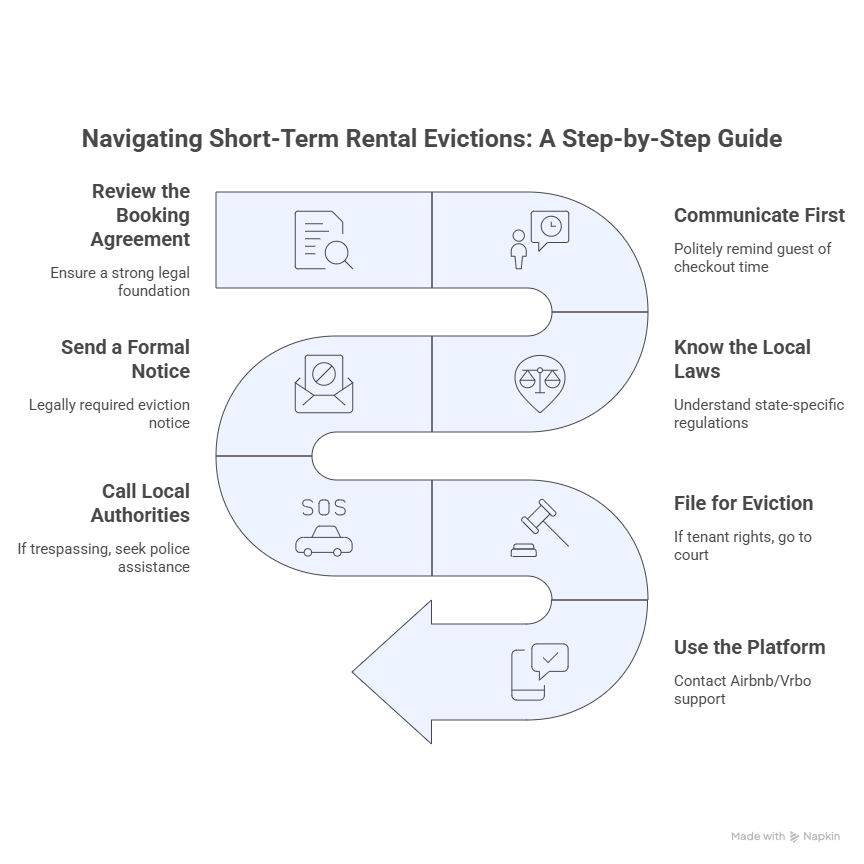
Path 1: Guest Removal (Trespass, No Tenant Rights)
If the person has not acquired tenant rights under your state’s laws, the process is faster:
- Confirm the reservation has ended. Screenshot the booking confirmation showing the checkout date. Pull records from Airbnb, Vrbo, or your direct booking system.
- Communicate in writing. Send a clear, documented message (text, email, or in-app message) stating the checkout date has passed and requesting immediate departure.
- Contact the booking platform. If the booking was through Airbnb or Vrbo, report the overstay through the platform’s resolution center. Airbnb allows hosts to charge an overstay fee of up to twice the nightly rate.
- Call local police. If the guest still refuses to leave, contact your local police department. Provide the booking records and checkout date. In most jurisdictions, police can remove overstaying guests as trespassers when the reservation has clearly ended and no tenant rights exist.
- Change the locks. Once the guest has departed (and only after), change or reset the lock codes. If you use smart locks, set codes to expire at checkout time as a preventive measure for future bookings.
Path 2: Formal Eviction (Tenant Rights Apply)
If the guest has stayed long enough to acquire tenant rights, you must follow your state’s formal eviction process. Attempting to remove them without a court order (changing locks, shutting off utilities, removing their belongings) is illegal in all 50 states.
- Serve a written eviction notice. The notice type and timeline depend on the reason and your state. Nonpayment notices typically require 3 to 14 days. Lease violation notices range from 3 to 30 days. “No cause” termination notices can require 30 to 60 days in states with such provisions.
- Wait for the notice period to expire. If the occupant does not leave within the notice period, proceed to court.
- File an eviction lawsuit (unlawful detainer). File in your local court. Filing fees range from $50 to $435 depending on the jurisdiction. In California, for example, court filing fees run $385 to $435.
- Attend the court hearing. Bring all documentation: the booking confirmation, rental agreement, communication records, photos of any damage, and the notice you served. The judge will issue a judgment of possession if the evidence supports eviction.
- Sheriff or marshal enforces the order. After the court issues an eviction order, the sheriff or marshal will serve the occupant and enforce the removal, typically within 5 to 14 days. In New York, a marshal posts a 72-hour notice before physical lockout.
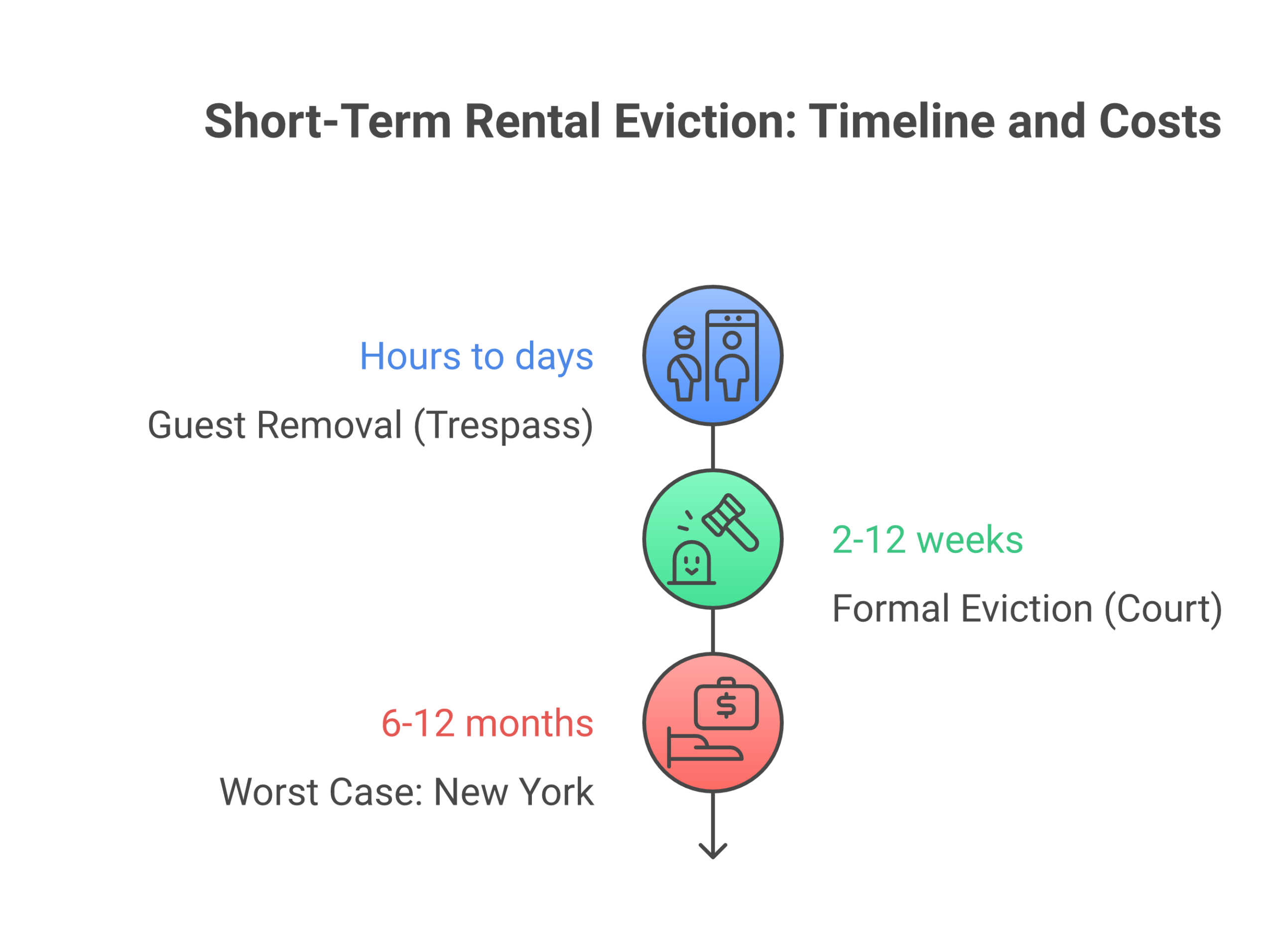
Total timeline for a formal eviction: 2 to 12 weeks in most states. In New York, contested evictions can take 6 to 12 months and cost $3,000 to $15,000+ in legal fees. In California, expect 6 to 12 weeks and $1,000 to $3,000 in costs.
Evicting an Airbnb Guest: Platform-Specific Process
Airbnb has its own policies for handling overstays, but the platform’s authority is limited. Here’s how it works in practice:
- Document the overstay. Screenshot the reservation showing the checkout date has passed.
- Message the guest through the Airbnb app. Keep all communication on-platform so Airbnb support can see it.
- Open a case with Airbnb support. Call or message Airbnb customer service. Provide the reservation details, your messages to the guest, and any evidence of the overstay.
- Airbnb will attempt contact. Airbnb may reach out to the guest, issue warnings, or charge overstay fees (up to 2x the nightly rate plus taxes and fees, per Airbnb’s overstay policy).
- If the guest still won’t leave. Airbnb cannot physically remove guests. You’ll need to involve local law enforcement (trespass) or file a formal eviction (if tenant rights apply).
Airbnb’s AirCover for Hosts covers up to $3 million in property damage, but it does not cover lost bookings during an eviction or legal fees. For better coverage, consider short-term rental insurance that specifically covers eviction-related losses.
How to Evict a Vrbo Guest
Vrbo’s process is similar to Airbnb’s, with a few differences:
- Review the rental agreement. Unlike Airbnb, Vrbo does not provide a standardized rental agreement. You should have your own agreement that specifies checkout dates, consequences for overstaying, and local legal provisions. The guest agreement template on 10XBNB works for both platforms.
- Contact the guest in writing. Send a formal notice through the Vrbo messaging system and via email or text.
- Report to Vrbo support. Vrbo’s support team can mediate and document the dispute, but like Airbnb, they cannot force a guest to leave.
- Follow the legal path. If the guest won’t leave, follow the trespass or formal eviction process outlined above, depending on whether tenant rights apply.
Can Airbnb Guests Become Squatters?
Yes. This is the nightmare scenario every host fears, and it does happen. When an Airbnb guest overstays long enough to gain tenant rights under state law, they effectively become a squatter with legal protections.
In California, this can happen after just 7 consecutive nights. In New York and Ohio, the threshold is 30 days. Once a guest crosses that line, you cannot simply call the police to remove them. You need a court order, which means weeks or months of legal proceedings while they live in your property rent-free.
A widely reported case involved an Airbnb guest who overstayed for 540 days in a California property. The host spent months in court and thousands in legal fees before finally regaining possession.
The best prevention: cap booking lengths at 27 days or fewer, use smart locks with auto-expiring codes, and never accept cash payments outside the platform (cash payments can be used as evidence of a landlord-tenant relationship).
The Short-Term Rental Loophole: What It Is and How to Close It
The “short-term rental loophole” refers to the gap in many states’ laws where guests can exploit vague tenant-rights thresholds to claim residency status. Some guests intentionally book long stays, then refuse to leave once they’ve crossed the tenant-rights threshold.
Here’s how to close the loophole on your properties:
- Maximum stay limits. Set your platform listing to a maximum of 27 consecutive nights. No exceptions.
- Strong rental agreements. Include explicit checkout dates, overstay penalties, and a clause stating the arrangement is a license, not a lease. A well-drafted house rules template is your first line of defense.
- No month-to-month extensions. Never verbally agree to extend a stay past 30 days. If a guest asks to extend, create a new booking through the platform.
- Smart lock codes. Use locks that auto-expire at checkout time. This forces the conversation immediately when a guest tries to overstay.
- Documentation from day one. Keep copies of the booking confirmation, all communication, and the signed rental agreement. If you ever end up in court, documentation wins cases.
Prevention: 7 Ways to Avoid Eviction Scenarios Entirely
The best eviction strategy is never needing one. These seven practices have kept the vast majority of my bookings trouble-free:
- Screen every guest. Check reviews from previous hosts. Look for patterns of complaints about overstaying, damage, or rule violations. If a guest has no reviews and won’t verify their identity, that’s a red flag. Our guide on how Airbnb vets guests covers the screening tools available to you.
- Set crystal-clear house rules. Specify checkout times, noise limits, maximum occupancy, and consequences for violations. Post them in the listing AND inside the property.
- Use a written rental agreement. Even for Airbnb bookings, have guests sign a supplemental agreement. This removes any ambiguity about the arrangement being temporary.
- Install smart locks. Codes that expire at checkout are the single best tool for preventing overstays. The guest literally can’t get back inside after checkout. Check out the automation tools in our hands-free automation guide for setup details.
- Communicate checkout expectations 24 hours before. A friendly automated message (“Just a reminder, checkout is tomorrow at 11 AM”) sets the expectation and creates a paper trail.
- Never accept off-platform payments. Cash or Venmo payments create evidence of a landlord-tenant relationship. Keep everything through the booking platform.
- Know your state’s laws before you start hosting. If you’re operating in a state with a low tenant-rights threshold (California, Montana, Florida), you need to be extra vigilant. Our state-by-state legal guide breaks down the regulations for every state.
Documentation Checklist for STR Eviction Cases
If you do end up in court, your documentation is your most powerful tool. Keep records of everything from day one:
- The original booking confirmation with checkout date
- Your rental agreement or house rules (signed by the guest if possible)
- All messages between you and the guest (screenshot in-app conversations)
- Photos or video of any property damage
- A copy of the eviction notice you served, with proof of delivery
- Police report numbers if law enforcement was contacted
- Records of communication with Airbnb or Vrbo support
- Receipts for any emergency expenses (locksmith, repairs, legal fees)
Courts favor hosts who can demonstrate a clear paper trail. Save everything, even if it seems minor at the time.
What Are My Rights as a Short-Term Rental Host?
As a property owner or operator, you have clear rights when dealing with problematic guests:
- Right to enforce your rental agreement. If a guest violates the terms, you can terminate the arrangement.
- Right to remove trespassers. If the reservation has ended and no tenant rights exist, the guest is a trespasser under most state laws.
- Right to collect damages. Through the platform (Airbnb’s resolution center, Vrbo’s damage protection) and through small claims court.
- Right to file for eviction. If tenant rights apply, you have the legal right to pursue a formal eviction through the courts.
What you cannot do: change locks while the occupant is inside, shut off utilities, remove their belongings, or threaten them. These “self-help” eviction tactics are illegal in all 50 states and can result in the court awarding damages to the occupant, even if they were the ones violating your agreement.
When to Involve a Lawyer
Not every eviction situation requires an attorney, but some definitely do. Consult a local real estate or landlord-tenant attorney if:
- The guest has stayed past the tenant-rights threshold in your state
- The guest claims they have a lease or tenancy agreement (even verbal)
- You’ve received any legal documents from the guest or their attorney
- The police refuse to remove the guest because they consider it a “civil matter”
- You own rental properties in a jurisdiction with strong tenant protections (New York City, San Francisco, Los Angeles)
Attorney fees for a straightforward eviction typically run $500 to $3,000. In contested cases, particularly in cities with tenant-friendly courts, expect $5,000 to $15,000 or more. That cost stings, but it’s far less expensive than the alternative: months of lost bookings while someone lives in your property for free.
How 10XBNB Students Protect Their Properties
Students in the 10XBNB rental arbitrage program learn how to set up their operations to minimize eviction risk from day one. The program covers legal entity structuring, rental agreement templates, guest screening workflows, and automation systems that prevent 90% of eviction scenarios before they start.
If you’re running rental arbitrage properties (or considering starting), having a proven system for handling tenant issues is not optional. A single eviction can wipe out months of profit. The hosts who succeed long-term are the ones who treat risk management as seriously as revenue optimization.
Book a free strategy call with 10XBNB to learn how the program protects your STR income from legal risks, problem guests, and operational mistakes.
Frequently Asked Questions
How long does it take to evict a short-term rental guest?
If the guest has not gained tenant rights, police can typically remove them within hours to a few days as a trespasser. If tenant rights apply, a formal eviction takes 2 to 12 weeks in most states. In New York, contested evictions can take 6 to 12 months.
Can I change the locks on an overstaying Airbnb guest?
Only after they have physically left the property. Changing locks while an occupant is still inside or still has belongings on the property is considered a “self-help eviction” and is illegal in every state. If they have acquired tenant rights, you must get a court order before changing locks.
What is the 30-day rule for short-term rentals?
In many states (Alabama, Kentucky, New York, Ohio, Pennsylvania), a guest who stays 30 or more consecutive days may gain tenant rights under state landlord-tenant law. This means they cannot be removed without a formal eviction process. Some states like California and Florida have even shorter thresholds (7 to 14 days). Always check your state’s specific laws.
Does Airbnb help with guest evictions?
Airbnb’s support team will contact the guest, issue warnings, and may charge overstay fees (up to 2x the nightly rate). However, Airbnb cannot physically remove a guest from your property. For physical removal, you need local law enforcement (trespass) or a court order (formal eviction).
How do I prevent Airbnb guests from becoming squatters?
Cap your maximum booking length at 27 days (below every state’s tenant-rights threshold). Use smart locks with auto-expiring codes. Never accept payments outside the platform. Have guests sign a written rental agreement that specifies the stay is a temporary license, not a tenancy. Screen all guests by reviewing their platform history and requiring identity verification.
Can police remove an Airbnb guest who won’t leave?
Yes, if the reservation has ended and the guest has not acquired tenant rights under state law. Bring the booking confirmation and checkout date to the police. If the guest has established tenant rights (stayed past the state’s threshold), police will usually classify it as a “civil matter” and direct you to file an eviction in court.