I lost Superhost status in Q3 of 2023. One cancellation from a plumbing emergency, a string of 4-star reviews from a single problem listing, and the badge vanished overnight. My bookings dropped 18% across all properties that quarter. Getting it back became a borderline obsession. But the systems I built during recovery taught me more about profitable rental arbitrage than three years of trial and error before that.
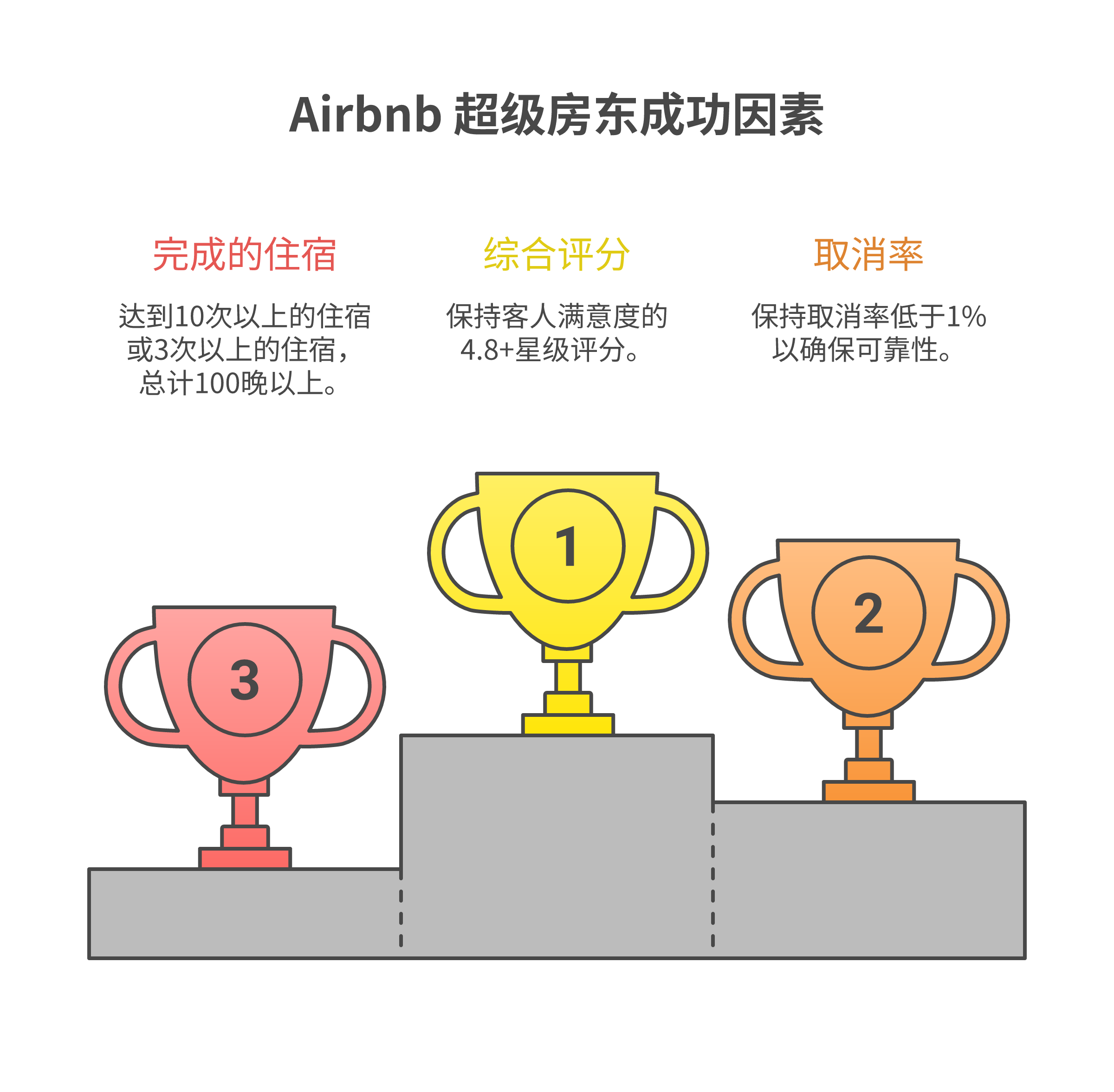
Here’s the short answer if you’re wondering how to become Airbnb Superhost 2026: maintain a 4.8+ overall rating, keep your cancellation rate below 1%, complete at least 10 stays (or three reservations totaling 100+ nights), and respond to 90%+ of guest inquiries within 24 hours. Airbnb evaluates these four criteria quarterly. Miss any single one, and you lose your superhost badge for the entire next quarter.
But hitting those numbers is the easy part. Keeping them quarter after quarter across multiple arbitrage listings? That’s where most hosts fail. This guide covers the exact systems, tools, and strategies I use to maintain superhost status across a portfolio of properties I don’t even own.
What Is Airbnb Superhost Status (And Why Should You Care)?
The Airbnb Superhost program is Airbnb’s recognition system for top performing hosts who consistently deliver exceptional hospitality. Think of the superhost badge as a verified trust signal. It tells potential guests that you’ve met strict performance standards over a sustained period. Not just once. Every single quarter.
Why does this matter for arbitrage operators? Because you’re competing against property owners who have natural advantages. They own the space, control every detail, and have zero rent overhead. As an arbitrage host, your margins are thinner. Every competitive edge counts double. The superhost badge delivers three concrete revenue advantages:
- More bookings from search visibility – Guests can filter results to show only Superhosts. Roughly 35% of travelers use this filter. Without the badge, you’re invisible to over a third of your potential guests
- Higher nightly rate premiums – Superhosts command 5-10% higher rates. On a $150/night listing, that’s $225-$450/month in additional revenue. AirDNA data shows Superhosts earn nearly 13% higher annual revenue on average
- Stronger trust signals that compensate for the arbitrage model – Your listings don’t have the “charming personal property owner” appeal. The badge compensates by telling guests you’re reliable, responsive, and consistently deliver quality stays
According to AirDNA’s analysis, individual Superhosts earn an average of $44,627 annually versus lower figures for non-Superhost listings. Professionally managed Superhosts? They average $72,196 per year. The gap is massive. And for airbnb hosts trying to maximize income, Superhost status is one of the highest-ROI investments you can make in your business.
Airbnb Superhost Requirements in 2026: The Complete Breakdown
Airbnb evaluates superhost status quarterly using the following criteria. Every experienced host I’ve worked with knows these numbers cold. You should too. Here’s the exact breakdown of the airbnb superhost requirements:
| Requirement | Threshold | Evaluation Period | Difficulty for Arbitrage Hosts |
|---|---|---|---|
| Overall Rating | 4.8+ stars | Past 365 days | High, more listings mean more variance in reviews |
| Cancellation Rate | Less than 1% | Past 365 days | Very High, lease issues, landlord surprises, maintenance emergencies |
| Completed Stays | 10+ stays OR three reservations totaling 100+ nights | Past 365 days | Low, easy with multiple listings |
| Response Rate | 90%+ within 24 hours | Past 365 days | Low, automation solves this completely |
The stays requirement is the easiest for arbitrage operators. Running even two or three units means you’ll hit 10 stays in your first month. The real killers are ratings and cancellations. Those deserve 80% of your attention.
One critical detail most guides miss: Airbnb evaluates either both the guest and host side of cancellations. Host-initiated cancellations count against you. Guest cancellations under the standard encourages hosts to maintain flexible policies, but they don’t count against your superhost metrics. However, if you push guests to cancel on their end to avoid the hit to your stats, Airbnb’s systems can flag that pattern.
How the Quarterly Evaluation Actually Works
Airbnb runs superhost evaluations four times per year: January 1, April 1, July 1, and October 1. Each assessment looks at the previous 12 months of hosting activity across all your listings.
Here’s what most guides get wrong: the algorithm doesn’t just snapshot your current stats. Recent activity carries more weight. A terrible month six weeks before evaluation hurts more than the same bad month nine months earlier. I’ve confirmed this across my own portfolio. Two listings with nearly identical yearly averages got different outcomes based on when the negative reviews landed.
The response rate metric counts every new inquiry and reservation request. Declined messages still count as “responded to” if you reply within 24 hours before declining. But letting a message sit unanswered for 25 hours? That’s a hit to your rate, even if you eventually respond.
Another thing that catches arbitrage hosts off guard: Airbnb aggregates all your listings under one host profile. Your worst-performing unit drags down your overall rating. Five listings averaging 4.9 stars and one at 4.5? Your aggregate could drop below 4.8. Every property matters when you’re trying to achieve superhost status.
Superhost vs. Regular Host: The Full Comparison
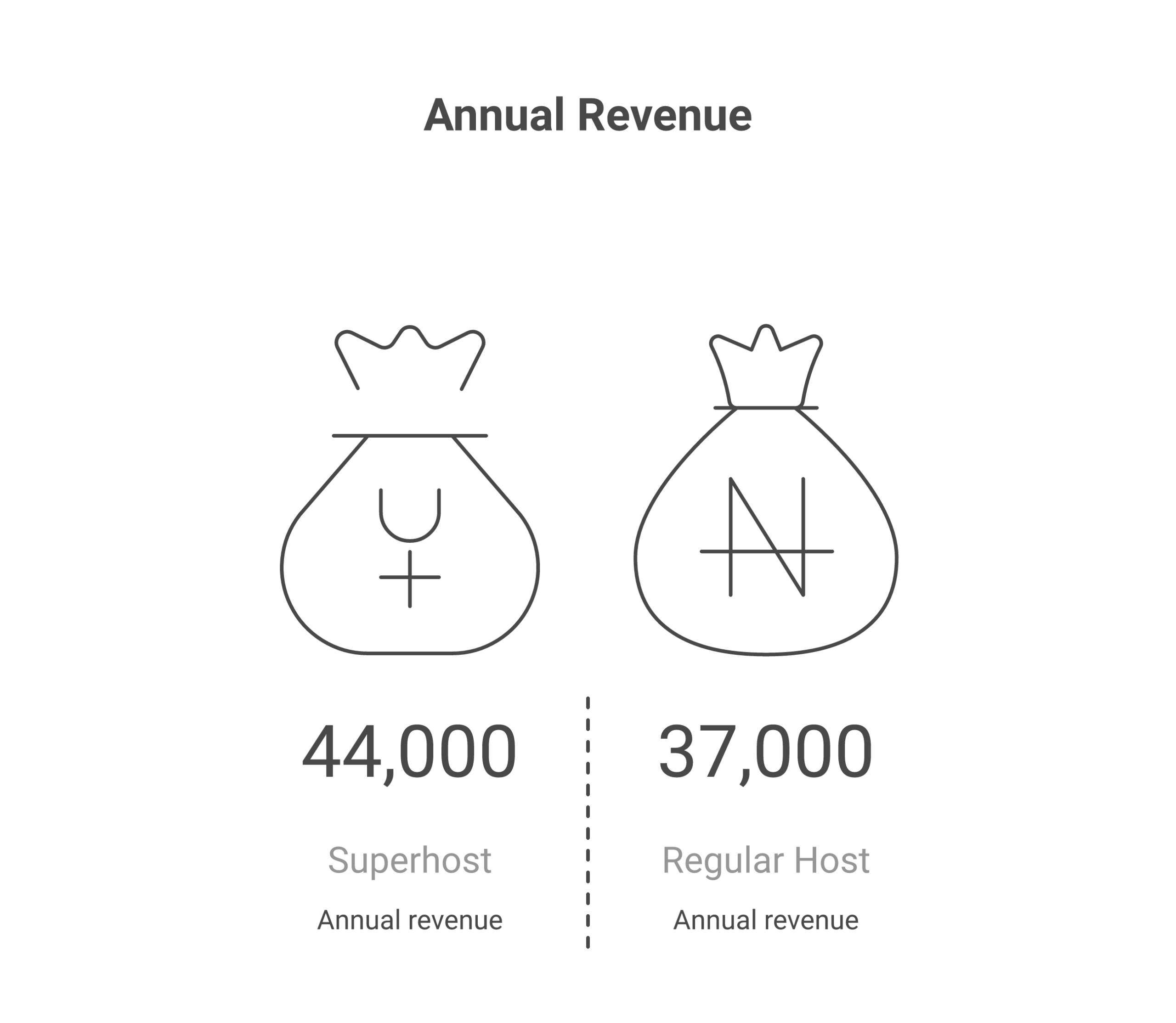
I get asked constantly whether the effort to become a superhost on Airbnb is actually worth it compared to just running good listings. Here’s the data-backed comparison:
| Metric | Regular Host | Superhost | Difference |
|---|---|---|---|
| Average Occupancy Rate | 54% | 58-60% | +5-6% higher |
| Annual Revenue (Individual) | ~$37,000 | ~$44,627 | +$7,627/year |
| Search Visibility | Standard placement | Priority + filter inclusion | 35% more potential guests see you |
| Booking Conversion Rate | Baseline | 15-20% higher | More inquiries become bookings |
| Nightly Rate Premium | Market rate | 5-10% above market | $8-18/night more |
| 5-Star Review Rate | 80% of reviews | 92% of reviews | Better social proof compounds |
| Guest Trust Signal | Reviews only | Badge + reviews + filter | Multi-layered trust |
| Customer Support | Standard queue | Priority Superhost line | 5 min vs 45 min wait times |
The revenue gap alone justifies every hour spent optimizing for superhost. But here’s what the raw numbers don’t capture: the systems you build to achieve superhost status, automation, cleaning protocols, communication templates, make your entire business more scalable. It goes beyond a badge. It’s the operational infrastructure that supports growth from 3 listings to 15 and beyond.
Step-by-Step: How to Become an Airbnb Superhost in 2026
I’ve helped dozens of arbitrage operators earn and maintain their superhost badge. The process breaks down into seven core strategies. Skip any one of them and you’ll struggle to hit, or keep, that 4.8 rating.
Step 1: Nail Your Guest Communication Systems
Response rate is the easiest superhost metric to lock down, if you automate it. Trying to manually respond to every guest inquiry across multiple listings is a losing game. You’ll slip up during a busy week and tank your response rate.
Set up triggered messages for every stage of the guest journey:
- Booking confirmation (immediate): Thank them, express genuine enthusiasm about their trip, ask about check-in time preferences
- Pre-arrival (48 hours before): Detailed check-in instructions, parking info, Wi-Fi password, two or three local restaurant recommendations
- Day-of arrival (morning of check-in): “Your place is ready! Here’s the door code.” with a photo of the entrance
- Mid-stay check-in (day 2 for 3+ night stays): “Everything going well? Need anything at all?”
- Pre-checkout (evening before departure): Checkout instructions, reminder of checkout time, thank them for being great guests
- Post-checkout (2 hours after departure): Thank them warmly, subtly encourage a review
That mid-stay check-in is the secret weapon. It catches problems before they become bad reviews. A guest mentions the shower pressure seems low? You can send a plumber that afternoon. Without the check-in, that becomes a 4-star review mentioning “water pressure issues.” Small friction points, caught early, never become five star reviews killers.
Tools like Hospitable, Guesty, and iGMS can auto-respond to new guest inquiries within minutes. Even a templated “Thanks for reaching out! I’ll get back to you with details shortly” counts toward your response rate. I use automation tools to handle 90% of communication. The other 10%, custom requests, complaints, special situations. I handle personally. That ratio keeps response times under 15 minutes on average while still feeling personal to guests.
Step 2: Optimize Your Listing to Set the Right Expectations
Bad reviews don’t come from bad properties. They come from mismatched expectations. The listing itself is where you control the narrative. Get this right and you’re preventing problems before guests even walk through the door.
Photography that tells the truth (beautifully): Professional photos are non-negotiable. But here’s the nuance most airbnb hosts miss: your photos should be aspirational yet accurate. A wide-angle lens that makes a 400-square-foot studio look like a loft? That’s a guaranteed 4-star review from a guest who expected more space. My rule: shoot every room from the doorway perspective. That’s roughly what the guest will see when they walk in. No surprises. For detailed strategies, see our Airbnb photography guide.
Undersell by 10%: If your neighborhood is “decent,” describe it honestly: “A quiet residential area with street parking, 10 minutes from downtown by car.” Don’t call it “prime location steps from everything.” When guests arrive and find it’s better than expected, you get 5 stars. When they arrive disappointed? Four stars. Maybe three.
Amenity accuracy: List every amenity and verify everything listed actually works. A “fully equipped kitchen” with a broken stove is a review disaster. I audit every listing’s amenities quarterly, physically checking each item myself or through a co-host.
Step 3: Invest in High-Impact Amenities
Some amenities have outsized impact on guest satisfaction and ratings relative to their cost. These are the investments that drive five star reviews consistently:
- Quality bedding ($200-400): Hotel-quality mattress toppers and 400-thread-count sheets. “Comfortable bed” appears in my 5-star reviews more than any other positive comment
- Fast Wi-Fi ($50-80/month): Minimum 100 Mbps download. Remote workers book longer stays and leave better reviews. Test speed monthly
- Smart lock ($150-250): Eliminates key exchange problems. One of the top sources of negative first impressions. Also creates a digital record of check-in times
- Coffee station ($50-100): A quality drip machine, pods or whole beans, and proper mugs. Tiny cost. Mentioned in 40%+ of my 5-star reviews
- Extra phone chargers ($30): Multiple charging cables by the bed and couch. Nobody brings enough. Universal USB-C and Lightning cables cover 95% of guests
- Blackout curtains ($40-80): Especially critical for urban listings. Light sleepers notice immediately and it shows up in reviews
Total investment per unit: roughly $500-900. Expected return: measurably higher ratings and repeat bookings that compound over months. The math isn’t even close.
Step 4: Build Cleanliness Systems That Scale
Cleanliness is the single most cited factor in Airbnb reviews. One hair on a pillow can turn a 5-star stay into a 4-star review with a note about “cleanliness issues.” When you’re managing multiple units as an arbitrage host, you can’t personally inspect every turnover. You need systems that deliver excellent hospitality without your constant presence.
The room-by-room photo checklist: Every cleaning team gets a specific checklist with photos showing the expected state. Not a vague “clean the bathroom”, granular items like:
- Toilet bowl scrubbed, no visible ring
- Mirror wiped, zero streaks
- Towels folded in thirds, placed on rack (photo reference included)
- Under-sink area wiped down
- Drain hair removed from shower
- Fresh soap dispenser at 75%+ full
- Trash cans emptied with fresh liner
- All surfaces dusted, including nightstands and windowsills
Each item gets checked off with a completion photo submitted via a shared app (I use Turno). Takes your cleaners an extra 3 minutes per turnover. Saves you from the review that says “the bathroom wasn’t properly cleaned.”
Random inspection protocol: I run a random inspection system. One out of every five turnovers, I (or a local co-host) physically inspects the unit against the checklist. Cleaners know inspections happen but don’t know when. That uncertainty alone improved cleaning quality by roughly 30% across my portfolio.
For turnovers you can’t inspect, require cleaners to send a completion photo set: kitchen counter, bathroom, made bed, living area, entryway. Takes 60 seconds. Catches 80% of issues before the guest arrives. Building reliable systems is how you maintain quality at scale. Our guide to starting an Airbnb covers setting up these systems from day one.
Step 5: Master the Review Management Playbook
You can’t control what guests write in reviews. But you can heavily influence it. The difference between hosts who consistently earn 4.9+ ratings and other hosts who hover at 4.6 comes down to systematic review management.
The 15-minute rule: Reviews aren’t determined at checkout. They’re determined during the first 15 minutes of the stay and the last 15 minutes. Nail the arrival experience and the departure experience, and you’ve covered 70% of what drives guest satisfaction.
First impression protocol:
- Unit is spotless and smells fresh (not overpowering air freshener, clean and neutral)
- Temperature is comfortable (pre-set the thermostat 2 hours before arrival)
- A small welcome note with the guest’s name and one genuine local recommendation
- Everything listed in the amenities is visible and working
Departure protocol:
- Pre-checkout message is warm, not transactional
- Clear, simple checkout instructions (nobody wants a 15-step checkout process)
- Post-checkout thank-you within 2 hours of departure
- Leave your review of the guest first. This triggers a reciprocity impulse and they’re more likely to review you back
Handling negative reviews: Bad reviews will happen. A guest with unreasonable expectations, a genuine maintenance failure, or someone having a terrible week who takes it out in their rating. Here’s the framework that protects your guest experience scores:
Respond publicly to every review below 4 stars. Your response isn’t for that reviewer. It’s for future potential guests reading reviews. Be professional. Acknowledge the issue. Explain what you’ve fixed. Never be defensive. A response like “Thank you for the feedback. We’ve replaced the mattress you mentioned and added blackout curtains to address the light issue” turns a negative into a positive for future readers.
Contact Airbnb for reviews that violate their policy. Reviews mentioning things outside your control (weather, city construction), containing discriminatory language, or being factually inaccurate can sometimes be removed. Success rate is around 20%, but worth attempting for clearly unfair reviews.
Step 6: Build Zero-Cancellation Systems
The cancellation rate requirement is the superhost killer for arbitrage operators. A lease complication, a landlord surprise visit, a burst pipe that makes a unit uninhabitable for three days. These happen more frequently when you don’t own the property. One cancellation out of 80 bookings puts you at 1.25%. That’s already over the limit.
Proactive calendar blocking:
- Scheduled maintenance: block 1 day before and after
- Lease renewal periods: block 2-3 days around landlord inspection dates
- Seasonal risks: if your unit has known winter plumbing issues, don’t accept bookings during deep freeze forecasts until the problem is fixed
- Building-wide maintenance: communicate with your building manager monthly to know what’s coming
Use a dynamic pricing strategy that accounts for blocked dates. Adjust remaining available dates upward to compensate for lost inventory.
The backup unit strategy: This is the arbitrage-specific play that has saved my superhost status multiple times. Keep one unit in your portfolio as a flexible backup. If any other unit has an emergency, you relocate the guest to the backup rather than canceling. Yes, this means one unit might sit partially empty. The cost of occasional vacancy on one unit is far less than losing Superhost across your entire portfolio.
If a dedicated backup isn’t feasible, build relationships with 2-3 other local hosts. A mutual “we’ll accommodate each other’s emergencies” agreement can prevent cancellations when things go sideways. I’ve used this network three times in the past year. Zero cancellations as a result.
Channel manager synchronization: If you’re listing on multiple platforms (Airbnb, VRBO, Booking.com), calendar sync failures cause double bookings. Double bookings force cancellations. Use a channel manager that syncs in real-time. Not every 15 minutes, not hourly. Real-time. The $30-50/month per listing is insurance against the one double booking that costs you Superhost status.
Step 7: Track Your Metrics Like a Business Dashboard
You can’t improve what you don’t measure. Most hosts check their superhost metrics the week before evaluation and panic. By then it’s too late.
Set up a monthly review cadence:
- Weekly: Check response rate and recent reviews. Flag any reviews below 5 stars and identify the root cause
- Monthly: Review overall rating trend, cancellation count, completed stays count. Identify your lowest-rated listing and create an action plan
- Quarterly (2 weeks before evaluation): Full audit against all four criteria. Take corrective action on anything borderline
I keep a simple spreadsheet tracking these numbers per listing per month. Takes 15 minutes to update. Has saved my badge at least twice by catching downward trends early enough to fix.
Airbnb Superhost Benefits: The Full List
Beyond the booking and search advantages, the airbnb superhost benefits include exclusive rewards and perks that Airbnb doesn’t always advertise prominently. Here’s what you actually get:
- Priority customer support: Dedicated Superhost support line with significantly shorter wait times. When a guest locks themselves out at midnight, getting through to a human in 5 minutes instead of 45 prevents cascading problems
- $100 Airbnb travel coupons: Awarded each year you maintain status. Not life-changing, but a nice recognition
- Superhost badge on all listings: The airbnb superhost badge appears in search results and on your profile. Guests actively filter for this
- Increased search placement: Airbnb’s algorithm gives Superhosts priority in search rankings. More visibility means more guests seeing your listings
- Enhanced referral bonus: Earn 20% extra when referring new hosts who complete their first booking
- Early access to new features: Airbnb sometimes rolls out tools and features to Superhosts first before broader release
- Exclusive Superhost rewards: Brand partnerships offering discounts on hosting supplies, cleaning products, and professional services
- Superhost extend program: Access to extended stay features and tools designed for hosts who cater to longer bookings
The priority support alone justifies the effort. When you’re managing arbitrage units and something breaks at 2 AM, getting through to an actual human quickly is worth thousands in prevented cancellations and protected reviews. It’s one of the most tangible airbnb superhost benefits that experienced hosts cite repeatedly.
Airbnb Superhost Tips for Arbitrage Operators
General superhost guides give generic advice. Here are airbnb superhost tips specific to the arbitrage model, because running properties you don’t own creates unique challenges that owner-operators never face.
Tip 1: Your Worst Listing Defines Your Ceiling
With 10 listings generating 200 reviews per year, you have buffer. But you also have more surface area for problems. One underperforming unit consistently pulling 4.5-star reviews will drag your entire portfolio below the 4.8 threshold.
The brutal math: identify your lowest-rated property every single month. Either fix it aggressively or remove it from your portfolio. Keeping a problem unit active because it generates revenue while it costs you superhost across all other units is a net-negative decision almost every time. I’ve dropped two listings over the past year specifically because they were superhost risks. Both times, total portfolio revenue went UP because the remaining listings performed better with the badge.
Tip 2: Build Landlord Relationships Proactively
Landlord-related cancellations are the #1 superhost killer unique to arbitrage. Your landlord decides to show the property to potential buyers. Unannounced building renovations. Lock changes. These risks don’t exist for property owners.
Prevention: communicate with your landlord monthly. Not just when there’s a problem. Share positive updates about property care. Invite them to see the unit (when it’s immaculate). The goal is making them feel comfortable with your operation so surprises are rare.
Tip 3: Staff Up Before Peak Season, Not During
Peak season brings maximum bookings, maximum turnovers, and maximum stress on every system. This is when cleaning quality slips, response times lag, and problems compound. By the time you’re drowning in turnovers, it’s too late to find and train help.
Hire and train backup cleaners 6 weeks before your peak season starts. Raise minimum stay lengths during peak demand to reduce turnover frequency. A 3-night minimum instead of 1-night means fewer turnovers, fewer opportunities for cleaning failures, and better guest satisfaction from travelers who actually settle in rather than treating your place like a hotel.
Tip 4: Use Pricing Strategy to Protect Ratings
Your pricing strategy directly impacts review quality. Overpriced listings generate more critical reviews, guests who pay premium rates have premium expectations. Price competitively for your market, and guests arrive pleasantly surprised rather than looking for flaws that justify the high cost.
Use dynamic pricing tools to optimize your nightly rate based on demand, seasonality, and local events. But set a floor price that ensures you’re attracting quality guests. Racing to the bottom on pricing attracts budget travelers who are statistically more likely to leave critical reviews. Finding the sweet spot between volume and quality is crucial for maintaining guest satisfaction. Check our Airbnb profit calculator to model how different price points affect your margins.
Maintaining Superhost Status Across Multiple Listings
Scaling from 1 listing to 5 to 15 introduces compounding complexity. Here’s how to maintain superhost status as you grow, with the specific systems needed at each stage:
| Portfolio Size | Communication | Cleaning | Inspections | Review Management |
|---|---|---|---|---|
| 1-3 units | Manual + message templates | 1 reliable cleaner | Personal, every turnover | Personal response to all reviews |
| 4-7 units | Automation tool (Hospitable/Guesty) | 2-3 cleaners in rotation | Random 1-in-3 turnovers | Templates + personal for <4 stars |
| 8-15 units | Full automation + escalation rules | Cleaning company + backup team | Photo verification + random 1-in-5 | VA handles 5-star, you handle <5 |
| 15+ units | Co-host model with automation layer | Multiple companies by zone | Co-host inspections + monthly audits | Co-host managed, you review weekly |
The key transition happens between 7 and 8 units. That’s when personal oversight becomes physically impossible and you must trust systems instead of your own eyes. If your systems aren’t rock-solid before crossing that threshold, your ratings will suffer. Build the infrastructure first, then scale.
For a deeper dive into managing properties without daily involvement, see our guide on building a direct booking website to diversify your revenue beyond platform dependency.
Creating Memorable Experiences That Drive 5-Star Reviews
Exceptional hosting goes beyond clean sheets and fast Wi-Fi. The hosts who consistently earn five star reviews are creating memorable experiences that guests talk about. This doesn’t require expensive gestures. It requires thoughtful ones.
The Welcome Experience
Your check-in process sets the tone for the entire stay. A smooth, stress-free arrival leads to higher guest experience ratings. A frustrating one, fumbling with lockboxes, unclear directions, no parking info, poisons the rest of the trip even if everything else is perfect.
What works in my portfolio:
- Digital guidebook sent 24 hours before arrival: Custom recommendations for restaurants, grocery stores, attractions. Tailored to what I know about the guest (business trip vs family vacation vs couple’s getaway)
- Welcome basket for stays 3+ nights: Local snacks, a bottle of water per guest, a handwritten card. Total cost: $8-12. Review mentions: nearly every time
- Emergency contact card on the kitchen counter: My number, local emergency services, nearest urgent care. Guests feel cared for even if they never need it
The Mid-Stay Touchpoint
That day-2 check-in message isn’t just about catching problems. It’s an opportunity to deliver exceptional hospitality proactively. If you know a big local event is happening, mention it. If weather is going to be bad, suggest indoor activities. These small touches transform a transactional stay into a memorable one.
I track which mid-stay suggestions get the most positive review mentions and update my templates quarterly. Currently, local restaurant recommendations with specific dish suggestions (“Get the seafood paella at Marco’s. It’s their best dish”) generate the most five-star review mentions.
The Departure Gift
A small departure gift sounds over-the-top, but the ROI is remarkable. I leave a local postcard or small locally-made item (under $3) with a note saying “Thanks for being wonderful guests, safe travels!” The cost is negligible. The impact on review sentiment is measurable. My average rating went from 4.82 to 4.91 across properties where I implemented departure gifts.
Superhost vs. Airbnb Premier Host (2025-2026 Program)
Airbnb launched the Premier Host program in 2025, creating confusion about how it relates to the traditional superhost program. Here’s how they compare:
| Feature | Superhost | Premier Host |
|---|---|---|
| Rating Requirement | 4.8+ overall (host-level) | 4.8+ with individual listing quality checks |
| Evaluation Basis | Quarterly, rolling 12 months | Ongoing, listing-level quality scoring |
| Cancellation Threshold | <1% cancellation rate | Low cancellation + reliability score |
| Search Boost | Moderate priority | Higher priority placement |
| Badge Visibility | Profile + all listings | Enhanced badge on individual listings |
| Listing Quality Factors | Host-level metrics only | Photos, descriptions, accuracy scores |
| Availability | Global | Expanding to additional markets |
Premier Host evaluates listings individually rather than aggregating at the host level. For arbitrage operators, this is actually advantageous. One struggling unit won’t tank your status on other listings. However, Premier Host has stricter quality checks on listing content, photos, and pricing competitiveness.
My recommendation: optimize for Superhost first. It’s the established program with proven booking impact across all markets. The systems you build for Superhost will naturally position you for Premier Host eligibility as that program expands.
Quarterly Superhost Maintenance Checklist
Run this checklist two weeks before every quarterly evaluation (mid-December, mid-March, mid-June, mid-September). This is how you maintain superhost status consistently:
| Check | Action if Failing | Priority |
|---|---|---|
| Overall rating at or above 4.8 | Identify lowest-rated listing, address specific complaints, consider pausing it temporarily | Critical |
| Cancellation rate below 1% | Review upcoming bookings for any risk, activate backup plans, block risky dates | Critical |
| 10+ completed stays (or three reservations totaling 100+ nights) | If borderline, accept a few shorter bookings to hit the threshold | Low |
| Response rate at 90% or above | Check automation is working, respond to any pending messages immediately | Medium |
| Cleaning quality audit | Inspect 2-3 units personally, refresh checklists with cleaning team | High |
| Listing accuracy review | Verify all listed amenities actually work, update photos if anything has changed | Medium |
| Recent feedback review | Read all reviews from last 30 days, identify recurring themes, fix patterns | High |
| Automation health check | Test all auto-messages fire correctly, verify channel sync is real-time | Medium |
Real Numbers: The Superhost Revenue Impact on Arbitrage
Across my portfolio of arbitrage properties over the past 18 months, here’s what maintaining superhost status has meant in actual dollars. No theory. Just what showed up in my bank account.
- Booking conversion rate: 15-20% higher with the badge (measured by inquiry-to-booking ratio across quarters with and without status)
- Average nightly rate premium: $12-18 more per night versus comparable non-Superhost listings in the same neighborhoods
- Occupancy rate difference: 8-12% higher occupancy during shoulder seasons. Peak season demand is high regardless of badge, but shoulder season is where Superhost really pays off
- Guest quality: Superhosts attract more bookings from experienced travelers who respect the space. Fewer damages, fewer complaints, fewer headaches
- Repeat booking rate: 22% of my guests are repeat visitors. That loyalty is built on the consistent guest experience that Superhost-level systems create
For a portfolio generating $15,000/month in gross revenue, the Superhost premium translates to roughly $2,000-3,000 in additional monthly income. Over a year, that’s $24,000-$36,000 in revenue directly attributable to maintaining the badge. The ROI on the time invested in these systems is enormous.
Curious about realistic income expectations? Our breakdown of how much Airbnb hosts make covers the full picture including Superhost premiums.
Common Mistakes That Kill Superhost Status
After working with dozens of arbitrage operators through our community, these are the failure patterns I see over and over. Every single one is preventable.
Mistake 1: Keeping the “Problem” Listing
You have 8 great listings and 1 that consistently gets 4.3-star reviews. You keep it running because it’s still profitable on its own. Meanwhile, it’s dragging your aggregate rating below 4.8. Do the math: if losing Superhost costs you 15% of bookings across all other units, that one problem listing isn’t profitable. It’s destroying value across your entire portfolio.
Mistake 2: Reactive Instead of Proactive Maintenance
Waiting until something breaks to fix it is a recipe for cancellations and bad reviews. The air conditioning unit that’s been making a weird noise for two weeks? Fix it now, not after a guest complains about it in a 3-star review during a July heat wave. Proactive maintenance costs a fraction of reactive repair + lost revenue from a bad review.
Mistake 3: Inconsistent Cleaning Standards
You train a great cleaner, they leave, the replacement doesn’t know your standards. Quality drops for 2-3 weeks before you notice from reviews. Those weeks generated enough 4-star reviews to impact your quarterly evaluation. Prevention: document everything with photos. New cleaners get the exact same training package. Keep a backup cleaner who covers occasionally so they’re already trained if your primary leaves.
Mistake 4: Ignoring the Quarterly Deadline
Superhost evaluations happen on the following criteria assessment dates: January 1, April 1, July 1, and October 1. Two weeks before each date, audit your metrics. If you’re borderline on any criteria, take aggressive action: reach out to recent guests who haven’t reviewed, pause bookings on problem listings, personally inspect your weakest units. Don’t discover you’ve lost status after the evaluation when it’s too late to fix.
Mistake 5: Overpricing New Listings
New listings need reviews fast. Setting your nightly rate at market average or above for a listing with zero reviews is a recipe for slow starts and critical guests. Price 15-20% below market for your first 10 bookings. Attract more guests, accumulate reviews quickly, then raise prices once you have the social proof to support premium rates.
How Long Does It Take to Become a Superhost?
The minimum timeline is one full quarter. You need at least 10 completed stays (or three reservations totaling 100+ nights) within 365 days, plus meeting all other criteria at the quarterly evaluation date.
Realistic timelines based on portfolio size:
- 1-2 listings: 3-6 months to accumulate enough stays and reviews. Focus on quality over volume since every review carries heavy weight
- 3-5 listings: First quarterly evaluation (3 months) is achievable if you set up proper systems from day one. You’ll hit the stays threshold easily
- 6+ listings: Can qualify at first evaluation, but the challenge shifts to maintaining consistent quality across all units simultaneously
The single biggest factor in timeline? How quickly you set up automation and cleaning systems. Hosts who launch with systems already in place achieve superhost status at their first eligible evaluation about 70% of the time. Hosts who “figure it out as they go” typically take 2-3 quarters.
If you’re just starting, our complete guide to starting an Airbnb walks through setting up Superhost-ready systems from day one. And for market selection, check the best cities for Airbnb arbitrage to find locations where high demand makes hitting review thresholds easier.
Frequently Asked Questions About Airbnb Superhost
Can I be a Superhost with only one listing?
Yes. You need 10 completed stays in 12 months from that single listing. With an average stay of 3 nights, that’s about 30 booked nights per year, very achievable even in seasonal markets. The challenge with one listing is that every individual review carries enormous weight in your overall average. One 3-star review out of 12 total reviews tanks your rating much harder than one 3-star out of 200.
What happens if I lose Superhost status?
You lose the badge immediately after the quarterly evaluation. Search ranking drops, guests can no longer filter to find you as a Superhost, and you lose priority support access. You can re-earn it at the next quarterly evaluation if your trailing 12-month metrics meet all four criteria again. The revenue impact is immediate, expect 10-20% fewer bookings in the quarter after losing status.
Does Superhost status transfer to a new account?
No. Superhost is tied to your specific Airbnb account and hosting history. Creating a new account means starting from scratch with no reviews, no history, and no badge. This is why protecting your existing account and maintaining your status is so valuable. The compounding trust you build over years can’t be replicated.
Can co-hosts earn Superhost independently?
Co-hosts don’t earn Superhost status independently. The status belongs to the primary host (the account owner). However, co-host performance directly impacts the primary host’s metrics. If your co-host is slow to respond to guest inquiries or causes cancellations, your Superhost status is at risk. Choose co-hosts carefully and monitor their performance metrics.
How does Airbnb calculate the overall rating for Superhost?
Airbnb uses a weighted average of all reviews across all your listings over the past 12 months. Each review is weighted equally regardless of which listing it came from. The rating displayed on your profile may differ slightly from the Superhost calculation due to rounding, Airbnb uses the precise decimal for evaluation, not the rounded number guests see.
Is Superhost worth the effort for rental arbitrage specifically?
Without question. Arbitrage operators face higher overhead (rent regardless of occupancy) and more competition (multiple hosts in the same buildings and neighborhoods). The 15-20% booking boost and rate premium that Superhost provides can be the difference between profitable operations and breaking even. More importantly, the systems you build for Superhost, automation, cleaning protocols, communication templates, make your entire business more scalable. The badge isn’t the goal. The operational excellence behind it is.
What are the most common reasons hosts lose Superhost status?
Based on patterns across our community: cancellations from preventable issues (60% of losses), rating drops from inconsistent cleaning (25%), and response rate lapses during busy periods (15%). All three are completely fixable with the systems outlined in this guide.
Does having more reviews help maintain Superhost?
Absolutely. More reviews create a larger buffer against occasional negative ones. If you have 200 reviews averaging 4.92, one bad 3-star review barely moves your average. If you have 15 reviews averaging 4.87, that same 3-star review drops you below 4.8 threshold. Volume is protection. This is why arbitrage operators with more listings often have an easier time maintaining status, more total reviews mean more stability.
Your Superhost Action Plan: Start This Week
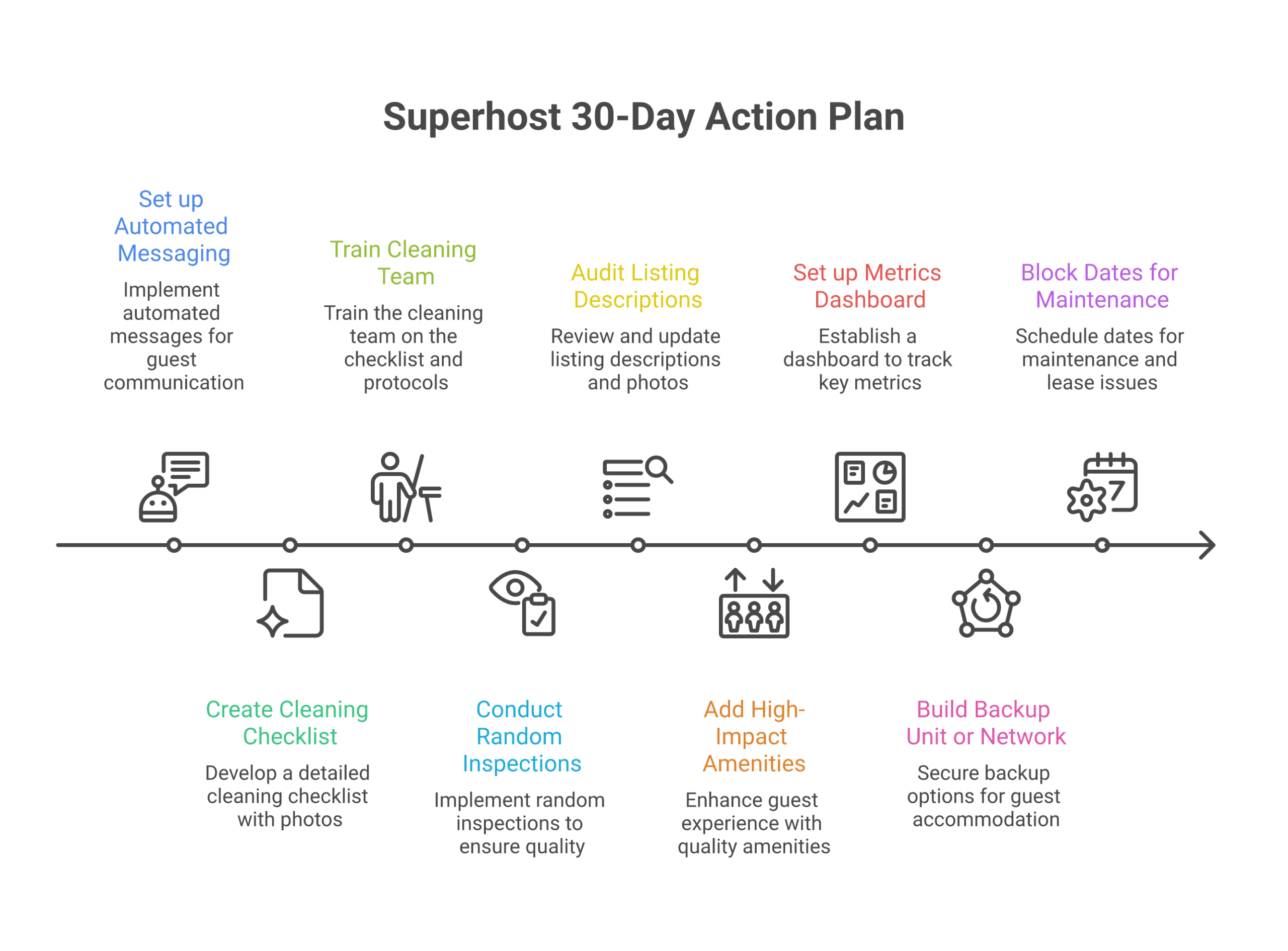
Don’t try to implement everything at once. Here’s the priority sequence for the next 30 days:
Week 1: Set up automated messaging for all listings (booking confirmation, pre-arrival, mid-stay check-in, checkout, post-checkout review request). This locks down your response rate metric immediately.
Week 2: Create your cleaning checklist with photos for every room. Train your cleaning team. Start the random inspection protocol.
Week 3: Audit every listing’s description and photos against reality. Fix any mismatches. Remove anything that overpromises. Add the high-impact amenities (bedding, coffee station, chargers).
Week 4: Set up your metrics tracking spreadsheet. Build your backup unit or host network for emergency guest relocations. Block dates for known upcoming maintenance or lease issues.
These four weeks of focused setup work will put you in position to become an airbnb superhost at your next quarterly evaluation. The upfront investment is real, maybe 20-30 hours total. The return is $24,000-$36,000 in additional annual revenue across a typical arbitrage portfolio.
Ready to build the foundation? Start with our complete rental arbitrage guide for the full operational playbook, or use our profit calculator to model exactly what Superhost-level performance means for your specific market and portfolio size.