
Airbnb bookkeeping is the practice of recording every dollar that comes into and goes out of your short-term rental business, in a way that survives an IRS audit and tells you which properties are actually making money. If you are renting out a place on Airbnb or Vrbo, you are running a business, and the books are the scoreboard. This guide is the same setup I walk new operators through inside 10XBNB before they ever scale past two doors. It is built on the real IRS rules (Schedule E, Schedule C, Publication 527, Publication 925), real software I have tested, and the monthly close workflow we teach our students.
By the end of this article, you will know exactly what to track, which IRS form your rental income goes on, which accounting software fits your size, and the monthly routine that keeps your books clean. No fluff, no fake case studies, no pretending taxes are simple when they are not.
If you want a real person to look at your portfolio and tell you which numbers actually matter for your goals, book a free coaching call with our team.
What Airbnb bookkeeping actually means
Bookkeeping is the daily record. It is every payout from Airbnb, every cleaning invoice, every Home Depot run, every Wi-Fi bill, every mile driven to fix a broken lock. Accounting is what you do with that record at tax time and when you decide whether to buy the next door.
Three things change once Airbnb income hits your bank:
- The payout you see is not your gross income. Airbnb takes a host service fee (typically 3% for most hosts) and may also collect cleaning fees, taxes, and damage deposits on your behalf. The IRS expects you to report the gross, not the net.
- The 1099-K you may receive is not the whole picture. Even when you do not get a 1099-K, every dollar earned is still taxable income. Airbnb’s official tax-form help page confirms hosts must report regardless of form delivery.
- Most expenses are deductible if (and only if) you have the receipt and the category is right. Sloppy bookkeeping is how operators pay tax on revenue they could have written off legally.
I have watched students hand a shoebox of receipts to a CPA in February and lose three weeks of their life to the cleanup. I have also watched students with a clean ledger pay 30% less tax in their first profitable year because they actually claimed everything. The difference is the bookkeeping system, not the smarts.
Why this matters more than people think
Two reasons. One is defensive. One is offensive.
Defensive: the IRS is paying more attention to short-term rentals. The threshold for Form 1099-K reverted to $20,000 in gross transactions AND more than 200 transactions under the One Big Beautiful Bill Act, but several states (Arkansas, DC, Illinois, Maryland, Massachusetts, Montana, New Jersey, Vermont, Virginia) have lower thresholds, so a 1099-K can still show up at far smaller volumes. You want books that match the form when it arrives.
Offensive: clean books make better decisions. If you do not know that Property A nets $1,200 a month and Property B nets $300 after cleanings, you cannot decide which one to keep. Operators who track at the property level (not just the portfolio level) find their losing units inside 90 days. Operators who only look at their bank balance find them after a year of bleed.
This is the part nobody likes to admit. Most hosts are not bad at hospitality. They are bad at math. Books are the cure.
What you actually need to track
Income
- Gross booking revenue per reservation (before Airbnb fees).
- Cleaning fees charged to guests (Airbnb passes these through; they are taxable income to you, and your cleaner’s invoice is the offsetting expense).
- Occupancy and lodging taxes collected. In many cities, Airbnb collects and remits for you. Some places they do not. Track both.
- Damage deposits or claim payouts received under AirCover.
- Co-host payouts if you split income with a partner or property owner.
Expenses
Everything that is ordinary and necessary for running the rental is deductible. The categories that actually move the needle:
- Cleaning fees paid to your cleaner (often the biggest single expense after rent or mortgage).
- Supplies and consumables: linens, coffee, toilet paper, soap, batteries, light bulbs.
- Repairs and maintenance: plumbing, locks, appliances, HVAC service.
- Utilities: electric, gas, water, internet, streaming services if provided.
- Insurance: short-term rental policy or commercial property coverage.
- Software: dynamic pricing, channel managers, accounting tools, locks, noise monitors.
- Marketing: professional photos, listing optimization, paid promotion.
- Professional services: CPA, attorney, bookkeeper.
- Mortgage interest, property tax, HOA dues (if you own).
- Rent paid (if you are arbitraging).
Mileage
Every trip to the property for a real business reason counts. Supply runs, repairs, owner meetings, guest emergencies. The IRS standard mileage rate for 2025 is 70 cents per mile. Log it in MileIQ or a paper notebook, but log it. Operators leave thousands on the table every year because they think the trip from Costco to the cabin “does not count.”
Depreciation
This is where most hosts get smaller refunds than they should. Two pieces:
- The building itself (if you own) is depreciated over 27.5 years under MACRS, per IRS Publication 527. You only depreciate the structure, not the land.
- Furniture, appliances, and structural improvements. Under the One Big Beautiful Bill Act, 100% bonus depreciation was permanently reinstated for qualifying property acquired after January 19, 2025. That means a $30,000 furniture buildout can potentially be written off in the year placed in service. This is the lever that makes the so-called short-term rental tax strategy work for operators who materially participate.
If you bought the property after 2017, ask your CPA about a cost segregation study. It is a paid engineering analysis that breaks the property into faster-depreciating components and can pull large deductions forward. We see students do this on properties with at least $300K of basis. Below that, the cost segregation fee can eat the benefit.
Occupancy taxes
Hotel tax, lodging tax, transient occupancy tax, tourist tax. The name varies; the math does not. Some cities collect via Airbnb. Some require you to register with the city, collect on direct bookings, and remit monthly or quarterly. Map your jurisdictions, because a $40 occupancy tax bill turned into a $4,000 penalty is the kind of mistake we see every quarter.
Three places to confirm what you actually owe:
- Your city or county finance department for the local tax rate, registration form, and remittance frequency.
- Your state department of revenue for state-level sales or accommodations tax (Florida and Texas are two examples where the state collects on top of the city).
- Your Airbnb listing dashboard under Taxes, which shows which taxes Airbnb is collecting on your behalf in that jurisdiction.
Even when Airbnb collects, you may still need to register the rental and file a zero return monthly. Skipping the registration is the part that creates penalties, not the math itself.
The chart of accounts we actually use
You do not need 50 categories. You need the 15 that match the IRS Schedule E line items and a few extras for management. The skeleton:
- Income: Rent revenue, Cleaning fee revenue, Refunds and discounts, Other income
- Direct expenses: Cleaning, Supplies, Repairs and maintenance, Utilities, Internet, Insurance, Software
- Occupancy: Rent paid (arbitrage) or Mortgage interest (owned), Property tax, HOA, Pest control
- Operations: Channel and host fees, Property management fees, Professional services (CPA, attorney), Bank and merchant fees
- Travel and admin: Mileage, Office supplies, Bookkeeping software, Phone
- Fixed assets: Furniture, Appliances, Improvements (each tagged for depreciation)
Match the line item names to the rows on Schedule E (page 1, lines 5-19) and your CPA can compile the return in one pass instead of three.
Schedule C or Schedule E: the call that changes everything
This is the single biggest tax decision you will make. Get it right and you save thousands. Get it wrong and you either overpay or invite an audit.
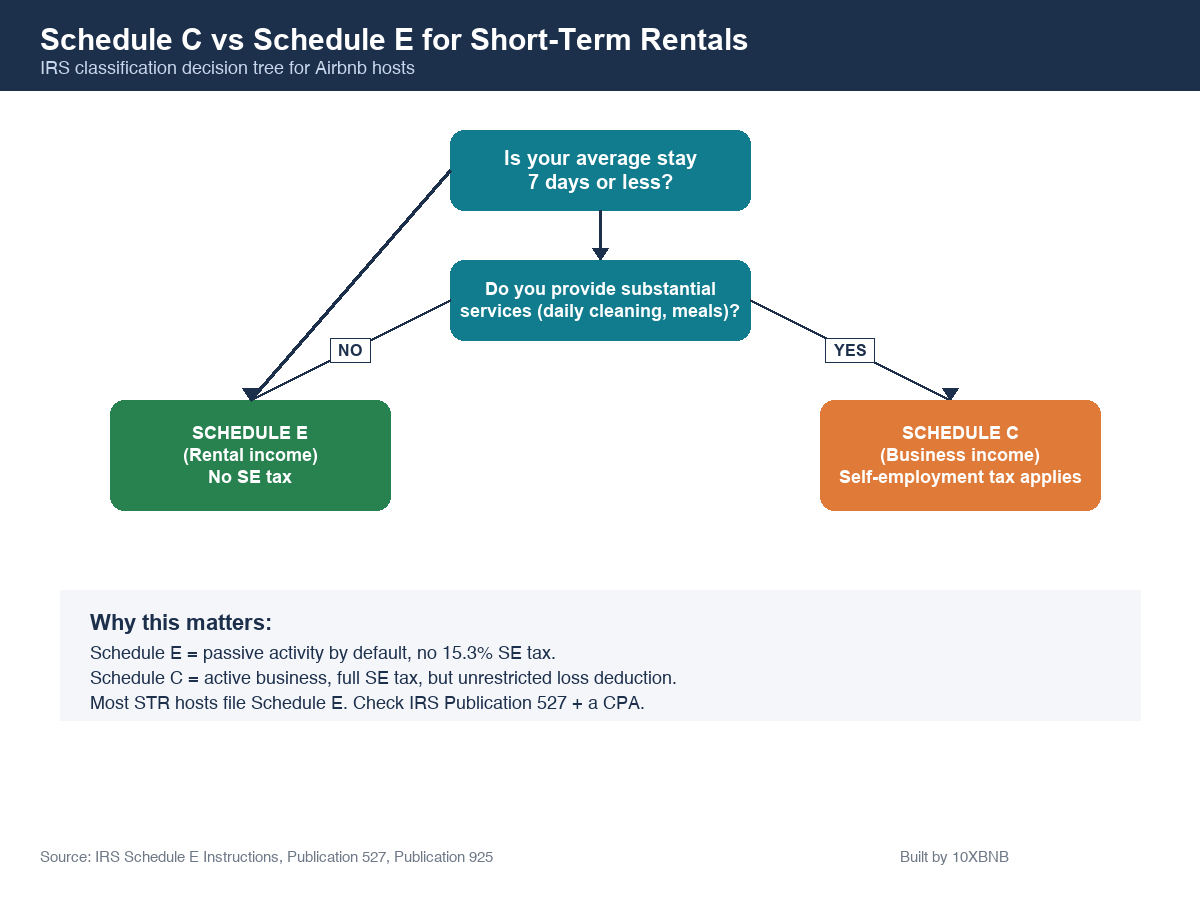
The IRS rule, in plain English: most rental real estate goes on Schedule E (Supplemental Income and Loss). But the Schedule E instructions are explicit: “if you provided significant services to the renter, such as maid service, report the rental activity on Schedule C, not on Schedule E.”
Two questions decide the form:
- Is your average rental period 7 days or less? If yes, the property is treated like a hotel for tax purposes under the rules in IRS Publication 925.
- Do you provide substantial services? Daily housekeeping during the stay, concierge, prepared meals, guided activities. Just changing the sheets between guests does not count as substantial.
If you answer “yes” to both, the IRS may classify it as a trade or business on Schedule C. That brings 15.3% self-employment tax into play on the net profit, but it also unlocks unrestricted loss deductions against ordinary income.
If you answer “yes” only to the 7-day question (the usual Airbnb pattern), most hosts report on Schedule E. No self-employment tax. Losses are normally passive, except for one important exception we will cover.
The exception that matters: the short-term rental tax strategy. When your average stay is 7 days or less AND you can prove material participation (typically 100+ hours and more than anyone else, or 500+ hours), the IRS treats the activity as non-passive even on Schedule E. Losses (often driven by bonus depreciation) can then offset W-2 income. This is what the high-income real estate community calls the “STR loophole.” It is legal. It is also paperwork-heavy. Time logs, contractor invoices, calendar exports, all of it has to be defensible.
Bottom line: do not guess. Talk to a CPA who actually works with short-term rentals before you file. The wrong form can cost more than five years of bookkeeping software.
Two quick examples from the field
Example 1: the Schedule E host. A student in Phoenix runs three units off Airbnb, average stay 4 nights, no concierge, no daily housekeeping. The cleaner turns the unit between guests. The host materially participated for about 180 hours managing renovations and guest communication that year. Filing path: Schedule E with non-passive treatment because of material participation, claiming cost-segregated bonus depreciation on roughly $42,000 of furniture and improvements. Result: large paper loss that offset W-2 income legally.
Example 2: the Schedule C host. A student in Sedona runs two boutique cabins, average stay 3 nights, but offers a curated mountain bike rental, breakfast delivery, and daily turndown service. The IRS likely views this as a hospitality business. Filing path: Schedule C with self-employment tax on net profit, plus business deductions on a more flexible footing. Higher tax bill on a profitable year, but unrestricted loss treatment on a slow year.
Same town, similar properties, completely different forms. The services delivered, not the property itself, drove the call.
The bookkeeping software stack: an honest comparison
I have either run or sat with students running every tool on this list. There is no one winner. There is a right tool for where you are right now.
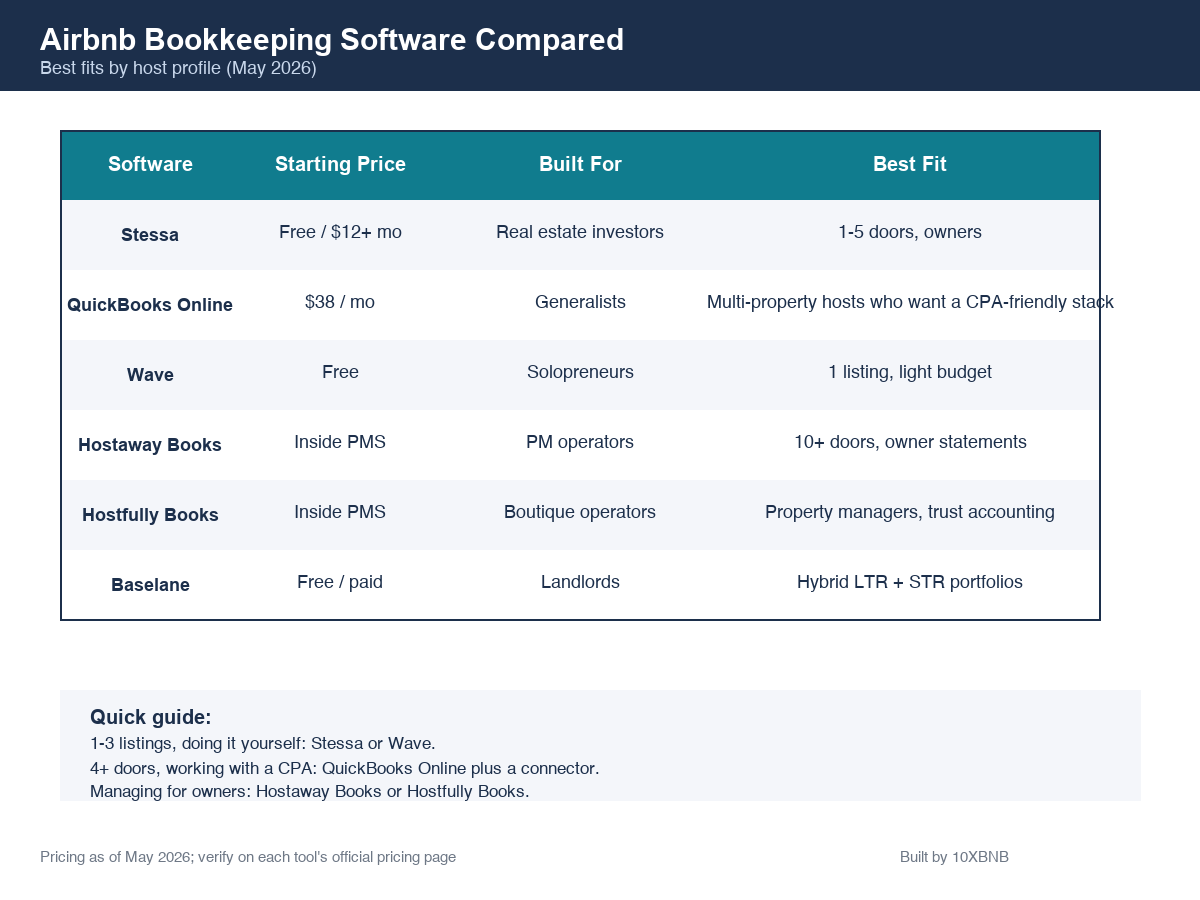
| Software | Starting price (May 2026) | Built for | Where it wins | Where it falls short |
|---|---|---|---|---|
| Stessa | Free; paid plans from $12 per month | Real estate investors | Property-level P&L out of the box; free tier is usable; auto-imports bank transactions; Schedule E export | Not double-entry; less flexible if a CPA wants full general-ledger reports |
| QuickBooks Online | Simple Start $38, Essentials $75, Plus $115 per month (Intuit) | Generalists, CPA-friendly | Industry standard; every CPA knows it; class tracking lets you split by property in Plus tier; tight integration with Airbnb via BnbTally connectors | Steeper learning curve; not STR-specific out of the box; class tracking requires the Plus tier |
| Wave | Free for the accounting core; paid add-ons for payments and payroll | Solopreneurs, one-listing hosts | Genuinely free; double-entry; clean reports | No real STR features; manual categorization; multi-property gets ugly fast |
| Hostaway Books | Included with Hostaway PMS (quote-based) | Property management operators | Owner statements, multi-channel revenue (Airbnb, Vrbo, Booking.com, Expedia) in one place; QuickBooks and Xero sync | Locked behind the full Hostaway subscription; overkill for a one or two-listing host |
| Hostfully Books | Included with Hostfully PMS | Boutique property managers | Trust accounting features for managers handling owner money | Same caveat as Hostaway: you pay for the PMS to get the books |
| Baselane | Free core with paid premium | Landlords running hybrid LTR and STR portfolios | Built-in banking, rent collection, and bookkeeping in one app; strong for portfolios with both long and short term | Newer player; STR-specific reports are still maturing |
The honest version: if you have 1-3 doors, start with Stessa or Wave. If you have 4+ and you work with a CPA, move to QuickBooks Online Plus with class tracking by property. If you manage units for owners, the books inside your PMS (Hostaway or Hostfully) save more time than a separate stack ever will. That is it. No tool will save bad input. Tools speed up clean input.
Want more on the broader software stack? Our roundup of the best Airbnb tools we use with students covers pricing, automation, and analytics in one place, and the best analytics tools rundown pairs the books with the dashboards.
The bookkeeping workflow we actually teach
Buying software does not give you books. A routine does. Here is the system we run with students inside 10XBNB. It takes 60-90 minutes a month per property once it is set up.
Day 0: set up the bones
- Open a dedicated business bank account for the rental. Personal funds never mix in. This single move is the difference between an audit you walk through in two hours and one that lasts six weeks.
- Open a separate business credit card for all property expenses. Cash back goes into the operating account.
- Pick your software (Stessa or QuickBooks for most hosts). Connect the bank and card.
- Set up a chart of accounts with the categories above. Most STR-specific tools come pre-set; you only need to add categories you actually use.
- Create one “class” or “property” per listing so every transaction can be tagged to the unit it belongs to.
Every reservation
- Let your software auto-import payouts, OR export the Airbnb earnings CSV monthly.
- Capture the gross amount, host service fee, cleaning fee passthrough, and any taxes Airbnb collected.
- Tag the property class.
Every week (15 minutes)
- Categorize new bank and card transactions.
- Snap and upload any paper receipts (cleaner cash, hardware store) into your software’s receipt module.
- Update mileage log if you drove to the property.
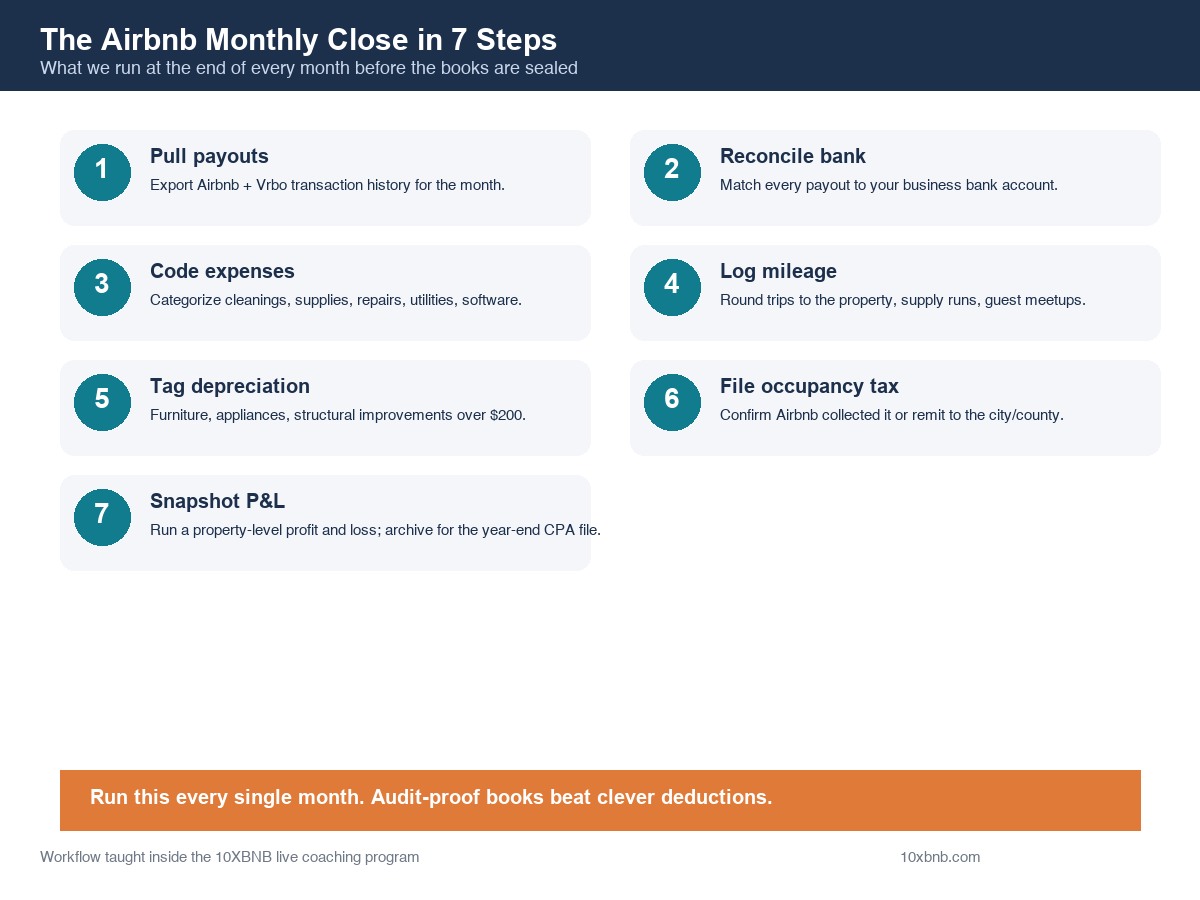
Every month (60-90 minutes)
- Pull payouts: export Airbnb + Vrbo transaction history for the period.
- Reconcile the bank: match every line to the statement. Differences get investigated, not papered over.
- Code expenses: nothing sits in “Uncategorized.”
- Log mileage for any property runs.
- Tag depreciable purchases over $200 (furniture, appliances, major repairs).
- File or verify occupancy tax for any jurisdiction Airbnb does not handle for you.
- Run a property-level P&L and a portfolio P&L. Save both as PDFs in a year-end folder.
Quarterly
- Pay quarterly estimated taxes (federal + state) using IRS Form 1040-ES. Most STR operators set aside 25-30% of net profit for tax. If you are unsure, the safe harbor is to pay in 100% of last year’s tax liability (110% if your AGI was over $150K).
- Review which properties are winning and which are dragging. Decide whether to renegotiate rent, raise pricing, or exit.
Year-end
- Run a full-year P&L per property.
- Export to your CPA along with: 1099-K (if received), mortgage interest statements, property tax bills, mileage log, and a fixed-asset schedule for anything you depreciated.
- Decide on Schedule E vs Schedule C with your CPA. Document material participation if you are claiming the STR strategy.
If you are still figuring out whether the unit itself even makes sense, our arbitrage calculator and startup cost breakdown give you the unit-economics view that pairs with the books.
The mistakes that cost hosts the most money
Patterns I see in the live coaching calls week after week:
- Booking net payouts as income. The Airbnb deposit in your bank is not gross revenue. Always work from the host earnings report. CPAs catch this in March and want to throw the laptop.
- Mixing personal and business funds. One Venmo for groceries that touches the rental card and your books need three hours of forensic work.
- Skipping mileage. Most hosts under-claim by 60% because they forget the small trips. A 2,000-mile year at the 2025 rate of 70 cents is $1,400 in deductions, gone.
- Never categorizing depreciation. Treating a $4,000 sofa replacement like a supply expense instead of a fixed asset misses the cost segregation conversation entirely.
- Ignoring occupancy tax. Airbnb collects in many cities, not all. Penalties compound fast.
- Filing Schedule C without substantial services. Self-employment tax of 15.3% paid for no real reason.
- Filing Schedule E and trying to write off W-2 income without material participation logs. The audit risk is real and the paper trail has to exist before the IRS asks.
- Waiting until April. Year-long messes do not compress into a weekend. Monthly close beats annual scramble every year.
None of these are stupid mistakes. They are the mistakes of operators who got busy. The fix is the routine, not the IQ.
When you actually need a CPA
You can DIY the books. The taxes themselves are where I push every student to get help.
Get a CPA who works with short-term rentals if any of these are true:
- You earn more than $50,000 of W-2 income and want to use the short-term rental strategy to offset it.
- You own the property and are considering cost segregation.
- You have 3 or more units, or units in 2 or more states.
- You took a 1099-K and the gross does not match your records.
- You are in a city with active enforcement (Nashville, New Orleans, Honolulu, anywhere in California).
- You bought property after January 19, 2025 and are weighing bonus depreciation.
A short-term-rental-savvy CPA typically charges $1,500-$4,000 for an annual return, depending on portfolio size. The Journal of Accountancy is a decent place to find specialty CPAs and read what they are publishing on STR rules. Ask any candidate three questions: how many STR returns they file each year, whether they have personally taken the STR strategy on a client’s return, and how they handle multi-state filings. If they hedge, keep looking.
How 10XBNB students approach the books
Here is what we actually do inside the program. We do not sell software. We do not sell tax services. We coach operators through the system that surrounds whichever tool they pick.
That looks like:
- Live coaching on the books two times per week, with operators who run multi-property portfolios.
- A student community sharing real CPAs, real cost seg vendors, real cleaners, and real mistakes so you do not pay for the same lesson twice.
- Mentorship from operators who collectively manage close to 1,000 doors, so you can ask “what would you do here” and get an answer the same day.
- The full operator playbook covering acquisition, listing setup, pricing, automation, hiring, and yes, the books and tax setup.
If you want to see whether the program fits your situation, the next step is to book a free coaching call. We will look at your portfolio, your goals, and tell you honestly whether it is the right move. If it is not, we will tell you that too. Our comparison of the best Airbnb courses available in 2026 is worth a read first if you want the wider landscape, and if you are transferring an existing listing into a new entity for tax reasons, our guide to transferring an Airbnb listing covers the mechanics.
Frequently asked questions
Do I need separate books for each Airbnb property?
You need separate ledgers, not separate companies. Use class tracking in QuickBooks or the property tagging in Stessa so every transaction is tied to one unit. You can hold all units inside a single LLC for liability and still run property-level reports.
Should I report Airbnb income on Schedule E or Schedule C?
Most hosts report on Schedule E. You only move to Schedule C when you provide substantial services (daily housekeeping, meals, concierge) on top of the rental. The IRS Schedule E instructions and IRS Publication 925 are the source documents; a CPA who handles STRs is the safest call.
What if I do not get a 1099-K from Airbnb?
You still report all of the income. The 1099-K is a reporting form for Airbnb, not the trigger for your tax obligation. The federal threshold is $20,000 in gross transactions and 200+ transactions, and several states have lower thresholds. If you do not receive one, pull your earnings report directly from Airbnb’s host dashboard.
Can I deduct the mortgage on my Airbnb?
Only the interest portion, not the principal. Property taxes are deductible. If you also live in the home for more than 14 days a year, the IRS vacation-home rules (Publication 527) split expenses between personal and rental days, and your deductions are limited to rental income. Pure investment STRs are simpler.
How long do I need to keep Airbnb records?
Three years from the date you filed is the standard IRS audit window for most situations. Six years if you under-report income by 25% or more. Seven years if you claim a loss from worthless securities or bad debt. Keep digital copies of bank statements, payout reports, receipts, mileage logs, and depreciation schedules.
Do I have to pay quarterly estimated taxes on my Airbnb income?
If you expect to owe at least $1,000 in federal tax after withholding, yes. Use IRS Form 1040-ES. The safe harbor is paying 100% of last year’s tax liability (110% if your AGI was over $150,000). Most STR operators set aside 25-30% of net profit for federal plus state income tax and self-employment tax (if Schedule C).
What software do you actually use yourself?
I run QuickBooks Online Plus with class tracking by property because we work with a CPA who lives in QuickBooks. For students with 1-3 units, I almost always start them on Stessa because the free tier is honest and the property-level P&L is what they need. Big PMS operators with 10+ doors end up in Hostaway Books or Hostfully Books because owner statements alone justify the move.
How do cleaning fees get reported?
The cleaning fee Airbnb passes through to you is part of your gross income, even though you turn around and pay the cleaner out of it. Book the inbound cleaning fee as revenue. Book the cleaner’s invoice as a separate cleaning expense. The two roughly net out, but the IRS expects to see both lines, not just the difference.
Can I write off furniture for an Airbnb I just bought?
Yes, and 2026 is a strong year to do it cleanly. Under the One Big Beautiful Bill Act, 100% bonus depreciation is permanently in effect for qualifying property acquired after January 19, 2025. A documented furniture and appliance buildout can usually be expensed in full the year placed in service. Real property improvements (HVAC, roofing, structural work) often go on the 27.5-year MACRS schedule unless a cost segregation study reclassifies components. Keep every invoice. Photograph the install. The audit defense is the paperwork.
What is the difference between repairs and improvements?
Repairs keep the property in working order and are fully deductible in the year paid. Improvements add value, prolong useful life, or adapt the property to a new use, and they are capitalized and depreciated. Fixing a leaky faucet is a repair. Renovating the bathroom is an improvement. The IRS publishes the “Betterment, Restoration, Adaptation” test in the tangible property regulations; when in doubt, ask the CPA before you book it.
Is paying a bookkeeper worth it?
For a single host on one or two properties, no. The monthly workflow above takes 60-90 minutes and you learn the business through the books. Once you cross 5+ doors, a part-time bookkeeper at $200-$500 per month usually saves more than they cost in catch-up fees, missed deductions, and your own opportunity cost. We see most students hire on the 4th or 5th door.
Final word
Airbnb bookkeeping is not glamorous. It is the work that makes everything else in this business real. Clean books tell you which properties to keep, when to scale, and what to legally write off. Sloppy books cost you in cash and in sleep.
Pick the right form (Schedule E for most). Pick the right tool for your size. Run the monthly close. Get a CPA before April. Those four moves separate hosts who own a job from operators who own a business.
If you want our team to look at your specific situation and map the path from where you are to where you want to be, grab a free coaching call here. No pitch deck, no pressure. Real answers from operators who have done it.
Related Operator Deep Dives
Other reviews and comparisons in this cluster operators have found useful: