
Short answer: AirDNA is the most complete short term rental data platform on the market in 2026, and it is worth the money if you are scouting multiple markets or running more than a handful of doors. For a single investment property side hustler, the free Rentalizer tier is usually all you need. A paid AirDNA subscription now starts at around $20 a month for a small market, about $12 a month if you pay for the year, and climbs quickly from there. After running AirDNA next to four competitors across 18 of my own deals, plus what my students have pulled, here is the honest operator take in this AirDNA review.
I have used AirDNA since 2019. I have watched students lean on it to find winning short term rental markets, and I have also watched a few of them get burned because they trusted Rentalizer projections in a thin rural market with nine comparable listings. This AirDNA review is the version I wish I had read before paying for my first subscription, written for hosts and real estate investing operators who want a good answer, not a sales pitch.
Not sure if AirDNA is the right call for your stage? Most of our students do not actually need a paid AirDNA subscription on day one. Book a free 10XBNB coaching call and we will tell you which tools are worth paying for at your current portfolio size, and which are a waste.
What AirDNA Is: The Best Data in Short Term Rental
AirDNA is a short term rental analytics service founded in 2015 and headquartered in Denver, Colorado. The company tracks more than 10 million properties across over 120,000 markets globally, pulling listing-level information from Airbnb and Vrbo vacation rentals, then layering statistical estimation on top to provide nightly rates, occupancy rates, revenue projections, and seasonality insights. For most operators it is simply the best data source available for vacation rentals.
It is the closest thing the short term rental industry has to a default data source. When you read a market report on Skift, a forecast from a hospitality consultant, or a CNBC piece quoting STR figures, the numbers most often trace back to AirDNA.
That said, AirDNA does not own the data. It scrapes it. The platform does not see your actual Airbnb back-end. It models what your competition is doing from the outside, so your gut should treat the output as an informed estimate, not gospel. Understanding that limit is the difference between a good market read and a costly one.
The Two Products Inside AirDNA: Rentalizer and MarketMinder
People talk about AirDNA as one tool. It is actually two products that investors use very differently.
Rentalizer is the property-level revenue estimator. You type in an address, pick beds, baths, and guest count, and it spits out projected revenue, ADR, and occupancy based on comparable listings, the comps, within a defined radius. This is the tool 90 percent of people first encounter when they Google an address. There is a free version with a small number of free lookups and a paid version with PDF reports and unlimited lookups inside an AirDNA subscription.
MarketMinder is the analytics dashboard. It gives you city or submarket level views of ADR, occupancy rates, RevPAR, supply growth, seasonality, top-performing properties, regulation notes, and a market grade. This is where investors actually live once they are scouting a short term rental market seriously. Data refreshes monthly, with the prior month’s numbers posting early in the following month.
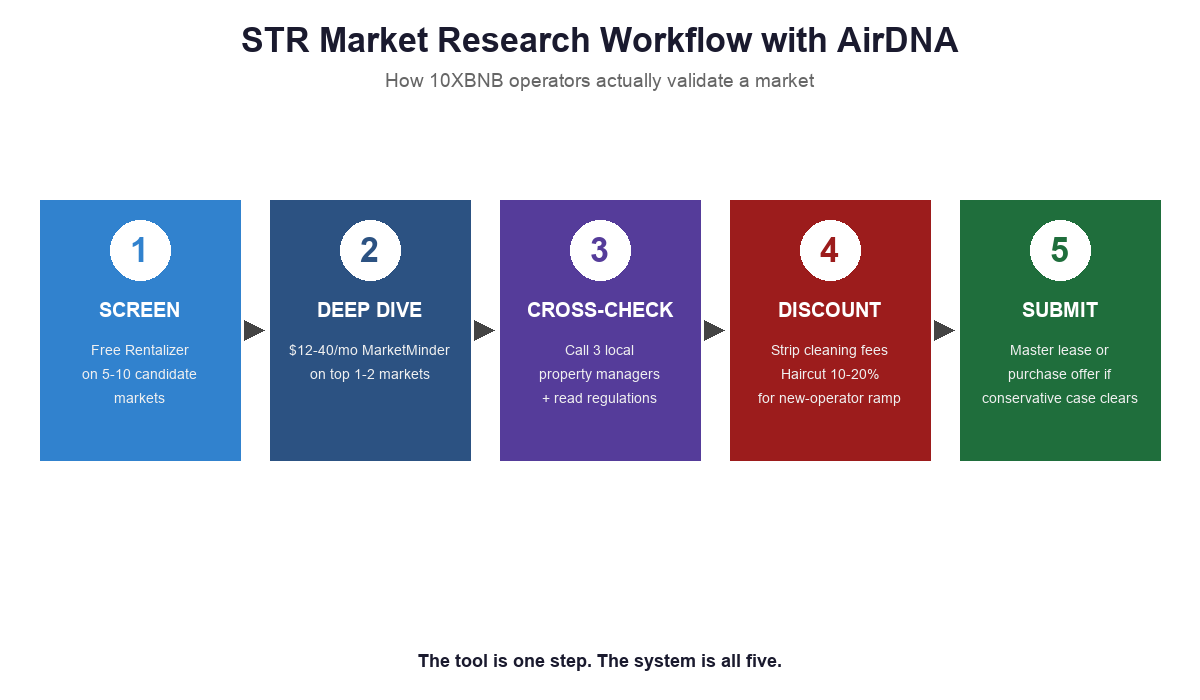
Most arbitrage operators I know use Rentalizer for the first-pass screen and MarketMinder for the deep dive. If you treat Rentalizer as the only step, you are making decisions on incomplete information.
AirDNA Cost and Subscription Plans in 2026
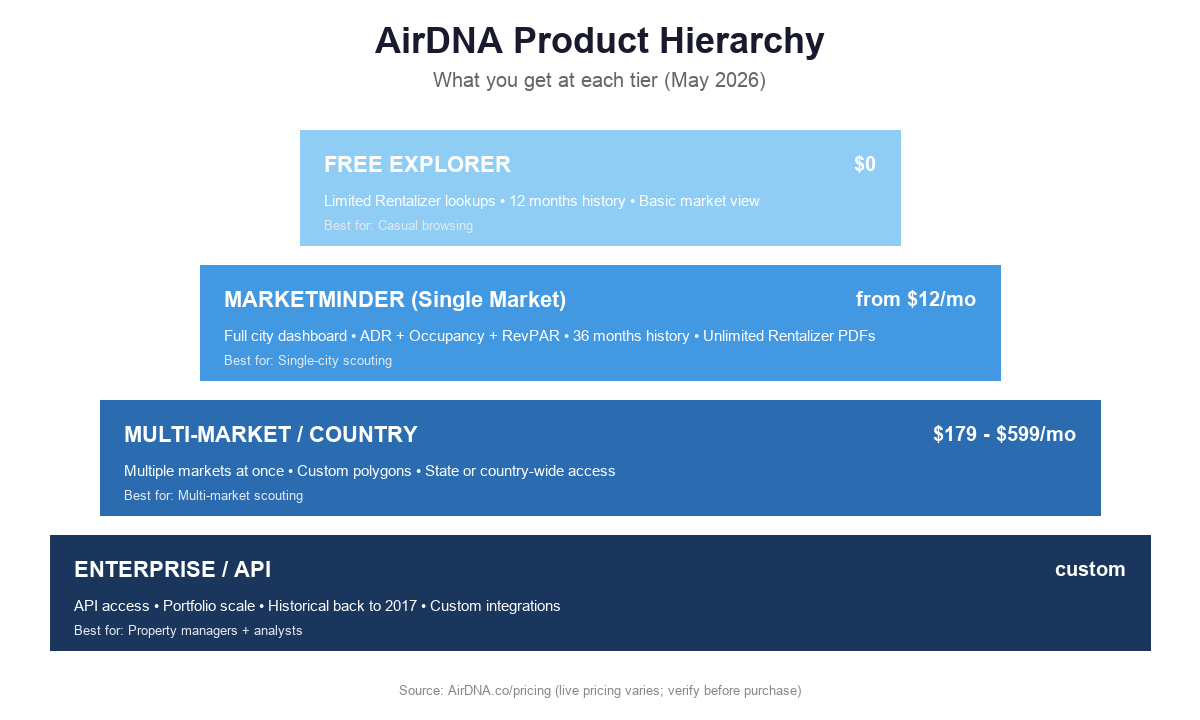
AirDNA’s pricing has moved several times in the last 24 months, and the plan names changed too, so check the live figures on the official AirDNA pricing page before you buy. As of June 2026, the subscription is priced by how many active listings sit in the market you want to research, and the plan tier you pick sets how deep the features go.
AirDNA Subscription Plans, Tier by Tier
- Free: The ability to explore every short term rental market on the planet at a glance, 12 months of historical data, and a limited number of Rentalizer lookups. No CSV export. A good first look before you pay.
- Research (most popular): Submarket access, the ability to draw polygons on the map, 36 months of history, CSV export, and custom comp sets so you can build your own comps. This is the AirDNA subscription most market scouters actually buy.
- Host (best value): Everything in Research, plus the ability to push Smart Rates to your calendar, competitor rate visibility, and Uplisting property-management integration for three listings (an advertised $1,200 value, then +$20 per month for each additional listing).
- Advanced: Everything in Host, plus historical data going back to 2017, five-year analysis, deeper market insights, and premium tools like the Repeat Rent Index and year-over-year market analysis.
- Property Manager: Built for PMs running 6+ properties who need portfolio-level insights and benchmarking across listings.
The subscription price is driven by the size of the market, not the plan name:
- Small market (under 100 active listings): $19.95 per month, or roughly $12 per month if you are billed annually.
- Mid-size market (100 to 1,000 active listings): $39.95 per month, about $24 per month billed annually.
- Major market (over 1,000 active listings): $99.95 per month, about $60 per month billed annually.
- Global access: $999.95 per month, or about $599.99 per month billed annually, to explore any market worldwide.
AirDNA runs a 40 percent annual discount fairly consistently. If you commit to a year, you save real money. If you bail after two months, you waste real money. Make the call based on whether you actually have a market scouting project that justifies 12 months of access, not on a coupon. For the features and terms included at each level, AirDNA documents the breakdown in the AirDNA Help Center.
For most arbitrage operators getting started, the free Rentalizer tier plus a single small-market subscription at roughly $20 to $40 a month covers what they need to find good markets. If you are scouting six markets at once, the math flips and stacking several markets, or stepping up a tier, starts to make sense.
Billing, Free Account, and Cancellation
Create a free account in a couple of minutes and explore markets before you enter a card. When you subscribe, AirDNA bills monthly or annually and renews automatically until you cancel inside your account. Confirm the cancellation and refund terms on your account page before you accept the annual terms. Refund handling on annual plans varies, so check the refund policy, then time the subscription to a real research project and cancel once the analysis is done.
How AirDNA Maps a Short Term Rental Market
This is the part most AirDNA reviews skip. Understanding the methodology tells you exactly where the data is reliable and where it is not.
AirDNA scrapes publicly visible Airbnb and Vrbo listings. It can see the nightly rates a host is asking, the listing’s calendar (booked vs. blocked vs. open), the number of bedrooms, the amenities, the reviews, and the photos. It cannot see:
- The actual amount a host received after Airbnb’s host fee.
- Last-minute discounts and Smart Pricing adjustments that fired hours before booking.
- Cleaning fees broken out separately from the nightly rate in revenue projections. AirDNA folds cleaning into total revenue, which can inflate the per-night picture.
- Direct bookings and off-platform messages between a host and repeat guests.
- Blocked dates that were actually owner stays vs. truly unbookable nights, which affects occupancy estimates.
- Refunds, chargebacks, and host-issued discounts after the booking is on the books.
- The cohort of guests behind each booking, so demographic shifts in a market are invisible to the model.
Two methodology details matter. First, the platform refreshes monthly, with the prior month’s numbers posting early in the following month, so the data you pull on the 3rd is up to a month behind reality. A fresh regulation change or supply shock will not show up for several weeks. Second, the available-days denominator drives occupancy. A host who blocks the calendar for personal travel looks artificially high, because the model treats blocked nights as unavailable rather than unsold. Always read paid occupancy and available occupancy side by side.
One more wrinkle: AirDNA’s revenue figures historically include some prorated future bookings on the calendar. A property with a heavy October trade-show booking already on the books will show inflated September data, because the booking value is recognized partially across the stay window. For most decisions this is a rounding error, but for tight underwriting on a high-RevPAR property, pull several months of data and read the trend rather than any single snapshot.
AirDNA then runs statistical models to estimate the gap between calendar-booked and actual revenue. The company publicly claims high accuracy on its core revenue and occupancy metrics, with stronger performance on Airbnb than on Vrbo. In my experience those claims hold up well in dense urban markets where there are hundreds of comparable listings to analyze. In a rural mountain town with 30 listings total, projections can drift 15 to 30 percent in either direction. That is not a knock on AirDNA. That is statistics: thinner samples produce wider error bars.
Where AirDNA Wins: Finding Profitable Properties
AirDNA’s strongest use cases, in order, all point back to helping investors find profitable properties faster:
1. Mature, dense urban markets. Nashville, Austin, Scottsdale, Orlando, Denver, San Diego: AirDNA data is good and dependable. The platform has thousands of listings to model from, the comps are good, and the projections track real-world performance within a tight range. For these markets, the subscription is genuinely worth what it costs.
2. Multi-market scouting. If you are deciding between four candidate markets, AirDNA lets you compare them on the same metrics: ADR, occupancy rates, RevPAR, supply growth, seasonality, top properties. Doing this manually by scrolling Airbnb is impossible. This is also where AirDNA’s market grade and Investment Explorer features earn their keep, giving investors the ability to research and rank markets in one place.
3. Historical depth. The Advanced tier goes back to 2017. If you are evaluating a market that boomed in 2021 and softened in 2024, that historical context and the long-range insights matter. Free analytics tools rarely provide more than 12 months of history.
4. Regulation tracking. AirDNA’s regulation notes flag where Airbnb is restricted, where permits are required, and where short term rentals are outright banned. The notes are not legal advice, but they save you from chasing a market that just banned non-owner-occupied STRs.
5. Institutional credibility. When you pitch a banker, an investor, or a landlord on arbitrage potential, an AirDNA report carries weight that a screenshot from a free tool does not. This matters when you are raising money or signing a master lease. I have had landlords sign off on a 30 percent higher rent number because the AirDNA PDF in the deck told a credible story about achievable revenue. The brand recognition does real work in those conversations.
6. Submarket granularity. Not every market scouting exercise is at the city level. AirDNA gives you the ability to draw custom polygons inside a city, so you can model just the beach blocks of a coastal town rather than the whole city. That submarket cut is where the service earns its keep over free tools locked into city-level views. Pair it with a regulation map and you can rule out half a city in 10 minutes.
7. Top-properties leaderboard. Inside any market, MarketMinder ranks the top-performing listings. Click into them. The amenities, photo strategy, pricing rules, and review velocity of those profitable properties are a free playbook. New operators can move from “I have no idea what guests want here” to “I know exactly what to copy” inside an afternoon. In my experience this single feature saves more time than the macro market data itself, and it is the fastest way to identify what already works.
Where AirDNA Falls Short
The honest list:
1. Emerging and rural markets. If your candidate market has fewer than 100 listings, AirDNA’s projections are guesses with confidence intervals wider than the projections themselves. I have seen Rentalizer estimate $54,000 in annual revenue for a property that actually pulled $37,000, and another that estimated $42,000 and pulled $61,000. In thin markets you need to layer in calls to local property managers and manual comp scrapes.
2. Cleaning fee inclusion. AirDNA’s revenue figures include cleaning fees collected from guests. For an operator, cleaning fees are a pass-through, not net income. Pull the cleaning fee out of your expenses model before you decide on your real spread.
3. Smart Rates is immature. AirDNA’s dynamic pricing tool, Smart Rates, is younger than PriceLabs and Wheelhouse and has fewer customizations for setting nightly rates. AirDNA has also announced a newer AI-native pricing tool called Adapt, but at the time of writing it is still rolling out. If pricing is your bottleneck today, use a dedicated dynamic pricing tool, not AirDNA’s.
4. Each market costs separately. If you scout 10 cities, you either pay for 10 markets or step up to a broader plan. Those subscription plans stack fast.
5. No operational tools. AirDNA tells you where to invest. It does not run your business. You still need a PMS, a channel manager, a dynamic pricing tool, and a cleaning workflow. The Host tier bundles in Uplisting integration for three listings, but most serious operators already have a separate PMS stack.
6. Learning curve. MarketMinder’s dashboard is dense. New users routinely misread the occupancy metric (paid occupancy vs. available occupancy is not obvious at first glance) and over-rotate on the market grade. Plan a couple of hours just to understand the interface.
7. Market grade can mislead beginners. The market grade is a composite score that combines demand, supply, revenue, and seasonality. A market can grade A and still be a bad fit for arbitrage because of regulation, while another can grade B and turn into a goldmine because supply is constrained. New investors chase A-grade markets and end up in saturated cities competing against thousand-listing professional managers. The grade is one input, not the answer.
8. Customer support is hit or miss. Across the operators I have talked to, support and service response times are inconsistent. Quick on billing questions, slower on data anomalies. Plan to figure out the platform on your own and use the documentation rather than the support queue.
AirDNA vs. Mashvisor vs. Rabbu vs. AirROI: How the Alternatives Compare
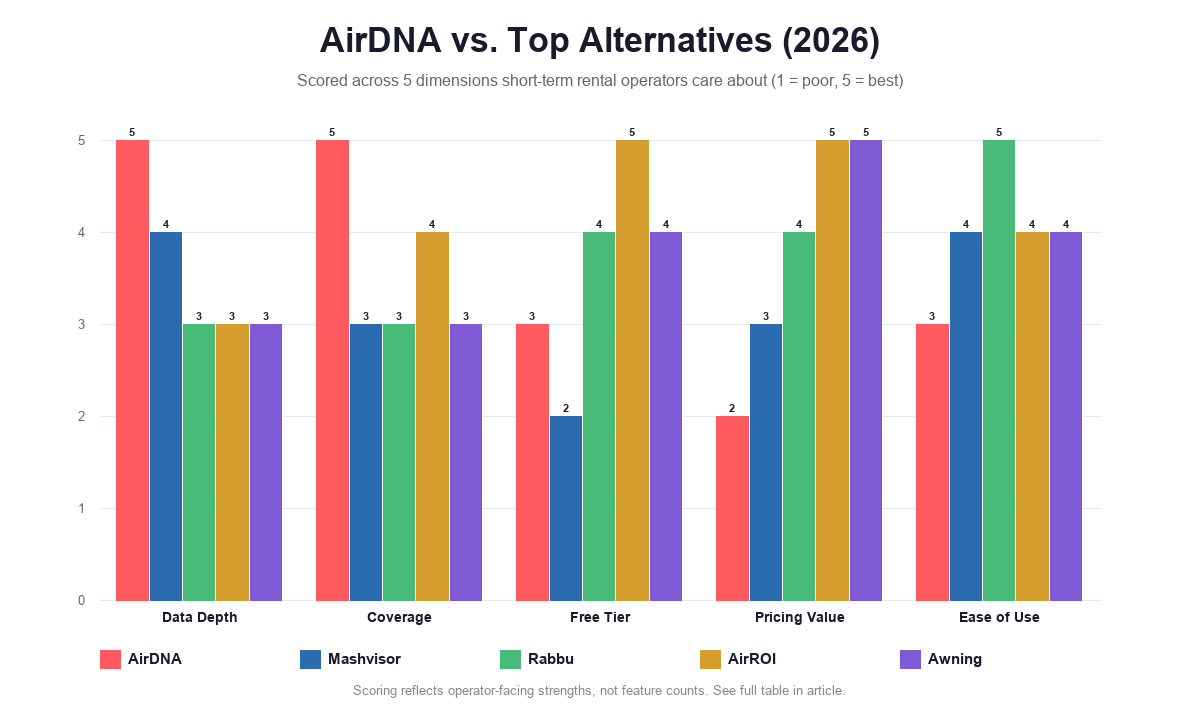
Here is how the main competitors stack up on the dimensions short term rental investors actually care about:
| Tool | Best For | Free Tier | Entry Paid | Data Depth |
|---|---|---|---|---|
| AirDNA | Deep market research, multi-market scouting | Yes (limited) | From ~$20/mo (about $12/mo annual) | Highest (10M+ properties, 120K+ markets) |
| Mashvisor | STR vs. long-term rental comparison, MLS overlay | Trial only | From ~$18/mo (full STR features ~$50/mo) | U.S. only, blends MLS + Airbnb + Vrbo |
| Rabbu | Polished property-level projections for pitches | Free property estimator | Pricing not public | Strong in major U.S. metros, thin in secondary markets |
| AirROI | Free Airbnb analytics, budget-conscious operators | Yes (substantial) | Free | Solid in covered markets, less depth than AirDNA |
| Awning | Free Airbnb estimator with investor playbooks | Yes | Free tools, paid services | U.S.-focused, lighter than AirDNA |
For a deeper side-by-side on the analytics tool landscape, read our full breakdown of the best Airbnb analytics tools for 2026.
Is AirDNA Worth It for Real Estate Investing and Your Investment Property?
AirDNA is worth the cost if you are:
- Scouting multiple markets before locking in an investment property or master lease.
- Operating 5+ doors and need real performance benchmarks to make pricing and inventory decisions.
- Pitching investors, lenders, or landlords and need an institutional-grade data source for projections.
- A property manager evaluating new territory expansion.
- An agent or broker representing STR-focused buyers who need a defensible underwriting tool for real estate investing.
AirDNA is probably not worth the cost if you are:
- Operating one property in a market you already know well.
- Brand new to short term rentals and still figuring out whether you want to do this at all. Use the free Rentalizer tier and a free competitor like AirROI.
- Targeting a thin rural or emerging market where the comp set is too small to model reliably.
- Only doing arbitrage in one city. A single small-market subscription is enough, and you do not need global access.
How 10XBNB Students Actually Use AirDNA
Inside the 10XBNB program, AirDNA is a tool, not a strategy. Here is how my students typically deploy it to find profitable properties:
Step 1: Create a free account and screen with Rentalizer. Before paying a cent, set up a free account and use the free Rentalizer lookups to triage 5 to 10 candidate markets. Throw out the ones with projected gross revenue below your target.
Step 2: Buy a single small-market subscription. Pick the top one or two markets and pay for a month of MarketMinder access at the city level. Pull ADR, occupancy, seasonality, supply trend, and the top 10 listings in the submarket for real insights.
Step 3: Cross-check with humans. AirDNA never replaces local intelligence. Call three property managers in the target market. Talk to a landlord who has done arbitrage there. Read the regulation language and local lease terms yourself, not just AirDNA’s note.
Step 4: Discount the Rentalizer projection. Take whatever Rentalizer says, strip out cleaning fees (typically 8 to 15 percent of gross), and then haircut another 10 to 20 percent for new operator ramp-up. The number that survives is your conservative case.
Step 5: Submit on the deal. A master lease or purchase offer goes in only if the conservative case still clears your spread requirement.
This is the system we teach inside the program: live coaching weekly, an active student community where people swap market findings in real time, and mentorship from operators who collectively manage close to a thousand doors. The tool gets you the numbers. The system gets you the deal.
For the math side of the underwriting step, our free Airbnb arbitrage calculator walks the same logic you would run in a MarketMinder workflow.
Want help running this AirDNA workflow on your actual target market?
Book a free 10XBNB coaching call. We will walk through your candidate market live, review your underwriting math, and tell you whether the deal is worth the master lease deposit. No pitch, no pressure, just real operator feedback from people who do this for a living.
Frequently Asked Questions About AirDNA
Is AirDNA accurate?
AirDNA is accurate in mature, dense markets where there are hundreds of comparable listings to model from. In thin markets with fewer than 100 listings, projections can drift 15 to 30 percent in either direction. Treat AirDNA output as an informed estimate, not a guarantee, and always cross-check with local property managers in the target market.
How much does AirDNA cost?
AirDNA has a free tier with limited Rentalizer lookups. A paid subscription is priced by market size: about $19.95 per month for a small market under 100 active listings, $39.95 per month for a mid-size market, and $99.95 per month for a major market over 1,000 listings. Global access runs $999.95 per month, or about $599.99 per month billed annually. There is a 40 percent discount for paying annually. Check the official pricing page for live numbers.
What is the difference between Rentalizer and MarketMinder?
Rentalizer is a property-level revenue estimator: enter an address, get a projected revenue figure. MarketMinder is the full market analytics dashboard with ADR, occupancy, RevPAR, seasonality, supply trends, top properties, and regulation notes. Most investors screen with Rentalizer and decide with MarketMinder.
Is there a free version of AirDNA?
Yes. AirDNA’s free tier gives you the ability to explore short term rental markets, 12 months of history, and a small number of Rentalizer lookups per month. It is enough for casual market browsing but not for serious investment underwriting. Above that limit, you either subscribe or use a free alternative like AirROI or Chalet.
AirDNA vs. Rabbu: which is better?
AirDNA wins on data depth, historical history, and global coverage. Rabbu wins on polished property-level reports that look great in an investor pitch and on its free property estimator. For ongoing market intelligence, use AirDNA. For a one-shot deal projection you can send to a banker, Rabbu gets there fast.
Does AirDNA work outside the United States?
Yes. AirDNA covers more than 120,000 markets globally, including most of Europe, Latin America, the Caribbean, Asia, and Australia. The data is densest in North America and Western Europe and thinner in some emerging markets, so check the listing count in your target submarket before you trust the projections.
Is AirDNA worth it for one rental property?
Usually not. For a single investment property in a market you already know, the free Rentalizer tier or a free alternative like AirROI or Awning gives you most of what you need. A paid MarketMinder subscription makes sense once you are comparing multiple markets, running 3+ doors, or pitching outside money.
AirDNA Review Verdict: Is It Worth It?
AirDNA is the best short term rental market data tool on the market in 2026. The data is deep, the coverage is wide, and in mature markets the projections are good and dependable. The tradeoff is cost. A full subscription gets expensive once you scale up to multiple markets, and the data thins out in rural and emerging zones where you most need a clear answer.
My rating: 4.2 out of 5. I would dock half a star for thin-market accuracy and another half star for the pricing structure that punishes operators who scout broadly. But there is no real substitute for the full MarketMinder feature set, and for any operator past the single-property stage, the investment usually pays back inside a quarter.
Use the free Rentalizer for the first pass. Upgrade to a single small-market subscription when you have a real market in mind. Step up to a broader plan or global access only when your portfolio justifies it. Pair the data with local intelligence, not in place of it. That is the short version of this AirDNA review for any investor weighing the tool against the price.
For the broader picture of what to pair AirDNA with, check out our deeper coverage of the best Airbnb markets in 2026, the most profitable Airbnb cities, and our ranking of the best states for Airbnb investing. AirDNA tells you what the data looks like. Those guides tell you what to do with it.
Pricing accurate as of June 2026. Always confirm current AirDNA pricing on the official pricing page. AirDNA’s underlying coverage figures are published on the AirDNA platform page. For context on the size of the underlying Airbnb marketplace, see the latest data from the Airbnb Newsroom.
Related Operator Deep Dives
Other reviews and comparisons in this cluster operators have found useful: