

Airbnb tax deductions are the ordinary business expenses a short-term rental host can subtract from rental income before paying tax. The IRS lets you write off cleaning and turnover, supplies, utilities, platform and host service fees, insurance, mortgage interest, property tax, repairs, and depreciation on the property itself, as long as the cost is ordinary and necessary for renting the place out. Most hosts report all of this on Schedule E. Two rules decide how much you actually keep in a given year: a repair is deducted the year you pay for it, while an improvement gets capitalized and written off over time.
I have handled the operations side of short-term rentals for years, and the tax return is the part every host underestimates. I am an operator, not a CPA, so here is my honest frame: below is how the IRS says these deductions work, and how I keep the books clean so my accountant can actually apply them. You should run your own numbers with a licensed professional before you file.
How short-term rental income gets taxed
Before you can claim a single deduction, you have to know where your income lands on the return. For most hosts, Airbnb income is rental income reported on IRS Schedule E, which the IRS describes as the form to “report income or loss from rental real estate.” You list the rent you collected, then subtract your deductible expenses, and the net number flows to your 1040.
There is one fork in the road. According to IRS Publication 527, if you provide “substantial services that are primarily for your tenant’s convenience, such as regular cleaning, changing linen, or maid service,” you report on Schedule C instead, and that income can be subject to self-employment tax. Basic services like heat, light, and trash collection do not count as substantial. Which schedule you belong on changes your tax bill, so I break down the whole test in our guide to Schedule E vs Schedule C for Airbnb. For the rest of this article I will assume the common case: a Schedule E rental.
The Airbnb write-offs you can claim
Publication 527 lists the most common rental expenses, and nearly all of them map directly onto how a short-term rental runs. The table below pairs each IRS category with the real-world costs hosts pay, plus whether you deduct it now or spread it out. Everything here traces to IRS Publication 527.
| Expense category | What it looks like for a host | How the IRS treats it |
|---|---|---|
| Cleaning and maintenance | Turnover cleaners, restocking, yard upkeep, pool service | Deduct in the year paid |
| Supplies and consumables | Toiletries, coffee, paper goods, linens, batteries | Deduct in the year paid |
| Utilities | Electric, gas, water, internet, streaming for guests | Deduct the rental-use share |
| Platform and host service fees | Airbnb host fee, channel and management fees | Deduct in the year paid |
| Insurance | Landlord or short-term rental policy premiums | Deduct (prorate if paid years ahead) |
| Mortgage interest | Interest on the loan against the rental | Deduct the interest portion only |
| Taxes | Property tax and local rental taxes | Deduct in the year paid |
| Repairs | Fixing a broken heater, patching a wall, a leaky faucet | Deduct in the year paid |
| Depreciation | The building itself and its systems | Written off over 27.5 years |
| Auto and travel | Driving to the property, out-of-town owner trips | Deduct the business portion |
| Legal and professional fees | CPA, bookkeeper, attorney, tax software | Deduct in the year paid |
| Commissions and management fees | Co-host splits, property manager fees | Deduct in the year paid |
| Rental payments | Rent you pay a landlord if you run arbitrage | Deduct as a business cost |
A few of these deserve a note. Your Airbnb host service fee is a cost of doing business, so it comes off the top the same way a management fee does. A dedicated short-term rental insurance premium is deductible too, which I cover in does insurance cover an Airbnb. And if you lease a place and re-rent it, the rent you pay your landlord is a deductible business expense, a big part of the math in rental arbitrage.
One thing that trips people up: your full mortgage payment is not a deduction. Only the interest portion is, since paying down principal builds your equity rather than being a business cost.
Repairs versus improvements: the line hosts get wrong
This is the single distinction that decides whether a cost saves you money this year or over the next few decades, so it is worth getting right. Publication 527 puts it plainly: “an expense for repairing or maintaining your rental property may be deducted if you aren’t required to capitalize the expense,” while “you must capitalize any expense you pay to improve your rental property.”
The IRS says a cost is an improvement, not a repair, if it does one of three things: a betterment, a restoration, or an adaptation of the property. That is the test to memorize.
- Betterment fixes a pre-existing defect, enlarges the property, or increases its capacity, strength, or quality.
- Restoration replaces a major structural part, rebuilds the property to like-new condition, or repairs damage after a casualty loss you already wrote down.
- Adaptation changes the property to a use it was not intended for when you started renting.
Publication 527 gives a table of examples the IRS treats as improvements you must capitalize: a new roof, an addition like a bedroom or bathroom, a new heating system or central air, a water heater, a security system, wall-to-wall carpeting, and a kitchen modernization all land on that list. A true repair is narrower. Patching drywall, fixing a broken appliance, unclogging a drain, or repainting a room to keep it in ordinary operating condition are the kinds of costs you deduct the year you pay them.
The IRS also references two safe harbors, the de minimis safe harbor for smaller-cost tangible property and the routine maintenance safe harbor, that can let you deduct some costs you might otherwise capitalize. Those elections have specific dollar and eligibility rules, so they are exactly the sort of thing to hand to your accountant rather than guess at.
Depreciation: writing off the property over time
Depreciation is the deduction most new hosts miss, and it is often the largest one. It is the IRS mechanism for recovering the cost of the building over its useful life. Land cannot be depreciated because it does not wear out, so your CPA splits the purchase price between the land and the structure, then depreciates the structure.
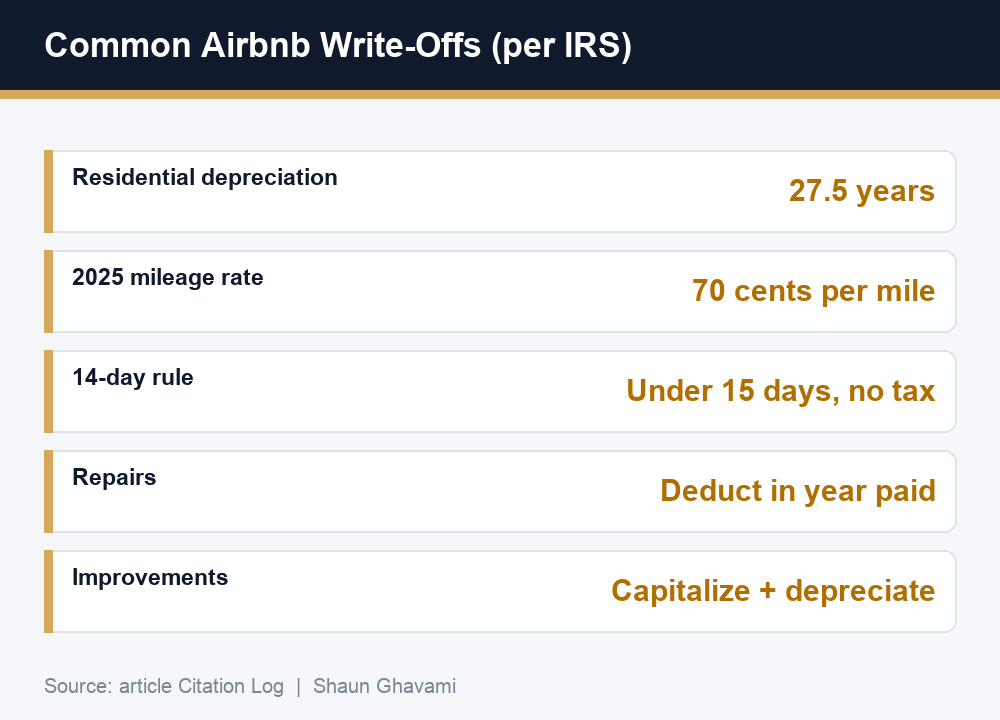
Per Publication 527, residential rental property is depreciated over 27.5 years under the General Depreciation System, part of MACRS. You start depreciating once the property is “ready and available for rent,” not the day you close. That 27.5-year clock means a real deduction lands on your return every year you own and rent the place, even in years you spend nothing on the property.
Two advanced moves speed this up, and both are CPA territory. A cost segregation study reclassifies parts of the building into shorter recovery periods so more can be written off sooner, which I cover in cost segregation for short-term rentals. Bonus depreciation stacks on top of that. Publication 527 states in its 2025 update that “the 100% special depreciation allowance is restored for qualified property acquired and placed into service after January 19, 2025,” though the exact percentage and effective dates shift with legislation, so confirm the current-year figure with your accountant. These accelerated deductions are also the engine behind the short-term rental tax loophole, which can let material participants offset other income. Do not run any of that without a professional.
The 14-day rule
There is a genuine free pass in the tax code, and short-term rental owners are the people most likely to qualify for it. Per IRS Topic No. 415: “There’s a special rule if you use a dwelling unit as a residence and rent it for fewer than 15 days. In this case, don’t report any of the rental income and don’t deduct any expenses as rental expenses.”
Read that carefully, because it cuts both ways. If you live in the home and rent it out for 14 days a year or fewer, the rental income is tax-free and never touches your return. The trade is that you cannot deduct any expenses tied to those days. This is sometimes called the Augusta rule, after homeowners who rent during a big local event. It is a real strategy for a primary residence during a nearby festival, but it is not how a full-time rental operates, since a business run for profit rents far more than 14 days.
Mixed-use and personal-use allocation
Plenty of hosts rent a place part of the year and use it themselves the rest of the time, a lake cabin or a spare condo being the classic case. The IRS does not let you deduct the personal share. Publication 527 is direct: “If you use a dwelling unit for both rental and personal purposes, divide your expenses between the rental use and the personal use based on the number of days used for each purpose.”
The counting rules matter. Any day the unit is rented at a fair rental price counts as a rental day, even if you also used it that day for maintenance. A day the place sits available but empty is not a rental day. And the IRS treats the property as a home, which limits your deductions, if your personal use is more than the greater of 14 days or 10% of the days you rented it at a fair price. Once you cross that line, you can still deduct expenses up to your rental income, but a loss gets limited.
Startup costs and getting the property ready
The money you spend before the property is a working rental gets treated differently from your ongoing expenses. Because depreciation and most deductions begin only when the place is “ready and available for rent” per Publication 527, costs you incur getting there often have to be capitalized into your basis or handled as start-up expenditures rather than written off immediately. Furnishing, the initial deep clean, and pre-launch fix-ups usually fall in this bucket. The exact treatment depends on the cost and the timing, so I sort out what is a startup cost and what is not in our Airbnb startup cost breakdown, and I confirm the classification with my CPA every time.
A quick word on the home office deduction, since hosts ask. It is generally reserved for a trade or business, and a typical Schedule E landlord does not qualify. Publication 527 points to Publication 587 for the test. Treat it as a maybe, not a given, and get a ruling from your accountant.
Mileage, travel, and vehicle use
Driving for the rental is deductible, within limits. Per Publication 527, if you use your car for rental activities you can deduct the cost “using one of two methods: actual expenses or the standard mileage rate,” and it lists the 2025 standard mileage rate at 70 cents a mile. The IRS updates that rate, so check the current figure before you file. The details on both methods live in IRS Publication 463.
The catch the IRS flags: driving between your home and a single rental property is usually treated as nondeductible commuting, unless your home is your principal place of business. Out-of-town trips whose main purpose is managing or maintaining the rental can be deductible travel. Keep a mileage log with dates and purpose, because this is a category the IRS scrutinizes.
Recordkeeping is what makes deductions survive
A deduction you cannot document is a deduction you can lose. Publication 527 tells owners to “separate the costs of repairs and improvements, and keep accurate records,” because you need the cost of improvements later when you sell or depreciate. Every category in the table above depends on a receipt, an invoice, or a bank record tying the cost to the rental.
Here is how I run it: a dedicated bank account and card for the rental, receipts captured the day they happen, and expenses tagged by property and category. That habit is the difference between claiming everything you are owed and leaving money on the table you could not prove. I lay out the exact system in our guide to Airbnb bookkeeping. If you are setting up your first listing, build the books at the same time you build the property, a step I stress in how to start an Airbnb business.
Frequently asked questions
Yes. The service fee Airbnb takes from your payout is an ordinary cost of running the rental, and the IRS lists commissions and management fees among deductible rental expenses in Publication 527. It comes off your gross rental income like any other business cost.
No. Only the mortgage interest portion is deductible, per IRS Publication 527. The principal you pay down is not deductible because it builds your equity. Property tax, insurance, and depreciation are deducted separately as their own categories.
Per IRS Topic No. 415, if you use a dwelling as a residence and rent it fewer than 15 days in the year, you do not report the rental income at all, but you also cannot deduct any expenses tied to that rental. It only helps a home you also live in, not a full-time rental.
No. The IRS treats a new roof, a kitchen modernization, and similar upgrades as improvements you must capitalize and depreciate over time, per Publication 527. A repair that keeps the property in ordinary operating condition, like fixing a broken appliance, is deducted the year you pay for it.
Residential rental property is depreciated over 27.5 years under MACRS, the General Depreciation System, per IRS Publication 527. Land cannot be depreciated, so the cost is split between land and building, and only the building is depreciated.
No. This is general education, not tax advice. Tax rules change and depend on your specific situation. Consult a licensed CPA or tax professional before acting on anything here, and confirm every figure against current IRS guidance.