

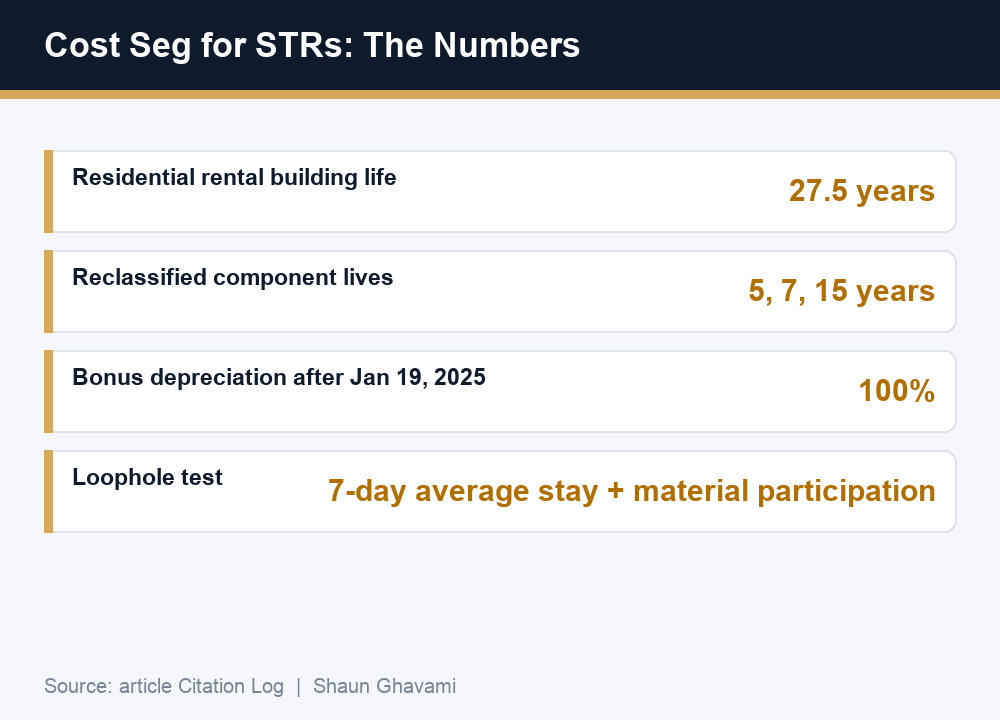
Cost segregation for a short-term rental is a study that breaks your property into its parts and moves the pieces that wear out faster, things like appliances, flooring, and outdoor improvements, into shorter tax depreciation lives of 5, 7, and 15 years instead of the standard 27.5 years the IRS assigns to a residential rental building. Front-loading those deductions means you claim far more depreciation in the early years, and when a study is paired with bonus depreciation, a large share of that write-off can land in a single tax year.
I have run short-term rentals and managed a large portfolio of them for owners, and cost segregation is one of the few tax moves that changes your first-year numbers in a real way. I am an operator, not a CPA, so read this as how the IRS rules work and how I handle it with my accountant, not as advice for your return. Every rule below traces to an IRS source you can open yourself.
What cost segregation actually is
When you buy a rental, the IRS does not let you deduct the purchase price all at once. You recover it slowly through depreciation. Residential rental property is depreciated over 27.5 years using the straight line method (IRS Publication 527), and commercial or nonresidential property runs even longer at 39 years. Land itself never depreciates at all. As the IRS puts it, “Land is never depreciable, although buildings and certain land improvements may be.”
A cost segregation study steps in before that slow clock starts. An engineer or specialist examines the property and separates it into components. The bones of the building stay on the 27.5-year schedule, but many pieces qualify for much shorter recovery periods:
- 5-year property: things like appliances and carpeting used in a rental. The IRS notes that “accelerated methods are generally used for property connected with rental activities, such as appliances and wall-to-wall carpeting.”
- 7-year property: certain furniture and fixtures.
- 15-year property: land improvements such as driveways, walkways, fencing, and landscaping.
That reclassification is the whole game. The IRS Cost Segregation Audit Techniques Guide is the agency’s own manual for how examiners review these studies, and it exists precisely because moving components into 5, 7, and 15-year buckets is a legitimate, well-worn strategy when it is done with real documentation. The dollars you assign here come straight out of your purchase price, so the accuracy of your startup and acquisition cost records feeds directly into the study.
How it pairs with bonus depreciation to front-load year one
Shorter lives alone would spread deductions over 5 to 15 years. Bonus depreciation collapses that timeline. Under Internal Revenue Code section 168(k), bonus depreciation lets you deduct a large share of qualifying short-life assets immediately in the year the property is placed in service, instead of a slice each year.
Here is the piece most guides get wrong, because it keeps changing. The percentage matters enormously, and it was rewritten by law in 2025. Public Law 119-21, the One Big Beautiful Bill Act, “reinstated the 100% special depreciation allowance for certain qualified property acquired and placed in service after January 19, 2025” (IRS 2025 Instructions for Form 4562). You can also elect a 40% allowance instead of the 100% figure if that serves your plan better. Confirm the current-year percentage and your eligibility with your CPA, because this number has moved several times in recent years.
Combine the two moves and the math gets loud. The components a study shifts into the 5, 7, and 15-year classes generally qualify for bonus depreciation, so instead of trickling out over years, most of that reclassified value can be deducted in year one. Form 4562 is where all of it, regular depreciation and the bonus allowance, actually gets reported on your return.
The tie-in to the short-term rental tax loophole
A giant first-year deduction is only useful if you can actually use it. For most rental owners, rental losses are passive and can only offset other passive income, not your W-2 paycheck. Short-term rentals have a special path around that, which is why cost segregation and the short-term rental tax loophole are usually discussed together.
The engine is a passive-activity rule. Per IRS Publication 925, “if the average period of customer use of the property is 7 days or less, the activity does not qualify as a rental activity.” Because it is not treated as a rental activity, it is not automatically passive. If you also materially participate, the loss can be non-passive and offset active income like wages. The IRS material-participation tests include participating more than 500 hours in the year, or participating more than 100 hours and at least as much as any other individual.
Stack these together and the picture is clear. A cost segregation study creates the large paper loss, bonus depreciation lands it in year one, the 7-day average stay keeps the activity out of the automatic passive bucket, and material participation lets that loss reach your other income. Whether your numbers belong on Schedule E or Schedule C is a separate question your CPA settles, and it interacts with all of your other Airbnb tax deductions.
Cost segregation only helps property owners
This is the hard line that catches a lot of hosts. Depreciation is a deduction against the cost of an asset you own. If you do not own the building, you have no depreciable basis, and there is nothing for a study to reclassify.
That rules out two popular models. Rental arbitrage hosts lease a unit and re-rent it, so they never own the real estate. Co-hosting hosts manage someone else’s property for a share of revenue and own nothing either. Both can be excellent businesses, and both have their own deductions, but cost segregation is not one of them. It is a tool for people who hold title to the property. If you are still deciding which model to run before you start an Airbnb business, this is a real factor in the ownership-versus-arbitrage decision.
When cost segregation is worth it, and when it is not
A study is a paid service, so it only makes sense when the tax benefit clearly beats the cost. Three inputs drive that: how much depreciable basis the building has, how long you plan to hold, and how high your tax rate is. The table below is how I sort a property before I ever call a firm.
| Factor | Cost seg tends to pay off | Cost seg tends to disappoint |
|---|---|---|
| Building basis (price minus land) | Higher basis, more to reclassify | Low basis, little to move |
| Marginal tax rate | High bracket, each deduction is worth more | Low bracket, deductions are worth less |
| Remaining hold period | Long hold, you keep the benefit | Selling soon, recapture arrives fast |
| Ability to use the loss | Material participation or other passive income to absorb it | No way to use a passive loss this year |
| Ownership | You hold title to the property | Arbitrage or co-host, you own no building |
The pattern that wins is a higher-basis property, held for years, owned by someone in a higher bracket who materially participates. The pattern that flops is a low-basis unit bought by someone who plans to sell in two years and cannot use the loss.
DIY versus a professional cost segregation study
You can attempt a rough allocation yourself by guessing what share of the price belongs to appliances, flooring, and land improvements. The problem is defensibility. The Cost Segregation Audit Techniques Guide describes what the IRS expects a quality study to contain, and casual back-of-the-envelope splits rarely hold up if your return is examined.
A professional engineering-based study is the standard for a reason. A firm inspects the property, values each component, assigns recovery periods, and hands you a report that supports the numbers on Form 4562. It is a real expense, so get a written quote and have your CPA weigh that cost against the expected first-year deduction and your tax rate before you commit. The benefit also depends on clean records, so keep your Airbnb bookkeeping tight from day one, since the study builds on your basis and your books.
A worked example (illustrative, assumed inputs)
These numbers are made up to show the mechanics. They are not a promise, a quote, or a projection for any real property. Your CPA runs your actual figures.
Assumed inputs:
- Purchase price of a short-term rental: $500,000
- Assumed land value (never depreciable): $100,000
- Assumed building basis: $400,000
- Assumed portion a study reclassifies into 5, 7, and 15-year property: $100,000 (25% of the building basis, an assumption only)
- Placed in service after January 19, 2025, so we assume 100% bonus depreciation applies to the reclassified assets
Illustrative result: Without a study, the whole $400,000 building basis depreciates over 27.5 years, roughly $14,500 of depreciation in a full year. With a study, the $100,000 of reclassified short-life property can be bonus-depreciated in year one, and the remaining $300,000 keeps depreciating over 27.5 years. That turns a first-year deduction of about $14,500 into roughly $110,000 in this example. If the owner materially participates and the average stay is 7 days or less, that paper loss may offset active income. Change any assumption and the answer changes, which is the point.
Depreciation recapture when you sell
Cost segregation does not erase tax, it moves it. When you sell, the IRS recaptures depreciation you already claimed, and the reclassified components are treated differently from the building.
The 5, 7, and 15-year items a study carved out are section 1245 property. Per IRS Publication 544, the depreciation you took on that personal property is generally recaptured as ordinary income on Form 4797 when you sell. The building itself is section 1250 property, and the part of your gain tied to its depreciation is “unrecaptured section 1250 gain,” taxed at a maximum rate of 25 percent.
None of that makes cost segregation a bad idea, because a deduction today is worth more than the same deduction spread over decades, and a dollar deferred can be reinvested. It does mean your hold period and exit plan matter. Some owners defer recapture through a like-kind exchange when they trade up, which is a conversation to have with your CPA well before you list the property, not after.
Frequently asked questions
It is a study that separates your rental property into components and reclassifies parts of it, such as appliances, flooring, and land improvements, into shorter IRS depreciation lives of 5, 7, and 15 years instead of the standard 27.5 years for a residential rental building. That front-loads your depreciation deductions into the early years of ownership.
Yes. The short-life components a study identifies generally qualify for bonus depreciation under IRC section 168(k). Under Public Law 119-21, the One Big Beautiful Bill Act, a 100% special depreciation allowance applies to qualified property placed in service after January 19, 2025, with an option to elect 40% instead. Confirm the current percentage and your eligibility with your CPA.
Only if your short-term rental loss is non-passive. Per IRS Publication 925, if the average period of customer use is 7 days or less the activity is not a rental activity, and if you also materially participate the loss can be non-passive and offset active income like wages. If you do not meet those tests, the loss is generally passive.
Yes. Depreciation is a deduction against an asset you own, so you must hold title to the building. Rental arbitrage hosts who lease and re-rent, and co-hosts who manage another owner’s property, have no depreciable basis, so cost segregation does nothing for them.
The IRS recaptures depreciation. The 5, 7, and 15-year items are section 1245 property, generally recaptured as ordinary income on Form 4797, and the building is section 1250 property, whose depreciation-related gain is taxed as unrecaptured section 1250 gain at a maximum 25 percent rate, per IRS Publication 544. Your hold period and exit plan affect how much this matters.
No. This is general education, not tax advice. Tax rules change and depend on your situation. Consult a licensed CPA or tax professional before acting on anything here.