
If you operate short-term rentals and you’re choosing between PriceLabs, Wheelhouse, and Beyond Pricing, here’s the operator-honest answer in one paragraph. PriceLabs is the right pick for hands-on hosts with 3+ listings who want granular rule control and the widest property management system network. Wheelhouse wins for event-heavy urban markets and operators who want a free starting tier with strong competitive benchmarking. Beyond Pricing is the right pick for new hosts with 1 to 3 vacation rental listings who want set-and-forget automation and a hands-off pricing strategy. There is no universal winner. There is a best fit for your portfolio, your time, and your skill level. This article gives you the side-by-side comparison, the math at scale, and the workflow each tool actually demands.
I’ve watched roughly 1,000 doors collectively go through this decision inside our community. The hosts who pick the wrong dynamic pricing tool for their workflow usually quit dynamic pricing entirely within 90 days, then go back to flat rates and leave 15 to 30 percent of revenue on the table. That’s the real cost of picking wrong. Read the full breakdown below, then if you want a second opinion from operators who’ve used all three, book a free coaching call and we’ll walk through your specific listings.
The 30-second verdict: which dynamic pricing tool fits which operator
Before the deep comparison, here’s the short version most other articles bury at the bottom.
- Best for hands-on hosts with 3+ listings: PriceLabs. The rule depth is unmatched.
- Best for new hosts (1 to 3 listings) who want zero learning curve: Beyond Pricing.
- Best for event-heavy urban markets and free-tier testers: Wheelhouse.
- Best for high-ADR properties pulling $5,000+ per month: PriceLabs or Wheelhouse Pro Flat. The Beyond percentage model gets expensive fast.
- Best market intelligence and competitive data: PriceLabs Market Dashboards, with Wheelhouse a close second.
The rest of this guide breaks down the why behind each pick. We’ll cover pricing, integrations, learning curve, who-it’s-best-for, and the system we teach inside 10XBNB that pairs with whichever tool you choose.
How dynamic pricing works for short-term rentals
A dynamic pricing tool sets your nightly rate every day based on real-time demand signals: booking pace, local events, day of week, season, comparable property rates, and historical performance. Static pricing (one flat rate year-round) leaves money on the table during peak demand and prices you out of the market during slow periods. Properties using dynamic pricing typically earn 15 to 40 percent more revenue than the same properties using flat rates, according to vendor case studies from PriceLabs, Wheelhouse, and Beyond Pricing (verify with their published customer stories, dated; numbers vary by market and operator).
Airbnb’s built-in Smart Pricing is technically free, but it has known limitations. Airbnb’s own help center confirms Smart Pricing won’t work alongside rule-sets from professional hosting tools and overrides custom weekly or monthly discounts in ways most hosts don’t catch until they audit their data. That’s why most operators with more than one listing graduate to a third-party tool within their first six months.
The three tools we’re comparing today are the three most-used dynamic pricing tools in the short-term rental space. PriceLabs prices 500,000+ listings daily across 100+ countries according to its company materials. Beyond Pricing has been live since 2014 and powers 50,000+ listings per public funding announcements. Wheelhouse has been operating since October 2014 and raised about $16 million across three rounds, with a Series B in April 2022.
Each tool takes a different approach. PriceLabs is rules-based and data-heavy. Wheelhouse leans on competitive intelligence and machine learning. Beyond Pricing is the hands-off, set-and-forget option with optional managed-service support. Picking among them is less about which is “best” and more about which workflow matches yours.
PriceLabs vs Wheelhouse vs Beyond Pricing: side-by-side comparison table
Here is the at-a-glance comparison. This is the table to bookmark. All pricing verified against each tool’s official pricing page as of May 2026. Pricing changes; check the live page before you sign up.
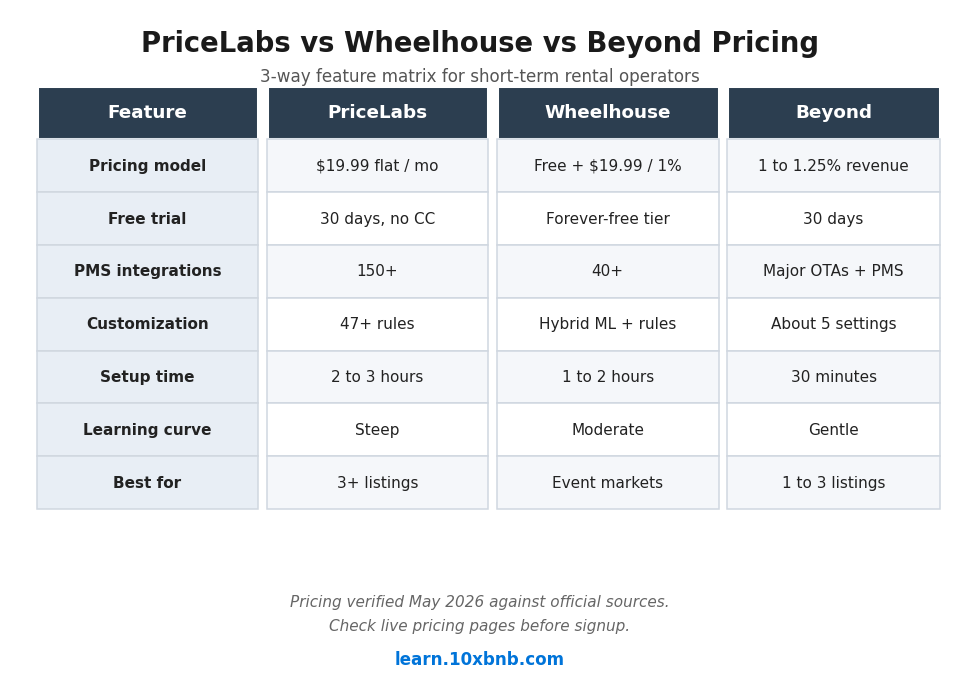
| Feature | PriceLabs | Wheelhouse | Beyond Pricing |
|---|---|---|---|
| Pricing model | $19.99 per listing per month flat (US/UK/CA/EU/AU/NZ/IL); $9.99 rest of world; 1% revenue alternative | Free tier (manual apply); Pro Flat $19.99/mo (drops to $16.99 at 10-49 listings); Pro Flex 1% of revenue ($2.99 min) | 1 to 1.25% of booked revenue; $2.99 per listing per month minimum; no flat-fee option |
| Free trial | 30 days, no credit card required | Free tier (forever) and 30-day Pro trial | 30-day free trial |
| PMS integrations | 150+ (widest in the category) | 40+ (covers major players) | Connects directly to Airbnb, VRBO, Booking.com, plus major property management systems |
| Customization depth | 47+ pricing rules (orphan day, length-of-stay, far-out, event overrides, day-of-week min/max) | Moderate; rule-based plus ML hybrid; last-minute discounts, day-of-week pricing | ~5 settings (min, max, base, weekend, last-minute); designed for minimal configuration |
| Setup time | 2 to 3 hours for full configuration | 1 to 2 hours | 30 minutes to be live |
| Learning curve | Steep for power users; rewards effort | Moderate | Gentle; no rule-writing required |
| Market data and dashboards | Best-in-class Market Dashboards (paid add-on for some plans) | Strong; analyzes 21 million listings nightly per company claims | Solid; includes Beyond Insights and Relay channel sync |
| Channel sync | Pushes prices to connected PMS/channels | Pushes prices to connected channels | Includes Relay tool for cross-OTA syncing |
| Best for | 3+ listings, hands-on operators, rule writers | Event-heavy urban markets, free-tier testers, boutique portfolios | 1 to 3 listings, hosts who want zero rule-writing |
| Founded | 2014, Chicago; founders Anurag Verma & Richie Khandelwal; $30M from Summit Partners (April 2024) | October 2014; founder Andrew Kitchell; ~$16M total raised | 2013-2014; co-founders Ian McHenry & David Kelso; $42.5M Series A led by Bessemer Venture Partners |
That’s the snapshot. Now let’s get into the cost math, because the pricing model differences are where most operators get blindsided.
The cost math at scale: where each pricing model breaks
The single biggest decision driver between these three tools is the pricing model itself. PriceLabs charges a flat $19.99 per listing per month in major markets. Wheelhouse offers both a flat plan and a 1% revenue plan. Beyond Pricing charges a percentage of revenue, full stop. That difference compounds.
Here’s the monthly cost at three revenue tiers. The breakeven point is roughly $2,000 per month in booked revenue. Below that, the percentage model is cheaper. Above that, flat fee wins.
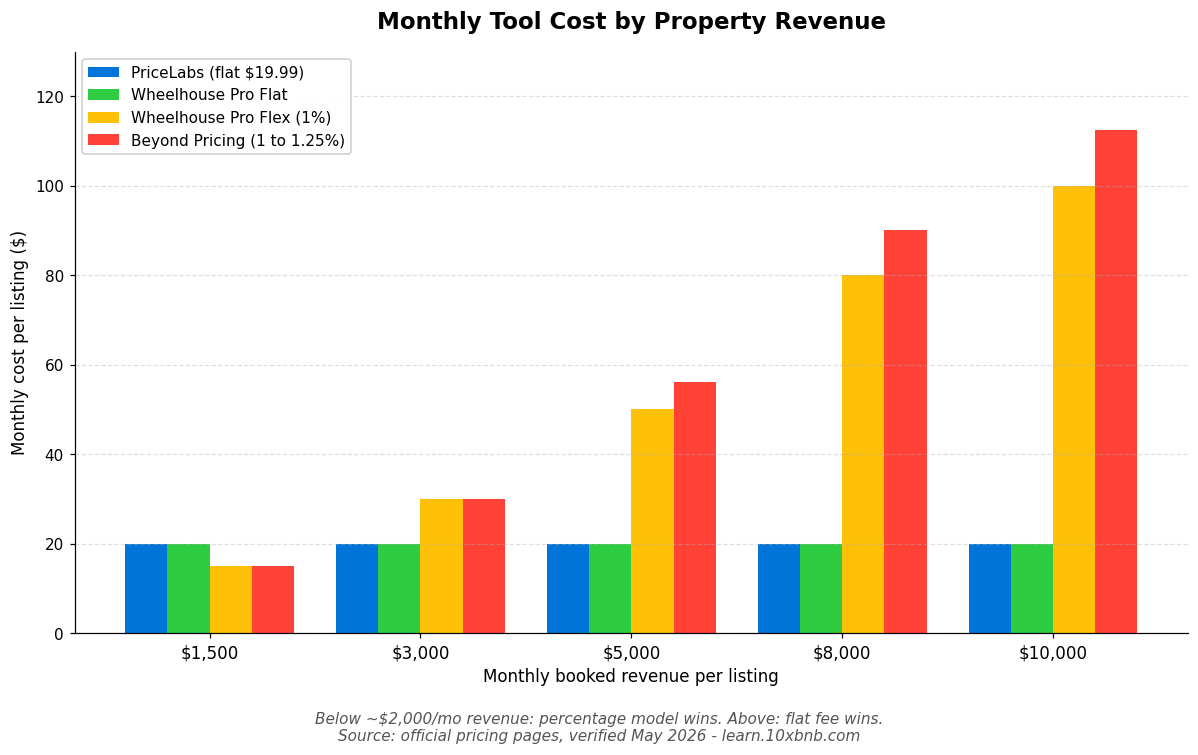
| Monthly listing revenue | PriceLabs (flat) | Wheelhouse Pro Flat | Wheelhouse Pro Flex (1%) | Beyond Pricing (1%) |
|---|---|---|---|---|
| $1,500 | $19.99 | $19.99 | $15.00 | $15.00 |
| $3,000 | $19.99 | $19.99 | $30.00 | $30.00 |
| $5,000 | $19.99 | $19.99 | $50.00 | $50.00 to $62.50 |
| $8,000 | $19.99 | $19.99 | $80.00 | $80.00 to $100.00 |
| $10,000 | $19.99 | $19.99 | $100.00 | $100.00 to $125.00 |
If you run a high-revenue property pulling $8,000 per month, Beyond Pricing costs you $80 to $100 every month against PriceLabs at $19.99. Over a year, that’s $720 to $960 difference per listing. Run 10 listings and that delta hits $7,200 to $9,600 annually. If that money would be better spent on a property tax or a furniture refresh, you have your answer.
The flip side: if you operate one listing in a soft market pulling $1,200 per month, Beyond Pricing or Wheelhouse Pro Flex at 1% of revenue costs you $12 against PriceLabs at $19.99. The percentage model wins at small scale.
PriceLabs: the depth pick for hands-on operators
PriceLabs was founded in 2014 by Anurag Verma and Richie Khandelwal in Chicago, with co-founder Sana Hassan. Verma has a Ph.D. In Industrial Engineering from Texas A&M and worked on revenue management at United Airlines before PriceLabs. The company raised $30 million from Summit Partners in April 2024, which was their first outside financing on top of an already-profitable business per the official announcement.
The product matches the founder DNA. PriceLabs is the most rule-driven dynamic pricing tool in the category. You get more than 47 pricing controls, including minimum and maximum rates per day of the week, base price adjustments by season, orphan day pricing, length-of-stay pricing discounts, last-minute pricing adjustments, far-out pricing premiums, and event-based pricing overrides. The interface is dense. The first time you open the recommendation screen you’ll see why advanced users love it and why brand new hosts often get overwhelmed.
Where PriceLabs wins:
- Customization: If you can think of a pricing rule, PriceLabs probably supports it.
- Integrations: 150+ PMS and channel manager connections. The widest of any tool in the category.
- Market intelligence: The PriceLabs Market Dashboards product is the best-in-class competitive data tool. It shows you booked pace, average daily rate, and occupancy for comparable properties in your zip code or radius.
- Pricing model at scale: $19.99 flat per listing per month is the cheapest at-scale option for hosts with high-revenue properties.
- Free trial: 30 days with no credit card required, and you can push live prices during the trial.
Where PriceLabs falls short:
- Learning curve: The first 5 hours of configuration are genuinely confusing. Most new users skip rules and get poor results, then blame the tool.
- UI density: The interface is information-dense. If you prefer a clean, opinionated tool, this isn’t it.
- Not for set-and-forget operators: If you won’t touch your pricing rules monthly, PriceLabs is overkill.
Who should pick PriceLabs: hosts with 3+ listings, property managers building a multi-market portfolio, operators in markets with strong event calendars who want to manually override peak nights, and data-driven operators who want to A/B test rule changes.
For the deeper feature-by-feature breakdown of PriceLabs, see our in-depth PriceLabs section in the dynamic pricing tools comparison.
Wheelhouse: the free-tier and urban-market pick
Wheelhouse was founded in October 2014 by Andrew Kitchell. The company has raised about $16 million across three rounds, with a Series B in April 2022 according to public funding records. Wheelhouse positions itself as a revenue management engine that pairs a machine learning model with rule-based customization.
The product is interesting because of its free tier. You can create a Wheelhouse account at no cost, link your listings, explore market reports, and test pricing recommendations without applying them automatically. That’s a real free tier, not a trial. The paid tiers are Pro Flex (1% of booked revenue, $2.99 per month minimum), Pro Flat ($19.99 per listing per month, dropping to $16.99 in the 10 to 49 listing band), and an Enterprise tier for portfolios of 50+ listings.
Where Wheelhouse wins:
- Free tier: The only top-3 tool with a permanent free plan. You can test recommendations on real listings without paying.
- Event-heavy urban markets: The ML model reads peak demand for events differently than rules-based tools. Hosts in Nashville, Austin, Miami, and similar event-driven markets often see better peak pricing.
- Market intelligence: Wheelhouse analyzes 21 million listings nightly per company claims. The competitive data view is strong.
- Hybrid model: You get ML recommendations plus the ability to layer in custom rules.
- Pricing flexibility: Both flat-fee and percentage-of-revenue plans are available, so you pick the model that fits your portfolio.
Where Wheelhouse falls short:
- Fewer integrations: 40+ PMS connections vs PriceLabs’ 150+. If your PMS isn’t on the list, this is a hard stop.
- Rule depth: Less granular than PriceLabs. Power users sometimes hit a ceiling.
- Smaller ecosystem: The community of operators sharing Wheelhouse-specific tips is smaller than the PriceLabs ecosystem.
Who should pick Wheelhouse: hosts in event-heavy urban markets, operators who want a free tier to validate dynamic pricing before paying, and boutique portfolio owners who care about competitive market data.
Beyond Pricing: the set-and-forget pick for new hosts
Beyond Pricing was founded in 2013 by Ian McHenry and David Kelso. McHenry came from Oliver Wyman, where he advised global airlines and hotels on revenue management and dynamic pricing. That airline-and-hotel DNA shows in Beyond’s product philosophy. The company raised a $42.5 million Series A led by Bessemer Venture Partners and powers 50,000+ listings according to public funding announcements.
Beyond Pricing is the simplest of the three. Setup takes about 30 minutes. You connect your Airbnb account, set your minimum and maximum nightly rates, set a base price, and the algorithm handles everything else. There are about five total settings to configure. If PriceLabs gives you 47 dials, Beyond gives you five and a “trust us” button.
Where Beyond Pricing wins:
- Setup speed: 30 minutes to live. The fastest onboarding of the three.
- Hands-off operation: Once configured, Beyond does not require monthly tuning.
- Managed service option: Beyond offers dedicated revenue management experts for portfolios that want human strategy on top of the algorithm.
- Relay channel sync: The Relay tool syncs your listings across OTAs so you don’t get double-booked and prices update across platforms automatically.
- Brand recognition: The most widely-known name among new hosts. Many PMS platforms default-recommend Beyond.
Where Beyond Pricing falls short:
- Percentage cost at scale: 1 to 1.25% of booked revenue compounds fast. A $5,000-per-month listing costs $50 to $62.50 per month against PriceLabs at $19.99.
- Customization ceiling: About 5 settings. Power users will hit the wall in a week.
- Black-box recommendations: You see the price but not always the why behind it.
- No flat-fee option: As of May 2026, Beyond does not offer a flat-fee subscription model.
Who should pick Beyond Pricing: new hosts with 1 to 3 listings who don’t want to learn a pricing tool, hosts in markets with revenue under $2,000 per listing per month (where the percentage model is cheaper), and operators who want a managed-service relationship.
How each dynamic pricing software actually sets your base price
The differences in pricing recommendations between PriceLabs, Wheelhouse, and Beyond Pricing come down to how each pricing engine builds its base price. The base price is the anchor. Every other rule, last minute discounts, day-of-week adjustments, seasonal trends, event premiums, builds off of it. Get the base price wrong and the rest of the pricing strategy stacks errors.
PriceLabs base price logic: PriceLabs lets you set your own base price manually or accept the algorithm’s suggestion. Many property managers prefer the manual route because PriceLabs gives you a clean view of comparable property nightly rates in your local market and you can pick a base price that matches your positioning. The pricing engine then applies your rules on top: minimum price floor, maximum price ceiling, length-of-stay pricing discounts, far-out premiums, last-minute discounts. Power users build pricing profiles per listing and reuse them.
Wheelhouse base price logic: Wheelhouse builds the base price for you using bedrooms, listing type, amenities, and historical performance from comparable properties. It then layers competitive market data on top. You can override the base price manually but the default is data driven. The data driven approach is what makes Wheelhouse strong in event-driven cities like Nashville and Austin, where the algorithm catches demand trends faster than most rule-based tools.
Beyond Pricing base price logic: Beyond gives you about five settings, including base price, minimum price, and maximum price. The algorithm does the heavy lifting. New users like that there is minimal configuration and minimal pricing decisions to make. Advanced users sometimes find the lack of customization options frustrating because they can see the algorithm pricing too aggressively or too softly and they can’t directly tune it.
The takeaway: if you want maximum control over your pricing strategy, PriceLabs is the right pricing software. If you want a hybrid of automation and customization, Wheelhouse fits. If you want minimum pricing decisions, Beyond is built for you.
Airbnb Smart Pricing vs third party tools: is Airbnb smart pricing good enough?
Almost every host asks the same question early on. If Airbnb has built-in smart pricing for free, why pay for a third party tool? The short answer: Airbnb Smart Pricing optimizes for occupancy. PriceLabs, Wheelhouse, and Beyond optimize for revenue. Those are different goals.
Airbnb’s own help center confirms Smart Pricing automatically adjusts nightly rates based on hundreds of factors including booking pace, comparable property rates, and local events. Hosts set a minimum price and maximum price, and the algorithm picks a price inside that range. The catch is that Airbnb’s incentive is to maximize bookings on the Airbnb platform, not necessarily to maximize your revenue.
The other Smart Pricing limitations most hosts don’t catch:
- It does not price your VRBO, Booking.com, or direct-booking listings. You’d need separate pricing on each platform.
- Rule-sets from third party tools and PMS platforms cannot run while Smart Pricing is enabled. You have to pick one.
- It does not always apply seasonal adjustments the way operator data suggests it should.
- Weekend pricing requires Smart Pricing off entirely.
For a single listing with simple pricing needs and a host who only sells on Airbnb, Smart Pricing might be fine. For anyone running multiple properties, selling across listing platforms, or trying to use length-of-stay rules, you’ll outgrow it within months. Most successful Airbnb hosts graduate to a third party Airbnb pricing tool by their second or third booked month.
The decision matrix: pick by operator profile, not by feature count
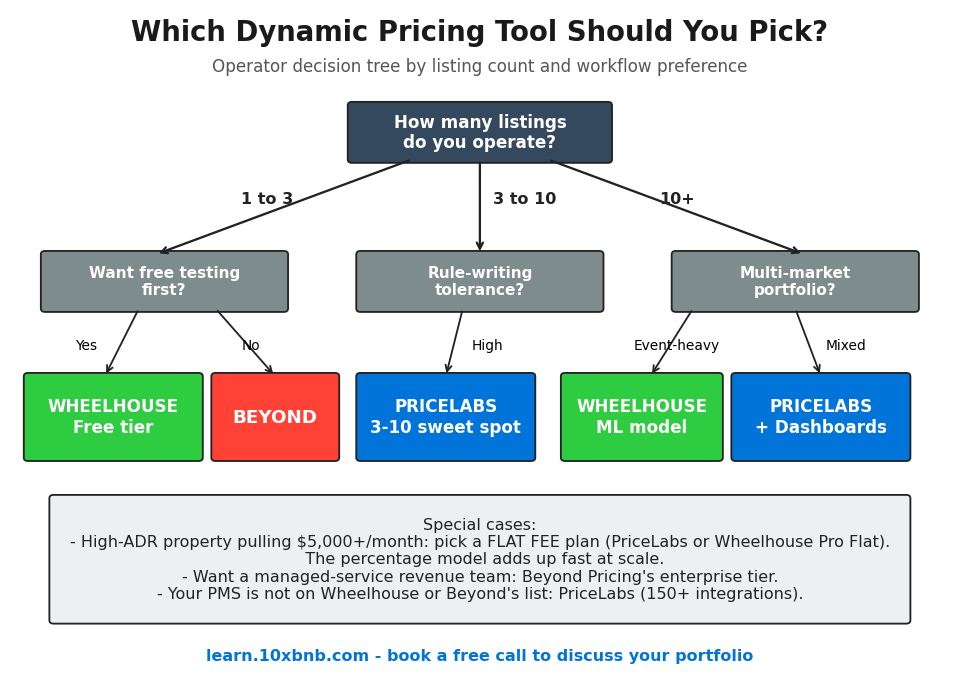
Most “X vs Y vs Z” articles try to crown a single winner. That’s lazy. The right tool depends on five factors: portfolio size, average revenue per listing, market type, time available, and rule-writing tolerance. Here’s the matrix.
| Operator profile | Best pick | Why |
|---|---|---|
| First listing, $1,000 to $2,000/month revenue, no time to learn rules | Beyond Pricing or Wheelhouse free tier | Percentage model is cheaper at low revenue; minimal setup |
| 2 to 3 listings, $2,000 to $4,000/month each, hands-off preference | Beyond Pricing | Set-and-forget; managed service available if needed |
| 3 to 10 listings, mixed revenue, willing to learn rules | PriceLabs | Customization unlocks the most upside at this scale |
| 10+ listings, multi-market portfolio | PriceLabs (with Market Dashboards add-on) | Widest PMS coverage and best market intelligence |
| Event-heavy urban market (Nashville, Austin, Miami, NYC) | Wheelhouse | ML model reads event demand spikes better |
| High-ADR luxury or boutique property ($5,000+ per month per listing) | PriceLabs or Wheelhouse Pro Flat | Flat fee saves $400 to $1,000+ per listing per year vs the percentage model |
| Wants to test dynamic pricing for free before committing | Wheelhouse free tier | Only top-3 tool with a permanent free plan |
| Property manager managing for other owners | PriceLabs | Best PMS integration coverage and team collaboration features |
One more consideration: the bundling shift. Hospitable now bundles dynamic pricing into all paid plans at no extra cost. That move signals where the market is heading. Pricing automation is becoming a standard feature of property management systems, not a standalone product. Both PriceLabs and Wheelhouse are expanding their analytics and portfolio management features to stay ahead of that shift. Beyond is leaning harder into its managed-service model. Watch this space.
The system that goes around whichever tool you pick
Here’s the part nobody talks about. The tool is 20% of the outcome. The system around the tool is 80%.
I’ve watched students with PriceLabs lose to students with Beyond Pricing because the Beyond user had a better minimum-stay rule, a sharper cleaning fee strategy, and a working knowledge of orphan day repair. The PriceLabs user had a more powerful tool and used 10% of it. Same outcome you’d expect.
The system we teach inside 10XBNB pairs with whichever pricing tool you pick. Specifically, the live coaching and active community help you with:
- Minimum and maximum price floors that actually match your market. Most operators set these too narrow and the algorithm has no room to work. We show you how to set the floor based on your fixed costs and the ceiling based on competitor peak rates.
- Length-of-stay pricing discounts. The single highest-use rule most hosts skip. We teach the exact discount curves that fill orphan nights without cannibalizing premium stays.
- Seasonal trends and event overrides. Pricing tools see demand. They don’t always see why. Local events, school calendars, weather, sports schedules. Our mentorship layer pulls that human context into your rules.
- Reading market dashboards correctly. Most operators look at competitor pricing and panic-match it. We teach you when to ignore the market and when to follow it.
- Auditing your tool monthly. Set-and-forget is a myth. Every tool needs a monthly review of bookings, lead time, and rule performance. We hold you to that cadence.
That’s the layer. Live coaching from operators with about 1,000 doors collectively. An active community of hosts running every one of these tools in every kind of market. Mentorship that catches mistakes before they cost you a month of bookings. If you want to see how that works alongside the tool you’re choosing, book a free coaching call and we’ll walk through your specific situation.
What strong dynamic pricing software actually delivers for your vacation rental business
Before we wrap, here’s the operator-honest view of what these dynamic pricing tools actually do for your rental business and where the limits sit. Every one of the major dynamic pricing tools we’ve covered, PriceLabs, Wheelhouse, and Beyond, pulls market data from comparable listings, ingests local events, factors in seasonal trends and historical data, and pushes a recommended nightly rate to your channels. That’s the core pricing engine.
The differences show up in five places:
- Pricing strategy depth: PriceLabs gives you granular control over your pricing strategy. Wheelhouse offers a mix of rule-based pricing and a data driven approach. Beyond gives advanced users less, which is intentional for hosts who want a hands-off airbnb pricing strategy.
- Market insights and dashboards: PriceLabs Market Dashboards and Wheelhouse market intelligence both surface competitor pricing and occupancy rates in your local market. Beyond’s market insights are solid but less detailed for data driven operators.
- How each handles low demand periods: All three drop your nightly rate during slow periods, but the depth of the discount and the willingness to push below your psychological floor varies. PriceLabs gives you a minimum price floor you control. Beyond and Wheelhouse have similar floors but the algorithm pushes against them differently.
- Portfolio analytics for larger portfolios: Property managers running larger portfolios across multiple properties typically pick PriceLabs because the portfolio analytics view and bulk-edit features are stronger. Wheelhouse handles multi-market portfolios well too. Beyond is functional but less detailed for multi-listing operators.
- Investment analysis use cases: If you also use these tools for investment analysis on potential new acquisitions, PriceLabs’ Market Dashboards and Wheelhouse’s market reports both surface average daily rate, occupancy, and seasonal trends for any zip code. That’s useful when you’re modeling a new market before you sign a lease.
The one consistent finding across every Airbnb host I’ve worked with: the best dynamic pricing tools earn back their cost in the first two months when set up correctly. The risk is not picking the wrong dynamic pricing tool. The risk is picking a tool, doing minimal configuration, and assuming the algorithm will fix everything. It won’t. Manual pricing decisions still matter. The tool just gives you more bandwidth to make them.
If you operate in competitive markets, watch your potential guests’ booking behavior monthly. If lead times are shrinking, your last minute discounts may be too aggressive. If your occupancy rates are high but ADR is flat, your maximum price ceiling is set too low. These are the kinds of pricing decisions the dynamic pricing tools surface for you. None of them make the call for you.
Other Airbnb tools that pair with dynamic pricing
A dynamic pricing tool is one piece of a full tech stack. Most successful operators also run a property management system, a channel manager, a guest messaging tool, and an analytics platform. We’ve covered the rest of the stack in detail elsewhere:
- Complete Airbnb tools stack, every category you need.
- Best Airbnb analytics tools, what pairs well with dynamic pricing for portfolio performance tracking.
- Airbnb arbitrage calculator, model the cash flow before you commit to a lease.
- Best Airbnb courses online in 2026, how the education layer compares.
- 10XBNB reviews, what students say about combining the system with their tool stack.
Frequently asked questions
Is PriceLabs better than Wheelhouse for a single Airbnb listing?
For a single listing under $2,000 per month in revenue, Wheelhouse’s free tier or Pro Flex (1% of revenue) is usually cheaper than PriceLabs at $19.99 flat. For a single listing above $2,000 per month, PriceLabs is the better value because the flat fee beats the percentage. Beyond rule depth, the Wheelhouse free tier is the only way to test dynamic pricing on your real listings without paying anything.
How much more revenue do dynamic pricing tools generate vs flat rates?
Vendor case studies from PriceLabs, Wheelhouse, and Beyond Pricing typically claim 15 to 40 percent revenue gains over flat rates. The real number depends on your market, your starting rate, and how aggressively the tool is configured. Most operators see meaningful gains within 60 to 90 days. Verify any specific claim against the vendor’s published case studies, dated.
Does Beyond Pricing offer a flat-fee subscription option?
No. As of May 2026, Beyond Pricing charges 1 to 1.25 percent of booked revenue with a $2.99 per listing per month minimum. There is no flat-fee plan. If you want a flat fee, PriceLabs at $19.99 per listing per month or Wheelhouse Pro Flat at $19.99 per listing per month are the two options.
Which dynamic pricing tool has the most property management system integrations?
PriceLabs wins on integrations. The company supports 150+ PMS and channel manager connections, the widest in the category. Wheelhouse covers about 40+ major players. Beyond Pricing connects directly to Airbnb, VRBO, and Booking.com, plus a smaller list of property management systems. If you run a PMS that isn’t on Wheelhouse’s or Beyond’s supported list, PriceLabs is your only option.
Can I use a dynamic pricing tool with Airbnb Smart Pricing turned on?
No. Airbnb’s own help center confirms that rule-sets from professional hosting tools won’t work with Smart Pricing enabled. You must disable Airbnb Smart Pricing before connecting PriceLabs, Wheelhouse, or Beyond Pricing. Otherwise your prices will conflict and the third-party tool’s recommendations get overridden in ways that are hard to debug.
How long does it take to set up each dynamic pricing tool?
Beyond Pricing is fastest at about 30 minutes to a live configuration. Wheelhouse takes 1 to 2 hours to set up rules and review recommendations. PriceLabs requires 2 to 3 hours for a full rule configuration. Most operators underestimate the PriceLabs setup time and end up with weak default rules, then blame the tool for poor results. Budget the full setup time on a weekend when you can focus.
Can I switch from one dynamic pricing tool to another later?
Yes. All three tools are month-to-month. You can disconnect one and connect another within a single day. The one caution: if you’ve been on the Beyond percentage model and you switch mid-month, prorate carefully. And if you’ve spent hours building custom rules in PriceLabs, you’ll rebuild from scratch in Wheelhouse or Beyond, which is the real switching cost.
Which of these is the best dynamic pricing tool for a property manager with high revenue properties?
For property managers running high revenue properties, the math points to PriceLabs as the best Airbnb pricing tool at scale. The flat $19.99 per listing per month beats the percentage model on any listing over $2,000 per month in revenue. Combine that with the 150+ PMS integrations and the steeper learning curve actually pays back. The depth of pricing strategy controls and automated pricing rules lets a property manager configure rules once and reuse them across multiple properties. Wheelhouse Pro Flat at $19.99 (or $16.99 in the 10 to 49 band) is a strong runner-up, especially in event-heavy competitive markets.
How do these tools handle market trends and market demand changes?
All three pull market data from comparable listings, but the way they react differs. PriceLabs surfaces market trends through its Market Dashboards add-on and lets you decide how to respond. Wheelhouse uses its data driven approach to automatically adjust pricing based on demand trends and ML predictions. Beyond Pricing automatically adjusts behind the scenes with less detail into the why. For vacation rental hosts who want to see the market demand signals and make manual pricing decisions, PriceLabs gives you the most visibility. For hosts who want the tool to handle market trends without intervention, Beyond is built that way.
Can these tools help with investment analysis for new vacation rental properties?
Yes. PriceLabs Market Dashboards and Wheelhouse market insights both surface average daily rate, occupancy, and seasonal trends for any zip code, which is useful investment analysis input when modeling a new property. AirDNA is the more focused investment analysis platform, but PriceLabs and Wheelhouse give you enough historical data and market intelligence to ballpark a deal. For a rental business comparing markets across software platforms, you’ll likely run AirDNA plus one of these dynamic pricing software tools.
The bottom line
PriceLabs, Wheelhouse, and Beyond Pricing all work. The question is which one matches your workflow. Hands-on hosts with 3+ listings pick PriceLabs. New hosts who want zero rule-writing pick Beyond. Event-market operators or hosts who want a free tier pick Wheelhouse.
Whichever you choose, the tool is the easier half of the problem. The system around the tool, the rules you write, the cadence at which you audit, and the operator community you learn from, that’s where the real revenue lift comes from. We teach that system inside 10XBNB with live coaching and an active community of operators running every one of these tools across every kind of market.
Want a second opinion from operators who’ve actually used all three? Book a free coaching call and we’ll walk through your portfolio, your market, and which tool fits your workflow. No price quote, no pressure, just an operator-to-operator conversation about what we’d do in your spot.
Sources and verification. Pricing data verified against each tool’s official pricing page as of May 2026: PriceLabs, Wheelhouse pricing, Beyond Pricing. Smart Pricing limitations sourced from Airbnb Help Center. PriceLabs $30M funding announcement: Summit Partners press release. Pricing changes frequently. Verify on the official site before signup.
Full Tool Reviews
Each tool also gets its own dedicated deep dive.
Related Operator Deep Dives
Other reviews and comparisons in this cluster operators have found useful: