
Wheelhouse is a dynamic pricing platform built for Airbnb and short-term rental operators who want machine-learning-driven nightly rates without becoming full-time revenue managers. It is the closest competitor to Pricelabs and Beyond Pricing, with a real free tier, a 1% of booking revenue option, and a flat $19.99 per listing per month option. I have spent the last few years inside this category as an operator and as the founder of 10XBNB, watching students plug Wheelhouse into portfolios of every size. This is the honest review I wish I had when I was evaluating it for the first time.
Here is the short version. Wheelhouse is excellent for property managers with 5 to 50 listings in event-heavy or volatile markets, where its booking pace signal and comp-set logic outperform Pricelabs on peak-day pricing. It is overbuilt for a single host running 1 or 2 stable listings in a tourist market with predictable seasonality. The 1% pricing model can quietly become more expensive than a flat tool once your average daily rate climbs above the mid-200s. And the company is real: founded in 2014 by Andrew Kitchell, headquartered in San Francisco, currently serving 1,500+ markets across 100+ countries according to its official site.
If you want a coach who has put 1,000+ doors through these tools to help you pick the right pricing strategy and the right rule-set for your specific market, book a free coaching call with our team. That is the system we teach inside 10XBNB. The tool is the easy part. The rules you set inside the tool are what actually move revenue.
What Wheelhouse actually is
Wheelhouse is a revenue management platform for short-term and mid-term rental operators. The product centers on dynamic pricing, but the company sells a wider stack: Dynamic Sets (portfolio grouping), Performance Analytics, and Reports & Snapshots for owners and clients.
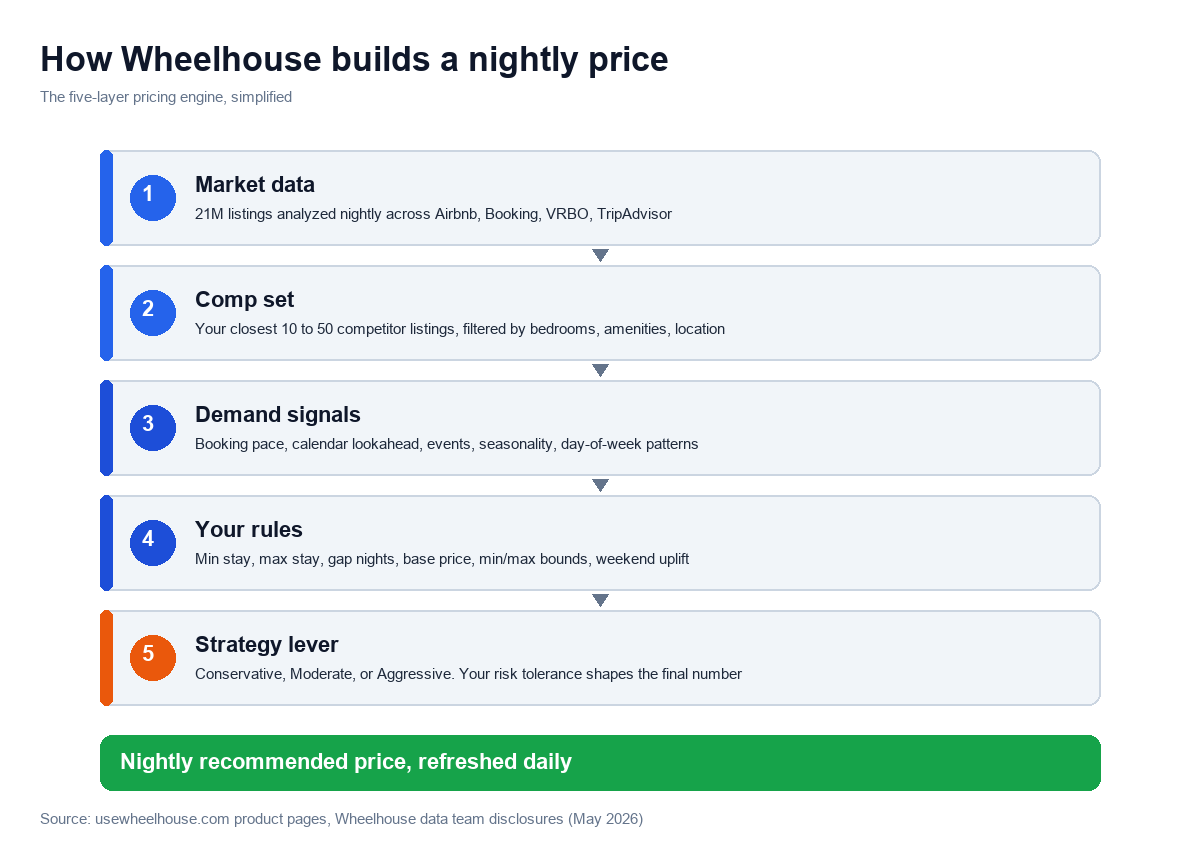
The core promise is simple. You connect your listings (directly with Airbnb, or via a property management system like Hostaway, Guesty, or Hospitable), set a base price and a few rules, and Wheelhouse pushes a new nightly rate every day based on real-time demand. The pitch is that the algorithm reads the market faster than you can manually, and the lift is meaningful enough to justify the fee.
According to Wheelhouse’s own published numbers, the engine analyzes 21 million listings nightly across Airbnb, Booking.com, VRBO, and TripAdvisor. The company is on the 5th generation of its pricing engine, backed by an in-house PhD data science team and what it describes as 8+ years of research. The headline claim on the home page is a 20.6% average revenue uplift for a standard user. Take that with the usual marketing-data caveat: it is a self-reported average, not an audited number. In my experience, the lift is real, but it is heavily dependent on what your nightly rates looked like before you turned the tool on. Hosts who were priced too low pre-Wheelhouse see bigger jumps than hosts who already had a competent pricing strategy.
The customer base ranges from solo operators on 1 listing to enterprise property managers running thousands of doors. Wheelhouse publicly names Avantstay and Highgate as enterprise customers on its site. That mix matters when you read reviews online: the same tool that a 200-door operator loves can feel like overkill to someone running a single cabin in Sevierville.
Wheelhouse features that actually matter
I want to break down what is actually load-bearing in the product versus what is marketing noise. Most operators only use about 30% of the features. Here is what I have seen move the needle for 10XBNB students.
1. The pricing engine and strategy lever
The first thing you pick in Wheelhouse is a strategy: Conservative, Moderate, or Aggressive. This is the most important setting in the entire tool. Conservative leans toward higher occupancy at lower nightly rates. Aggressive pushes for fewer bookings at higher rates. Moderate sits between them.
What most reviews miss is that the strategy lever is dynamic across your calendar. You can run Aggressive for known high-demand windows (think Austin in March during SXSW, or Nashville on CMA Fest weekend) and Moderate for soft seasons. That mid-flight adjustability is what separates Wheelhouse from a “set it and forget it” tool like Beyond Pricing.
2. Comp sets and Insights
Wheelhouse builds a comp set for each of your listings: the 10 to 50 nearby properties it thinks are your closest competitors based on bedrooms, amenities, and location. You can audit and edit this set, which I strongly recommend doing the first week you turn the tool on. The default comp set is usually 70% right and 30% wrong. The 30% you fix is where the algorithm starts pricing correctly.
The free Insights tier gives you the market data without paying for dynamic pricing. If you are doing market research for a new acquisition, this is genuinely useful. It is one of the few legitimate free-tier offerings in the space.
3. Booking pace tracking
This is Wheelhouse’s strongest technical edge over Pricelabs and Beyond. The tool tracks how quickly your listing is filling forward dates compared to the same window last year and compared to your comp set. When your pace is slower than the market, it nudges prices down. When you are pacing ahead of comps, it pushes prices up. StaySTRA’s 2026 head-to-head test found Wheelhouse to be the only major tool offering real-time pace tracking as a default feature.
4. Dynamic Sets
If you run a portfolio with multiple property types or markets, Dynamic Sets lets you group listings by tags and apply rules in bulk: minimum stay, gap nights, weekend uplift, base price changes. The interface is solid. At $12.99 per set per month, it is an add-on, not included in the base pricing.
5. What you can mostly ignore
Wheelhouse has 15+ tweakable settings per listing. New users get overwhelmed and try to use all of them. Don’t. The settings that matter are: base price, minimum price, maximum price, minimum stay rules, gap night rules, and weekend uplift. Everything else is fine-tuning that should wait until you have 60 days of data inside the tool.
Wheelhouse pricing in 2026
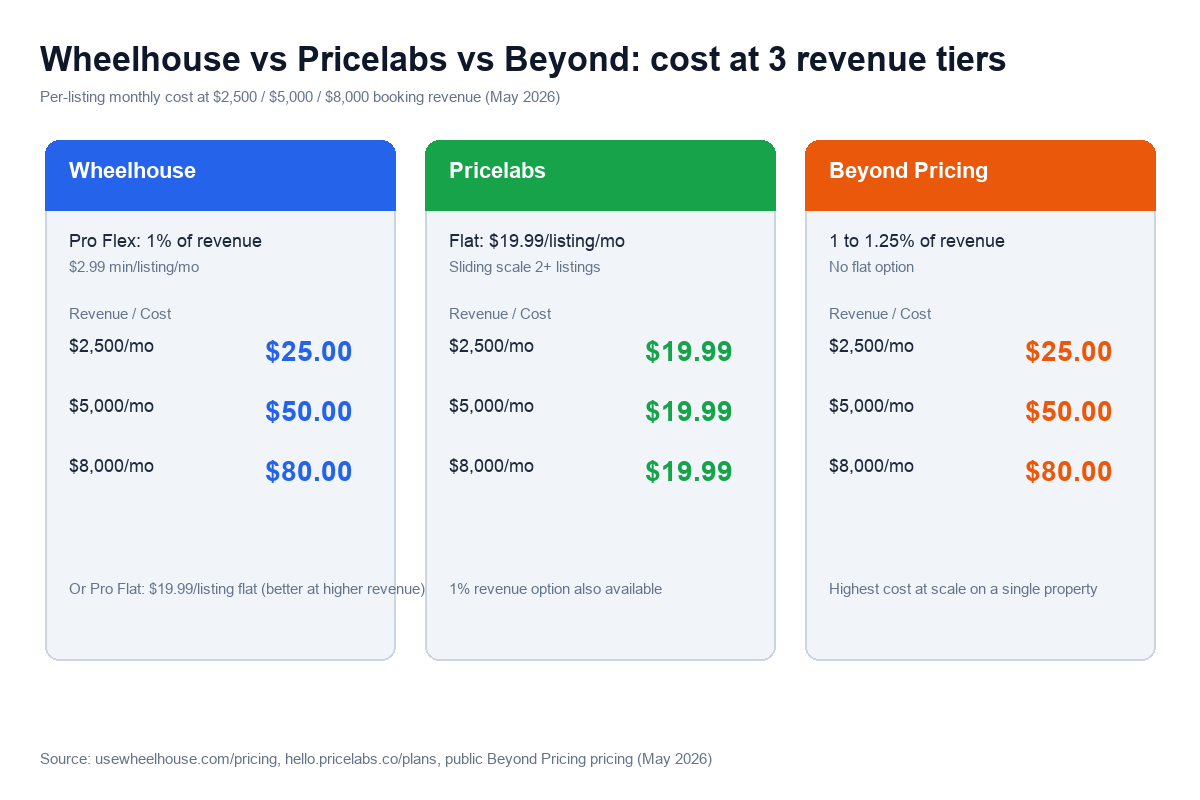
Wheelhouse runs four tiers. Pricing is current as of May 2026 from the official pricing page. Check the live page before signing up; it changes.
- Free tier: Link your listings, see your market report, test settings. No dynamic pricing automation. Genuinely free, no credit card.
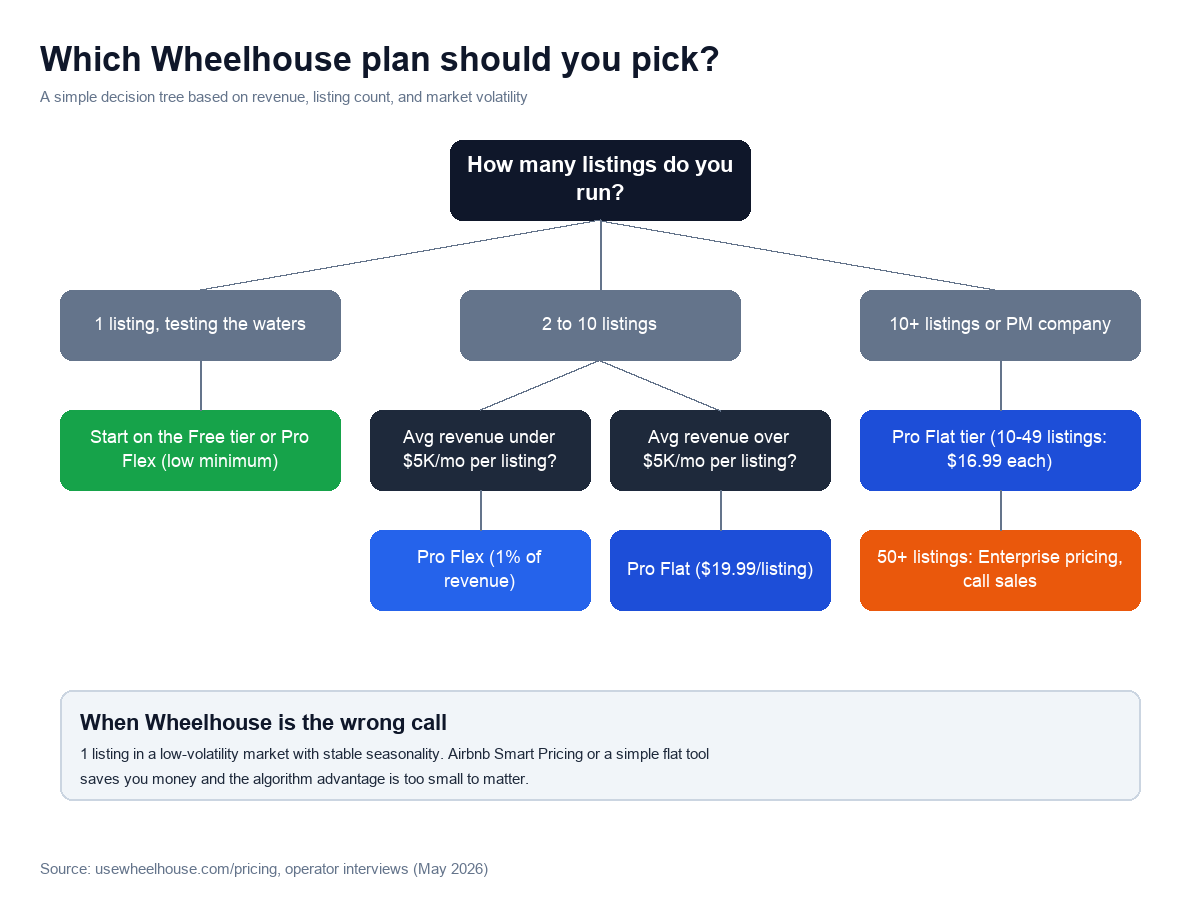
- Pro Flex: 1% of booking revenue per listing with a $2.99 per month minimum. Discounts for portfolios over 50 listings.
- Pro Flat: $19.99 per listing per month. Drops to $16.99 per listing at 10-49 listings.
- Enterprise: Custom pricing for 50+ portfolios with data, software, and services bundled together.
- Dynamic Sets: $12.99 per set per month add-on for portfolio grouping rules.
The 1% trap nobody talks about
Pro Flex at 1% of revenue sounds cheap until you do the math. Here is what you actually pay per listing at different monthly revenue levels:
| Monthly revenue per listing | Pro Flex (1%) | Pro Flat | Better deal |
|---|---|---|---|
| $1,000 | $10.00 | $19.99 | Pro Flex |
| $2,000 | $20.00 | $19.99 | Tie (Pro Flat by 1 cent) |
| $5,000 | $50.00 | $19.99 | Pro Flat |
| $8,000 | $80.00 | $19.99 | Pro Flat (4x cheaper) |
| $12,000 | $120.00 | $19.99 | Pro Flat (6x cheaper) |
The break-even point is around $2,000 in monthly revenue per listing. If any of your listings reliably clear that bar, you should be on Pro Flat. I have seen too many operators sign up on Pro Flex because it has the lower minimum and never go back to switch tiers once their listings start performing. That mistake costs hundreds of dollars a month on a portfolio of 5 to 10 listings.
How Wheelhouse pricing stacks up vs Pricelabs and Beyond
This is where the comparison gets interesting. Pricelabs charges $19.99 per listing per month in the US, UK, Canada, EU, Australia, New Zealand, and Israel, with a sliding scale that drops the second listing to $9.99 and listings 10 through 19 to $8.99 each. Beyond Pricing runs 1 to 1.25% of revenue with no flat-fee alternative, which means a high-revenue listing pulling $8,000 a month costs you $80-$100 monthly on Beyond, versus $19.99 on Wheelhouse Pro Flat or Pricelabs flat.
On pure cost, Pricelabs is the most predictable. On flexibility, Wheelhouse wins because it gives you both pricing models under one roof.
Wheelhouse vs Pricelabs: which one wins
This is the single most-searched comparison in the category, so let me handle it head-on. I have run both tools on real portfolios and seen students run them across markets from Joshua Tree to the Smokies to coastal Maine.
| Dimension | Wheelhouse | Pricelabs |
|---|---|---|
| Pricing models | Free, 1% of revenue, $19.99 flat, Enterprise | $19.99 flat (sliding scale 2+ listings) or 1% revenue option |
| Free tier | Yes (real free Insights tier) | No (trial only) |
| PMS integrations | 40+ | 150+ (clear winner) |
| Customization settings | 15+ per listing | 47 customization options (clear winner) |
| Setup time | 1 to 2 hours | 2 to 3 hours |
| Pricing lookahead | 365 days | 540 days (clear winner) |
| Real-time booking pace | Yes (clear winner) | No |
| Mobile app | Web only | Web only |
| VRBO direct connection | Via partners only | Direct + partners |
| Capterra rating | 4.8 / 5 (162 reviews) | 4.8 / 5 (300+ reviews) |
Picks by use case:
- Pricelabs wins if you run 3 to 10 listings, want deep manual control, need broad PMS compatibility, or run a multi-PMS stack across VRBO and Booking.com.
- Wheelhouse wins if you operate in event-heavy or seasonally volatile markets (Nashville, Austin, Miami, Las Vegas, Park City), want a free tier to test before paying, or specifically need real-time booking pace as a pricing input.
- Tie if you run 2 to 5 listings in a stable seasonal market. Either tool produces 90% of the result. Pick on interface preference.
For the longer head-to-head with all four major tools, our complete Airbnb dynamic pricing tools comparison runs the side-by-side with Beyond and DPGO included.
Where Wheelhouse wins
Event-heavy and volatile urban markets. The booking pace signal and demand layer pick up event spikes faster than competitors. If you operate in Austin, Nashville, Las Vegas, Miami, New Orleans, or Park City, this is meaningful revenue. Operators in these markets I have spoken to consistently report Wheelhouse pricing peak weekends 8-15% higher than Pricelabs in head-to-head tests, with similar occupancy.
The free Insights tier. Genuinely free market data without a credit card is a real differentiator. If you are doing acquisition research, you can use Wheelhouse Insights to evaluate a market before you ever own a listing in it. That is unusual in this category.
Portfolio operators with mixed property types. Dynamic Sets is a strong feature for property managers running multiple property types or markets. The ability to apply rule changes in bulk across grouped listings saves real time at the 10+ listing mark.
The 5th-generation engine. 8+ years of price-recommendation history and a PhD data team is a real moat. The model is more sophisticated than the lighter dynamic pricing tools (Beyond at the simpler end, DPGO at the newer end).
Strong onboarding for non-technical operators. The interface is clean. The setup is faster than Pricelabs. New operators reach a usable pricing strategy in under two hours.
Where Wheelhouse falls short
Honest review means I have to call out the gaps. These are not marketing complaints; they are issues I have hit personally or watched students hit repeatedly.
VRBO and Booking.com coverage is weaker. Wheelhouse does not have a direct VRBO/HomeAway connection. You have to route through a PMS partner, which adds setup cost and complexity. Capterra reviewers flag this consistently as the #1 complaint across 162 verified reviews. If you operate primarily on VRBO, Pricelabs is the cleaner choice.
No mobile app. Web-only access in 2026 is a real limitation. When a guest cancels at 11 p.m. and you want to drop the next-night price to catch a same-night booking, doing it on your phone in a mobile browser is clunky. Both Pricelabs and Beyond Pricing share this gap, but in a category where same-day calendar moves matter, the absence still stings.
Pricing complexity at scale. The Pro Flex (1% of revenue) model can quietly become more expensive than competitors at high ADRs. I have audited portfolios where the operator was paying $400-$600 a month on Pro Flex when Pro Flat would have cost $100. Wheelhouse will not proactively flag that you are on the wrong plan. You have to audit it yourself or have someone audit it for you.
Aggressive default pricing on new markets. The algorithm can occasionally set rates too aggressively in markets where it has thin comp data, particularly newer emerging vacation rental markets. Rental Recon’s 2026 review flagged the same issue: rates occasionally set high enough to price out the listing entirely. Setting a sensible minimum price (not just a base price) prevents this.
Customer support has gotten slower. Long-term Capterra reviewers (50+ unit operators) flag declining support responsiveness over the past 12 months. Wheelhouse has not publicly addressed this. If you require white-glove support, the Enterprise tier is the way to get it; the standard support queue can stretch into days during peak season.
Wheelhouse alternatives worth considering
Wheelhouse is not the only option. Here are the four tools I rank against it most often.
| Tool | Pricing model | Best for |
|---|---|---|
| Pricelabs | $19.99/listing flat or 1% revenue | Hands-on operators with 3+ listings, multi-PMS portfolios, deep customization |
| Beyond Pricing | 1 to 1.25% of revenue (no flat) | New hosts who want set-and-forget simplicity |
| DPGO | Tiered SaaS per listing | Operators wanting AI-first pricing, slightly behind on accuracy |
| Airbnb Smart Pricing | Free (built into Airbnb) | Brand-new 1-listing hosts who haven’t outgrown Airbnb defaults yet |
One quick note on Airbnb’s built-in Smart Pricing: it is free, it adjusts within bounds you set, and for a brand-new host on a single listing in a stable market it is fine for the first 60-90 days. Once you have data, you’ll outgrow it fast. Smart Pricing analyzes Airbnb signals only, ignores VRBO and Booking.com, and does not account for booking pace or comp set data. It is a starting line, not a finish line.
If you are exploring the full stack of host tools beyond just pricing, our breakdown of the best Airbnb analytics tools and the broader Airbnb tools roundup covers the analytics, automation, and PMS layers that sit alongside whichever pricing tool you pick.
Who Wheelhouse is for (and who should skip it)
Pick Wheelhouse if:
- You operate in an event-heavy or seasonally volatile market (peak nights matter)
- You run 5 to 50 listings and want one pricing tool across the portfolio
- You want a real free tier to test the market data before paying
- You prefer machine-learning-driven defaults over deep manual configuration
- Your primary platform is Airbnb (with Booking.com secondary)
Skip Wheelhouse if:
- You run 1 to 2 listings in a stable market with predictable seasonality (a flat tool or Airbnb Smart Pricing is enough)
- VRBO is your primary platform (Pricelabs handles this better)
- You want maximum manual control over every pricing rule (Pricelabs has 47 settings to Wheelhouse’s 15+)
- You operate primarily outside the US in a small market where Wheelhouse’s comp data is thin
- Your average daily rate is below $80 (the % fee math works against you faster than you’d expect)
How 10XBNB students actually use Wheelhouse
Here is where most reviews end and where I think the real conversation starts. The tool is the easy part. What separates operators who get the full 20% revenue lift from operators who get a 5% bump is the rule-set inside the tool, and the system that surrounds it.
Inside 10XBNB, students get live coaching from operators who collectively manage close to 1,000 doors. The pricing tool is one layer. The other layers we teach are: the acquisition criteria you use to pick listings that actually respond to dynamic pricing (some markets and property types have wider pricing windows than others), the rule structure inside the tool (minimum stays, gap nights, weekend uplift, advance-booking discounts), the calendar-strategy overlay that runs on top of the algorithm (event windows, seasonal floors, last-minute drops), and the listing-quality work that lets you price 10-20% above comps without losing occupancy.
The community matters too. When something unusual happens in a market (a venue opens, a hurricane changes the calendar, a city changes its STR rules), a 1,000-door network spots it before any algorithm does. That early signal is worth a meaningful slice of revenue every year.
If you want a coach to walk through your actual portfolio, set up Wheelhouse (or Pricelabs, or Beyond, depending on what fits) the right way, and build the rule-set around it, book a free coaching call here. That is the system we teach. The tool you pick matters less than how you use it.
Wheelhouse review FAQ
Is Wheelhouse worth it?
Wheelhouse is worth it for operators with 3+ listings in volatile markets where the booking pace signal and comp set logic produce meaningful revenue lift. For a single host in a stable market, Pricelabs flat or Airbnb Smart Pricing produces 90% of the result for less money. Run the free tier first and validate the lift before paying.
How much does Wheelhouse cost per month?
As of May 2026, Wheelhouse runs four tiers. Free (Insights only, no dynamic pricing), Pro Flex (1% of revenue with $2.99 minimum per listing), Pro Flat ($19.99 per listing per month, drops to $16.99 at 10-49 listings), and Enterprise (custom pricing for 50+ portfolios). The Pro Flat tier is usually the better deal once your listings clear $2,000 in monthly revenue.
Wheelhouse vs Pricelabs: which is better?
Pricelabs wins on PMS integrations (150+ vs 40+), customization depth (47 settings vs 15+), and pricing lookahead (540 days vs 365). Wheelhouse wins on the free tier, booking pace tracking, and event-heavy urban market pricing accuracy. For most 3-10 listing operators, either tool produces strong results; the choice usually comes down to which interface you prefer and which PMS you run.
Does Wheelhouse work with VRBO?
Wheelhouse does not have a direct VRBO connection. You have to route through a PMS partner like Hostaway, Guesty, or Hospitable. If VRBO is your primary platform, Pricelabs is the cleaner pick because it offers direct VRBO integration.
Is Wheelhouse better than Beyond Pricing?
Wheelhouse offers more pricing flexibility (free tier, flat or % fee, Enterprise) than Beyond, which is 1 to 1.25% of revenue only with no flat option. Wheelhouse also exposes more configuration to the operator. Beyond is simpler to set up but costs significantly more on high-revenue listings. For most operators above $5K monthly revenue per listing, Wheelhouse Pro Flat is cheaper than Beyond.
What is the Wheelhouse free tier?
Wheelhouse’s free tier (called Insights) gives you market data, comp-set visibility, and the ability to test settings without dynamic pricing automation turned on. No credit card required. It is genuinely useful for market research and pre-purchase due diligence on a potential acquisition.
How accurate is Wheelhouse pricing?
Wheelhouse claims a 20.6% average revenue uplift for standard users on its homepage. In my experience, the real number depends heavily on your pre-Wheelhouse pricing strategy. Hosts who were priced too low see large jumps. Hosts who already had a competent pricing strategy typically see 5-12% lift. The bigger value is time saved, not just revenue uplift.
Final verdict
Wheelhouse is a strong dynamic pricing tool that earns its place in the top three of the category alongside Pricelabs and Beyond Pricing. The free tier is real. The booking pace signal is meaningfully better than the simpler tools. The pricing flexibility (flat or % fee) gives you optionality that Beyond does not. And the algorithm is genuinely sophisticated, not marketing veneer.
It is not the right tool for every operator. If you run 1 to 2 listings in a stable market, Pricelabs flat or Airbnb Smart Pricing wins on simplicity and cost. If VRBO is your main platform, Pricelabs wins on integration. If you want set-and-forget with zero configuration, Beyond is faster to onboard.
My honest rating: 3.9 out of 5. Strong product, real algorithm, fair pricing, but it loses points for the VRBO gap, the no-mobile-app gap, and the way the Pro Flex pricing math quietly punishes high-revenue operators who never upgrade to Pro Flat.
The biggest piece of advice I give every 10XBNB student: the pricing tool is the easy part. The rules you set inside the tool, the calendar strategy that overlays it, and the listing-quality work that lets you price above comps are what actually move revenue. We teach that whole stack inside 10XBNB through live coaching, an active operator community, and mentorship from people running real portfolios. If you want help setting up Wheelhouse (or any other tool) the right way, book a free coaching call. The first call is free, and you’ll leave with a concrete pricing plan for your portfolio whether you sign up for anything or not.
One last note for operators planning an acquisition: before you buy a listing, run the market through Wheelhouse Insights (or Pricelabs market data, or AirDNA) to validate that the unit economics actually work. If the math is wrong on a property you don’t yet own, our Airbnb arbitrage calculator will tell you before you sign a lease. The cheapest pricing mistake is the one you don’t make.
Related Operator Deep Dives
Other reviews and comparisons in this cluster operators have found useful: