

Airbnb Arbitrage Coaching: What It Costs and How to Pick a Coach (2026)
I quit my $200,000 banking job at 33. The thing that replaced my salary was Airbnb arbitrage, and I learned it the slow, expensive way before anyone taught me a system. That is the whole reason coaching exists. Airbnb arbitrage coaching is paid guidance, either 1-on-1 or in a group, that teaches you how to lease a property from a landlord, sublet it as a short-term rental, and keep the spread as profit. Coaching is worth the money when you want to compress a 6 to 12 month self-taught grind into a few weeks, get real landlord scripts, and have someone check your first lease before you sign it.
This guide breaks down what arbitrage coaching covers, what the price tiers look like for the courses on the market, how to tell a real coach from a marketer, and when a coach actually earns back the fee. If you are still deciding whether the business model itself fits you, start with what rental arbitrage is, then come back here to pick how you learn it. New to the model entirely? The step-by-step beginner walkthrough covers your first property from scratch.
What Airbnb Arbitrage Coaching Covers for Airbnb Hosts
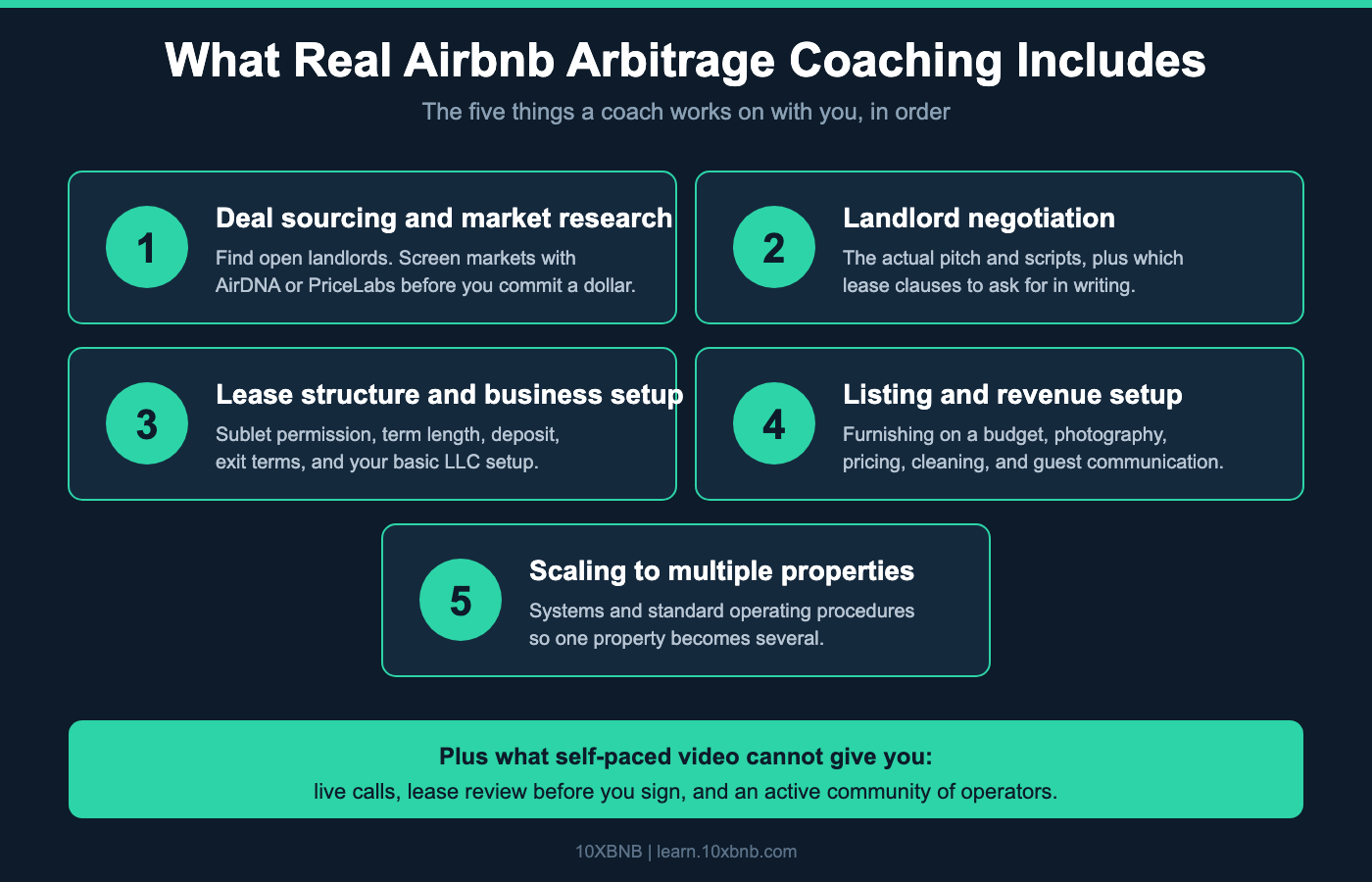
Here is the thing. Generic coaching for airbnb hosts teaches you to run any rental, whether you buy it or rent it. Airbnb arbitrage coaching is narrower. It teaches the rent-to-rent model, where you never buy real estate. You sign a lease, get written permission to sublet on Airbnb, furnish the unit, and run it as a short-term rental that makes money on the gap between your rent and your nightly revenue. A coach who knows this model well works with you on five concrete things, and good coaching takes you through each one in order.
- Deal sourcing and market research. Finding landlords and property managers open to a sublet arrangement, and screening markets with tools like AirDNA or PriceLabs before you commit a dollar. Good market research keeps you out of saturated markets and away from cities that ban short-term rentals.
- Landlord negotiation. The actual pitch. How to present short-term rental subleasing to an owner so they say yes, and which lease clauses to ask for in writing.
- Lease structure and business setup. Sublet permission language, term length, deposit, and exit terms that protect your cash flow if a city changes its rules. A coach should also point you toward setting up an LLC and the basic legal structure before you sign anything.
- Listing and revenue setup. Furnishing the listing on a budget, photography, pricing strategy, cleaning systems, and the guest communication that earns five-star reviews and steady bookings. Revenue rises and falls with how well the listing and pricing are managed.
- Scaling to multiple properties. Going from one property to several without burning out, by building systems and standard operating procedures and handing off cleaning and guest support.
The landlord conversation is where most new hosts get stuck. My own first deal was a $65-a-night spare bedroom. I slept in the smallest room and shared the bathroom with guests. Had to start somewhere. A coach who has signed their own sublease deals can role-play that landlord call, hand you a script, and tell you which objections come up most. That is different from a course that just says “find a landlord who is open to it.” For the wider context, see how the rental arbitrage business model works end to end, from your first property to a portfolio.
What Airbnb Arbitrage Coaching Costs: Pricing Tiers
The word “coaching” gets used for everything from a $20 video course to a five-figure mentorship, so the price range is wide. What you pay buys a different amount of live human help at each tier. Here is how the market breaks down, with named programs and their published numbers.
| Tier | Price range | What you get | Examples |
|---|---|---|---|
| Budget course | $15 to $60 | Pre-recorded intro videos, no live access | Udemy arbitrage courses |
| Focused single course | $180 to $800 | One deep skill: pricing, negotiation, or the algorithm | Sean Rakidzich’s individual courses |
| Mid-range program | $1,400 to $3,000 | Full curriculum, some group support | Airbnb Kickstart ($1,497), BNB Formula |
| Full mentorship program | Varies by program | Live coaching, community, scripts, tools, systems | Book a strategy call |
| Elite mentorship | Up to $25,000 | High-touch 1-on-1, capped enrollment | Premium boutique programs |
Two things drive the price: how much live human time you get, and how specific the help is to your market and your deal. A $200 course can teach you the theory of negotiation. A program with weekly live calls can look at the actual lease a landlord sent you and tell you what to push back on. You pay for access and feedback, not secret knowledge, because the core mechanics of arbitrage are not secret. The point is not finding the cheapest option. It is matching the amount of live help to how fast you want to move. If you want the side-by-side, our ranked comparison of the best arbitrage courses weighs the programs against each other, and the broader rental arbitrage course comparison covers the full field.
DIY Free Content vs Paid Coaching
You can learn rental arbitrage for free. YouTube has hundreds of hours from working airbnb hosts, and the mechanics are all out there. I learned a lot of it that way myself. The honest tradeoff is time and error cost, not access.
The self-taught path usually takes 6 to 12 months and plenty of wasted days before a first profitable property, because you are stitching scattered videos into a system, testing on your own, and learning from your own mistakes. Some of those mistakes are expensive. Signing a lease without sublet permission in writing, picking a market that bans short-term rentals, or furnishing a unit poorly can each cost you thousands. Coaching compresses that timeline because it gives you a tested sequence, direct feedback, and a second set of eyes before you commit money.
A simple way to decide. If your biggest constraint is cash, learn free and move slowly. If your biggest constraint is time, and you can afford the fee without straining, coaching usually pays back fast once you account for avoided mistakes and the months you save. Either way, run the numbers before you buy anything. Circumstances do not define outcomes. Decisions do.
Why People Pick Arbitrage Coaching Over Other Ways to Make Money
Arbitrage appeals to people who want to make money from Airbnb without the capital that buying real estate requires. Owning a rental means a down payment, a mortgage, and years of holding costs. Arbitrage skips all of that. You find a property, sign a lease, and start earning from bookings within weeks instead of a year. For a lot of people the model starts as a side hustle next to a full-time job and grows into a business once the first listing is steady. Your 9-to-5 is not your prison. It is your launchpad.
Coaching is popular here because the work is front-loaded. The hard part is the first 90 days: finding a market, finding landlords who say yes, and getting the first listing live and earning revenue. After that, much of the work is systems and repetition. A coach helps most exactly where most students struggle, in those first months, which is why people who could technically learn arbitrage free still pay for one to get through the slow part faster. More income, sooner, with fewer expensive mistakes. That is the whole pitch.
1-on-1 vs Group Airbnb Coaching
Most programs run one of two formats, and a few blend both. The two formats suit different people, different budgets, and different goals. Picking the right one is partly a money question and partly a question of how you learn best.
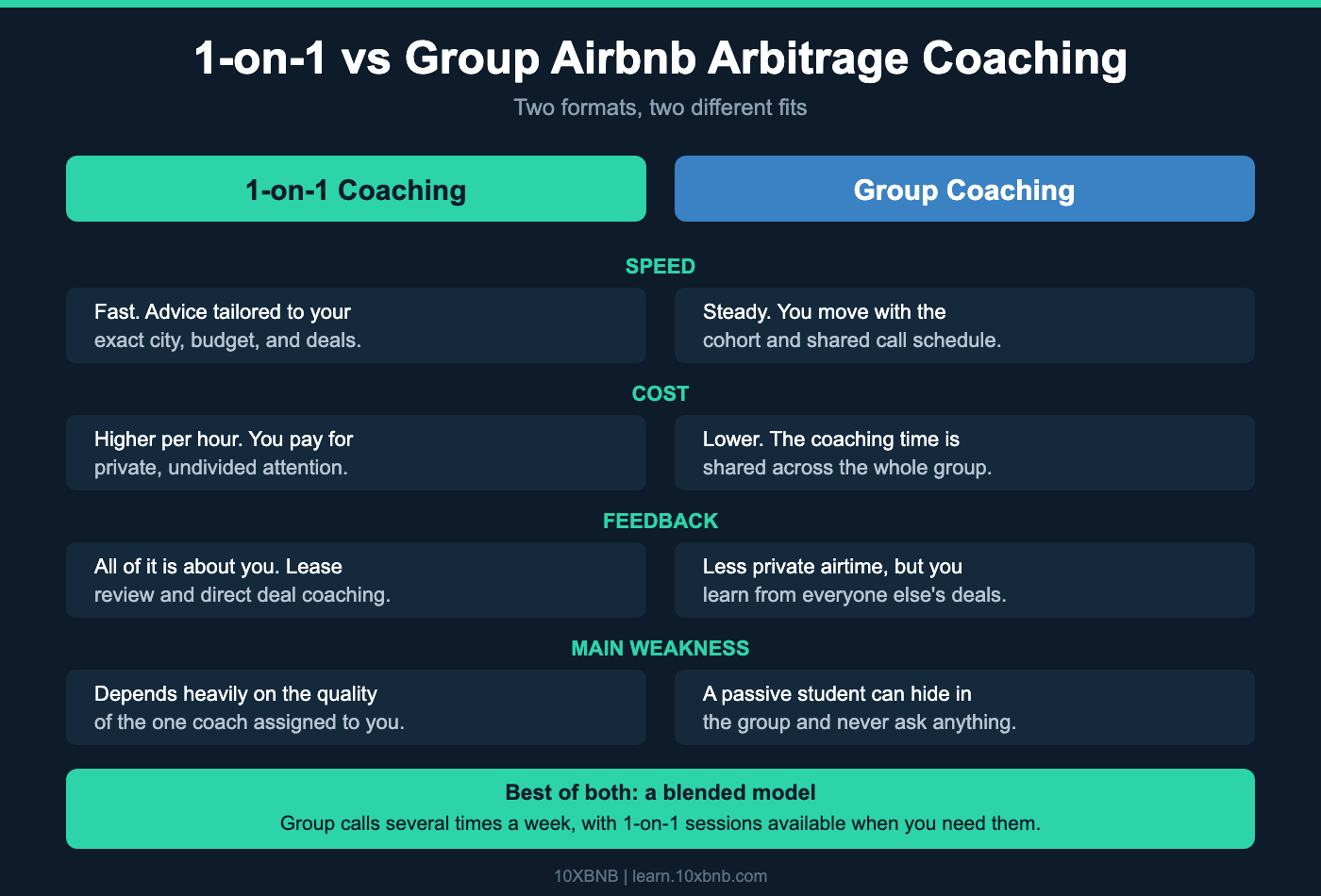
1-on-1 coaching gives you a dedicated airbnb coach and private calls focused only on your situation. It moves fast and the advice is tailored to your city, your budget, and your specific landlord conversations. It costs more per hour and depends heavily on the quality of the one person assigned to you.
Group coaching puts you on live calls with other students and one or more coaches. You get less private airtime, but you hear other students’ deals, objections, and wins, which surfaces problems you have not hit yet. It costs less and the community itself becomes a resource. The weakness: a passive student can hide in a group and never ask a question. Nobody can be successful in isolation, but you still have to speak up.
A blended model, where group calls run several times a week and 1-on-1 sessions are available when you need them, tends to give the best of both. You get the accountability of a community and the precision of private help. For a deeper look at the mentor relationship, read about arbitrage mentorship and how a structured airbnb mentorship program is run week to week. If you want a full breakdown of curriculum and module depth, our guide to the structure of an arbitrage course covers what a real syllabus looks like.
How to Vet an Airbnb Arbitrage Coach
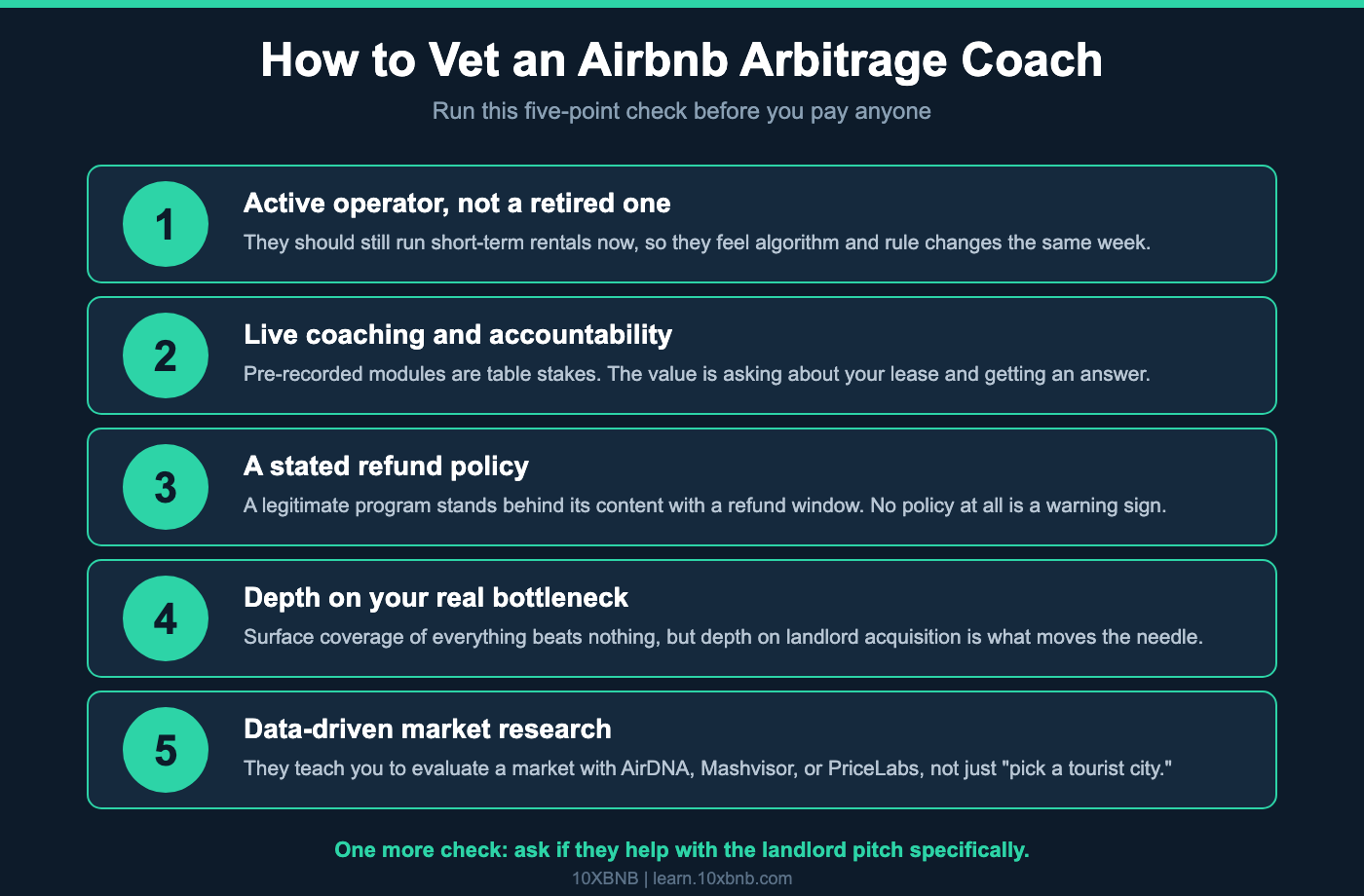
The arbitrage coaching space has real airbnb hosts and pure marketers in the same search results. Run this five-point checklist before you pay anyone.
- Active operator, not a retired one. Your coach should still run short-term rental properties right now. When the Airbnb algorithm shifts or a city changes its rules, an active host feels it the same week. A coach who stopped operating years ago is teaching an old market.
- Live coaching and accountability. Pre-recorded modules are table stakes. The value is being able to ask about your market, your lease, and your problem property and get an answer. Programs with regular live calls produce better student outcomes than self-paced-only courses.
- A refund policy. A legitimate program stands behind its content with a stated refund window. No refund policy at all is a warning sign.
- Depth on your bottleneck. A program that covers sourcing, pricing, operations, and legal at surface level is worse value than one that goes deep on the single thing blocking you, which is usually landlord acquisition. Match the program to your actual gap.
- Data-driven market research. A good coach teaches you to evaluate a market with tools like AirDNA, Mashvisor, or PriceLabs before you sign. If the advice is just “pick a tourist city,” that is not coaching.
One more check. Ask whether the program helps with the landlord pitch specifically. Deal sourcing is where most arbitrage businesses stall, and a coach who hands you scripts and role-plays the call is solving the real bottleneck. You can pressure-test any program’s market and pricing claims yourself by running a property through the Airbnb arbitrage calculator before you commit. For a structured look at what a real curriculum should cover, our breakdown of what real arbitrage training teaches is a useful checklist against any program you are weighing.
The ROI Math: When Coaching Pays for Itself
Coaching is an expense until your first properties are running, then it becomes a small percentage of the income they produce. The arithmetic is the easiest way to find out whether the money makes sense, so here it is. Plug in whatever the program in front of you actually charges and the math works the same way.
Take your program fee. A single arbitrage property in a well-chosen market nets a conservative $1,200 a month in cash flow after rent, cleaning, and fees. The breakeven is one division problem:
Program fee divided by $1,200 per month = months to break even on one property
Sign three properties in your first few months, each netting roughly $1,200, and combined monthly income is $3,600. Now the division uses a bigger denominator:
Program fee divided by $3,600 per month = months to break even on three properties
Run it with the real number once you have it. A fee that takes one property six months to clear is paid back in two months once three are running. Those are illustrative spreads, not a promise. Real profit per property varies with the market, the lease terms, the season, and how well the listing is run. Plenty of hosts net less than $1,200 a month, and some net more. The point is the structure. Coaching is a one-time cost, an arbitrage property produces monthly cash flow, and the breakeven depends on how fast you sign and how well you operate. A coach mainly affects the speed side of that equation. The faster you land a first signed lease, the sooner the math turns into income.
One honest caveat belongs here. If you sign zero properties, coaching returns nothing. The fee only converts to ROI through execution, which is why accountability and a refund policy matter as much as the curriculum. Take the shot, study the bounce, take the next shot. New to the business entirely? Read how to start an Airbnb business before you weigh a coach.
How 10XBNB Coaches Airbnb Rental Arbitrage
10XBNB is the coaching and mentorship program I co-founded with Ari Rahmanian. We teach airbnb rental arbitrage and co-hosting. It sits in the full-mentorship tier, and it is built around the exact parts of arbitrage that new hosts get stuck on, from picking a market to landing that first listing. We built the program we wished we had when we started, because we figured this out the hard way and there is no reason you should have to.
The 10XBNB curriculum walks through the same arbitrage pipeline this guide describes: a nine-framework market research system, a rental arbitrage email script, a phone reach-out script, a brochure for pitching landlords, a rental arbitrage contract template, and an income calculator for vetting a property before you commit. Beyond the self-paced modules, the program runs live coaching calls multiple times a week and an active private community of students, so a question about a specific lease or a difficult landlord gets answered by people who handle the same situations every week.
Ari and I are Airbnb Superhosts. Between us we have generated over $5 million in Airbnb bookings and manage a $100 million portfolio of short-term rentals we do not own. That is the model we teach, the same one that replaced my banking salary. If you want to see what students have done with it, the 10XBNB student results page collects their stories, and the honest 10XBNB reviews page lets you read what members say in their own words.
If you want the full module list, the live coaching schedule, and exactly what is included, see the 10XBNB program details and book a strategy call. If you are still comparing options, the honest breakdown of whether 10XBNB is worth it weighs it against the alternatives. And if arbitrage is only one of several models you are weighing, the broader general Airbnb coaching overview covers co-hosting and property ownership too.
Before you commit to any program, including this one, two things are worth doing first. Read your prospective lease and confirm sublet permission in writing. Airbnb’s own guidance is direct: you need your landlord’s permission to host, and Airbnb’s Help Center covers how to raise the topic with a building manager. Second, check your city’s rules. Some markets, like New York City under NYC’s Short-Term Rental Registration Law (Local Law 18), require host registration and on-site presence, which makes traditional whole-unit arbitrage unworkable there. A coach should steer you away from those markets, not into them. For background on how short-term rental rules vary by city, the Wikipedia entry on Local Law 18 of 2022 is a useful primer.
Frequently Asked Questions
How much does Airbnb arbitrage coaching cost?
Pricing ranges from about $15 for a budget Udemy course to $25,000 for elite 1-on-1 mentorship. Focused single courses run $180 to $800, and mid-range programs run $1,400 to $3,000. Full mentorship programs with live coaching vary by program, so book a strategy call to get a current figure. What you pay for is live human time and feedback specific to your market and your deal.
Is Airbnb arbitrage coaching worth it?
It is worth it when your main constraint is time rather than cash, and you can pay the fee without strain. Coaching compresses a 6 to 12 month self-taught learning curve into weeks, gives you tested landlord scripts, and provides feedback before you sign a lease. It returns nothing if you never act on it, so accountability matters as much as the curriculum.
Can I learn rental arbitrage for free instead of paying a coach?
Yes. The mechanics of arbitrage are freely available on YouTube from working airbnb hosts. The tradeoff is speed and error cost. Self-taught operators usually take 6 to 12 months to a first profitable property and risk costly mistakes like signing a lease without written sublet permission. Free learning suits cash-constrained beginners. Coaching suits people who want to move faster.
What should I look for in an arbitrage coach?
Pick a coach who still actively runs short-term rental properties, offers live coaching and accountability, publishes a refund policy, goes deep on your specific bottleneck (usually landlord acquisition), and teaches data-driven market research with tools like AirDNA or PriceLabs.
Is 1-on-1 or group coaching better for rental arbitrage?
1-on-1 coaching is faster and fully tailored to your situation but costs more and depends on one coach. Group coaching costs less and exposes you to other students’ deals and problems, though a passive student can hide in a group. A blended model with frequent group calls plus available 1-on-1 sessions usually gives the strongest mix of accountability and precision.
Do arbitrage coaches help with landlord negotiation?
A good one does, and this is the part most worth paying for. Deal sourcing and the landlord pitch are where most arbitrage businesses stall. A coach who has signed their own subleases can give you scripts, role-play the call, and tell you which objections come up most and how to answer them.
How long until arbitrage coaching pays for itself?
It depends on how fast you sign properties and how well you run them. The math is one division: program fee divided by monthly cash flow. One property netting $1,200 a month clears a fee far quicker once two or three are running, because the denominator grows while the fee stays fixed. Real per-property income varies with market, lease terms, and season, and signing zero properties means zero return.