Short-term rental regulations in the United States are a moving target. I’ve operated in three states and tracked laws across all fifty, and I can tell you firsthand: picking a host-friendly state versus a restrictive one can mean $30,000 or more in annual revenue difference. That’s not an exaggeration. The gap between Florida’s welcome mat and New York City’s brick wall is that wide.
This guide breaks down airbnb regulations by state so you know exactly where you stand, whether you’re an investor buying property, a host renting out a spare room, or building a short term rental business through rental arbitrage without owning real estate.
How Short Term Rental Regulations Actually Work in the US
Before we get into individual states, you need to understand the regulatory layers that affect every vacation rental in America. It’s not one law. It’s a stack of them, and missing any layer can get you fined or shut down.
The Three Layers of STR Regulation
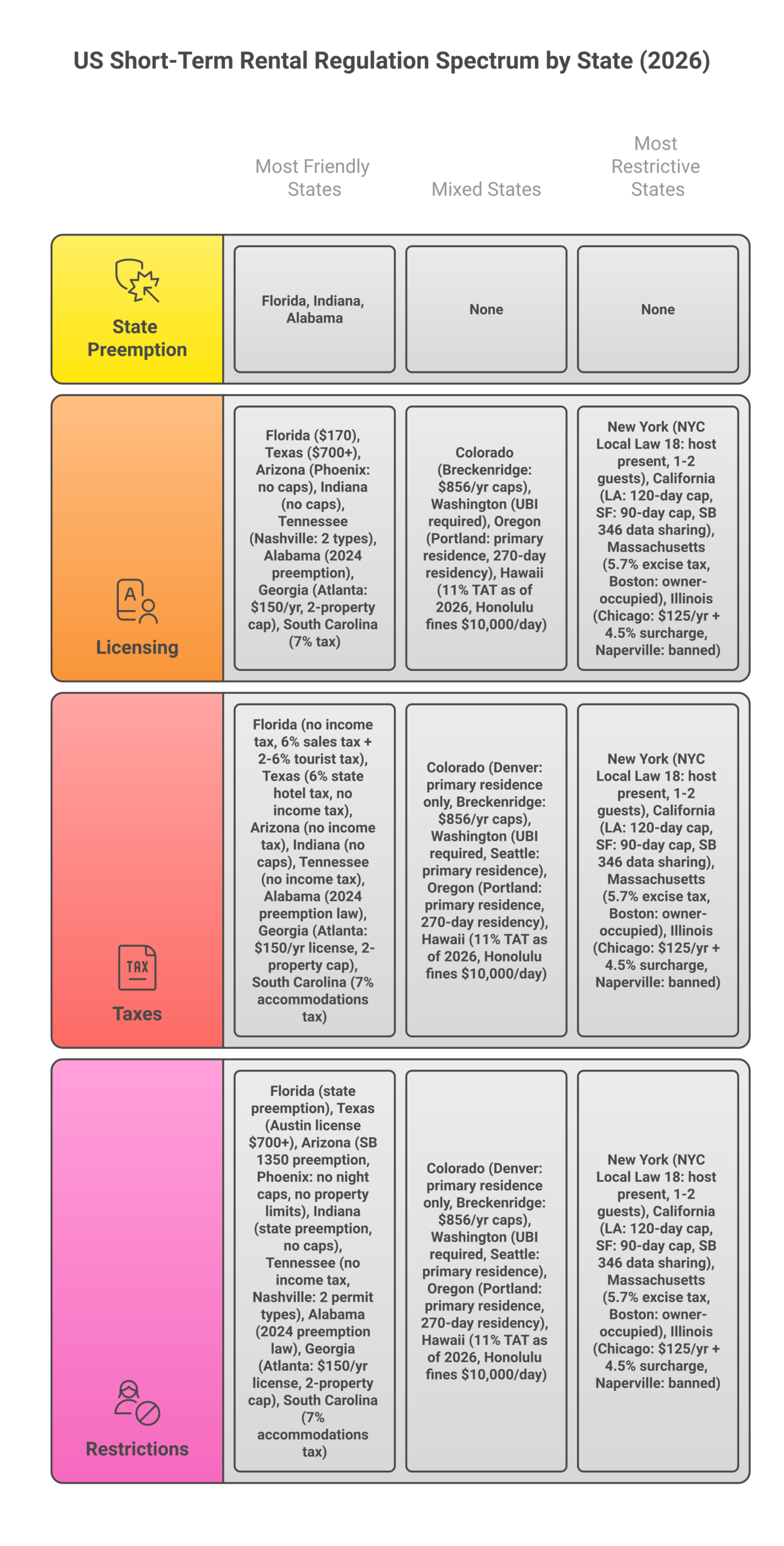
State-level laws set the broad framework. Some states (Florida, Arizona, Indiana) have passed preemption laws that prevent local governments from outright banning vacation rentals. Others (New York, California) give cities full authority to regulate, or crush, short term rentals however they see fit.
City and county ordinances are where most of the action happens. This layer determines permit types, night caps, zoning restrictions, occupancy limits, and whether non-owner-occupied rentals are even allowed. Two cities in the same state can have wildly different local rules. Miami Beach bans most residential STRs while Orlando builds entire communities for them. Same state. Completely different reality.
HOA and lease restrictions add a third layer that catches a lot of new property owners off guard. Even if your city allows Airbnb, your HOA or lease agreement might prohibit it entirely. If you’re doing rental arbitrage, landlord approval is step one, non-negotiable.
Common Regulatory Elements Across Most Jurisdictions
Across the country, most local governments now require some combination of these for vacation rental owners:
- Business license and/or STR permit, annual registration, typically $50-$500 depending on the local jurisdiction
- Lodging and occupancy taxes: local lodging taxes of 2-15% on top of state sales tax
- Safety inspections: smoke detectors, fire extinguishers, CO monitors, egress windows
- Liability insurance: $500,000-$1,000,000 minimum in some cities
- Registration number displayed on listings: required by most platforms now
- Local contact person: someone who can respond to complaints within 30-60 minutes
- Occupancy limits: usually 2 guests per bedroom plus 2-4 additional
- Night caps: some cities limit STR days to 90-180 per year
The trend in 2026 is unmistakable: more cities are requiring registration, more states are mandating platform tax collection, and enforcement is getting sharper with software that scrapes listings to catch unlicensed operators. Local authorities in cities like Key Biscayne, Florida have deployed AI-powered scraping tools, and Cape Coral has issued fines exceeding $30,000 for a single property’s violations.
States Ranked by STR-Friendliness (2026)
I’ve ranked every state based on four factors: statewide preemption protecting hosts, typical permit costs and barriers, night caps or unit caps in major vacation rental hotspots, and overall arbitrage viability. Here’s how they stack up.
| Tier | States | Why |
|---|---|---|
| Most Friendly | Florida, Texas, Arizona, Alabama, Tennessee, Georgia, South Carolina, Indiana | State preemption laws, low barriers, strong tourism demand, no state income tax (FL/TX/TN) |
| Host-Friendly | North Carolina, Ohio, Nevada, Missouri, Kentucky, Louisiana, Mississippi, Oklahoma, Arkansas, Idaho, Montana, Wyoming, Utah | Moderate short term rental regulations, reasonable permit costs, few night caps in major markets |
| Mixed | Colorado, Washington, Oregon, Virginia, Maryland, Michigan, Minnesota, Wisconsin, New Mexico, Connecticut, New Hampshire, Maine, Alaska, Hawaii, Rhode Island | Friendly at state level but restrictive in key cities; varies widely by local jurisdiction |
| Restrictive | California, New York, Massachusetts, New Jersey, Illinois, Pennsylvania, Vermont, Delaware, Iowa, Nebraska, Kansas, West Virginia, North Dakota, South Dakota | Heavy local restrictions, night caps, primary residence requirements, strict regulations and high costs in major cities |
A word of caution: even “Most Friendly” states have individual cities with tough rules. Miami Beach bans most residential STRs despite Florida being the friendliest state overall. Always check city-level regulations, not just state rankings. And consult a local lawyer if you’re investing significant money in an unfamiliar market.
State-by-State Guide: The Southeast
Florida
Florida is hands-down the most arbitrage-friendly state in 2026. I don’t say that lightly, I’ve analyzed every state’s regulatory environment, and Florida’s combination of protections, demand, and tax advantages is unmatched.
The state’s preemption law (originally passed in 2011 and updated since) prevents local governments from outright banning vacation rentals that were operating before June 2011. Any property owner renting a full unit more than three times per calendar year for stays under 30 days must register with the Florida Department of Business and Professional Regulation (DBPR) and obtain a vacation rental license. That’s the state-level requirement for anyone in the vacation rental business.
Permit costs: The DBPR short term rental license runs $170 for initial application. Local permits vary. Some counties charge nothing extra, others run $100-$300 annually. Compared to Breckenridge’s $856/year or Austin’s $700+ application fee, Florida’s costs are minimal.
Taxes: Florida charges a 6% state sales tax plus county-level local tourist development taxes ranging from 2% to 6% depending on the county. Broward County’s tourist tax sits at 6%. No state income tax. That’s a massive profitability advantage for property managers and vacation rental owners alike.
Key cities and their local rules:
- Miami Beach: The exception to Florida’s friendliness. Rentals under 30 days are illegal in most residential zones. Aggressive enforcement with fines starting at $20,000. Stick to commercially zoned properties or look elsewhere in Miami-Dade County.
- Orlando/Kissimmee: Extremely STR-friendly. Osceola County has entire communities purpose-built for vacation rentals. Great for rental arbitrage.
- Tampa/St. Petersburg: Permits required, reasonable fees. Strong demand from tourists and business travelers.
- Fort Lauderdale: Registration required but straightforward. Broward County’s tourist tax is 6%.
- Clearwater: Prohibits rentals under 31 days in most residential zones, check zoning before committing.
- Pinellas County: Operating permit required plus mandatory property inspection and compliance with parking, occupancy, and noise rules.
Arbitrage viability: Excellent. Florida’s combination of year-round tourism, state-level protections, no income tax, and massive demand from the vacation rental market makes it the top pick. The Florida Department of Business and Professional Regulation keeps the process straightforward. Read our full breakdown of Florida rental arbitrage laws for city-by-city details.
Georgia
Georgia doesn’t have a statewide STR definition, so vacation rental regulations are entirely local. The good news? Most Georgia cities are reasonable about permits and don’t impose harsh restrictions on the short term rental industry.
Taxes: 4% state sales tax plus a $5 per-night state hotel-motel fee, plus local taxes that vary by county. Savannah’s local lodging taxes are higher than average.
Key cities:
- Atlanta: $150/year business license. Hosts can operate a maximum of two properties total, including their primary residence. Annual renewal required. The two-property cap limits scaling but doesn’t kill arbitrage entirely.
- Savannah: Registration required with caps on STR units in certain historic districts. Zoning rules are strict downtown but more flexible in surrounding areas.
- Augusta: Less regulated than Atlanta or Savannah. Growing market, especially around Masters Tournament season when ADR spikes.
Arbitrage viability: Good in Atlanta (within the 2-property cap) and surrounding suburbs. Savannah works for owner-operators more than arbitrage players.
Alabama
Alabama flies under the radar, and honestly? That’s a competitive advantage. The state has minimal regulation at the state level, and in 2024 Alabama passed a state preemption law preventing most local governments from banning STRs outright. Cities can still regulate them, but they can’t slam the door shut.
Taxes: 4% state lodging tax plus varying local taxes. Some counties charge additional bed taxes, typically 1-3%. Sales taxes apply on top.
Key cities:
- Gulf Shores/Orange Beach: Tourist-heavy areas with established vacation rental markets. Registration required, process straightforward.
- Birmingham: Growing short term rental market with relatively few restrictions. Business license required.
- Huntsville: Booming tech economy driving short-term demand. Minimal STR-specific regulation from local authorities.
Arbitrage viability: Strong. Low cost of living plus light regulation equals good margins for the vacation rental business.
South Carolina
South Carolina’s regulatory landscape is a patchwork. No single statewide STR law, but Senate Bill S.442 (passed in 2025) created new statewide standards while preserving local authority. The state’s 7% accommodations tax applies to all stays, collected by the South Carolina Department of Revenue.
Key cities:
- Charleston: One of the more complex regulatory environments in the Southeast. STRs split into Commercial and Residential categories. Non-owner-occupied STRs only allowed in the Short Term Rental Overlay Zone. Owner-occupied STRs require the owner to be present during guest stays. Maximum four unrelated adults per stay. Permit plus business license required.
- Myrtle Beach: STRs not allowed in R-zoned residential neighborhoods. Business license required, 3% local accommodations tax, and properties must fall within permitted use districts.
- Greenville: Less restrictive than Charleston. Growing market with reasonable permit requirements.
Arbitrage viability: Moderate. Charleston’s overlay zone plus on-site owner rules make arbitrage challenging there. Myrtle Beach works in commercial zones. Greenville and Columbia offer better arbitrage potential.
North Carolina
North Carolina’s Vacation Rental Act governs contractual relationships for stays under 90 days, but real short term rental regulations happen at the city level. Most NC cities are relatively host-friendly, though mountain and beach towns tend to have tighter rules than inland cities.
Key cities:
- Charlotte: Business license required but no specific STR ordinance. One of the easier major cities to operate in.
- Raleigh: Registration required with zoning verification. Events banned at STR properties. Permit number must display on all advertisements. Operational standards for multifamily buildings.
- Asheville: More restrictive. Homestay permits for primary residences, whole-dwelling STRs limited to certain zones. STRs are effectively banned in resort zoning districts. Strong demand from tourism means high ADR for permitted hosts.
- Outer Banks: Established vacation rental market with well-defined rules. Dare County and Currituck County both require registration.
Arbitrage viability: Good in Charlotte and the Triangle area. Asheville is tougher but high ADR compensates for those who qualify.
Tennessee
Tennessee passed the Short-Term Rental Unit Act creating a statewide framework while giving cities authority to set their own local rules. Nashville, the state’s biggest STR market, has some of the most well-known short term rental regulations in the country.
Key cities:
- Nashville: Two permit types, owner-occupied (allowed in all residential zones) and non-owner-occupied (restricted to non-residential zones only). All permits require annual renewal. Operating under an expired permit means a one-year ban from getting a new one. Occupancy limited to 2 per bedroom plus 4, max 12 total. Minimum $500,000 liability insurance required. Permit application through Metro Codes can take 4-8 weeks.
- Memphis: Less regulated than Nashville. Business license and registration required, fewer zoning restrictions.
- Gatlinburg/Pigeon Forge: Tourist-focused economies where vacation rentals are core to the local ecosystem. Smoky Mountain towns are generally very welcoming.
Arbitrage viability: Nashville is tough for non-owner-occupied arbitrage due to zoning restrictions, but owner-occupied works everywhere. Memphis and Smoky Mountain towns offer better arbitrage potential with fewer barriers. Tennessee has no state income tax.
State-by-State Guide: The South and Southwest
Texas
Texas is a powerhouse for Airbnb, strong demand, no state income tax, and a state government that historically sides with property rights. But the city-level picture has gotten more complicated in 2025-2026, and property managers need to pay closer attention to state and local regulations than ever before.
Taxes: 6% state hotel occupancy tax plus local hotel taxes (typically 7-9% in major cities). State and local taxes combined can hit 15-17% total. No state income tax, which partially offsets the lodging tax burden.
Key cities:
- Austin: Requires an STR operating license, application fees exceed $700. As of September 2025, platforms must collect and remit Hotel Occupancy Taxes on behalf of operators. Density restrictions on STR locations. Platforms must verify valid license numbers on all listings. Type 1 (owner-occupied) allowed citywide; Type 2 (non-owner-occupied) restricted to certain areas.
- Dallas: Relatively lenient. STR operators collect and remit the 6% state tax plus 9% local occupancy tax. No owner-occupancy requirement. One of the better major-city environments for arbitrage.
- Houston: Brand new STR ordinance effective January 1, 2026 (Ord. 2025-322) requires valid city registration, $1 million in liability insurance, display of STR number on listings, and occupancy limits of 2 guests per bedroom plus 2. Significant tightening from Houston’s previously unregulated short term rental market.
- San Antonio: Registration required with a $200 annual permit fee. Must comply with noise, parking, and occupancy standards.
Arbitrage viability: Excellent in Dallas and San Antonio. Austin is viable but getting more complex. Houston’s 2026 ordinance adds costs (that $1M insurance requirement is steep) but doesn’t kill the model.
Arizona
Arizona passed a landmark STR preemption law in 2016 (SB 1350) that prevented cities from banning vacation rentals. The state amended that law in 2022 (SB 1168) to allow some local regulations, but it still protects the fundamental right to operate an STR. Arizona’s Court of Appeals recently ruled against Sedona’s attempt to prevent mobile homes from operating as STRs, a sign the courts are still siding with property rights.
Key cities:
- Phoenix: Very host-friendly. No limits on the number of properties a host can operate. No yearly caps on rental nights. Registration required, sales tax and Transient Lodging Tax must be collected, $500,000 minimum liability insurance mandatory. Landlords must respond to police calls within one hour.
- Scottsdale: Among Arizona’s strictest. Requires a specific STR license ($250/year), detailed operational requirements for noise control, neighborhood notification, and responsible management.
- Sedona: Annual STR permit required. Nearly 1,000 of Sedona’s 6,600 housing units are STRs. The city launched a $10,000 incentive program to get vacation rental owners to convert back to long-term rentals. Late fees for permit renewal as of January 2026.
- Tucson: Registration required, relatively straightforward. Lower barrier than Scottsdale or Sedona.
Arbitrage viability: Phoenix is one of the best arbitrage cities in America. No property limits, no night caps, strong year-round demand. Scottsdale and Sedona work but with higher compliance costs.
Nevada
Nevada’s STR landscape is complicated, largely because of Clark County (Las Vegas). The state doesn’t set a single statewide definition. AB 363 created a framework that includes jurisdiction-specific licensing, lodging tax obligations of 13-13.8%, and safety compliance standards.
Key cities:
- Las Vegas (Clark County): Clark County’s STR ordinance faced legal challenges, and a U.S. District Court judge granted a preliminary injunction blocking enforcement of some provisions as of early 2026. Applications for new STR licenses remain closed. The market exists in a legal gray area, proceed with extreme caution.
- Henderson: Has its own STR permit system separate from Clark County. More structured and predictable.
- Reno (Washoe County): STR permits available with zoning restrictions. Vacation rental permits required, caps in certain neighborhoods.
Arbitrage viability: Clark County’s regulatory uncertainty makes Las Vegas risky. Henderson and Reno are safer with clearer state and local regulations.
New Mexico
New Mexico saw multiple STR bills in 2025 (HB 109, HB 139, HB 1445) aimed at creating more structure around short-term rentals. The state’s regulatory landscape is shifting fast.
Key cities:
- Santa Fe: Registration required with annual renewal. Zoning restrictions in historic districts. Strong tourism demand year-round.
- Albuquerque: Business registration required. Less restrictive than Santa Fe. Growing short term rental market with expanding demand.
Arbitrage viability: Moderate. Tourism-driven markets like Santa Fe have strong ADR but regulatory uncertainty from pending legislation. Watch the 2026 session.
State-by-State Guide: The West
California
California is the poster child for fragmented vacation rental regulations. No statewide Airbnb law. Each city sets its own rules. And California cities don’t hold back. Senate Bill 346, effective January 1, 2026, gives local governments new power to compel platforms like Airbnb and VRBO to share information about STRs operating within their jurisdictions. This is a game of local laws and local rules, and they’re getting tighter.
Key cities:
- Los Angeles: Only primary residences with active City Planning Home-Sharing registration can operate. Limited to 120 rental days per year unless approved for Extended Home-Sharing. 14% Transient Occupancy Tax. One of the toughest major-city environments for the short term rental industry.
- San Francisco: Must be a permanent resident. STR limited to your primary residence. 90-day annual cap for unhosted stays. Quarterly reports required. 14% TOT. Register with the Office of Short-Term Rentals.
- San Diego: Since July 2022, all STR properties need a license with four tiers based on usage level. Zone-based TOT rates range from 11.75% to 13.75%. Updated fee structures took effect March 2025.
- Palm Springs/Desert Cities: More STR-friendly than coastal cities. Registration required but fewer restrictions. Strong seasonal demand drives the vacation rental market.
Arbitrage viability: Poor in LA and SF due to primary residence requirements. San Diego is possible in the right zones. Desert cities and smaller beach towns offer the best California opportunities for rental arbitrage.
Colorado
Colorado’s short term rental market is split between mountain resort towns (getting restrictive) and cities (varying widely). No statewide preemption, cities have full authority. A new state law now allows counties to raise local lodging taxes to a maximum of 6% via ballot measures, and multiple counties approved increases in the November 2025 election.
Key cities:
- Denver: Primary residence only. License required, $100 annual renewal. 4.81% city sales tax plus 10.75% lodger’s tax. Denver has filed lawsuits against property managers operating illegal non-primary rentals. Zero tolerance.
- Breckenridge: Among the most restrictive in Colorado. Cap of 2,200 licenses (down from 3,945). Town divided into four STR zones with different caps. Annual fees scale by bedroom, a one-bedroom condo runs $856/year. Breckenridge successfully defended its restrictions in federal court in 2024.
- Boulder: New “Festival Lodging Rental License” introduced for stays under one month during designated multiday events. Effective January 2027 in preparation for the Sundance Film Festival relocation.
- Colorado Springs: Less restrictive than Denver. Business license and STR registration required, no primary residence requirement.
Arbitrage viability: Denver is a no-go for traditional arbitrage (primary residence only). Mountain towns are increasingly capped. Colorado Springs offers better arbitrage potential.
Washington
Washington requires a state Unified Business Identifier (UBI) for all STR operators, but the real rules are local. State and local regulations combine to create a patchwork that varies dramatically by city.
Key cities:
- Seattle: STR operators need a city business license, STR permit, and platform registration. Primary residence requirement. Limited to two units. STR operators tax applies on top of lodging tax.
- Vancouver: STR permit program paired with city business license. Local contact required, nuisance standards enforced.
- Tacoma: Less restrictive than Seattle. Registration required, fewer unit caps.
Arbitrage viability: Limited in Seattle due to primary residence requirement. Better opportunities in mid-size cities and tourist areas.
Oregon
Oregon has a 1.5% state Transient Lodging Tax filed quarterly. Portland has some of the strictest short term rental laws in the West, while coastal towns and smaller cities are more welcoming to vacation rental owners.
Key cities:
- Portland: Must be your primary residence. Minimum 270 days/year residency required. Permit required, safety inspections mandated. Type A (2 bedrooms or fewer) needs basic permit; Type B (3-5 bedrooms) requires additional review. Recently approved stricter safety standards. 6% Multnomah County transient lodging tax plus state and city taxes.
- Bend: More STR-friendly. Permit required, fewer restrictions. Tourism-driven economy supports strong demand.
- Coastal towns: Varies by local jurisdiction. Some have caps on STR permits, others are more open.
Arbitrage viability: Not viable in Portland (primary residence only). Bend and coastal markets offer opportunities.
Hawaii
Hawaii is among the most restrictive states for vacation rentals. Each county sets its own rules, and they’re getting tighter. As of January 1, 2026, the state Transient Accommodations Tax (TAT) increased from 10.25% to 11%. Hawaii also implemented a new “green fee” supporting environmental projects, expected to raise $100 million annually. When you add local taxes on top, the tax burden is enormous.
Key areas:
- Honolulu (Oahu): Requires a Non-Conforming Use Certificate (NUC). Aggressive enforcement with fines up to $10,000/day. Very limited legal STR inventory.
- Maui: Cracking down hard. Many previously permitted STRs being phased out. Permits increasingly difficult to obtain.
- Hawaii County (Big Island): Slightly more relaxed, but now requires registration for both STR operators and marketplaces. Must provide property information to county.
Arbitrage viability: Extremely difficult. High barriers, limited permits, aggressive enforcement. Not recommended for beginners entering the vacation rental business.
Alaska
Alaska has no statewide STR definition, cities and boroughs set their own criteria. State business license required for all operators, plus state sales taxes and local bed taxes.
Key cities:
- Anchorage: Local license per unit, 24-hour contact required, liability insurance mandatory. Registration number must display on listings.
- Juneau: STRs defined as stays under 30 days. Annual renewal with safety verification.
- Fairbanks: State and borough business licenses required. No dedicated STR registration. One of the simpler setups.
Arbitrage viability: Niche. Strong seasonal demand but limited market size.
Utah, Idaho, Montana, Wyoming
These Mountain West states share a common thread: relatively light state-level regulation with most rules set locally.
- Utah: No statewide STR ban. Salt Lake City requires STR licenses. Park City has strict regulations with permit caps. Counties now authorized to increase transient room tax by 0.25% to maximum 4.5%. Eighteen counties adopted increases in 2025, including Wasatch, Summit, and Grand counties, all popular vacation rental hotspots.
- Idaho: Minimal statewide regulation. Boise requires business licenses for STR operators. McCall and Sun Valley have their own local rules.
- Montana: State lodging facility use tax applies. Most regulation is at the city/county level. Whitefish and Big Sky have specific STR ordinances due to tourism pressure.
- Wyoming: Among the least regulated states. State lodging tax applies. Jackson Hole has its own regulations, but most of Wyoming is wide open for property owners.
State-by-State Guide: The Midwest
Ohio
Ohio has been slower to regulate STRs than coastal states, making it attractive for property managers and arbitrage operators looking for affordable markets with manageable state and local regulations.
Key cities:
- Columbus: Annual STR license required, renewed yearly. BCI background check mandatory. Registration number must display on listings. Notable privacy rules per Ohio Revised Code 2933.52, must disclose monitoring devices, cannot record in sleeping or bathroom areas.
- Cleveland: STR permit required. Building and fire inspections. Residential occupancy limits enforced.
- Cincinnati: 3-year permits available. Business license required. Over-the-Rhine and downtown are popular STR zones with strong demand.
Arbitrage viability: Good. Ohio’s major cities have reasonable regulations, affordable rents, and solid demand. Columbus and Cincinnati are particularly strong for rental arbitrage.
Michigan
Michigan’s STR regulation varies dramatically between its tourism-heavy areas and its major cities.
- Detroit: Relatively few STR-specific regulations. Business license required. Emerging market with low entry costs.
- Traverse City: More restrictive. STR permits, zoning restrictions, and growing pushback from local communities concerned about housing availability.
- Grand Rapids: Registration required. Moderate regulations. Strong event-driven demand.
Arbitrage viability: Good in Detroit and Grand Rapids. Northern Michigan resort towns are getting tighter but high seasonal ADR compensates.
Indiana
Indiana passed a state preemption law that significantly limits local governments’ ability to restrict STRs. Cities can require registration and impose safety standards but can’t ban them outright. This creates one of the most predictable regulatory environments in the Midwest for the short term rental business.
- Indianapolis: Registration required, safety standards enforced, but no permit caps or primary residence requirements. Strong event demand (Indy 500, conventions).
- Bloomington: Registration with some zoning restrictions near the university.
Arbitrage viability: Excellent. Indianapolis is a strong arbitrage market with clear rules.
Illinois
Illinois became more aggressive with STR taxation in 2025. As of July 1, 2025, STR properties are subject to the state Hotel Operators’ Occupation Tax. Chicago is the main story.
- Chicago: Requires a Shared Housing License, $125 annual fee, 4.5% surcharge on bookings. Must register with the city. Two-unit cap for non-primary residences. Maximum 2 guests per bedroom (excluding children under 18) or 1 guest per 125 square feet, whichever is less. Monthly data submission requirement to aldermen. Naperville has effectively banned STRs, fines of $1,000-$2,500 per violation.
Minnesota, Wisconsin, Iowa, Missouri
- Minnesota: Minneapolis requires STR licenses with annual renewal. St. Paul has its own ordinance. State lodging tax applies statewide.
- Wisconsin: State requires a Tourist Rooming House license for any STR operator. Annual license fee plus inspection. Milwaukee and Madison have additional local rules.
- Iowa: Minimal statewide regulation. Des Moines requires business licenses. Generally host-friendly.
- Missouri: No statewide STR law. Kansas City introduced special event permits at $50 (versus the normal $200 annual fee) for the 2026 FIFA World Cup under Ordinance 250965 passed November 2025. St. Louis requires registration.
Kansas, Nebraska, North Dakota, South Dakota
The Great Plains states have minimal STR-specific regulation at the state level:
- Kansas: Local control. Kansas City area seeing increased regulation ahead of the 2026 FIFA World Cup.
- Nebraska: Omaha requires business licenses. Lincoln has minimal specific STR rules. State lodging tax applies.
- North Dakota: Minimal regulation. State lodging tax. Williston saw STR activity during oil boom periods.
- South Dakota: Minimal regulation. Rapid City (near Mount Rushmore) and Sioux Falls are primary markets. State tourism tax applies.
State-by-State Guide: The Northeast
New York
New York is the cautionary tale for STR operators. The state gives cities full authority to regulate, and New York City used that authority to create one of the toughest vacation rental environments in the world. The short term rental industry in NYC has been fundamentally reshaped.
Key cities:
- New York City: Local Law 18 (effective September 2023) requires all STR hosts to register with the Mayor’s Office of Special Enforcement. Hosts must be present during all stays. Only one or two guests allowed. No entire-apartment rentals unless the host is present. Registration numbers must appear on all listings. Platforms face penalties for listing unregistered properties. This essentially killed the traditional Airbnb model in NYC.
- Upstate New York: Much more relaxed. In January 2025, the state legislature approved a law allowing counties to develop their own STR registries, with platforms required to submit quarterly reports including rental locations, occupancy nights, guest counts, and taxes collected. Counties with active registries now include Albany, Columbia, Oneida, Tompkins, and Washington. The Catskills, Adirondacks, and Finger Lakes remain viable markets.
Arbitrage viability: Essentially impossible in NYC. Upstate markets offer much better opportunities. The Hudson Valley and Catskills are popular destinations with more manageable state and local regulations.
Massachusetts
Massachusetts enacted a statewide STR law in 2019 requiring registration with the state, imposing a 5.7% state excise tax on STRs, and allowing cities to add a local community impact fee up to 3%.
- Boston: Only owner-occupied or owner-adjacent units can be STRs. Must register with the city. Limited to one listing per host. Annual registration fee plus state and local taxes.
- Cape Cod/Martha’s Vineyard: Registration required. Seasonal vacation rental hotspots with very high ADR but limited off-season demand.
Arbitrage viability: Very limited in Boston (owner-occupancy requirement). Seasonal markets work for owners, not arbitrage operators.
New Jersey, Connecticut, Pennsylvania
- New Jersey: No statewide STR law. Jersey Shore towns have heavy local regulation. State sales tax applies. Atlantic City and Jersey City have specific ordinances.
- Connecticut: State requires STR operators to collect a 15% room occupancy tax. Registration varies by town.
- Pennsylvania: No statewide STR law. Philadelphia requires a rental license and collects 8.5% hotel tax. State hotel occupancy tax of 6% applies statewide.
Vermont, New Hampshire, Maine, Rhode Island, Delaware
- Vermont: State requires STR registration and collects 9% rooms tax plus 1% local options tax. Burlington has additional restrictions.
- New Hampshire: Operators register with the state as tourist accommodation. 8.5% meals and rooms tax applies.
- Maine: No statewide short term rental license. Portland has annual registration, primary-residence rules, and caps in certain districts. Kennebunkport requires licenses with inspections and zone-based caps.
- Rhode Island: Statewide local hotel tax increased from 1% to 2% in 2025. New 5% tax on whole-home STRs. Providence has registration requirements.
- Delaware: New 4.5% accommodations tax on stays of 31 consecutive nights or less, effective 2025. “Accommodations intermediaries” must obtain a Division of Revenue license. Beach towns have their own rental permit requirements. Strict regulations for the size of the market.
State-by-State Guide: The Mid-Atlantic and South Central
Virginia, Maryland, West Virginia
- Virginia: No statewide STR law. Virginia Beach has criminal penalties available for violations. State transient occupancy tax of 2% plus local taxes. Arlington requires registration, limits to primary residences.
- Maryland: State requires platforms to collect local lodging taxes (reinforced in 2025). Montgomery County and Baltimore have specific regulations. Ocean City has established rules.
- West Virginia: Minimal statewide regulation. State hotel occupancy tax applies. Ski resort areas have some local rules. Generally welcoming to vacation rental owners.
Kentucky, Louisiana, Mississippi
- Kentucky: State tax collection registration required. $200+ annual fee for first unit in most areas. Liability insurance of $500,000+ required unless platform provides coverage. Louisville requires registration with zoning limits. Lexington requires registration, unlicensed STRs face fines up to $500/day from local authorities.
- Louisiana: State now requires platforms to collect local lodging taxes (new as of 2025). New Orleans has a strong STR system with permits, caps in certain neighborhoods, and whole-home license requirements. The Fifth Circuit Court of Appeals struck down New Orleans’ corporate ownership prohibition, ruling it discriminated against business entities.
- Mississippi: Minimal statewide regulation. State sales taxes apply to lodging. Most cities have basic business license requirements. Low barriers for property owners.
Oklahoma, Arkansas
- Oklahoma: State preemption limits local restrictions. Oklahoma City updated its home-sharing ordinance in 2025 with stricter rules including limits on guest numbers and rental nights per month. State hotel tax applies.
- Arkansas: No statewide STR ban. Hot Springs and Eureka Springs have regulations tied to their tourism economies. Arkansas Supreme Court upheld Fayetteville’s STR ordinance. State tourism tax applies.
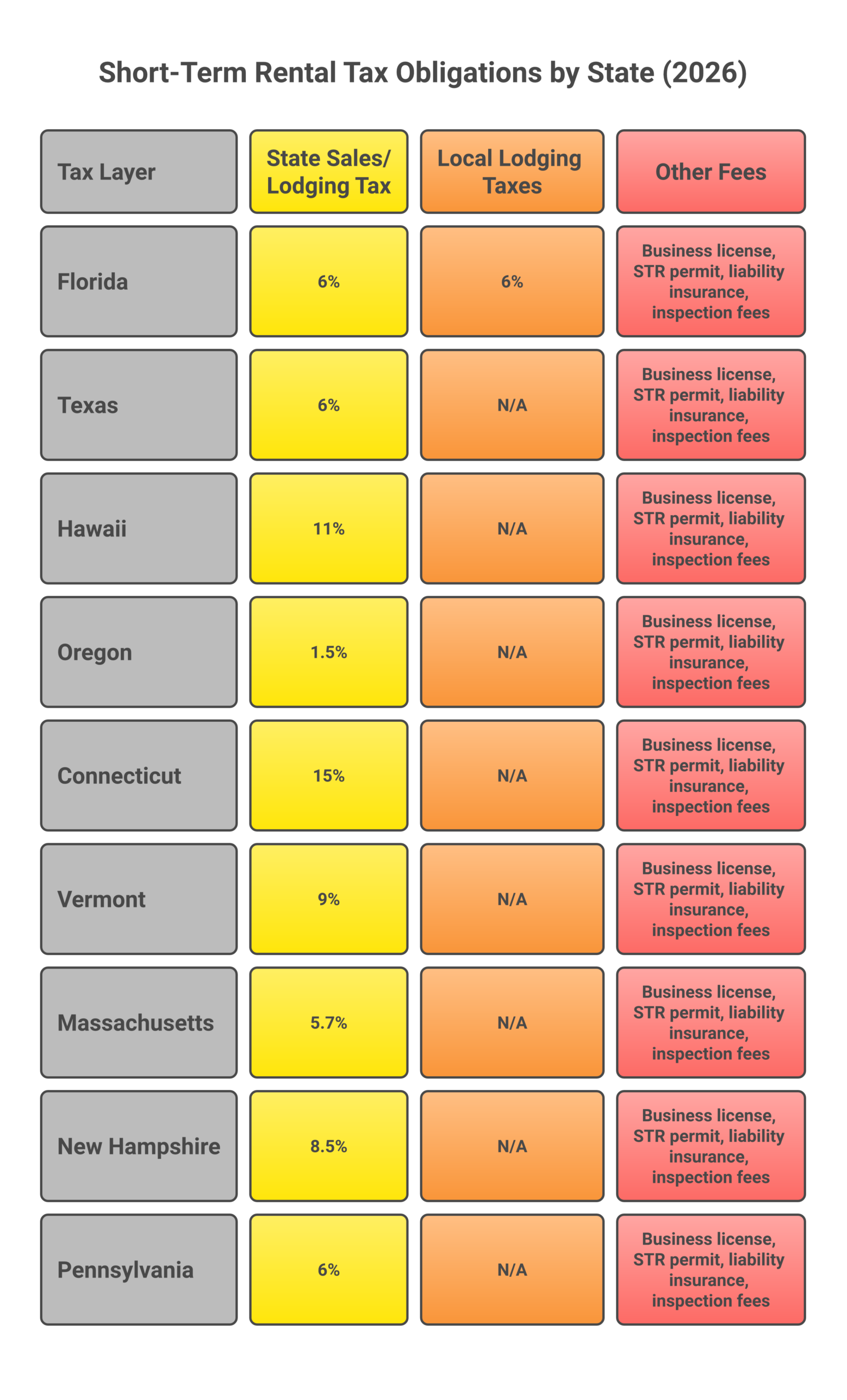
Short Term Rental Tax Obligations: What You Actually Owe
Taxes trip up more new hosts than regulations do. Here’s the full picture of what vacation rental owners face.
Most hosts pay three layers of tax:
- State sales tax or lodging tax: ranges from 0% (states without sales tax) to 11% (Hawaii’s TAT as of 2026). Most states fall in the 4-7% range.
- Local lodging taxes: local tourist development taxes, hotel/motel taxes, and transient occupancy taxes ranging from 2% to 15% depending on the city. These fund affordable housing initiatives in some jurisdictions and tourism marketing in others.
- Income tax on rental profits: federal income tax plus state income tax where applicable. States with no income tax (Florida, Texas, Tennessee, Nevada, Washington, Wyoming, Alaska) give hosts a built-in profitability advantage.
In high-tax jurisdictions like San Francisco, total sales taxes and lodging taxes on a single booking can exceed 14%. Compare that to a city in Florida or Texas with 12-13% total tax and no state income tax, and the annual difference adds up fast.
Platform tax collection: As of 2026, most states require Airbnb to collect and remit state and local taxes automatically. Louisiana and Maryland joined the list in 2025. But automatic collection doesn’t always cover every local tax. You may still need to register separately for county or city-specific taxes. Always verify with your local jurisdiction.
Key Regulatory Trends in 2026
After tracking short term rental regulations across all 50 states, here are the five biggest trends affecting the vacation rental market this year:
1. Platform Accountability Is the New Normal
More states are requiring Airbnb, VRBO, and other platforms to collect and remit sales taxes and lodging taxes automatically. California’s SB 346 (effective January 2026) lets cities compel platforms to share STR operator data. New York counties can now require quarterly reports with locations, occupancy nights, guest counts, and taxes collected. This eliminates the “honor system” and makes it harder for unlicensed operators to hide from local authorities.
2. Event-Driven Temporary Regulations
The 2026 FIFA World Cup (hosted across multiple US cities) is creating a new category: temporary event permits. Kansas City introduced special event permits at $50 versus the normal $200 annual fee under Ordinance 250965. Boulder, Colorado created a “Festival Lodging Rental License” effective January 2027 for the Sundance Film Festival relocation. Southampton, New York lifted STR limits during the U.S. Open Championship. Expect more cities to create fast-track licensing for major events.
3. Housing Affordability Backlash From Local Communities
Sedona offering $10,000 to convert STRs back to long-term housing is the tip of the iceberg. Cities across the country are tightening rules specifically to address housing availability. Primary-residence requirements, unit caps, and night limits are all tools local governments use to push housing back to long-term residents. Colorado counties can now raise lodging taxes via ballot measures, with revenues earmarked to fund affordable housing initiatives. This trend is accelerating.
4. Enforcement Technology Getting Sharper
Local governments are investing in software that scrapes Airbnb, VRBO, and other platforms to identify unlicensed operators. Denver has filed lawsuits. Miami Beach issues $20,000 fines. Key Biscayne deployed AI-powered scraping tools. Cape Coral issued fines exceeding $30,000 at a single property. Hilton Head Island increased STR-related fines in 2025. Virginia Beach now has criminal penalties available. The days of operating under the radar are numbered. If your local jurisdiction requires a short term rental license, get one.
5. Junk Fee Transparency
The FTC’s “Junk Fee” rule requires full upfront price disclosure for all STR operators, including Airbnb, VRBO, and independent hosts. Fees must display alongside the base price. This doesn’t change whether you can operate, but it changes how you price, and guests can now comparison-shop on total cost more easily.
How Regulations Affect Rental Arbitrage Specifically
If you’re building a short term rental business through rental arbitrage, leasing properties long-term and subletting them as vacation rentals, regulations hit you differently than property owners. Here’s what matters most for this model.
Primary Residence Requirements Kill Arbitrage
Cities like Denver, Los Angeles, San Francisco, Portland, Seattle, and Boston require operators to live in the property as their primary residence. You can’t do arbitrage if you have to physically live in the unit. These cities are off-limits for the arbitrage model (though you could still do arbitrage with a room in your primary residence).
Non-Owner-Occupied Permit Restrictions
Nashville, Austin, and several other cities distinguish between owner-occupied and non-owner-occupied STRs, with the non-owner category facing tighter zoning restrictions. As an arbitrage operator, you’re in the non-owner category even if you have a lease. You don’t own the property.
Lease Compliance Is Your Responsibility
No city regulation exempts you from your lease terms. You need explicit written permission from your landlord to sublet as an STR. A solid rental arbitrage LLC structure is non-negotiable for liability protection. Some states require landlord consent for any subletting.
Best Arbitrage Markets in 2026
The best markets share common traits: no primary-residence requirement, reasonable permit costs, strong tourist or business traveler demand, and affordable long-term rents relative to STR income. Cities like Phoenix, Indianapolis, Columbus, Dallas, Memphis, and Orlando top the list. For a complete analysis, see our startup costs breakdown to model your numbers before committing.
Step-by-Step: How to Research Regulations for Any Market
Whether you’re starting an Airbnb business or expanding into a new market, here’s the exact process I follow before committing money to any location.
Step 1: Check State Law First
Does the state have a preemption law (like Florida or Arizona) that protects your right to operate? Or does it give cities full authority (like New York or California)? This tells you whether you’re starting from a position of strength or caution. Look for the state’s department of business and professional regulation website. That’s usually where licensing requirements live.
Step 2: Research City-Level Ordinances
Go to the city’s official website and search for “short-term rental” or “vacation rental.” Look for:
- Permit and short term rental license requirements plus costs
- Zoning restrictions, which zones allow STRs
- Primary residence requirements
- Night caps or unit caps
- Occupancy limits
- Insurance requirements
- Tax obligations, state sales tax, local lodging taxes, tourist development taxes
Step 3: Check HOA and Lease Restrictions
If you’re buying, check the HOA CC&Rs before closing. If you’re doing arbitrage, get landlord approval in writing before signing. This step trips up more new hosts than any city regulation.
Step 4: Calculate Total Compliance Costs
Add up every cost: permit fees, annual renewals, required insurance, tax obligations, safety equipment, and any required inspections. These reduce your margins and need to be in your financial projections from day one. Don’t forget to factor in state and local taxes when calculating your break-even.
Step 5: Apply for Permits Before Listing
Many cities require a business license or STR permit before you can legally list on any platform. Nashville’s one-year ban for operating under an expired permit shows how seriously cities take this. Get your permits first, then list.
Step 6: Set Up Tax Collection
Most platforms now collect and remit taxes automatically in most jurisdictions. But verify this for your specific city. Some local taxes still need to be collected and remitted manually. Register with your state and local tax authorities to avoid penalties.
Step 7: Consult a Local Lawyer
For complex markets or high-value investments, a 30-minute consultation with a local lawyer who specializes in vacation rental regulations can save you thousands in fines. This is especially important in states like California, New York, and Colorado where regulations are dense and penalties are steep. Don’t guess on insurance requirements either, get professional advice.
Frequently Asked Questions
Which state is the most Airbnb-friendly in 2026?
Florida takes the top spot. State preemption protects your right to operate a vacation rental, there’s no state income tax, tourism demand is year-round, and most Florida cities (with the notable exception of Miami Beach) have reasonable permit processes through the Florida Department of Business and Professional Regulation. Texas and Arizona are close seconds.
Can I run an Airbnb in any state legally?
Short-term rentals are legal in all 50 states at the state level. However, individual cities and local governments can restrict or ban them within their jurisdictions. The question isn’t whether your state allows Airbnb. It’s whether your specific city and zoning district does.
What states have banned Airbnb?
No state has banned Airbnb outright. However, specific cities have effectively banned most short-term rentals. New York City’s Local Law 18 makes traditional whole-apartment hosting nearly impossible. Miami Beach bans STRs in most residential zones. Honolulu severely restricts permits. These are city-level bans imposed by local authorities, not state bans.
Do I need a short term rental license to Airbnb my house?
In most US cities with populations over 100,000, yes. The specific license type varies. Some call it a Short-Term Rental Permit, others a Shared Housing License, Vacation Rental License, or Home-Sharing Registration. Costs range from $0 in some jurisdictions to over $856/year in places like Breckenridge. Check your local government’s website for exact requirements.
What taxes do Airbnb hosts pay?
Most hosts pay three layers: state sales tax (typically 4-9%), local lodging taxes including local tourist development taxes (typically 2-15%), and income tax on rental profits. In high-tax jurisdictions, total tax on a booking can exceed 14%. States with no income tax, Florida, Texas, Tennessee, Nevada, Washington, Wyoming, Alaska, give property managers a significant profitability advantage.
Is rental arbitrage legal in every state?
Rental arbitrage is legal as a business model in every state. Your ability to execute depends on three things: local STR regulations (especially primary-residence requirements), your lease terms (you need landlord permission), and zoning. Cities with primary-residence requirements effectively block arbitrage since you can’t live in every unit you lease. For a complete guide, see our Airbnb business plan template.
What happens if I operate without a permit?
Penalties vary wildly. Miami Beach starts at $20,000. Cape Coral has issued fines exceeding $30,000. Denver files lawsuits. Nashville bans you for one year. Lexington, Kentucky fines $500/day. Naperville, Illinois charges $1,000-$2,500 per violation. Platforms are increasingly requiring registration numbers and delisting properties that can’t provide them. The risk isn’t worth it, comply with all state and local regulations.
How are short term rental regulations changing in 2026?
Five major trends: platform accountability (states requiring Airbnb/VRBO to collect taxes and share data), event-driven temporary permits (FIFA World Cup cities), housing affordability measures (local communities converting STRs back to housing), enforcement technology (AI-powered listing scrapers), and price transparency rules (FTC junk fee disclosure). The overall direction is more regulation. But for permitted operators, tighter enforcement actually reduces competition from illegal listings.
Which states require Airbnb to collect taxes automatically?
As of 2026, the majority of states have tax collection agreements with Airbnb, including Florida, Texas, California, New York, Colorado, Tennessee, and many others. Louisiana and Maryland joined in 2025. Illinois added state hotel tax obligations effective July 2025. Automatic platform collection doesn’t always cover all local taxes, verify with your local jurisdiction.
What’s the best state for Airbnb rental arbitrage?
For the short term rental business through arbitrage specifically: Florida (state protections, no income tax, massive demand), Texas (lenient in most cities, no income tax), Arizona (Phoenix especially. No property limits or night caps), Indiana (state preemption, affordable rents), and Ohio (reasonable regulations, low cost of living). Avoid states and cities with primary-residence requirements.