Think you need $50,000 to start an Airbnb business? You don’t. I spent $4,200 launching my first rental property through rental arbitrage, and it hit positive cash flow in 38 days. The real airbnb startup costs range from $1,500 for a bare-bones bootstrap to around $12,000 for a fully loaded premium setup. Most people land somewhere around $3,500 to $6,000 for their first airbnb property.
I’ve watched hundreds of students launch profitable Airbnb listings over the past six years. The ones who map out every dollar before they start? They succeed. The ones who guess at their upfront costs and wing it? They run out of cash halfway through furnishing a living room and blame the business model.
This guide breaks down every airbnb expense you’ll encounter, line item by line item, so you can plan your upfront investment with confidence and dodge the nasty surprises that sink first-time hosts. Whether you’re doing rental arbitrage (leasing a property and subletting on Airbnb) or buying a rental property outright, these are real 2026 numbers from real short term rental operators.
Rental Arbitrage vs. Buying: Two Very Different Airbnb Cost Structures
Before we dig into specific numbers, you need to understand the two main paths into the airbnb business, because they require wildly different levels of capital and carry different risk profiles.
Rental arbitrage is the model we teach at 10XBNB, and it’s how most people start an airbnb with limited capital. You lease a property with the landlord’s written permission, handle property setup and furnishing, and list it on Airbnb. Your biggest upfront expenses are furniture and a security deposit. No mortgage. No down payment. No property taxes. If the market doesn’t work, you walk away at the end of your lease without being anchored to a property acquisition that went sideways.
Buying a property means you’re looking at a down payment of $20,000 to $100,000+ depending on your market, plus closing costs, plus everything else on this list. Many buyers use DSCR loans to finance the purchase, but even with favorable lending terms, the upfront investment dwarfs the arbitrage model. It’s a fundamentally different business with a much longer payback period.
Here’s how they compare side by side:
| Cost Category | Rental Arbitrage | Buying Property |
|---|---|---|
| Property Acquisition | $0 | $20,000–$100,000+ (down payment) |
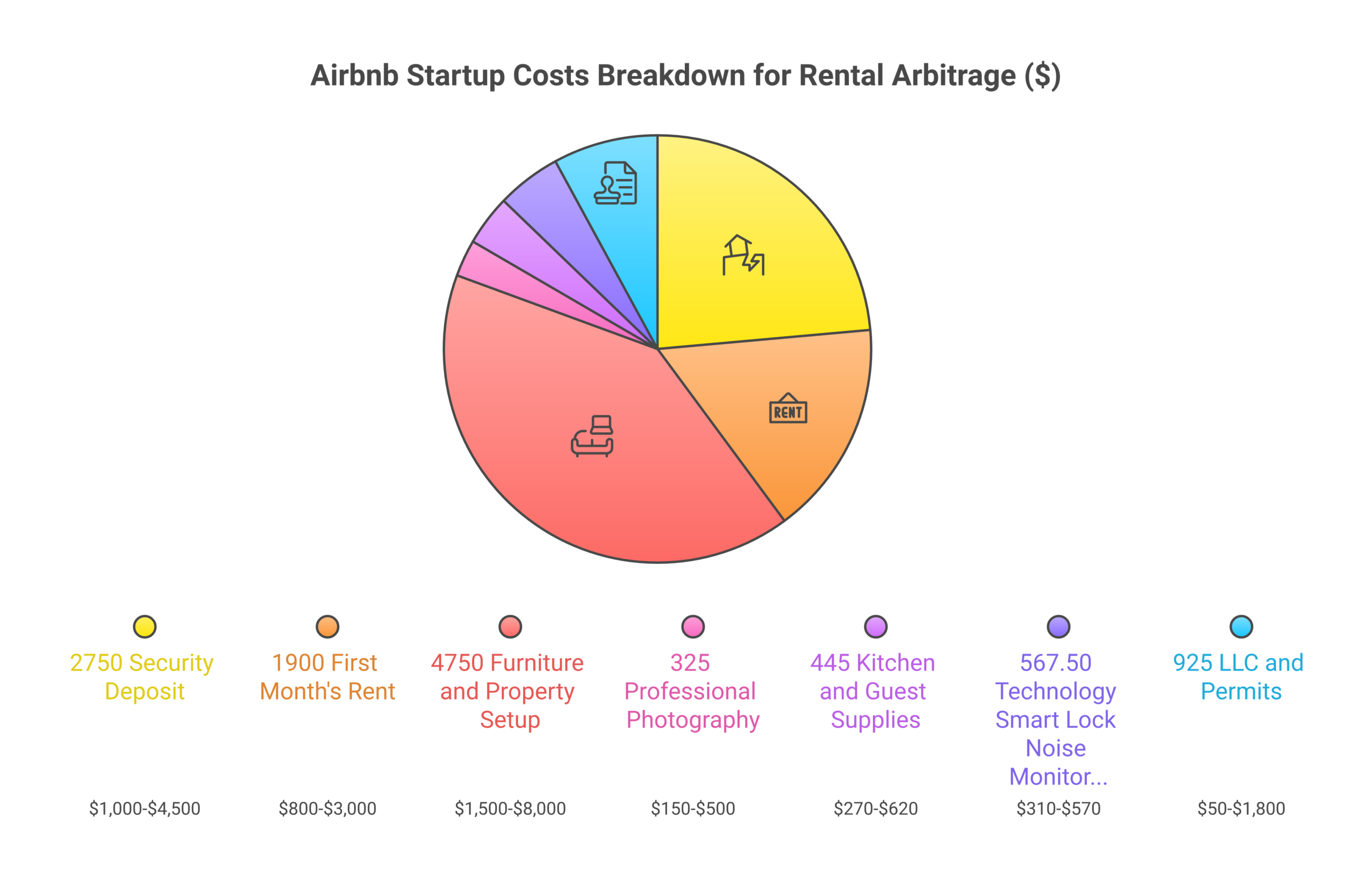
| Security Deposit | $1,000–$4,500 | N/A |
| First Month’s Rent | $800–$3,000 | N/A (mortgage instead) |
| Furnishing & Property Setup | $1,500–$8,000 | $3,000–$15,000 |
| Photography | $150–$500 | $150–$500 |
| Supplies & Amenities | $200–$600 | $200–$600 |
| Insurance & Liability Coverage | $80–$175/month | $125–$250/month |
| Business Registration | $50–$500 | $50–$500 |
| Tech & Software | $0–$100/month | $0–$100/month |
| Total Upfront Costs | $3,500–$15,000 | $25,000–$120,000+ |
| Time to Positive Cash Flow | 1-3 months | 12-36 months |
The difference is staggering. Rental arbitrage lets you test a market, prove the model works, and start generating income in weeks. Not years. That’s exactly why it’s the entry point we recommend for anyone learning how to start an Airbnb business.
Essential Airbnb Startup Costs: The Complete Line-Item Breakdown
Here’s where we get granular. Every startup cost you’ll encounter, with real 2026 numbers. I’m using rental arbitrage as the base model since that’s what most new airbnb hosts use, but the furnishing and property setup costs apply to property owners too.
Security Deposit
Your landlord will typically require one to two months’ rent as a security deposit. In most markets, this is your single largest upfront expense and the first check you’ll write.
- Low-cost market (Midwest, smaller Southern cities): $800–$1,500
- Mid-range market (Nashville, Tampa, Charlotte): $1,200–$2,500
- High-cost market (Austin, Denver, LA suburbs): $2,000–$4,500
Pro tip: Some landlords will accept a smaller deposit if you offer two or three months’ rent upfront. Sounds counterintuitive, but it demonstrates financial stability and can actually reduce your total cash outlay compared to paying last month’s rent plus a full security deposit. You’ll learn negotiation strategies like this when navigating rental arbitrage legalities for your listing.
First Month’s Rent
You’ll pay rent before you earn a single dollar from Airbnb. Budget for at least one full month of rent before your first guest checks in, because you need time to furnish, photograph, list, and get your first booking. This is the period of negative cash flow that catches people off guard.
- 1-bedroom apartment: $800–$1,800/month
- 2-bedroom apartment: $1,200–$2,800/month
- 3-bedroom house: $1,500–$3,500/month
Realistically, budget for 6 weeks of rent before income arrives. Some students get their first booking within 48 hours of going live. Others take 2-3 weeks to build momentum with the algorithm. Plan for the slower scenario so you’re not panicking during the ramp-up.
Furniture & Decor
This is where most people either overspend or underspend, both are mistakes. Overspend and you delay your breakeven point by months. Underspend and your listing photos look like a dorm room, which tanks your nightly rate and occupancy.
Here’s a realistic furniture budget for a one-bedroom rental arbitrage unit:
| Item | Budget Option | Mid-Range | Premium |
|---|---|---|---|
| Queen bed frame + headboard | $120 | $280 | $550 |
| Queen mattress | $200 | $450 | $850 |
| Bedding set (sheets, duvet, pillows) | $75 | $160 | $350 |
| Nightstands (×2) | $50 | $120 | $280 |
| Sofa | $250 | $600 | $1,200 |
| Coffee table | $40 | $120 | $300 |
| TV + wall mount | $180 | $350 | $650 |
| Dining table + chairs | $100 | $280 | $600 |
| Dresser | $80 | $200 | $450 |
| Lamps (×3) | $45 | $100 | $240 |
| Curtains/blinds | $40 | $90 | $200 |
| Wall art & decor | $30 | $120 | $350 |
| Bath towel set | $35 | $75 | $150 |
| Total Furniture | $1,245 | $2,945 | $6,170 |
Two-bedroom units? Add roughly 60-70% on top of these numbers for the extra bedroom and living space furniture. Three-bedroom? Double the one-bedroom total and add 20%.
If you want to skip the headache of sourcing everything individually, check out pre-built furniture packages designed specifically for airbnb hosts. They’re not always the cheapest option, but they save massive amounts of time and come designed to photograph well.
Kitchen Essentials & Guest Supplies
Guests expect a functional kitchen, clean towels, and basic toiletries. Meeting guest expectations doesn’t mean running a hotel. But your space shouldn’t feel like camping, either.
- Cookware set (pots, pans, utensils): $60–$150
- Dishes, glasses, silverware (service for 6): $40–$100
- Small appliances (coffee maker, toaster, blender): $50–$120
- Cleaning supplies starter kit: $30–$60
- Toiletries (shampoo, conditioner, soap, toilet paper): $25–$50
- Extra linens (backup sheets, towels): $50–$100
- Welcome basket items (snacks, local guide): $15–$40
Total kitchen & supplies: $270–$620
Don’t overthink the welcome basket. A $12 assortment of granola bars, instant coffee packets, and a printed local restaurant guide gets you five-star reviews. I’ve seen it happen hundreds of times. Guests remember thoughtfulness, not expense.
Professional Photography
Your listing photos are the single most important factor in your airbnb listing click-through rate. Bad photos kill bookings before a guest ever reads your description. This isn’t optional spending. It’s the highest-ROI line item in your entire startup budget.
- DIY with smartphone: $0 (but expect lower bookings)
- Budget photographer: $150–$250
- Professional Airbnb photographer: $300–$500
- Premium photographer + drone/twilight shots: $500–$800
The sweet spot for most new hosts is $200–$350. That gets you 15-25 professionally edited images that make your listing look like an interior design showcase. Airbnb also offers their own Pro Photography Program where the cost gets deducted from future payouts, zero upfront cash.
Technology & Smart Home Setup
You need a smart lock. Non-negotiable. It handles guest communication around check-in/check-out automatically and eliminates the #1 headache new hosts face: key handoffs. Everything else is optional but increasingly necessary as you scale.
- Smart lock (Schlage Encode, August, Yale): $150–$300
- Noise monitor (Minut, NoiseAware): $100–$150 + $10–$15/month
- WiFi router upgrade (if existing is weak): $60–$120
- Streaming service (Netflix, shared account): $8–$16/month
- Channel manager/PMS (Hospitable, Guesty): $0–$40/month (free tiers available)
- Dynamic pricing tool (PriceLabs, Beyond Pricing): $20–$40/month
Total tech upfront: $310–$570
Total tech monthly: $38–$111
Running a single property? Skip the channel manager and dynamic pricing tool in month one. Manual pricing works fine while you’re learning. Add automation tools after you’ve proven the unit is profitable. For more on optimizing your nightly rates, see our Airbnb pricing strategy guide.
Insurance & Liability Coverage
Airbnb’s AirCover program provides up to $3 million in host damage protection and $1 million in liability coverage, at no extra cost. But it has gaps. A guest slips in the shower and sues you personally? AirCover won’t cover your legal fees. A dedicated short term rental insurance policy fills those gaps and protects your business properly.
- Proper Insurance: $125–$170/month (complete four-in-one policy)
- CBIZ: $100–$165/month (largest STR insurer in the US)
- Budget option (umbrella policy addition): $80–$120/month
For your first airbnb property, a budget umbrella policy plus AirCover is acceptable. But the moment you scale to two or three units, get proper liability coverage. One guest injury lawsuit without adequate insurance could wipe out everything you’ve built. Dig deeper in our Airbnb insurance guide.
Business Registration, Permits & Local Rules
This varies enormously by city and state. Some jurisdictions require nothing beyond a standard business license. Others demand short-term rental permits, fire inspections, and annual renewals. Local rules around STRs have gotten stricter in many cities since 2023, so don’t skip this research.
- LLC formation: $50–$500 (state-dependent; Wyoming and New Mexico are cheapest)
- Business license: $0–$100/year
- Short-term rental permit: $0–$1,000/year (some cities don’t require one; others charge heavily)
- Fire safety inspection: $0–$200 (required in some jurisdictions)
- Hotel/occupancy tax registration: Usually free to register, but you’ll owe 6-15% of revenue
Total registration costs: $50–$1,800 (first year)
Always check local rules before signing a lease. Nashville stopped issuing new non-owner-occupied STR permits in certain zones. Denver caps the number of licenses. Don’t learn this the hard way, check your city’s STR regulations before you put a dollar down.
The Minimum Startup Cost: What’s the Real Floor?
Everyone wants to know the minimum startup cost to get an airbnb listing live. So here it is, stripped to the absolute bones:
If you already own your home and want to rent a spare room, the minimum startup cost is roughly $300–$800. That covers basic furnishing, fresh linens, a smart lock, and cleaning supplies. No security deposit. No first month’s rent. You’re using an asset you already have.
For rental arbitrage in a low-cost market, the minimum startup cost is realistically $2,500–$3,000. That gets you a security deposit, first month’s rent, used furniture from Facebook Marketplace, basic supplies, and a smart lock. It’s tight. There’s no room for error. But it’s doable, I’ve watched a student in Memphis launch with $2,642 total invested and hit breakeven in 35 days.
For a comfortable launch where you’re not stressed about every unexpected expense? Budget $5,000–$6,000. That’s the sweet spot where the average airbnb host doing rental arbitrage starts.
Three Budget Tiers: What Each Level Actually Gets You
Not everyone has $10,000 sitting around. And you don’t need it. Here’s what launching at three different budget levels actually looks like in practice.
$1,500 Bootstrap (The “Scrappy Starter”)
This is the absolute minimum. You’re furnishing with Facebook Marketplace finds, doing your own photography, and skipping anything that isn’t essential.
| Expense | Cost |
|---|---|
| Security deposit (1 month, low-cost market) | $800 |
| Used furniture (Marketplace, estate sales) | $400 |
| Kitchen essentials & supplies | $100 |
| Smart lock (basic model) | $150 |
| Bedding & towels | $50 |
| Total | $1,500 |
Reality check: This works, but it’s razor-thin. You’re living on the edge with no cushion for first month’s rent (you’d need a rare landlord who waives the security deposit or allows installments). The more realistic minimum is $2,500–$3,000 when you include first month’s rent in a low-cost market.
$5,000 Standard (The “Smart Start”)
This is where most successful new hosts land. Enough budget to do things right without being extravagant.
| Expense | Cost |
|---|---|
| Security deposit (1 month) | $1,400 |
| First month’s rent | $1,400 |
| Furniture (mix of new & used) | $1,200 |
| Kitchen & supplies | $250 |
| Professional photography | $250 |
| Smart lock + basic tech | $250 |
| Bedding, towels, decor | $200 |
| LLC + permits | $150 |
| Total | $5,100 |
Why this tier wins: Professional photos generate measurably more bookings, listings with pro photography tend to earn significantly more revenue in their first 90 days compared to smartphone shots. At $5K, you’ve got a real business, not a side hustle held together with duct tape.
$10,000 Premium (The “Launch Like a Pro”)
This budget lets you furnish a 2-bedroom unit in a competitive market with everything a Superhost would want from day one.
| Expense | Cost |
|---|---|
| Security deposit (1.5 months) | $2,700 |
| First month’s rent | $1,800 |
| New furniture (mid-range, 2BR) | $3,200 |
| Kitchen, linens, supplies | $500 |
| Professional photography | $400 |
| Smart lock + noise monitor + tech | $450 |
| Insurance (first 2 months) | $300 |
| LLC + permits + legal | $350 |
| Cash reserve (vacancy buffer) | $500 |
| Total | $10,200 |
The advantage: You’re launching with a cash reserve, which means one slow week won’t send you into panic mode. You can afford to hold out for higher nightly rates rather than slashing prices to fill the calendar. That patience often results in stronger positive cash flow within the first quarter.
Ongoing Monthly Expenses: The Real Operating Costs
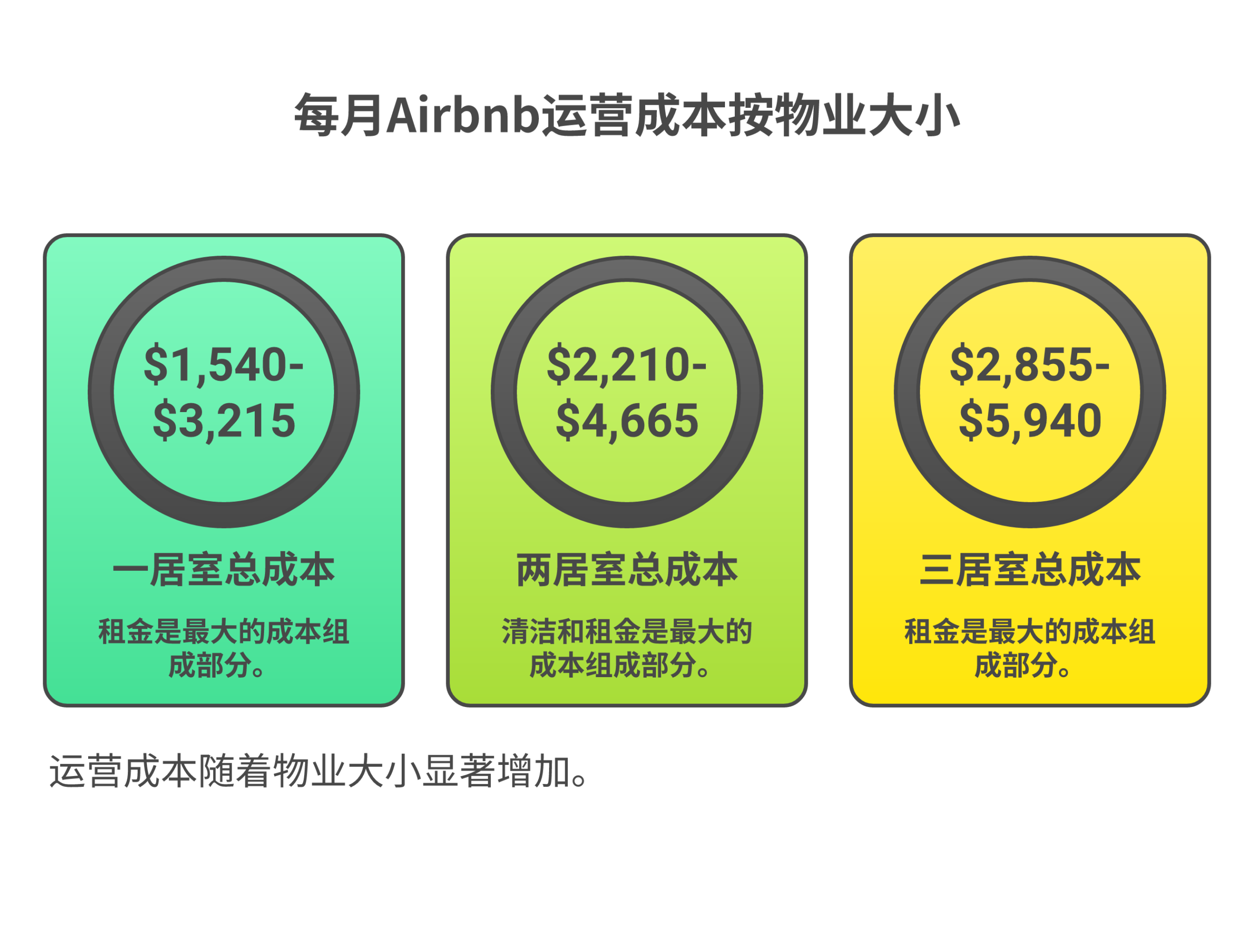
Start up costs are one thing. But the monthly expenses and operational costs that eat into your margins every single month? That’s what actually determines whether your airbnb business survives. Here’s the honest picture.
| Monthly Expense | 1-Bedroom | 2-Bedroom | 3-Bedroom |
|---|---|---|---|
| Rent | $800–$1,800 | $1,200–$2,800 | $1,500–$3,500 |
| Utility Bills (electric, gas, water, internet) | $150–$300 | $200–$400 | $250–$500 |
| Cleaning Service (per turnover, ~8-12/month) | $420–$630 | $575–$865 | $800–$1,200 |
| Supplies Restocking | $40–$80 | $60–$120 | $80–$160 |
| Insurance | $80–$175 | $100–$200 | $125–$250 |
| Software & Subscriptions | $0–$80 | $0–$80 | $0–$80 |
| Maintenance Costs & Repairs | $50–$150 | $75–$200 | $100–$250 |
| Airbnb Host Service Fee (3%) | Varies | Varies | Varies |
| Total Monthly Expenses | $1,540–$3,215 | $2,210–$4,665 | $2,855–$5,940 |
These numbers assume you’re charging cleaning fees to guests that cover (or nearly cover) your actual cleaning costs. Most airbnb hosts pass the full cleaning service expense to guests. It’s standard practice and expected on Airbnb.
The numbers that actually matter? Rent + utility bills. That’s your fixed expenses floor. Everything else scales with occupancy. Higher occupancy means more cleaning turns but also more revenue. It’s a good problem to have.
Your operating costs as a percentage of revenue should land between 55-75%. If you’re above 75%, your rent is too high for the market, your nightly rate is too low, or both. If you’re below 55%, you’re running an efficient operation, keep scaling.
The Hidden Costs Most Startup Guides Won’t Tell You About
This section separates people who launch successfully from people who run out of money in month three. Every other guide gives you the obvious airbnb expenses. Here are the ones that blindside new hosts.
Lost Income During Ramp-Up
Your listing won’t be fully booked from day one. New listings on Airbnb typically take 2-4 weeks to gain traction in the algorithm, build reviews, and achieve steady booking rates. During this ramp-up period, you’re hemorrhaging cash, paying rent and utility bills with little or no income. This lost income period is the #1 reason new hosts fail.
Budget for: 1-2 months of rent as a vacancy cushion ($800–$3,500)
Some hosts mitigate this by launching with aggressive introductory pricing, 25-35% below your target nightly rate, to build reviews fast. Five-star reviews are rocket fuel for the Airbnb algorithm. Get 5-10 of them quickly and your occupancy climbs fast.
Damage & Wear Replacement
Guests break things. Not maliciously (usually). Wine glasses chip, towels stain, remote controls vanish into parallel dimensions. Budget for replacing small items continuously.
Budget for: $75–$200/month in ongoing replacement costs
Bigger damage happens too. A guest locks themselves out and kicks in the door, $400. Someone drags furniture across hardwood floors, $200 repair. AirCover handles some of this, but the claims process is slow and doesn’t cover everything. Keep a cash reserve.
Seasonal Revenue Swings
Unless you’re in a market with year-round demand (Miami, Hawaii, parts of Arizona), you’ll experience seasonal dips. Some markets see occupancy drop from 85% in summer to 40% in winter. That’s not a crisis. It’s normal. But you need to survive the slow months without dipping into negative cash flow territory.
Budget for: 2-3 months of reduced revenue (save 20% of peak-season profits)
The average host uses the slow season to negotiate better rates with landlords, refresh decor, update listing photos, and run promotions targeting long-term stays. Monthly discounts of 40-50% during off-peak months can keep units occupied and cash flowing even when nightly bookings dry up.
Tax Obligations & Tax Deductions
This catches people off guard every April. Short-term rental income is taxable, and depending on your location, you may owe:
- Federal income tax: 10-37% (depends on your bracket)
- Self-employment tax: 15.3% (if you provide substantial services to guests)
- State income tax: 0-13.3% (varies by state)
- Occupancy/hotel tax: 6-15% (Airbnb collects this in many, but not all, jurisdictions)
Budget for: Set aside 25-30% of net profit for taxes
The silver lining? The tax deductions available to airbnb hosts are substantial. Furniture depreciation, home office deduction, mileage, cleaning supplies, insurance premiums, software subscriptions, all tax deductible. A good CPA who understands short-term rentals pays for themselves many times over. For a full breakdown, see our Airbnb tax guide for rental arbitrage.
Guest Communication & Management Time
Nobody budgets for their own time, but guest communication eats hours every week. Answering booking inquiries, coordinating check-ins, handling mid-stay requests, managing your cleaning service schedule, dealing with noise complaints from neighbors. In the early months, expect to spend 5-10 hours per week per property on management tasks.
You can either absorb this as sweat equity or pay for a property management service (10-25% of revenue). Most new hosts handle it themselves for the first 1-3 units, then automate with Airbnb automation tools or hire help as they scale.
How to Slash Your Start Up Costs (Without Slashing Quality)
I’ve seen students cut their airbnb startup costs by 40-60% using these strategies. None of them require compromising on guest expectations.
Source Furniture Strategically
Facebook Marketplace is the single best tool for furnishing an Airbnb on a budget. Wealthy homeowners replacing perfectly good furniture sell it for 10-20 cents on the dollar. I’ve seen students furnish entire one-bedroom units for under $600 by checking Marketplace daily for two weeks.
Other sources worth checking:
- Estate sales: Often 50-80% below retail, and you get quality older furniture
- IKEA: The MALM dresser ($180) and HEMNES bed frame ($250) photograph well and hold up to guest use
- Amazon Warehouse deals: Open-box items at 20-40% off
- Wayfair clearance: End-of-season pieces at steep discounts
- Habitat for Humanity ReStore: Donated furniture and home goods at rock-bottom prices
The key: buy a good mattress new. Everything else can be used. Guests will forgive a scratched coffee table. They won’t forgive a lumpy mattress. A quality queen mattress ($300–$500 range) is the single best investment in your listing’s review scores.
DIY Photography (That Actually Works)
Can’t afford a photographer? You can take decent listing photos with a smartphone if you follow these rules:
- Shoot during “golden hour” (the hour after sunrise or before sunset) for warm, natural light
- Clean every surface. Then clean again. Clutter kills photos
- Shoot from corners, not the center of the room. It makes spaces look 30% larger
- Use HDR mode on your phone for balanced exposure
- Edit with free tools (Snapseed, Lightroom Mobile) to brighten and straighten
- Take at least 50 photos per room and pick the best 3-5
Will this beat a professional? No. But it’s good enough to launch, get your first bookings, and use that revenue to pay for a pro shoot within 30-60 days.
Negotiate With Landlords
Most new hosts accept whatever lease terms the landlord offers. That’s leaving money on the table. Here’s what you can negotiate:
- Reduced security deposit in exchange for slightly higher rent (spreads the upfront costs)
- Free first month if you sign a longer lease (18-24 months)
- Landlord-provided furnishings (some include basic furniture, especially in college towns)
- Gradual rent increases tied to your Airbnb performance
- Written permission baked into the lease (essential for rental arbitrage)
The best negotiating use? Data. Show the landlord comparable long-term rental rates, your projected occupancy, and proof of insurance. Landlords say yes when they feel protected.
Phase Your Spending
You don’t need everything on day one. Here’s a phased approach that keeps cash flow positive sooner:
Week 1 (Must-haves to go live): Bed, sofa, basic kitchen items, smart lock, towels, bedding. Budget: $1,200–$2,000.
Week 3 (After first payouts): Coffee table, dining set, wall art, extra linens, welcome basket. Budget: $300–$600 (funded by first bookings).
Month 2 (Reinvest profits): Professional photography, noise monitor, upgraded decor, premium toiletries. Budget: $400–$700 (funded by revenue).
This approach means you might launch with a slightly less polished listing, but you stay solvent. And you can upgrade continuously as revenue flows in.
Real Numbers From Actual Hosts
Theory is fine. Real numbers are better. Here are startup cost breakdowns from students who’ve gone through the 10XBNB program and launched real properties. These represent the average host experience across different markets and budgets.
Sarah, Nashville, TN (1-Bedroom Apartment)
| Expense | Amount |
|---|---|
| Security deposit | $1,650 |
| First month’s rent | $1,650 |
| Furniture (75% Facebook Marketplace) | $1,340 |
| Kitchen & supplies | $285 |
| Professional photos | $275 |
| Smart lock + tech | $210 |
| LLC formation (Tennessee) | $100 |
| Insurance (first month) | $130 |
| Total invested | $5,640 |
Result: First booking within 5 days of going live. Averaged $3,800/month gross revenue in the first 90 days. Broke even on her startup investment in 47 days. Now operates three units.
Marcus, Atlanta, GA (2-Bedroom House)
| Expense | Amount |
|---|---|
| Security deposit | $2,200 |
| First month’s rent | $2,200 |
| Furniture (new, mid-range) | $3,450 |
| Kitchen, linens, supplies | $420 |
| Professional photos + drone | $475 |
| Smart lock + noise monitor | $380 |
| LLC + STR permit | $350 |
| Insurance (first month) | $155 |
| Total invested | $9,630 |
Result: Slower start (first booking took 11 days) but the 2-bedroom premium pricing made up for it. Averaged $5,200/month gross in the first 90 days. Breakeven at 62 days. Now runs five properties and quit his 9-to-5.
Jaylen, Memphis, TN (1-Bedroom Apartment)
| Expense | Amount |
|---|---|
| Security deposit | $850 |
| First month’s rent | $850 |
| Furniture (100% used, Marketplace & estate sales) | $547 |
| Kitchen & supplies | $135 |
| DIY photos (smartphone) | $0 |
| Smart lock | $165 |
| Towels, bedding, decor | $95 |
| Total invested | $2,642 |
Result: Launched with a scrappy listing and aggressive introductory pricing ($59/night). Got 8 bookings in the first month. Invested in professional photos after week 3 using Airbnb revenue. Raised his nightly rate to $89 and currently averages $2,900/month gross. Breakeven at 35 days.
Notice a pattern? The ones who launched fastest, even with less-than-perfect setups, reached profitability sooner. Perfectionism is the enemy of Airbnb profitability. Speed to market matters more than a flawless property setup.
ROI Timeline: When You’ll Actually Break Even
When does this upfront investment start paying for itself? Here’s a realistic timeline based on what we’ve seen across hundreds of listings from the average airbnb host.
Breaking Down the Math
Let’s use a concrete example. You invest $5,000 in a one-bedroom rental property through rental arbitrage with $1,400/month rent.
- Monthly revenue (75% occupancy at $120/night): $2,700
- Monthly expenses (rent + utility bills + cleaning fees + supplies + insurance): $2,050
- Monthly profit: $650
- Months to recoup $5,000 investment: 7.7 months
That’s the conservative case. Plenty of hosts in strong markets see:
- Monthly revenue (80% occupancy at $140/night): $3,360
- Monthly expenses: $2,050
- Monthly profit: $1,310
- Months to recoup $5,000: 3.8 months
Want to run the numbers for your specific market? Use our rental arbitrage profit calculator to model different scenarios with your actual rent, expected nightly rate, and occupancy projections.
Typical Breakeven Timeline by Budget Tier
| Budget Tier | Total Invested | Breakeven (Conservative) | Breakeven (Optimistic) |
|---|---|---|---|
| Bootstrap ($1,500–$3,000) | ~$2,500 | 4-6 months | 1-3 months |
| Standard ($5,000) | ~$5,000 | 6-9 months | 3-5 months |
| Premium ($10,000) | ~$10,000 | 8-14 months | 5-8 months |
Here’s what makes rental arbitrage special: your ROI accelerates as you scale. Your second unit is cheaper to launch because you already own the smart lock setup knowledge, have photographer contacts, have bulk supplier relationships, and know exactly which furniture items to buy. Students commonly report their second unit costing 25-35% less to launch than their first.
Once you’ve got 3-5 units running profitably, you’re looking at $2,000–$8,000/month in combined profit. That’s when this shifts from a side hustle to a real business. For more on whether you can make money on Airbnb without owning property, we’ve got the complete breakdown.
The Biggest Mistake New Hosts Make With Money
After watching hundreds of students launch, one financial mistake stands above the rest: underestimating the gap between going live and generating consistent income.
They calculate startup costs perfectly. They budget for furniture, photography, and the security deposit down to the penny. Then they forget about the lost income period. It takes 2-4 weeks to get a first booking, another week to get paid (Airbnb’s payout schedule), and another 2-3 weeks to build enough reviews for the algorithm to favor their listing.
That’s potentially 6-8 weeks of airbnb expenses with minimal revenue. If your monthly nut is $2,000 in rent plus utility bills, that’s $3,000–$4,000 in operating costs before meaningful income kicks in.
The fix? Add a cash reserve equal to 2 months of fixed expenses to your startup budget. If your rent and utilities total $2,200/month, add $4,400 to your launch capital. Yes, it increases your upfront investment. But it also means you can survive the ramp-up period without panicking, slashing prices, or, worst case, abandoning the business before it has a chance to reach positive cash flow.
Airbnb Business Plan: Putting Your Startup Budget Together
Knowing the costs is step one. Organizing them into an actual plan is step two. Here’s a framework for building your Airbnb business plan budget that accounts for every category of airbnb cost you’ll face.
One-Time Upfront Costs Worksheet
| Category | Your Budget | Typical Range |
|---|---|---|
| Security deposit | $_____ | $800–$4,500 |
| First month’s rent | $_____ | $800–$3,500 |
| Furniture & property setup | $_____ | $500–$8,000 |
| Kitchen & guest supplies | $_____ | $100–$620 |
| Photography | $_____ | $0–$500 |
| Technology (smart lock, etc.) | $_____ | $150–$570 |
| Insurance (first month) | $_____ | $80–$175 |
| LLC + permits + licenses | $_____ | $50–$1,800 |
| Cash reserve (2 months fixed expenses) | $_____ | $1,600–$7,000 |
| TOTAL UPFRONT INVESTMENT | $_____ | $3,500–$15,000+ |
Monthly Operating Budget Template
| Category | Your Budget | Typical Range |
|---|---|---|
| Rent/mortgage | $_____ | $800–$3,500 |
| Utility bills | $_____ | $150–$500 |
| Cleaning service | $_____ | $420–$1,200 |
| Supplies restocking | $_____ | $40–$160 |
| Insurance | $_____ | $80–$250 |
| Software & subscriptions | $_____ | $0–$111 |
| Maintenance costs | $_____ | $50–$250 |
| Damage reserve | $_____ | $75–$200 |
| TOTAL MONTHLY OPERATING COSTS | $_____ | $1,615–$6,171 |
Print this out, fill it in with your actual market numbers, and you’ll have more clarity on your airbnb cost structure than 95% of people who start an airbnb this year.
Frequently Asked Questions
How much does it cost to start an Airbnb in 2026?
The total airbnb startup costs in 2026 range from $1,500 to $12,000 for rental arbitrage (leasing a rental property), or $25,000 to $120,000+ if you’re buying a property. Most first-time airbnb hosts using the rental arbitrage model invest between $3,500 and $6,000, which covers a security deposit, first month’s rent, furniture, photography, supplies, a smart lock, and basic insurance. Your exact upfront costs depend on your market, property size, and whether you buy furniture new or used.
Can I start an Airbnb with $1,000?
Starting a fully independent airbnb listing for under $1,000 is extremely difficult because security deposits alone typically cost $800–$2,500. If you already have a spare room in a property you own, your start up costs could be as low as $300–$800 for furnishing, supplies, and a smart lock. For rental arbitrage, plan for a minimum startup cost of $2,500–$3,000 to cover the deposit, first month’s rent, and basic furnishing in a low-cost market.
What is the single biggest Airbnb startup expense?
For rental arbitrage hosts, the single biggest upfront expense is the combination of security deposit plus first month’s rent, which typically totals $1,600–$6,000 depending on your market. For property buyers, property acquisition (the down payment) dwarfs every other airbnb cost combined, often ranging from $20,000 to $100,000+. After securing the property, furniture and property setup is the next largest expense at $1,200–$8,000.
How much should I budget for Airbnb furniture?
Budget $1,200–$3,000 for a one-bedroom unit and $2,500–$5,500 for a two-bedroom unit. You can slash these upfront costs by sourcing from Facebook Marketplace, estate sales, and discount retailers. Some hosts furnish entire one-bedroom units for under $600 using 100% secondhand furniture. Always buy the mattress new ($300–$500 for a quality queen) because guest comfort directly impacts your review scores and future bookings.
What ongoing monthly costs should I expect?
For a one-bedroom rental arbitrage unit, expect $1,500–$3,200/month in total monthly expenses, including rent ($800–$1,800), utility bills ($150–$300), cleaning service ($420–$630 based on 8-12 turnovers), supplies restocking ($40–$80), insurance ($80–$175), and maintenance costs ($50–$150). Most cleaning fees are passed to guests through Airbnb’s cleaning fee feature, so your actual out-of-pocket operational costs are lower than the gross number.
How long until an Airbnb business becomes profitable?
Most rental arbitrage hosts start generating positive cash flow within 1-3 months of going live. Breaking even on the total startup cost typically takes 3-9 months depending on your market, nightly rate, occupancy, and initial upfront investment. A $5,000 investment in a market generating $650/month in profit breaks even in about 8 months. Stronger markets with higher nightly rates can cut that to under 4 months.
Do I need an LLC to start an Airbnb?
An LLC isn’t legally required to list on Airbnb, but it’s strongly recommended for liability coverage, especially if you’re operating as a business rather than occasionally renting a spare room. LLC formation costs range from $50 to $500 depending on your state. The liability protection alone, separating your personal assets from your airbnb business, is worth the small investment.
Your Next Step
You’ve got the numbers. You know every line item, which upfront expenses you can cut, and how long it’ll take to recoup your startup cost. Now it’s time to actually do it.
Start by picking your market and running the numbers through our profit calculator. If the math works, and in most markets, it does, your next move is finding a rental property and securing landlord approval.
The students who succeed aren’t the ones with the biggest budgets. They’re the ones who stop researching and start executing. You’ve done the research. Go execute.
Want a step-by-step system for launching your first (or next) airbnb property with minimal risk? Learn exactly how to start an Airbnb business with our complete guide, or explore the pros and cons of rental arbitrage to see why it’s the fastest path from zero to profitable host.