
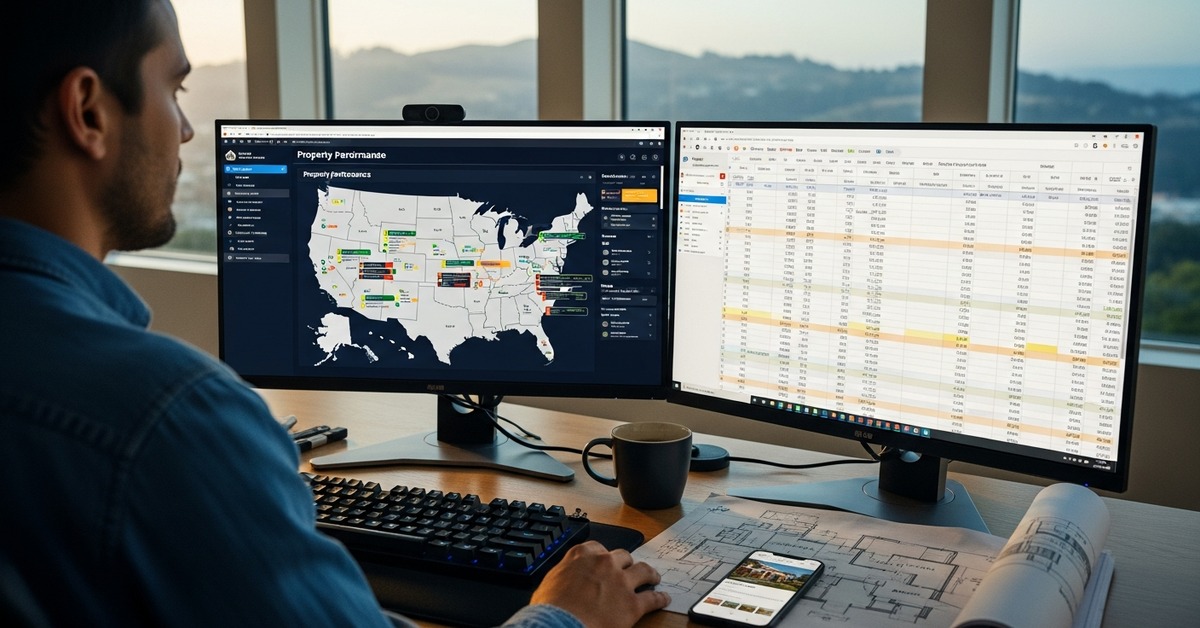
You work at a tech company. Maybe Meta, Stripe, Google, or a late-stage startup. Your total comp is somewhere between $180K and $600K a year. You’ve maxed your 401K, you’ve got a brokerage account full of index funds, and yet the wealth progress feels slower than it should. Every year more of your paycheck goes into the same four ETFs, and every year you wonder if there’s something better you should be doing with it. There is. Most tech workers just never get shown the actual math on real estate.
Real estate side income for tech workers in 2026 has never looked better, and most of your coworkers are still ignoring it. The One Big Beautiful Bill Act restored 100% bonus depreciation in January 2025. AI-driven layoffs are hitting tech hardest. AirDNA identified multiple Sun Belt markets with 15%+ cash-on-cash returns. And your engineer brain is literally the best skill set on earth for automating the operational side of rental properties. If you wanted the wedge that turns a $200K tech salary into $300K+ of real annual economic return, this is it.
I’m Shaun. I run 30+ short-term rentals at 10XBNB. My approach to operating real estate has been featured in Fast Company’s roundup of side hustles you can start with $0 and an Inc. feature on growing a side hustle into a real business. Over the last few years, I’ve specifically helped clients who are tech workers at FAANG, fintech, and late-stage startups deploy capital into real estate without giving up their W-2. This is all this, the honest playbook.
Note: income data, tax rules, and financing terms in this article are US-specific. The framework applies globally; check your local context before acting.
What real estate side income for tech workers actually looks like in 2026
The honest picture for tech worker money. Tech workers have three structural advantages in real estate investing that most other W-2 professionals don’t have: high income that qualifies for any DSCR loans for Airbnb, strong automation skills from their tech career that reduce operational hours, and remote work flexibility that allows geographic airbnb arbitrage (your San Francisco paycheck buying Houston or Nashville property).
Three configurations actually work for a tech worker holding a full time job:
- Owned rental arbitrage strategy with a property manager or co-host. You deploy $80K-$200K per property. A co-host runs day-to-day operations for 10-20% of revenue. You capture cash flow + appreciation + the full OBBBA-era 100% bonus depreciation tax benefit. Time budget: 3-6 hours a month.
- Self-managed short-term rental with automation. Same capital deployed, but you tap into your engineer skills to run it yourself via PriceLabs, Hospitable, and Zapier. Keep the 10-20% a property manager would take. Time budget: 8-15 hours a week in year 1, 5-10 hours a week at steady state.
- Co-listing someone else’s property. Zero capital required. You take 15-25% of revenue for running operations for other property owners’ properties. Fastest path to first dollar. Time budget: 10-20 hours a week at the start.
Most tech workers we work with, when weighing money use, deployment, and whether to own property, pick one of two stacks: Plan A is a co-listing + index fund combo to generate real cash flow without capital risk. Plan B is an owned short-term rental with a co-host + maxed 401K + index funds, capturing the tax loophole and long-term wealth compounding at the same time. The specific stack for your situation comes down to capital, time, and how badly you want the tax benefit.
Why Bay Area tech workers are rethinking traditional investing
If we’re talking about the Bay Area tech worker specifically, if you work in the Bay Area, the investing math looks different than it does for a Dallas software engineer making half as much. A Bay Area tech worker earning $350K TC at Google or Stripe pays roughly 40-45% effective tax on the last dollar of that income. A $200K/year brokerage contribution into VTI delivers maybe $16K-$18K of post-tax compounded growth in year one. That same $200K deployed as down payment + furnishing on a Sun Belt short-term rental, with cost segregation + 100% bonus depreciation, can deliver $60K-$100K of combined cash flow + appreciation + first-year tax savings.
The math isn’t just about returns. It’s about what to do with your money. It’s about correlation. Every Bay Area tech worker’s portfolio, built to create long-term wealth, is already drowning in tech concentration: your salary, your RSUs, your index funds heavy in Mag-7 stocks. If AI displacement compresses tech pay (and Challenger, Gray & Christmas logged 52,050 tech layoffs in Q1 2026 alone with AI as the top cited reason in March), every lever in your financial life moves the same direction at the same time. Real estate in Sun Belt markets is structurally uncorrelated. When tech pay compresses, Houston rental demand doesn’t.
That’s the diversification case. A growing number of Bay Area engineers are making it. The 83% of short-term rental hosts who also hold a W-2 include a disproportionate share of Bay Area tech workers quietly running 2-4 properties in Texas, Tennessee, or North Carolina.
The passive income path software engineers and tech workers miss
Ask any software engineer how to put their money into passive income and you get the same list: micro SaaS, Chrome extension, API product, YouTube channel, online courses. Every category has been compressed by AI. Your $29/month niche SaaS now competes against a GPT wrapper that a non-developer can build in 45 minutes. Your course competes against a free YouTube tutorial that a GPT-4 generated in six hours.
The path that doesn’t create AI-exposure and isn’t getting compressed: physical real estate. In a world of rapid AI advancement, an AI agent cannot clean a bathroom, receive a package for a guest, or handle a 2 a.m. plumbing emergency. The real estate industry’s operational moat in the real world is real. Even if future AI agents run the software layer of an STR (they will), the physical layer stays human. Tech workers who see this early and move to create positions now and start deploying capital into physical assets now are the ones who end up with real diversification ten years from now.
This isn’t replacing your career. It’s hedging it. Plenty of other investors already figured this out. We broke out the full ranking of passive income options for software engineers in our companion piece, passive income for software engineers. Short-term rentals consistently win on four of five factors: time-to-cashflow, effective tax rate, AI immunity, and starting capital.
Real estate hustle ideas ranked by capital deployed
Generic “best real estate side hustle” listings and side hustle ideas articles treat every side hustle the same list 20 options, most of which are not relevant to a tech worker pulling $200K+. Here are the options that actually make sense, ranked by capital required.
- $0 capital. Co-listing another owner’s Airbnb startup budget property. 15-25% of revenue. 30-90 day path to first cash flow.
- $10K-$40K capital. Rental arbitrage. Lease a property (with owner permission to sublease), furnish it, list on Airbnb. $800-$2,500/month per unit after rent and operating costs.
- $20K-$50K capital. Master leasing a multifamily unit + subletting short-term to the 14-step Airbnb business launch travelers. Higher margin than arbitrage if executed well.
- $50K-$150K capital. House hacking: buy a house, move your household in, a 2-4 unit property via FHA (3.5% down, owner-occupied), live in that one house unit, rent the others. Eliminates or offsets your housing cost. Best for tech workers willing to live in the investment for 1-2 years.
- $80K-$200K capital per property. Owned short-term rental. 20-25% down on a $400K-$1M property. Captures the full OBBBA-era 100% bonus depreciation tax benefit.
- $500K+ capital. Small multifamily (5-20 units) or a single luxury short-term rental in high-barrier markets. Better for staff-plus engineers with large RSU proceeds.
- Passive LP slots. Syndications where you’re a limited partner in a larger deal. Typical 6-10% preferred return + profit share. Capital: $25K-$100K per deal.
- REITs and fractional platforms. Fundrise, Arrived, and public REITs. $100-$100K flexible. Low touch, lower returns.
For most tech workers with $100K+ sitting in business savings sitting in savings or accumulated RSU proceeds, the sweet spot for a real estate business is a single owned short-term rental with a co-host. Enough capital to capture the tax benefit. Low enough ongoing time to fit around a demanding W-2. High enough returns (15-25% cash-on-cash + appreciation + first-year tax savings) to matter. We broke down the startup capital math in our rental arbitrage startup costs piece for the lower-capital path.
Using your real estate business as a full tax shelter
The single most underused advantage tech workers have in their decision making in real estate is the short-term rental tax loophole combined with cost segregation and OBBBA-era 100% bonus depreciation. Most tech worker CPAs and real estate professionals specialize in RSU taxation, not real estate, and skip this entirely. Here’s the full stack.
The mechanics, briefly. Under IRS Publication 946 and Section 167/168, residential real estate depreciates over 27.5 years. But a property isn’t one asset. It’s land + structure + 5-year personal property (appliances, furniture) + 15-year land improvements (landscaping, driveways). A cost segregation study (a one-time project) correctly classifies each asset so the shorter-life components can be depreciated faster. Then the One Big Beautiful Bill Act (signed January 19, 2025) restored 100% bonus depreciation for qualified property acquired after that date, meaning the full 5-year and 15-year property basis becomes an immediate first-year deduction.
Here’s where tech workers create the real tax win. STR losses (from depreciation) are NOT passive under IRS rules IF: (a) the average guest stay is 7 days or less, AND (b) you “materially participate” in the operation (roughly 100+ hours/year, more than any other person). Meet those two conditions and the full first-year deduction offsets your W-2 income dollar for dollar.
Worked example for a Bay Area software engineer with $350K TC. Buy a $500K short-term rental in a strong market. Cost segregation identifies $125K of 5-year and 15-year property. At 100% bonus depreciation under OBBBA, that’s a $125K immediate first-year deduction, plus Section 179 expensing on furniture, plus regular MACRS on the remaining 27.5-year basis. Total year-one deduction: $140K-$170K. At a 40% combined federal + California marginal tax rate, that saves $56K-$68K in year-one tax.
Before any cash flow from the property itself. Before any appreciation. That’s just the tax shelter layer. This is the real estate business most tech workers haven’t been shown.
Do you actually need a real estate agent as a tech worker investor?
Yes and no. You need one FOR purchase transactions, but you should be extra selective about which real estate agent you hire. Most real estate professionals, realtors, other real estate professionals, and real estate agents sell to owner-occupiers. A small subset specialize in investor transactions, and an even smaller subset specialize in short-term rental properties. Interview 3-5 real estate agents whose services you trust before picking one. Ask these filter questions:
- How many STR properties have you helped investors buy properties in this market in the last 12 months?
- Do you work with an STR-experienced lender, CPA, or tax services provider you can refer me to?
- What’s the current regulatory environment in this market (permit rules, HOA restrictions)?
- Can you pull comp sales, successful recent deals, and where the property was bought as an STR investment, not primary residence?
Real estate agents and realtors with a real estate license who can answer these fluently are the ones worth your time. The 90% who can’t should be filtered out. Most tech workers overpay at companies because they hire a generic agent instead of an STR-specialist agent. Good investor agents and realtors also refer (often for a referral fee) you into their preferred services network of property management companies, cleaners, and handymen, which cuts months off your operational learning curve.
On the sell side (if you ever exit a property), the same logic applies. STR-experienced real estate agents, realtors, and real estate professionals who close investor deals can attract both sellers and buyers can attract investor buyers who pay based on income potential. Generic agents close deals based on comparable home sales, which usually undervalues a cash-flowing STR.
Cash flow vs appreciation: what tech workers should optimize for
Every real estate investor eventually hits this fork. Do you buy for cash flow (monthly income) or appreciation (property value growth)? For tech workers, the answer is specific and different than generic advice.
Cash flow markets: Port Arthur, TX; Abilene, TX; Jackson, MS; Memphis, TN; Columbia, SC; Cleveland, OH. Strong cash-on-cash returns (15-25%), lower appreciation (1-3% annually). Median home prices $80K-$250K. Good for smaller capital deployments where monthly cash matters.
Appreciation markets: Nashville TN, Asheville NC, Boise ID, Austin TX (selective), parts of Florida. Moderate cash-on-cash (8-12%), higher appreciation (4-6% annually). Median home prices $400K-$800K. Good for tech workers who want the wealth compound and can afford to reinvest cash flow.
The right choice for most Bay Area tech workers is a hybrid: your first 1-2 properties in pure cash-flow markets (to generate deployable income and extra cash and prove your operational system), then scale into appreciation markets once you have experience. Tech workers with $500K+ in RSU proceeds can skip straight to appreciation markets, but this is the exception.
The one decision rule: never buy for appreciation alone. Always underwrite a minimum 10% cash-on-cash return after all operating expenses. If the property doesn’t cash flow at today’s rates, you’re speculating, not investing. We compare this explicitly in our co-listing vs real estate investing breakdown.
Property management: the time-multiplier decision
Property management is the single biggest operational decision for a tech worker owning real estate. The wrong choice here wastes your most scarce resource (time), and the right choice makes the entire real estate side income thing sustainable alongside your demanding W-2 day job.
Three tiers:
- Full property manager services (15-25% of revenue). Traditional property management company. They handle listings, guest comms, cleaner coordination, maintenance, and reviews. You review monthly reports. Time: 3-6 hours a month. Cost: high. Best for tech workers who live 1000+ miles from the property or who truly cannot commit operational hours.
- Co-host (10-20% of revenue). Lighter-touch. They handle day-to-day guest comms, pricing, and cleaner dispatch. You handle strategic decisions (pricing bands, refurbishment, capex). Time: 5-10 hours a month (best work life balance). Cost: moderate. Best for most tech workers who want balance.
- Self-managed with automation. You run it using PriceLabs (pricing), Hospitable (guest comms), TurnoverBnB (cleaner scheduling), and a review-response workflow. Time: 8-15 hours a week in year 1, 5-10 at steady state. Cost: keep the 15-25%. Best for tech workers with strong automation chops and a nearby property (1 hour drive).
The engineer-specific advantage in property management: automation. A tech worker running 3 properties self-managed with a clean automation stack can spend 10 hours a week on operations while a non-technical operator spends 35. That 25-hour gap is worth the entire math of doing this as a side hustle rather than a career change.
Not every tech worker wants to operate property. For the subset who don’t, there are semi-passive real estate vehicles that still generate meaningful income.
Syndications. You invest as a limited partner in a larger deal sponsored by an experienced operator. Typical structures: 6-10% preferred return, then a profit split (70% LP / 30% GP is common). Capital: $25K-$100K per deal. Fully passive. Returns include K-1 pass-through depreciation, which can offset other passive income. Major platforms: CrowdStreet, RealtyMogul, or direct private placements from known sponsors.
Private lending services. Lend capital to active investors (usually fix-and-flippers or rehabbers) at 10-15% annualized. Secured by the property. Good for tech workers with RSU-heavy balance sheets who want yield without operational work.
Online courses. A fair number of tech workers create content via online courses to supplement real estate deals about their professional expertise AND then use the course income to fund real estate acquisitions. The two stack well: courses are front-loaded work with declining marginal effort, real estate is front-loaded capital with growing returns. Running both business paths and side hustle paths simultaneously is harder than it sounds, though, and few people do it well.
REITs and fractional platforms. Fundrise, Arrived, CityVest, public REITs (O, STAG, PSA). Totally passive, lower returns (3-7% typical dividend yield), tax-efficient in an IRA. Best as a supplement to direct real estate, not a replacement.
The 10-point due diligence checklist for tech worker investors
Do not buy real estate on pro forma alone. Tech workers especially, because your analytical skill is an advantage here. Use it. The 10-point checklist:
- AirDNA Rentalizer projection. Pull the property-specific forecast, not the market average.
- Comp set occupancy. Target minimum 55% annual occupancy. Lower = underwrite tighter.
- Comp set nightly rate. Cross-check AirDNA with real Airbnb listings from sellers in the same neighborhood.
- Furnishing budget. 8-12% of purchase price for turnkey. Budget $40K on a $500K property.
- Platform + booking fees. Airbnb 3% host-only or 14% guest-pays-more split. VRBO 8%.
- Turnover costs. $80-$180 per cleaning in most US markets. Higher in luxury.
- Local regulations. Permits, transient occupancy tax, HOA rules. Never skip this.
- STR-specific insurance. Proper, Slice, or standalone rider. NOT standard landlord policy. $1,500-$3,500 annual on a $400K-$500K property.
- Property tax + HOA. Annual numbers, not monthly escrow.
- Full PITI. Principal + interest + tax + insurance + HOA + reserves. Including any DSCR loan escrow if applicable.
Plug all 10 into a spreadsheet. Any real estate investor who tells you due diligence takes “a few hours” is fooling themselves. Budget 10-15 hours per property. Tech workers who skip this step are the ones who end up with a 4.3-star property losing money while a 4.9-star property in the same market clears 20% cash-on-cash.
How real estate side income delivers financial freedom faster than RSUs
Every tech worker has been sold the RSU-to-retirement story. Everyone’s talking about it. Accumulate equity in the stock market via tech company stock, not a house. Diversify at vest. Live off 4% withdrawal rate in 20 years. Call that financial freedom.
The problem: the 4% rule assumes $3.75M in invested assets to throw off $150K a year. For most tech workers, that’s a 15-25 year accumulation path from zero. And that path is entirely correlated to tech equity performance, which (see: Challenger Gray data, Anthropic economic study) is exposed to AI disruption in 2026.
Real estate delivers financial freedom and a durable income stream through a different path. Three owned short-term rentals clearing $3K-$5K/month each, after mortgage + operating costs + property management, deliver $108K-$180K/year in cash flow. That’s post-tax after depreciation. You don’t need $3.75M invested. You need $300K-$600K of down payment capital deployed across 3-5 properties, and 5-15 hours a week of operational attention.
Time to financial freedom on the real estate path: 3-5 years for a tech worker starting with RSU proceeds. Time to financial freedom on the RSU-only path: 15-25 years. The difference is the cash flow multiplier from tap into (mortgage financing lets $100K control $500K of real estate) and the tax efficiency of rental real estate vs fully-taxed W-2 income.
We modeled the full real estate industry comparison against every alternative salary-replacement path in our how to replace a six-figure salary pillar. Short-term rentals win on four of five factors, with the only loss being on predictability.
Three paths ranked by capital: co-listing vs arbitrage vs owned STR
For tech workers at different capital levels, the right entry path is different. Here’s the ranked path and the basics:
Path 1: Co-listing (capital: $0-$1K). You manage another owner’s Airbnb. 15-25% of revenue. Zero capital at risk. 30-90 day path to first cash flow. Best for tech workers who want to test operations before committing to property ownership. No tax loophole benefit (not your property), but no capital risk either. Our co-listing primer walks through setup. And for the zero-capital entry path broadly, see make money on Airbnb without owning property.
Path 2: Rental arbitrage (capital: $10K-$40K per unit). Lease a property, furnish it, sublet on Airbnb. Higher cash flow per unit than co-listing ($800-$2,500/month). No ownership, no tax loophole. Best for tech workers with some capital but not ready to commit $100K+ to a purchase. Sanity-check the numbers using our arbitrage calculator.
Path 3: Owned STR (capital: $80K-$200K per property). 20-25% down on an investment property, plus furnishing, plus 6 months operating reserves. Full OBBBA-era 100% bonus depreciation tax advantages for the business. Best for tech workers with RSU proceeds or accumulated savings who want the full economic return profile (cash flow + appreciation + tax shelter + principal paydown).
Most Bay Area tech workers in our community in the 10XBNB community with $200K+ in capital should start at Path 3 directly, because the tax benefit alone on one owned property often exceeds the annual cash flow from 3 co-listings. But there’s real value to testing Path 1 first if you’re new to real estate and want to learn operational craft before committing ownership capital. We broke down the full capital math in co-listing vs real estate investing.
The Bay Area market reality: what actually works for a bay area tech worker
Specific advice for Bay Area tech workers, because the local market is unusual. Direct Bay Area STR investing is usually a bad idea. San Francisco has strict STR regulations (primary-residence-only permits, 90-night annual cap on entire-home listings, and a 275-night-per-year primary residency requirement). Oakland has active enforcement. Marin and the Peninsula have HOA restrictions in most condo buildings. Santa Cruz and Tahoe have better STR regulatory environments but high purchase prices and seasonal demand.
What actually works for Bay Area tech workers putting money into real estate:
- Sun Belt remote investing. Buy in Texas, Tennessee, North Carolina, Florida, or other markets while living in the Bay Area. Use a strong local real estate agent + property manager or co-host. This is the dominant pattern for Bay Area tech workers who want the cash flow and tax benefit without California’s regulatory drag.
- Central California co-listing. Co-list properties in Monterey, Carmel, or Sonoma owned by others. Zero capital, 15-25% of revenue. Operationally possible within a 2-3 hour drive of the Bay Area.
- Tahoe or mountain STR ownership. Truckee, Kings Beach, and some Tahoe neighborhoods still allow STR. High purchase prices ($700K-$1.5M+) mean large capital deployment, but also large first-year depreciation for high-income Bay Area buyers.
The typical Bay Area software engineer plan: start with a co-listing in a Sun Belt market (3-6 month test). Once operations feel natural, buy one owned STR in the same market or a nearby one (maximize the tax benefit against a Bay Area salary for you and your family). Scale to 2-3 owned properties over 2-3 years, building a real estate portfolio, closing one real estate deal at a time. Exit when the cash flow + tax savings + appreciation compound to cover your living expenses and to cover your Bay Area living costs.
For the broader “why now” case tying this to AI disruption, read our AI job-loss hedge pillar and the 90-day tactical version in what to do if AI takes your job. For the operational detail on the tax and financing side, read short term rental investment for busy professionals.
Frequently asked questions
What’s the best real estate side hustle for a tech worker with $200K+ in savings?
A single owned short-term rental in a strong Sun Belt market with a co-host or local property manager. This deploys $100K-$150K of capital (20-25% down + furnishing), captures the OBBBA-era 100% bonus depreciation tax benefit, delivers $15K-$35K/year net cash flow, and takes 5-10 hours a month of your time. It’s the highest-return use of $200K for most tech workers holding a $200K+ W-2.
Can a Bay Area tech worker really invest in remote real estate while keeping their job?
Yes. The 83% of short-term rental hosts who hold another job include a disproportionate share of Bay Area tech workers. Remote investing works because property management and co-host networks exist in every good STR market. You need a strong local real estate agent + cleaner + handyman trio; you do not need to physically be in the market. Geographic arbitrage (Bay Area salary, Sun Belt property) is the single biggest structural advantage Bay Area tech workers have in real estate.
How does the OBBBA 100% bonus depreciation restoration change the math for tech workers?
Significantly. For property acquired after January 19, 2025, cost segregation identifies roughly 20-30% of a property’s basis as 5-year and 15-year property, and 100% of that becomes immediately deductible. On a $500K short-term rental, that’s a $100K-$150K first-year deduction. At a 40% combined federal + California marginal tax rate, that’s $40K-$60K in year-one tax savings for a Bay Area tech worker. That single money line item often exceeds the net cash flow from the property itself in year 1.
Is real estate side income actually passive income for a tech worker?
Semi-passive, not fully passive. With a property manager, it’s 3-6 hours a month of your time, which most tech workers would call effectively passive. Self-managed with automation, it’s 5-15 hours a week, which is not passive but is a small fraction of the 40-60 hour tech work week. The honest money framing is that real estate delivers a 4-10x hours-per-dollar improvement over your W-2, not zero hours.
What about using HELOC or RSU loans to fund the down payment?
HELOC on a primary residence can work for tech workers with significant home equity, though rates are typically 1-2% above 30-year mortgage rates. RSU loans (margin lending against vested stock) are aggressive; they introduce correlation between your tech equity and your real estate. Safer approach: wait until vested RSU proceeds are in cash, then deploy. Avoid using volatile tech equity to buy real estate, because a 30% tech correction simultaneously drops your collateral AND compresses your W-2 income.
What if I get laid off during the first year of owning an STR?
This is the scenario the tax loophole is tailored for. If you lose your W-2 income in year 1, the first-year cost segregation + 100% bonus depreciation deduction can offset your remaining 6-9 months of W-2 income for that tax year, creating a large refund. The STR itself continues to generate cash flow (it was never dependent on your job). Many tech workers who did this in 2022-2023 layoff cycles report that the STR tax refund was the single largest dollar amount they received in the layoff year.
Your next move: the first 30 days
Here’s what to do in the next 30 days if you’ve decided to move forward with real estate side income as a tech worker.
- Days 1-7. Interview 2-3 STR-experienced CPAs (ask the “materially participate” and “cost segregation” questions directly). Pull AirDNA data on 3-5 candidate Sun Belt markets. Check local regulations in each.
- Days 8-14. Run the 10-point due diligence model on 10-15 candidate properties. Shortlist 3-5 that clear 12% cash-on-cash after all expenses. Use our arbitrage calculator as a starting framework.
- Days 15-21. Get pre-approved on conventional investment mortgage. Request DSCR loan quote for comparison. Identify cost segregation firm familiar with STR properties. Interview 2-3 property management companies or co-hosts in the target market.
- Days 22-30. Make offers on the top 2-3 properties. Close on the winner. Schedule cost segregation study for after close. Launch guest experience setup (photos first, then amenities, then review-response workflow).
Two to three well-operated STR properties can deliver $150K-$300K/year of combined cash flow + appreciation + tax savings for a tech worker over a 4-6 year hold. Unlike other things a tech worker could do, no other side hustle available to a tech worker in the side hustle space has that economic return profile in 2026 has that return profile at that time commitment.
Every year you wait and hope things get better on their own, the tax benefits phase back down (the OBBBA 100% bonus depreciation is permanent as of Jan 2025, but Congress can always legislate again). Every year you wait, AI pressure on tech pay compounds. Every year you wait, you spend another 2,000 hours trading time for dollars. Pick your plan and path. Run the math. Start the 30-day clock.
For the underlying investment framework that drives this analysis, see our master guide on how to invest in short-term rentals.
Tech workers comparing passive funds vs DIY should review our breakdown of the best airbnb investment platforms in 2026.