
Co-listing is the better Airbnb business model for beginners. It requires zero capital, carries no lease liability, and lets you earn $500 to $1,500 per property each month from day one. Rental arbitrage has higher income potential per unit, but it also demands $3,000 to $10,000 in upfront costs, exposes you to fixed rent obligations, and can wipe out months of profit in a single slow season. If you’re choosing between co-listing and rental arbitrage as your first Airbnb business model, start with co-listing. Build skills, build capital, then graduate to arbitrage. You can also explore how co-listing compares to real estate investing for a full side-by-side breakdown.
That said, the “right” model depends on your financial situation, risk tolerance, and timeline. This guide breaks down both models with real numbers, income projections at multiple scales, and honest assessments of when each model actually makes sense.
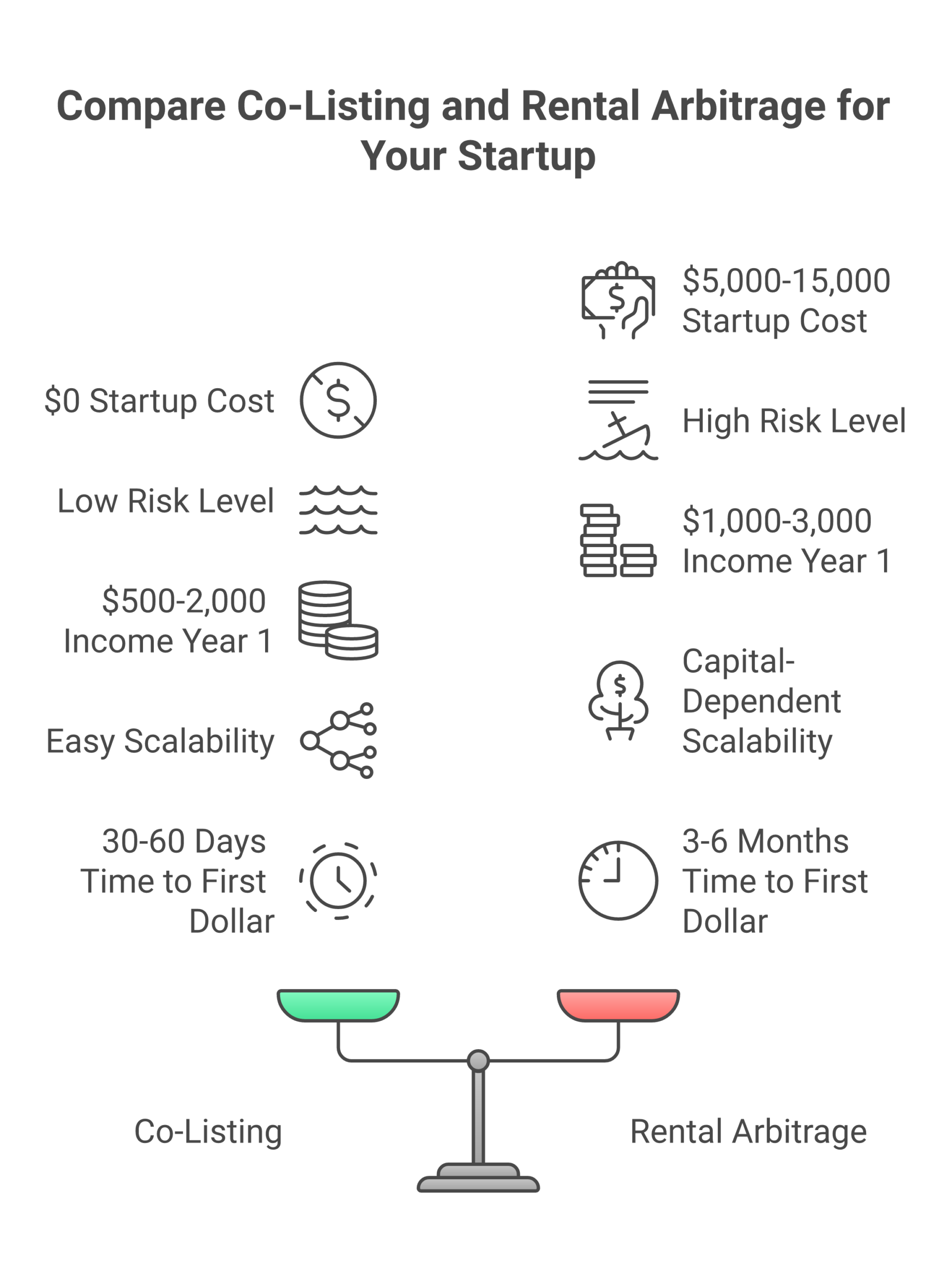
Co-Listing Explained in 60 Seconds
Co-listing means you manage someone else’s Airbnb property and earn a commission on every booking. The property owner keeps the listing in their name. You handle guest communication, pricing, cleaning coordination, and reviews. Your commission typically runs 10% to 25% of gross booking revenue.
You don’t sign a lease. You don’t furnish the property. You don’t pay rent if a property sits empty for two weeks. If a property underperforms, you walk away with zero financial loss. That’s the core appeal for people entering the short-term rental space without savings or credit history.
Shaun Ghavami, founder of 10XBNB and a UBC Sauder Finance graduate who manages a portfolio worth over $100M, built his entire teaching methodology around co-listing as the entry point. His reasoning: why risk your own money before you’ve proven you can fill a calendar? His 1,600+ students begin with co-listing before moving to any capital-intensive model.
The day-to-day work of a co-lister includes responding to guest inquiries (often automated through tools like Hospitable or Guesty), adjusting nightly rates based on demand and local events, coordinating turnover cleanings between guests, handling any issues during stays, and writing review responses. Most co-listers spend 5 to 10 hours per week per property once systems are in place.
For a deeper explanation, read our full guide on what Airbnb co-listing is and how it works.
Rental Arbitrage Explained in 60 Seconds
Rental arbitrage means you sign a long-term lease on a property, furnish it, and list it as a short-term rental on Airbnb, Vrbo, or Booking.com. You pay the landlord fixed monthly rent and keep all booking revenue above your total costs.
The math looks simple on paper. If your rent is $1,500 per month, your operating costs are $400, and your Airbnb revenue is $3,500, you pocket $1,600. But that $1,500 rent is due every month regardless of whether a single guest books. January in a beach town? You still owe $1,500. Local festival cancelled? Still $1,500.
Startup costs add up fast. Security deposit (often first and last month’s rent) puts you at $3,000 to $4,500 before you even start furnishing. Furniture runs $3,000 to $7,000 for a one-bedroom, depending on whether you buy new or source second-hand. Add kitchen supplies, linens, toiletries, professional photography ($150 to $300), and initial Airbnb fees. A single arbitrage unit typically requires $5,000 to $10,000 to launch.
The legal requirements are also more complex. You need explicit written permission from your landlord (many leases prohibit subletting). You need a business license in most municipalities. And you need to confirm your city allows short-term rentals at all, since regulations vary wildly. Some cities like Nashville require permits with annual caps. Others like New York City have near-total bans on rentals under 30 days unless the host is present.
See our ranked list of the best cities for mid term rentals with demand drivers and income data for each market.
See our full breakdown of how much mid term rentals make with city-by-city earnings and tenant demand analysis.
For a complete breakdown, check out our rental arbitrage training guide.
Head-to-Head Comparison: Co-Listing vs Rental Arbitrage
Here’s how these two models stack up across 13 factors that actually matter when choosing your first Airbnb business.
| Factor | Co-Listing | Rental Arbitrage |
|---|---|---|
| Startup Cost | $0 to $500 (business cards, software) | $5,000 to $10,000 per unit |
| Monthly Overhead | Near zero (software subscriptions only) | Rent + utilities + insurance + supplies |
| Risk Level | Very low. No financial exposure | Medium to high. Lease obligations continue during slow months |
| Income Potential (Year 1) | $500 to $2,000/month per property | $800 to $3,000/month per unit (after expenses) |
| Income Potential (Year 3) | $10,000 to $30,000/month (10-20 properties) | $5,000 to $15,000/month (5-10 units) |
| Time to First Dollar | 1 to 3 weeks | 4 to 8 weeks (lease + furnish + list + first booking) |
| Scalability | High. Add properties with zero capital | Limited by capital and creditworthiness |
| Exit Difficulty | Easy. Walk away anytime | Hard. Lease termination fees, furniture liquidation |
| Skills Needed | Guest communication, pricing, cleaning coordination | All co-listing skills plus lease negotiation, interior design, market analysis |
| Credit Check Required | No | Yes (landlord lease application) |
| Lease Liability | None | Full liability for lease term (typically 12 months) |
| Property Damage Risk | Owner’s responsibility | Your responsibility (security deposit at risk) |
| Passive Income Potential | Semi-passive with systems (automate messaging, pricing, cleaning) | Semi-passive with systems, but rent obligations require consistent occupancy |
The pattern is clear. Co-listing wins on risk, speed, and scalability. Arbitrage wins on per-unit income ceiling. Your choice depends on which column matters more to you right now.
The Real Numbers: Co-Listing Income vs Arbitrage Income
Theory only takes you so far. Here’s what the math looks like at different scales, based on typical U.S. market averages as of early 2026.
Co-Listing Income Projections
Assumptions: 15% average commission rate, $2,800 average monthly gross revenue per property (mid-tier market like Tampa, Asheville, or Scottsdale).
| Properties Managed | Gross Revenue (All Properties) | Your Commission (15%) | Software/Expenses | Net Monthly Income |
|---|---|---|---|---|
| 1 | $2,800 | $420 | $50 | $370 |
| 5 | $14,000 | $2,100 | $150 | $1,950 |
| 10 | $28,000 | $4,200 | $300 | $3,900 |
| 20 | $56,000 | $8,400 | $500 | $7,900 |
At 20 properties and a 15% commission, you’re looking at roughly $7,900 per month with almost no financial risk. Push that commission to 20% (common for full-service co-listing where you handle everything from pricing to restocking supplies) and the same 20 properties generate $10,700 monthly.
The key advantage: each property you add costs you nothing. No deposit. No furniture budget. No lease. Your only constraint is your time, and that’s where automation comes in. Tools like PriceLabs for dynamic pricing and Hospitable for guest messaging can reduce your per-property workload to under 2 hours per week.
Want to see how co-listing income scales in detail? Read our breakdown of Airbnb co-host income expectations.
Rental Arbitrage Income Projections
Assumptions: $1,800 average monthly rent, $400 operating costs (utilities, insurance, supplies, cleaning supplies between guests), $3,200 average monthly gross revenue per unit at 65% occupancy.
| Units Leased | Gross Revenue | Total Rent | Operating Costs | Net Monthly Income |
|---|---|---|---|---|
| 1 | $3,200 | $1,800 | $400 | $1,000 |
| 5 | $16,000 | $9,000 | $2,000 | $5,000 |
| 10 | $32,000 | $18,000 | $4,000 | $10,000 |
| 20 | $64,000 | $36,000 | $8,000 | $20,000 |
At scale, arbitrage generates more cash per month. Twenty arbitrage units at $1,000 net each means $20,000 monthly. But look at the capital required to get there: 20 units at $7,500 average startup cost per unit = $150,000 in capital deployed. And every one of those units carries a 12-month lease obligation.
With co-listing, the same 20 properties cost you effectively nothing to onboard. The trade-off is clear: arbitrage pays more per unit, but co-listing is dramatically cheaper and safer to scale.
The Risk-Adjusted Comparison
Here’s what most comparison articles miss. Arbitrage looks better on a per-unit basis when occupancy stays high. But when you factor in downside risk, the picture changes.
A co-lister with 20 properties who loses 3 clients simply earns less that month. No financial damage. No lease to buy out. No furniture sitting in a storage unit. You move on and replace those clients.
A rental arbitrageur with 20 units who hits a slow season still owes $36,000 in rent. One bad month can erase three good ones. Two bad months in a row, and you might be dipping into personal savings to cover lease obligations.
Sonder, one of the largest rental arbitrage companies in the world, filed for Chapter 11 bankruptcy in late 2023 with over $300M in lease obligations. Their model was profitable during peak travel seasons but couldn’t survive sustained low occupancy. That’s the structural weakness of arbitrage at any scale, from 2 units to 2,000.
Allan Cuevas, who manages over 50 units, runs a 30/70 split between arbitrage and management. His reasoning: management (co-listing) provides the stable base, while arbitrage provides the upside. That ratio tells you something about how experienced operators think about risk.
When Co-Listing Is the Better Choice
Co-listing wins in these five specific situations.
1. You Have Little or No Startup Capital
If you don’t have $5,000 to $10,000 sitting in savings, co-listing is your only realistic option. You can start with nothing more than a phone, a free PMS trial, and the willingness to knock on doors or send cold emails to property owners with underperforming listings. Our guide on how to find property owners for co-listing walks through exactly how to land your first client.
2. You’re Risk-Averse by Nature
Some people lose sleep over financial obligations. That’s not a weakness. It just means co-listing fits your personality better than arbitrage. You’ll perform better, make clearer decisions, and last longer in the business when you’re not stressed about making rent on an empty unit during a slow February.
3. You’re Testing a New Market
Moving to Austin and wondering if short-term rentals work there? Co-list first. You’ll learn occupancy patterns, seasonal demand curves, popular neighborhoods, and guest demographics without risking a dime. If the market turns out to be weaker than expected, you’ve lost nothing but time. If it’s strong, you now have the data to confidently sign an arbitrage lease.
4. You Want a Side Hustle, Not a Full-Time Business
Co-listing works well alongside a 9-to-5 job. Managing one to three properties requires maybe 5 to 10 hours per week once you’ve set up automated messaging, dynamic pricing, and a reliable cleaning team. Arbitrage demands more upfront time: lease hunting (weeks of touring apartments and negotiating), furnishing (shopping, assembly, staging), listing optimization, and handling maintenance issues that a property owner would normally manage.
5. You’re Building Experience Before Going Bigger
Every skill you need for arbitrage or property ownership, you learn through co-listing first. Pricing strategy. Guest screening. Cleaning team management. Review optimization. Dynamic pricing tools. Handling noise complaints and guest damage claims. You learn all of it on someone else’s dime, with someone else’s property, and with zero personal financial exposure.
Before you sign your first co-listing agreement, make sure you have the right contract in place. Read our co-listing agreement template guide so you’re protected from day one.
When Rental Arbitrage Is the Better Choice
Be honest about arbitrage: it’s the higher-reward play. And in the right circumstances, it makes total sense to pursue it.
1. You Have Capital and Want Higher Per-Unit Returns
If you’ve got $20,000 to $30,000 in available capital and good credit, arbitrage lets you build a portfolio that generates $1,000+ net per unit per month. That’s roughly 2x to 3x what you’d earn co-listing the same property. The math works in your favor if you can absorb a few slow months while your listings gain traction and reviews.
2. You Know Your Market Cold
If you’ve been co-listing for six months and you know exactly which neighborhoods outperform, which property types attract premium nightly rates, and what seasonal patterns look like in your city, the risk of arbitrage drops significantly. Market knowledge is the single biggest risk reducer in this model. Guessing at demand is how people lose money. Having six months of pricing data from co-listing properties removes most of that guesswork.
3. You’re Going Full-Time
Arbitrage demands more attention than co-listing. Lease negotiations with landlords who may be skeptical about short-term rentals. Furnishing decisions that affect your listing quality and nightly rate. Maintenance issues you can’t hand back to an owner because you are the tenant. If you’re treating this as your primary income source and can dedicate 40+ hours per week, arbitrage rewards that commitment with higher returns.
4. You Want Equity-Like Returns Without Buying Property
Arbitrage sits between co-listing and ownership on the risk-reward spectrum. You don’t build actual equity in the property, but you control the asset and keep all upside above your fixed costs. For people who want ownership-level returns but can’t qualify for a mortgage or don’t have a down payment saved, arbitrage is the middle ground. It’s also a way to generate the capital you’ll eventually use for a down payment on your own investment property.
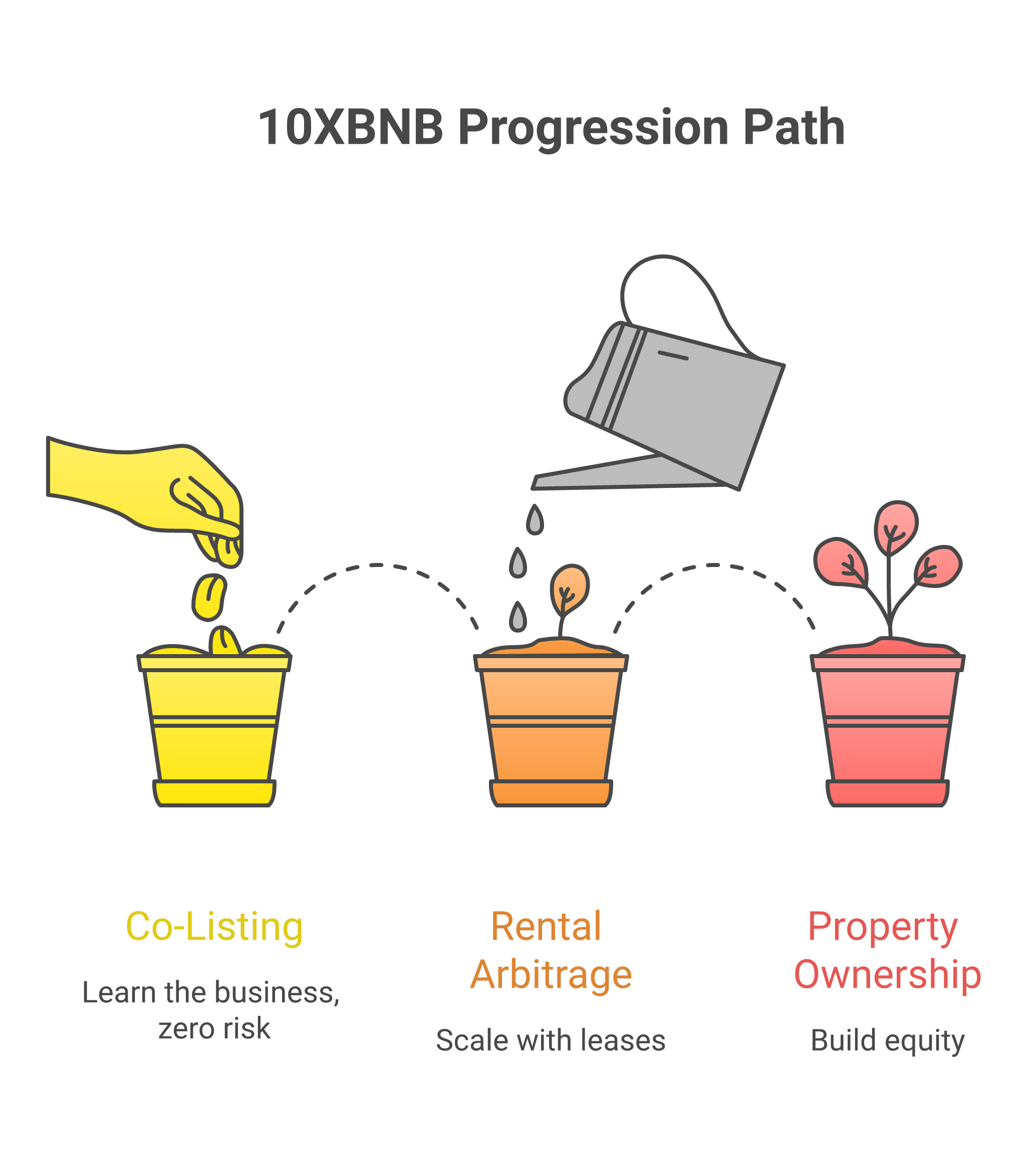
The 10XBNB Progression Path
10XBNB, founded by Shaun Ghavami, teaches a specific sequence that over 1,600 students have followed since the program launched. The approach is deliberate: start where risk is lowest, then move up as your skills and capital grow.
Phase 1: Co-Listing (Months 1 to 6)
Sign your first co-listing agreement. Learn the business with zero money at risk. Build your Superhost rating. Develop systems for guest communication, dynamic pricing, and cleaning team coordination. Get to 3 to 5 properties.
The focus during this phase is skill-building, not income maximization. You’re learning which markets respond to which pricing strategies. You’re figuring out which cleaning teams show up on time and which don’t. You’re discovering whether you actually enjoy hosting or if it’s just something that sounded good on a YouTube video.
According to a 2026 10XBNB student survey, 73% of students become profitable within their first 90 days using the co-listing model. That number matters because it shows the model works even for people with zero prior experience in hospitality or real estate.
Phase 2: Rental Arbitrage (Months 6 to 18)
Once you’ve proven you can fill calendars and manage operations, take the capital you’ve earned from co-listing and launch your first arbitrage unit. You now have real market data, reliable cleaning contacts, proven pricing tools, and a track record of guest reviews. The risk is still there, but it’s informed risk based on actual performance data from your own market.
Most 10XBNB students who move to Phase 2 keep their co-listing properties running alongside their arbitrage units. The co-listing income serves as a financial safety net: even if the arbitrage unit has a slow month, you still have commission income coming in.
Phase 3: Property Ownership (Year 2+)
The long-term play. Use arbitrage profits and co-listing savings for down payments on your own investment properties. Now you’re building real equity while running short-term rentals with skills you developed in Phases 1 and 2. The property appreciation, tax benefits, and full revenue control make ownership the eventual goal for most serious Airbnb entrepreneurs.
Each phase builds on the last. You don’t jump to ownership before you know how to manage a calendar. And you don’t jump to arbitrage before you’ve proven you can generate bookings consistently.
Ready to see the full training approach? Learn how to become an Airbnb co-host through the 10XBNB system, or explore the best Airbnb courses available in 2026.
Can You Do Both at the Same Time?
Yes. And many successful operators do exactly that.
The smart structure looks like this: maintain a base of co-listed properties for stable, risk-free income, then add arbitrage units selectively when you find deals with strong margins and favorable lease terms.
A practical split for someone managing 10 total properties might be 7 co-listed and 3 arbitrage. The co-listing income covers your living expenses and provides a cash cushion. The arbitrage income builds your savings for future property purchases or additional unit expansion.
Allan Cuevas, who operates 50+ units, uses a 70% management (co-listing) and 30% arbitrage ratio. His logic: the management side is predictable and requires no capital. The arbitrage side is where the growth comes from. If an arbitrage unit underperforms for a month, the management income absorbs the hit without any lifestyle disruption.
How to Structure a Hybrid Portfolio
- Step 1: Build your co-listing base to 5+ properties first. This gives you stable monthly income and operational experience
- Step 2: Save 3 to 6 months of operating reserves from co-listing income before signing any lease
- Step 3: Add your first arbitrage unit in a market and neighborhood you already know from co-listing. Use your existing pricing data to project revenue accurately
- Step 4: Keep your co-listing-to-arbitrage ratio at 2:1 or higher until you’re consistently profitable on arbitrage for at least 6 months
- Step 5: Scale arbitrage only when each new unit passes your minimum margin threshold (aim for $800+ net per month per unit after all expenses)
This hybrid approach gives you stability from co-listing and growth potential from arbitrage. The co-listing properties protect you during market downturns, while the arbitrage units amplify your income during strong months.
Common Mistakes to Avoid With Each Model
Co-Listing Mistakes
- No written agreement: A handshake deal with a property owner is an invitation for disputes. Always use a formal co-listing agreement that spells out your commission rate, responsibilities, termination terms, and liability
- Taking on bad properties: Not every property is worth co-listing. If the owner’s place has terrible furniture, a 2-star average, and no willingness to invest in improvements, you’re spending time on a property that won’t generate meaningful income
- Undercharging your commission: New co-listers often accept 10% when they should charge 15% to 20%. If you’re handling pricing, guest communication, cleaning, and reviews, you’re providing full property management. Price accordingly
Arbitrage Mistakes
- Signing a lease without doing the math: Run the numbers at 50% occupancy, not 70%. If the property doesn’t break even at 50%, your margin of safety is too thin
- Ignoring seasonality: A beach town that generates $5,000 per month in summer might generate $1,200 in winter. Average your projected revenue across 12 months, not just peak season
- Overspending on furniture: Your furnishing budget should target a nightly rate sweet spot, not Instagram aesthetics. A $3,000 furniture budget in a $100/night market is reasonable. A $12,000 budget in the same market will take over a year to recoup
- Skipping landlord disclosure: Running an Airbnb without your landlord’s written permission can get you evicted and sued for lease violations. Always disclose
Frequently Asked Questions
What is the difference between co-listing and rental arbitrage?
Co-listing means you manage someone else’s Airbnb property for a commission (typically 10% to 25% of gross revenue). You never sign a lease or pay rent. Rental arbitrage means you sign a long-term lease, furnish the property yourself, and list it on Airbnb. You pay rent to the landlord and keep all booking revenue above your total costs.
Which model makes more money per property?
Rental arbitrage typically generates $800 to $1,500 more per unit per month than co-listing the same property. But co-listing is easier to scale because each new property requires no capital. At 20 properties, a co-lister earning 15% commission can make $7,900 per month with zero financial risk.
Can I start co-listing with no money?
Yes. Co-listing requires no upfront capital. Your only costs are a phone, internet connection, and optionally a property management software subscription ($0 to $100 per month). You earn income from your first booking.
Is rental arbitrage legal?
Rental arbitrage is legal in most locations, but you need two things: explicit written permission from your landlord, and compliance with local short-term rental regulations in your city. Some cities ban short-term rentals entirely. Others require permits or limit the number of rental nights per year. Always check both your lease and local laws before signing.
How much does it cost to start rental arbitrage?
Plan for $5,000 to $10,000 per unit. This covers first and last month’s rent (security deposit), furniture, kitchen supplies, linens, professional photography, and initial Airbnb listing fees. One-bedroom units in lower-cost markets can be launched for as little as $3,000 if you source used furniture.
What happens if my arbitrage unit doesn’t get bookings?
You still owe rent. That’s the core risk of arbitrage. If you lease a property at $1,800 per month and get zero bookings, you’re losing $1,800 plus utilities every month until your lease ends or you find bookings. This is why market research and running conservative revenue projections before signing any lease is critical.
How do I find property owners who want a co-lister?
Look for underperforming Airbnb listings in your market (low review counts, bad photos, inconsistent pricing, gaps in their booking calendar). Contact the owners directly through the Airbnb platform or find their contact info through property records. Offer to improve their revenue in exchange for a commission. You can also target traditional landlords who are curious about short-term rentals but don’t want to manage guests themselves. Read our full guide on finding property owners for Airbnb co-listing.
Should I take an Airbnb course before starting?
A good course compresses months of trial-and-error into structured training. Programs like 10XBNB’s co-host training teach co-listing systems, pricing strategies, and owner acquisition scripts that most people spend 6+ months figuring out alone. The 10XBNB program has trained over 1,600 students, with 73% reaching profitability within 90 days (per their 2026 student survey). A course won’t guarantee success, but it shortens the learning curve significantly.
Start With Co-Listing, Then Decide Your Next Move
Both models work. Both generate real income for people who execute well. But co-listing gives you something arbitrage can’t: a risk-free education in how the Airbnb business actually operates.
Learn pricing. Learn guest management. Learn which markets and property types actually perform in your area. Do all of it without putting your savings on the line. Then, once you have data, experience, and capital, decide whether arbitrage, ownership, or a hybrid portfolio is the right next step for you.
Over 1,600 students have followed this exact progression through the 10XBNB program, starting with co-listing and building from there. Get free co-listing training and see if the co-listing model is the right starting point for your Airbnb business.
There’s also a middle ground between nightly arbitrage and co-listing. Our mid-term rental arbitrage guide explains how 30+ day stays reduce costs and regulation risk while keeping strong margins.