

Most Airbnb hosts file Schedule E, not Schedule C. If you rent out a property and provide the ordinary things a guest expects (a clean space at check-in, utilities, trash pickup), the IRS treats that as passive rental income on Schedule E, and it is not hit with self-employment tax. You only file Schedule C if you provide “substantial services” primarily for the guest’s convenience, the way a hotel does, with things like daily housekeeping during the stay, meals, or a concierge. That single distinction, per the IRS, is what separates the two forms.
I have run short-term rentals and managed a large portfolio for owners for years, and this is the question new hosts get wrong more than any other. Below I break down what the IRS actually says, what “substantial services” means, why Schedule C can cost you thousands, and why the famous 7-day rule is a completely different question that people constantly confuse with this one. I run my own returns with a CPA, and you should too.
The short answer: Schedule E for most hosts
Here is the rule in plain terms. The IRS says the basic form for reporting residential rental income and expenses is Schedule E. The IRS describes Schedule E as the form to report income or loss from rental real estate, royalties, partnerships, S corporations, estates, and trusts. A normal short-term rental, even one you host actively, lands here.
Schedule E income is treated as passive rental income. The big practical win is that it is generally not subject to self-employment tax. You still pay income tax on your profit, but you skip the extra 15.3% that business owners pay on top. For most hosts, staying on Schedule E is both correct and cheaper.
Schedule C is the exception, not the default. The IRS Publication 527 puts it directly: “Generally, Schedule C is used when you provide substantial services in conjunction with the property or the rental is part of a trade or business as a real estate dealer.” So the trigger is not how active you are, how many properties you own, or whether you formed an LLC. The trigger is whether you provide substantial services. Everything hinges on that phrase.
What “substantial services” actually means to the IRS
This is where hosts talk themselves into the wrong form. “Substantial services” has a specific meaning, and it is narrower than most people assume. Per Publication 527, if you provide substantial services that are primarily for your tenant’s convenience, such as regular cleaning during the stay, changing linen, or maid service, you report your income and expenses on Schedule C. The key idea is convenience-of-the-guest services delivered while they are staying, the kind a hotel or a bed-and-breakfast provides.
Services that DO point toward Schedule C
Think hotel, not rental. The IRS examples and the standard hotel-style pattern include:
- Regular cleaning or maid service during a guest’s stay (not the turnover clean between guests)
- Changing linens or towels mid-stay, room service style
- Serving meals or providing food
- Concierge service, guided tours, or transportation you arrange as part of the booking
Services that do NOT trigger Schedule C
This is the part that keeps most hosts safely on Schedule E. Publication 527 states plainly that substantial services “don’t include the furnishing of heat and light, cleaning of public areas, trash collection, etc.” The ordinary operating basics of any rental do not make you a business in the self-employment-tax sense:
- Utilities: heat, light, water, internet, and air conditioning
- Cleaning the unit between guests (turnover cleaning)
- Trash collection and cleaning of shared or public areas
- Providing Wi-Fi, a stocked kitchen, linens set out before arrival, or a welcome guide
Read that list again. Nearly everything a typical Airbnb host does falls into the “ordinary” bucket, which is exactly why the default answer is Schedule E. If you want the full picture of what you can write off on either form, our guide to Airbnb tax deductions walks through the common categories.
Get the free Airbnb training and see the operating playbook we use, then take the specifics to your own CPA.
Schedule E or Schedule C? A quick decision table
Run your own situation through this. The one question that matters is whether you provide substantial, hotel-like services for the guest’s convenience.
| Your situation | Form (per IRS) | Self-employment tax? |
|---|---|---|
| Rent the space, provide utilities, clean between guests, supply Wi-Fi and linens | Schedule E | No, generally not |
| Own several short-term rentals, host actively, but still only ordinary services | Schedule E | No, generally not |
| Provide daily housekeeping during stays, meals, concierge, or tours (hotel style) | Schedule C | Yes, generally |
| Operate as a real estate dealer, or the rental is part of a trade or business | Schedule C | Yes, generally |
The flow is short: substantial services for the guest’s convenience? If yes, Schedule C. If no, Schedule E. That is the decision, straight from Publication 527.
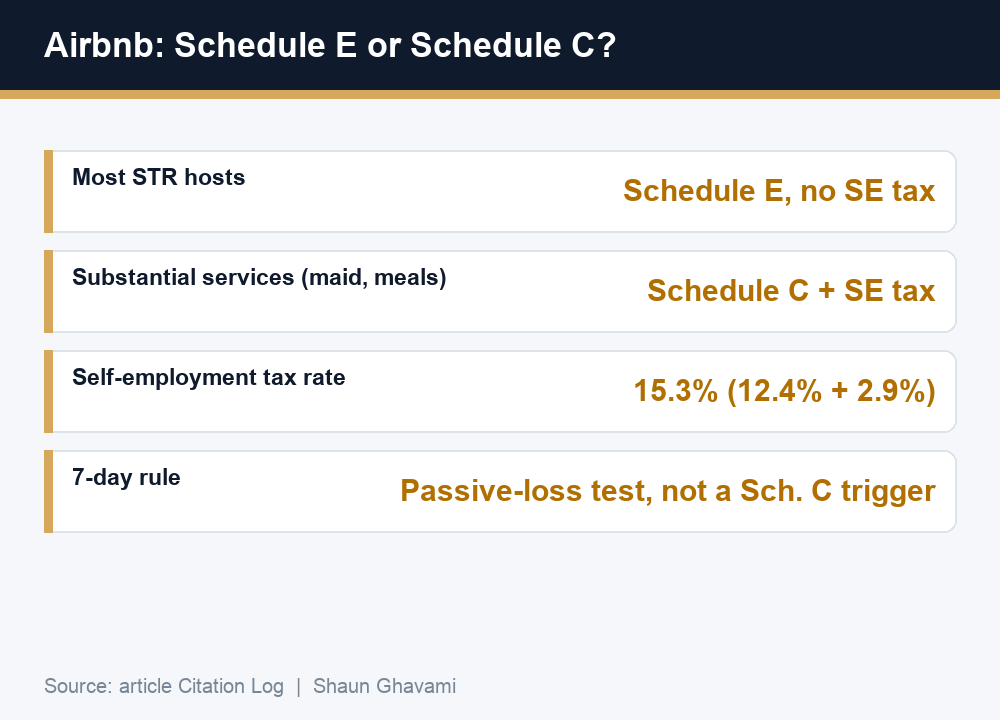
Why Schedule C costs you: the 15.3% self-employment tax
The reason this form choice matters so much is money. Schedule E rental income is generally not subject to self-employment tax. Schedule C business income usually is. Per IRS Topic No. 554, the self-employment tax rate is 15.3%, made up of 12.4% for Social Security and 2.9% for Medicare. That is on top of your regular federal income tax, not instead of it.
Here is illustrative math to make it concrete. These numbers are a simplified example, not a projection of your return:
| Net rental profit | On Schedule E (no SE tax) | On Schedule C (SE tax applies) |
|---|---|---|
| $30,000 | $0 self-employment tax | About $4,239 self-employment tax* |
*Illustrative only. Self-employment tax is calculated on roughly 92.35% of net earnings, so 15.3% of about $27,705 is around $4,239, and half of that is deductible against income tax. Your CPA runs the real figures on Schedule SE.
That is thousands of dollars a year on a single property, purely from which form your income lands on. It is why you do not want to volunteer yourself onto Schedule C by mislabeling ordinary services as “substantial.” Publication 527 confirms the flip side too: if you do provide substantial services, “you may have to pay self-employment tax on your rental income using Schedule SE (Form 1040).” So the form and the tax move together. This is one reason clean Airbnb bookkeeping matters, because your records are what prove which services you actually provided.
The test everyone confuses this with: the 7-day rule
Now the part that trips up almost everyone, including hosts who have read a few blog posts. You may have heard that short-term rentals with an “average stay of 7 days or less” get special treatment. That is true, but it answers a different question. It has nothing to do with Schedule E versus Schedule C.
There are two separate tests running in parallel, and mixing them up is the single biggest mistake I see:
Test 1: Which form? (substantial services)
This decides Schedule E versus Schedule C, and whether you owe self-employment tax. The trigger is substantial services, as covered above, straight from Publication 527. Nothing about the length of a guest’s stay changes this test.
Test 2: Are my losses passive? (the 7-day rule plus material participation)
This is a completely different question about whether a loss from the rental can offset your other income, such as W-2 wages. It comes from the passive activity rules in IRS Publication 925 and Treasury Regulation 1.469-1T(e)(3)(ii). Publication 925 says that if the average period of customer use of the property is 7 days or less, the activity is not treated as a “rental activity” for the passive loss rules. If you then materially participate, a loss can be non-passive and offset active income.
Material participation has its own tests in Publication 925. The two most common: you participated in the activity for more than 500 hours during the year, or you participated for more than 100 hours and at least as much as any other individual. Meeting one of those, on a property with an average stay of 7 days or less, is the engine behind what people call the short-term rental tax loophole.
Here is the piece that ties it together, and the piece nearly every explanation online gets muddy. Qualifying under the 7-day rule does not push you onto Schedule C, and it does not create self-employment tax. You can be on Schedule E (no SE tax) and have non-passive losses that offset your wages, at the same time. In fact that combination is the whole point: you keep the cheaper form and still get to use the losses. The 7-day rule is about your losses, not about your form. Do not let anyone talk you into Schedule C because your stays are short.
The reason those losses can be large enough to matter usually comes from depreciation, and specifically from a cost segregation study that front-loads it. That is a bigger topic, but the sequence is: substantial-services test decides your form, then the 7-day-plus-material-participation test decides whether your losses are passive.
What about the QBI deduction?
One more piece worth knowing. The Qualified Business Income (QBI) deduction under Section 199A can let eligible owners deduct up to 20% of their qualified business income. Per the IRS Qualified Business Income Deduction page, this applies to many owners of sole proprietorships, partnerships, and S corporations, and a rental real estate enterprise can be treated as a trade or business for QBI purposes if certain criteria are met.
The nuance: QBI eligibility for a rental depends on whether the activity rises to the level of a trade or business, either under the IRS safe harbor or under the general trade-or-business standard. It is not automatic for every rental, and it is not the same test as the Schedule E versus Schedule C question or the passive-loss question. A short-term rental reported on Schedule E can still be eligible for QBI if it qualifies as a trade or business. This is exactly the kind of thing to confirm with your accountant rather than assume, since the criteria have specifics that go beyond this article. I would not overstate it: many hosts qualify, but you have to meet the standard.
How I handle this with my CPA
My own approach is simple. I keep my hosting to ordinary services, so I stay on Schedule E and avoid the self-employment tax. I do not provide daily maid service or meals, because I have no reason to volunteer for Schedule C. I track my hours honestly for the material participation test when I am pursuing the loss offset, and I document what I do. Then I hand clean records to my CPA, who makes the final call on the forms.
If you are still setting up, the order that has worked for me is: get the operation running first (our guide on how to start an Airbnb business covers that), keep tidy books from day one, and bring a short-term-rental-savvy accountant in before your first full tax year closes. If you want a professional in your corner, we cover how to find and work with an accountant who understands short-term rentals, and if you want hands-on help building the business itself, that is what our Airbnb consulting is for.
The rules here are the IRS’s, not mine. I am an operator, not a CPA, so treat this as the map, and let a professional confirm the route for your specific numbers.
Get the free Airbnb training to see how we structure, run, and scale rentals, then confirm every tax move with your CPA.
Frequently asked questions
Most Airbnb hosts file Schedule E. Per IRS Publication 527, you use Schedule C only if you provide substantial services primarily for the guest’s convenience, like a hotel does, such as regular cleaning during the stay, meals, or concierge service. Ordinary services like utilities, trash collection, and cleaning between guests keep you on Schedule E.
Per IRS Publication 527, substantial services are services provided primarily for your tenant’s convenience, such as regular cleaning during a stay, changing linen, or maid service. The publication states these do not include furnishing heat and light, cleaning of public areas, or trash collection, so ordinary rental operations do not count.
No. The 7-day rule is a separate test. Per IRS Publication 925, if the average period of customer use is 7 days or less and you materially participate, a rental loss can be non-passive and offset other income. That determines whether losses are passive, not which form you file. You can qualify under the 7-day rule and still report on Schedule E with no self-employment tax.
Generally no. Rental income reported on Schedule E is treated as passive and is generally not subject to self-employment tax. Schedule C business income generally is subject to self-employment tax, which per IRS Topic No. 554 is 15.3%, made up of 12.4% for Social Security and 2.9% for Medicare.
It can. Per the IRS, the Qualified Business Income deduction under Section 199A can allow up to 20% of qualified business income, and a rental real estate enterprise can be treated as a trade or business if certain criteria are met. Eligibility is not automatic and depends on whether the activity rises to a trade or business, so confirm it with your CPA.
No. This is general education, not tax advice. Tax rules change and depend on your situation. The rules described here come from the IRS, and Shaun is an operator, not a CPA. Consult a licensed CPA or tax professional before acting.