
Short answer: you cannot transfer existing Airbnb bookings to another account. Airbnb’s policy is that listings and reservations live with the host account that created them. But you have one workaround Airbnb officially supports, two workarounds operators use successfully, and a stack of guest communication, tax, and timing decisions that most blog posts gloss right past. I have walked students through every version of this, sale closings with 14 guests on the calendar, LLC restructures mid-season, sudden co-host swaps. The mechanics matter and so does the order of operations.
If you are deep into a property sale, a co-host change, or an LLC restructure right now and the calendar is loaded, book a free call with our team and we will sketch the safest path for your specific timeline. Otherwise, keep reading. By the end of this you will know exactly what Airbnb permits, what they do not, and how operators thread the needle without burning guests or Superhost status.
Book a free 10XBNB coaching call if your closing date is within 60 days. The clock matters more than people think.
The four scenarios where this question comes up
Before getting into Airbnb’s policy, it helps to name the scenario you are actually in. The mechanics shift depending on which one applies.
- You are selling the property and the buyer wants to keep operating it as a short-term rental. The buyer wants the calendar, the reviews, the pricing history, all of it. The closing date may or may not fall on a clean changeover day.
- You are swapping co-hosts. Maybe your current co-host is burning out, you brought in a property manager, or you fired one. Existing reservations were accepted by the outgoing co-host and need to be handled cleanly.
- You are restructuring your LLC or moving the property under a new entity. Same physical asset, same operator, different legal owner on paper. Bookkeeping and tax IDs change. The bank account collecting payouts changes.
- You are handing the listing to a new manager or family member. You are not selling. The property stays in your name. Someone else will run it day-to-day.
Each scenario has a different answer to “can I transfer existing bookings.” Two of them have a clean path. Two of them require some footwork. None of them work the way most hosts assume.
Airbnb’s official policy on transfers
Here is the policy in plain language, sourced from Airbnb Help Center article 1431 (verified May 2026):
“There’s no way to merge or move information or bookings between Airbnb accounts. There isn’t a way to transfer ownership of an Airbnb account to a different host.”
Read that twice. Airbnb does not have a “transfer ownership” button. You cannot call support and ask them to move account A to account B. You cannot move reservations from one account to another account. The listing, the reviews, the booking history, and the payout method all stay tied to whichever account created them.
Airbnb’s recommendation if you have two accounts and want to consolidate: pick the one you want to use going forward, and deactivate or delete the other. Any pending reservations on the deactivated account get cancelled. That is the official path, and the official path is destructive for existing bookings.
So how do operators actually move a property to a new owner or operator while keeping the calendar intact? With the one feature Airbnb does support: co-hosts.
The co-host workaround that actually works
Airbnb supports up to 10 co-hosts per listing, per Help Center article 1244. A full-access co-host can manage the calendar, accept and decline reservations, message guests, modify reservations, and even receive co-host payouts. The listing owner controls payout setup, taxpayer information, and who has which permissions.
Here is the critical piece that almost no other guide spells out, sourced directly from Help Center article 1536 (Primary Hosts):
“When the primary host designation changes, existing reservations remain unchanged.”
Re-read that one too. If the original listing owner promotes a full-access co-host to primary host, the existing reservations on the calendar stay live. The guest sees the new primary host’s name and photo. The new primary host handles check-ins, messages, and resolution requests. The original owner still controls the bank account collecting payouts unless they update that separately.
This is the closest thing Airbnb has to a “transfer.” It is not a transfer in the legal or financial sense. The account on file is still the original owner. But the day-to-day hosting moves to a new person, and existing reservations are preserved.
What the co-host route does not solve
- Payout still goes to the original account. If you sold the property, you collect the money and have to forward the buyer’s share offline. Most sale agreements settle this in escrow or with a simple post-closing wire. You need a written agreement.
- Reviews stay on the original account. The new owner does not build their own Superhost track record from the existing reviews. Their separate guest reviews on this listing accrue to the original listing-owner profile per Airbnb’s Primary Host rules.
- The original owner is still legally responsible for the listing terms in Airbnb’s eyes. You are loaning your account to the new operator until the existing bookings clear. That is real liability and the agreement needs to reflect it.
What actually happens to existing reservations in each scenario
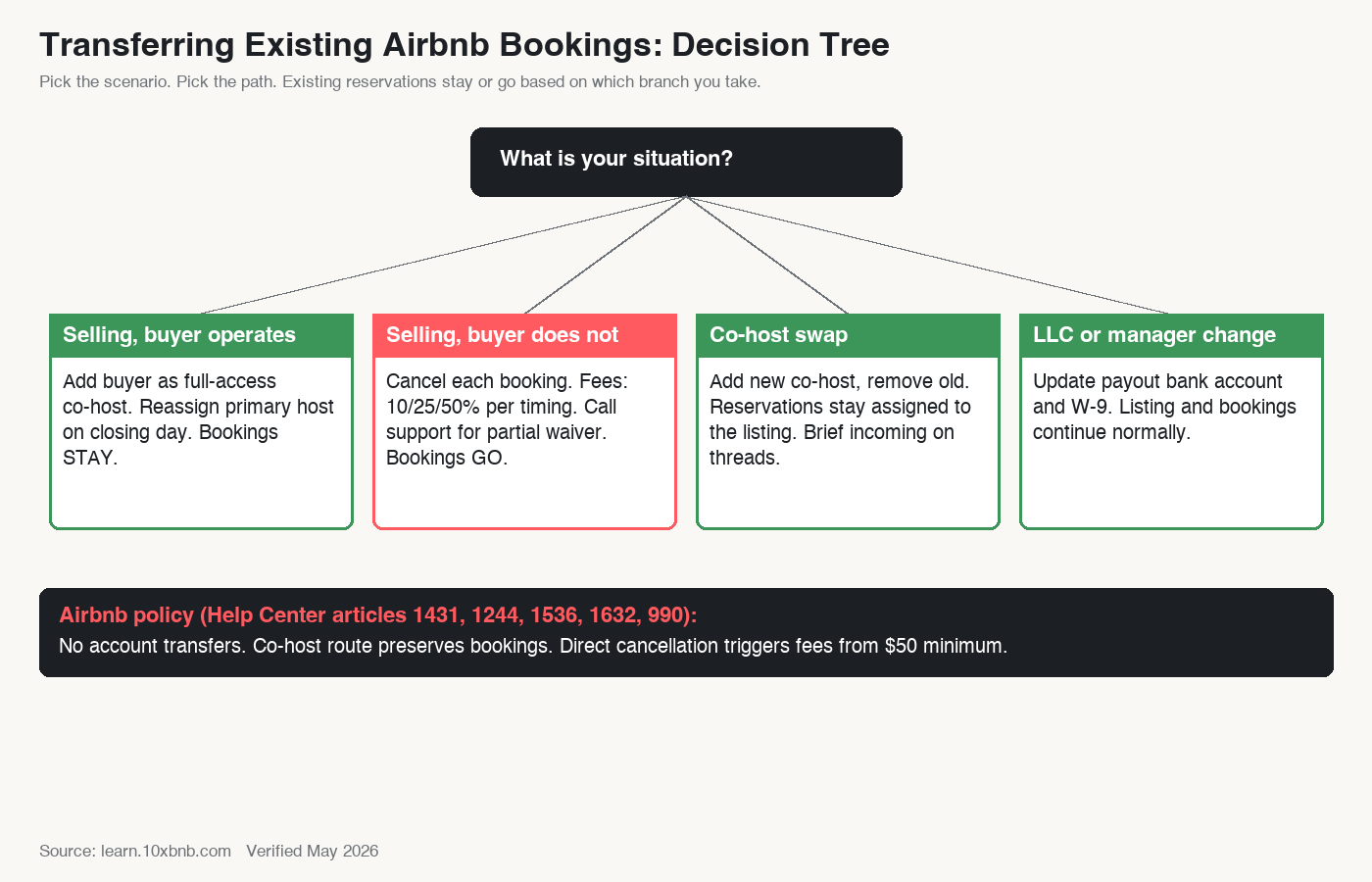
Scenario 1: Selling the property, buyer will operate
The buyer creates their own Airbnb account, you add them as a full-access co-host, you transfer the primary host designation on the closing day, and existing reservations stay on the calendar. The buyer takes over messaging and check-ins. The payout still hits your bank account; you forward their portion per your written agreement.
This path keeps the listing’s reviews, ranking, and pricing history intact for the buyer. They get a property that already converts. You get to close the sale without nuking 14 future bookings and eating the cancellation fees.
When the last existing reservation has checked out and been reviewed, you can step away by removing yourself from co-host duties. The listing stays under your original account, but the new owner is now the primary host and running everything. Most buyers eventually create a fresh listing of their own to own the asset cleanly. The transition listing buys them runway.
Scenario 2: Selling the property, buyer will not operate
Different problem. The buyer is going to use the property as a primary residence, a long-term rental, or just sit on it. They do not want your guests showing up after closing.
You have one option: cancel the bookings. Airbnb’s host cancellation policy fees are real. Per Help Center article 990 (effective October 9, 2023), the standard host cancellation fee is 50% of the reservation amount for cancellations within 48 hours of check-in or after, 25% between 48 hours and 30 days out, and 10% if more than 30 days out, with a $50 minimum.
Property sale is not on Airbnb’s list of automatic fee waivers. You will need to call Airbnb support, explain the situation, and ask for a waiver. Some hosts get a partial waiver. Others get nothing. Superhost status is also at risk; cancellations count against your reliability metrics.
If you have 30 or more days before each reservation’s check-in date, push the cancellations through then. The fees are smaller and you give guests time to rebook elsewhere. If guests are checking in next week, call them first, see if they can be relocated to a nearby property you also operate, and only cancel as a last resort.
Scenario 3: Co-host swap
Existing reservations stay on the listing regardless of who the co-host is. Per Help Center article 1632, when you remove a co-host, “the primary host is automatically changed back to the listing owner” if no other full-access co-host remains. Reservations stay assigned to the listing, not the co-host who originally accepted them. The new co-host (or you) takes over messaging from that point forward.
Operational risk: if your outgoing co-host had context on a guest that you do not, those threads can get awkward. Pull the message history, brief the new co-host, and proactively message guests with a quick “you’ll be hearing from [name] going forward” note.
Scenario 4: LLC restructure or moving the property under a new entity
This is where most operators stumble. The Airbnb account is tied to a person, not an LLC. If you create a new LLC and want to “move” the property to it for tax or liability reasons, the listing does not have to move. The reservations do not move. What changes is:
- The payout bank account (update under Account, Payments and Payouts)
- The taxpayer information on file (W-9 update for U.S. hosts)
- Your internal bookkeeping (the new LLC’s books pick up income from the changeover date)
The listing keeps running. Reservations are untouched. Guests notice nothing. The IRS sees a clean split between the old entity and the new entity once you update the W-9 and the payout account. Talk to your CPA before the changeover date. This is not a do-it-yourself moment.
Step-by-step: selling the property with bookings on the calendar
This is the most common version of the question. Here is the exact sequence I walk operators through.
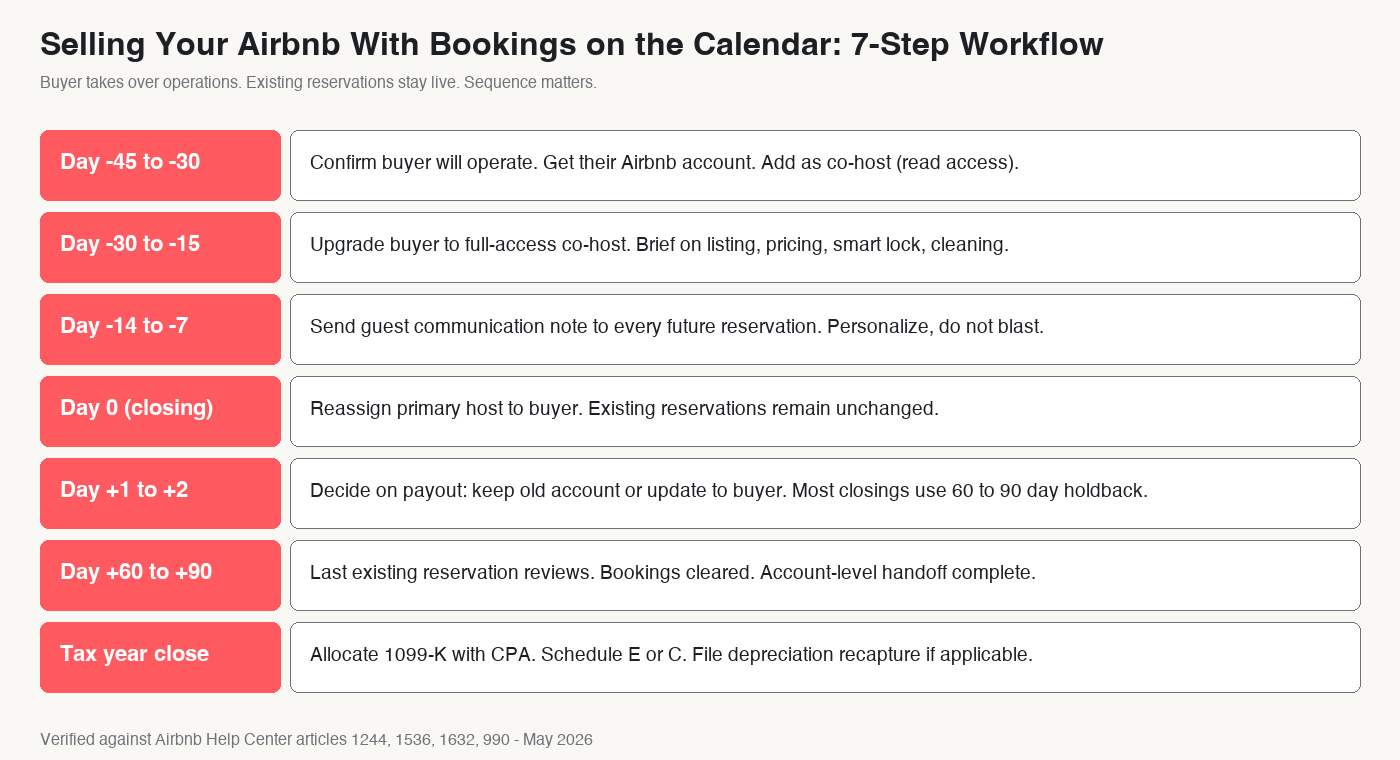
- 30 to 45 days before closing. Decide with the buyer whether they will operate the property. If yes, get their Airbnb account ID and add them as a full-access co-host now. Give them read access to the calendar and let them start absorbing the listing, the pricing rules, the smart lock codes, the WiFi network, and the house rules.
- 15 to 30 days before closing. Update co-host permissions to full access. Walk the buyer through the message templates, the cleaning crew, the linen vendor. Brief them on every guest who has a future booking, especially repeat guests or anyone who has flagged a special request.
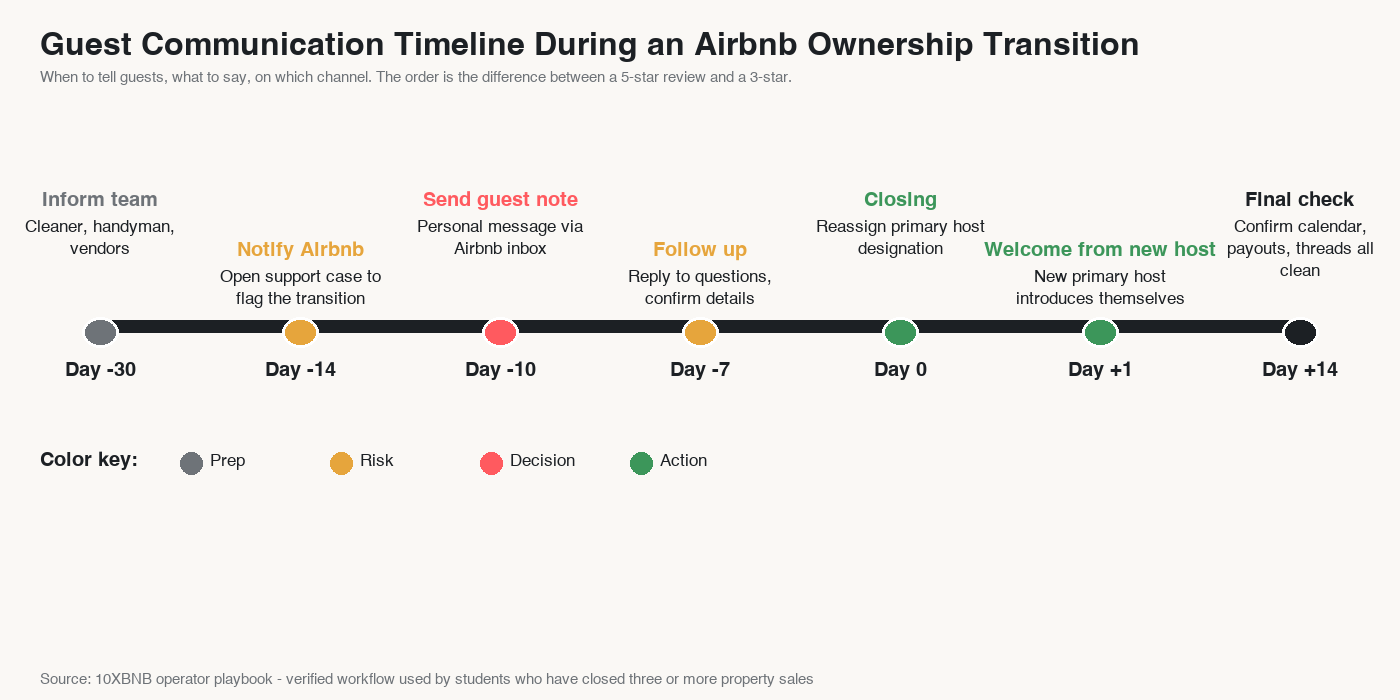
- 7 to 14 days before closing. Message every guest with a future stay. Use the template below. Do not blast a generic note; personalize each one.
- Closing day or the day after. Inside Listings, Co-hosts, change the primary host designation to the buyer. Existing reservations remain unchanged per Airbnb policy. The buyer’s name and photo are now what new guests see.
- Within 48 hours of closing. Update the payout method only if the buyer is taking over the cash flow immediately. If you are honoring bookings under the old payout and forwarding funds, leave the payout where it is and reconcile per your closing agreement. Most attorneys recommend a 60 to 90 day escrow holdback for booking funds clearing through the original account.
- After the last existing reservation has reviewed. Remove yourself as listing owner only if the buyer has migrated to their own account; otherwise the listing remains under your account indefinitely. Most operators keep the original listing live for the buyer for one to two years to preserve reviews while the buyer builds their own.
- For your tax return. Schedule E income shows through to the changeover date if you are a passive investor; Schedule C if you provide substantial services like daily cleaning and concierge. Coordinate with a CPA on the tax-year split.
Guest communication template
Copy and customize. Send 7 to 14 days before the ownership change so guests can ask questions before their check-in date.
Hi [Guest first name],
Quick heads up about your stay at [Property name] from [check-in] to [check-out].
I am transitioning operations to [New host first name], who is taking over hosting on [Date]. Your reservation is confirmed and the price you booked is locked in. The check-in process, the door code, the WiFi, all of it stays the same. The only change is that you will be messaging with [New host first name] instead of me from [Date] forward.
You do not need to do anything. If you have any questions before then, message me here and I will route it to [New host first name] so they have full context when they take over.
Looking forward to hosting you [or, looking forward to handing you off to [New host first name] who I trust with this property].
[Your name]
That note does four things. It confirms the reservation is honored. It locks in the price. It names the new host. It removes the guest’s anxiety that they have to do anything. Eight out of ten guests reply with “thanks for letting me know” and you never hear from them again. The other two ask a clarifying question, and now you have a chance to make a good handoff.
Tax and financial implications
This is the section most blog posts skip and most operators wish they had read first.
1099-K and split tax years
Airbnb issues a Form 1099-K to the account that received the payouts. If the original owner kept the payout method through the year of sale, the original owner gets the full 1099-K, even for the buyer’s portion of the bookings. You will have to allocate income on your tax return and the buyer will need a clear written record of what they received from you. Talk to your CPA in the same conversation where you finalize the sale paperwork.
Schedule E vs Schedule C
If the property is reported on Schedule E (passive rental income), the sale is reported on Form 4797. If the property is reported on Schedule C (active business with substantial services), the sale also goes on Form 4797 but the depreciation recapture treatment can differ. The general rule per Nolo’s tax guide for landlords: gain attributable to depreciation you took over the years is taxed as ordinary income up to 25%, not at the lower long-term capital gains rate.
Depreciation recapture
If you depreciated the property on past returns, the IRS wants that depreciation back when you sell. Depreciation recapture is taxed at a maximum 25% federal rate. On a property you depreciated $40,000 over five years of hosting, you could owe up to $10,000 in recapture tax at closing, on top of any capital gains. This is not exotic; it is standard rental property tax law, and it surprises operators who have only ever looked at the gross sale price.
Section 1031 exchange
If you are rolling the proceeds into another rental property, a 1031 like-kind exchange defers the capital gains and the depreciation recapture, but the rules are strict. You must identify replacement property within 45 days and close within 180 days, and a qualified intermediary has to hold the funds. Section 1031 changed in 2017 to exclude personal property; it now applies only to real property. This is CPA territory, not a DIY move.
Common pitfalls
- Trying to “transfer” without using co-hosts. Hosts try to log out, hand the buyer their password, and pretend nothing happened. Airbnb’s Terms of Service prohibit account sharing and they catch it through device fingerprinting and IP changes. You can lose the account entirely. Do not do this.
- Cancelling all future bookings before closing. Cancellation fees stack and Superhost status takes a hit. Almost every operator who cancels everything regrets it. The co-host route preserves the calendar.
- Forgetting to update the payout account or W-9. If the LLC changes mid-year and the W-9 does not, your 1099-K is wrong and your tax filing is a mess.
- Not putting the operating agreement in writing. If the buyer is running the property under your account for 60 days post-closing while bookings clear, every cent that flows through your bank account is your tax problem unless the closing documents allocate it correctly. Have an attorney draft the handoff terms.
- Telling guests too late. A guest who finds out at check-in that the host they messaged with sold the place six weeks ago is a guest who leaves a 3-star review. Tell them 7 to 14 days out, in writing, on Airbnb, so the platform has a record.
- Letting the buyer use your Resolution Center requests. If something breaks during the transition period, the original owner is on the hook in Airbnb’s eyes. Pre-agree on how repair and damage claims get handled before they happen.
- Skipping the CPA conversation. Every operator who tried to figure out the depreciation recapture and Schedule E / C split on their own ended up either overpaying or filing an amendment. Pay the CPA fee.
What our 10XBNB students do during transitions
Most operators only sell or restructure once or twice. We have students who have sold three properties this year alone, and the system they use is the system we teach inside the 10XBNB program: live weekly coaching with operators who have done dozens of transitions, a community where you can post your closing date and timeline and get specific feedback from people who have done it, and mentorship from the founding team that has collectively touched roughly a thousand short-term rental doors.
What you get out of that is not magic. It is being able to ask “I have 11 bookings on the calendar, my closing is in 17 days, the buyer is reluctant to be a co-host because they want their own account, what do I do,” and getting an answer that night. You do not solve this in a Facebook group. You do not solve this in a blog post. You solve it by having a room of operators who have already lived it.
Grab a free coaching call and we will walk through your specific scenario, your timeline, and the exact sequence we would run if it were our property. No pitch. We just answer the question.
Frequently asked questions
Can I transfer my existing Airbnb bookings to a new owner?
Not directly. Airbnb does not permit moving reservations between accounts. The workaround is to add the new owner as a full-access co-host and transfer the primary host designation. Existing reservations remain unchanged when the primary host is updated this way, per Airbnb Help article 1536.
What happens to my Airbnb bookings if I sell my house?
Your options are to add the buyer as a co-host so the bookings stay on the calendar, or to cancel each booking. Cancellation fees apply: 10% of the reservation amount more than 30 days out, 25% between 48 hours and 30 days, 50% within 48 hours or after check-in, with a $50 minimum per cancellation. Property sale is not an automatic fee waiver, but Airbnb support sometimes grants partial waivers if you call ahead.
Can a co-host take over my existing reservations?
Yes. A full-access co-host can manage existing reservations, message guests, modify dates, and accept or decline new requests. Per the Co-Host Help Center documentation, when the primary host designation moves from the listing owner to a full-access co-host, “existing reservations remain unchanged.” The new primary host handles those bookings going forward.
Do I lose Superhost status if I cancel bookings to sell my property?
Possibly. Superhost criteria include a low cancellation rate. Multiple cancellations within the assessment window can pull you below the threshold. The co-host workaround avoids this entirely because no bookings get cancelled.
How do I move my Airbnb listing into a new LLC?
The listing does not move. You update the payout bank account and the W-9 to the new LLC and adjust your bookkeeping for the changeover date. Existing reservations continue as normal. Your CPA should set the cutover date so the tax-year allocation is clean.
Do reviews transfer when I change the primary host?
Reviews stay attached to the listing owner’s profile, not the primary host. If you make a co-host the primary host, the listing’s review history stays with you (the original listing owner). The new primary host does not inherit those reviews to their own profile, although they manage the listing day-to-day.
How long does an Airbnb ownership transition take?
Two to four weeks is the practical window. You need 7 to 14 days for the buyer to absorb the operations, 7 days minimum for guest communication, and the closing date to align with a clean handoff. Tight timelines (under 14 days) work but require longer hours and tighter coordination.
Bottom line
You cannot transfer existing Airbnb bookings to another account, full stop. But you can preserve every reservation on your calendar by adding the new owner or co-host as a full-access co-host and reassigning the primary host designation. Airbnb leaves the existing bookings intact. The new primary host runs the day-to-day. The original owner stays on the account until the calendar clears, which for most sales takes 60 to 90 days post-closing.
The mistakes that cost real money are the ones that happen before you read the policy: cancelling bookings unnecessarily, sharing account passwords, forgetting to update the W-9, and skipping the CPA. The mistakes that cost trust are the ones with guests: telling them too late, telling them in the wrong channel, or not telling them at all.
If your closing date is on the calendar and the bookings are stacked, book a free 10XBNB coaching call and we will run the sequence with you. Two related reads if you have not already: Transfer Airbnb Listing: A Complete Guide covers the listing-level mechanics, What Happens If Airbnb Host Sells House goes deeper on the sale dynamics, and our co-hosting guide walks through the operational structure once the handoff is done. For VRBO-side transfers, see co-hosting on VRBO.
Related Operator Deep Dives
Other reviews and comparisons in this cluster operators have found useful: