The Airbnb business model is a two-sided marketplace (or platform business model) that connects hosts (supply) with guests (demand) for short term rentals and experiences. Airbnb earns revenue primarily through a 15.5% host-only service fee on each booking, charged under the host-only fee model that became standard in December 2025. Airbnb does not own the properties listed on its platform, which makes it an asset-light platform. As of 2024, Airbnb operates in over 220 countries and regions and has more than 8 million active listings. For hosts who want to earn income through the platform, four main host business models exist: property ownership, rental arbitrage, co-hosting, and Airbnb Experiences. Each varies in startup capital, monthly obligation, and risk profile. The 10XBNB system has produced over $5 million in booking fees across 24 properties operating within Airbnb’s platform business model.
What Is the Airbnb Business Model? A Two-Sided Platform
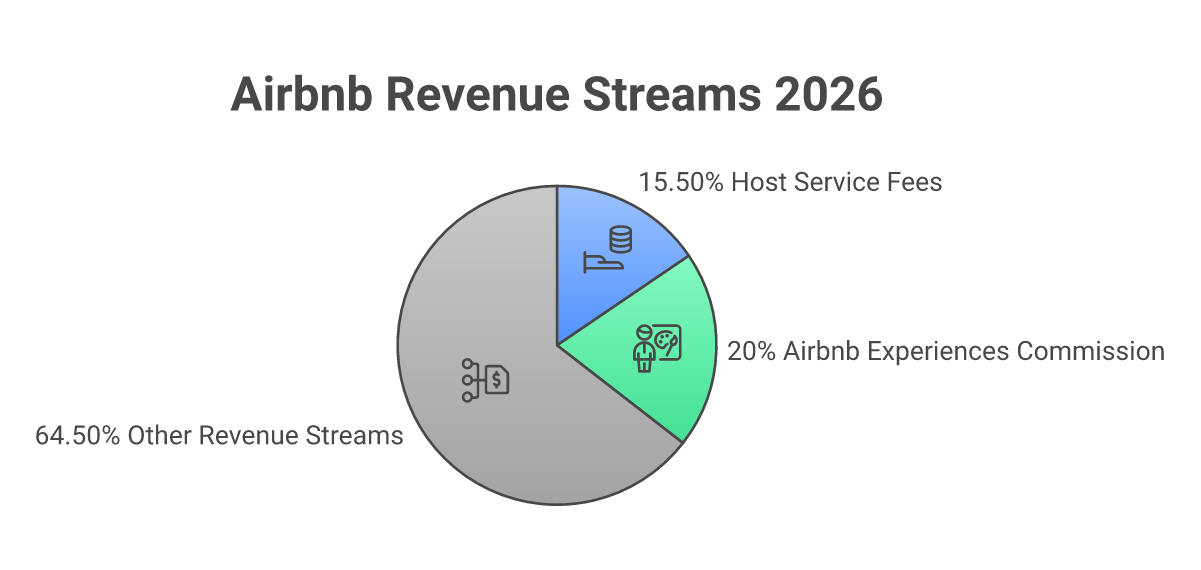
The Airbnb business model is a two-sided online marketplace that matches travelers (guests) with property owners and rental arbitrage hosts (hosts) who list short term rentals. Airbnb the company does not own the properties on its platform. It earns commission on each booking by providing the technology layer, the trust layer (reviews, payments, host verification, AirCover insurance), and the discovery layer (search, ranking, recommendations).
This two-sided marketplace structure is sometimes called a platform business model. The same structure powers Uber (riders and drivers), DoorDash (diners and restaurants), and Etsy (buyers and sellers). Each platform creates value by reducing friction between two user groups that would otherwise have trouble finding each other.
Airbnb launched in 2008 in San Francisco when founders Brian Chesky and Joe Gebbia rented out air mattresses in their apartment during a design conference. The original name “Airbed and Breakfast” captures the founding insight: travelers wanted cheaper, more authentic alternatives to hotels, and property owners had unused space they could monetize. Per Airbnb’s 2024 annual filings, the platform now operates in over 220 countries and regions with more than 8 million active listings and 5 million hosts.
How Airbnb Makes Money: Revenue Streams
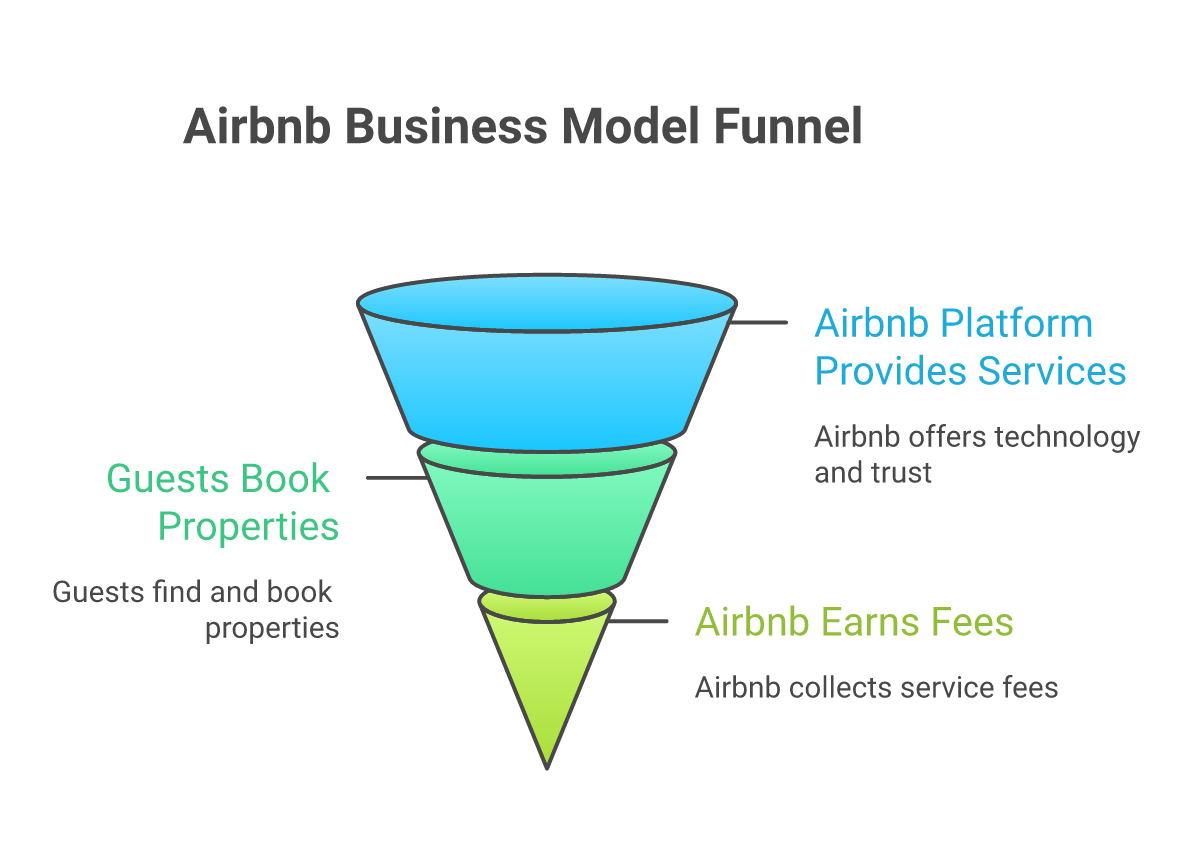
Airbnb earns revenue through service fees on each booking made through its platform. The fee structure shifted in December 2025 to a single host-only fee model. Three smaller revenue streams supplement the core service fee revenue.
Service Fees on Bookings (Primary Revenue Stream)
Since December 2025, Airbnb charges a 15.5% host-only service fee on the booking subtotal, deducted before payout to the host. The host-only fee model replaced the older split-fee model (where Airbnb charged the host approximately 3% and the guest 14% to 16% separately). The Airbnb service fees article in the Airbnb Help Center documents the current 15.5% structure.
Service fees account for the vast majority of Airbnb’s annual revenue. Airbnb reported $11.1 billion in revenue for fiscal year 2024 (per Airbnb’s 2024 10-K filing with the SEC), nearly all of which came from booking service fees.
Airbnb Experiences Fees
Airbnb Experiences are guided activities, classes, and tours offered by local hosts. Airbnb charges a 20% commission on each Experience booking, higher than the 15.5% short term rentals fee. The Experiences revenue stream is small relative to short term rentals but expanding.
Currency Conversion Fees
Guests booking in a currency other than the host’s local currency pay a small foreign exchange conversion fee. This is a minor revenue stream but contributes margin on cross-border bookings.
Co-Host Network Revenue Share
The Airbnb Co-Host Network, launched 2024, lets property owners hire co-hosts to manage their listings. Airbnb takes a small commission on revenue paid from owner to co-host. The Co-Host Network is structured to expand Airbnb’s supply by lowering the operational barrier for property owners who do not want to manage listings themselves.
Airbnb’s Business Model Canvas
The Business Model Canvas framework (developed by Alex Osterwalder) breaks any business model into nine building blocks. Applied to Airbnb, the canvas reveals how the platform creates value, captures revenue, and defends against competitors.
| Canvas block | Airbnb’s approach |
|---|---|
| Customer Segments | Hosts (property owners, rental arbitrage hosts, co-hosts, experience providers) and Guests (leisure travelers, business travelers, long-stay guests) |
| Value Propositions | For hosts: monetize unused space, reach global demand, payment processing, guest screening, insurance. For guests: unique stays at varied price points, local cultures, kitchens, longer stays at lower per-night cost than hotels |
| Channels | Airbnb.com website, iOS and Android apps, search engine traffic, paid social, brand marketing, partnerships |
| Customer Relationships | Two-sided self-service platform with 24/7 customer support, host community programs, Superhost status, review systems |
| Revenue Streams | 15.5% host service fee, Experiences commission (20%), Co-Host Network revenue share, currency conversion fees |
| Key Resources | The platform technology, the host and guest community (network effect), the brand, data and ML for pricing and matching, AirCover insurance program |
| Key Activities | Platform development, trust and safety operations, marketing and demand generation, host onboarding, regulatory and legal work |
| Key Partnerships | Payment processors, insurance underwriters, cleaning service providers, smart home device makers, professional photographers in major markets |
| Cost Structure | Marketing spend, R&D, customer support, trust and safety operations, payment processing fees, AirCover claims, legal and regulatory costs |
The key insight from the canvas: Airbnb is asset-light. It does not own the properties on its platform. Hosts provide the supply. This makes the Airbnb business model highly scalable. Adding a new listing costs Airbnb very little, but each new listing adds to the platform’s network effect.
The 4 Host Business Models You Can Run on Airbnb
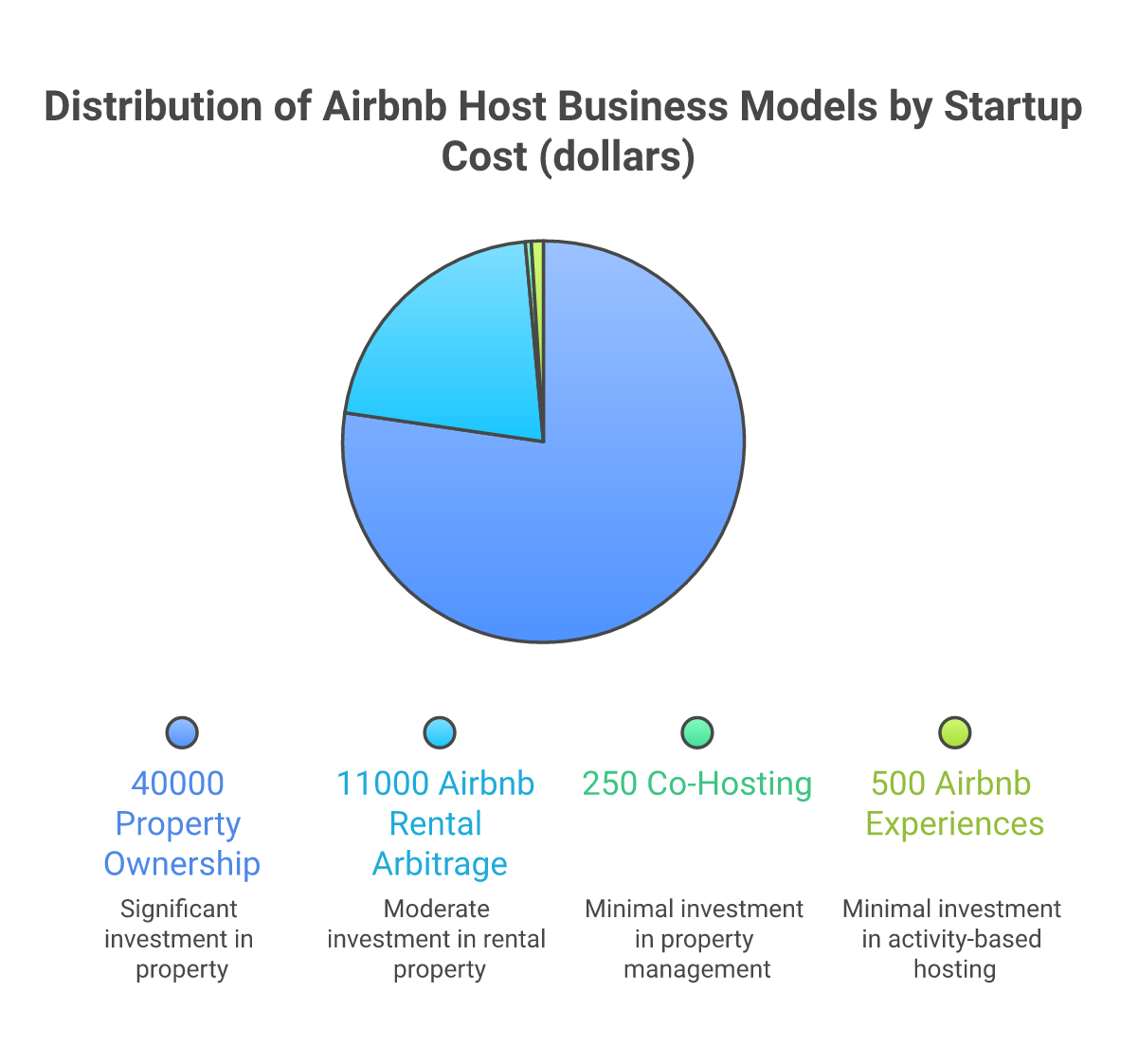
The Airbnb platform business model is one layer of the question. The other layer matters more if you want to earn income on Airbnb: which host business model should you operate? Four main host business models exist in 2026. Each varies in startup capital, monthly obligation, and risk. The lowest-capital entry point is rental arbitrage, covered in our guide to starting a rental arbitrage business.
Host Model 1: Property Ownership
You own the property and list it on Airbnb. The highest-startup-capital host business model. Down payment plus closing costs plus furnishing typically runs $40,000+ for a 1 to 2 bedroom unit. Monthly obligation includes mortgage payment, property tax, HOA fees, and operating costs.
The advantage of property ownership: you build long-term equity through mortgage paydown and appreciation. You qualify for depreciation tax benefits per IRS Tax Topic 415 on rental real estate. The disadvantage: capital requirements lock most aspiring hosts out for years.
Host Model 2: Airbnb Rental Arbitrage
You lease a property long-term from a property owner and re-list it on Airbnb. Startup capital runs $7,000 to $15,000 per unit. Monthly obligation is the fixed lease rent, paid whether bookings come in or not.
The advantage of airbnb rental arbitrage: low startup capital relative to property ownership, ability to scale quickly across multiple units, no long-term mortgage debt. The disadvantage: no equity buildup, landlord and regulatory dependency, and you carry the full lease obligation during void periods. For a deeper look at the arbitrage model, see our guide on what is Airbnb arbitrage.
For specific deal math, our free Airbnb arbitrage calculator projects monthly cash flow and net margin in under 60 seconds for any arbitrage scenario.
Host Model 3: Co-Hosting
You manage someone else’s property for a commission (typically 10% to 25% of gross revenue). No startup capital required beyond a laptop and software subscriptions. No monthly obligation. The Airbnb Co-Host Network (launched 2024) makes finding placements faster than ever.
The advantage of co-hosting: zero capital risk, fast cash flow, low overhead. The disadvantage: lower income ceiling per unit, dependency on the property owner, no equity buildup.
Host Model 4: Airbnb Experiences
You offer guided activities, tours, or classes instead of property bookings. Zero property cost. Airbnb takes a 20% commission instead of the standard 15.5% short term rentals fee. The Experiences host business model works best for hosts with niche local expertise (food tours, photography walks, surf lessons).
The advantage of Airbnb Experiences: lowest possible startup cost, scalable through repeat bookings, builds local audience. The disadvantage: lower per-booking revenue than property hosting, market still maturing in many cities.
Comparing the 4 Host Business Models
| Host model | Startup | Monthly obligation | Net profit / unit |
|---|---|---|---|
| Property ownership | $40,000+ | Mortgage + tax + HOA | $1,500 to $5,000 |
| Airbnb rental arbitrage | $7,000 to $15,000 | Fixed monthly rent | $1,000 to $3,000 |
| Co-hosting | $0 to $500 | None | $500 to $2,000 |
| Airbnb Experiences | $0 to $1,000 | None | $300 to $1,500 |
Most 10XBNB students start with co-hosting or airbnb rental arbitrage as their first host business model, then transition to property ownership once their cash flow allows. The skills compound. Every co-host learns market analysis. Every arbitrage host learns property management. By the time you buy your first property, you have already operated 2 to 6 short term rentals through other models.
Airbnb’s SWOT Analysis
Strengths
- Strong brand recognition. “Airbnb” is the default verb for short term rentals globally, similar to “Google” for search.
- Network effect. More listings attract more guests. More guests attract more hosts. The flywheel compounds with scale.
- Asset-light model. Airbnb does not own real estate, which keeps the platform business model capital-efficient.
- Trust infrastructure. Reviews, host verification, AirCover insurance, and 24/7 support reduce booking friction.
- Data and ML capabilities. Airbnb’s pricing recommendations, search ranking, and host matching are powered by years of platform data.
Weaknesses
- Regulatory exposure. Cities like New York, Barcelona, and Amsterdam have tightened short term rentals rules, shrinking Airbnb’s addressable market in some major destinations.
- Quality variance. Listing quality depends on individual hosts, which can damage trust when a high-profile stay goes wrong.
- Concentration risk. A small share of professional hosts operates a disproportionate share of listings, creating dependency on professional operators.
- Currency conversion friction. Foreign exchange complexity adds friction for cross-border bookings.
Opportunities
- Co-Host Network expansion. The 2024 Co-Host Network lowers the operational barrier for new property owners and expands supply.
- Experiences platform. Airbnb Experiences is a small but growing revenue stream with 20% commission (higher than the 15.5% short term rentals fee).
- Mid-term rentals. 30+ night stays for travel nurses, remote workers, and corporate relocations is a fast-growing segment with different regulatory exposure.
- AI-powered features. Better search, pricing, and matching through ML can increase booking conversion.
Threats
- Competition from Vrbo and Booking.com. Both are aggressive on commission and listing volume.
- Regulatory tightening. Local laws restricting short term rentals can shrink Airbnb’s addressable market overnight.
- Hotel industry response. Major hotel chains are launching their own home-share platforms.
- Macroeconomic risk. Travel demand is cyclical. A global recession reduces leisure travel spending.
How the Airbnb Business Model Compares to Hotels
The Airbnb business model and the hotel business model serve similar customer needs (lodging) but use very different operational models. The comparison reveals why both can coexist.
| Dimension | Airbnb business model | Hotel business model |
|---|---|---|
| Asset ownership | Asset-light (no property ownership) | Asset-heavy (real estate ownership or long-term leases) |
| Supply scaling | Fast (hosts add listings in hours) | Slow (years to build new properties) |
| Inventory consistency | Highly variable (each host different) | Highly consistent (brand standards) |
| Revenue per stay | Often higher (entire property, kitchen, longer stays) | Lower (per-room pricing) |
| Loyalty programs | Limited (Superhost program, no points) | Strong (Marriott Bonvoy, Hilton Honors) |
| Revenue model | Platform fee (15.5% host) | Direct nightly revenue + ancillary services |
The Airbnb business model wins on supply elasticity, price competitiveness for longer stays, and unique listings (treehouses, beach huts, design-forward apartments). Hotels win on brand consistency, business-traveler loyalty programs, and predictable on-site amenities. Both will continue to serve different segments of travel demand.
The Future of the Airbnb Business Model
Three strategic shifts are reshaping the Airbnb business model heading into 2026 and beyond.
1. Single host fee structure (December 2025). The shift to 15.5% host-only fees simplifies pricing for guests (no separate guest service fee) and shifts pricing competition to hosts. Per the Airbnb service fees Help Center article, this change is meant to reduce booking abandonment from sticker shock.
2. Co-Host Network growth. The 2024 Co-Host Network expands supply by letting more property owners list without operational burden. This is Airbnb’s response to regulatory pressure on professional rental arbitrage operators in some cities.
3. AI-driven matching and pricing. Airbnb’s Smart Pricing tool and recommendation algorithms increasingly use machine learning to optimize both guest discovery and host revenue. Expect continued AI investment as the platform business model evolves.
Frequently Asked Questions
What is Airbnb’s main source of revenue?
Service fees on bookings. Since December 2025, Airbnb charges a 15.5% host-only service fee on the booking subtotal. Service fees account for nearly all of Airbnb’s $11.1 billion in fiscal year 2024 revenue per Airbnb’s 10-K filing. Airbnb Experiences (20% commission), currency conversion fees, and Co-Host Network commissions contribute smaller revenue streams.
How does Airbnb make money without owning properties?
Airbnb operates a platform business model. It does not own the properties listed on its platform. Hosts provide the supply (their properties). Guests provide the demand (booking traffic). Airbnb provides the technology, trust, and discovery layers and earns a 15.5% service fee on each booking. This asset-light model is what makes the Airbnb business model so scalable.
What business model can I use to make money on Airbnb?
Four main host business models. Property ownership (highest startup capital, builds equity). Airbnb rental arbitrage (lease and re-list, $7K-$15K startup). Co-hosting (manage someone else’s property for 10-25% revenue, near-zero startup). Airbnb Experiences (offer activities instead of stays, near-zero startup). Most hosts start with co-hosting or rental arbitrage and transition to property ownership later.
Is the Airbnb business model still profitable for hosts in 2026?
Yes, when the host business model fits the market. Rental arbitrage hosts typically generate $1,000 to $3,000 monthly net profit per unit at 20% to 30% net margin. Property owners can clear $1,500 to $5,000 monthly per unit (excluding mortgage paydown). Co-hosts earn $500 to $2,000 per managed property. Profitability depends on market selection, occupancy, ADR, and operating efficiency.
What is Airbnb’s competitive advantage?
The network effect plus brand recognition plus trust infrastructure. More listings attract more guests. More guests attract more hosts. AirCover insurance, host verification, and the review system reduce friction. Competitors like Vrbo and Booking.com are aggressive but have not matched Airbnb’s brand recognition or network density in most markets.
What are the biggest risks to Airbnb’s business model?
Regulatory tightening (cities restricting short term rentals), competition from Vrbo and hotel chains, quality variance across hosts, and macroeconomic risk (travel demand is cyclical). Airbnb mitigates regulatory risk through proactive city partnerships and lobbying. Competition is managed through brand and network effect. Quality variance is managed through Superhost status and AirCover.
The Bottom Line on the Airbnb Business Model
The Airbnb business model is a two-sided marketplace that connects hosts with guests for short term rentals and experiences. Airbnb does not own the properties listed on its platform. It earns revenue through service fees on bookings (15.5% under the host-only fee model since December 2025) and smaller revenue streams from Experiences, currency conversion, and the Co-Host Network.
For hosts who want to earn income through the platform, four host business models exist. Each varies in startup capital, monthly obligation, and equity buildup. Most successful hosts start with co-hosting or airbnb rental arbitrage and transition to property ownership over time as their cash flow allows.
For the full launch playbook within the Airbnb business model, see our 14-step guide to starting an Airbnb business. For the deep dive on rental arbitrage as a host business model, see our rental arbitrage strategy guide. And to see how 10XBNB students operate within the Airbnb platform without owning property, our 2026 Airbnb course comparison ranks the programs that teach this model.