

Co-listing on Airbnb costs $0 to start and can generate $1,400 or more per property each month. Buying an investment property requires $50,000 to $150,000 upfront and might net you $500 a month after the mortgage, insurance, and maintenance. So which path actually builds more wealth?
Before you look for a shortcut like a verified Airbnb account for sale, understand why every listing is either a scam or a federal risk.
Once you start operating, ranking matters. See our vacation rental SEO guide covering both Google and Airbnb internal ranking.
The right operational stack is non-negotiable for co-listing. Start with our best channel manager for Airbnb and VRBO in 2026.
For a broader look at the category, compare the 6 best Airbnb co-hosting courses of 2026.
Before committing to any program, see documented outcomes in our honest take on whether 10XBNB is worth it, with 47 real student results.
I’ve watched over 1,600 students go through our program, and the answer depends on where you are right now, not where you want to be in ten years. The short version: co-listing is the fastest way to generate cash flow with zero capital, and that cash flow becomes the fuel for real estate investing later. They aren’t competing strategies. One feeds the other.
Here’s the full breakdown with real numbers.
What Is Co-Listing on Airbnb?
Co-listing means you manage someone else’s property on Airbnb. The property owner keeps ownership. You handle everything the guests need: creating the listing, setting pricing, managing bookings, coordinating cleaning, and handling guest communication from check-in through checkout. Airbnb added co-listing as an official platform feature in 2024, giving co-hosts direct access to the listing dashboard. If you’re new to the concept, our complete guide to Airbnb co-listing covers the fundamentals.
You earn a percentage of each booking. Most co-hosts charge between 15% and 25% of the rental income depending on whether they offer full-service management or just handle guest messaging and reviews. At full service, you’re running every part of the short-term rental operation while the property owner collects passive income without lifting a finger.
No mortgage. No down payment. No lease. No furniture to buy. Your startup cost is your time and a smartphone. That’s one of several reasons co-listing appeals to people who want to make money on Airbnb without owning property.
What Is Real Estate Investing? (The Full Picture)
Real estate investing covers a wide range of strategies, and most people only think about one of them. Here’s what falls under this umbrella:
- Buy-and-hold rental properties: Purchase a house or condo, rent it long-term on Zillow or Apartments.com, collect monthly rent. Requires a down payment (typically 20-25% for investment properties), a mortgage, insurance, and ongoing maintenance.
- Short-term rental ownership: Buy a property specifically to list on Airbnb or VRBO. Higher revenue potential than long-term rentals, but also higher operating costs (cleaning, furnishing, guest turnover, dynamic pricing management).
- Fix-and-flip: Buy undervalued properties, renovate them, sell for profit. Capital-intensive, high risk, and requires construction knowledge or a reliable contractor network.
- REITs (Real Estate Investment Trusts): Buy shares in companies that own commercial or residential real estate. Low barrier to entry ($100 minimum on many platforms), but you have zero control and returns average 8-12% annually.
- Syndications: Pool money with other investors to buy larger commercial properties. Typical minimum investment: $25,000 to $100,000. Passive but illiquid, with 5-7 year hold periods.
For this comparison, I’m focusing on the most common path: buying a rental property versus co-listing on Airbnb. That’s the decision most people are actually weighing.
The Math: Co-Listing Income vs Real Estate Returns
I get asked about this comparison constantly, so let me lay out the numbers the same way I explain it to our students. You can also run your own projections with our co-listing income calculator.
The Landlord (Traditional Real Estate Investor)
A landlord buys a property for $350,000 with 20% down ($70,000). They finance the remaining $280,000 at a 6.5% interest rate (the national average as of early 2026 per Freddie Mac). Their monthly mortgage payment is roughly $1,770.
They list the property as a long-term rental on Zillow for $2,200 per month. After the mortgage, property taxes ($290/mo), insurance ($150/mo), and a maintenance reserve (1% of property value annually, or $292/mo), they pocket about $422 a month in positive cash flow. That’s $5,064 a year on a $70,000 investment.
The cash-on-cash return: 7.2%. Not bad, but the landlord is also building equity through mortgage paydown and potential appreciation. If the property appreciates at the historical average of 3-4% annually, the total return including equity is closer to 12-15% per year.
The Co-Lister
A co-lister reaches out to that same landlord. The Zillow listing has been sitting empty for 20 days. The landlord is losing cash flow every day the property sits vacant. The co-lister proposes listing it on Airbnb at $175 per night.
At 75% occupancy (about 23 nights per month), the property generates $4,025 in gross revenue. The co-lister keeps 20% as their management fee: $805 per month from that single property. The property owner collects $3,220, which is $1,020 more than their Zillow asking price, and they don’t have to manage a single guest.
The co-lister invested $0. Their cash-on-cash return is technically infinite because the denominator is zero. For a deeper look at realistic earning ranges, see our breakdown of Airbnb co-host income.
Scale that to five properties at the same rate, and the co-lister earns $4,025 per month. Ten properties: $8,050 per month. Fifteen properties: $12,075 per month.
One of our students, Taslima, manages eight co-listed properties. Using conservative numbers, she earns over six figures annually. She started with zero capital and zero real estate experience.
Side-by-Side: 10 Factors That Matter
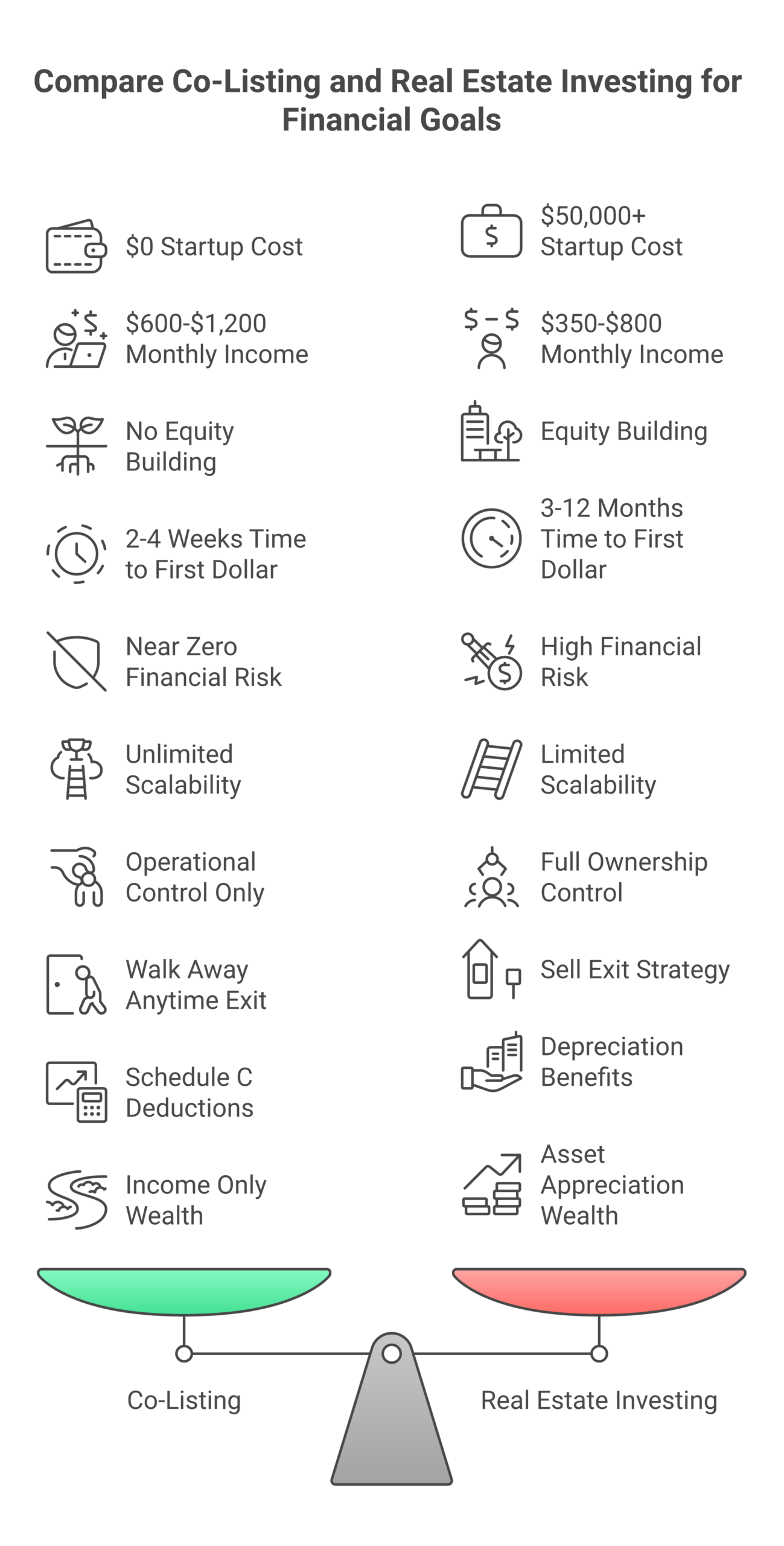
| Factor | Co-Listing | Real Estate Investing |
|---|---|---|
| Startup cost | $0 to $500 | $50,000 to $150,000+ |
| Monthly income per property | $600 to $1,200 (15-25% of revenue) | $350 to $800 after expenses (buy-and-hold) |
| Equity building | None | Yes (mortgage paydown + appreciation) |
| Time to first dollar | 2 to 4 weeks | 3 to 12 months |
| Financial risk | Near zero (no capital deployed) | High (market downturns, vacancies, repairs) |
| Scalability | Unlimited (add properties with no capital) | Limited by capital and lending capacity |
| Control | Operational control only | Full ownership control |
| Exit strategy | Walk away anytime | Sell property (6-12 months, 5-6% transaction costs) |
| Tax benefits | Standard business deductions (Schedule C) | Depreciation, 1031 exchange, cost segregation |
| Long-term wealth | Income only (no asset) | Asset appreciation + rental income |
5-Year Wealth Comparison: Co-Lister vs Investor
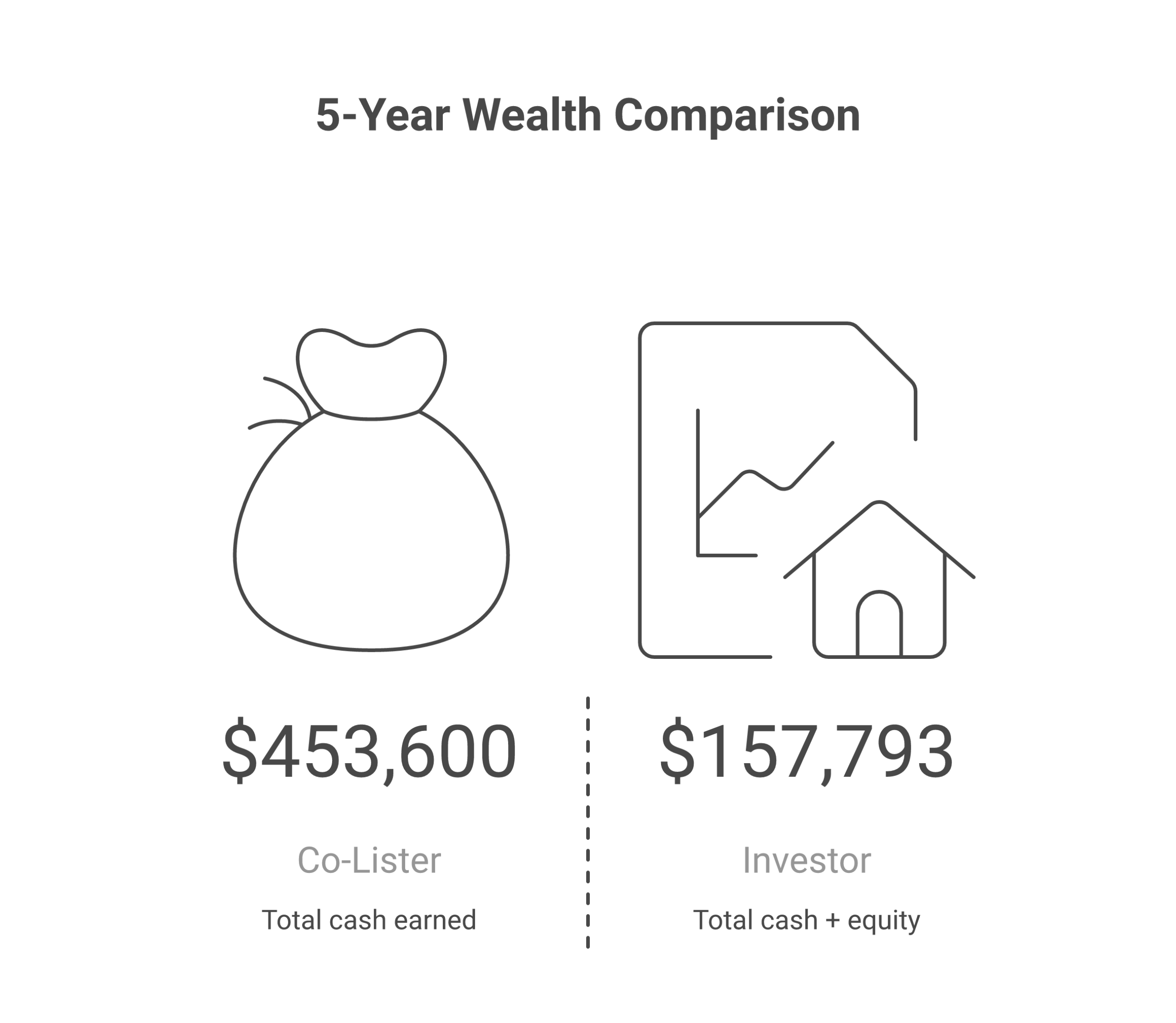
This is the comparison nobody else is making. Let me model both paths over five years with realistic assumptions.
Path A: The Co-Lister
Assumptions: Starts with 3 properties in month 1, adds 2 properties every 6 months, charges 20% management fee, average gross revenue per property is $3,500/month.
| Year | Properties Managed | Monthly Income | Annual Income | Cumulative Earnings |
|---|---|---|---|---|
| Year 1 | 3 to 5 | $2,100 to $3,500 | $33,600 | $33,600 |
| Year 2 | 7 to 9 | $4,900 to $6,300 | $67,200 | $100,800 |
| Year 3 | 11 to 13 | $7,700 to $9,100 | $100,800 | $201,600 |
| Year 4 | 13 to 15 | $9,100 to $10,500 | $117,600 | $319,200 |
| Year 5 | 15 to 17 | $10,500 to $11,900 | $134,400 | $453,600 |
Total cash earned over 5 years: $453,600
Equity built: $0
Assets owned: $0
Path B: The Real Estate Investor
Assumptions: Buys first property for $350,000 with $70,000 down in Year 1. Buys second property in Year 3 with another $70,000 down. 3.5% annual appreciation. Cash flow of $422/month per property (long-term rental).
| Year | Properties Owned | Monthly Cash Flow | Annual Cash Flow | Cumulative Cash + Equity |
|---|---|---|---|---|
| Year 1 | 1 | $422 | $5,064 | $5,064 + $17,850 equity |
| Year 2 | 1 | $422 | $5,064 | $10,128 + $36,324 equity |
| Year 3 | 2 | $844 | $10,128 | $20,256 + $73,898 equity |
| Year 4 | 2 | $844 | $10,128 | $30,384 + $95,247 equity |
| Year 5 | 2 | $844 | $10,128 | $40,512 + $117,281 equity |
Total cash earned over 5 years: $40,512
Equity built: ~$117,281 (mortgage paydown + appreciation)
Total capital deployed: $140,000 (two down payments)
Net position: $157,793 (cash + equity)
The Verdict
After five years, the co-lister has $453,600 in cash earned with zero risk and zero capital invested. The real estate investor has $157,793 in combined cash and equity, but they put $140,000 of their own money on the line to get there.
The investor has assets. The co-lister has liquidity. Both have value, but they solve different problems at different stages of life.
Risk Profile: What Can Go Wrong
Co-Listing Risks
- Property owner ends the agreement: You lose that income stream. Mitigate this by managing 10+ properties so no single owner represents more than 10% of your income.
- Seasonal demand drops: Bookings slow in off-peak months. Handle this with dynamic pricing and minimum-stay adjustments.
- Bad guest reviews: Your reputation affects all your listings. Deliver excellent service on every booking.
- Regulatory changes: Some cities restrict short-term rentals. Stay informed about local regulations in your market.
For a full analysis, read our Airbnb co-listing pros and cons breakdown.
Real Estate Investment Risks
- Market downturn: Property values can drop 10-20% in a recession. You’re underwater on the mortgage with no easy exit.
- Vacancy periods: Every month without a tenant costs you $2,000+ in mortgage, taxes, and insurance with zero income.
- Major repairs: A new roof ($8,000 to $15,000), HVAC system ($5,000 to $12,000), or foundation issue ($10,000+) can wipe out years of cash flow overnight.
- Interest rate risk: With the 30-year fixed rate averaging 6.5% in early 2026, financing costs eat into returns far more than they did when rates were 3%.
- Illiquidity: Selling a property takes 3 to 6 months and costs 5-6% in agent commissions and closing costs.
Time to First Dollar
This is the factor most people underestimate.
A co-lister can go from zero to first booking within 14 to 30 days. Find a property owner, sign an agreement, create the Airbnb listing, optimize the photos, set your pricing, and guests can book within the first week the listing goes live. Our students who follow the system consistently report reaching profitability within 90 days. 73% of our co-hosting students hit that benchmark.
A real estate investor? Finding the right property takes 1 to 3 months. Closing takes another 30 to 60 days. Renovations or furnishing (if doing short-term rentals) add 2 to 8 weeks. Finding a tenant or getting your first booking adds another 2 to 4 weeks. You’re looking at 4 to 8 months before your first dollar of rental income arrives, and you’ve already spent $50,000 to $150,000 to get there.
Tax Treatment: How Each Model Gets Taxed
This section matters more than most people realize, because it changes the effective income comparison.
Co-Listing Taxes
The IRS treats co-hosting income as self-employment income reported on Schedule C. You’ll owe self-employment tax (15.3% on the first $184,500 of net earnings in 2026) on top of your regular income tax rate. However, you can deduct business expenses: your phone, mileage to properties, software subscriptions, cleaning supplies, and a home office if you use one.
The effective tax rate on co-hosting income for someone in the 22% bracket: approximately 33-37% after self-employment tax. A co-lister earning $8,000 per month keeps roughly $5,200 to $5,360 after taxes.
Real Estate Investment Taxes
Long-term rental income goes on Schedule E as passive income. No self-employment tax. You can deduct mortgage interest, property taxes, insurance, repairs, and depreciation. Depreciation is the big one: you can write off the cost of the building (not land) over 27.5 years, which often creates a “paper loss” that offsets your rental income even when you’re cash-flow positive.
An investor collecting $4,344 per year in cash flow might show a taxable loss of $2,000 to $5,000 after depreciation. That loss can offset other income. When you sell, you can defer capital gains taxes through a 1031 exchange by rolling the proceeds into another investment property.
The tax advantages of owning real estate are significant. But they only matter if you have the capital to buy property in the first place.
The Progression Path: Co-Listing as Your Launchpad
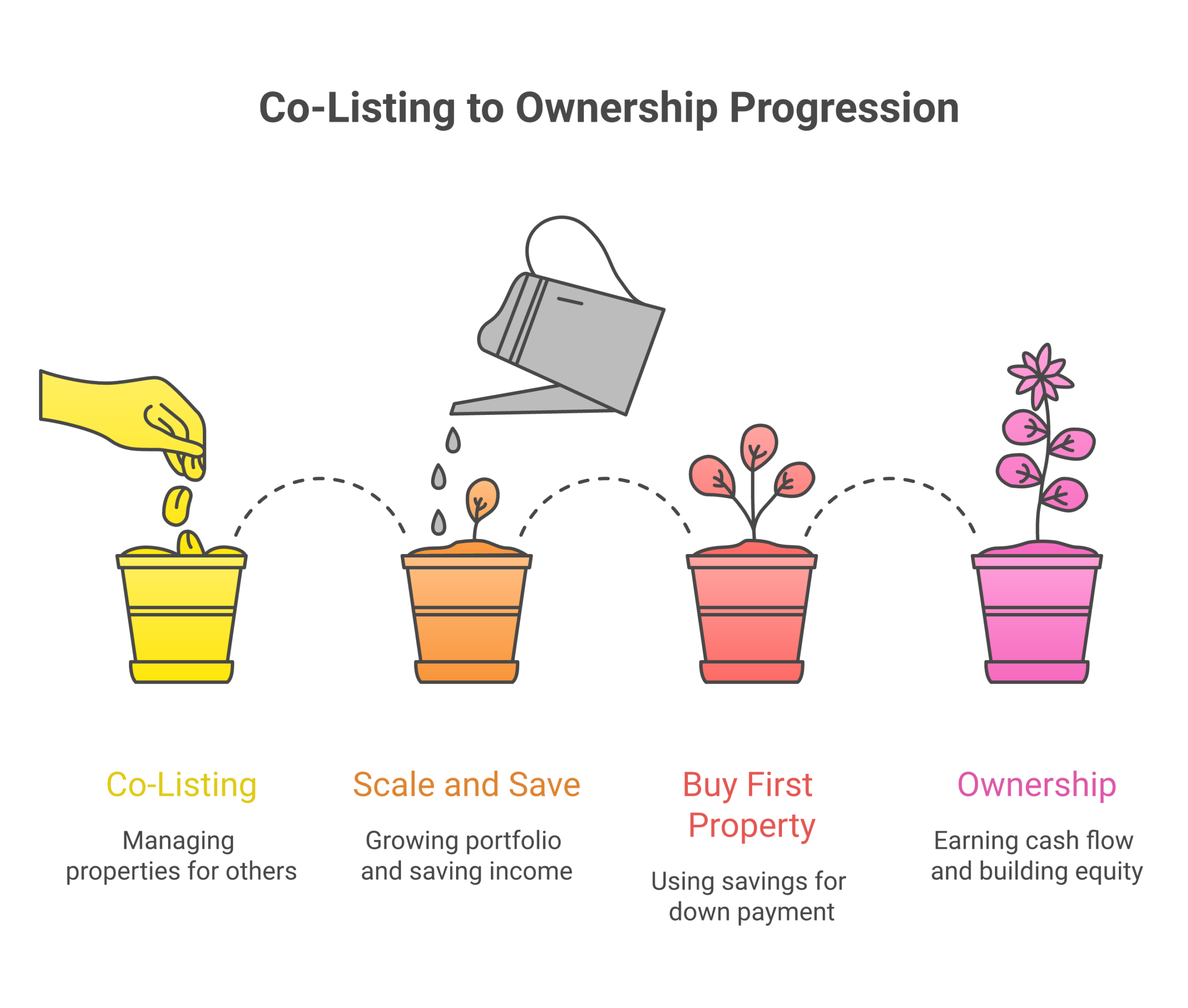
Here’s what I tell every student who asks me “should I co-list or invest in real estate?” The answer is: do both, in the right order.
Phase 1: Co-List (Months 1 to 12)
Start by co-listing 3 to 5 properties. Learn the short-term rental business from the inside: pricing strategy, guest management, cleaning coordination, how to handle guest communication, what makes a listing profitable. You’re getting paid to learn the business that you’ll eventually operate as an owner. Our Airbnb co-listing guide walks through the full process from finding owners to managing your first property.
During this phase, you’re also building capital. If you’re earning $4,000 to $6,000 per month from co-listing and saving 40% of it, you’ll have $19,200 to $28,800 set aside after 12 months.
Phase 2: Scale and Save (Months 12 to 24)
Grow your co-hosting portfolio to 10 to 15 properties. Monthly income: $7,000 to $10,500. Continue saving 30-40% of your co-hosting income. You now have $38,000 to $72,000 saved, plus 12 to 24 months of operational data showing you which markets, property types, and price points perform best as short-term rental properties.
You’re not guessing about where to buy. You have real booking data, real occupancy rates, and real revenue numbers from properties you’ve managed yourself.
Phase 3: Buy Your First Property (Month 24+)
Use your co-listing savings for a down payment on your first investment property. If you don’t qualify for a conventional mortgage based on W-2 income alone, a DSCR loan for Airbnb lets you qualify based on the property’s projected rental income instead. List it as a short-term rental on Airbnb, and manage it yourself since you already know how. Your co-listing income covers your living expenses while your property builds equity.
Now you have the best of both worlds: cash flow from co-listing AND equity from ownership. Most real estate investors never get this combination because they put every dollar into the down payment and have no income buffer.
Who Should Start With Co-Listing
- You have less than $20,000 in savings
- You want to test the short-term rental market before committing six figures
- You need cash flow within the next 30 to 60 days
- You’re new to real estate and want to learn the business without financial risk
- You want location flexibility (co-list from anywhere with a phone)
- You’re building capital for a future property purchase
If you’re leaning toward co-listing but want to compare it against other low-cost models first, see our breakdown of co-listing vs rental arbitrage.
Who Should Start With Real Estate Investing
- You already have $70,000+ in liquid capital that you can afford to lock up
- You have strong credit (720+ FICO) and qualify for investment property loans
- You understand your local real estate market deeply
- Your primary goal is long-term wealth building and you can wait 5 to 10 years for the full return
- You already have a stable income stream and don’t need cash flow immediately
- You’re comfortable managing property maintenance, vacancies, and repairs
2026 Market Reality: Why This Comparison Matters Now
Three factors make co-listing especially attractive in the current market:
Interest rates are still elevated. The 30-year fixed mortgage rate sits around 6.5% in early 2026, compared to 3% in 2021. That means buying a $350,000 investment property costs roughly $460 more per month in interest alone compared to four years ago. Higher financing costs squeeze cash flow on every deal, making the math harder for new investors.
Home prices haven’t corrected. The median existing-home sale price in the U.S. is $398,000 as of February 2026 according to the National Association of Realtors. A 20% down payment on a median-priced home is roughly $80,000 before closing costs. For first-time investors, that barrier keeps getting higher.
Short-term rental demand is growing. Airbnb reported Q4 2025 revenue growth of 12% year over year. U.S. short-term rental demand grew 7.0% in 2024 according to AirDNA, and the upward trend continues into 2026. Property owners are actively looking for co-hosts who can help them capture this demand, which means more opportunities for co-listers in high-demand markets.
The math that made buying a rental property a no-brainer in 2020 doesn’t work the same way in 2026. Co-listing lets you participate in the short-term rental market without absorbing that interest rate and affordability risk.
There’s also a supply-side advantage for co-listers right now. More property owners are sitting on homes they can’t sell at prices they want, and many landlords are open to the idea of earning more money through Airbnb if someone else handles the work. STR owners who tried managing their own listings but burned out on guest communication, cleaning schedules, and bad reviews are actively looking for co-hosts. The market conditions that make buying harder are the same conditions that make co-listing easier.
How to Get Started With Co-Listing Today
The co-hosting business model runs on relationships with property owners. Here’s the first step most people skip: find landlords who already have vacant properties listed on Zillow, Apartments.com, or Craigslist. These owners are losing money every day their property sits empty. You’re solving their problem by helping them list on Airbnb and managing the guest experience.
You don’t need a real estate license. You don’t need prior hospitality experience. You need a co-listing agreement (we provide a free template), an Airbnb account, and the willingness to deliver excellent service to every guest.
Your first property is the hardest to land. After that, referrals from satisfied property owners become your best client acquisition channel. Many successful co-hosts start with a single vacation rental property in their city, prove they can increase bookings and maintain high reviews, and get introduced to other owners in the same neighborhood.
Once you have systems in place, the daily time commitment drops to 30 to 60 minutes. Guest messaging, pricing adjustments, cleaning coordination, check-in instructions, and review management can all run from your phone. The hospitality side of the business (making sure guests have a great experience with clean spaces, stocked amenities, and fast communication) is what drives your reputation. A strong reputation on Airbnb means more bookings, higher occupancy, and property owners who stay with you long-term.
Some co-hosts operate as a one-person business managing 5 to 8 properties. Others build a small team and scale to 20 or more co-hosted properties, turning it into a full-service property management company. The model adapts to your goals. For more approaches, check out our guide on building Airbnb passive income.
Ready to start your first co-listing?
I put together a free training that walks through exactly how I find property owners, structure agreements, and scale to 10+ properties. Over 1,600 students have used this system to build their co-hosting business.
Frequently Asked Questions
Can you make a full-time income from co-listing on Airbnb?
Yes. Managing 8 to 12 properties at a 20% commission with average monthly revenue of $3,500 per property generates $5,600 to $8,400 per month. Many of our students treat co-hosting as their primary income source. The key is building a portfolio of properties in high-demand markets and delivering consistent guest experiences that earn five-star reviews.
Is co-listing safer than buying rental property?
From a financial risk perspective, yes. Co-listing requires no capital investment, so your maximum downside is the time you’ve invested. A property investor can lose their down payment if the market drops, face unexpected repair costs, or get stuck with a vacant property while still owing the mortgage. Co-listers can walk away from any property at any time with no financial penalty.
Do I need a real estate license to co-list properties?
In most states, no. Co-listing is classified as property management or hospitality services, not real estate brokerage. However, a few states have specific requirements for short-term rental managers, so check your local regulations. Airbnb’s co-hosting feature does not require any license to use.
How much do Airbnb co-hosts charge property owners?
The standard range is 15% to 25% of gross booking revenue. Full-service co-hosts who handle everything from listing creation to guest communication to cleaning coordination typically charge 20-25%. Co-hosts who only manage guest messaging and reviews charge 10-15%. See our complete breakdown of co-host fees for more details.
Can I co-list and invest in property at the same time?
Absolutely, and that’s what I recommend. Co-listing generates the cash flow and market knowledge you need to make smarter property investment decisions. Many of our students start with co-listing, save their earnings for a down payment, and buy their first property within 18 to 24 months, already knowing which markets and property types perform best because they have real booking data from their co-hosted properties.
What happens if a property owner cancels my co-listing agreement?
You lose that income stream, which is why diversification matters. Experienced co-hosts manage 10 to 20 properties so that losing any single property represents less than 10% of their total income. Most co-listing agreements include 30 to 60 day notice periods, giving you time to replace the property with a new owner.
How does rental arbitrage compare to co-listing?
With rental arbitrage, you sign a lease on a property and sublease it as a short-term rental. You keep all the profit above your lease payment, but you also carry the risk of the lease obligation. Co-listing has no lease, no upfront cost, and no financial risk, but your income per property is lower since you’re earning a percentage rather than the full margin.
The Bottom Line
Real estate investing builds generational wealth. Nobody debates that. But for someone stepping into this field for the first time, buying a $350,000 property with $70,000 down is a big bet to make when you’ve never managed a single booking.
Co-listing lets you earn while you learn. Zero capital at risk. Income within 30 days. And the operational knowledge you gain from managing short-term rental properties as a co-host makes you a better real estate investor when you’re ready to buy.
You’ll understand which markets have strong vacation rental demand. You’ll know what amenities guests actually care about (and which ones waste money). You’ll have real revenue data from properties you’ve managed, not projections from a spreadsheet. And you’ll have cash in the bank from your co-hosting business to fund your down payment.
The smartest path isn’t choosing one over the other. It’s starting with co-listing, building your portfolio of managed properties, scaling your income, and using those profits to fund your first property purchase from a position of strength.
Start building your Airbnb business with zero capital
Our free training shows you the exact system our students use to land their first co-listing property and start earning within 30 days. No down payment. No mortgage. No risk.
If you’re running this math because AI is coming for your day job, co-listing fits the same thesis from a different angle. Same market, same cash flow, far less capital. We broke down the full case for a hedge against AI job loss with three short-term rentals (with the 502K layoff data and the 24-month salary-replacement model).
This co-listing vs real estate investing framework also fits one more use case: the worker who’s already worried about AI displacement and wants a fast path to replacement income. We laid out a 90-day playbook for what to do if AI takes your job, including the task audit that tells you exactly how exposed your role really is.
Co-listing vs traditional real estate investing is one specific comparison. The broader comparison across every salary-replacement path (stocks, digital products, freelance, STR, and the corporate ladder) is broken down in the full comparison of how to replace a six-figure salary. STR wins the 4-of-5 columns test on post-tax math.
For the tech-worker-specific angle on co-listing vs traditional real estate, see the software engineer passive income ranking. It compares STR against micro SaaS, APIs, YouTube, and courses using post-tax numbers and AI-displacement risk.
If you’re weighing co-listing vs owned real estate and want the full operational, financing, and tax implementation playbook, read the detailed short term rental investment playbook for professionals.
Tech workers specifically evaluating co-listing vs owned real estate will find the tech-specific capital and regulatory angles in the tech-worker real estate side income guide.