
$1.9 million – that’s the crazy number our friends at Airbnb are talking about. And the wild part? Zero of those properties belong to me. Don’t even think about renting them though – I’ve got a secret to sharing the wealth.
So what exactly is this ‘co-listing’ thing? I get the keys from home or property owners, empty units get flipped into top notch Airbnb listings – and my cut is a sweet 20 to 25% of every guest booking. No mortgage, no lease, just pure execution.
My name is Shaun Ghavami. I ditched a $200k banking career at 33 to build a portfolio of 24 co-listed properties in my first year. And guess what? In 2022 I raked in over $1.9 million in gross revenue. Now, I’ve had over 1,600 hosts and students go through the 10XBNB program, and most of them started from scratch – literally from zero experience and zero capital and no owning required. As I told Inc. Magazine, “There are so many ways to get started with no money.” That’s the whole point of the co-listing model. Some had never even opened the Airbnb app before signing up.
If you’re in the market for a real Airbnb airbnb airbnb co host training course or training program that actually delivers, this page is where it’s at. Honest numbers, real student results – the whole 9 yards.
Before we get going though, can we just get one thing straight? Most ‘co-hosting guides’ out there tell you to purchase and sign up for Airbnb’s Co-Host Network and wait for leads to come to you. Yeah, okay – that’s one thing they get right. But they conveniently leave out the important bits – how to actually talk to home or property owners, structure your agreements, automate your operations and scale past 10 properties without losing your mind. All of that is what this page is about.
What is Co-Listing and Why Does it Trump Traditional Co-Hosting
Okay now, let me clear something up because people get these two mixed up all the time.
Traditional Airbnb co-hosting is basically just an assistant for an existing host. You get to answer messages, co-co-ordinate cleaning, deal with guest check-ins. It’s like having a fancy virtual assistant with a nice title. The host still calls the shots – and the co-host gets a small cut.
Now co-listing on the other hand is a whole different ball game.
When I co-list a home or property, I create the listing from scratch. Take the photos. Write the description. Set the pricing. And manage every guest interaction from start to finish. The owner just gets to sit back and cash their cheques. I built the co host co-listing model inside 10XBNB specifically for this: keeping full control over the business – with none of the financial risks of owning or leasing a home or property.
Here’s a quick rundown of the four main ways to make money on Airbnb:
| Model | Upfront Cost | Risk Level | Your Cut | Control |
|---|---|---|---|---|
| Property Ownership | $50K to $500K+ | High (mortgage, vacancy) | 100% after expenses | Full |
| Rental Arbitrage | $3K to $10K per unit | Medium (lease obligation) | Revenue minus rent | Full |
| Traditional Co-Hosting | $0 | Low | 10 to 15% | Limited |
| Co-Listing (10XBNB Model) | $0 | Low | 20 to 25% | Full |
See the difference? Co-listing is like having the control of ownership – with the risk profile of co-hosting. The perfect sweet spot. Exactly what I teach inside the 10XBNB co-listing program.
How I Built a $1.9 Million Co-Listing Business with Zero Money Down
Now, let me give it to you straight – the polished version makes it sound easier than it was.
My first Airbnb was a $65 a night spare bedroom. I slept in the smallest room in my apartment and shared the bathroom with guests. Honestly, it was pretty cringe-worthy at times. But it worked, and it taught me this one thing: the actual hosting part of it – taking good photos, writing a good description, pricing the unit right, being responsive to guests – its all learnable skills. The problem is getting the keys to the properties in the first place.
And that was where I got stuck for months.
Eventually I got a manage and handle on it. I came up with a pitch that I started using on landlords and hosts and property managers who had vacant units. Here’s what it looked like:
“Listen, your property’s been sitting empty for 28 days – you could be making double or triple what you’re getting in long-term rent. I’ll manage and handle everything – set it all up, manage every guest, deal with every problem. You don’t lift a finger. I take 20%.”
That pitch landed my first co host client through co-listing. Then my second. Then my fifth. Within 18 months enough properties were generating revenue that quitting the banking job started to make sense. $175,000 a month in gross guest bookings across my portfolio at that point. To be honest though, it wasn’t exactly a heroic ‘I quit’ moment. It was more like a panic attack in a Goldman conference room – and I suddenly thought, “Hey, answering 3 AM guest messages sounds a whole lot better than sitting through another quarterly review”. That was my sign.
Here’s the 5 year timeline:* Year 1: Started with my own spare room, charging $65 a night. Got to know the Airbnb platform inside and out, and managed to land 3 clients who let me co-list their properties
- Year 2: Expanding to 8 properties, I started automating things like messaging, cleaning and pricing. Still working at my banking job full time (managing and running on about 4 hours sleep a night, which is bloody crazy)
- Year 3: Had 15 properties on the go. Revenue started crossing $80K a month, so I finally quit my banking job and went full time
- Year 4: Grew to 24 properties. Hired my first two team members and built systems for pretty much everything
- Year 5: Made a cool $1.9 million and started 10XBNB to teach other people the system. Even managed to buy my parents a house using the income from co-listing
That last milestone still gets me, though. Growing up, my dad worked double shifts at a restaurant six days a week. When I handed him those keys, I ugly-cried in the driveway for a good 15 minutes. Just thinking about the freedom to be able to take care of the people who took care of me gets me every time. That’s what it’s all about.
Anyway, back to the nitty gritty.
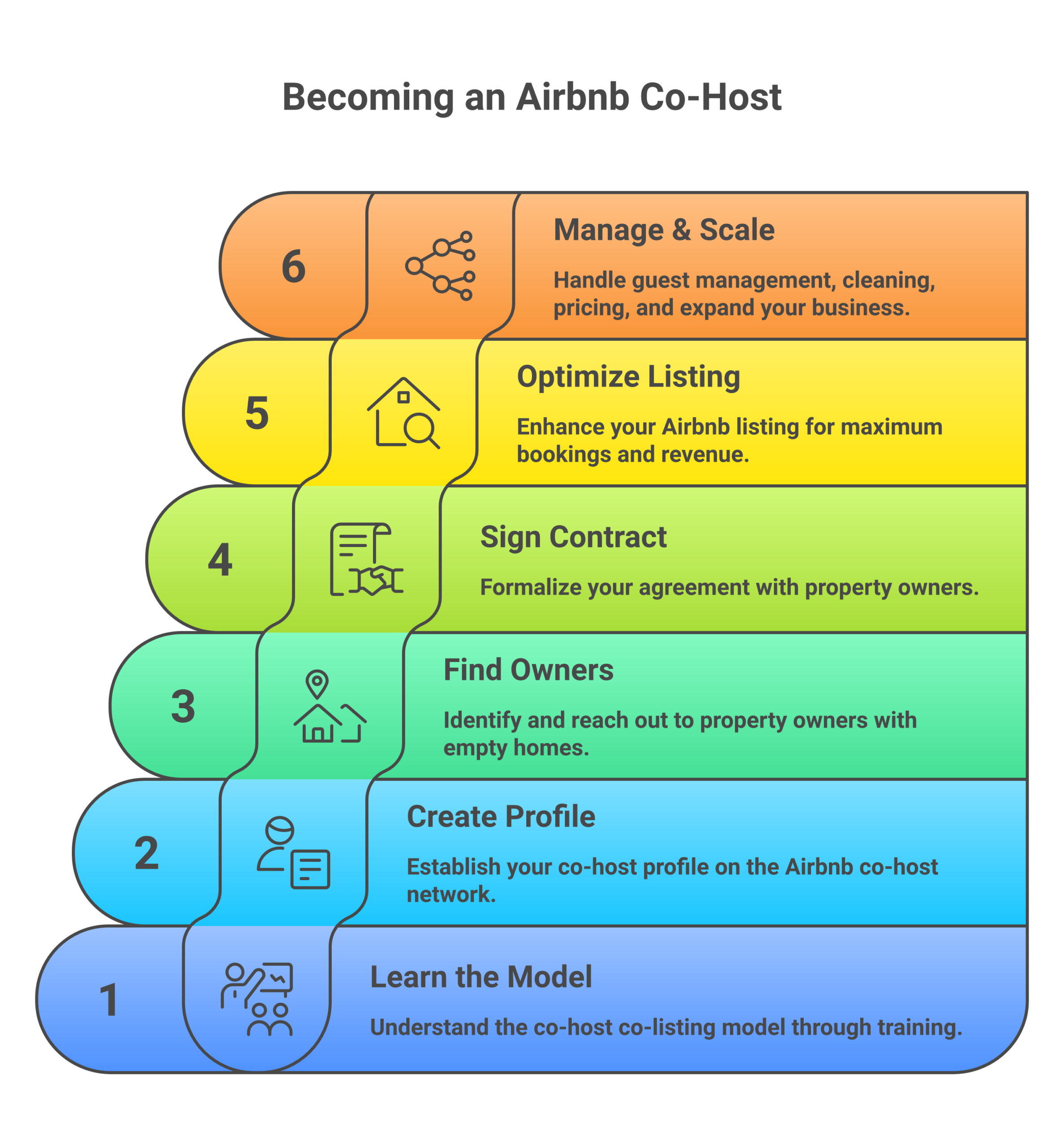
The 5-Step System to Land Your First Co-Listing Client
Most Airbnb courses will gloss over this part and tell you how to set up a listing, but getting that property to list in the first place is a whole different ball game. And that’s where the real money is.
Step 1: Pick Your Target Market
Start by looking at your local area, within a 30 minute drive or so of where you live. The reason for this is that early on you’ll need to be able to manage and handle problems in person. Take a look at the data from AirDNA or Mashvisor in your area. You’re looking for markets where the average daily rate is over $100 and the occupancy rate is between 50 and 70%. That gap is your window of opportunity. The bigger it is, the more room you’ve got to work with and the more chance you have of proving your value.
Step 2: Build a “Property Owner Hit List”
A lot of people make a big deal about this, but in reality it’s pretty simple. You just need to find property owners with vacant or underperforming properties. Here’s where to look:
- Zillow and Realtor.com – filter for “for rent” listings that have been sitting vacant for 30 days or more
- Craigslist rental listings with dodgy photos
- Facebook Marketplace – rentals with zero engagement are usually a good bet
- Local property management companies – they’re often overwhelmed and might be open to a partnership
- Real estate investor meetups and Facebook groups – these are a good place to start making connections
Airbnb’s Co-Host Network – this has just launched in a bunch of countries, including the US, and it connects property owners with successful co-hosts
Don’t get too hung up on this bit – aim for 50 potential targets in the first week. Sounds crazy, I know, but it’s a numbers game and most of those 50 will say no or ignore you. But one or two yeses will get you off the ground, and momentum is way more important than being perfect.
Step 3: Make the Pitch
Now, here’s what you’re probably worried about.
“Do I have to have loads of experience to do this? Why would anyone trust me with their property?”
Fair point. But here’s the thing – these owners have properties that are sitting empty, bleeding money every day that unit goes unbooked. When you frame yourself as the person who can fix that, at zero cost to them, the conversation changes completely.
Inside 10XBNB, we teach a simple pitch framework that works:
Start with their pain: “I noticed your property at [address] has been listed for [X] days. That adds up to [X] months of lost income”
Sell them on the opportunity: “Properties like yours in [area] are averaging [X] per night on Airbnb, which comes to [X] per month, or [X]% more than long-term rent”
Take away the risk: “I’ll manage and handle everything – setup, photos, guest communication, cleaning, maintenance coordination. Zero up-front cost to you. My commission is 20% of guest bookings”
Provide some proof: “Here’s what I’ve done with similar properties” (show them screenshots, testimonials or data)
Even without any properties under management, this pitch works. Just use some market data from AirDNA, create a mock listing with some decent photos, and show them what their property could look like on Airbnb. My first landlord said yes on the second call – and I had no track record at all.
Step 4: Close the Agreement
Once the owner says yes to working with you, get it in writing ASAP. A co-listing agreement should cover the basics:
- Commission percentage (20-25% is standard)
- Who pays for what (cleaning fees, supplies, maintenance thresholds)
- Minimum contract length (6 months to prove the concept)
- Cancellation terms (30 day notice from either party)
- Insurance requirements (the owner keeps their property insurance, you keep liability coverage)
Property access and key management.Inside 10XBNB, hosts and students get a proven template they use to nail down co-listing deals with hundreds of other property owners. It works for everyone involved.
Step 5: Launch and Optimize the Listing
Now we get to the part where you put your new hosting skills into action. Got your keys and your property is ready – time to turn it into a 5-star listing:
You’re gonna need some professional quality photos (I spent $150 on a photographer the first time and it was well worth it)
A title that includes the city name and some of the key ‘wow’ features of the place
A description that sells the experience you have to offer, not just the square footage of the place
Dynamic pricing through PriceLabs (it adjusts the price of your place daily based on how much people are looking, what’s going on in the local area, and the season)
Some sort of automated messaging system for confirming guest bookings, sending out guest check-in instructions and follow-up on those reviews from guests
A reliable cleaning team – they’re probably the most important hire you can make. Hands down
First 30 days: focus on getting those 5-star guest reviews in, and price aggressively if that means making some of the first few guest bookings cheap. A few reviews will purchase and pay for themselves ten times over. Trust me on this one.
What You’ll Actually Do as a Co-Lister (Day-to-Day Operations)
People always ask “What’s a typical day like for you?” So here’s what it’s really like. Running 24 properties, my daily routine probably took about 2 hours.
Morning Routine (30 minutes)
Check in with any messages from overnight guests
Have a quick look at who’s checking in and out today
Just make sure the cleaning crews are on schedule
Midday Break (15 minutes)
Just a quick scan to see if we need to adjust pricing for any gaps in bookings coming up
Check for any booking inquiries and get back to people ASAP
Evening Routine (15 minutes)
Send out the guest check-in instructions to anyone arriving tomorrow
Follow up on any maintenance issues that came up during the day
Weekly Wrap-Up (1 hour)
Take a look at how much revenue we made from all the properties
Decide if we need to adjust our pricing strategy for the next week
Get in touch with the property owners (we do a monthly report on how much they’re making)
Two hours a day, maybe a bit more on weekends when we get a lot of properties coming and going. Rest of the time? Mine. Off to the gym in the morning, some work on the business in the afternoon, and the family in the evening. That’s what this business looks like when it’s all managing and running smoothly.
And the 2-hour thing only works because I set up some systems. Automated messaging for guests through Hospitable, PriceLabs for adjusting the prices, cleaning teams that can schedule themselves. I put in the work upfront, set up the machine and now it pretty much runs itself. That’s what the 10XBNB mentorship program covers by the way.
How Much Money Can You Make? Some Real Numbers from Real Students
First things first, let’s talk math, then we’ll get some real numbers to back it up. It’s totally reasonable to be a bit skeptical here, but real numbers get rid of skepticism pretty fast.
Revenue Math for Co-Listing
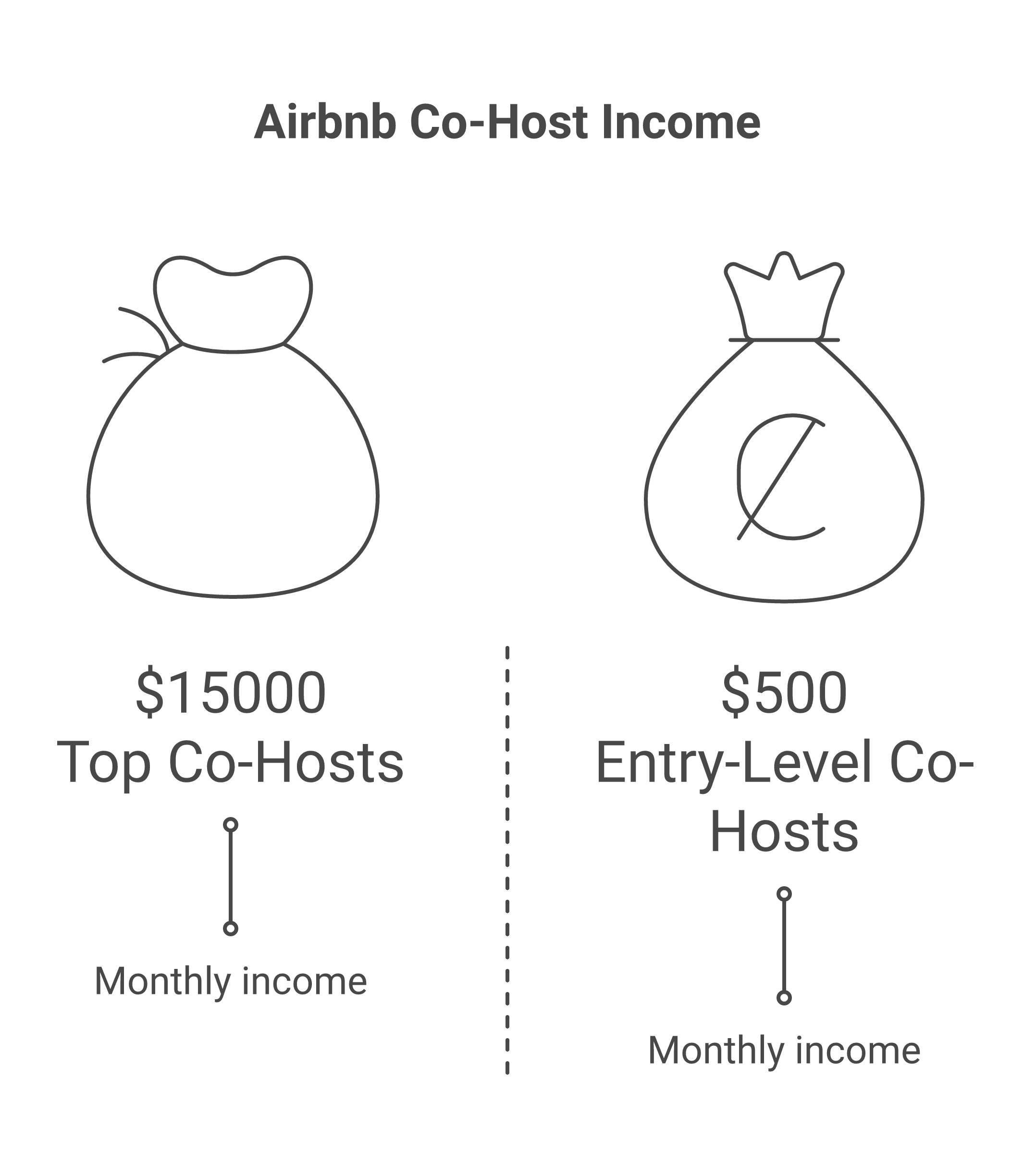
Let’s say you co-list a property that’s earning $3,000 in gross bookings each month – that’s roughly what you’d expect from an Airbnb property charging $100 a night with 50% occupancy (which is pretty much in line with what AirDNA says is average in the US). At a 20% commission, that’s a $600 a month income just from one property. Which isn’t going to change your life on its own. But add a few more to the mix and it starts to add up.
| Properties | Gross Monthly Revenue | Your 20% Commission | Annualized Income |
|---|---|---|---|
| 1 property | $3,000 | $600 | $7,200 per year |
| 5 properties | $15,000 | $3,000 | $36,000 per year |
| 10 properties | $30,000 | $6,000 | $72,000 per year |
| 20 properties | $60,000 | $12,000 | $144,000 per year |
My own portfolio, which is all about picking strong markets and obsessing over the pricing, averaged a lot higher than $3,000 per month – up to $6K or $8K in some cases.
Real Student Results
I’m getting a bit carried away with my own numbers, so here are the real deal from some of the hosts and students that went through 10XBNB:
John (Vancouver, Canada): Got 4 co host client through co-listings in his first 90 days. Made $50,000 in his first three months. Was working full time in construction when he started and now runs this business full time.
Javon (Arizona): Zero Airbnb experience. Picked up two properties within 6 weeks of joining 10XBNB, using the same exact pitch we use today
Gian Marco (Florida): Comes from a hospitality background, applied the 10XBNB system to co-listing and managed to scale to 8 properties within his first year
Cindy (Seattle): Single mom, started this as a side hustle and now manages 6 properties
Robert (California): Retired from the military, wanted a second income stream, and used the co host co-listing model to build a second income – now managing 12 properties in San DiegoEvery single one of these people started from exactly the same place you are now.
Co-listing vs Rental Arbitrage vs Property Ownership
I get asked this all the time : “Shaun, should I be co-listing or doing rental arbitrage.? To be honest my answer might just surprise the heck out of you
Rental arbitrage is where you sign a lease on a property for a long time, then list it on Airbnb and pocket the difference between what you pay in rent and what you get from nightly bookings. Yeah, it can be super profitable. But its got real financial risk. If bookings dry up because of a pandemic or slow season, that lease payment is still due. And guess what? It’s due every month. Without fail.
Co-listing totally eliminates that risk.
Don’t sign a lease, don’t owe rent. Worst case, a property doesn’t do as well as you hoped? You just lose a bit of commission that month. No debt. No sleepless nights worrying about how to pay for rent on a property you don’t even live in.
That’s why co-listing is a great place to start if you’re new to short term rentals. Build up some cash flow and get some experience first. Once your co host business is making sense and the money is rolling in, then you can use that to fund rental arbitrage deals – or even buy a property. And the best part is, starting with co-listing means you can learn the game without risking any real money.
Quick lowdown for someone starting from scratch:
Comparison of Options
| Factor | Co-listing | Rental Arbitrage | Property Ownership |
|---|---|---|---|
| Startup cost | $0 | $3K to $10K per unit | $50K to $500K+ |
| Monthly obligation | None | Lease payment (fixed) | Mortgage + taxes + insurance |
| Downside risk | Earn less commission | Personal liability on lease | Foreclosure, market decline |
| Income per property | 20 to 25% of revenue | Revenue minus rent (variable) | 100% of profit after expenses |
| Speed to first dollar | 2 to 6 weeks | 4 to 8 weeks | 3 to 12 months |
| Scalability | High (no capital needed) | Medium (capital-limited) | Low (capital-intensive) |
| Best for | Beginners, side hustlers | Experienced hosts with capital | Investors with deep pockets |
Tools and Systems Every Co-Lister Needs
In the early days everything was done by hand. Sending messages to guests at 2 AM from my phone, updating a spreadsheet for cleaning schedules, manually adjusting prices every morning before work. Do that at 1 or 2 properties and its manageable. But when you hit 10 properties? Burnout sets in fast. Trust me, I know.
Tools we use and recommend to every 10XBNB student:
PriceLabs: Dynamically adjust your nightly rates based on local demand, events, day of the week, seasonality, and what your competitors are asking. I’d say this alone can increase revenue by 15 to 30%
Hospitable (formerly Smartbnb): automate all the guest messaging. Sends booking confirmations, check-in instructions, check-ins mid-stay and review requests all on auto-pilot
Turno (formerly TurnoverBnB): connects with local cleaning teams and auto-schedules turnovers based on your Airbnb calendar
Breezeway or Properly: track your property inspections and maintenance with ease
QuickBooks or Wave: you need some kind of accounting and expense tracking for tax time
Google Sheets: still use a simple spreadsheet to track owner payouts, property performance & KPIs. No need to get fancy here.
A good camera, or hire a photographer: Honestly, professional photos are the single biggest factor in getting bookings. No argument here.
These tools cost around $100 to $200 per month depending on how many properties you have. A fraction of the extra revenue they’re bringing in.
One thing to keep in mind (and this matters way more than most people realize): don’t try to build out some crazy custom tech stack right from the get-go. PriceLabs and Hospitable first, please. Those two save you 5 to 10 hours a week per property. Add the rest in once you hit 5 properties. By 10 properties, the whole stack is non-negotiable, but at 1 to 3? Keep it super simple. The best system is the one that actually gets used consistently.
Oh, and don’t forget about Airbnb’s built in host dashboard. A lot of new co-listers forget it gives you occupancy data, revenue tracking, and review management for free. Check your performance metrics once a week. Compare your occupancy and average nightly rate to the market average. If you’re underperforming? More often than not its either pricing or photos. More often than not.
How to Scale from 1 to 10+ Properties
Getting that first property up is the hardest part.
Once the first listing goes live & that first 5 star review comes in, something just clicks. Wait, actually thats not right. What really happens is you spend two weeks checking the Airbnb app every 45 minutes waiting for a booking, convinced it will never happen, and then suddenly three reservations come in on the same Tuesday afternoon and suddenly its real. Then the question shifts from “can I do this?” to “how fast can I grow?”So Here’s the proof of concept. From 1 to 5 properties you’ve got the concept down – it’s time for systems and people to kick in though. Here’s the lowdown on what you can expect inside 10XBNB:
Days 1 to 30: Foundation
You’re going to need to figure out which market you want to target, obviously
Build yourself a list of potential owner targets (50 names as a bare minimum)
Get your pitch deck or one-pager sorted out
Start trying to get in contact with people (aim for at least 10 new contacts a day)
Land and launch your first property
Kick off with an incredibly aggressive pricing strategy to get reviews rolling in ASAP
Days 31 to 60: Steady Gains
Time to go back and fine-tune your first listing based on what your guests are saying
Keep pitching, even if you’ve managed to get one owner on board – you still need to keep working the network
Land your second and third properties
Get set up with some tools to automate pricing and messaging – think PriceLabs and Hospitable
Build a cleaning team from the ground up (interview 3 to 5 cleaners and give each one a test run before deciding which ones stick)
Days 61 to 90: Stepping Up a Gear
By now you should be managing 3 to 5 properties – that’s where the real proof of concept comes in
Get an owner report template sorted (you want to be sending monthly revenue updates to your owners to build that trust)
Start asking for referrals from owners who are already happy with your service ( simple as “do you know anyone else who might benefit from this?”)
Figure out: is the market working? Are the properties performing? If the answer is yes, you can double down. If not, it’s time to adjust.
Beyond 90 Days: Let’s Scale Things Up!
Once you’ve proven the model, it’s time to start scaling. Every new property is basically the same: pitch, sign, photograph, list, optimise , automate. Once you hit 8 to 10 properties, it’s time to bring on some help – a part-time operations coordinator can start handling day to day stuff and leave you to focus on finding new business.
Full disclosure: I didn’t actually bring anyone in until we’d got to property 12.. probably should have done it at property 8.
And here’s what really surprised me when we hit scaling mode: it actually gets easier. I mean, this seems weird but it makes sense. Every new property is following the same system you’ve set up, so you’re not re-inventing the wheel every time. And owner referrals get warmer and warmer as you go along – it’s like they’re starting to get the word out for you. By the time you get up to 20 properties, you’re getting half your new clients from existing owners sending over their investor friends, saying “you need to talk to Shaun”. No marketing spend, no cold outreach – that’s what happens when you treat owners like partners.
Common Mistakes That’ll Kill Your New Co-Lister Business
Over 1600 hosts and students have gone through this program. Some nail it in 60 days, some struggle for months. Almost every single time though, the difference comes down to one of these 7 mistakes. I made most of them myself, so I guess you could say I’m saving you the pain.
1. Waiting around to feel ‘ready’ before pitching. Newsflash: ready never actually comes. Just make 10 calls this week. Seriously.
2. Pricing too low out of fear. New co-listers often end up setting rates 30 to 40% below market because they’re just too scared to charge what they’re worth. Bad move. Get some data-driven pricing going with tools like PriceLabs, and trust the numbers not your own anxiety.
3. Skipping the contract. Partnerships go to pieces without a written agreement. A handshake deal is just fine till someone has a claim for $2000 in damages and then nobody knows who’s on the hook. Get it in writing.
4. Hiring cheap cleaners. Cleaners are the only people who are touching your product between every guest. A bad one will trash your reviews faster than anything else. Pay for quality. Inspect regularly. No second chances.
5. Numbskulls the owner relationship. Send them a monthly report, share the good reviews, flag up any issues before they become problems. Owners who trust you will refer their friends, real estate agents, hosts and property managers. That’s organic scaling, no marketing spend needed.
6. Trying to do everything manually. Copy-pasting the same check in instructions to every guest wastes hours of your week. Automate now, for goodness sake.
7. Flying blind on numbers. Quick test: can you name your occupancy rate, average daily rate and revenue per property off the top of your head? If not, that’s a problem. Track everything. Review it weekly.
What 10XBNB Airbnb Co-Host Training Actually Does (no hype, honest)
Okay, I’m biased, I built the thing. Here’s what I can tell you, though: this program exists because nothing like it existed when I started out. I looked.
Every other airbnb airbnb airbnb co host training course I saw was either all surface level (“just list on Airbnb and money will roll in”) or focused entirely on rental arbitrage, with zero mention of co-listing as a standalone model. Nobody had a structured, step by step way of showing you how it was done. So building what I wished I’d had three years earlier became the project.
What’s inside the 10XBNB program:* **Co-Listing Blueprint: My exact system for pitching owners, signing deals, and launching listings – the same process that landed me a 24 property portfolio in no time
Live Weekly Coaching: I’m on calls with hosts and students every week. We tackle questions, I give feedback on listings, and we troubleshoot in real-time together – not some pre-recorded video you watch by yourself at midnight
Property Finder System: A step-by-step method for finding underperforming properties in any market and turning cold outreach into signed partnerships
Listing Optimization Masterclass: We go over the ideal descriptions, photos, pricing strategy that maximizes guest bookings and revenue
Automation Stack: Complete setup guides for PriceLabs, Hospitable, and Turno so managing and running 10+ properties takes only 2 hours a day
Agreement Templates: Legally-reviewed co-listing agreements ready to customize to your needs
Community of 1600+ Students: A private group for sharing wins, asking questions, and making connections with other co-listers
Want to know more about what’s involved in co host co-listing income and whether this training is right for what you want to build? The best next step is to book a free strategy call with us.
Also, a bit of a disclaimer – this isn’t for everyone. If you’re looking to just watch videos and have money magically appear, this isn’t the place for you. Co-listing is a real business that requires real conversations with real property owners and real follow-through when things get tough (because they will, especially at the start) . What I can tell you is the numbers work for those who put in the work. I went from a spare bedroom at $65 a night to $1.9 million in annual revenue. My hosts and students are building five and six figure co host and co-listing businesses all over the US and Canada right now. The model works. Only question is: are you up for doing the work?
What’s Included When You Purchase the 10XBNB Airbnb Co Hosting Course for Airbnb Hosts
A lot of airbnb co host training programs out there sell you a bunch of pre-recorded video lessons and call it a day. That’s not what we do. When you purchase the 10XBNB airbnb co host training course, here’s what’s actually included in each package:
The Lessons and Curriculum
The 10XBNB curriculum is broken down into structured lessons that take you from zero to running a profitable co listing business. The core lessons included cover: how to find property owners with vacant properties using our proven outreach methods, how to pitch landlords and close co listing deals (we give you the exact scripts), how to set up your first Airbnb listing from scratch including photography and description writing, how to manage guests and handle every scenario from difficult check-ins to property damage, how to set up dynamic pricing so your listings earn maximum revenue for property owners, and how to scale from 1 to 10+ co host managed and co listed properties using automation and systems.
The lessons are designed so you can work through them at your own pace. Most hosts and students complete the core curriculum lessons in 2 to 3 weeks depending on how much time they put in each day. But the real learning happens on the live co host coaching calls where you can bring your specific situations to me and Ari and get real-time guidance that no pre-recorded lessons can provide.
Templates, Contracts, and Tools Included
Every template and contract you need to run a airbnb co host business is included when you purchase the co host program. Here’s what’s included:
Co hosting contract template: A professionally drafted co host agreement you can customize for each property owner. This contract covers payment terms, services provided, property damage liability, insurance requirements, termination clauses, and the commission structure. You don’t need to hire a lawyer to create your own contract from scratch because this template is included and it’s the same one we use across our own portfolio.
Landlord pitch templates: Email and phone scripts for reaching out to property owners. These templates have been tested by over 1,600 hosts and students and refined based on what actually gets landlords to respond and agree to a co listing partnership. The pitch templates included cover cold outreach to Craigslist listings, warm referral approaches, and follow-up sequences.
Listing optimization templates: Templates for writing Airbnb listing titles, descriptions, house rules, and check-in instructions that convert browsers into bookings. These templates are based on what we use across our own 24 co host managed and co listed properties and what’s proven to work for our students’ listings.
Guest communication templates: Pre-written message templates for every stage of the guest experience: booking confirmation, pre-arrival instructions, check-in details, mid-stay check-in, checkout reminders, and review requests. These templates automate 90% of your guest communication so you can manage multiple properties without spending hours on messages every day.
Financial tracking tools: Spreadsheets and calculators included for tracking revenue, expenses, profit margins, and payments to property owners across your entire co host portfolio. Keeping clean financial records from day one is essential for managing your airbnb co host business properly and for tax purposes.
Live Coaching and Community Access Included
This is where 10XBNB is fundamentally different from every other airbnb co hosting course on the market. The live weekly coaching calls with me and Ari are included in every package we offer. You’re not just purchasing access to lessons and templates. You’re purchasing direct access to two co hosts who manage 24+ properties and have helped over 1,600 students build their own co listing businesses.
On these calls, students bring their specific challenges – how to handle a difficult property owner, how to price a new listing in an unfamiliar market, what to do when a guest causes property damage, how to negotiate better contract terms with landlords. We give real-time answers because we’re dealing with the same situations every week across our own portfolio.
The private student community is also included. This is a group of active co hosts sharing what’s working in their markets, posting their revenue results, asking questions, and helping each other. The community is honestly where a lot of the learning happens because you’re surrounded by people at every stage of building their airbnb co host services business and the experiences they share are invaluable.
The 10XBNB Packages and What Each One Includes
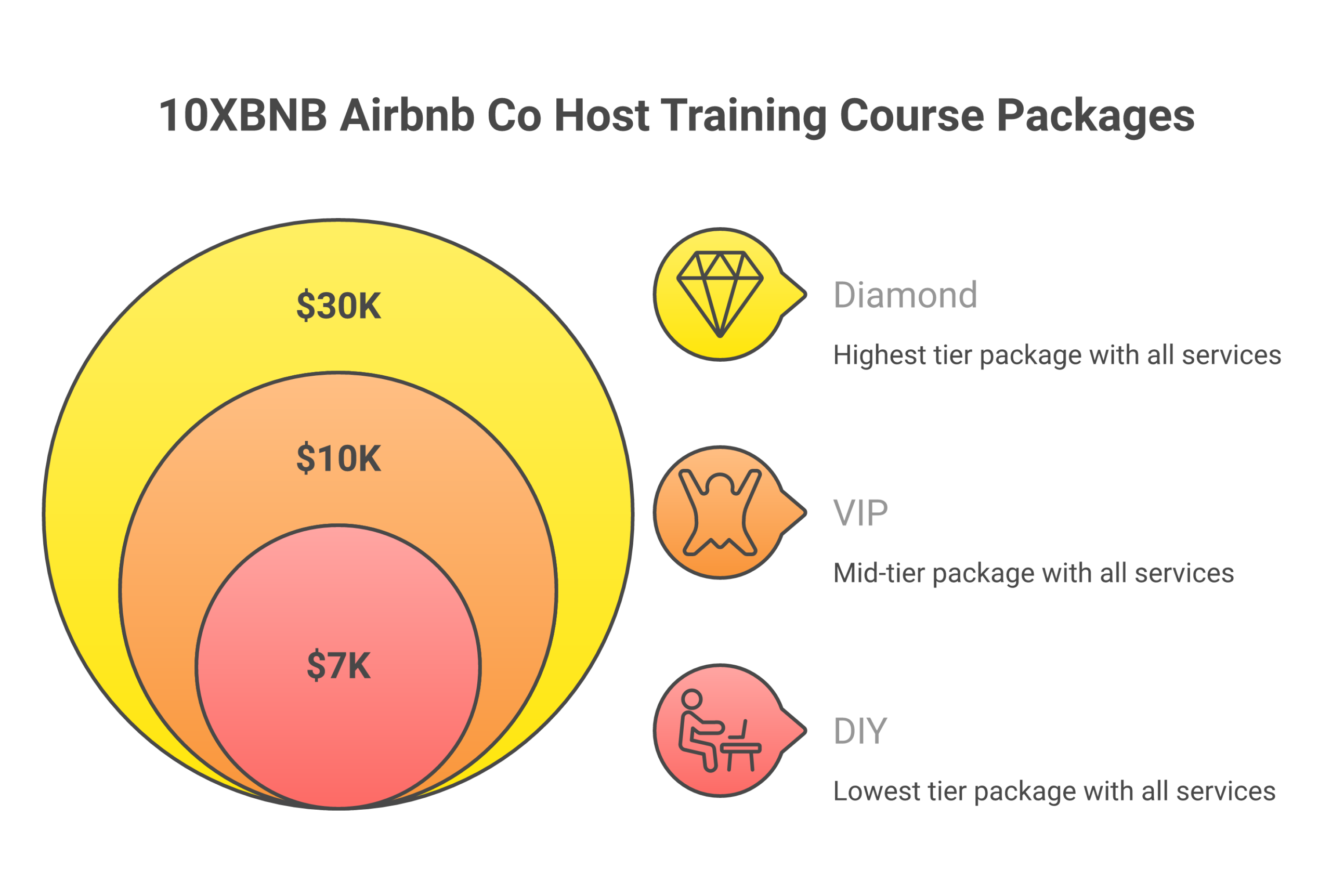
| Package | Price | What’s Included |
|---|---|---|
| DIY | $7,000 | All lessons and curriculum, all templates and contracts, community access, weekly live group coaching calls |
| Done-With-You VIP | $10,000 | Everything in DIY plus private 1-on-1 coaching sessions, personalized market analysis, priority support |
| Done-For-You Diamond | $30,000 | Everything in VIP plus we build your first listings for you, done-for-you property outreach, professional photography included, complete business setup |
I won’t pretend the purchase price is cheap. But here’s how the math works: if the co hosting course helps you land just 3 co listing clients at $1,500 per month each in management fees, you’re making $4,500 per month. The DIY package pays for itself in under 2 months. The VIP pays for itself in just over 2 months. And the Diamond – where we literally build the business for you – has the highest success rate because we’re doing the heavy lifting alongside you.
How to Find Co Host on Airbnb Clients and Build Your Services Business
Finding your first co host on airbnb clients after you purchase the training is the part that intimidates most students. But once you understand that you’re solving a real problem for property owners – not asking for a favor – the whole dynamic shifts. Here’s how we teach students to find clients and build their airbnb co host services into a real business:
Craigslist and Zillow outreach. Properties that have been listed for 20+ days on rental platforms represent landlords and property owners who are losing money right now. These are your warmest leads because they have an active pain point you can solve. Use the pitch templates included in the course you purchase to reach out with a clear value proposition: you’ll help them earn more from their property through short term rentals while you handle all the work as their co host.
Using Airbnb Co Host Network to Build Your Co Hosting Services
Airbnb launched their Co Host Network in late 2024 which allows property owners to find and hire co hosts directly through the platform. To join you need a track record of 10+ stays with a 4.8+ rating and less than 3% cancellation rate. This is a newer channel for finding clients but it’s growing fast as more property owners discover they can partner with experienced co host on airbnbs instead of managing listings themselves.
Local networking and referrals. Once you have 2 to 3 co host clients and you’re delivering strong results for those property owners, referrals start coming in. Happy property owners talk to other property owners. Real estate agents hear about your co hosting services and send clients your way. This is how our students scale past 5 properties without doing cold outreach every week.
Managing client relationships. Every co host client gets a monthly report showing their property’s performance – occupancy rates, revenue, guest reviews, any maintenance you handled. Transparency builds trust with property owners and trust leads to longer contracts, better terms, and referrals to new clients. Managing these relationships well is as important as finding new clients because a property owner who fires you costs more than not landing a new client in the first place.
Setting Up Payments and Co Host Profile for Airbnb Properties
and commission structures. Most co hosts work on a commission basis – typically 20 to 25% of gross booking revenue. The co host contract template included in the co host program covers how payments are structured, when they’re due, how property owners receive their share, and what happens if there are disputes about payments or damages. Getting the payment terms clear in the contract from day one prevents problems down the road.
What Successful Airbnb Hosts and Co Hosts Do Differently
After working with over 1,600 hosts through 10XBNB I’ve noticed clear patterns that separate hosts who build profitable co host on airbnb businesses from hosts who struggle. The successful hosts treat this like a real business from day one. Here’s what the best hosts and co hosts do that the struggling hosts don’t:
Successful hosts respond to every inquiry within 1 hour. Airbnb’s algorithm rewards hosts who respond fast with better search rankings and more guest bookings. The top hosts in our community have their automated messaging set up on day one so guests always get immediate responses even when the hosts are busy managing other properties or working their day jobs.
The best co hosts on airbnb obsess over their guest reviews. Hosts who maintain a 4.9+ rating consistently earn 20-30% more per night than hosts sitting at 4.6 or 4.7. Why? Because guests filter search results by rating and the highest-rated hosts get the most visibility. Every 5-star review makes it easier for hosts to charge premium rates and fill their calendar. Smart hosts invest in the guest experience – clean properties, thoughtful amenities, clear communication – because those reviews are what drive their co host business forward.
Profitable hosts and co hosts track their numbers weekly. Revenue, occupancy, expenses, profit per property, guest satisfaction scores. The hosts who know their numbers make better decisions about pricing, about which properties to keep and which to drop, and about when to scale versus when to optimize what they already have. Hosts who don’t track their numbers are guessing and guessing is expensive in the short term rental business.
The most successful co hosts on airbnb specialize. Some hosts focus exclusively on beach vacation rentals. Others specialize in urban apartments near convention centers. Some co hosts only work with luxury homes while other hosts focus on budget-friendly stays in college towns. The hosts who try to be everything to every property owner end up spread thin. The co hosts who pick a niche and become the go-to hosts for that type of property in their market are the ones making the most money as co hosts on airbnb.
Top hosts manage and handle guest issues proactively. When something goes wrong – and it will for every airbnb co host at some point – the best hosts don’t wait for guests to complain. They reach out first. If hosts notice a maintenance issue they fix it before the guests even know about it. If there’s a problem with guest check-in the best hosts are already on the phone solving it before the guests have time to get frustrated. This proactive approach is what separates hosts who get 5-star reviews from hosts who get 3-star complaints.
Smart co hosts and hosts on airbnb build systems before they need them. The hosts who wait until they have 5 properties to set up automated messaging, dynamic pricing, and a cleaning schedule are already behind. The best hosts set up their co host systems with their very first property so that adding property number 2 and 3 is just plugging a new listing into the existing system. That’s how experienced hosts and co hosts on airbnb scale quickly without burning out.
Whether you choose to purchase the DIY package or the VIP option, every new airbnb co host who joins 10XBNB gets the tools to manage guests professionally, handle property operations without owning a single home, and build a co host business that creates real income. The guests you manage will leave better reviews, the property owners you partner with will earn more revenue, and you’ll have a co host business that grows every month.
If you want to go deeper on any of these topics, here are the guides I’d recommend starting with: our complete rental arbitrage guide covers the full lease-to-profit process, the co-listing vs rental arbitrage comparison helps you decide which path to start with, and the what is co-listing explainer breaks down exactly how the model works. For the legal side, check the co-listing agreement template we provide to every student. And if you’re evaluating other programs alongside 10XBNB, here’s our honest review of the best Airbnb courses in 2026 including our competitors. For students ready to apply, the 10XBNB mentorship program page has full details on what each package includes and how to get started.
Frequently Asked Questions About Airbnb Co-Host Training
Do I need experience to become an Airbnb co-host?
No, none at all. Many of my most successful 10XBNB students started from scratch with zero Airbnb experience. I’ve had students in Arizona with no experience to speak of landing their first co host client through co-listings within six weeks. What matters is your ability to communicate, organize, and market – those are skills you can definitely learn. What really matters is a willingness to pitch property owners and follow a proven system.
How much does it cost to get started with co-listing?
Effectively nothing at first. You don’t have to buy or lease any property to get started – your main expenses in that first month will be a pro photographer ($100 to $200 per listing), cleaning supplies for that first turnover, and some software subscriptions (PriceLabs and Hospitable run about $50 to $100 a month combined). That’s a far cry from $3,000 to $10,000+ for rental arbitrage or tens of thousands for property ownership.
How is co-listing different from Airbnb’s Co-Host Network?
Airbnb launched its Co-Host Network in October 2024 as part of its winter release but it’s a whole different thing. They’re connecting property owners with experienced co-hosts in 10 countries including the US, UK, Canada, and Australia. To qualify, you need 10+ stays (or 3 stays totaling 100+ nights) in the past 12 months, a 4.8+ star rating, and a cancellation rate under 3%. That’s one channel for finding clients, but it won’t teach you listing optimization, dynamic pricing, or how to build systems – this training program does. We teach you the full business behind co-listing and the Co-Host Network becomes just one of many lead sources.
What commission should I charge as a co-lister?
Between 20 and 25% of gross booking revenue. At 20%, it’s a pretty sweet deal for the owner (they get to keep 80% and do zero work). At 25%, it’s still well below what traditional property management companies charge (30 to 40% is pretty standard). You want to depend on the market, what you’re offering, and the property’s potential revenue. Properties earning $5,000+ per month can often justify 20% because the owner’s net income is still substantial.
Can I do co-listing as a side hustle?
Yep. I did it myself for over two years while working a $200K banking career. Once my systems were in place, I was only committing about 2 hours a day. Many of my 10XBNB students start while working full-time. The key is automation: PriceLabs for pricing, Hospitable for messaging, a reliable cleaning team. Those three pieces make co-listing super easy to fit alongside a 9 to 5.
How long does it take to get my first co-listing client?
Most of my students following the outreach system end up landing their first client within 2 to 6 weeks. It all comes down to how hard you’re willing to work. Students pitching out to 10+ owners per week get results faster than those sending a few emails and waiting for the phone to ring. I had a student in Vancouver land 4 clients in 90 days, another in Arizona get his first 2 in six weeks. More outreach, faster results. That’s pretty simple.
Do I need a business license or LLC to co-list?Requirements can and do vary by city and state, so it’s worth doing your homework. Generally, forming an LLC for liability protection is a no-brainer in most US markets – the purchase cost will be $50 to $500, depending on which state you live in – although some cities may also require a short-term rental permit or business licence. Always check what the local regulations are before deciding to start. Inside 10XBNB, we make navigating the legal setup a whole lot easier for our members, by covering the common markets and compliance requirements in a way that’s easy to follow.?
What happens if a guest damages the property?
Airbnb has got you covered – or at least, they have got you covered up to a certain extent. As part of AirCover their Host damage protection kicks in, providing up to $3 million in damage insurance in case of property damage, furnishings, and some valuables. On top of that, you should work out some damage handling procedures with your co-host, and also factor in the need for a security deposit – which can serve as an added layer of protection. Owner’s or landlord’s insurance usually covers major incidents, while AirCover covers the guest-caused damage.
Is co-listing legal?
Now, as for whether co-listing itself is legal – the answer is yes, it is, in all 50 US states and most countries. That being said, the rules and regulations around short-term rentals vary wildy by city and town. Some places require the property owner themselves to register the listing under their name, while others require the person managing the property to get a property management licence. The bottom line is, do your homework and research the local STR regulations before you even think about launching a listing. If you’re stuck, Airbnb itself has a resource centre which can provide all the regulatory information you need, or you can try contacting your local city hall or planning department to get the lowdown on permit requirements.
How is 10XBNB different from other Airbnb co hosting courses?
You know, most of the course you purchases out there will teach you how to list a property on Airbnb, which is just the tip of the iceberg. 10XBNB on the other hand takes a totally different approach – we teach you how to build a co host and co-listing business from scratch, starting from finding and pitching to owners, all the way through to signing them up and optimising and automating the management so it scales. We give you access to live coaching (so it’s not just pre-recorded videos) – proven agreement templates – and most importantly, a community of 1,600+ students who are right there with you, actively building their own co host and co-listing businesses. We’re not just another course for you to buy and figure out on your own – we provide a system that actually works, with a coach, a community, and a proven track record.
Before starting your co-hosting business, use our free co-listing agreement template to set up a professional arrangement with property owners. Learn how to find property owners who need co-listing help.
Not sure what to charge? Our co-host fees and commission guide breaks down rates by service level so you can price your services competitively from day one.