I made $1.9 million from Airbnb last year and the craziest part is that I don’t own a single rental property – not owning any of them. Don’t rent any either. I manage 24 short term rental listings through a model called co-listing where I take a 20 to 25% cut of every booking and the landlord or landlords and property owners keep the rest.
But that’s not where I started.
I started with rental arbitrage – leasing properties long term and listing them on Airbnb as short term rentals for a higher nightly rate. That’s the business model that took me from a $65 per night spare bedroom to $175,000 a month in revenue before I quit my $200,000 banking job at 33.
This is the complete guide to rental arbitrage in 2026. I’m going to cover everything: what rental arbitrage actually is, what it costs to start, how to find properties and get landlord approval, the lease agreement terms you need, insurance and liability protection, the legal side, and the exact system I teach to over 1,600 students inside 10XBNB. I’ll also explain why I think most people should actually start with co-listing before rental arbitrage – and that’s coming from someone who built his entire Airbnb business on arbitrage first.
Need a lease? Download our free mid term rental agreement template with all 12 clauses explained.
Related: See our guide on landlord pitch scripts for rental arbitrage for detailed templates and legal requirements.
Related: See our guide on insurance coverage for Airbnb hosts for detailed templates and legal requirements.
No fluff. Real numbers. Real risks. Real results.
What Is Rental Arbitrage and How Does This Airbnb Business Model Work
Rental arbitrage is a business model where you sign a long term lease on a property – usually an apartment, condo, or house – and then list that property on Airbnb, VRBO, or other short term rental and vacation rental platforms. You pay the landlord a fixed monthly rent and you collect higher nightly rates from short term rental guests. The profit is the difference between what guests pay you and what you pay in rent plus operating costs and expenses.
See our ranked list of the best cities for mid term rentals with demand drivers and income data for each market.
Let me list a simple example. You lease a 2-bedroom apartment for $1,800 a month on a long term lease. You furnish it, photograph it, and list it on Airbnb at $175 per night. At 65% occupancy you’re bringing in roughly $3,400 a month in gross bookings. After rent ($1,800), cleaning fees ($600 for 8 turnovers), utilities ($200), insurance ($100), and supplies ($75), you’re making and netting about $625 a month in profit from that single property.
Now $625 doesn’t sound like a lot – and honestly for a single unit it’s a modest return. But the rental arbitrage business model is designed to scale. Get 5 units running at that level and you’re making $3,125 a month. Get 10 and you’re at $6,250. The airbnb arbitrage operators who do well in this business don’t rely on one property. They build a portfolio of 5, 10, even 20+ rental arbitrage units across one or more markets and the profits compound as you add each property to your short term rental and vacation rental operations.
The appeal of airbnb rental arbitrage compared to actually owning property is that the barrier to entry is way lower. You don’t need $50,000 to $500,000 for a down payment. You don’t need a mortgage because you’re not owning the property. You don’t need perfect credit. You need enough cash to cover first month’s rent, a security deposit, and basic furnishings – typically $3,000 to $10,000 depending on the market and the size of the property.
That said – and this is something a lot of rental arbitrage guides gloss over – you ARE signing a lease. That means you owe rent every month whether the property books or not. If demand drops, if you pick the wrong market, if there’s a slow season that lasts longer than expected, you’re still on the hook for that rent payment. This is not a zero-risk business model. It’s a lower-cost entry to the short term rental and vacation rental industry but it carries real financial risk that you need to plan for.
How I Built an Airbnb Rental Arbitrage Business From a $65 Spare Bedroom
My first Airbnb listing was a spare bedroom in the townhouse I was renting with my girlfriend. $65 a night. I slept in the smallest room and shared the bathroom with guests. It was awkward and uncomfortable and I had to start somewhere.
Both rooms booked almost immediately. And when I woke up the next morning to a payment notification from Airbnb while I was still half asleep – something clicked. Who would’ve thought I could make money while I slept? That $65 spare room taught me that momentum beats perfection. You don’t need the perfect property or the perfect plan. You just need to start.
At the time I was making $200,000 a year as a Director at BMO – one of Canada’s biggest banks. I’d spent 12 years in banking across Standard and Poor’s, RBC, Scotiabank, and BMO. Good salary. Good benefits. But I’d grown up on welfare – my family came to Canada as refugees from Iran when I was 5 years old – and I knew that a paycheck wasn’t going to build the kind of wealth I wanted for my family.
So I kept the banking job and built the Airbnb rental arbitrage business on the side. Here’s how the timeline played out:
Year 1: Listed the spare rooms on Airbnb. Learned the short term rental platform inside and out. Made every mistake – bad photos, wrong pricing, slow guest communication. But bookings kept coming and the cash flow was real even if it was modest.
Year 2: Automated the rental arbitrage operations. Set up messaging templates, dynamic pricing tools, a cleaning team on call. Got my weekly time commitment down to about 2 hours across all properties. Started understanding how to run short term rental and vacation rental operations like a real business and not a side hustle.
Year 3: Hit $100,000 a year in Airbnb rental income. Still working at BMO full time. This was the turning point where rental arbitrage stopped feeling like a hobby and started feeling like a legitimate business model that could replace my salary.
Year 4: Scaled from 1 to 12 rental arbitrage properties. Revenue hit $120,000 a month. I was managing everything remotely using the tools and systems I’d built. The bank job started feeling like the side gig.
Year 5: $175,000 a month. I quit banking. Bought my parents a house with the Airbnb rental arbitrage income. Growing up on welfare and government housing, buying my parents a home was everything. That’s what this business model made possible.
The Rental Arbitrage Business Model: Immediate Cash Flow, Costs, and Profit Margins
Before you sign any lease you need to understand the actual economics. Not the Instagram version. The real version with all the costs included.
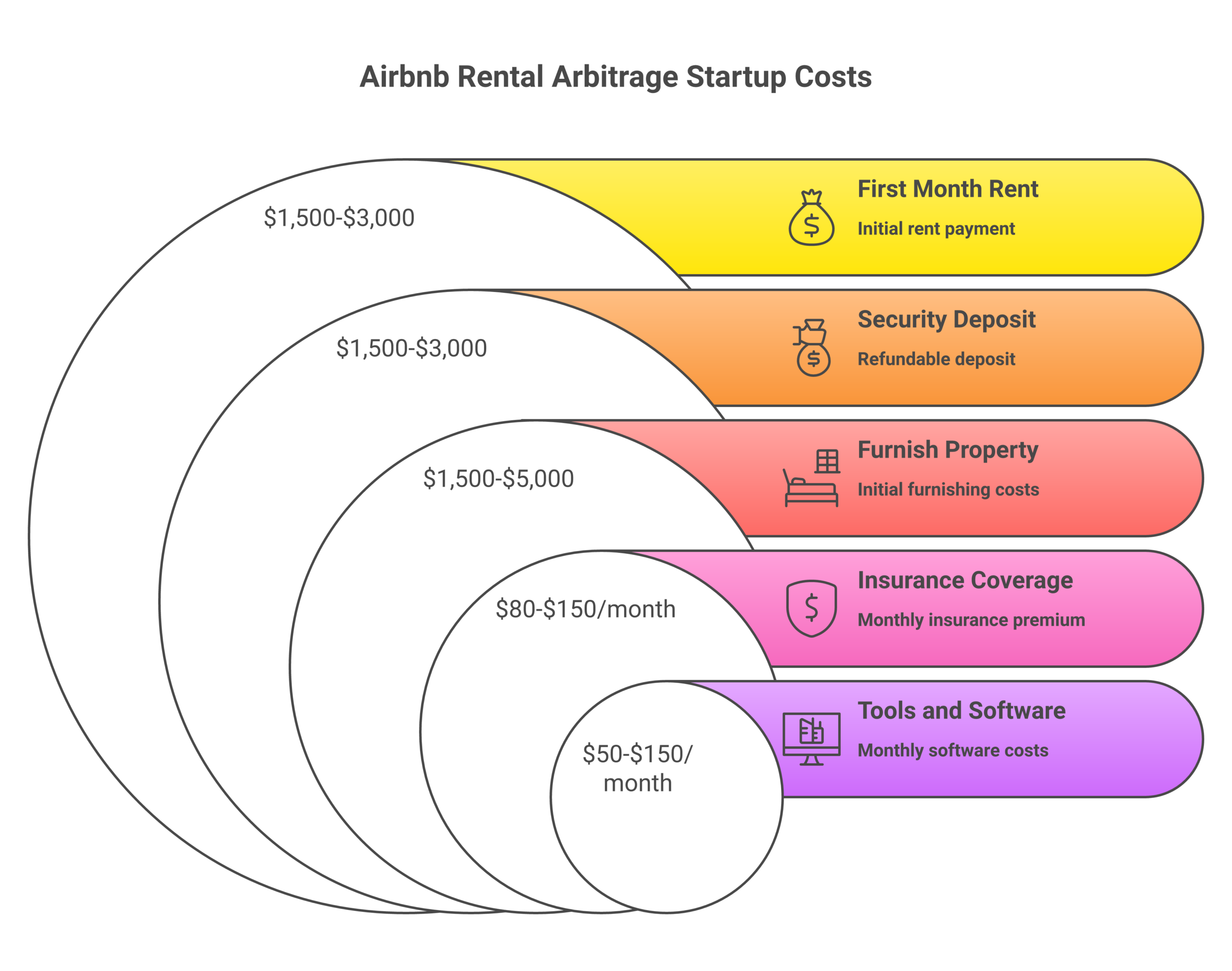
Startup Costs for Your First Rental Arbitrage Property
| Expense | Typical Range | Notes |
|---|---|---|
| First month’s rent | $1,500 – $3,000 | Depends on market and property size |
| Security deposit | $1,500 – $3,000 | Usually equal to one month’s rent |
| Furniture and furnishings | $1,500 – $5,000 | Can furnish for under $2,000 if you use Facebook Marketplace and thrift stores |
| Professional photography | $150 – $400 | Don’t skip this – bad photos kill bookings and destroy your occupancy rates |
| Supplies and amenities | $200 – $500 | Linens, towels, kitchen essentials, toiletries for guests |
| Smart lock | $150 – $300 | Essential for keyless check-in – allows remote operations |
| Insurance | $80 – $150/month | Short term rental insurance from Proper or CBIZ – covers liability and property damage |
| Dynamic pricing tool | $20 – $50/month | PriceLabs, Wheelhouse, or Beyond Pricing – pays for itself in higher rates |
Total startup cost: $5,000 to $12,000 for your first rental arbitrage unit. You can go lower if you’re scrappy about furnishing – some of our 10XBNB students have launched for under $3,000 by finding deals on used furniture and keeping the setup minimal. I actually recommend starting lean. Prove the cash flow works before you invest in higher end furnishings.
Monthly Cash Flow Breakdown (Real Example)
Let’s use a real market example. A 3-bedroom property in Nashville listed for $2,200 per month as a long term lease. Based on AirDNA data for that market in 2026, a well-optimized 3-bedroom short term rental in a decent Nashville neighborhood can generate $5,500 to $7,000 a month in gross bookings at around 60-65% occupancy.
| Monthly Expense | Amount |
|---|---|
| Rent to landlord (long term lease) | $2,200 |
| Cleaning (8 turnovers at $120 each) | $960 |
| Utilities (electric, water, internet) | $250 |
| Short term rental insurance coverage | $100 |
| Dynamic pricing tools and software | $50 |
| Supplies restocking and maintenance | $100 |
| Platform fees (Airbnb host fee 3%) | $180 |
| Total monthly operating costs and expenses | $3,840 |
At $6,000 gross monthly revenue, that’s $2,160 in immediate cash flow and profit from a single rental arbitrage property. Scale to 5 units and you’re looking at $10,800 a month. That’s real cash flow that can replace most people’s salary.
But here’s what I tell every student: run your numbers conservatively. Use 55% occupancy in your projections, not 70%. Account for seasonal dips. Build in a maintenance reserve because things break – water heaters fail, guests damage furniture, pipes leak. If the airbnb rental arbitrage math still works at conservative estimates, you’ve got a good viable property. If it only works at optimistic numbers, walk away and find a better deal.
How to Find Rental Arbitrage Properties and Get Landlord Approval
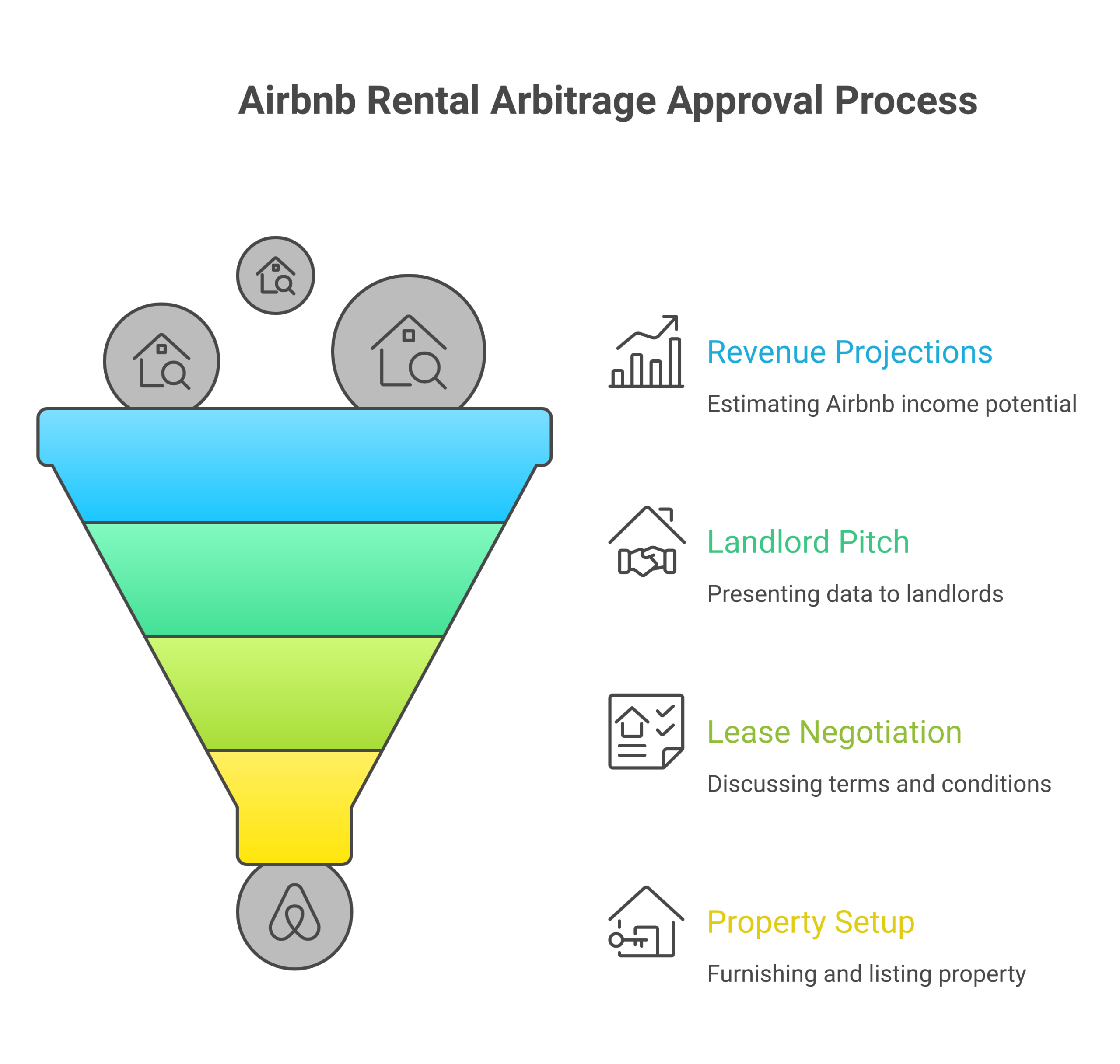
Finding the right property is half the game in the rental arbitrage business. The other half is getting the landlord or landlord or property owner to agree to let you use it as a short term rental. Here’s the process I teach inside 10XBNB that’s worked for over 1,600 students across dozens of markets.
Step 1: Research Your Market
Before you start contacting landlords you need to know that airbnb rental arbitrage is viable in your target market. Check three things: local short term rental regulations (some cities require permits, some limit the number of rental days, some ban short term rentals entirely), average Airbnb nightly rates for your target property type (use AirDNA or search Airbnb directly), and average long term rental rates on Zillow or Craigslist. If the Airbnb revenue is at least 2x the monthly rent at 55-60% occupancy, you’ve probably got a viable market for rental arbitrage.
Step 2: Find Properties That Have Been Sitting Empty
This is the key to getting landlord approval. Go to Craigslist and sort rental listings by oldest first. Any property that’s been on the list for 20 days or longer represents a landlord who is losing money right now. Every single day that property sits empty is lost rental income. And that lost income is your use when you approach landlords with a short term rental proposal.
You’re not begging for permission. You’re solving a pain point. Property owners with vacant units need your help – they just don’t know it yet.
Step 3: Run the Numbers Before You Reach Out
Use the rental arbitrage calculator or AirDNA to estimate what the property could generate as a short term rental on Airbnb. You want to know the projected monthly revenue, the average nightly rate, the expected occupancy rate for that specific area, and the STR premium (how much more you’d make versus what the landlord is asking in long term rent). Have these numbers ready before you ever call or email a landlord because data is what closes these deals.
Step 4: Make the Pitch and Get Landlord Approval
Here’s pretty much what I say when I approach a landlord or property owner – adjusted for whatever the specific property and market terms look like:
“Hey – I noticed your property has been listed for about 28 days now. I specialize in short term rental management in this area and based on the data I’ve pulled, this unit could generate roughly $5,500 a month on Airbnb compared to the $2,200 you’re asking for a long term lease. I handle everything – listing creation, guest communication, cleaning, maintenance, and any property damage and damages issues. You get a guaranteed monthly payment that’s higher than your asking rent and you don’t have to deal with any of it. Want me to walk you through the numbers?”
That pitch works because it leads with the landlord’s problem (empty property losing money every day) and offers a clear solution (higher income with zero work on their end). You’re not asking for a favor. You’re offering a business partnership.
Some landlords will say no. Actually most landlords will. Maybe 7 or 8 out of 10 won’t respond or will turn you down. That’s normal and it’s a numbers game. But the ones who say yes become your rental arbitrage properties. And you only need a few to build real cash flow.
Top of my list of recommendations: I always recommend bringing receipts. Pull up your Airbnb dashboard on your phone and show the landlord actual booking revenue from properties you’re already managing. Nothing gets landlord approval faster than real numbers on a real screen.
Creating and Optimizing Your Airbnb Rental Arbitrage Listing
Your listing is what sells your rental arbitrage property to potential guests. A bad listing on a great property will sit empty while a great listing on an average property fills up. I’ve seen this pattern play out hundreds of times across properties managed by hosts in our 10XBNB community and it’s always the listing quality that makes the difference.
Here’s what your Airbnb rental arbitrage listing needs to compete with experienced hosts in any market:
Professional photography. This is the single highest ROI investment you can make for your listing. Hosts who use professional photos see 40% more bookings on average compared to hosts using phone photos. Hire a photographer ($150-$400) and list every room, every amenity, and every detail that makes your rental arbitrage property stand out. Bad photos on your listing are the number one reason Airbnb rental arbitrage properties underperform in bookings.
A title that includes your area and key amenities. Don’t be clever with your listing title. Be descriptive. “Spacious 3BR Downtown Nashville – Walk to Broadway” beats “Cozy Paradise Retreat” every time because guests search by location and your listing title is what Airbnb’s algorithm uses to match your listing with guest searches.
A description written for guests, not search engines. Your listing description should answer every question a potential guest has before they ask it: how many guests can stay, what the check-in process looks like, what amenities are included, what’s in the area, and what makes your property different from the other listings nearby. Hosts who write detailed listing descriptions with specific details about the guest experience consistently earn more bookings and higher nightly rates than hosts who write generic copy.
Competitive pricing strategies from day one. New listings with zero reviews need to price 15-20% below comparable listings in the area for the first 30 days. This pricing strategy helps you build bookings and reviews quickly. Once you have 10+ five-star reviews, gradually increase your rates using dynamic pricing strategies through tools like PriceLabs. Hosts who try to charge premium rates on new listings with no reviews end up with empty calendars and negative cash flow.
Travel nurses are the largest mid term tenant segment. See our renting to travel nurses on Furnished Finder for setup details.
See our full breakdown of mid term rental income data with city-by-city earnings and tenant demand analysis.
Response time matters for your listing ranking. Airbnb’s algorithm rewards hosts who respond to guest inquiries within an hour. Fast response times increase your listing’s visibility in search results and help convert inquiries into bookings. Set up automated messaging templates so you can maintain fast response times even when you’re managing multiple rental arbitrage listings across different properties.
Operational Strategies That Separate Profitable Hosts From Struggling Ones
The rental arbitrage operators who make the most money aren’t the ones with the most properties. They’re the ones with the best operational strategies and systems. Here are the strategies that I use across my portfolio and teach to hosts inside 10XBNB:
Dynamic pricing strategies are non-negotiable. Static pricing is one of the most common mistakes hosts make and it directly kills your rental arbitrage profits. The market changes daily – weekends versus weekdays, holidays, local events, seasonal shifts, competitor pricing. Dynamic pricing strategies through tools like PriceLabs or Wheelhouse adjust your rates automatically based on all of these factors. Hosts using dynamic pricing strategies earn 15-36% more revenue than hosts who set a flat nightly rate.
Cleaning operations make or break your reviews. Guests care more about cleanliness than almost anything else. One bad cleaning between turnovers can result in a negative review that damages your listing’s ranking and bookings for months. Build a good reliable cleaning team, create a detailed checklist, and inspect properties between guests until you trust your team completely. Good cleaning operations are the backbone of every successful rental arbitrage business.
Maintenance strategies prevent expensive emergencies. Don’t wait for things to break. Schedule quarterly maintenance checks on every rental arbitrage property – HVAC filters, plumbing, smoke detectors, appliances, furniture condition. Proactive maintenance strategies cost less than emergency repairs and they prevent the kind of mid-stay issues that lead to guest complaints, negative reviews, and refund requests that eat into your profits.
Guest communication strategies build repeat bookings. Automated check-in messages, mid-stay check-ins, and post-checkout thank-you messages create a professional guest experience that hosts who wing it can’t match. These communication strategies take 30 minutes to set up once and then run automatically for every booking. Hosts with strong guest communication earn better reviews, higher occupancy rates, and more repeat bookings from returning guests.
Track your numbers religiously. Every rental arbitrage property should have a simple spreadsheet tracking monthly revenue, occupancy rate, ADR, expenses, NOI, and cash flow. Review these numbers weekly. If a property’s performance is declining, the data will show you exactly where the problem is – occupancy dropping, rates too low, expenses creeping up, or seasonal patterns you need to adjust your strategies for.
Lease Agreement Essentials for Airbnb Rental Arbitrage
The lease agreement is the legal foundation of your entire rental arbitrage business and every listing you list on Airbnb. Get the terms wrong and you’re risking eviction, loss of your security deposit, and potentially a lawsuit from the landlord or property owner. Here’s what needs to be in every lease agreement terms you sign for a short term rental arbitrage property.
Explicit subletting permission. Your lease agreement must specifically state that you’re allowed to sublet the property as a short term rental on platforms like Airbnb and VRBO. If the standard lease doesn’t include this language, you need to add an addendum. Never assume verbal landlord approval is enough – get it in writing every single time. Operating a short term rental without explicit permission in your lease agreement terms violates most standard lease agreements and can get you evicted.
Duration and renewal terms. Most rental arbitrage operators sign 12-month lease agreements. Some landlords will offer month-to-month which gives you flexibility to exit if the property isn’t performing. Longer lease terms (18-24 months) sometimes come with lower rent but lock you in for longer, which carries more risk. I generally recommend starting with a 12-month lease agreement for your first rental arbitrage property.
Property damage and liability terms. Your lease agreement should clearly define who is responsible for what kinds of property damage. Normal wear and tear from short term rental guests should be covered by your insurance, not deducted from your security deposit. Make sure the lease agreement terms address the terms for how property damages claims are handled and what your liability terms and limits are. Get a rental agreement template and customize it for your specific situation.
Maintenance responsibilities. Clarify who handles what. In most airbnb rental arbitrage arrangements, the operator (you) handles day-to-day maintenance for guests – broken appliances, plumbing issues, cleaning between stays. The property owner handles structural issues and major repairs. Put these terms and responsibilities in writing in the lease agreement so there are no surprises.
The most important lease agreement terms to negotiate for airbnb rental arbitrage include: subletting permission terms that specifically allow short term rental use on platforms like Airbnb and VRBO, property damage liability terms defining who pays for what, lease renewal terms and under what terms you can extend, early termination terms in case the rental arbitrage property doesn’t perform, and insurance terms requiring you to carry dedicated short term rental and vacation rental insurance. Get all of these terms documented in writing before you sign anything. Verbal agreements on any of these terms are worthless if a dispute arises between you and the landlords and property owners.
Is Airbnb Rental Arbitrage Legal? Is Airbnb Arbitrage Legal in Your State?
Is airbnb rental arbitrage legal? Is airbnb arbitrage legal in your state? In most places, yes – as long as you meet three terms and conditions: your lease agreement allows subletting, you have explicit landlord approval, and you comply with local short term rental regulations and terms in your city or state.
The legal landscape for airbnb arbitrage varies dramatically depending on where you operate. Some states and cities are very friendly to short term rental operators. Others have strict rules that make rental arbitrage difficult or impossible. Here’s what you need to research before committing to any market:
Local STR permits and licenses. Many cities require short term rental operators to register and obtain a permit before listing on Airbnb or other platforms. Permit costs range from $50 to $2,000+ annually depending on the city. Some cities limit the number of permits they issue which can make it harder to scale your rental arbitrage business in those markets.
Zoning restrictions. Some cities only allow short term rentals in certain zones. Check your city’s zoning code to make sure the property you’re considering for rental arbitrage is in an area where short term rentals are allowed. Operating in a restricted zone can result in fines, loss of your permit, and legal liability issues.
Night cap limits. Some states and cities limit how many nights per year you can rent a property as a short term rental. If your market has a 90-day limit, for example, your rental arbitrage cash flow projections need to account for the fact that you’ll need to find long term rental or mid-term rental guests for the remaining 275 days.
Tax obligations. Short term rental income is taxable. Most states require you to collect and remit occupancy taxes (sometimes called hotel taxes or transient occupancy taxes). Airbnb collects these automatically in many markets but not all. You’re also responsible for reporting your rental arbitrage income on your federal and state tax returns. Talk to a CPA who understands short term rental taxes – the deductions available to rental arbitrage operators can significantly reduce your tax liability.
HOA rules. If the rental arbitrage property is in a building or community with a homeowners association, the HOA rules may prohibit or restrict short term rentals regardless of what your landlord agrees to. Always check HOA regulations before signing a lease agreement for a rental arbitrage property.
Insurance, Liability, and Property Damage Protection for Rental Arbitrage
This section is one that most rental arbitrage guides barely touch and it’s one of at the top of the list the most important. Proper insurance and liability coverage is what protects your rental arbitrage business from the kind of events that can wipe you out financially.
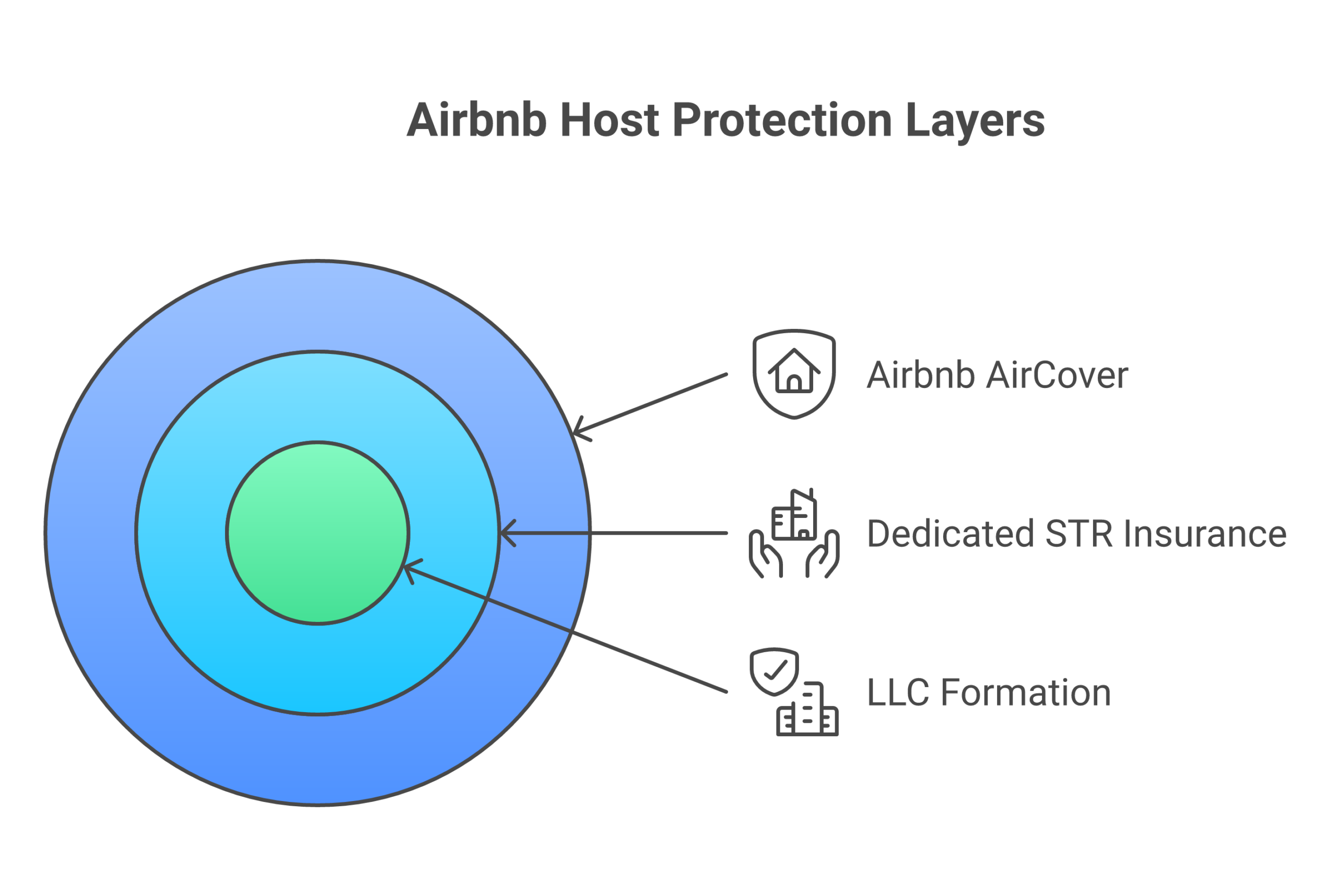
Airbnb’s AirCover Program
Airbnb provides AirCover for hosts which includes up to $3 million in property damage protection and $1 million in liability coverage. This sounds complete but there are significant gaps. AirCover doesn’t cover all types of property damage caused by guests. It doesn’t cover loss of rental income during repairs. The claims process can be slow and Airbnb has the final say on what they’ll pay. Relying solely on AirCover is a risk I don’t recommend for any serious rental arbitrage operator.
Dedicated Short Term Rental Insurance
Get a dedicated short term rental and vacation rental insurance policy terms from a provider like Proper Insurance, CBIZ, or Safely. These policies are designed specifically for short term rental operators and they cover things that standard renter’s insurance and AirCover don’t:
Property damage coverage: Covers damages to the property and its contents and furnishings caused by guests, accidents, or natural events. This protects both you and the property owner from having to pay out of pocket for repairs.
Liability insurance: If a guest is injured on the property and files a claim against you, liability insurance covers your legal costs and any damages awarded. Without proper liability coverage, a single guest injury claim could destroy your rental arbitrage business financially.
Loss of rental income: If property damage makes the unit uninhabitable for a period, this coverage replaces the rental income you lose during repairs. This is critical for rental arbitrage operators because you’re still on the hook for rent to the landlord even when the property is damaged and can’t host guests.
Short term rental insurance typically costs $80 to $150 per month per property. That’s a small price for the protection it provides. Every rental arbitrage property in your portfolio should have its own dedicated insurance policy terms. This is non-negotiable.
Protecting Against Property Damage
Property damages from guests is an inevitable part of the short term rental and vacation rental business. It’s not a question of if it will happen – it’s when. Here’s how experienced rental arbitrage operators handle it:
Screen guests before accepting bookings. Check their review history and rating. Guests with no reviews or poor ratings are higher risk for property damage. Set house rules that are clear about what is and isn’t allowed. Document the condition of the property with photos to protect against damages claims with photos before every guest checks in so you have evidence if property damage occurs. File damage claims with your insurance provider and through Airbnb’s resolution center immediately – don’t wait.
The insurance coverage, the guest screening, and the documentation practices together create a system that covers you when property damage inevitably happens. No single protection is enough on its own. You need all three layers working together.
Key Terms Every Airbnb Rental Arbitrage Operator Needs to Know
If you’re new to the short term rental and vacation rental industry, the terminology can be confusing. Here’s a list of the most important terms that rental arbitrage operators, hosts, and landlords and property owners use daily. Understanding these terms helps you communicate with landlords, negotiate better lease terms, and make smarter investment decisions in your rental arbitrage business.
STR (Short Term Rental): Any property rented for less than 30 days at a time. This is the core of the rental arbitrage business model. STR and vacation rental operators list properties on platforms like Airbnb and VRBO to earn higher nightly rates compared to long term leasing. Most STR hosts focus on vacation rental guests and business travelers.
ADR (Average Daily Rate): The average nightly rate your short term rental listing earns over a given period. This is one of the most important terms for tracking your rental arbitrage revenue and making pricing strategies work. Higher ADR means more revenue per guest night which directly increases your profit margins and cash flow.
Occupancy Rate: The percentage of available nights that are actually booked from your list of available nights by guests. A good occupancy rate for STR rental arbitrage properties is 55 to 70% depending on the market and season. Hosts who achieve higher occupancy while maintaining good strong nightly rates are the ones making the most revenue.
RevPAN (Revenue Per Available Night): Your total rental revenue divided by the total available nights. This is a better metric than ADR alone because it accounts for both your nightly rates and your occupancy. Smart rental arbitrage operators optimize for RevPAN, not just ADR or occupancy in isolation.
STR Premium: The difference between what a property earns as a short term rental versus what it would earn under a long term lease agreement. This is the fundamental terms equation that makes rental arbitrage profitable. A property with a long term rental value of $2,000 per month that generates $5,000 per month on Airbnb has a 150% STR premium.
Turnover: Each time a guest checks out and a new guest checks in, that’s a turnover. More turnovers mean higher cleaning costs but often higher total revenue because shorter stays typically command higher nightly rates. Managing turnovers efficiently is essential for rental arbitrage operators running multiple properties.
Cap Rate: The rate of return on a real estate investment property based on the expected rental income. While this terms is more commonly used in property ownership, rental arbitrage operators should understand cap rates when evaluating whether to eventually transition from arbitrage to owning investment properties.
NOI (Net Operating Income): Your total rental revenue minus all operating expenses (cleaning, utilities, insurance coverage, supplies, platform fees, maintenance). This is your actual profit before taxes. NOI is the number that tells you whether your rental arbitrage investment is working or not.
Building Relationships With Landlords and Property Owners
Your relationship with landlords and property owners is the foundation of any rental arbitrage business. These are the people allowing you to use their properties as short term rentals, and keeping them happy ensures your lease agreements get renewed and your portfolio keeps growing.
Here’s what I’ve learned about working with landlords and property owners over the years of running airbnb rental arbitrage and co-listing operations:
Landlords care about three things: reliable rent payments, no property damage, and minimal hassle. If you can deliver all three consistently, most property owners will happily renew your lease agreement terms and even refer you to other landlords in the area who have vacant properties. Good landlord relationships are the best strategy for scaling because it’s easier to get landlord approval from a landlords referral than from a cold pitch.
Communication with property owners matters more than you think. Send your landlords a monthly report showing the property’s performance – occupancy rates, revenue generated, guest reviews, any maintenance you handled. This helps property owners see the value you’re providing and builds trust over time. Landlords who feel informed and respected are far more likely to offer favorable lease agreement terms and renewal terms when time comes.
Handle property damage immediately and transparently. When damages occur from guests (and they will), don’t try to hide it from the property owners. File insurance claims, get repairs done quickly, and communicate with the landlord about what happened and how you’re handling it. Landlords who find out about unreported damages lose trust fast and that can end your airbnb rental arbitrage relationship with that property owner permanently.
Pay rent early. Not on time. Early. This single strategy sets you apart from 95% of tenants property owners deal with. It also ensures that if there’s ever a slow month where your rental arbitrage bookings are lower than expected, you’ve already built goodwill with the landlord through consistent early payments.
Offer landlords and property owners more than they’re asking for. If a landlord lists a property for $2,000 per month long term and your airbnb rental arbitrage projections show you can still be profitable at $2,200, offer $2,200. That extra $200 per month makes you a far more attractive tenant than someone trying to negotiate the rent down, and it helps ensure landlord approval when you explain your short term rental and vacation rental business model.
Airbnb Arbitrage Without Owning Property: The Co-Listing Alternative
Now here’s where I tell you something that might change how you think about getting started in the short term rental and vacation rental business.
Rental arbitrage works. I just showed you the numbers and the business model. But it does require capital ($3,000 to $12,000 for your first property) and it does carry risk because you’re signing a long term lease. If the property doesn’t perform, you’re still paying rent.
What if you could start an Airbnb business without owning any property AND without renting or leasing any property?
That’s exactly what co-listing is. With the co-listing model you partner with property owners who already have furnished properties sitting empty and you manage their Airbnb and vacation rental listings for a 20 to 25% management fee on every booking. Zero capital required. No lease agreement. No financial liability. No risk of property damage coming out of your pocket because the owner’s insurance covers their property.
That’s how I manage a portfolio worth over $100 million in real estate without owning a penny of it. And that’s how I generated $1.9 million in 2022 from properties that aren’t mine.
Here’s what most people don’t realize: co-listing is actually the fastest and lowest risk path TO rental arbitrage. You build up cash flow from managing other people’s properties, you learn every aspect of the short term rental business with zero financial exposure, and then when you’re ready you use that income and those skills to fund your first rental arbitrage unit. It’s the progression I teach inside the 10XBNB co-listing and co hosting training and it’s the path that’s worked for the majority of our successful students.
| Business Model | Startup Cost | Monthly Risk | Your Cut | Owning Property Required |
|---|---|---|---|---|
| Property Ownership | $50K – $500K+ | High (mortgage, maintenance, vacancy) | 100% after expenses | Yes |
| Rental Arbitrage | $3K – $12K per unit | Medium (long term lease obligation) | Revenue minus rent and costs | No |
| Co-Listing | $0 | Low (no lease, no liability) | 20-25% of bookings | No |
The investment comparison makes the co-listing path even more obvious when you look at the expenses involved. The co-listing approach has been featured in Inc. Magazine as one of the top side hustles you can start with $0. Rental arbitrage requires a real financial investment in furniture, supplies, insurance coverage, and 2-3 months of rent as cash reserves to cover any expenses during slow periods. Co-listing requires none of those expenses. You’re using the property owner’s furniture, their supplies, their insurance. Your only investment is your time and effort to find landlords with properties, create listings, and manage guests. That’s why co-listing helps so many new operators get started – it removes every financial barrier and expense while still allowing you to learn the skills that make rental arbitrage profitable later.
If you want to understand the difference in detail I wrote a full comparison on co-listing vs rental arbitrage with real numbers and student results from people who’ve done both.
Scaling Your Rental Arbitrage Operations
Getting your first rental arbitrage property profitable is the hardest part. Scaling after that is mostly about building systems, managing your operations efficiently, and reinvesting your cash flow into additional properties.
Months 1 to 3: Focus entirely on making your first property work. Optimize your listing, dial in your pricing with a dynamic pricing tool like PriceLabs, build relationships with a reliable cleaning team, and get your guest communication systems running smoothly. This is the learning phase and it’s okay if it feels messy. Every experienced rental arbitrage operator went through this.
Months 3 to 6: Your first property should be generating consistent cash flow. Use this proof of concept to pitch additional landlords landlords – now you have real data showing what short term rentals can earn in your market. Add properties 2 and 3. Each new unit gets easier because you’ve already built the operational systems.
Months 6 to 12: This is where the rental arbitrage business model really starts to compound. With 3 to 5 properties running, your combined cash flow should be replacing or exceeding a typical salary. Start delegating. Hire a virtual assistant at $5 to $8 per hour to handle guest messages and booking coordination. Use channel managers if you’re listing on multiple platforms like Airbnb and VRBO to avoid double bookings. Automate everything you can so your time goes toward finding and onboarding new properties rather than managing day-to-day operations.
The tools that make scaling possible: PriceLabs or Wheelhouse for dynamic pricing ($20/month per listing), a smart lock system for keyless guest check-in ($200-$300 one-time per property), Hospitable or Guesty for automated guest messaging and multi-platform channel management ($30-$100/month depending on portfolio size), and a reliable local cleaning team you can depend on for same-day turnovers.
My approach – which I teach in the 10XBNB mentorship program – is to start with co-listing to build immediate cash flow and learn the business with zero risk, then use that income to fund rental arbitrage units, and eventually progress toward property ownership as your profits and experience allow. Co-listing to arbitrage to ownership. That’s the complete progression.
Best Markets for Short Term Rental Arbitrage in 2026
Not every market works for rental arbitrage. Some are oversaturated with hosts. Some have regulations that make short term rental operations impossible. And some are absolute goldmines that most operators overlook because they’re chasing the obvious tourist destinations.
The rental arbitrage markets that perform best in 2026 share these characteristics: a wide gap between long term rent and short term rental nightly rates (at least 2x), consistent demand from tourists or business travelers throughout the year (not just one season), manageable STR regulations with clear permitting processes, and reasonable startup costs for leasing and furnishing properties.
Based on what our students are reporting and what AirDNA market data shows, strong rental arbitrage markets right now include Nashville, Tampa, Scottsdale, San Antonio, Columbus Ohio, Jacksonville, and secondary markets in Florida outside of the overregulated Miami market. The mid-size cities with growing tourism and relatively relaxed short term rental regulations are where the best opportunities on your list exist for new rental arbitrage operators.
Airbnb arbitrage operators should avoid markets where regulations make it nearly impossible: New York City, San Francisco, and parts of Los Angeles have heavy restrictions that make rental arbitrage extremely difficult and expensive. Always research local rules and regulatory requirements before committing to any market.
I put together a detailed breakdown of the most profitable Airbnb cities for rental arbitrage that gets updated with fresh data regularly.
Real Results From Rental Arbitrage Operators
I could talk about my own results all day but honestly what matters more is what normal people are achieving with this business model. These are 10XBNB students who started from different situations and built real rental income and profit streams:
John in Vancouver landed 4 co-listing properties and generated $50,000 in bookings within 3 months. One of those properties was a chalet on an acre of land in Ladysmith – not exactly a prime tourist market – and it still performed because the listing was optimized correctly, the pricing strategy was dialed in, and the guest experience was consistent.
Javon in Arizona started with zero experience in the short term rental industry. No properties, no Airbnb account, nothing. Within 60 days of joining 10XBNB he’d landed his first co-listing client and within 6 months had multiple properties generating consistent monthly cash flow. His market isn’t even a major tourist destination.
Gian Marco in Florida, Cindy in Seattle, Robert in California – all started from scratch and started making money and built real income streams using the same system. What they have in common isn’t some special background or natural talent for the short term rental business. It’s that they followed the process, did the work, and didn’t quit when it got hard.
I’m not going to pretend every student makes $50,000 in 3 months. Some take longer to find their first rental arbitrage or co-listing property. Some struggle with the landlord pitch. And some don’t follow through at all. The honest truth is that results depend entirely on effort, market selection, and execution. But the operators who stick with the business model and apply what they learn consistently are the ones who build real rental income by making consistent cash flow.
Not sure if rental arbitrage is the right passive income path for you? Our 10XBNB vs Fiction Profits Academy comparison examines how Airbnb income stacks up against Amazon KDP self-publishing for real costs, timelines, and earnings potential.
Frequently Asked Questions About Airbnb Rental Arbitrage
How much money do I need to start a rental arbitrage business?
Most operators invest $3,000 to $12,000 for their first rental arbitrage property, covering first month’s rent, security deposit, furnishings, supplies, insurance, and professional photography. If you want to start with literally $0, the co-listing business model lets you build cash flow and learn the short term rental business before committing any capital to a lease agreement.
Is airbnb rental arbitrage legal?
Airbnb rental arbitrage is legal in most markets as long as you have written landlord approval to sublet, your lease agreement explicitly allows short term rental use, and you comply with local STR regulations including permits, taxes, and zoning terms and rules. Always verify the legal requirements in your specific city and state before starting a rental arbitrage business.
How much profit can you realistically make with rental arbitrage?
A single well-optimized rental arbitrage property typically nets $500 to $3,000 per month in profit after all operating costs depending on market, property size, occupancy rates, and nightly rates. Operators managing 5 to 10 units commonly generate $5,000 to $30,000 in monthly cash flow. ROI varies but successful rental arbitrage properties can return 50 to 200% annually on the initial investment.
What’s the difference between rental arbitrage and co-listing?
With rental arbitrage you sign a long term lease, pay rent, furnish the property, manage all operations, and keep all profit after costs. You carry the financial risk of the lease. With co-listing you manage someone else’s property for a 20 to 25% management fee. No lease, no rent, no furnishing costs, no financial risk. Co-listing earns less per property but requires zero capital and is the safer entry point for new operators.
What insurance do I need for rental arbitrage?
Get a dedicated short term rental insurance policy (not just standard renter’s insurance) from a provider like Proper, CBIZ, or Safely. This should cover property damages from guests, liability for guest injuries, and loss of rental income during repairs. Airbnb’s AirCover provides some protection but has significant gaps. Budget $80 to $150 per month per property for proper insurance coverage.
Do I need an LLC for rental arbitrage?
I strongly recommend forming an LLC before signing your first rental arbitrage lease agreement. An LLC separates your personal assets from your business liabilities. If a guest files a liability claim or property damage dispute, your personal savings and home are protected. LLC filing costs $50 to $500 depending on your state.
How long does it take to become profitable with rental arbitrage?
Most rental arbitrage operators see their first property become cash flow positive within 60 to 90 days of their first guest booking. It takes time to build up reviews (you typically need 5-10 five-star reviews before bookings become consistent), optimize your pricing, and work through the slow season for your market. The operators who make rental arbitrage work plan for 2 to 3 months of building before expecting consistent profits.
Can I do rental arbitrage while working a full-time job?
Yes and I actually recommend it. I built my entire Airbnb rental arbitrage business over 5 years while working as a banking director. Once you automate the operations – messaging, pricing, cleaning coordination – each property takes about 2 to 3 hours per week to manage. Start rental arbitrage as a side business and scale from there. Your 9-to-5 isn’t your prison – it’s your launchpad.
What are the biggest risks of rental arbitrage?
The main risks: lease obligation (you owe rent whether the property books or not), regulatory changes (a city could restrict short term rentals after you’ve signed a lease), property damage from guests exceeding your insurance coverage, market saturation driving down nightly rates and occupancy, and seasonal demand fluctuations. Mitigate these risks with cash reserves (2-3 months rent per property), proper insurance, conservative financial projections, and starting with co-listing to learn the business before taking on lease liability.
Is rental arbitrage still worth it in 2026?
Yes, but it’s not as easy as it was in 2019. The short term rental market has matured. There are more hosts, tighter regulations in many states, and guests have higher expectations. But demand for short term rentals keeps growing and the operators who treat rental arbitrage like a real business – with proper tools, pricing strategies, insurance coverage, legal compliance, and professional guest experiences – are making more money and making better returns than ever. The lazy operators are being filtered out, which is actually good news if you’re willing to learn and do the work properly.
If you prefer managing properties without leasing them yourself, Airbnb co-listing lets you earn 10-25% commission by managing other people’s listings. See our co-listing vs rental arbitrage comparison to decide which model fits your situation.
Want to earn from short-term rentals without signing leases? Read our guide on how to become an Airbnb co-host and learn what co-hosts charge. If you’re already doing nightly arbitrage, our mid-term rental arbitrage guide shows how 30+ day stays can cut your costs by 40-60%.