

A standard 12-month residential lease does not work for mid term rentals. The terms are wrong, the clauses are wrong, and the expectations are wrong. A travel nurse on a 13-week contract does not need a lease designed for someone staying a year. A corporate relocator on a 3-month assignment does not need clauses about lawn maintenance and lease renewal.
I have used the same core mid term rental agreement across dozens of properties and tenants. It is simple, clear, and covers everything both sides need without the legal bloat that makes tenants nervous and landlords liable for clauses they do not enforce. Below is the full template with every clause explained, plus the specific modifications you need for travel nurses, corporate tenants, and insurance displacement tenants.
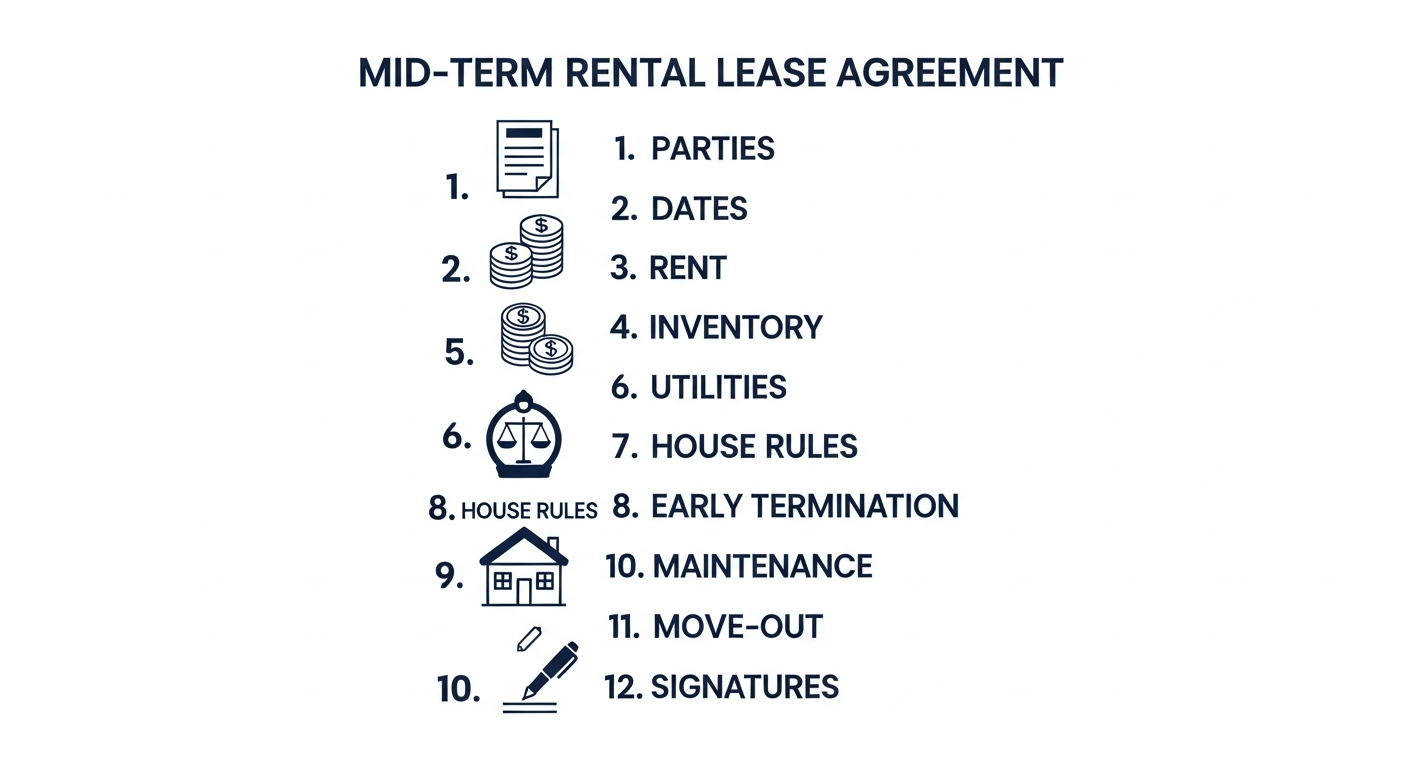
Mid Term Rental Agreement Template: Complete Clause-by-Clause Guide
This lease agreement template is designed for furnished rentals with stays of 30 days to 12 months. It covers the essentials without unnecessary complexity. Customize it for your state’s landlord-tenant law and your specific property. This is not legal advice. Have a local real estate attorney review your final version before using it with tenants.
Section 1: Parties and Property
This section identifies who is involved and what property is being rented. It sounds obvious, but missing or vague details here cause problems later.
Template language:
This Mid Term Rental Agreement (“Agreement”) is entered into on [DATE] between:
Landlord/Property Manager: [FULL LEGAL NAME], (“Landlord”)
Address: [LANDLORD ADDRESS]
Phone: [PHONE] | Email: [EMAIL]Tenant: [FULL LEGAL NAME], (“Tenant”)
Phone: [PHONE] | Email: [EMAIL]Property Address: [FULL PROPERTY ADDRESS INCLUDING UNIT NUMBER]
The Landlord agrees to rent the above property to the Tenant as a furnished residential rental for the term specified below.
If you are managing the property as a co-listing manager rather than the property owner, list yourself as “Property Manager” and include the owner’s name and contact information as well. This protects both you and the tenant if a maintenance issue requires the owner’s involvement.
Section 2: Lease Term and Dates
Mid term leases must have clear start and end dates. Unlike a month-to-month arrangement, a mid term lease covers a fixed period (typically matching a travel nurse’s 13-week contract or a corporate assignment timeline).
Lease Start Date: [DATE]
Lease End Date: [DATE]
Total Lease Duration: [NUMBER] weeks / monthsTenant shall vacate the property by 11:00 AM on the Lease End Date unless a lease extension has been agreed to in writing by both parties.
Why this matters: Travel nurse contracts are 13 weeks. Corporate relocations are typically 1-6 months. Insurance displacement can be 2-18 months. Match your lease term to the tenant’s actual need. Avoid rolling month-to-month terms for your first mid term tenants because it makes income less predictable and complicates scheduling the next tenant.
Section 3: Rent, Payment, and Late Fees
Monthly Rent: $[AMOUNT] per month, due on the [1st/15th] of each month.
Payment Method: [Bank transfer / Zelle / check / Furnished Finder direct payment]
First Month’s Rent Due: On or before the Lease Start Date.Late Fee: A late fee of $[AMOUNT or 5% of monthly rent] will be applied to any rent payment received more than [5] days after the due date.
Prorated Rent: If the Lease Start Date does not fall on the first day of the month, rent for the first partial month will be prorated at a daily rate of $[MONTHLY RENT / 30].
The rent amount should be all-inclusive for mid term rentals. Travel nurses and corporate tenants expect utilities, wifi, and basic supplies included in the monthly rate. If you charge separately for utilities, state the cap clearly (for example: “Utilities are included up to $200 per month. Tenant is responsible for any usage exceeding this amount.”). Utility caps protect you from tenants running the air conditioning at 65 degrees all summer in Phoenix or Tampa.
Section 4: Security Deposit
Security Deposit: $[AMOUNT] (typically equal to one month’s rent).
Due: On or before the Lease Start Date.
Refund: The security deposit will be returned within [14-30] days of the Lease End Date, minus any deductions for damages beyond normal wear and tear, unpaid rent, or cleaning fees as specified in this Agreement.
Check your state’s security deposit law. Some states cap the deposit amount (California caps at one month’s rent for unfurnished, two months for furnished). Some states require deposits held in a separate escrow account. Some states require interest paid on deposits held longer than 12 months. A local attorney or your state’s HUD tenant rights page can clarify your specific requirements.
Section 5: Furnished Inventory
This is the clause most landlords skip, and it is the one that prevents deposit disputes. List every piece of furniture and major item in the property. Both parties sign the inventory at move-in.
The property is rented fully furnished. A complete inventory of furnishings, appliances, and household items is attached as Appendix A. Both parties will review the inventory and note the condition of each item at move-in. Any damage beyond normal wear and tear at move-out will be deducted from the security deposit at replacement cost.
Create Appendix A as a simple table: item, room, condition at move-in, condition at move-out. Include furniture, appliances, kitchenware, bedding, towels, electronics (TV, router), and any decorative items of value. Take photos of everything and email them to the tenant at move-in as a shared record.
Section 6: Included Utilities and Services
The following utilities and services are included in the monthly rent at no additional cost to the Tenant:
[ ] Electricity
[ ] Gas / Heating
[ ] Water and Sewer
[ ] Trash and Recycling
[ ] Internet / WiFi (speed: [100+] Mbps)
[ ] Cable / Streaming Services: [specify or “not included”]Utility Cap: Total utility costs are included up to $[AMOUNT] per month. Tenant is responsible for any excess.
Most mid term rental operators include all utilities and wifi in the rent. This is what Furnished Finder tenants expect, and it simplifies your bookkeeping. The utility cap protects you from extreme usage without nickel-and-diming your tenant on a $15 electric bill difference.
Section 7: House Rules
Keep rules short, reasonable, and enforceable. Travel nurses and corporate tenants are adults. They do not need a page of micromanagement.
1. No smoking inside the property. Smoking permitted in [designated outdoor area / not permitted on premises].
2. Quiet hours: 10:00 PM to 7:00 AM.
3. No unauthorized pets. [OR: Pets permitted with a non-refundable pet fee of $[AMOUNT]. Maximum [1-2] pets. Breeds: [any restrictions].]
4. No overnight guests for more than [3] consecutive nights without prior written approval from Landlord.
5. Tenant is responsible for reporting any maintenance issues within 24 hours of discovery.
6. No alterations to the property (painting, mounting, drilling) without written approval.
The BiggerPockets mid term rental community puts it well: too many rules make tenants pass on your property. A travel nurse comparing 10 listings will skip the one with 25 house rules and book the one with 6 clear, reasonable expectations. Keep it simple.
Section 8: Early Termination
This is the clause that separates a mid term lease from a long term lease. Travel nurse contracts get canceled. Corporate assignments get shortened. You need a clear exit path for both sides.
Either party may terminate this Agreement early with [30] days written notice. If the Tenant terminates early, the Tenant forfeits [one month’s rent / the security deposit / a specified early termination fee of $[AMOUNT]]. If the Landlord terminates early, the Landlord will refund any prepaid rent and the full security deposit within [14] days.
The 30-day notice period gives you time to find a replacement tenant. The early termination fee compensates you for the vacancy. Some operators waive the fee if the tenant finds a qualified replacement tenant to take over the remaining lease term. This is common in the travel nurse space because agencies sometimes reassign nurses mid-contract.
Section 9: Lease Extension
If both parties agree, this Agreement may be extended for an additional term of [NUMBER] weeks/months at the same monthly rent, or at a mutually agreed rate. Extension must be confirmed in writing at least [14] days before the current Lease End Date.
Many travel nurses extend their contracts for a second 13-week term at the same hospital. If your tenant is happy, reaching out 4-6 weeks before their lease ends to offer an extension is the highest-ROI action you can take. Extensions mean zero vacancy, zero turnover costs, and six months of continuous income instead of three.
Section 10: Maintenance and Repairs
The Landlord is responsible for maintaining the property in habitable condition, including structural repairs, plumbing, electrical, HVAC, and appliance replacement. The Tenant is responsible for minor maintenance (replacing light bulbs, batteries, air filters) and for reporting any issues promptly. The Tenant agrees not to attempt repairs without Landlord approval.
Section 11: Move-Out Procedures
At the end of the lease term, the Tenant will:
1. Remove all personal belongings by 11:00 AM on the Lease End Date.
2. Leave the property in the same condition as move-in, accounting for normal wear and tear.
3. Return all keys, remotes, and access devices to the Landlord.
4. Complete a move-out walkthrough with the Landlord (in person or via video) to review the furnished inventory condition.A cleaning fee of $[AMOUNT] will be deducted from the security deposit unless the Tenant arranges professional cleaning prior to move-out.
The move-out walkthrough is where the furnished inventory (Section 5) pays off. Compare the move-in photos and inventory list against the current condition. Most travel nurses leave properties in excellent shape. Having the documentation means the rare dispute is resolved in minutes, not weeks.
Section 12: Signatures
By signing below, both parties agree to the terms of this Mid Term Rental Agreement.
Landlord/Property Manager: _________________________ Date: _________
Tenant: _________________________ Date: _________
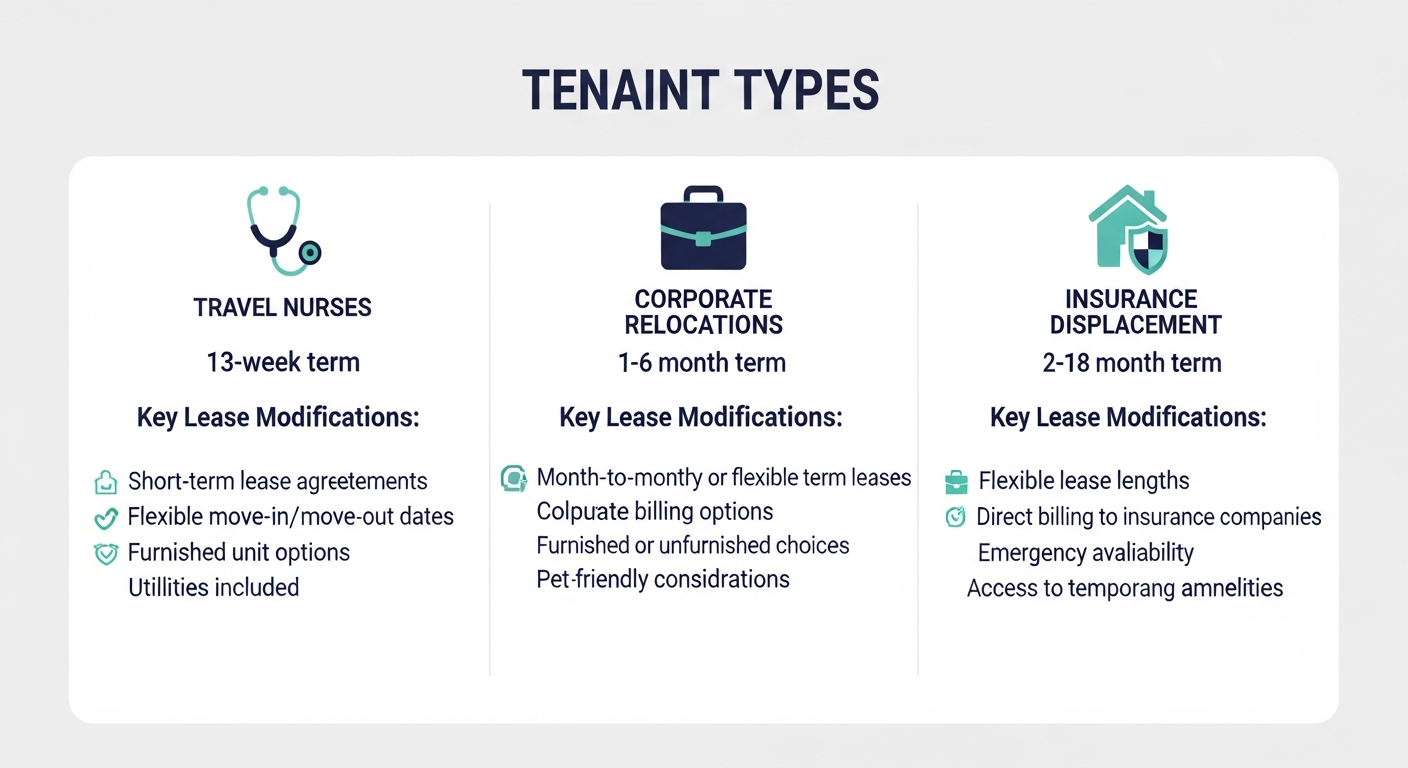
Modifications by Tenant Type
The core template above works for any mid term tenant. Here are the specific modifications for the three most common tenant types.
Travel Nurse Modifications
- Set the lease term to 13 weeks (standard contract length)
- Add an extension clause that allows a second 13-week term at the same rate
- Include the staffing agency name and contact as an additional reference
- Note that the housing stipend may be paid by the agency or the nurse directly
- Allow flexible move-in dates (nurses sometimes arrive 1-2 days before their start date)
Corporate Relocation Modifications
- Lease term typically 1-6 months depending on the assignment
- Add the employer name and HR contact as reference
- Some companies pay rent directly on behalf of the employee (specify payment source)
- Include a clause for company-requested early termination with a shorter notice period (14 days)
- Higher cleaning and damage standards may apply (corporate tenants expect move-in perfect condition)
Insurance Displacement Modifications
- Lease term is variable (2-18 months depending on FEMA assistance duration)
- Payment may come from the insurance company or FEMA directly. Specify the payment source and timing
- Include a clause allowing early termination if the tenant’s home is repaired ahead of schedule
- Families with children may need additional flexibility on guest policies and quiet hours
- Pet policy is especially important because displaced families often have pets
Where to Use This Agreement
This lease template works for properties listed on Furnished Finder, Airbnb (30+ day stays), Zillow Rentals, and direct bookings from Facebook groups or referrals. If you are managing properties as a co-listing manager, use this template between the property owner and the tenant, with yourself listed as the Property Manager handling day-to-day communication.
For Airbnb bookings specifically, the platform’s Terms of Service serve as the primary agreement. This separate lease agreement adds an additional layer of protection for both parties, especially for stays longer than 30 days where Airbnb’s resolution process may not cover all scenarios.
Getting Started With Mid Term Rentals
This agreement is one piece of the setup. To build a profitable mid term rental business, you also need to select the right market, price your property correctly, and find tenants consistently.
- How much do mid term rentals make? Full income breakdown by city and property type.
- Best cities for mid term rentals in 2026 12 markets ranked by demand and income.
- How to rent to travel nurses Platform setup, pricing, and property requirements.
- Startup cost breakdown What it costs to launch your first mid term unit.
If you want structured guidance on building a mid term rental portfolio from zero, whether through co-listing (zero capital) or rental arbitrage (invested capital), book a strategy call to see if the 10XBNB program fits your goals.
Frequently Asked Questions About Mid Term Rental Agreements
Do I need a separate lease for mid term rentals?
Yes. A standard 12-month residential lease includes clauses that do not apply to 30-90 day stays (lease renewal terms, annual rent increases, long term maintenance obligations). A mid term lease should be simpler, shorter, and tailored to the actual stay duration. Use the template above as your starting point and have a local attorney review it.
What lease term should I use for travel nurses?
13 weeks, matching the standard travel nurse contract. Include an extension clause allowing a second 13-week term at the same rate. Many nurses extend, giving you 6 months of continuous income with one tenant.
Should I include utilities in the rent?
Yes. Mid term tenants expect all-inclusive pricing (rent, utilities, wifi). Include a utility cap ($150-$250/month depending on your market) to protect against extreme usage. This is standard practice on Furnished Finder and expected by travel nurse and corporate tenants.
How much should the security deposit be?
One month’s rent is standard for mid term rentals. Check your state law because some states cap deposit amounts (California caps furnished rentals at two months’ rent). Return the deposit within 14-30 days of move-out, minus documented deductions for damage beyond normal wear and tear.
What if the tenant needs to leave early?
Include an early termination clause with 30 days notice and a specified fee (typically one month’s rent or forfeiture of the security deposit). This gives you time to find a replacement tenant while compensating for the unexpected vacancy. Some operators waive the fee if the tenant provides a qualified replacement.
Do I need a furnished inventory list?
Absolutely. List every piece of furniture, appliance, and significant item. Both parties sign the inventory at move-in. Take photos of everything. This is the single most effective protection against deposit disputes. Most mid term tenants are responsible professionals, but documentation prevents the rare disagreement from becoming a legal issue.
Can I use this template if I manage someone else’s property?
Yes. If you are a co-listing manager, list yourself as Property Manager in Section 1 and include the property owner’s name and contact. The lease is between the owner and the tenant, with you acting as the authorized management contact. Make sure your co-hosting agreement with the owner explicitly authorizes you to sign lease agreements on their behalf.