

I have run properties in markets that work for mid term rentals and markets that do not. The difference comes down to three things: a reliable source of tenants who need 30 to 90 day housing, rent-to-revenue ratios that leave room for profit, and local regulations that do not make the business model illegal. Here are the 12 best cities for mid term rentals in 2026, ranked by the strength of their demand drivers and what operators are actually earning.
What Makes a City Good for Mid Term Rentals
Before the city list, you need to understand what separates a strong mid term rental market from a weak one. Not every city with a hospital or a corporate headquarters generates enough 30+ day demand to sustain a business.
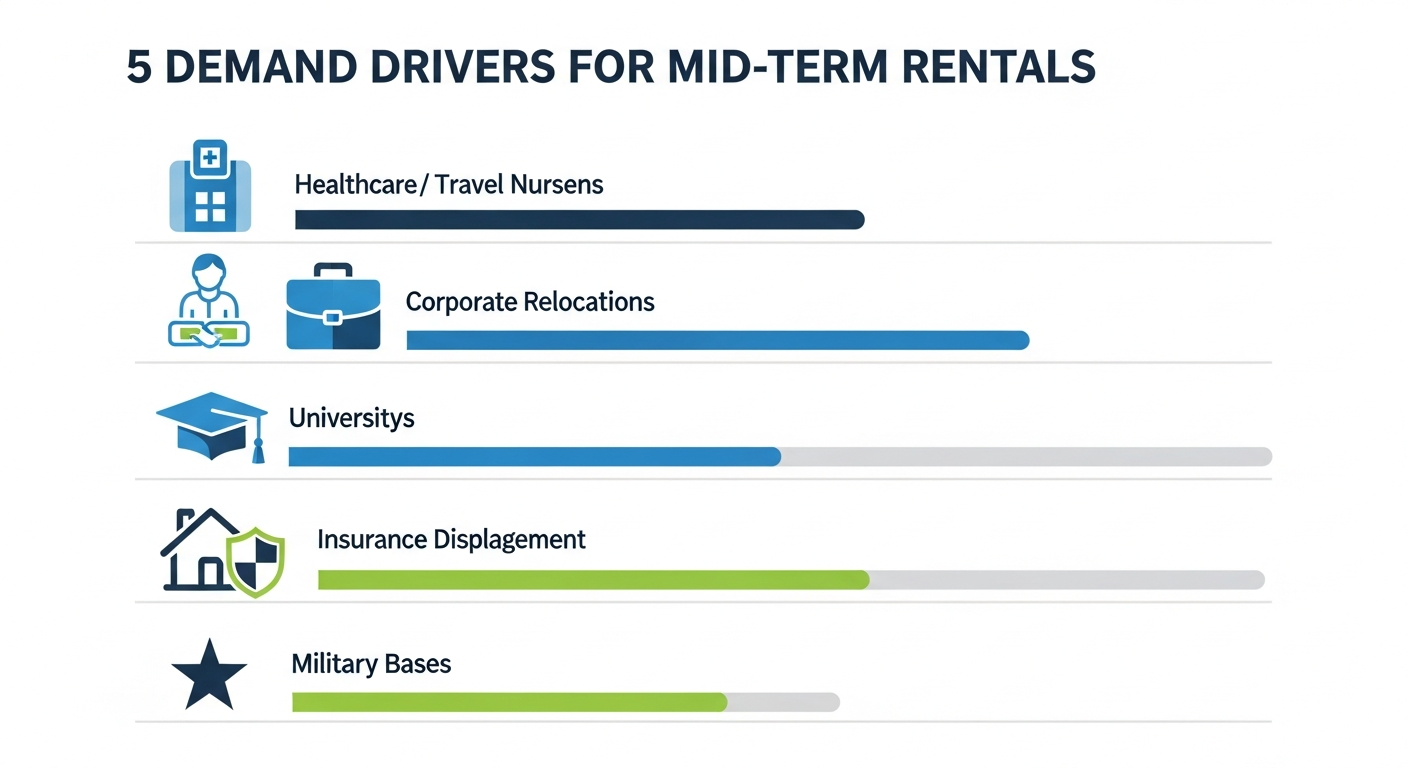
Major hospital or medical center nearby. Travel nurses are the single largest source of mid term rental demand. They account for about 25% of all bookings on Furnished Finder. The Bureau of Labor Statistics projects 197,000 registered nurse job openings annually through 2033. Cities with Level 1 trauma centers, teaching hospitals, and large medical systems generate consistent, year-round demand.
Corporate offices or military bases. Business relocations, project-based assignments, and military transfers create 1-3 month housing needs. Cities with Fortune 500 headquarters, tech campuses, or active military installations generate corporate and government tenant demand that pays premium rates (40-60% above unfurnished long term rent).
Need a lease? Download our free mid term rental agreement template with all 12 clauses explained.
University or research presence. Visiting professors, postdoctoral researchers, and medical residents need 3 to 12 month housing. University towns have built-in academic calendar demand that is predictable and renewable every semester.
Favorable rent-to-revenue ratio. Your furnished mid term rate needs to be at least 1.5x your total monthly costs (rent, utilities, wifi, insurance, platform fees). In expensive cities like San Francisco, high rents can erase the margin even though demand is strong. In mid-size cities like Columbus or Charlotte, lower rents mean wider margins.
Limited or no short term rental restrictions. Cities that heavily regulate nightly Airbnb stays often leave 30+ day rentals untouched. This is a structural advantage. Markets where STR operators are being squeezed by regulations become better mid term markets because the supply of furnished housing shrinks while demand stays constant.
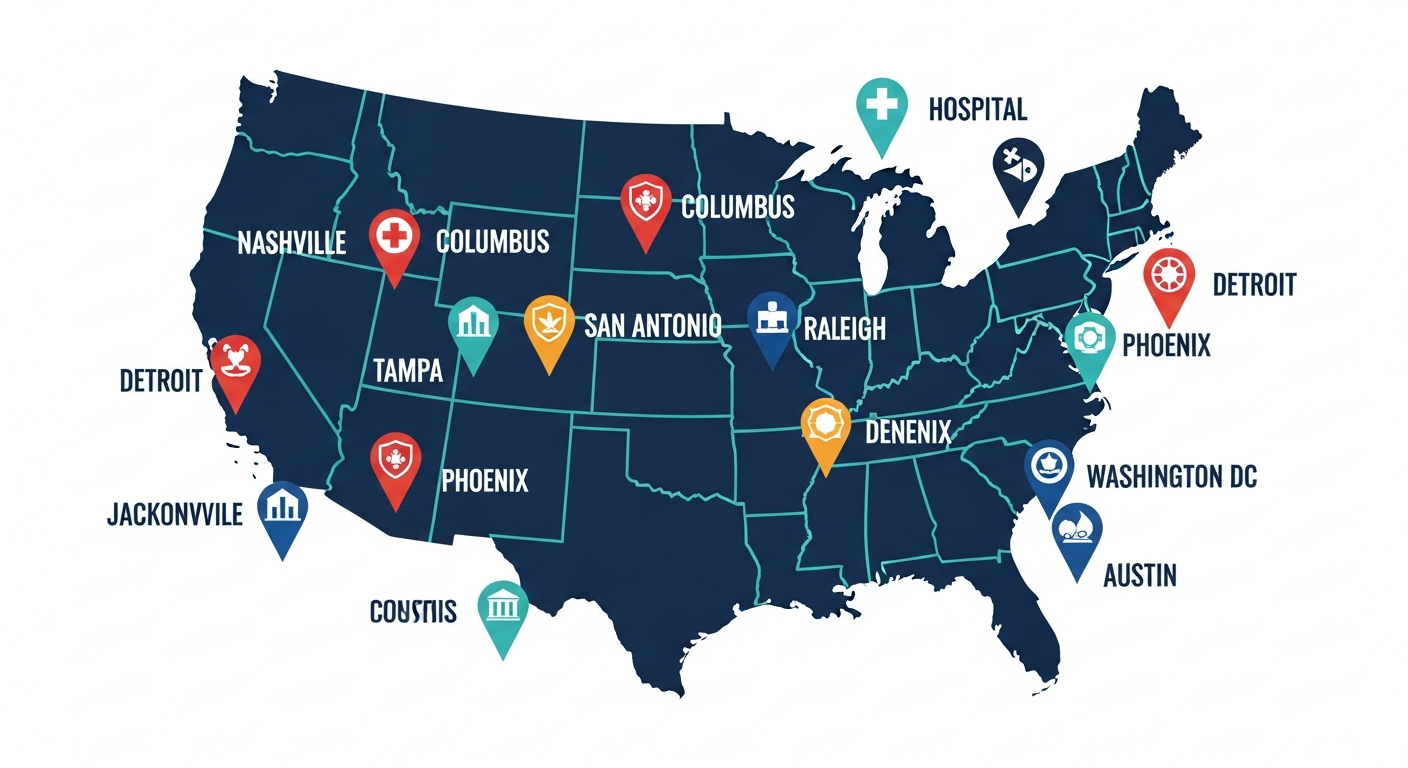
The 12 Best Cities for Mid Term Rentals in 2026
1. Nashville, Tennessee
Why it ranks #1: Nashville has the highest concentration of healthcare companies of any U.S. city, with over 500 healthcare businesses headquartered in the metro area. Vanderbilt University Medical Center, HCA Healthcare (the largest hospital operator in the country), and Ascension Saint Thomas create year-round travel nurse demand. On top of healthcare, Nashville’s music and entertainment industry brings production crews, touring professionals, and corporate event teams on 30 to 90 day assignments.
For a complete setup walkthrough, see our how to rent to travel nurses with platform comparisons and pricing data.
Demand drivers: Travel nurses (VUMC, TriStar, Ascension), corporate relocations (Oracle, Bridgestone, AllianceBernstein), entertainment industry (3-6 month production contracts), university (Vanderbilt, Belmont, Tennessee State).
What operators earn: Furnished 2-bedroom apartments rent for $2,800 to $3,500 per month on Furnished Finder. Net annual income after operating costs: $26,000 to $32,000 per unit. Nashville is the tenth fastest-growing metro in the U.S., which means demand continues to outpace supply.
Regulatory environment: Nashville has strict short term rental permit requirements, but stays of 30 days or longer are generally treated as standard furnished rentals. This means mid term operators avoid the permitting process entirely.
2. Columbus, Ohio
Why it ranks #2: Columbus is one of the most underrated mid term rental markets in the country. Ohio State University’s Wexner Medical Center is the largest academic medical center in the Midwest, employing over 30,000 people and generating constant travel nurse and medical resident demand. The city also has a growing tech sector (Intel’s $28 billion semiconductor factory project in nearby New Albany, Amazon Web Services data centers) that brings corporate relocations on 3-6 month assignments.
Demand drivers: Travel nurses (Wexner Medical Center, OhioHealth, Mount Carmel), corporate relocations (Intel, Amazon, JP Morgan Chase), university (Ohio State, 60,000+ students), military (Defense Supply Center Columbus).
What operators earn: Furnished 2-bedrooms at $1,800 to $2,500 per month. Annual net: $20,000 to $26,000. The rent-to-revenue ratio in Columbus is one of the best in the country because base rents are low relative to what furnished units command.
3. Charlotte, North Carolina
Why it ranks #3: Charlotte’s healthcare expansion is driving mid term rental demand faster than most cities in the Southeast. Atrium Health (now part of Advocate Health, the third-largest nonprofit health system in the U.S.) and Novant Health both run major hospital networks in the metro. Bank of America, Wells Fargo, Truist, and Honeywell headquarters bring corporate relocations. Charlotte added over 100,000 new residents between 2020 and 2025.
Demand drivers: Travel nurses (Atrium Health, Novant Health), financial services relocations (Bank of America, Wells Fargo, Truist), tech growth (Microsoft, Infosys), military (Fort Liberty, formerly Fort Bragg, is 2.5 hours away but feeds Charlotte’s housing market).
What operators earn: Furnished 2-bedrooms at $2,400 to $3,200 per month. Annual net: $24,000 to $30,000. Lower operating costs than Nashville with comparable demand strength.
4. Tampa, Florida
Why it ranks #4: Tampa combines healthcare demand, military presence, and insurance displacement into a three-season market. Tampa General Hospital and Moffitt Cancer Center generate travel nurse demand. MacDill Air Force Base (home of U.S. Central Command) creates military housing needs. And every hurricane season, insurance displacement from storm damage across Florida funnels families into Tampa’s furnished rental inventory.
Demand drivers: Travel nurses (Tampa General, Moffitt Cancer Center, BayCare), military (MacDill AFB), insurance displacement (hurricane season: June through November), corporate relocations (tech growth, financial services).
What operators earn: Furnished 2-bedrooms at $2,400 to $3,200 per month. Annual net: $22,000 to $30,000, with seasonal spikes during hurricane displacement periods when demand and rates increase simultaneously.
5. Detroit, Michigan
Why it ranks #5: Detroit’s healthcare infrastructure is in the middle of a massive expansion. The $3 billion expansion of the Henry Ford Health campus is creating thousands of new healthcare jobs and drawing travel nurses from across the country. Neighborhoods like Corktown and Midtown are seeing rapid gentrification, which means properties acquired or leased now will appreciate in value. Detroit’s low property costs mean the rent-to-revenue ratio is among the best in the country.
Demand drivers: Travel nurses (Henry Ford Health, Detroit Medical Center, Beaumont), automotive industry (GM, Ford, Stellantis contract workers), university (Wayne State, University of Michigan-Dearborn).
What operators earn: Furnished 1-bedrooms at $2,350 to $3,200 per month. Annual net: $22,000 to $28,000. The entry cost for rental arbitrage in Detroit is among the lowest of any major metro, which means you can start with less capital and achieve profitability faster.
6. San Antonio, Texas
Why it ranks #6: San Antonio has one of the largest military populations in the country. Joint Base San Antonio (which includes Fort Sam Houston, Lackland Air Force Base, and Randolph Air Force Base) employs over 80,000 military and civilian personnel. The San Antonio Military Medical Center is one of the largest Department of Defense hospitals, creating travel nurse demand year-round. No state income tax in Texas keeps more of your revenue.
Demand drivers: Military (Joint Base San Antonio, 80,000+ personnel), travel nurses (SAMMC, University Hospital, Methodist Healthcare), university (UT Health San Antonio, UTSA), corporate (USAA, Valero, H-E-B headquarters).
What operators earn: Furnished 2-bedrooms at $2,000 to $2,800 per month. Annual net: $20,000 to $26,000. No state income tax on rental earnings.
7. Raleigh-Durham, North Carolina
Why it ranks #7: The Research Triangle (Raleigh, Durham, Chapel Hill) combines three major research universities, a massive healthcare system, and a growing tech sector. Duke University Hospital, UNC Medical Center, and WakeMed generate heavy travel nurse demand. The Research Triangle Park (RTP) hosts over 300 companies including IBM, Cisco, and Fidelity, bringing corporate relocations on project-based timelines.
Demand drivers: Travel nurses (Duke, UNC Health, WakeMed), corporate/tech (Research Triangle Park, Apple’s new campus), university (Duke, UNC Chapel Hill, NC State), biotech and pharmaceutical research.
What operators earn: Furnished 2-bedrooms at $2,200 to $3,000 per month. Annual net: $22,000 to $28,000.
8. Phoenix, Arizona
Why it ranks #8: Phoenix is one of the fastest-growing metros in the U.S. and has a massive healthcare system anchored by Banner Health, HonorHealth, and Mayo Clinic’s Arizona campus. The city’s warm winter climate creates seasonal demand from snowbirds and winter residents on 3-6 month stays. The semiconductor industry expansion (TSMC’s $165 billion fabrication plant complex in north Phoenix) is bringing thousands of construction and engineering workers on 6-12 month assignments.
Demand drivers: Travel nurses (Banner Health, Mayo Clinic, HonorHealth), semiconductor construction (TSMC), snowbird seasonal demand (October through April), corporate relocations.
What operators earn: Furnished 2-bedrooms at $2,200 to $3,000 per month. Annual net: $20,000 to $26,000. Seasonal pricing: winter rates can be 20-30% higher than summer.
9. Jacksonville, Florida
Why it ranks #9: Jacksonville is the largest city by land area in the continental U.S., which means the rental market is spread across distinct submarkets. Mayo Clinic Jacksonville, Baptist Health, and UF Health Jacksonville generate travel nurse demand. Naval Station Mayport and Naval Air Station Jacksonville bring military housing needs. Lower cost of living than Tampa or Miami with comparable demand drivers.
Demand drivers: Travel nurses (Mayo Clinic, Baptist Health, UF Health), military (NAS Jacksonville, Naval Station Mayport), corporate (FIS, Southeastern Grocers, CSX).
What operators earn: Furnished 2-bedrooms at $2,000 to $2,600 per month. Annual net: $18,000 to $24,000. Insurance displacement during hurricane season adds revenue.
10. Denver, Colorado
Why it ranks #10: Denver’s healthcare system (UCHealth, SCL Health, Denver Health) generates consistent travel nurse demand. The city’s tech sector (Google, Amazon, Oracle offices) and aerospace industry (Lockheed Martin, Ball Aerospace, United Launch Alliance) bring project-based workers. Denver’s outdoor recreation appeal attracts digital nomads and remote workers on 1-3 month stays. Higher rents mean tighter margins, but demand is strong enough to maintain high occupancy.
Demand drivers: Travel nurses (UCHealth, Denver Health), tech and aerospace (Lockheed Martin, Google, Amazon), remote workers and digital nomads, university (CU Anschutz Medical Campus).
What operators earn: Furnished 2-bedrooms at $2,600 to $3,400 per month. Annual net: $22,000 to $28,000. Higher base rents require larger upfront investment but command premium rates.
11. Austin, Texas
Why it ranks #11: Austin’s tech boom has made it one of the most in-demand corporate relocation markets in the country. Tesla, Apple, Google, Meta, Amazon, and Oracle all have significant operations in the metro. Dell Technologies is headquartered here. UT Austin brings academic demand. The downside: Austin’s rapid growth has pushed rents higher, compressing margins for arbitrage operators. Mid term still works, but the rent-to-revenue ratio is tighter than cities ranked above it.
Demand drivers: Corporate relocations (Tesla, Apple, Google, Meta, Oracle, Dell), travel nurses (Ascension Seton, St. David’s), university (UT Austin, 50,000+ students), entertainment (SXSW, ACL, Formula 1 bring seasonal demand).
What operators earn: Furnished 2-bedrooms at $2,600 to $3,500 per month. Annual net: $20,000 to $26,000. Event-driven seasonal spikes (SXSW in March, ACL in October, F1 in October).
12. Washington, D.C.
Why it ranks #12: The federal government is the largest employer in the D.C. metro area. Government contractors, lobbyists, consultants, and political staff regularly need 1-6 month furnished housing. The diplomatic corps, international organizations (IMF, World Bank), and think tanks add another layer of demand. The downside: D.C. has high rents, strict short term rental regulations, and complex landlord-tenant law. Mid term works here, but the startup capital requirement is higher than most markets on this list.
Demand drivers: Federal government and contractors, military (Pentagon, Andrews AFB, Fort Belvoir), diplomatic and international organizations, travel nurses (MedStar, Johns Hopkins nearby), university (Georgetown, GWU, Howard, American).
What operators earn: Furnished 2-bedrooms at $3,200 to $4,500 per month. Annual net: $24,000 to $32,000. Highest absolute rates on this list but also highest base rent costs.
How to Evaluate Any City for Mid Term Rental Potential
If your target city is not on this list, use this framework to evaluate whether it supports a mid term rental business.
Step 1: Identify the demand driver. Search Furnished Finder for your city. If there are 50+ listings already active, demand exists. Check Indeed or LinkedIn for travel nurse job postings at local hospitals. If hospitals are actively recruiting travel nurses, those nurses need housing.
Step 2: Calculate the rent-to-revenue ratio. Find the average unfurnished 2-bedroom rent on Zillow. Multiply by 1.4 (the low end of the furnished premium). That is your projected mid term monthly revenue. Subtract your total monthly costs (rent + utilities + wifi + insurance + platform fees). If the result is positive and represents at least 1.5x your total costs, the market works.
Step 3: Check the regulatory environment. Search “[city name] short term rental regulations” and read the ordinance. Look specifically for: minimum stay requirements (if 30+ days is exempt from STR rules, you are clear), licensing or permit requirements for furnished rentals, and zoning restrictions on rental properties.
Step 4: Test before committing. Before signing a lease, list a co-listing arrangement on Furnished Finder to gauge demand. If you receive 3-5 inquiries within 30 days, the market has enough demand to support a unit. If you hear nothing, the demand is not there yet.
Getting Started: Zero Capital vs Invested Capital
If you have zero capital, start with co-listing. Find property owners in one of the cities listed above who have vacant furnished units or underperforming Airbnb listings. Offer to manage their property on Furnished Finder and Airbnb (30+ day minimum) for 20-25% of the monthly rent. You manage the listing, handle tenant communication, and coordinate cleaning between stays. The owner keeps the rest. No lease. No furniture. No risk.
If you have $7,000 to $12,000, rental arbitrage lets you lease a property, furnish it, and keep all the revenue above your costs. Your target market should have a furnished mid term rate that is at least 1.5x your total monthly costs. See our full breakdown of mid term rental income by city for exact numbers.
If you are serious about building a portfolio in mid term rentals and want structured guidance, live coaching, and a community of operators doing the same thing, book a strategy call to see if the 10XBNB program is the right fit for your market and goals.
Frequently Asked Questions About Mid Term Rental Markets
What is the best city for mid term rentals in 2026?
Nashville, Tennessee ranks first because of its concentration of 500+ healthcare companies, major hospital systems (Vanderbilt, HCA, Ascension), growing tech sector, and favorable regulatory environment for 30+ day stays. Operators earn $26,000 to $32,000 net per unit annually.
Which cities have the highest mid term rental demand?
Cities with major medical centers, military installations, and corporate headquarters generate the most consistent mid term demand. Nashville, Columbus, Charlotte, Tampa, and San Antonio lead due to their combination of healthcare, military, and corporate demand drivers.
Can I start mid term rentals with no money?
Yes, through the co-listing model. You manage property owners’ furnished units on platforms like Furnished Finder and Airbnb (30+ day stays) for 20-25% of the monthly rent. No lease, no furniture, no financial risk. Co-listing vs rental arbitrage applies the same way in mid term as in short term.
How much does a mid term rental make per month?
Furnished 2-bedroom apartments in strong markets rent for $1,800 to $4,500 per month depending on the city. After operating costs (20-35% of revenue), net income ranges from $18,000 to $34,000 per year per unit. See our full mid term rental income guide for city-by-city breakdowns.
Are mid term rentals legal everywhere?
In most U.S. cities, yes. A 30-day minimum stay typically classifies as a standard furnished rental under existing landlord-tenant law, avoiding the permitting, licensing, and occupancy tax requirements that apply to nightly short term rental bookings. Always check your specific city’s regulations before starting.
What platform should I use for mid term rentals?
Furnished Finder is the largest dedicated mid term rental platform with over 300,000 listings and 2 million annual tenant inquiries. List simultaneously on Airbnb (set 28+ day minimum stay), Zillow Rentals, and local Facebook groups for travel nurses and relocating professionals to maximize occupancy.