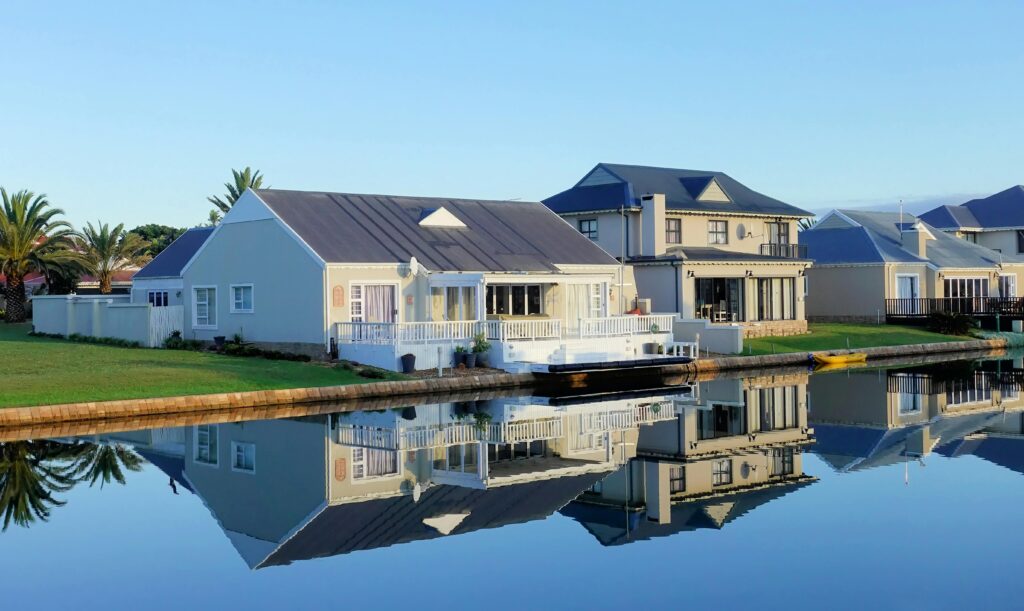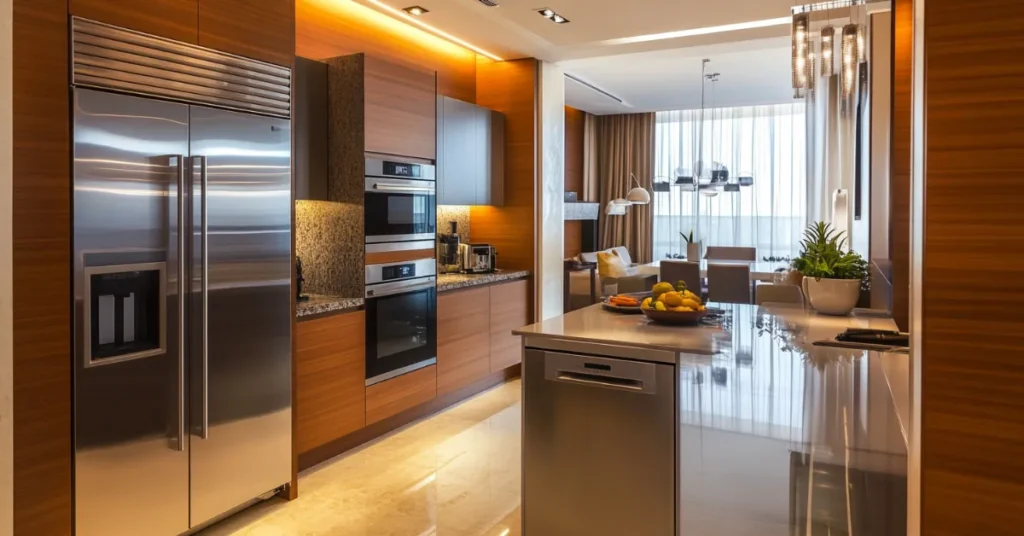

Airbnb is one of the most accessible side hustles in 2026, and one of the few where you can start with zero capital, scale at your own pace, and eventually replace your full-time income if you want to. The short-term rental market is still growing, platforms like Airbnb and VRBO are actively recruiting new hosts, and there are multiple business models that don’t require you to own a single property. The best part? You can run this entire operation from your phone during lunch breaks, after the kids go to bed, or on weekend mornings. This guide covers five proven ways to start an Airbnb side hustle, real income data from people actually doing it, and practical strategies for balancing hosting with a 9-to-5 job. Our learn how to host on Airbnb guide covers everything you need.
Why Airbnb Is the Perfect Side Hustle
Not all side hustles are created equal. Driving for Uber caps your earnings at one passenger at a time. Freelancing trades hours for dollars. Dropshipping requires paid ads and inventory risk. Airbnb hits differently because it combines passive income mechanics with active entrepreneurship. You build something that generates revenue even while you sleep.
Flexible Hours That Fit Around Your Job
Unlike gig economy jobs that demand your physical presence, an Airbnb side hustle runs on your schedule. Guest messages come through an app. Pricing adjustments take two minutes. Cleaning crews handle turnovers. Most successful part-time hosts spend 5-10 hours per week managing their listings, and the bulk of that time is frontloaded during setup. Once your systems are dialed in, weekly maintenance drops to a few hours at most.
Scalable Income Without a Ceiling
A single Airbnb listing can generate $1,000-$4,000 per month depending on your market, property type, and management quality. But here’s what makes this different from most side hustles: you can add more listings without proportionally increasing your time. Managing five properties doesn’t take five times longer than managing one, especially with the right automation tools and standard operating procedures. That scalability is what separates a side hustle from a side job.
Multiple Entry Points (No Property Required)
The biggest misconception about Airbnb is that you need to own real estate. You don’t. There are at least five distinct ways to enter the short-term rental market, and three of them require zero property ownership and minimal startup capital. Whether you have $0 or $10,000 to invest, there’s a path that fits your situation. Wondering what’s actually possible? Check out student success stories from people who started Airbnb as a side hustle. We break all five down in the next section.
A Growing Market with Room for New Hosts
According to Airbnb’s own data, the platform added over 1.5 million new listings globally in the past year, and demand continues to outpace supply in many markets. The U.S. Travel industry generated over $1.3 trillion in 2025, with short-term rentals capturing an increasing share. Rural markets, mid-size cities, and experience-driven destinations are still underserved, meaning the window of opportunity for new hosts is wide open.
5 Ways to Start an Airbnb Side Hustle
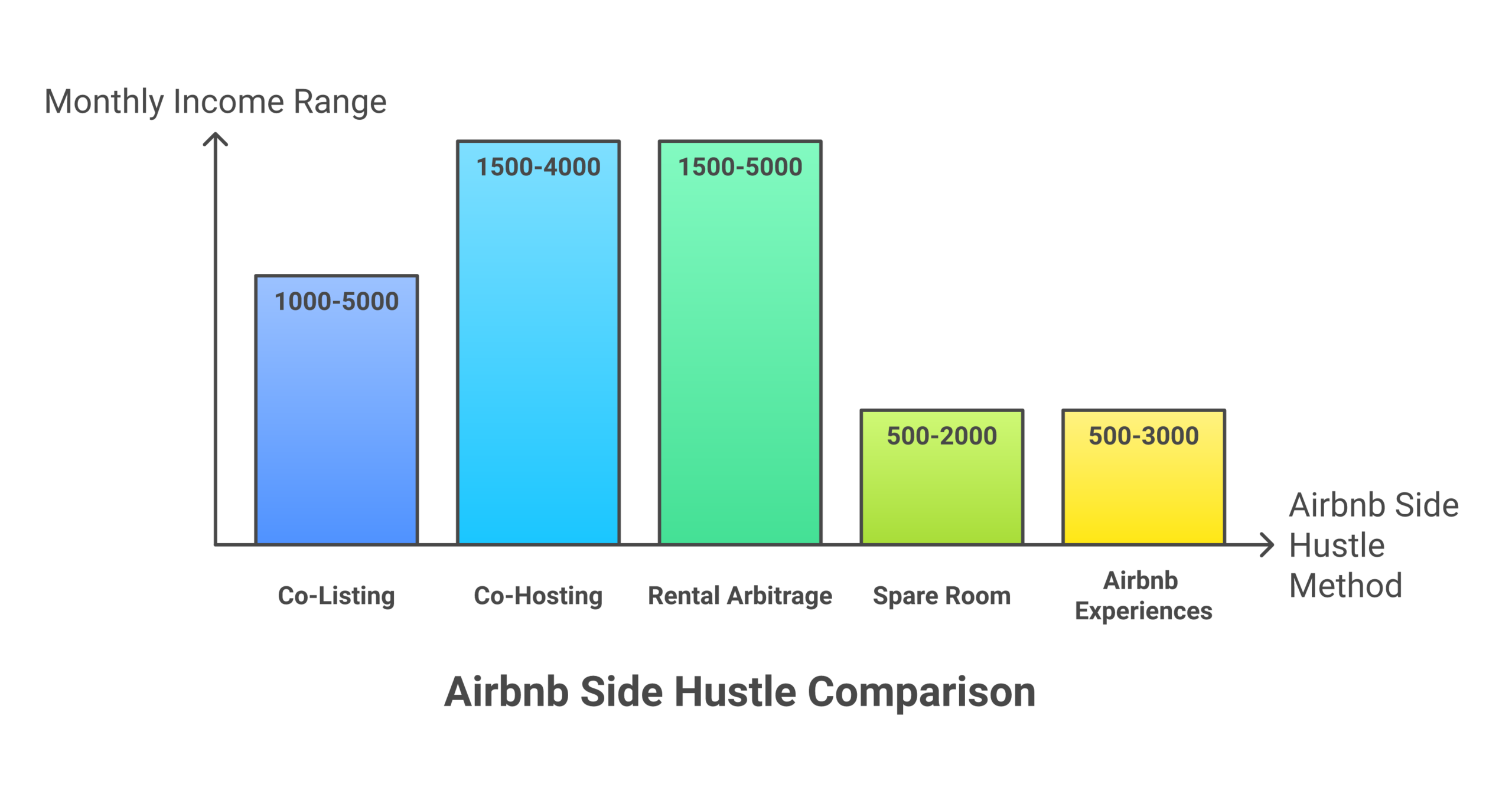
Each of these methods works as a side hustle. The difference is your starting capital, risk tolerance, and how hands-on you want to be. Here’s the honest breakdown.
<! - wp:image {"id":6615,"sizeSlug":"large","linkDestination":"none"} - >
<! - /wp:image - >
1. Co-Listing (Manage Other People’s Properties)
Co-listing is the fastest path from zero to earning because you don’t need property, capital, or even local market access. You partner with property owners who want their homes listed on Airbnb but don’t want to handle the work. You create the listing, optimize it, manage bookings, coordinate cleaners, and handle guest communication. In return, you earn 10-20% of every booking.
The beauty of co-listing as a side hustle is the math: land three properties averaging $3,000/month in bookings at a 15% split, and you’re earning $1,350/month with no lease liability, no furniture costs, and no financial risk. Scale to ten properties and you’re at $4,500/month, all while keeping your day job.
Finding property owners is easier than most people think. Many homeowners already own vacation properties, second homes, or investment properties that sit empty for weeks or months at a time. They know they should list on Airbnb but don’t have the time, knowledge, or desire to manage it. Your pitch is simple: “I’ll handle everything, and you get passive income from a property that’s currently making you nothing.” Learn the full co-listing model in our Airbnb co-listing guide.
2. Co-Hosting (Help Existing Hosts)
Co-hosting is similar to co-listing but with one key difference: you’re helping someone who already has an active Airbnb listing. They’ve done the setup. They just need help managing the day-to-day. Airbnb has a built-in co-host feature that lets property owners add you to their listing with a defined commission split.
As a co-host, you might handle guest messaging, review management, pricing adjustments, or cleaning coordination. Some co-hosts are hands-on (doing check-ins and inspections), while others operate entirely from their phone. The commission typically ranges from 10-25% depending on how much responsibility you take on.
This is an ideal starting point if you want to learn the Airbnb business with training wheels. You’re working with someone else’s listing, their reviews, and their property, which means lower stakes while you build skills and confidence. Read our complete co-hosting breakdown for scripts and strategies to land your first co-hosting client.
3. Rental Arbitrage (Lease and Sublet)
Rental arbitrage means signing a long-term lease on a property and then listing it on Airbnb at a higher nightly rate. Your profit is the spread between your monthly rent and your short-term rental revenue. For example, you might lease a two-bedroom apartment for $1,800/month and generate $4,500/month in Airbnb bookings, clearing $1,500-$2,000/month after expenses.
The upside is higher per-unit profit than co-hosting or co-listing. The downside is that arbitrage requires more startup capital ($5,000-$12,000 per unit for deposits and furnishing) and you carry lease liability even during slow months. As a side hustle, start with one unit in a proven market, build cash reserves, and scale only after you’ve demonstrated consistent profitability. Our rental arbitrage guide walks through the entire process including landlord negotiation, market selection, and furnishing on a budget.
4. Rent Out a Spare Room
The simplest entry point. If you have an extra bedroom, basement suite, or guest house, listing it on Airbnb requires almost nothing to get started. You already have the space. You just need clean linens, a few amenities, and a compelling listing. Spare room hosts typically earn $500-$1,500/month depending on location and demand.
The limitation here is scalability. You only have one spare room (maybe two), so your income ceiling is fixed. But as a first step into the Airbnb world, it’s hard to beat: zero financial risk, immediate income, and hands-on experience with the platform that translates directly to co-listing or arbitrage later.
5. Airbnb Experiences
Airbnb Experiences let you monetize a skill, hobby, or local knowledge without any property at all. You create and host activities, walking tours, cooking classes, photography workshops, surfing lessons, wine tastings, and Airbnb handles the booking platform. Hosts set their own prices (typically $25-$150 per person per session) and keep 80% after Airbnb’s 20% service fee.
As a side hustle, Experiences work best if you live in a tourist-friendly area and have a unique skill or deep local knowledge. The income potential varies widely, but top Experience hosts report $2,000-$5,000/month running 3-4 sessions per week. The downside: it’s time-intensive and trades hours for dollars, making it harder to scale than property-based models.
Comparison: All 5 Methods at a Glance
| Method | Startup Cost | Monthly Income | Hours/Week | Risk Level | Scalability |
|---|---|---|---|---|---|
| Co-Listing | $0-$300 | $1,000-$6,000+ | 5-15 | Very Low | Very High |
| Co-Hosting | $0-$200 | $500-$4,000 | 5-12 | Very Low | High |
| Rental Arbitrage | $5,000-$12,000 | $1,500-$3,000/unit | 10-20 | Medium-High | Medium |
| Spare Room | $100-$500 | $500-$1,500 | 3-5 | Very Low | Very Low |
| Experiences | $0-$500 | $500-$5,000 | 8-20 | Low | Low |
For most people starting from scratch with limited capital, co-listing is the strongest option. Zero financial risk, high scalability, and you can operate it entirely from your phone while working a full-time job. That’s exactly why it’s the model 10XBNB students use to build their first $1,000-$6,000/month in side income.
Ready to Start Your Airbnb Side Hustle?
Learn how our students earn $1,000-$6,000/month while keeping their day jobs.
How Much Can You Make with an Airbnb Side Hustle?
Let’s get specific. Theoretical income ranges are fine for blog posts, but if you’re seriously considering this, you need real numbers from real people working real hours.
Income Ranges by Method and Time Commitment
| Hours/Week | Co-Listing | Co-Hosting | Rental Arbitrage | Spare Room |
|---|---|---|---|---|
| 5-10 hrs | $1,000-$2,500/mo | $500-$1,500/mo | $800-$1,500/mo (1 unit) | $500-$1,500/mo |
| 10-15 hrs | $2,500-$4,500/mo | $1,500-$3,000/mo | $1,500-$3,000/mo (1-2 units) | $500-$1,500/mo |
| 15-20 hrs | $4,500-$8,000/mo | $3,000-$5,000/mo | $3,000-$6,000/mo (2-3 units) | $500-$1,500/mo |
What 10XBNB Students Report
The numbers above aren’t hypothetical. 10XBNB students who started Airbnb as a side hustle, while working full-time jobs in industries like healthcare, education, tech, and finance, regularly report hitting $1,000-$6,000/month within their first 90 days using the co-listing model. Some highlights:
- A registered nurse in Tennessee landed three co-listing clients within 45 days and now earns $2,800/month managing them on evenings and weekends
- A software engineer in Colorado manages five properties remotely, earning $4,200/month with roughly 8 hours of work per week
- A teacher in Florida started with one co-hosting client, then transitioned to co-listing and scaled to $5,500/month in six months, all before quitting her day job
These results vary by market, effort, and execution quality. But the pattern is consistent: people who follow a proven system and take action within the first 30 days see their first income quickly. Check out documented earnings and screenshots on our Airbnb co-host income page and verified student results.
What Determines Your Income Ceiling?
Your Airbnb side hustle income depends on four variables:
- Market selection – A property in Gatlinburg, Tennessee will generate 2-3x more revenue than the same property in a sleepy suburb. Research markets before committing to any method. Our best states for Airbnb analysis breaks down the top-performing markets.
- Number of properties – More properties = more income. With co-listing, adding a property doesn’t require additional capital, just additional relationships with property owners.
- Listing optimization – Professional photos, compelling descriptions, competitive pricing, and fast response times can increase a listing’s revenue by 20-40% compared to a poorly managed property.
- Automation level – The more you automate (pricing, messaging, cleaning scheduling), the more properties you can manage without drowning in admin work.
How to Balance Airbnb with a Full-Time Job
This is the question everyone asks, and it’s the right one. An Airbnb side hustle is only worth pursuing if you can actually do it without burning out or tanking your performance at work. Here’s how people pull it off.
Automate Everything Possible
Automation is the difference between a side hustle that runs smoothly and one that consumes your life. At minimum, you should automate:
- Guest messaging – Use saved templates for booking confirmations, check-in instructions, checkout reminders, and review requests. Most can be fully automated through Airbnb’s built-in tools or third-party software like Hospitable or Guesty.
- Pricing – Dynamic pricing tools (PriceLabs, Wheelhouse, Beyond) adjust your nightly rate based on demand, seasonality, local events, and competitor rates. Set it once, review weekly.
- Cleaning coordination – Set up automatic cleaning triggers that notify your cleaner after every checkout. No manual scheduling needed.
- Reviews – Automate review posting with templates. A personalized touch helps, but a good template beats no review at all.
When your systems are dialed in, managing a property takes 20-30 minutes per week. That’s not a typo. The heavy lifting is upfront, once your listing is live, optimized, and automated, the ongoing work is minimal. Dive deeper into our hands-free Airbnb automation guide for the complete tech stack.
Start with 1-2 Properties
Resist the urge to scale fast. Your first property is your training ground. You’ll make mistakes with messaging, pricing, cleaning coordination, and guest expectations, and that’s fine. It’s much better to learn those lessons with one property than with five.
Here’s a realistic timeline for a side hustler with a full-time job:
- Weeks 1-2: Learn the fundamentals, research your market, identify potential property owners or co-hosting opportunities
- Weeks 3-4: Pitch property owners, secure your first client or listing
- Month 2: Launch your first listing, optimize and iterate based on initial bookings
- Month 3: Stabilize operations, begin looking for your second property
- Months 4-6: Scale to 3-5 properties with established systems
Set Clear Boundaries
You don’t need to be available 24/7. Set expectations upfront:
- Response time: Airbnb rewards fast responses, but “fast” means within an hour. Not within seconds. Use auto-replies during work hours: “Thanks for your message! I’ll respond with a detailed answer within the hour.”
- Check-in windows: Set specific check-in times (3 PM-8 PM) so you’re not coordinating arrivals during work meetings
- Emergency protocol: Have a local backup person (a friend, your cleaner, a handyman) who can handle true emergencies if you’re in a meeting or on a work trip
Build a Support Team Early
Even with one property, start building your team. You need:
- A reliable cleaning team (the most critical hire, bad cleaners sink listings)
- A handyman for minor repairs
- A local contact for emergencies (if you’re managing remotely)
- Eventually, a virtual assistant for messaging overflow
Your team doesn’t need to be expensive. A good cleaning crew for a single property costs $80-$150 per turnover, paid by the guest through the cleaning fee. A handyman on call might charge $50-$100 per visit for basic fixes. The goal is to remove yourself from tasks that don’t require your personal attention so you can focus on growing the business.
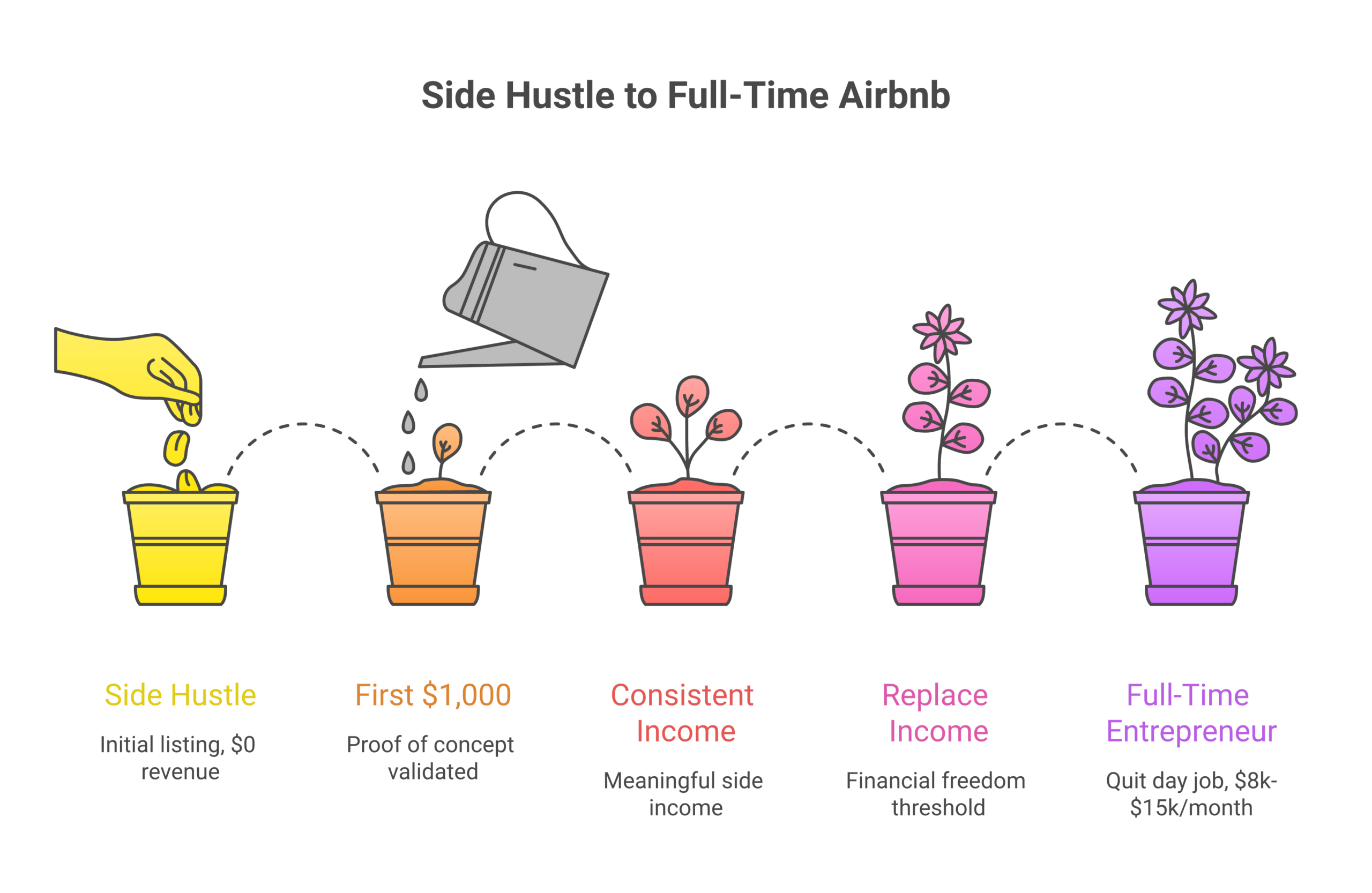
From Side Hustle to Full-Time Income
At some point, your Airbnb side income might rival, or exceed, your day job salary. When that happens, you face a decision. Here’s how to think about it clearly.
<! - wp:image {"id":6617,"sizeSlug":"large","linkDestination":"none"} - >
<! - /wp:image - >
When to Know You’re Ready to Go Full-Time
Don’t quit your job based on one good month. Use these benchmarks:
- Consistent income: Your Airbnb income has exceeded your salary for at least 3 consecutive months
- Cash reserves: You have 6 months of personal expenses saved as a safety net
- Proven systems: Your operations run smoothly without your constant attention
- Growth runway: You can clearly see how to add 3-5 more properties within 90 days of going full-time
The psychological threshold matters too. Some people leave their jobs at $3,000/month because they have low expenses and high risk tolerance. Others wait until $10,000/month because they have a family to support. There’s no universal number. But there is a universal principle: don’t make an emotional decision. Let the data guide you.
Students Who Made the Transition
10XBNB has hundreds of students who started part-time and transitioned to full-time Airbnb entrepreneurs. The stories share common threads:
- Most started while working full-time jobs they didn’t hate. They weren’t running from something, they were running toward financial freedom
- The average transition happened between months 4 and 8, once monthly co-listing income stabilized above $5,000/month
- Nearly all say the co-listing model was the key because it scales without proportional time increases, managing 10 properties takes maybe 2x the effort of managing 3, not 3.3x
Why Co-Listing Scales Without Burning You Out
This is the critical insight most people miss about Airbnb as a side hustle that becomes a career. With rental arbitrage, each new unit adds real financial liability and operational overhead. With co-listing, each new property adds revenue with almost no additional cost. You’re managing relationships and systems, not leases and furniture.
At ten co-listed properties, your systems handle 90% of the work. Guest messaging is templated. Pricing is automated. Cleaning is scheduled automatically. Your job becomes owner relationship management and growth, the high-use activities that actually move the needle. Explore the full system on our program details page.
Turn Your Side Hustle Into a Real Business
Get the proven co-listing system. No property needed.
Frequently Asked Questions
Can I really do Airbnb as a side hustle while working full-time?
Yes, and thousands of people do exactly that. Co-listing and co-hosting are specifically designed for part-time operators. Most successful side hustlers spend 5-10 hours per week managing their Airbnb properties, primarily through their phone. The key is automation: automated messaging, dynamic pricing tools, and a reliable cleaning team handle 80-90% of the operational work. Many 10XBNB students started their first co-listing clients while working 40+ hour corporate jobs.
Do I need to own property to start an Airbnb side hustle?
No. Three of the five methods in this guide, co-listing, co-hosting, and Airbnb Experiences, require zero property ownership. Co-listing and co-hosting let you earn income by managing other people’s properties, while Experiences monetize your skills or local knowledge. Even rental arbitrage doesn’t require ownership; you lease a property and sublet it on Airbnb. The only method that requires owning property is renting a spare room in your own home.
How much money do I need to start?
It depends on your chosen method. Co-listing and co-hosting can be started with $0-$300 (mainly for a laptop and phone you probably already own). Renting a spare room costs $100-$500 for linens and supplies. Airbnb Experiences range from $0-$500 depending on supplies needed. Rental arbitrage is the most capital-intensive at $5,000-$12,000 per unit for deposits, furniture, and setup. If you’re starting with limited funds, co-listing is the clear winner.
How long does it take to earn my first dollar?
With co-listing, most motivated starters land their first property owner client within 2-4 weeks and see their first payout within 30-45 days. Co-hosting follows a similar timeline. Rental arbitrage takes longer, typically 30-60 days to sign a lease, furnish the property, and receive your first booking. Spare room listings can go live within 24 hours if your space is ready. Airbnb Experiences require an application process that takes 2-4 weeks for approval.
Is Airbnb hosting legal in my area?
Short-term rental regulations vary dramatically by city, county, and state. Most areas allow some form of hosting, but specific rules around permits, licensing, occupancy taxes, and zoning differ widely. Before committing to any method, check your local short-term rental ordinances, HOA rules (if applicable), and state laws. The U.S. Small Business Administration provides guidance on local permits and licensing requirements. For rental arbitrage, you also need explicit written permission from your landlord.
What’s the biggest mistake new Airbnb side hustlers make?
Trying to do everything manually. New hosts who respond to every message personally, adjust prices by hand, and coordinate cleaning through text messages hit a wall fast, usually around 2-3 properties. At that point, the side hustle starts feeling like a second full-time job. The fix is simple: automate from day one. Set up message templates before your first guest arrives. Use a dynamic pricing tool before your first booking. Establish a cleaning schedule before your first turnover. The operators who build systems early are the ones who scale to 5, 10, or 20+ properties without burning out.