Can Airbnb actually generate passive income? The short answer is yes, but the longer answer matters more. True passivity on Airbnb doesn’t happen by accident. It requires choosing the right business model, building systems from day one, and resisting the urge to handle every guest message yourself at 11 PM. Most hosts start active and stay active because they never architect their business for automation. The operators who earn $5,000, $10,000, or $20,000 per month without daily involvement didn’t get lucky. They built deliberately. In this guide, you’ll learn exactly which Airbnb business models offer the most passive income potential, how to automate the pieces that eat your time, and what realistic income looks like at each stage. Whether you own property, lease it, or manage listings for others, there’s a path to Airbnb passive income that fits your situation.
What Does Airbnb Passive Income Actually Look Like?
Let’s kill a myth right now: there is no such thing as 100% passive income on Airbnb. Even the most automated operators spend a few hours per week reviewing performance, handling edge cases, or making strategic decisions. But “a few hours per week” is a far cry from the 40+ hours many new hosts pour into their single listing.
Airbnb passive income exists on a spectrum. On one end, you have the hands-on host who personally greets every guest, cleans between stays, and answers every booking question. That’s a job, not passive income. On the other end, you have operators running 10, 20, or 50+ listings with automated messaging, a cleaning team on rotation, dynamic pricing tools adjusting rates nightly, and a co-host handling the rare escalation. They check in for maybe 3-5 hours per week.
The key distinction is this: passive Airbnb income isn’t about doing nothing. It’s about building a system where your involvement is strategic rather than operational. You make decisions about which markets to enter, which properties to add, and which team members to hire. You don’t unclog toilets or argue about late checkouts.
Where you land on that spectrum depends almost entirely on two factors: your business model and your willingness to build systems before you think you need them. The operators who reach near-passive status fastest are the ones who treat their Airbnb business like a business from day one, not a side hustle they’ll “figure out later.”
3 Airbnb Business Models Ranked by Passivity
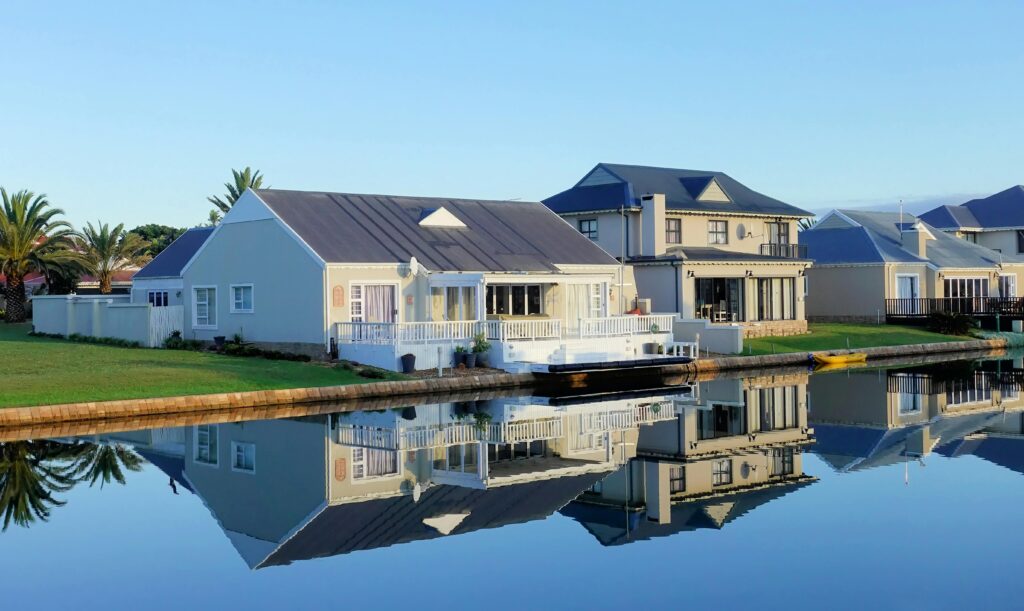
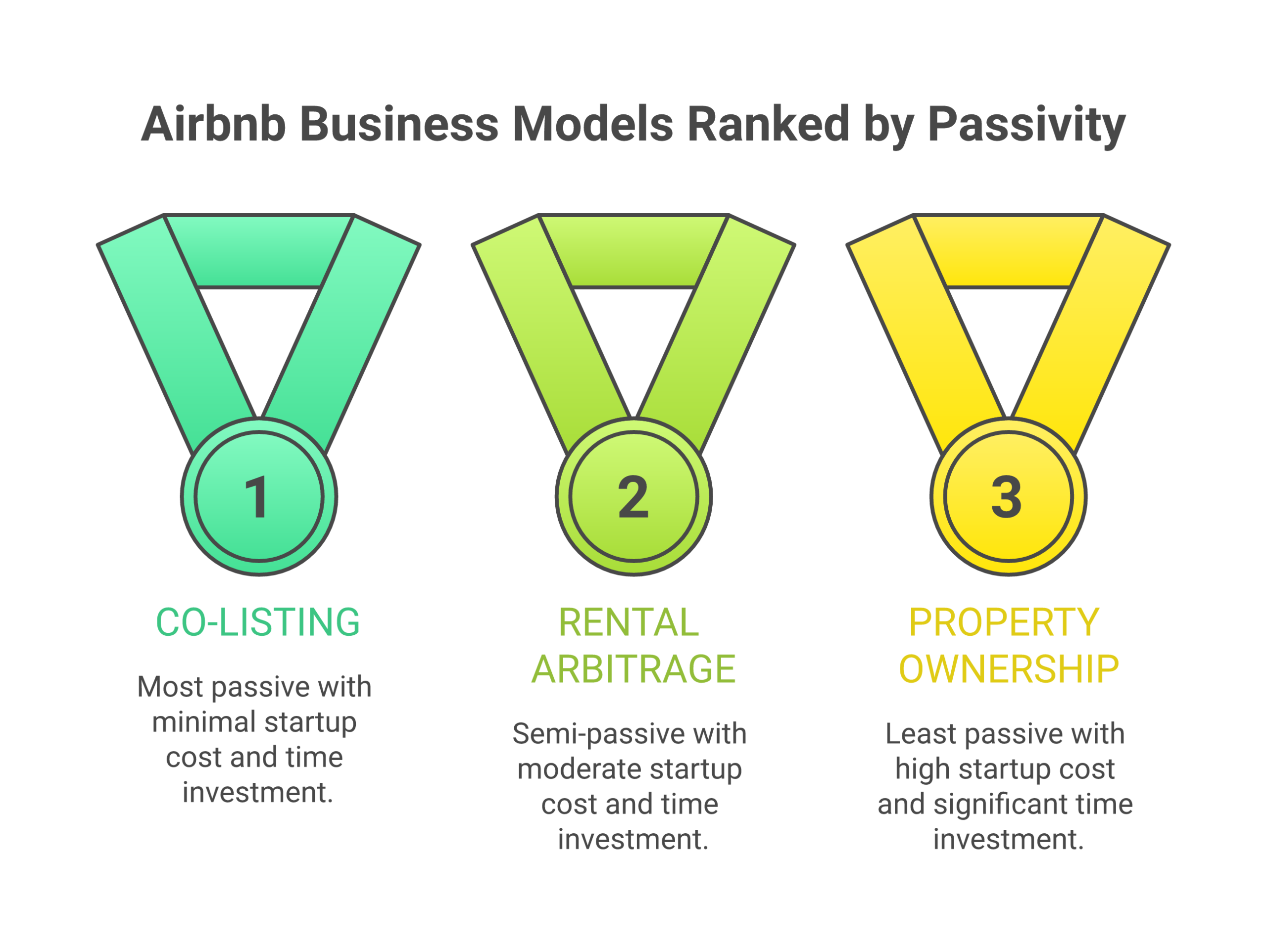
Not all Airbnb business models are created equal passive income potential. Here’s how the three most common approaches stack up, ranked from most to least passive.
<! - wp:image {"id":6611,"sizeSlug":"large","linkDestination":"none"} - >
<! - /wp:image - >
Co-Listing / Co-Hosting (Most Passive Potential)
Co-listing (also called co-hosting) is the closest thing to truly passive Airbnb income. Here’s why: you don’t own the property, you don’t sign a lease, and you don’t pay rent. Instead, you manage Airbnb listings for property owners who either don’t want to or don’t know how to host effectively. You earn a percentage of each booking, typically 10-25%, in exchange for handling guest communication, coordinating cleanings, and optimizing the listing.
The passive income potential is high because every operational task in co-listing can be systematized. Guest messages follow templates. Cleaning schedules run on autopilot. Pricing tools adjust rates automatically. Once you’ve set up systems for one property, adding the next takes a fraction of the effort. You’re scaling revenue without scaling your personal time.
Co-listing also carries the lowest financial risk of any Airbnb model. There’s no mortgage payment if bookings slow down, no lease obligation if a market shifts, and no capital required to get started. That combination of low risk, high scalability, and strong automation potential is why co-listing has become the fastest-growing segment of the short-term rental industry. See real student results from co-listers who have built passive income streams using this model.
Rental Arbitrage (Semi-Passive)
Rental arbitrage sits in the middle of the passivity spectrum. You sign a long-term lease on a property, furnish it, and list it on Airbnb at nightly rates that exceed your monthly rent. The difference is your profit. A two-bedroom apartment leased at $1,500 per month might generate $3,500-$5,000 in Airbnb revenue, leaving you $2,000-$3,500 in gross profit before expenses.
Arbitrage can become semi-passive with the right systems. Automated messaging, a reliable cleaning crew, and dynamic pricing handle the daily operations. But you still carry lease obligations. If occupancy drops or a market softens, you’re on the hook for rent regardless. That financial exposure means you need to stay more engaged with market conditions, seasonal trends, and property performance than a co-lister would.
The upside of arbitrage is higher per-property margins compared to co-listing. You keep 100% of the profit above your costs, rather than earning a percentage. For operators who want to build passive income and are comfortable with moderate risk, arbitrage offers a strong middle ground.
Property Ownership (Least Passive Initially)
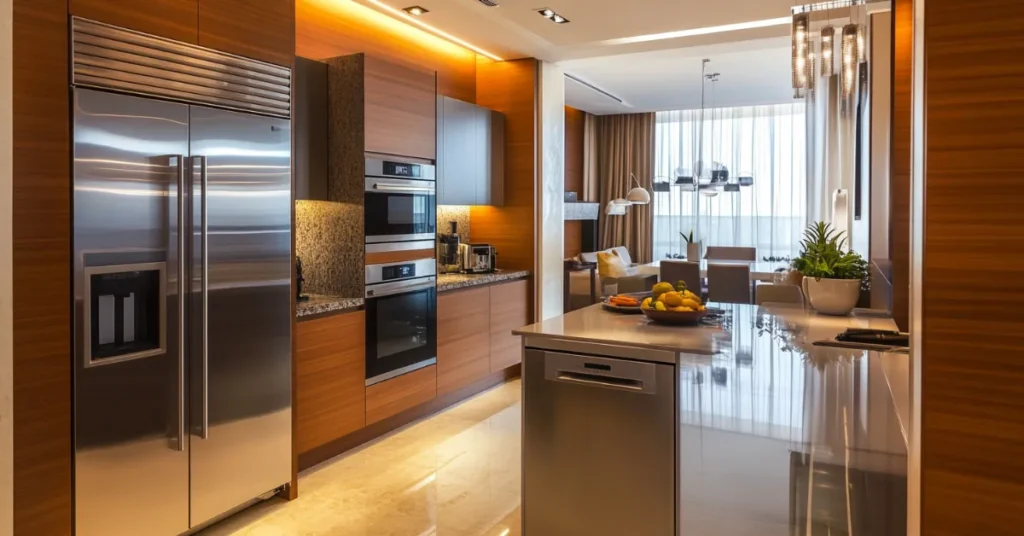
Owning short-term rental properties is the least passive model at the start but potentially the most rewarding long-term. You’re dealing with mortgages, property taxes, insurance, maintenance, and all the responsibilities of ownership on top of Airbnb hosting operations.
The path to passive income through ownership requires the most capital and the longest timeline. You need a down payment, you need to furnish the property, and you need to survive the learning curve of both real estate investing and short-term rental management simultaneously. However, ownership builds equity. Every mortgage payment increases your net worth, and property values in strong short-term rental markets have historically appreciated well.
Many successful operators combine models. They start with co-listing to learn the business and generate cash flow with zero risk, then use those profits and skills to move into arbitrage or ownership when the time is right.
| Factor | Co-Listing / Co-Hosting | Rental Arbitrage | Property Ownership |
|---|---|---|---|
| Startup Capital | $0 – $500 | $3,000 – $10,000 | $30,000 – $100,000+ |
| Monthly Risk | None | Lease payments | Mortgage + taxes + insurance |
| Passivity Potential | High | Medium | Low (initially) |
| Scalability | Very high | Moderate | Capital-limited |
| Equity Building | No | No | Yes |
| Time to Passive | 30-90 days | 3-6 months | 6-18 months |
| Best For | Beginners, low-risk seekers | Moderate risk tolerance | Long-term investors |
How to Make Your Airbnb Income Truly Passive
Regardless of which business model you choose, the path to passive Airbnb income runs through automation and delegation. Here are the four systems that separate passive operators from overworked hosts.
Automate Guest Communication
Guest communication is the biggest time sink for most Airbnb hosts. Booking confirmations, check-in instructions, mid-stay check-ins, checkout reminders, review requests. Multiply that across multiple properties and you’re spending hours daily on repetitive messages.
The fix is automated messaging. Tools like Hospitable (formerly Smartbnb), Host Tools, and Airbnb’s built-in scheduled messages let you create template sequences triggered by booking events. A guest books and immediately receives a confirmation with house rules. Two days before check-in, they get detailed access instructions. The morning of checkout, a reminder with departure steps. After checkout, a review request.
Well-crafted templates handle 85-90% of guest communication without you touching your phone. You only step in for genuine questions or issues that fall outside the templates. That alone can reduce your weekly time commitment by 5-10 hours per property.
Build a Cleaning Team
Turnover cleaning is the operational backbone of any short-term rental. A missed or poorly done cleaning destroys your reviews, and reviews are everything on Airbnb. Building a reliable cleaning team, rather than doing it yourself or scrambling for one-off cleaners, is non-negotiable for passive income.
The best approach is having a primary cleaning team and a backup. Pay competitively, because a great cleaner who stays for years is worth far more than saving $20 per clean on someone unreliable. Use a turnover management tool like TurnoverBnB or Breezeway that automatically notifies your cleaner when a guest checks out and the next guest’s check-in is approaching. The cleaner confirms completion with photos. You never have to coordinate manually.
Use Dynamic Pricing Tools
Manual pricing is a trap. You either leave money on the table during high-demand periods or sit vacant during slow seasons because your rates are too high. Dynamic pricing tools like PriceLabs, Beyond Pricing, and Wheelhouse analyze market demand, competitor rates, local events, seasonality, and day-of-week patterns to adjust your nightly rate automatically.
Operators using dynamic pricing tools consistently report 10-30% higher revenue compared to manual pricing. More importantly for passive income, you eliminate the need to monitor rates daily. Set your minimum and maximum thresholds, configure your strategy preferences, and let the algorithm optimize. Review performance weekly rather than adjusting prices daily.
Hire a Co-Host or Property Manager
The final piece of the passive income puzzle is delegation. Even with automated messages, a cleaning team, and dynamic pricing, there will be situations that require a human decision. A guest locks themselves out at midnight. A pipe bursts. A neighbor complains about noise. If you want truly passive income, you need someone else handling those calls.
Hiring a co-host typically costs 10-20% of revenue, but it buys you something no tool can: complete freedom from operational interruptions. A good co-host handles guest issues, coordinates with your cleaning team, manages maintenance requests, and only escalates to you for major decisions. For operators managing multiple properties, this is the difference between a business and a second job. For a deeper look at building a hands-free operation, see our guide on hands-free Airbnb automation.
Want to Build Passive Airbnb Income Without Owning Property?
See how real students built automated co-listing businesses from scratch.
How Much Passive Income Can You Make from Airbnb?
Income potential varies significantly based on your model, market, and number of listings. Here’s what realistic passive income from Airbnb looks like at different stages.
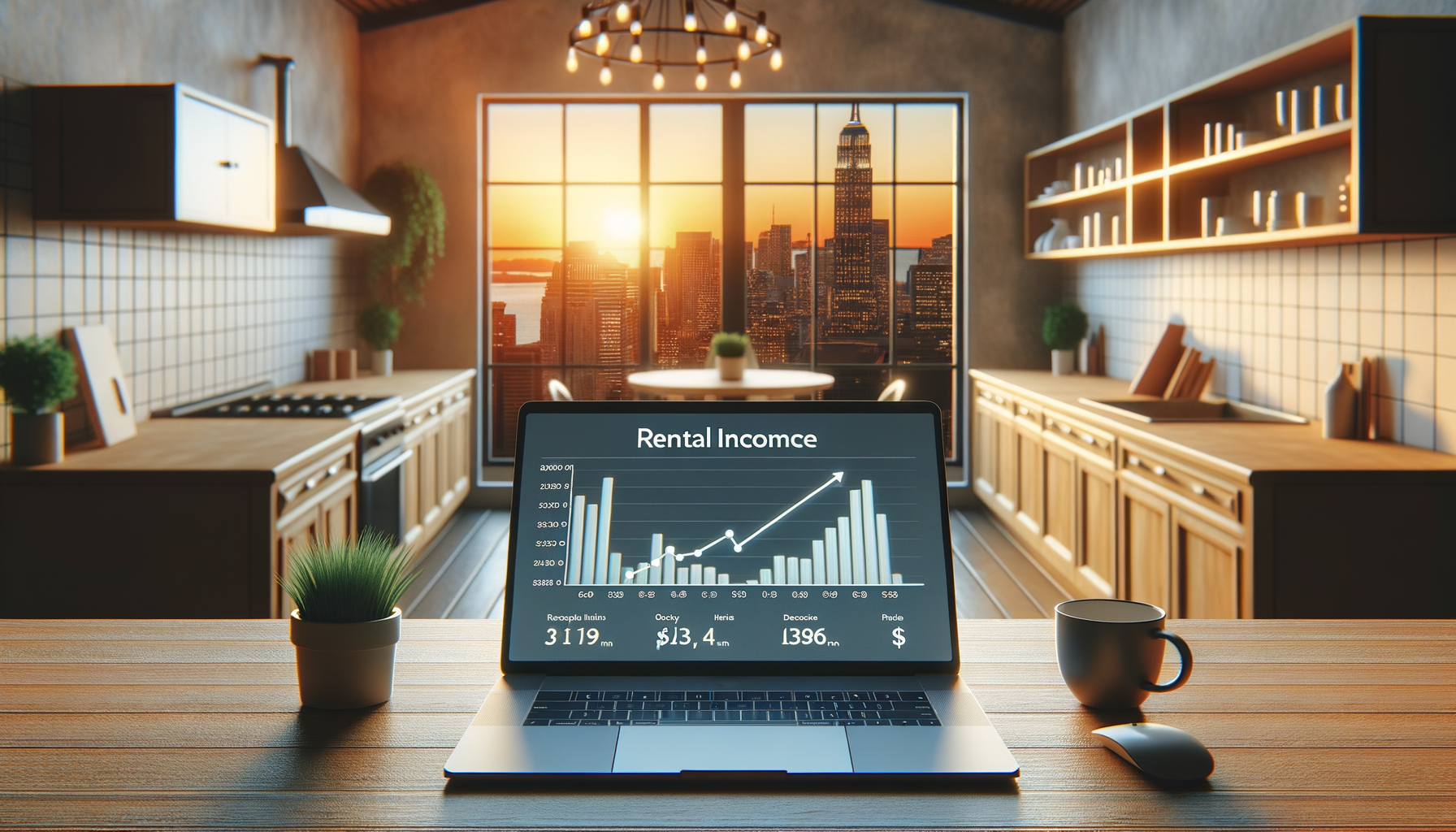
Starter Stage (1-3 Listings): $1,000 – $3,000/month. At this level, you’re learning the business and refining your systems. Co-listers managing 2-3 properties can expect $1,000-$2,000 per month in management fees. Arbitrage operators with 1-2 units typically net $1,500-$3,000 after rent and expenses. This stage is semi-passive at best. You’re still building processes and handling many tasks personally.
Growth Stage (4-10 Listings): $3,000 – $10,000/month. This is where passive income starts to feel real. Your systems are proven, your cleaning team is reliable, and you’ve developed templates for nearly every guest scenario. Co-listers at this stage manage a portfolio generating $20,000-$60,000 in gross booking revenue, earning $3,000-$10,000 in management fees. Time commitment drops to 5-10 hours per week because you’re not reinventing the wheel with each new property.
Scale Stage (10+ Listings): $10,000 – $30,000+/month. Operators at this level have typically hired a co-host or virtual assistant to handle day-to-day operations. They spend 3-5 hours per week on strategic decisions: which markets to enter, which properties to add, and how to optimize underperformers. Multiple 10XBNB students have built co-listing portfolios reaching this level, some within 12 months of starting.
The numbers above represent net income after expenses for arbitrage and ownership, and gross management fees for co-listing. For a detailed breakdown of what co-hosts earn at each level, check out our analysis of Airbnb co-host income.
One thing to keep in mind: these numbers compound. Adding your fifth listing doesn’t take five times the work of your first. It takes maybe 20% more effort because your systems, team, and knowledge base already exist. That’s the real power of building Airbnb passive income with the right foundation.
The Fastest Path to Airbnb Passive Income
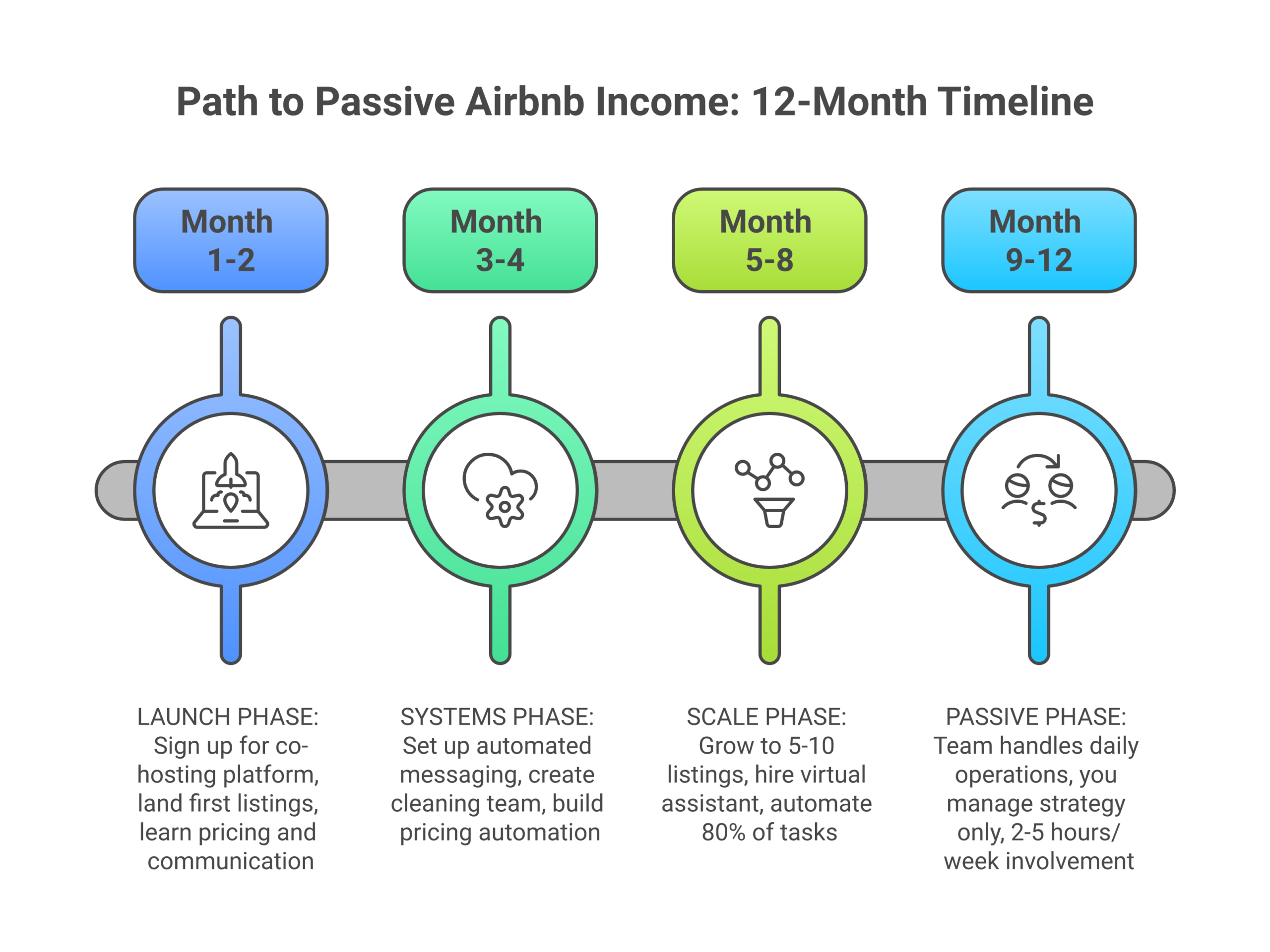
If you’re starting from zero and want the fastest route to passive Airbnb income, the path is clear: start with co-listing.
<! - wp:image {"id":6613,"sizeSlug":"large","linkDestination":"none"} - >
<! - /wp:image - >
Co-listing eliminates the two biggest barriers to entry: capital and risk. You don’t need a down payment, you don’t need to sign a lease, and you don’t need to furnish a property. You need a laptop, a phone, and the knowledge to manage listings effectively. That means you can start generating income in weeks rather than months, and you can scale without proportionally increasing your financial exposure.
The critical mistake most new operators make is doing everything manually first and planning to “systematize later.” That later never comes because you’re too busy putting out fires. Instead, build your systems from the first listing. Set up automated messaging before your first guest arrives. Hire a cleaner before you do your first turnover. Use dynamic pricing from day one. The upfront investment in systems pays for itself within the first month through time saved and revenue optimized.
Scaling a co-listing business means adding properties, not adding hours. Each new property you take on uses the same messaging templates, the same pricing strategy, the same cleaning coordination system. Your marginal time per property decreases as your portfolio grows. That’s how operators go from one listing to twenty without their weekly hours increasing proportionally.
The 10XBNB program teaches this exact system: how to find property owners who need management help, how to structure co-listing agreements, and how to build the automation stack that makes the income genuinely passive. Students follow a step-by-step framework that covers everything from landing your first property to scaling a portfolio. The emphasis is on building right from day one so you’re not untangling a mess later.
Market selection also matters. Some markets support higher nightly rates, longer seasons, and stronger occupancy. Understanding which states perform best for Airbnb gives you a strategic advantage before you list your first property. The operators earning the most passive income chose their markets deliberately, not randomly.
According to the U.S. Small Business Administration, market research and competitive analysis are foundational to any successful business, and short-term rentals are no exception. Treating your Airbnb operation as a real business, with market analysis, systems, and scalable processes, is what separates passive income earners from burnt-out hosts.
Your Next Step to Airbnb Passive Income
Learn the co-listing system that helps beginners build income in 30-60 days.
Frequently Asked Questions
Can you make passive income on Airbnb without owning property?
Yes. Co-listing (also called co-hosting) lets you manage Airbnb properties for owners and earn a percentage of each booking. You don’t own or lease the property, so there’s zero financial risk. With automated messaging, a cleaning team, and dynamic pricing tools, co-listing is the most passive Airbnb model available. Many operators build portfolios of 10-20+ managed properties generating $5,000-$15,000 per month in management fees.
How much money do you need to start earning passive income from Airbnb?
It depends on your business model. Co-listing requires virtually zero startup capital since you’re managing other people’s properties. Rental arbitrage typically requires $3,000-$10,000 for the security deposit, first month’s rent, and furnishing. Property ownership requires a down payment of $30,000-$100,000 or more. Co-listing is the fastest and most affordable entry point for building passive Airbnb income.
How long does it take for Airbnb income to become passive?
With co-listing and proper systems, you can reach semi-passive status within 30-60 days of landing your first property. Full passive income, where you spend fewer than 5 hours per week, typically takes 3-6 months as you build your team and refine your automation. Rental arbitrage takes 3-6 months, and property ownership typically requires 6-18 months before operations feel truly passive.
Is Airbnb passive income realistic or just hype?
It’s realistic, but it requires intentional system building. Hosts who treat Airbnb as a casual side hustle end up working 20-40 hours per week. Operators who invest in automation, build a team, and follow a proven framework achieve genuinely passive income. The difference is approach, not luck. Thousands of co-listing operators earn passive income from Airbnb portfolios they manage but don’t own.
What tools do you need to automate Airbnb for passive income?
The core automation stack includes: a messaging tool (Hospitable, Host Tools, or Airbnb’s built-in scheduled messages), a dynamic pricing tool (PriceLabs, Beyond Pricing, or Wheelhouse), a turnover management platform (TurnoverBnB or Breezeway), and a channel manager if you list on multiple platforms. These tools combined handle 85-90% of daily operations automatically, leaving you to focus on strategy and growth.
What’s the difference between co-hosting and rental arbitrage for passive income?
Co-hosting means managing properties for owners and earning a percentage (10-25%) of bookings. You carry zero financial risk because there’s no lease or mortgage. Rental arbitrage means leasing properties long-term and subletting them on Airbnb at higher nightly rates. Arbitrage offers higher per-property profit but carries lease obligations regardless of occupancy. Co-hosting is more passive and more scalable; arbitrage offers higher margins with higher risk.