
A co-listing agreement is a written contract between a property owner and an Airbnb co-lister that spells out exactly who does what, how money gets split, and what happens if things go sideways. If you manage short-term rentals for other people, you need one. Period. Without a signed agreement, you’re one bad guest, one missed payment, or one property damage claim away from losing everything you built. This free template gives you a professional-grade starting point with all 10 clauses that protect both parties. You can learn the full co-listing model here before customizing your contract.
What a Co-Listing Agreement Covers
Think of a co-listing agreement as the operating manual for your business relationship with a property owner. It defines the rules before problems show up. And problems always show up.
A solid agreement covers three categories: money, responsibilities, and protection. The money section locks in your commission rate, payment timing, and what counts as “revenue” for calculation purposes. The responsibilities section maps out every task, from guest messaging to linen changes to pricing adjustments. The protection section handles insurance, liability, termination, and disputes.
Most free templates you’ll find online skip the details. They give you a two-page document with vague language like “co-host will manage the property.” That’s not a contract. That’s a handshake with extra steps. The template below includes specific, enforceable language for all 10 essential clauses.
If you’re just getting started with the co-listing business model, read the complete guide to becoming an Airbnb co-host first. It walks through the full process from finding owners to signing your first agreement.
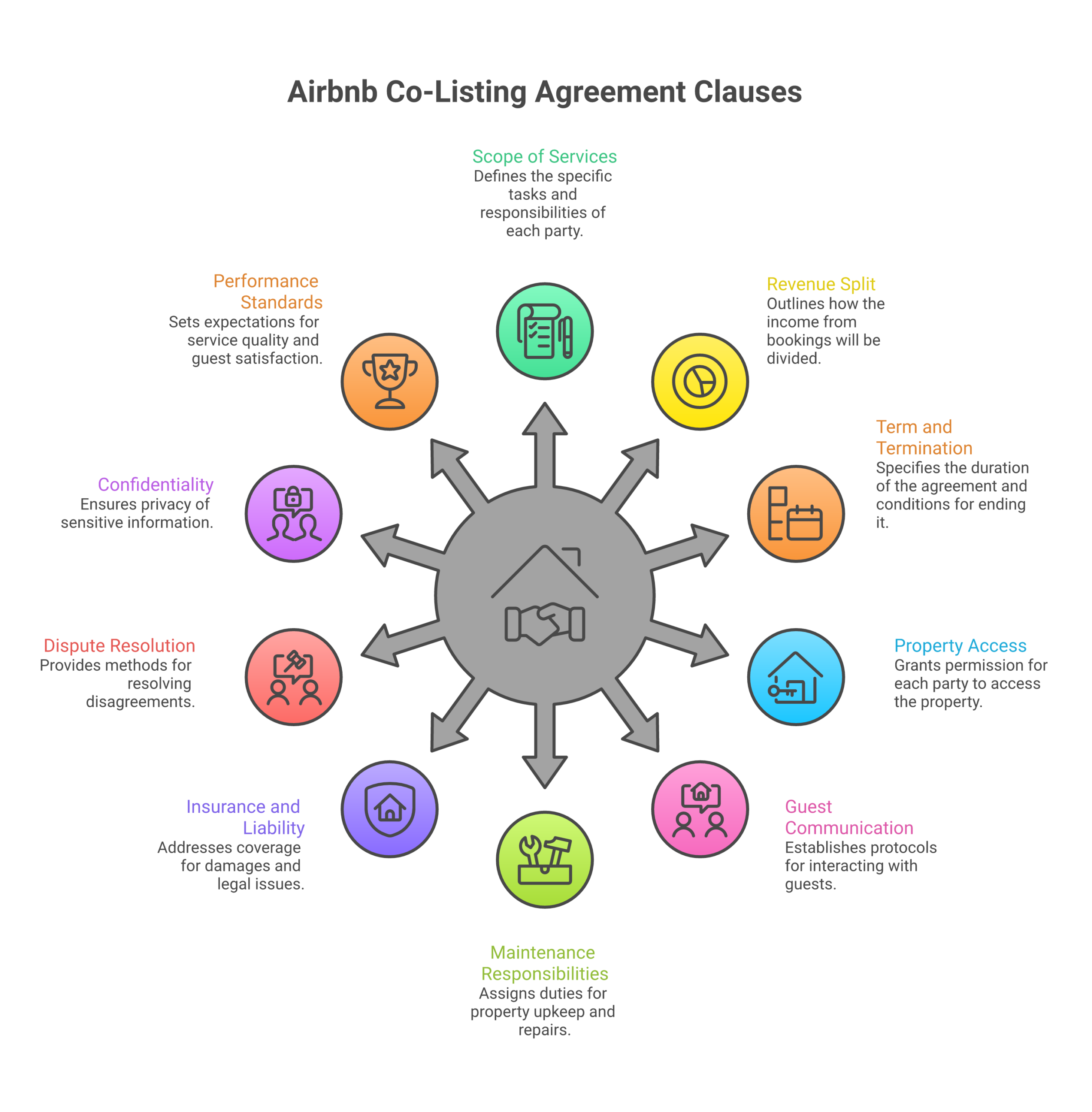
10 Key Clauses Every Co-Listing Contract Needs
After reviewing dozens of co-hosting agreements and working with hosts who manage 5 to 50+ properties, these are the 10 clauses that separate a real contract from a liability waiting to happen.
1. Scope of Services
This clause lists every single task you’ll perform. Be specific. “Manage the listing” means nothing in court. Instead, spell it out:
- Create and optimize the Airbnb listing (photos, title, description, pricing)
- Respond to all guest inquiries within 1 hour during business hours
- Coordinate cleaning between turnovers
- Handle check-in and check-out communication
- Manage dynamic pricing adjustments
- Arrange maintenance and repairs under a set dollar threshold (e.g., under $200 without owner approval)
- Provide monthly performance reports
The more detailed this section is, the fewer arguments you’ll have later. I’ve seen partnerships fall apart because one side assumed “manage the listing” included restocking supplies while the other side didn’t.
Pro tip: add an “excluded services” subsection too. If you don’t handle landscaping, pool maintenance, or HOA communication, say so explicitly. This prevents the owner from gradually adding tasks that weren’t part of the original deal.
2. Commission and Revenue Split
This is where most disputes start. Nail it down with zero ambiguity. Your clause should answer:
- What percentage does the co-lister earn? Industry standard ranges from 10% to 25% of gross booking revenue. Shaun Ghavami, founder of 10XBNB and manager of a $100M+ co-listing portfolio, teaches that 15-20% is the sweet spot for most markets
- What counts as “revenue”? Gross booking amount? Net after Airbnb fees? Net after cleaning fees? Define it
- When does payment happen? After each payout, monthly, or bi-weekly?
- Who covers expenses? Cleaning supplies, linens, minor repairs, software subscriptions
Sample language: “The Co-Lister shall receive 20% of gross booking revenue (defined as the total amount paid by guests before Airbnb service fees are deducted, minus cleaning fees collected). Payment shall be remitted within 5 business days of each Airbnb payout.”
One detail that catches people off guard: Airbnb charges hosts either a 3% service fee (split-fee model) or a 15% host-only fee (simplified pricing). Your commission calculation changes depending on which model the listing uses. Specify this in the contract or your math won’t add up at payout time.
For a deeper look at typical co-host earnings across different markets, check the Airbnb co-host income breakdown with real numbers from active hosts.
3. Term and Termination
Every agreement needs a start date, an end date (or auto-renewal terms), and clear exit rules. Here’s what to include:
- Initial term: 6 months or 12 months is standard. Shorter terms favor the owner. Longer terms favor the co-lister who invested time building the listing’s reviews and ranking
- Auto-renewal: Does the contract automatically renew for another term unless one party gives notice?
- Notice period: 30 days written notice is typical. 60 days is better for the co-lister
- Termination for cause: Either party can terminate immediately for breach of contract, illegal activity, or repeated failure to meet performance standards
- Post-termination obligations: Return of keys, transfer of listing access, handling of existing bookings
One clause that protects you as a co-lister: require that all confirmed bookings at the time of termination be honored under the original commission terms. Otherwise, an owner can terminate right before a $5,000 holiday booking and pocket the full amount.
4. Property Access and Security
Document how you’ll access the property and who else has access. This matters for liability reasons.
- Smart lock codes or physical key arrangements
- Who can authorize third-party access (cleaners, maintenance workers, inspectors)
- Security camera disclosure requirements (Airbnb requires disclosure of all exterior cameras)
- Key return procedures upon termination
Also specify: if the owner enters the property during a guest stay without authorization, that’s a breach. Guest experience is your reputation. Protect it in the contract.
Smart locks make this easier for multi-property co-listers. You can generate unique codes per guest, per cleaner, and per maintenance person, then deactivate them instantly if a relationship ends. If the owner insists on physical keys, specify how many copies exist and who holds each one.
5. Guest Communication Standards
Airbnb’s Superhost criteria require a 90% response rate within 24 hours. Your contract should set a higher standard:
- Response time targets (e.g., within 1 hour during 8am-10pm, within 4 hours overnight)
- Who handles guest reviews and what tone/approach to use
- Escalation procedures for emergencies (broken pipes, lockouts, safety issues)
- Guest screening criteria (instant book settings, ID verification requirements)
Poor guest communication is the fastest way to lose Superhost status and tank your listing’s ranking. Both parties need to agree on standards upfront.
Here’s a clause most templates miss: define who responds to negative reviews. The owner might want to handle this personally, or they might prefer you write a professional response. Either approach works, but you need to agree in advance. A defensive or emotional reply to a 3-star review can do more damage than the review itself.
6. Maintenance and Repair Responsibilities
Set a dollar threshold. Below that number, the co-lister handles it. Above it, the owner approves. A common split:
- Under $150: Co-lister authorizes and arranges repairs, deducted from next payout
- $150 to $500: Co-lister gets verbal or text approval from owner before proceeding
- Over $500: Owner handles directly or provides written authorization
Also define: who pays for routine wear-and-tear items? Replacing a broken coffee maker is different from replacing a water heater. The contract should distinguish between “consumable replacements” (owner’s cost) and “damage from guest negligence” (handled through Airbnb’s AirCover or the guest’s security deposit).
Build in a response time requirement for the owner too. If you report a broken HVAC system in August and the owner takes two weeks to approve the repair, you’ll lose bookings and reviews. A clause like “owner shall respond to maintenance requests over the threshold amount within 48 hours” keeps things moving.
7. Insurance and Liability
This clause saves you from financial disaster. Both parties need clarity on:
- Property insurance: Owner must maintain adequate homeowner’s or landlord insurance that covers short-term rental activity. Many standard policies exclude it
- Liability insurance: Should the co-lister carry their own general liability policy? For anyone managing 3+ properties, yes. A $1M policy typically costs $300 to $600 per year
- Airbnb’s AirCover: Acknowledge it exists but specify it doesn’t replace proper insurance. AirCover has exclusions, caps, and a claims process that can take months
- Indemnification: Each party indemnifies the other against claims arising from their own negligence
Get this wrong and a guest injury could wipe out both of you. A $500/year liability policy is cheap protection.
One more thing: require the owner to provide proof of insurance annually. Policies lapse. Coverage changes. An owner who had short-term rental coverage last year might have switched to a cheaper policy that excludes it. Annual verification takes five minutes and prevents catastrophic gaps.
8. Dispute Resolution
Nobody wants to think about disputes when starting a partnership. But the time to negotiate resolution terms is before you’re angry at each other. Include:
- Step 1: Written notice of the dispute with 14 days to respond
- Step 2: Mediation by a mutually agreed third party
- Step 3: Binding arbitration (faster and cheaper than litigation)
- Governing law: Which state’s laws apply? Use the state where the property is located
Arbitration clauses save both parties money. The average small claims court case costs $2,000 to $5,000 in legal fees. Mediation through the American Arbitration Association starts at $250 per party.
9. Confidentiality and Non-Compete
Two separate protections that often get combined into one clause:
Confidentiality: The co-lister agrees not to share the owner’s financial information, property access codes, guest data, or pricing strategies with third parties. This survives termination of the agreement.
Non-solicitation (not non-compete): I recommend a non-solicitation clause over a broad non-compete. A non-compete that prevents someone from co-listing anywhere in a city is likely unenforceable. A non-solicitation clause that prevents you from directly approaching the owner’s other properties or their contacts for 12 months after termination? That’s reasonable and enforceable in most states.
The Federal Trade Commission’s 2024 rule limiting non-compete agreements makes broad non-competes riskier than ever. Courts in California, Colorado, Minnesota, and Oklahoma already refuse to enforce them. A narrow non-solicitation clause achieves the same goal without the legal risk.
10. Performance Standards and Reviews
Set measurable benchmarks so both parties know what “good” looks like:
- Minimum occupancy rate: e.g., 65% monthly average (excluding seasonal adjustments)
- Minimum review score: e.g., maintain 4.7+ overall rating
- Response time: e.g., 95% of messages answered within 1 hour during business hours
- Reporting: Monthly reports including revenue, occupancy, average nightly rate, and guest feedback summary
If the co-lister consistently misses these benchmarks, the owner has grounds for termination under the “cause” provisions in Clause 3. And if the owner makes the property impossible to manage (refuses needed repairs, overrides pricing, blocks calendar dates), the co-lister has grounds too.
Include a ramp-up period. New listings typically take 60 to 90 days to build reviews and search ranking on Airbnb. Your performance benchmarks shouldn’t kick in until after this initial period. A clause like “performance standards apply beginning 90 days after listing activation” gives you a fair runway.
How to Customize the Template for Your Market
A template is a starting point. Your final contract needs to reflect your specific market conditions. Here’s what to adjust:
Urban vs. rural markets: Urban properties in cities like Austin, Nashville, or Miami typically run 70-85% occupancy with higher turnover. Your maintenance threshold should be higher (more wear and tear) and your response time standards tighter (more guest inquiries). Rural vacation properties may run 40-60% occupancy with longer stays. Adjust your minimum occupancy benchmarks accordingly.
Seasonal markets: If you’re managing ski chalets or beach houses, build seasonal adjustments into your performance standards. A ski property at 30% occupancy in July isn’t underperforming. Your contract should define “peak season” and “off-season” with different benchmarks for each.
Local regulations: Some cities require short-term rental permits, transient occupancy tax registration, or business licenses. Your agreement should specify who obtains and maintains these. In most cases, the property owner holds the permit, but the co-lister handles the compliance paperwork. Check your city’s specific requirements before finalizing the contract.
Multi-property arrangements: If you’re managing 5+ properties for the same owner, consider volume-based commission tiers. Example: 20% commission on properties 1 through 3, 18% on properties 4 through 7, 15% on properties 8 and above. This incentivizes owners to consolidate their portfolio with you.
Luxury vs. budget properties: A $800-per-night luxury cabin and a $95-per-night studio apartment require different contract terms. Luxury properties need higher maintenance thresholds, stricter guest screening criteria, and more detailed inventory lists. Budget properties need tighter cost controls and faster turnaround times. Your template should flex to match the property tier you’re managing.
Owner involvement level: Some owners want weekly updates and approve every pricing change. Others want a monthly report and nothing else. Define the communication cadence in your contract: weekly check-in calls, monthly written reports, or real-time dashboard access through your property management software. Mismatched expectations about involvement cause more friction than money disputes.
The 10XBNB co-listing training covers market-specific customization in detail, including contract language that’s been tested across 1,600+ students in dozens of markets.
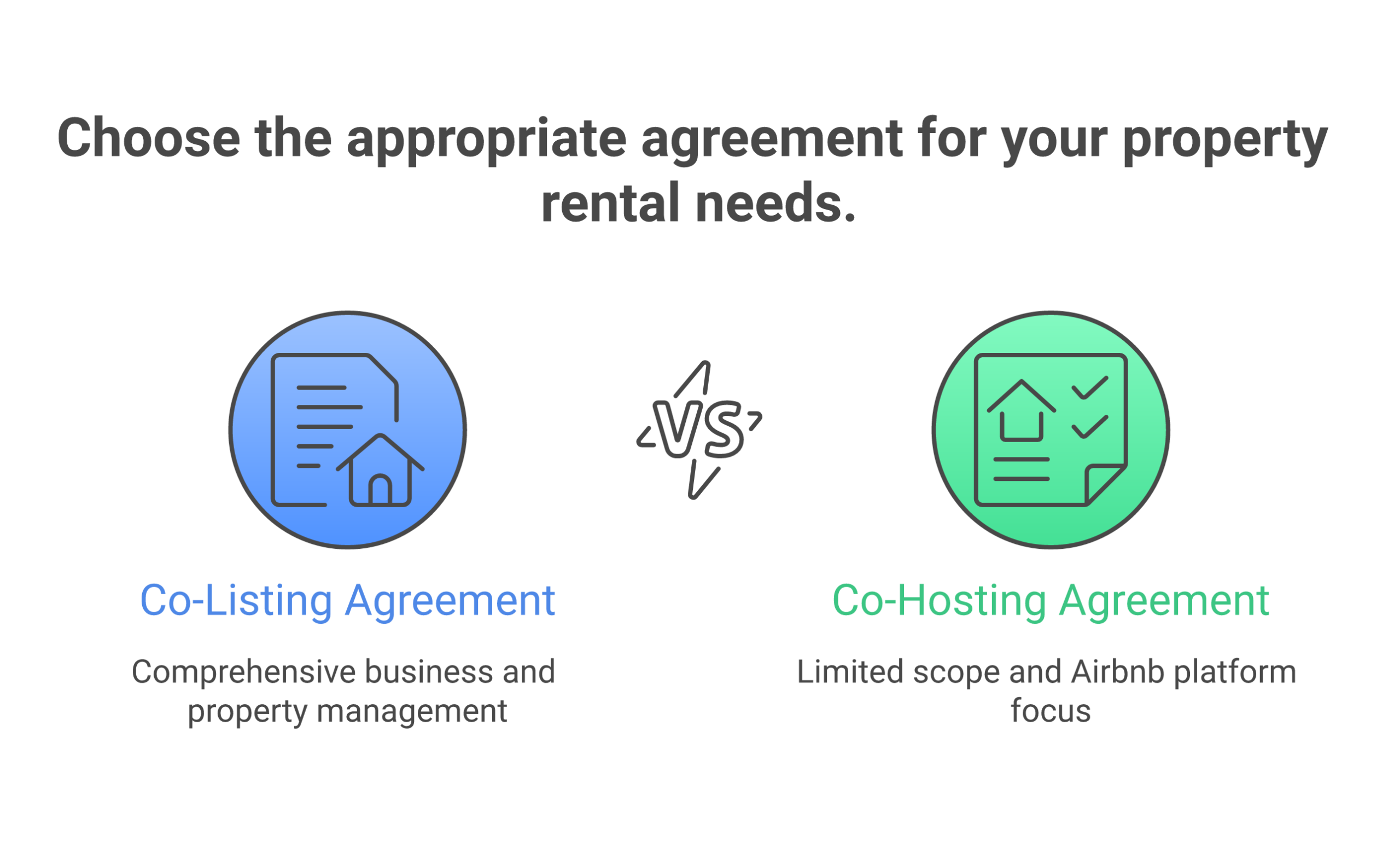
Co-Listing Agreement vs Co-Hosting Agreement: What’s the Difference?
These terms get used interchangeably online, but there’s a real distinction that affects your contract.
Co-hosting is Airbnb’s official platform feature. When an owner adds you as a co-host through Airbnb’s system, you get dashboard access, can message guests, and Airbnb splits the payout automatically based on the percentage set in the platform. The co-hosting agreement on Airbnb’s platform is minimal. It covers the payout split and permissions. That’s it.
Co-listing is the full business model. It includes everything the platform handles plus everything it doesn’t: who pays for supplies, what happens during emergencies, performance expectations, insurance requirements, and termination procedures. A co-listing agreement is the real contract that governs your working relationship.
Here’s the problem: many new co-hosts rely only on Airbnb’s built-in co-host feature and never sign a separate agreement. That leaves gaps. Airbnb’s platform doesn’t address maintenance responsibilities, insurance requirements, performance standards, or dispute resolution. If the owner removes you as a co-host on the platform, you have no contractual protections.
| Feature | Airbnb Co-Hosting (Platform) | Co-Listing Agreement (Contract) |
|---|---|---|
| Payout split | Yes (automatic) | Yes (defined in detail) |
| Dashboard access | Yes | Referenced, not controlled |
| Scope of services | No | Yes (detailed list) |
| Maintenance responsibilities | No | Yes (with dollar thresholds) |
| Insurance requirements | No | Yes (proof required) |
| Performance standards | No | Yes (measurable benchmarks) |
| Termination procedures | Owner can remove anytime | Notice period required |
| Dispute resolution | No | Yes (mediation/arbitration) |
| Legal enforceability | Platform-dependent | Independent contract |
The 10XBNB method treats co-listing as a standalone business. The Airbnb platform co-host feature is just the tool. The co-listing agreement is the foundation. Shaun Ghavami built his portfolio of $100M+ in managed properties on this exact principle: the contract comes first, the platform setup comes second.
For a full comparison of co-listing education programs, see our best Airbnb co-hosting courses guide.
When You Need a Lawyer
Templates save time. Lawyers save you from expensive mistakes. Here’s an honest breakdown of when a template is enough and when you need professional help.
A template is probably fine if:
- You’re managing 1 to 3 properties
- The properties are in one state
- The commission structure is straightforward (flat percentage)
- Both parties are individuals (not LLCs or corporations)
- Property values are under $500,000 each
Get a lawyer if:
- You’re managing properties across multiple states (different landlord-tenant laws)
- The portfolio exceeds $1M in combined property value
- Either party operates through an LLC or corporate entity
- The revenue split involves complex structures (tiered commissions, bonus incentives, equity stakes)
- The property is in a city with strict short-term rental regulations (NYC, LA, San Francisco)
- You’re hiring subcontractors (cleaners, maintenance teams) under your agreement
A real estate attorney familiar with short-term rentals will typically charge $500 to $1,500 to review and customize a co-hosting agreement. That’s a fraction of what a single lawsuit costs. If you’re building a co-listing business and plan to manage 10+ properties, pay for the legal review. It’s a business expense, not a luxury.
Where to find the right attorney: look for lawyers who specialize in real estate or hospitality law, not general practice. The National Association of Realtors maintains a directory of real estate attorneys by state. You can also ask in Airbnb host Facebook groups for recommendations from other hosts in your market. The right attorney will already know what short-term rental regulations apply in your area.
Common Mistakes in Co-Host Contracts
After working with hundreds of co-listing students, these are the contract mistakes that come up again and again:
1. No written agreement at all. Roughly 40% of new co-hosts start with a verbal agreement or a text message thread. That works until it doesn’t. In a 2024 survey by Hospitable, 62% of co-hosting disputes involved partners who had no written contract.
2. Vague scope of services. “Manage the property” is not a scope of services. One host assumed management included landscaping. The co-host did not. The owner withheld $2,800 in commissions over an argument about lawn care. A three-sentence scope clause would have prevented it.
3. No termination procedure. If either party can walk away at any time with no notice, you have no stability. A 30-day notice requirement with a transition plan protects both sides.
4. Missing insurance requirements. Most standard homeowner’s policies exclude short-term rental activity. If a guest gets injured and the owner doesn’t have proper coverage, both the owner and the co-lister could face personal liability. The contract must require proof of adequate insurance.
5. Relying on Airbnb’s platform agreement. Airbnb’s co-host feature handles payout splits. It does not replace a real contract. Airbnb can change its co-host policies, modify payout structures, or remove features at any time. Your business agreement should exist independently of any platform.
6. No performance benchmarks. Without measurable standards, you can’t prove you’re doing a good job, and the owner can’t prove you’re not. Define the numbers upfront. This also protects you: if an owner tries to terminate “for cause” but you’ve hit every benchmark in the contract, their termination claim won’t hold up.
7. Ignoring local laws. Some jurisdictions require property managers to hold a real estate license. Others require specific business permits. If your co-listing activities fall under property management in your state, operating without a license can void your contract entirely. Check your state’s requirements through the co-host contract essentials guide.
8. Copying a template without reading it. This sounds obvious, but it happens constantly. Someone downloads a template from Google, fills in names and addresses, and signs it without reading the boilerplate clauses. Some templates include terms that favor one party heavily, automatic fee escalations, or waiver-of-liability clauses that strip away your protections. Read every word before you sign.
Frequently Asked Questions
Do I need a written co-listing agreement for Airbnb?
Yes. While Airbnb’s platform lets you add a co-host without a separate contract, the platform agreement only covers payout splits and dashboard access. A written co-listing agreement protects both parties by defining responsibilities, insurance requirements, performance standards, and termination procedures that Airbnb’s system doesn’t address.
What percentage should an Airbnb co-host charge?
Most co-hosts charge between 10% and 25% of gross booking revenue. The exact rate depends on the scope of services. A co-lister who handles everything from listing creation to guest communication to maintenance coordination typically charges 15-20%. Someone who only manages guest messaging might charge 10-12%. The co-host income guide breaks down typical rates by service level.
Can I use a free template or do I need a lawyer?
A free template works well for straightforward arrangements with 1 to 3 properties in one state. If you manage properties across state lines, work with high-value properties (over $1M combined), or operate through an LLC, hire a real estate attorney. Legal review costs $500 to $1,500. That’s cheaper than any contract dispute.
What’s the difference between co-hosting and co-listing on Airbnb?
Co-hosting is Airbnb’s platform feature that lets an owner share listing access with a partner. Co-listing is the full business model where a professional manages someone else’s property end-to-end, from listing optimization to guest communication to maintenance. Co-hosting is the tool. Co-listing is the business. Your agreement should cover the business side, not just the platform permissions.
How long should a co-listing agreement last?
Initial terms of 6 to 12 months are standard. Shorter terms (3 months) favor owners who want flexibility. Longer terms (12 months with auto-renewal) favor co-listers who invest time building the listing’s reviews and search ranking. Include a 30 to 60-day notice period for either party to opt out at the end of any term.
What happens to existing bookings if the agreement ends?
Your contract should state that all confirmed bookings at the time of termination will be honored under the original commission terms. Without this clause, an owner could terminate right before a peak-season booking and keep the full payout. Specify a transition period (typically 30 days after the last confirmed booking) for final payouts and key returns.
Do I need a separate agreement for each property?
Not necessarily. You can use a master agreement with a “Property Schedule” attachment that lists each property’s address, specific terms, and any unique conditions. When you add a new property, you attach a new schedule to the existing agreement instead of drafting an entirely new contract. This is how most professional co-listers manage multi-property portfolios.
Should my co-listing agreement mention Airbnb specifically?
Your agreement should reference the platforms you’ll use, but avoid making it Airbnb-exclusive. Many co-listers cross-list on Vrbo, Booking.com, and direct booking sites. Write your contract to cover “short-term rental platforms” generally, then list specific platforms in a schedule or addendum. This lets you add or remove platforms without amending the core agreement.
Start With the Right Foundation
A co-listing agreement isn’t just paperwork. It’s the foundation of a real business. Every successful co-lister who manages 10, 20, or 50+ properties started with a solid contract that protected both sides.
If you’re serious about building an Airbnb co-listing business, the contract is step one. Step two is learning the systems, strategies, and scripts that turn a signed agreement into consistent monthly income. Over 1,600 students have started with the free 10XBNB co-listing training to learn exactly how Shaun Ghavami built a $100M+ portfolio without owning a single property.
Get the template. Customize it for your market. And if you want to accelerate the process, join the free training to see the full co-listing business model in action.