

Airbnb co-hosts typically earn between $1,000 and $10,000 per month, depending on the number of properties they manage, their market, and their commission structure. At the low end, managing one or two properties part-time generates $500-$1,500/month. At the high end, co-hosts running 15-20+ listings pull in $8,000-$12,000/month or more — with zero property ownership required. These aren’t theoretical numbers. We’ve documented students inside the 10XBNB program hitting $1,100 to $6,000+/month, many starting from scratch with no hospitality experience. You can read their full stories in our 10XBNB reviews from actual students page. This guide breaks down exactly what co-hosts earn, what drives income up or down, and how to position yourself at the top of the pay scale with real data and documented results.
Average Airbnb Co-Host Income Breakdown
Most Airbnb co-hosts earn a commission between 10% and 25% of total booking revenue for each property they manage. The exact percentage depends on the scope of services you provide. Basic guest communication and key handoffs sit at the lower end. Full-service management — listing creation, pricing optimization, cleaning coordination, guest vetting, and review management — commands 20-25%. According to AirDNA’s short-term rental data, markets with higher average daily rates naturally translate to larger co-host commissions, even at the same percentage.
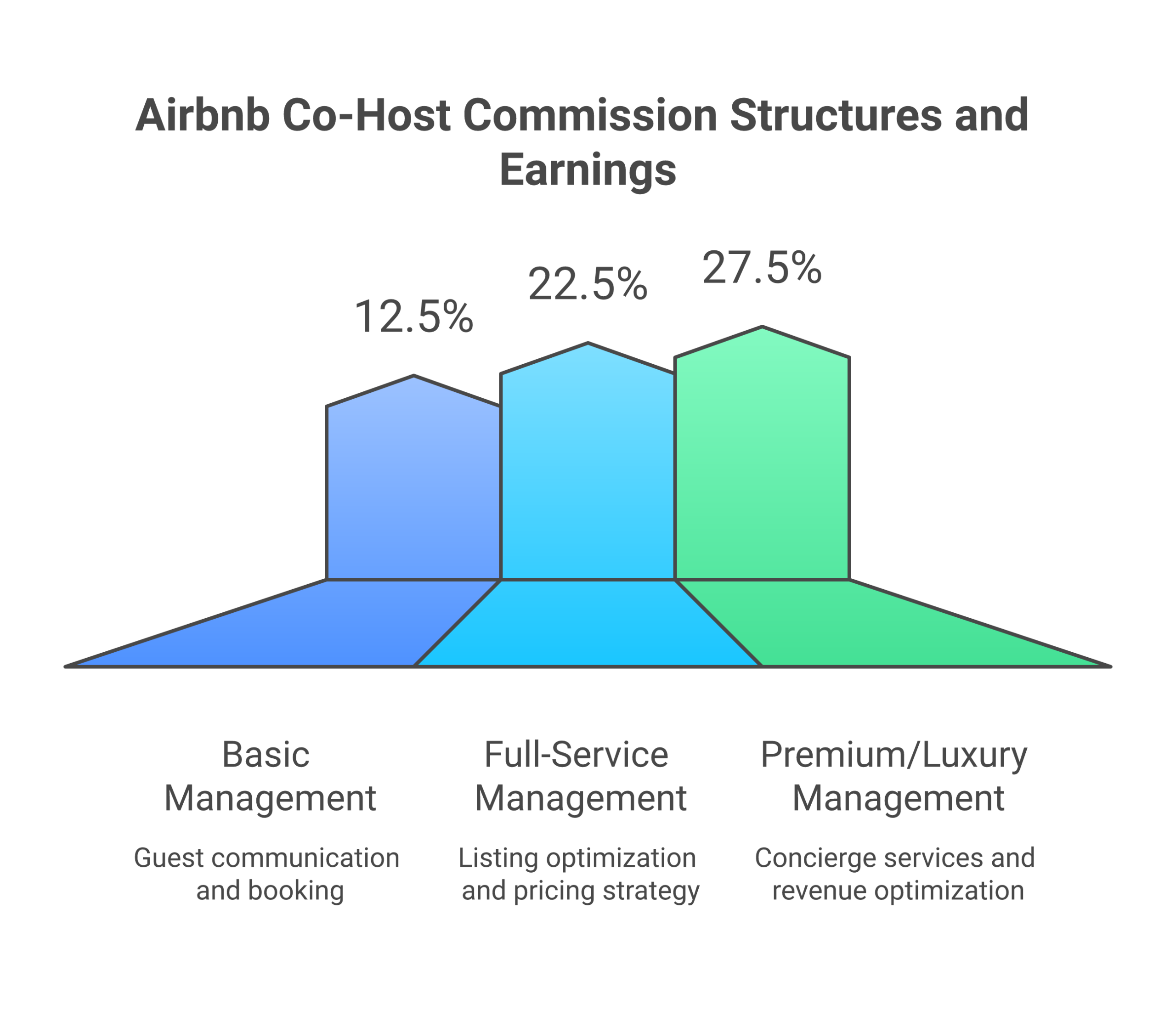
Here’s what your monthly income looks like at a 20% commission rate across different portfolio sizes:
| Properties Managed | Avg Monthly Revenue/Property | Your Commission (20%) | Monthly Income |
|---|---|---|---|
| 1 | $3,000 | $600 | $600 |
| 3 | $3,000 | $600 | $1,800 |
| 5 | $3,000 | $600 | $3,000 |
| 10 | $3,000 | $600 | $6,000 |
| 20 | $3,000 | $600 | $12,000 |
These figures use $3,000/month as an average property revenue — a conservative estimate for most U.S. Markets. In high-demand destinations like Nashville, Scottsdale, Joshua Tree, or coastal Florida, average monthly revenue per property often hits $4,000-$6,000+. That pushes your per-property commission to $800-$1,200 and makes five-figure months achievable with fewer listings. See our guide on honest co-listing advantages and disadvantages.
Related: See our guide on co-hosting agreement with payment terms for detailed templates and legal requirements.
Keep in mind: actual income varies based on seasonality, occupancy rates, property quality, and how aggressively you optimize pricing. The numbers above represent a realistic baseline, not a ceiling.
What Real Co-Hosts Are Actually Earning
Income projections are useful, but documented results tell the real story. The 10XBNB student results page features dozens of verified case studies from co-hosts who started with no properties and built profitable portfolios. Here’s what the data shows:
- Entry-level earners ($1,100-$2,000/month) — Students managing 2-3 properties within their first few months, earning steady commissions while learning the business. Many started while working full-time jobs, treating co-hosting as a side income stream.
- Mid-level earners ($3,000-$5,000/month) — Co-hosts who scaled to 5-8 properties within 6-12 months. At this level, many have refined their prospecting, automated guest communication, and built relationships with multiple property owners.
- Top performers ($6,000+/month) — Students managing 10+ properties with systemized operations. Some have built small teams, hired cleaners, and created repeatable processes that let them add properties without proportionally increasing their workload.
The pattern across these results is clear: income scales almost linearly with the number of properties you manage. The first property is the hardest to land. After that, referrals, reputation, and refined pitches make each subsequent property easier to acquire. See our guide on Airbnb co-host tax obligations.
Career Changers Who Replaced Their Income
Some of the most compelling results come from students who transitioned from traditional W-2 employment to full-time co-hosting. These aren’t people who had real estate backgrounds or hospitality degrees. They’re former teachers, office workers, retail managers, and corporate employees who learned a system, executed it, and built enough monthly income to hand in their resignations.
For a complete setup walkthrough, see our travel nurse rental income with platform comparisons and pricing data.
The common thread? They didn’t wait until they had 15 properties to go full-time. Most made the jump once they consistently hit $3,000-$5,000/month — enough to cover living expenses with a buffer. From there, the extra time freed up by leaving their jobs accelerated their growth because they could dedicate full days to prospecting new owners and optimizing existing listings.
You can see their documented results and video interviews on the student results page.
Factors That Affect Your Co-Host Income
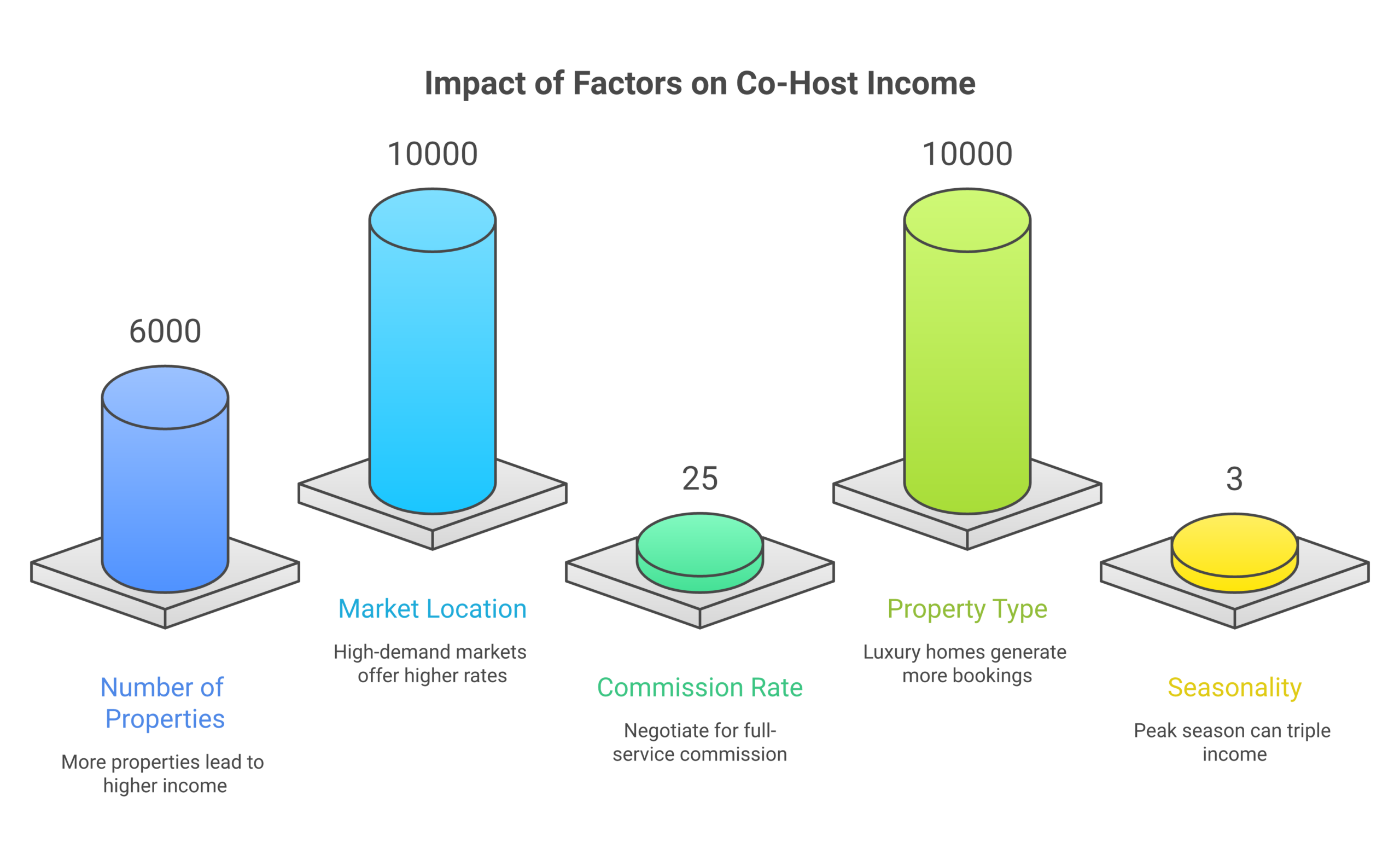
Not every co-host earns the same. Five key variables determine whether you’re making $600/month or $6,000+. Understanding these factors lets you make strategic decisions that maximize your earnings from day one.
Number of Properties You Manage
This is the single most important lever. A co-host managing one property earning $3,000/month at 20% commission makes $600. Manage ten identical properties and you’re at $6,000. The math is simple, but the execution requires consistent prospecting — reaching out to property owners, pitching your services, and closing management agreements.
The best co-hosts treat property acquisition like a sales pipeline. They’re always prospecting, always following up, and always asking for referrals from existing clients. One property leads to two. Two leads to five. Five leads to ten. The compounding effect is real, and it’s the difference between a side hustle and a full-time business.
Your Market and Location
Geography matters enormously. A co-host in a market where properties average $5,000/month in revenue earns almost double what someone in a $2,500/month market earns — managing the same number of properties.
High-demand short-term rental markets include:
- Tourist destinations — Coastal cities, mountain towns, national park gateways
- Business travel hubs — Cities with convention centers, corporate headquarters, hospitals
- Event-driven markets — Nashville, Austin, Las Vegas, Orlando
- Emerging markets — Secondary cities with growing tourism and less competition
Check our guide on the best states for Airbnb to identify high-revenue markets where co-hosting income potential is strongest. You don’t have to live in these markets either — remote co-hosting is increasingly common with the right systems in place. See our guide on our Airbnb co-listing income calculator.
For operators considering 30+ day stays, see our mid term rental income guide guide.
Commission Structure
Your commission rate directly multiplies every other factor. Here’s how different rates compare on a property generating $3,500/month:
- 10% commission — $350/month (basic services: guest messaging, key handoff)
- 15% commission — $525/month (moderate services: messaging, cleaning coordination, basic pricing)
- 20% commission — $700/month (full-service: listing creation, pricing optimization, cleaning, guest management)
- 25% commission — $875/month (premium: everything above plus furnishing guidance, professional photography coordination, multi-platform listing)
The takeaway: offer more value, charge a higher commission. Co-hosts who create listings from scratch, implement dynamic pricing tools, and handle every aspect of the guest experience justify 20-25% easily. Property owners gladly pay more when they see higher occupancy rates and better reviews.
Property Type and Quality
A one-bedroom apartment in a mid-tier market generates different revenue than a luxury cabin or a beachfront home. Premium properties command higher nightly rates, which means your commission per property is larger. Managing three luxury properties can match the income from managing seven budget-friendly units — with less operational complexity.
When prospecting for new properties to co-host, target owners with well-located, well-appointed homes. A single high-performing property is worth more to your bottom line than two mediocre ones.
Seasonality
Short-term rental income fluctuates with demand. Beach properties peak in summer. Ski cabins peak in winter. Urban apartments near convention centers spike around major events. During off-peak months, occupancy drops and so does your commission income.
Smart co-hosts mitigate seasonality in two ways:
- Diversify across markets or property types — Manage a mix of beach and mountain properties so peaks and valleys offset each other.
- Adjust pricing strategy for off-peak months — Lower nightly rates to maintain occupancy, offer weekly/monthly discounts, and target different guest segments (remote workers, traveling nurses, relocations).
Seasonality is real, but it’s manageable. The co-hosts who earn consistent income year-round are the ones who plan for it rather than getting surprised by it.
Co-Hosting Income vs Other Airbnb Business Models
Co-hosting isn’t the only way to make money on Airbnb without owning property. But it offers a distinct combination of low startup cost, low risk, and fast time-to-income that other models can’t match. Here’s how the three main approaches compare:
| Business Model | Startup Cost | Monthly Income Potential | Risk Level | Time to First Dollar |
|---|---|---|---|---|
| Co-Hosting / Co-Listing | $0-$500 | $1,000-$10,000+ | Low | 30-60 days |
| Rental Arbitrage | $3,000-$10,000/unit | $1,000-$5,000/unit | Medium | 60-90 days |
| Property Ownership | $20,000-$100,000+ | $1,000-$5,000/unit | High | 90-180 days |
The standout advantage of co-hosting is the near-zero barrier to entry. You don’t sign leases, take on debt, or furnish properties. If a property owner decides to sell or stop hosting, you lose that income stream — but you don’t lose thousands of dollars in sunk costs. You simply replace that property with another one.
For a detailed side-by-side comparison of pricing, curriculum, and instructor credentials, see our top Airbnb courses for building co-hosting income.
Many successful Airbnb entrepreneurs start with co-hosting to build cash flow and operational experience, then reinvest profits into rental arbitrage units for higher per-property returns. The two models complement each other well.
For a detailed comparison of co-hosting versus co-listing (they’re related but distinct), read our Airbnb co-listing guide.
How to Maximize Your Co-Host Earnings
Earning potential in co-hosting has a high ceiling, but reaching it requires intentional strategy. Here are the four levers that separate $1,000/month co-hosts from $10,000/month operators.
Add More Properties Consistently
Your income is directly proportional to your portfolio size. Treat property acquisition like lead generation: build a prospecting system that delivers a steady stream of conversations with property owners. Cold outreach on Airbnb (messaging hosts with underperforming listings), Facebook groups, local real estate investor meetups, and Craigslist ads from landlords are all proven channels.
Set a weekly prospecting target. Even reaching out to five property owners per week creates momentum. Not every conversation converts, but consistency compounds. Within 90 days, you’ll have a pipeline that produces new management agreements regularly.
Optimize Listings for Higher Bookings
More bookings at higher nightly rates mean more commission for you. The co-hosts who earn the most per property invest time in:
- Professional photography — Listings with professional photos get 40% more bookings according to Airbnb data.
- Dynamic pricing — Tools like PriceLabs and Beyond Pricing adjust nightly rates automatically based on demand, competition, and events. This alone can increase revenue 15-30%.
- Listing copy optimization — Clear titles with location keywords, compelling descriptions that highlight unique amenities, and complete amenity checklists.
- 5-star review strategy — Fast response times, thoughtful touches (welcome baskets, local guides), and proactive problem-solving drive reviews that boost search ranking.
When you can show a property owner that their listing earned 25% more after you took over management, you’ve earned a long-term client and a powerful referral source.
Automate Operations to Scale
The co-hosts earning $6,000+/month aren’t manually responding to every guest message or scheduling every cleaning. They use systems and automation to handle repetitive tasks so they can focus on growth.
Key automations include:
- Automated messaging — Pre-written message sequences for booking confirmations, check-in instructions, mid-stay check-ins, and checkout reminders.
- Cleaning scheduling software — Tools like TurnoverBnB or Hospitable that automatically notify cleaners when a guest checks out.
- Channel managers — Software that syncs your calendar across Airbnb, VRBO, and Booking.com to prevent double bookings.
- Smart locks — Eliminate key handoffs entirely with automated access codes that change per guest.
For a deeper look at the tools and workflows that let you manage 10+ properties without burning out, read our guide on hands-free Airbnb automation.
Set Up Your Co-Host Role Through Airbnb
Once you’ve agreed on terms with a property owner, Airbnb’s official co-host program lets owners invite you directly through the platform. This formalizes your role, gives you access to manage the listing, and ensures your commission is handled through Airbnb’s payment system — which protects both parties.
How to Start Co-Hosting on Airbnb
Getting started as an Airbnb co-host is simpler than most people think. You don’t need a real estate license, a hospitality degree, or any upfront capital. Here’s the five-step process:
- Learn the co-hosting business model. Understand how commissions work, what services you’ll provide, and what tools you’ll need. Read our complete co-hosting guide and explore the co-listing breakdown to understand the differences. Our best co-hosting course breaks down the top programs.
- Find property owners who need help. Search Airbnb for listings with poor photos, low review counts, inconsistent pricing, or slow response times. These are owners who are leaving money on the table — and they know it. Reach out with a clear value proposition: you’ll increase their bookings and revenue in exchange for a commission.
- Sign a co-hosting agreement. Use a simple management agreement that outlines your responsibilities, commission rate, payment terms, and termination clause. Airbnb’s built-in co-host invitation system handles the platform-level setup.
- Create or optimize the listing. Upload professional photos, write compelling copy, set up dynamic pricing, and ensure the amenity checklist is complete. This is where you immediately demonstrate your value.
- Manage, optimize, and scale. Deliver an excellent guest experience, maintain high occupancy, and use your results as proof to land your next property. Each successful property becomes a case study for the next owner you pitch.
Industry Benchmarks: How Co-Host Income Compares
While our student data paints a detailed picture, let’s cross-reference with broader industry figures. According to short-term rental industry research:
- Standard co-host commission: 10-25% of gross booking revenue is the industry standard, with full-service co-hosts commanding 20-25% (AirDNA)
- Average Airbnb co-host managing 5-10 properties: $3,000-$8,000/month depending on market and property type
- Top-performing co-hosts (20+ properties): $15,000-$30,000/month, typically operating as registered property management businesses
- Co-host costs to account for: PriceLabs ($20-50/listing/month), cleaning coordination, guest communication tools, insurance (~$500-1,500/year)
Property management industry data from Hostaway shows that co-hosts who use professional property management software reduce their per-listing time investment by 40-60%, which directly increases their effective hourly earnings. The co-hosts earning $15,000+/month are almost always using automation and software — not just working more hours.
Challenges of Airbnb Co-Hosting (What Nobody Tells You)
Co-hosting isn’t passive income from day one. Here’s what to expect:
- Owner communication overhead: Some property owners require weekly reports, real-time booking notifications, or have strict rules that complicate management
- Liability concerns: Without a formal co-hosting agreement, disputes over damage costs, cleaning fees, or guest issues can get messy. Always use a written contract
- Income inconsistency: Seasonal markets can see 40-60% revenue swings between peak and off-season months
- Scale challenges: Managing 1-3 properties is manageable solo. Beyond 5, you need systems, tools, and possibly staff — which eats into margins
- Guest emergencies at odd hours: Lockouts at 2 AM, plumbing failures during holidays, and noise complaints from neighbors are part of the job. Having a reliable local contact or backup co-host helps, but the first year you’ll likely handle most issues yourself
- Owner churn: Property owners sell, move back in, or decide to self-manage. Losing 1-2 properties per year is normal — which is why consistent prospecting matters even when your portfolio feels full
None of these challenges are deal-breakers, but going in with realistic expectations sets you up to handle them without getting discouraged. The co-hosts who last beyond year one are the ones who treated it like a real business from the start, not a get-rich-quick side project.
Frequently Asked Questions
Is Airbnb co-hosting passive income?
Not entirely. Co-hosting requires active management — guest communication, cleaning coordination, and pricing adjustments. However, with the right automation tools and systems, you can reduce your weekly time commitment to 5-10 hours for a portfolio of 5-8 properties. It’s semi-passive income that gets more passive as you systemize operations.
How many properties do I need to replace a full-time income?
Most co-hosts can replace a $4,000-$5,000/month income with 7-10 properties at a 20% commission rate, assuming average monthly revenue of $3,000 per property. In higher-revenue markets, you may need fewer. Students inside 10XBNB have replaced full-time salaries with as few as 5-6 well-performing properties.
Do I need prior experience to become an Airbnb co-host?
No. Most successful co-hosts started with zero hospitality or real estate experience. What matters more is your willingness to learn guest communication, pricing strategy, and property marketing. The 10XBNB program provides step-by-step training specifically for beginners.
Can I co-host part-time while keeping my full-time job?
Yes. Co-hosting is one of the best Airbnb business models for part-time operators. Guest messaging can be handled during breaks or in the evening, cleaning teams handle turnovers, and pricing tools run automatically. Many students start part-time and transition to full-time once their co-hosting income exceeds their salary.
How long does it take to get my first co-hosting property?
With consistent outreach, most new co-hosts secure their first property within 30-60 days. The timeline depends on your prospecting volume and the quality of your pitch. Students using proven prospecting scripts and frameworks from 10XBNB often land their first client within the first month.
Is co-hosting better than rental arbitrage?
It depends on your situation. Co-hosting has lower risk and zero startup capital, making it ideal for beginners or anyone who wants income without financial exposure. Rental arbitrage offers higher per-unit profit but requires lease commitments and furnishing costs. Many entrepreneurs start with co-hosting to build cash flow, then expand into arbitrage. The two models work well together.
Ready to Start Co-Hosting?
Learn the system our students use to build co-hosting income from scratch.
For a detailed breakdown of co-host earnings by service level, see our co-host fees and commission guide. You can also estimate your income using the co-listing income calculator.