

A free Airbnb calculator estimates your short term rental income, expenses, and net profit before you sign a lease or buy a property. The 10XBNB Airbnb income calculator below uses your average daily rate (ADR), occupancy rates, monthly rent or mortgage financing payment, and operating expenses to project annual revenue, cash flow, and a deal-go-or-no-go score. Most airbnb hosts run a profitable short term rental at 60% to 70% expense ratio. Plug in your numbers and see whether your specific property hits that benchmark in under 60 seconds.
You need a rental how to start an Airbnb business calculator before you sign any lease. The difference between a profitable deal and a money pit often comes down to a $200 rent swing or a 5-point occupancy shift. Shaun Ghavami’s first property was a $65/night spare bedroom that proved the math works at any scale. Plug in your numbers below and see exactly where you stand in under 60 seconds. For the full strategy behind these numbers, read our complete rental arbitrage guide.
Figures and benchmarks updated as of June 2026.
Key Takeaways:
If you want a structured path from calculator to first deal, see our best rental arbitrage course picks of 2026.
- Use the calculator below to estimate monthly profit from any rental rent to rent arbitrage (plain-English definition) (and our no-capital Airbnb playbook) deal in under 60 seconds
- Most successful arbitrage deals target a minimum 20% profit margin after all expenses
- Break-even typically occurs within 2-4 months with proper market selection
- A 10% drop in ADR or occupancy can cut your profit by 60%, so always run conservative numbers

Airbnb Income Calculator: How Much Can You Make on Airbnb?
Before any new airbnb hosts sign a lease or close on a property, the first question to answer is how much can I make on Airbnb at this specific property. The Airbnb income calculator below combines four inputs (nightly rates, occupancy rates, monthly rent or mortgage, and operating expenses) to project annual revenue and net profit for a short term rental.
The calculator works for three main vacation rental scenarios: rental arbitrage (lease a property, list it on Airbnb), property ownership (buy a property, list it on Airbnb), and co-listing (manage someone else’s property for 10% to 25% of revenue). The math is the same. Only the cost basis changes.
Most Airbnb investors and airbnb hosts focus on top-line airbnb revenue and skip the expense side. That is the fastest way to launch a money-losing short term rental. Revenue projections without expense modeling are useless. The Airbnb income calculator below forces both sides of the ledger.
For the formula in plain English: annual airbnb revenue equals nightly ADR times occupancy rate times 365 nights. Net profit equals annual revenue minus monthly rent (or mortgage) times 12, minus utilities, minus cleaning fees, minus the Airbnb host service fee (15.5% under the host-only fee model as of December 2025, per the Airbnb service fees Help Center article), minus insurance, minus management fees if you use a property manager. Run the inputs through the calculator and read the score.
Free Airbnb Arbitrage Profit Calculator
Enter your property details below. Results update instantly as you change any input. Not sure what numbers to use? See our worked examples for Nashville, Phoenix, and Charlotte below the calculator.
This table shows monthly profit at different ADR and occupancy combinations. Your current inputs are highlighted in blue.
Get a detailed PDF report of this deal analysis, or download our Google Sheets template to model multiple properties at once.
0?’#166534′:’#991b1b’; // Bars var maxBar=Math.max(d.gross,d.totalExp+d.platFees+d.pmFees,Math.abs(d.profit),1); var revBar=document.getElementById(‘erc-b-rev’); revBar.style.width=(d.gross/maxBar*100)+’%’;revBar.textContent=fmt(d.gross); var expBar=document.getElementById(‘erc-b-exp’); expBar.style.width=((d.totalExp+d.platFees+d.pmFees)/maxBar*100)+’%’;expBar.textContent=fmt(d.totalExp+d.platFees+d.pmFees); var profBar=document.getElementById(‘erc-b-prof’); profBar.style.width=(Math.abs(d.profit)/maxBar*100)+’%’;profBar.textContent=fmt(d.profit); profBar.style.background=d.profit>=0?’linear-gradient(90deg,#059669,#34d399)’:’linear-gradient(90deg,#dc2626,#f87171)’; // Expense breakdown var eb=document.getElementById(‘erc-expense-breakdown’); eb.innerHTML= ‘
Ready to Launch?
‘+ ‘This deal shows strong profit potential at ‘+fmt(d.profit)+’/month. Our students average $5,234/month per unit using the same math you just ran. The difference: knowing which markets, properties, and pricing strategies turn good numbers into great ones.
‘+ ‘Book a Free Strategy CallThis Deal Loses Money
‘+ ‘At these numbers, you would lose ‘+fmt(Math.abs(d.profit))+’ every month. The good news: profitable deals exist in almost every market. Our market selection framework helps you find properties where the math actually works.
‘+ ‘Learn Our Market Selection FrameworkWant to Find Better Deals?
‘+ ‘This deal is borderline. Most successful arbitrage operators evaluate 5 to 10 properties before signing their first lease. Our data tools and market selection framework show you exactly where the profitable gaps are.
‘+ ‘Learn Our Market Selection Framework‘+bestName+’ Looks Strong
‘+ ‘With ‘+fmt(bestDeal.profit)+’/month profit and a ‘+bestDeal.breakeven+’-month break-even, this deal passes our screening criteria. Our students average $5,234/month per unit. Want to learn how they get there?
‘+ ‘Book a Free Strategy Call‘; }else{ cmpCta.innerHTML=’Want to Find Stronger Deals?
‘+ ‘Neither property is a slam dunk yet. Our market selection framework helps you identify the properties and markets where rental arbitrage numbers consistently work.
‘+ ‘Learn Our Market Selection Framework‘; } } window.ercCompCalc=ercCompCalc; /* ====== INIT ====== */ ercCalc(); })();Beyond Arbitrage: Airbnb Income Calculator Use Cases
Most airbnb investors use this Airbnb income calculator for one of four scenarios. Each has slightly different inputs and a different way to read the output. The math is identical. The decision threshold changes.
Short Term Rental Investment Property (Owned)
You bought the unit. The calculator projects airbnb revenue against your mortgage payment, property taxes, insurance, HOA fees, and operating costs to produce annual rental income and cash flow. The key benchmark for short term rental investment property: cash-on-cash return of 8% to 15% in year one is a healthy short term rental. Below 5% and the airbnb investment is underperforming a basic index fund. Use cap rate alongside cash flow for a complete picture, especially when comparing similar properties.
Vacation Rental in a Seasonal Market
Vacation rental markets like Gatlinburg, Destin, and Lake Tahoe peak in 3-4 month windows. The calculator handles this if you input a BLENDED annual occupancy rate (typically 50% to 65% for vacation rental properties). Look at AirDNA’s market trends data for nearby airbnb listings to set realistic numbers. A vacation rental at 80% occupancy in peak season plus 20% in off-season averages around 50%, not 80%.
Rental Arbitrage (Leased Unit)
The original use case. Monthly rent replaces mortgage on the expense side. The calculator’s deal score is most sensitive in this scenario because you carry the full lease obligation whether bookings come in or not. Use a 60% occupancy floor when stress-testing the deal, even if your market average is higher.
Co-Listing or Property Management Income
You manage someone else’s short term rental for 10% to 25% of revenue. Property managers in 2026 typically charge 20% to 25% for full service. To estimate your share, run the calculator with the owner’s expense load to get annual airbnb revenue, then multiply by your commission percentage. Talk to local real estate agents and property managers to benchmark commission ranges before signing a co-listing agreement.
Long Term Rental Comparison
Before committing to a short term rental, run the same property through a long term rental income scenario (a 12-month lease at fair market rent). Compare the cash flow side by side. Long term rental income is lower per month but eliminates cleaning fees, management fees, and most operating overhead. The short term rental usually wins on gross revenue, but cap rate and rental yield can favor long term rentals in saturated short term rental markets. Run the math both ways before committing.
How to Find Your ADR and Occupancy Numbers
The calculator above is only as good as the numbers you feed it. Here is how to get accurate inputs for any market.
How to Pull Rental Comps and Real Data Points
Strong projections start with strong comps. A comp is a comparable short term rental property near the street address you are evaluating, and because it already books on Airbnb or Vrbo, its calendar gives you actual performance data instead of a guess. Pull 8 to 10 comps within a mile or two, then record three data points for each listing: nightly rate, booked nights per month, and cleaning fee.
Average those data points to set the ADR and occupancy you enter above, and the calculator converts them into projected revenue and monthly cash flow you can defend. If you are weighing a purchase instead of a lease, local real estate brokers can share recent sale prices and rent rolls, which sharpens the buy-versus-rent math the same way comps sharpen an arbitrage deal when you are investing. Confirm the numbers hold up before you purchase or sign, because investors who rely on list-price guesses are the ones who overpay.
Finding your ADR: Search Airbnb for 10-15 comparable listings within 2 miles of your target property. Filter by bedroom count, guest capacity, and similar amenities. Write down each nightly rate and take the average. For faster research, AirDNA’s Rentalizer tool pulls ADR data from over 10 million listings. Mashvisor and Rabbu offer free alternatives. Always use the lower end of the range for your first projection. You can revise upward once you have real booking data.
Setting occupancy expectations: Most urban markets average 60-75% annual occupancy. Vacation destinations swing harder. Mountain towns like Whistler or Park City can hit 85%+ in peak winter months but drop to 45-50% during shoulder seasons. Beach markets flip that pattern. For conservative math on your first deal, use 60%. Anything above 70% consistently is excellent and usually requires strong reviews (50+ with 4.8+ stars), optimized listing photos, and dynamic pricing.
Hidden costs most calculators miss: Vacancy gaps between guests cost more than people expect. Even at 70% occupancy, you will have empty nights mid-week that generate zero revenue but still cost you utilities and rent. Budget $50-150 per month for maintenance and small repairs (broken appliances, damaged furniture, plumbing). Platform policy changes can also shift your economics. Airbnb adjusted its fee structure in 2024, and seasonal rate drops in oversaturated markets can cut ADR by 20-30% during slow months. Build a 2-month cash reserve before launching.
For deeper market analysis, check our guides on rental arbitrage, profitable Airbnb cities, and finding rental arbitrage properties.
How to Calculate Airbnb Arbitrage Profit (Step-by-Step)
Whether you use the calculator above or run numbers on a spreadsheet, every Airbnb arbitrage profit analysis follows the same six-step process.
Step 1: Enter Your Monthly Rent
Start with the total monthly lease cost for the property. This is usually your single biggest expense. For rental arbitrage, you will typically be looking at properties in the $1,200-$2,500/month range depending on market.
Step 2: Set Your Average Daily Rate (ADR)
Research comparable Airbnb listings within 1-2 miles of your target property. Look at listings with similar bedroom count, amenities, and quality. Tools like AirDNA, Mashvisor, or simply browsing live Airbnb listings will give you a realistic ADR. For conservative projections, use the lower end of the range you find.
Step 3: Estimate Your Occupancy Rate
Occupancy rate is the percentage of nights booked per month. Most urban markets average 60-70% annually. Vacation and seasonal markets swing more dramatically, sometimes 40% in off-peak months and 90%+ during peak season. For your first deal, use 60% to build in a safety margin.
Step 4: Add Setup and Operating Costs
One-time setup costs typically include your security deposit, first month’s rent, furniture, decor, and initial supplies. Ongoing monthly costs include cleaning between guests, utilities, consumable supplies, insurance, permits, and any property management software. Underestimating expenses is the most common mistake new operators make. See our breakdown of rental arbitrage startup costs for a detailed checklist.
Step 5: Calculate Monthly Cash Flow
The core formula: Monthly Revenue = ADR x Occupancy Rate x 30 days. Then subtract platform fees (typically 3% on Airbnb) and any PM fees. Monthly Expenses = Rent + Cleaning + Utilities + Supplies + Insurance + Maintenance. Monthly Cash Flow = Net Revenue minus Expenses. Positive cash flow means the property makes money. Negative cash flow means you are paying out of pocket, a clear signal to renegotiate or walk away.
Step 6: Evaluate ROI and Break-Even
Annual Net Profit = Monthly Cash Flow x 12. ROI = (Annual Net Profit / Startup Costs) x 100%. A strong arbitrage deal targets 50%+ annual ROI. Break-even = Total Startup Cost / Monthly Profit. Most operators recover their initial investment in 2-4 months on a well-chosen property. Compare multiple properties before committing. Want to find the right market first? Check our guide to profitable Airbnb cities and best markets for rental arbitrage in 2026.
Airbnb Arbitrage Profit Examples: Nashville, Phoenix, and Charlotte
Numbers are easier to understand with real scenarios. Here are three worked examples using realistic 2026 market data for popular arbitrage cities.
Example 1: Nashville, TN, 2BR Downtown Apartment
| Input | Value |
|---|---|
| Monthly Rent | $2,100 |
| Average Daily Rate | $185 |
| Occupancy Rate | 72% |
| Setup Costs | $6,000 |
| Monthly Cleaning | $520 |
| Monthly Utilities | $320 |
| Monthly Supplies + Other | $280 |
Results: Monthly revenue comes to roughly $3,996 (185 x 0.72 x 30). After 3% platform fees ($120), net revenue is $3,876. Total monthly expenses are $3,220. That produces monthly cash flow of about $656 and annual net profit of approximately $7,872. ROI on setup costs: 131%. Nashville’s strong tourism and music scene drive consistent demand. Break-even on setup costs happens in about 10 months.
Example 2: Phoenix, AZ, 3BR Suburban Home
| Input | Value |
|---|---|
| Monthly Rent | $1,900 |
| Average Daily Rate | $165 |
| Occupancy Rate | 68% |
| Setup Costs | $7,500 |
| Monthly Cleaning | $480 |
| Monthly Utilities | $350 |
| Monthly Supplies + Other | $250 |
Results: Monthly revenue is roughly $3,366 (165 x 0.68 x 30). After 3% platform fees ($101), net revenue is $3,265. Total monthly expenses are $2,980. Monthly cash flow is about $285, producing annual net profit of roughly $3,420. ROI on setup costs: 46%. Phoenix has strong snowbird and event-driven demand from October through April, with slower summer months. The 3BR format attracts families and groups who stay longer and book further in advance. Break-even takes about 27 months.
Example 3: Charlotte, NC, 1BR Uptown Condo
| Input | Value |
|---|---|
| Monthly Rent | $1,500 |
| Average Daily Rate | $125 |
| Occupancy Rate | 70% |
| Setup Costs | $4,200 |
| Monthly Cleaning | $350 |
| Monthly Utilities | $250 |
| Monthly Supplies + Other | $200 |
Results: Monthly revenue is roughly $2,625 (125 x 0.70 x 30). After 3% platform fees ($79), net revenue is $2,546. Total monthly expenses are $2,300. Monthly cash flow: about $246. Annual net profit: roughly $2,952. ROI on setup costs: 70%. Charlotte is an underrated market with growing LLC travel demand, lower rents, and consistent corporate bookings. The lower entry cost makes it ideal for first-time operators. Break-even happens in about 18 months.
Want to plug in your own numbers? Jump back to the calculator above and test any market.

Sensitivity Analysis: What Changes Break Your Deal?
Running a single set of numbers is not enough. You need to know how your deal holds up when conditions change, because they will. Here is what happens to a base-case property ($160 ADR, 70% occupancy, $1,900 rent, $900 operating expenses, $560/month profit) when key variables shift.
ADR drops 10% (from $160 to $144): Monthly revenue falls from $3,360 to $3,024. Monthly profit drops to $224, a 60% decrease. A 10% ADR swing is common during shoulder seasons or when new competition enters your market.
Occupancy drops 10 points (from 70% to 63%): Monthly revenue also falls to $3,024. Profit drops to $224, the same 60% hit. Occupancy and ADR carry equal weight in the formula, so a move in either direction has the same dollar impact.
Rent increases 10% (from $1,900 to $2,090): Revenue stays at $3,360 but expenses climb. Profit drops to $370, a 34% decrease. Rent hikes hurt, but less than revenue drops because rent is a smaller portion of total costs than most people assume.
Combined worst case (ADR -10% AND occupancy -10%): Revenue falls to $2,722. Expenses stay at $2,800. Profit: -$78 per month. The property is now losing money. This scenario happens in real markets during off-seasons or economic downturns, which is exactly why you need a 2-month cash reserve.
The takeaway: Small changes in ADR and occupancy have outsized effects on profit. Always run your calculator with best-case, expected, and worst-case inputs before signing any lease. If the deal does not survive a 10% drop in both ADR and occupancy, it is too risky.
Want Help Picking the Right Market?
Market selection is the single biggest factor in rental arbitrage profitability. Our students get access to proprietary market data and a deal evaluation framework that accounts for seasonality, competition, and regulatory risk.
5 Common Calculation Mistakes That Kill Profitability
These errors account for most bad deals in rental arbitrage. Each one inflates your projected profit and hides the real risk.
Mistake 1: Underestimating Operating Expenses
Only counting rent and utilities while ignoring cleaning, platform fees, maintenance, and insurance. The fix: include every line item (rent, utilities, cleaning per turnover, platform fees at 3-10% of revenue, maintenance at 5-10% of revenue, insurance). Underestimating by 20% can turn a profitable property into a money-losing one.
Mistake 2: Overestimating Occupancy
Planning for 80-90% occupancy when most markets average 56-62%. Use actual market data from AirDNA or similar tools. Hybrid markets average 65-75%, STR-only markets 55-65%. Build in a 5-10% buffer below market average. Overestimating occupancy by 20% can inflate your projected profit by 40-50%.
Mistake 3: Ignoring Seasonality
Using peak-season ADR and occupancy for annual projections. A property that earns $2,000/month profit in summer might lose $500/month in winter. Calculate monthly projections with seasonal adjustments, then average them for your annual number.
Mistake 4: Forgetting Platform Fees
Calculating revenue as ADR x nights without deducting platform fees. Airbnb takes 3% from hosts. If you list on Vrbo (8%) or Booking.com (15%), the cut is larger. Always calculate: Net Revenue = Gross Revenue x (1 minus Platform Fee %). Forgetting this overstates profit by 8-10%.
Mistake 5: Using List Price Instead of Actual ADR
Your listing price is not your ADR. After discounts, promotions, last-minute rate drops, and slow mid-week nights, actual ADR is typically 15-25% below list price. Use historical ADR data from AirDNA rather than what you hope to charge.
Airbnb Calculator vs AirDNA Rentalizer vs Airbnb’s Built-In Estimator
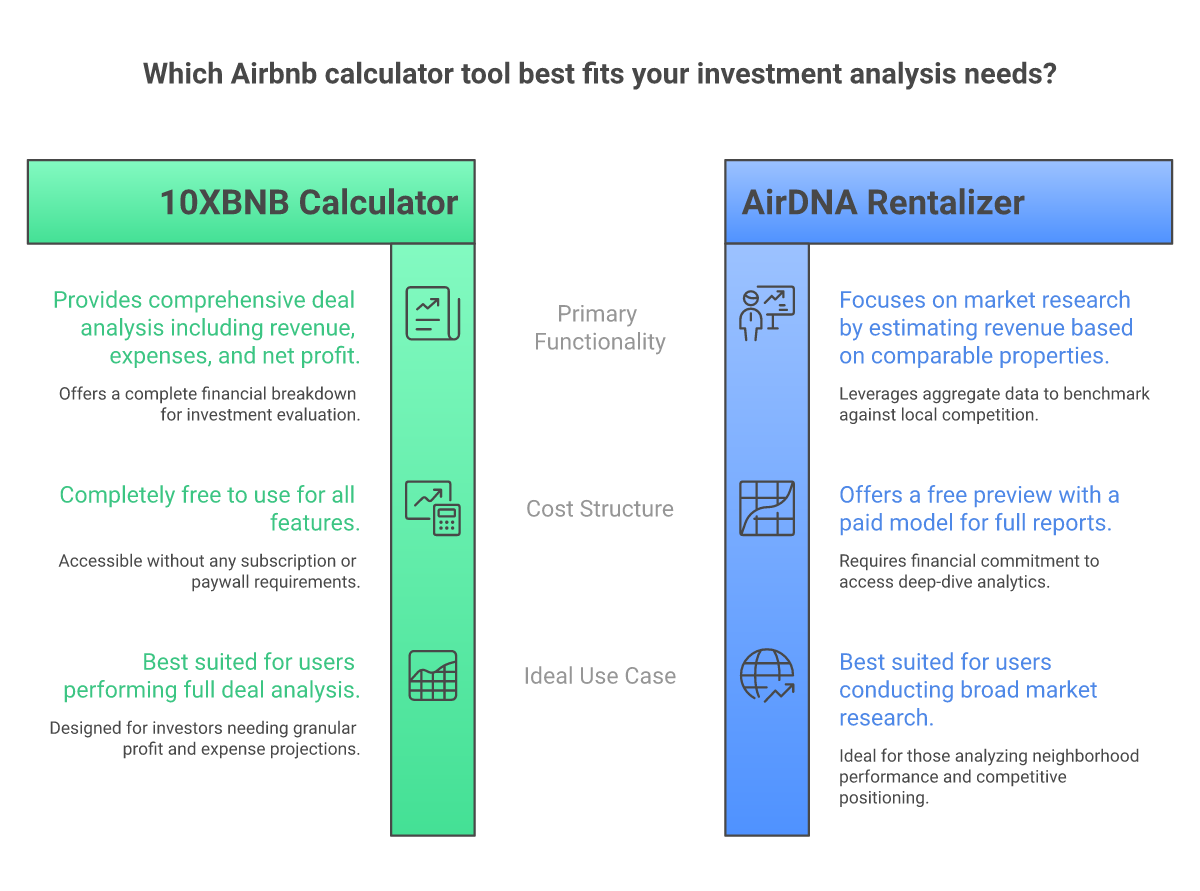
Three Airbnb calculator tools dominate the market in 2026. Each pulls market data differently and produces different revenue estimates for the same specific property. Picking the right one depends on whether you need revenue projections only, or revenue plus expense modeling for full investment analysis.
| Tool | Best for | Cost | What it estimates |
|---|---|---|---|
| 10XBNB Airbnb calculator (this page) | Net profit + cash flow + deal score | Free | Revenue, expenses, net profit, break-even, deal score |
| AirDNA Rentalizer | Revenue projections from comparable properties | Free preview, paid for full report | Revenue forecast from nearby airbnb listings |
| Airbnb What’s My Place Worth tool | Quick what-if estimate inside Airbnb | Free | Estimated annual airbnb income only, no expenses |
The trade-off is depth of analysis. AirDNA Rentalizer pulls market trends from comparable properties to produce revenue estimates with strong data backing. Airbnb’s built-in tool surfaces a single nightly rate suggestion from market conditions. The 10XBNB Airbnb calculator on this page handles both revenue and the full expense side, which is what you need for a real go-or-no-go decision on a vacation rental investment.
The rule for serious Airbnb investors: use AirDNA Rentalizer for revenue projections from similar properties, then plug those numbers into the 10XBNB Airbnb calculator to layer on your specific cost basis. Two-tool stack beats any single tool for data-driven investment decisions.
Best Airbnb Arbitrage Calculator Tools Compared (2026)
No single calculator gives you the full picture. The best approach is to cross-reference 2-3 tools using conservative estimates.
| Tool | Price | Data Source | Best For | Limitations |
|---|---|---|---|---|
| AirDNA (Rentalizer) | From $250/yr | 10M+ Airbnb & Vrbo listings | Revenue estimates, market data | Expensive; can overestimate revenue |
| Rabbu | Free | Airbnb data + proprietary | Quick free estimates, interactive | Less granular than AirDNA |
| Mashvisor | From $50/mo | MLS + Airbnb + public data | Comparing investment metrics | More investment-focused than STR |
| Hostaway Calculator | Free | Aggregated listing data | PMS users wanting quick checks | Tied to their platform |
| Awning | Free | Airbnb + proprietary data | Address-level estimates | Newer tool, smaller dataset |
| 10XBNB Calculator (above) | Free | Your own inputs | Custom profit scenarios, ROI, break-even | Requires you to research inputs |
Pro tip: Use AirDNA or Rabbu to find your ADR and occupancy estimates, then plug those numbers into our calculator above for a detailed profit breakdown including ROI, break-even occupancy, and deal verdict. That two-step process gives you the most accurate projection.
Free Airbnb Arbitrage Spreadsheet Template
Want to analyze multiple properties side by side? Download our free Google Sheets template that lets you compare up to 10 properties at once. It includes pre-built formulas for monthly cash flow, annual profit, ROI, and break-even calculations, plus a scenario tab where you can stress-test different occupancy rates and ADR assumptions.
Get the Free Google Sheets Template (Make a Copy)
The spreadsheet includes columns for property address, monthly rent, ADR, occupancy rate, all operating costs, monthly and annual profit, ROI, and break-even month. It is the same tool many 10XBNB students use to evaluate deals before signing leases.
Airbnb Arbitrage Risks and How to Mitigate Them
Rental arbitrage avoids some traditional real estate risks. You don’t own the property, so you are not exposed to market value drops or major structural repairs. But you face a different set of risks that you need to plan for.
Lease termination risk is the biggest threat. If your landlord decides not to renew or terminates your lease, you lose the business at that location instantly. Mitigate this by getting subletting permission in writing, building a strong landlord relationship, and keeping properties with multiple landlords so no single termination wipes you out.
Regulatory risk is growing in many cities. Short-term rental regulations change frequently, and some cities have enacted strict limits or outright bans. Before entering any market, research the current rules thoroughly. Check our coverage of the current state of rental arbitrage regulations for an updated overview.
Seasonality risk catches many first-time operators off guard. Plan for 2-3 slow months per year where occupancy may drop 20-30%. Build a cash reserve of at least 2 months’ rent to cover lean periods. Smart operators in seasonal markets adjust their risk management strategy by running properties in multiple markets with different peak seasons.
Maximizing Your Airbnb Arbitrage Returns
Dynamic Pricing and Revenue Optimization
Static pricing leaves money on the table. Dynamic pricing tools like PriceLabs, Beyond Pricing, or Wheelhouse automatically adjust your nightly rate based on local demand, day of week, seasonal trends, and competitor pricing. Most operators see a 10-20% revenue increase after implementing dynamic pricing. Combine this with optimized listing photos, detailed descriptions, and fast response times to maximize both your ADR and occupancy rate.
Cost Control Strategies
Every dollar saved on expenses drops straight to your bottom line. Negotiate cleaning rates by guaranteeing consistent volume. Buy supplies in bulk. Use smart thermostats and LED lighting to reduce utility costs. Consider self-managing your first 1-3 properties before hiring a property manager (who typically charges 15-25% of revenue). Keep detailed expense records so you can identify cost creep early.
Scaling Across Properties
The real power of rental arbitrage is scalability. Once you have proven one property is profitable, the process is repeatable. Many successful operators run 5-20+ properties. Each additional property uses the systems, vendor relationships, and market knowledge you have already built. The key is to scale systematically. Add properties in the same market first to maximize operational efficiency before expanding to new cities.
Explore Markets by City
Ready to plug real numbers into the calculator? Browse our detailed city guides for market-specific revenue data, occupancy rates, and rent ranges you can use as calculator inputs:
- Southeast: Nashville, Atlanta, Charlotte, Asheville, Raleigh
- Florida: Tampa, Miami, Orlando, Jacksonville, Destin
- Texas: Austin, San Antonio, Dallas, Houston
- West: Phoenix, Scottsdale, Denver, San Diego, Portland, Seattle
- Resort/Vacation: Gatlinburg, Pigeon Forge, Myrtle Beach, Gulf Shores, Columbus
See the full city rankings for all 25 markets, or use our free deal analyzer spreadsheet to compare multiple properties side by side.
Airbnb Arbitrage Calculator FAQ
How much can you realistically make with Airbnb arbitrage?
Most operators earn $500-$2,500 per property per month in net profit after all expenses. Returns depend heavily on location, property type, occupancy rate, and how well you manage operations. A well-chosen property in a strong market like Nashville or Savannah can generate $1,500-$3,000 monthly. Your first property typically takes 2-4 months to recoup setup costs.
What is a good occupancy rate for Airbnb arbitrage?
A good occupancy rate is 65-75%. Most urban markets average 60-70% annually. Vacation markets can swing from 40% off-peak to 90%+ in peak season. For conservative financial projections, use 60%. Anything above 70% consistently is excellent.
How much does it cost to start Airbnb arbitrage?
Typical startup costs range from $4,000-$8,000 per property. This covers first month’s rent, security deposit, furniture and decor, and initial supplies. Some operators start for under $3,000 by furnishing with secondhand items and negotiating reduced deposits. See our full startup cost breakdown for detailed numbers.
What is the best Airbnb calculator tool?
AirDNA Rentalizer is the industry standard for revenue estimates, using data from over 10 million listings. For free alternatives, Rabbu offers solid projections with an interactive calculator. The best approach is to cross-reference 2-3 tools and use conservative figures. See our full calculator comparison table above.
What is the minimum occupancy needed to break even?
It depends on your ADR and expenses. The formula: Break-Even Occupancy = (Monthly Expenses / ADR) / 30 x 100. Typical break-even occupancy ranges from 50-65%. The calculator above automatically calculates your break-even occupancy based on your specific inputs. Aim for a market where average occupancy is 10-15% above your break-even point.
Is Airbnb arbitrage legal?
Airbnb arbitrage is legal in most areas, but regulations vary significantly by city and state. You typically need written landlord permission to sublet, a short-term rental permit or license, compliance with local zoning laws, and proper insurance coverage. Some cities like New York and San Francisco have strict rules that make arbitrage very difficult or impossible. Always verify local regulations before signing a lease.
How do I calculate Airbnb arbitrage profit?
Gross Monthly Revenue = Average Daily Rate x Occupancy Rate x 30 days. Subtract platform fees (3%) and any PM fees for Net Revenue. Total Monthly Expenses = Rent + Cleaning + Utilities + Supplies + Insurance + Maintenance. Monthly Profit = Net Revenue minus Expenses. Annual ROI = (Monthly Profit x 12) / Startup Costs x 100%. Use our free calculator to run the numbers instantly.
Start Running Your Numbers Today
Every successful Airbnb arbitrage business starts with the same step: running the numbers honestly before signing a lease. Use the free calculator above to evaluate any property in under 60 seconds, cross-reference with tools like AirDNA or Rabbu, and download our free spreadsheet template to compare multiple deals side by side.
Whether you are analyzing your first property or your twentieth, the fundamentals don’t change: accurate inputs, conservative assumptions, and thorough cost accounting. Get the numbers right and the profits follow.
Ready to go deeper? Read our complete Airbnb arbitrage guide or book a free strategy call to learn the exact system our students use to build profitable short-term rental portfolios.
The calculator above tells you what one property earns. The bigger question in 2026 is how many properties it takes to replace your W-2. We ran the full math on how three short-term rentals can replace a six-figure salary, including a 24-month timeline and the AI-job-loss backdrop driving the conversation.
A profit calculator only helps if you know when to act. If your role is AI-exposed, we put together a tactical guide on what to do if AI takes your job in the next 12 months, including the task audit that tells you whether your current role is on the wrong side of the automation chart.
If you’re using this arbitrage calculator to compare rentals against other passive income options, the full head-to-head is in the full passive income ranking for engineers. Seven options, real post-tax numbers, engineer-specific framing.
After running the calculator numbers, if you want the full implementation walkthrough (tax loophole, financing, property management, 5-15 hr weekly time budget), read the detailed STR investment playbook for busy professionals.
Tech workers using this calculator will find the full tech-specific playbook in the tech-worker real estate side income guide, with Bay Area-specific regulations and the OBBBA tax benefit math.
2026 Tool Deep Dives
We published a full operator-honest review cluster in May 2026. Each one walks through actual pricing, real pros and cons, and where the tool falls short.
- Pricelabs Review, the dynamic-pricing tool most arbitrage operators run.
- Wheelhouse Review, machine-learning dynamic pricing, and where it pays off.
- Beyond Pricing Review, the category’s original tool and where it stands today.
- Pricelabs vs Wheelhouse vs Beyond Pricing, the operator-honest 3-way comparison.
- AirDNA Review, STR market data deep dive.
- Mashvisor Review, the buy-vs-rent dual-strategy analytics tool.