
Quick answer: Mashvisor is a useful supplement for short term rental investors who care about buy-vs-rent math, dual-strategy property analysis, and multi-market scouting from a single dashboard. It’s weaker than AirDNA on pure short term rental data depth, and the platform’s submarket comps thin out fast once you leave major metros. We give it an honest 3.6 out of 5. Useful in the acquisition phase, light on the operating phase. Below is the full operator-grade Mashvisor review for 2026, including pricing, accuracy notes, alternatives, and how our 10XBNB students fold this tool into a larger workflow.
Already feel like you want a second set of eyes on your numbers before you act? Book a free coaching call with a 10XBNB operator and we’ll pressure-test the deal alongside whatever tool you’re using.
This Mashvisor review covers the platform as a real estate investors’ decision engine and as a short term rentals data source, with separate verdicts for each. We’ve used Mashvisor on real deals, talked to active 10XBNB students who use it daily, and cross-checked its projections against listing-level data from AirDNA. The goal of any honest Mashvisor review should be the same: tell you when the tool earns its money, and when you should be reaching for something else.
What Mashvisor Actually Is
This Mashvisor review starts from the same place every honest tool review should: what is the platform, who built it, and what job is it actually trying to do? Mashvisor is a real estate investment platform built around the idea that a property’s value lives in its rental income potential, not just its appraised price. It was founded in 2014 by Peter Abualzolof and Mohammed Jebrini after a Startup Weekend event in Ramallah, then joined the 500 Startups accelerator in Silicon Valley in 2016. The company’s pitch from day one: aggregate real estate data, run it through investment math, and let users compare a property as a traditional long-term rental against the same property run as an Airbnb.
That dual-strategy framing is what separates Mashvisor from a pure short term rental data shop like AirDNA. AirDNA is built for one job: tell you what an Airbnb listing earns. Mashvisor is built for a bigger question: is this property worth buying, and which rental strategy makes it work? The answer changes the kind of investor it serves and the kind of decision it helps you make.
You use Mashvisor when you’re shopping. You use AirDNA when you’re already operating. There’s overlap, but that distinction is the easiest way to think about it before you pay for anything.
The Features That Matter
Mashvisor’s platform has more than a dozen tools across investment analysis and property management. After spending real time inside it, three of them carry most of the weight for short term rentals investors.
Mashvisor Property Finder
The Mashvisor Property Finder is the platform’s investment search engine and the feature most real estate investors actually open the dashboard for. You set filters: city, property type, bed and bath count, price range, cap rate floor, cash-on-cash return floor, and rental strategy (traditional or Airbnb). The property search function returns a sorted list of investment properties for sale that match your criteria, each one stamped with projected rental income for both strategies, projected expenses, cash flow, cap rate, and a Mashmeter score. This is where the platform earns its keep for investors who want to compare deals across two or three markets without rebuilding a spreadsheet for each one.
The screen is dense and the filter logic takes ten minutes to learn, but once you’ve got the criteria dialed in, you can scan 40 to 60 candidate properties in an hour. Compare that to manually pulling Zillow property listings and dropping each one into your own pro-forma sheet. That’s the time-save. Property managers and property owners who want to identify lucrative investment properties in fresh markets get faster investment property analysis from this single screen than they would from any spreadsheet-only workflow.
Airbnb Investment Calculator
The Airbnb investment calculator (Mashvisor’s rental property calculator) is the per-property deep dive. Click any investment property in Property Finder (or paste in a Zillow URL) and Mashvisor returns projected occupancy rate, average daily rate, monthly rental income, monthly expenses (mortgage estimate, property tax, insurance, HOA, utilities, cleaning, supplies, management), cap rate, and cash-on-cash return. You can flip the same property between “Traditional” and “Airbnb” strategy in one click and watch the numbers swap. This is the property analysis model that drives most investment decisions on the platform.
The calculator’s projections are based on Mashvisor’s internal rental comps and comparable properties for the neighborhood. In dense urban markets with hundreds of comparable listings, the numbers are reasonable. In rural counties or thin submarkets, the projections wobble. We’ll come back to that under data accuracy.
Heatmap
The neighborhood Heatmap is the marketing tool everyone associates with Mashvisor, and for good reason. Pick a city, pick a metric (cap rate, cash-on-cash return, Airbnb occupancy, or Airbnb rental income), and the platform colors every neighborhood on the map by performance. Green for top quartile, red for bottom. It’s the fastest way to identify which submarket in a metro you actually want to be shopping in before you waste time on property listings in dead zones. Many active real estate investors use this single feature to handle initial market triage.
The heatmap is genuinely useful, but it’s an entry point, not a verdict. The neighborhood-level data feeding it is only as good as the comp depth in that ZIP code. We’ve seen the heatmap call a neighborhood “high cash-on-cash” only to find that the comp pool was twelve listings, half of which were defunct or owner-occupied. Use it to narrow your search. Then verify with listing-level data from a tool like AirDNA or Airbtics before you write an offer.
Mashmeter, MLS Access, and the API
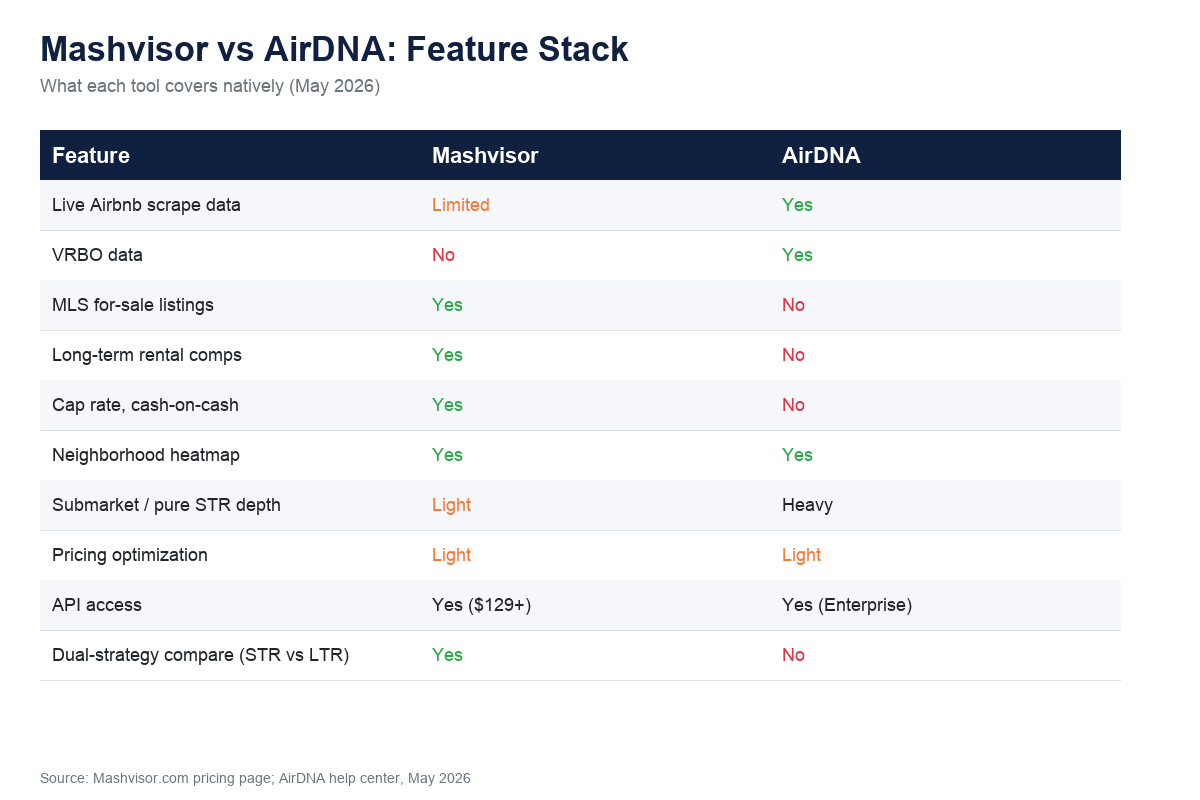
Three more of Mashvisor’s tools and Mashvisor’s features round out what serious investors actually touch. The Mashmeter is Mashvisor’s proprietary one-number investment score (it folds neighborhood-level returns, cap rate, and cash-on-cash into a single 0-to-100 number). Take it as a quick triage signal, not gospel. MLS access on the Professional plan lets you see for-sale property listings the second they hit the market, which matters in tight inventory cycles for residential real estate investors and real estate professionals chasing fresh inventory. The Real Estate API ($129+/month, usage-based) is for developers and shops that want to pull Mashvisor data and property analytics into their own dashboards or CRMs.
Together, Mashvisor’s tools handle property search, neighborhood property analytics, and per-deal investment analysis from one login. For a property analysis model that combines short term rentals math with traditional rental math, that’s a tight package.
Mashvisor Pricing in 2026
Mashvisor pricing is annual-billed, with monthly billing also available at higher per-month rates. The numbers below reflect the published rates on the official Mashvisor pricing page as of May 2026. Pricing moves, and the platform runs promotional discounts often (we’ve seen 20 to 50 percent off advertised), so check live before paying.
| Plan | Annual Billing | Best For | Key Features |
|---|---|---|---|
| Lite | $49.99/month | One property at a time | Individual property analysis, ROI calc, regulatory rules for 500+ cities |
| Standard | $74.99/month | Multi-market scouting | Heatmap, neighborhood analytics, property comparison, 20 Excel exports/month |
| Professional | $99.99/month | Active investors with deal flow | Multifamily, foreclosure filters, CRM, MLS access (up to 3 cities), 60 exports/month |
| Enterprise | Custom (contact sales) | Funds, brokerages, large operators | Raw data access, API, up to 10 years historical data, bulk downloads |
| API | From $129/month | Developers and platforms | Usage-based, programmatic access to Mashvisor’s full data stack |
Mashvisor also runs a separate Vacation Rental Management product (Starter at $11/month annual billed) that bundles a bookable site, channel manager integration with Airbnb/Vrbo/Booking.com, reservation handling, and guest messaging. We don’t recommend it as a primary PMS for serious operators (Hospitable, Hostaway, and Guesty are deeper), but it’s worth knowing it exists if you’re a single-property investor looking for one bill instead of two.
There is no permanent free tier. Mashvisor offers a limited free trial period for new accounts. Plans below the Professional tier don’t include MLS access, which limits the deal-sourcing speed of the Lite and Standard plans for active buyers.
Where Mashvisor Wins
Strip away the marketing copy and there are five places Mashvisor genuinely earns its subscription.
- Dual-strategy comparison for Airbnb and traditional rentals. The single best feature. One property, two strategies, side by side. No other STR-focused real estate analytics platform gives you that view as cleanly. The rental strategy tab shows projected cash return for both paths.
- Buy-side property search. MLS integration plus investment math means you can analyze property listings filtered by investor metrics (cap rate, cash-on-cash return) rather than retail metrics (price per square foot). The Property Finder also flags foreclosure properties and off market properties on higher tiers, surfacing investment opportunities most retail-focused real estate analytics tools never show. This is what investors actually want.
- Multi-market scouting. The heatmap and Mashmeter let you compare three or four metros in an afternoon as a real estate investing tool. AirDNA can do the same but charges per market on its Pro plan.
- Affordable entry point. $49.99/month annual gets you the core investment analysis tools, plus enough property analytics to make smart investment decisions on individual investment properties. AirDNA’s comparable tier starts higher for similar metro coverage.
- Useful side math. Mashvisor can calculate net operating income, factor in one time startup costs, and stress-test cash return across multiple scenarios in seconds. That’s the kind of math investors used to do in Excel.
- BiggerPockets integration. Mashvisor partners with BiggerPockets through the agent finder network, so deal-flow handoff to a local investor-friendly agent is one click away.
Where Mashvisor Falls Short
Honest review means honest pushback. Five real gaps to know before you pay.
- Data thins outside major metros. In Phoenix, Nashville, Orlando, the comp pool is deep enough that projections are reasonable. In secondary markets and rural counties, occupancy rate projections can be off by 10 to 20 percentage points because there aren’t enough comparable Airbnb listings to model from. AirDNA, which scrapes live Airbnb and Vrbo, holds up better in those markets.
- No operational tools that matter. Mashvisor is built for buying, not for running. If you need dynamic pricing automation, smart calendar locking, channel manager logic, or guest messaging at scale, you’re using PriceLabs, Wheelhouse, Hospitable, or Hostaway, not Mashvisor.
- Submarket STR depth is shallow. AirDNA can show you the top 10 listings in your exact ZIP code, their ADR, their occupancy, their amenity stack. Mashvisor aggregates one level up and can’t drill that deep.
- Pricing keeps moving. The published rates and the rates after the promo codes are often different by 30 to 50 percent. That’s fine for the buyer but makes recommendations awkward.
- No permanent free tier. Tools like AirROI and AirDNA’s free MarketMinder give you basic market data without paying. Mashvisor doesn’t.
Mashvisor vs AirDNA: The Comparison That Matters
This is the single comparison every investor runs into. Here’s the operator-grade version.
| Dimension | Mashvisor | AirDNA |
|---|---|---|
| Primary use case | Property acquisition + dual-strategy analysis | Active short term rental market intelligence |
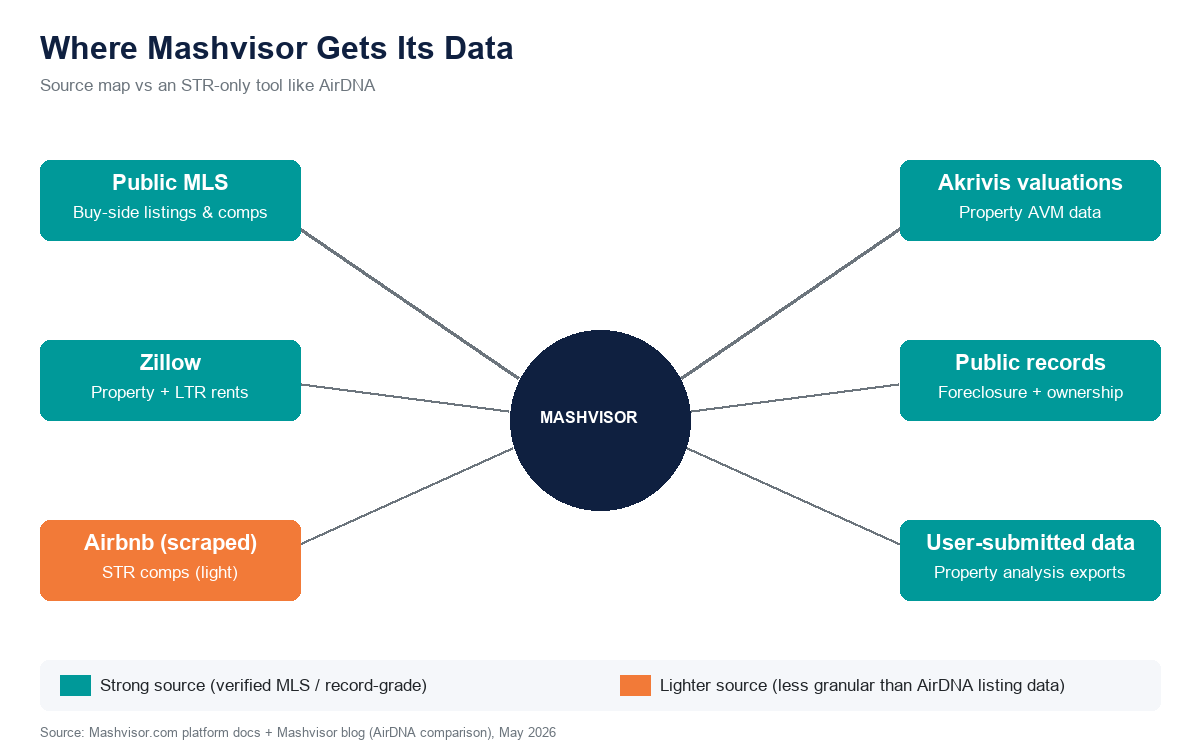
| Data source | MLS, Zillow, public records, scraped Airbnb (lighter) | Live Airbnb + Vrbo scrape |
| STR data depth | Aggregated, neighborhood-level | Listing-level, granular |
| Best for | Buy-side decisions, multi-strategy investors | Operating hosts, pricing strategy, market entry |
| Long-term rental data | Yes | No |
| For-sale listings | Yes (MLS) | No |
| Entry pricing (2026) | $49.99/month annual | Around $40 to $99/month annual depending on market access |
| Free tier | No (trial only) | Yes (MarketMinder free version) |
Reading the table: they aren’t actually competing for the same job. Most serious operators we work with end up paying for both at different stages. Mashvisor during the acquisition push. AirDNA once the property is live and the question is rate optimization. Mashvisor’s own blog quietly admits this in their AirDNA comparison piece, where they position the two as complementary rather than competitive. That’s the honest read.
Mashvisor Alternatives Worth Knowing
If Mashvisor doesn’t fit your workflow, here’s the field. Each tool wins on a different dimension.
| Tool | Strength | Weakness | Starting Price (May 2026) |
|---|---|---|---|
| AirDNA | Listing-level STR data, deep market reports | No buy-side or LTR data | ~$40/month (single market) |
| Airbtics | Global STR coverage, fast UI | Lighter in tertiary US markets | ~$29/month single city |
| AirROI | Free market data, simple ROI math | Limited features beyond free tier | Free / Pro from $19/month |
| Rabbu | STR-specific deal sourcing | US only, lighter analytics | Around $99/month |
| BiggerPockets STR Calculator | Investor-community vetted, free with membership | Manual data entry required | Bundled with BP Pro |
If you want the full landscape, including which tool we recommend at which stage of your operator journey, read our guide to the best Airbnb analytics tools.
Who Should Actually Use Mashvisor
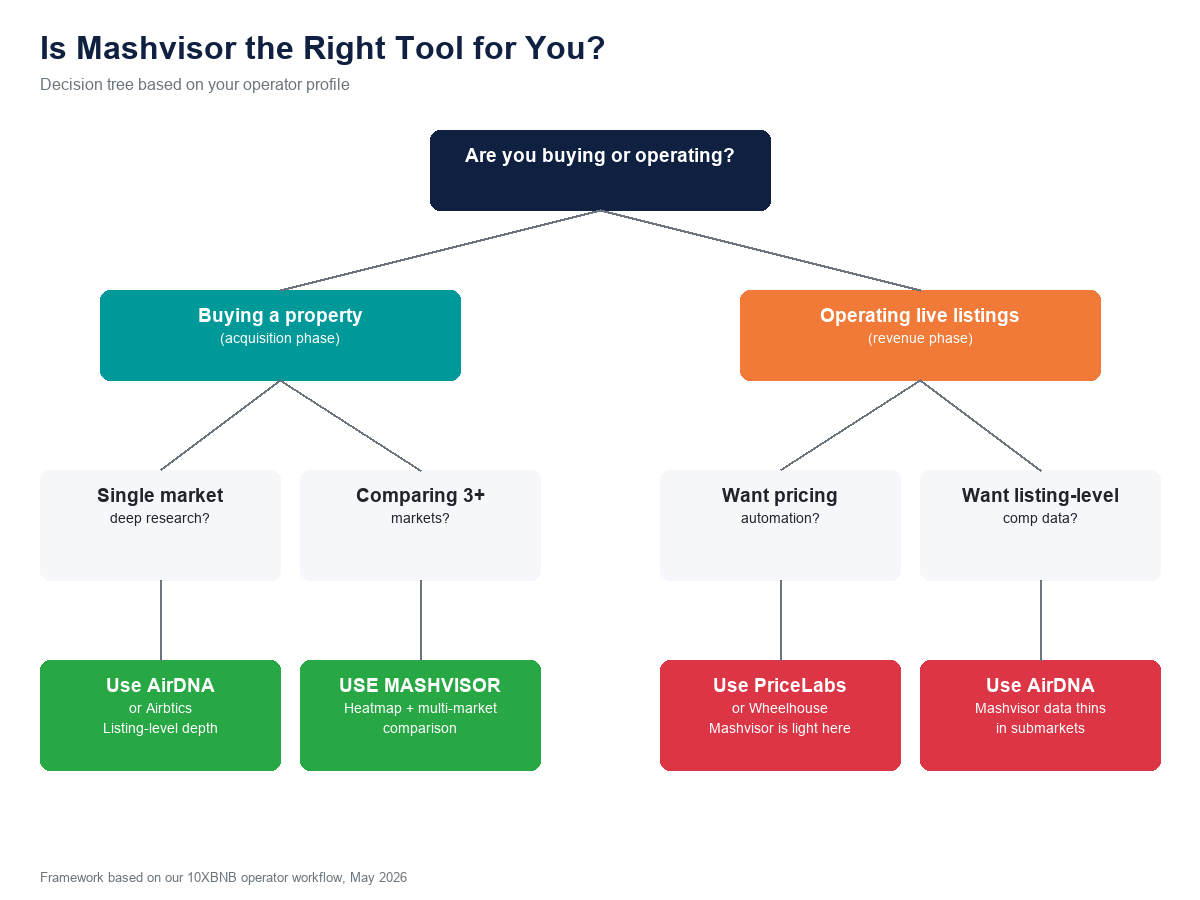
Buyers who want one dashboard for both rental strategies. Investors comparing three or more markets before committing capital. People running a hybrid portfolio of long-term rentals and short term rentals who need consistent math across both. New investors who want a guided way into Airbnb data without building their own spreadsheets.
You’ll find Mashvisor genuinely useful if any of those describe you.
Who Shouldn’t Bother
Established hosts focused on revenue management. Operators with five or more active listings who need pricing automation, calendar logic, and channel management. Anyone whose investment strategy is rental arbitrage rather than property acquisition (Mashvisor has no real arbitrage modeling, which is why we built our own Airbnb arbitrage calculator). Investors hunting in rural or tertiary markets where the underlying Airbnb data is thin.
If any of those describe you, your money is better spent on AirDNA plus PriceLabs plus a property management system. Mashvisor is the wrong primary tool for that workflow.
Is Mashvisor Worth It in 2026?
Worth it depends on the job. For acquisition-phase research where you want to compare two or three target markets, run quick cap rate and cash-on-cash math on dozens of properties, and stress-test a property as both a long-term rental and a short term rental, yes, Mashvisor is worth $49.99 to $99.99/month. The time-save alone covers it once you’re seriously hunting.
For operating-phase work where you’re optimizing existing listings, no. You’ll outgrow Mashvisor within the first month. Buy AirDNA for market intelligence and a pricing tool like PriceLabs for nightly rate optimization instead.
The biggest mistake we see new investors make: paying for Mashvisor’s Lite plan, getting confused by the thin data in their target submarket, then concluding the platform is broken when the real issue is they picked the wrong tool for their phase of the journey. Match the tool to the question you’re trying to answer. The investment decisions you’re trying to make should determine which tool you reach for, not the other way around. Done right, Mashvisor’s property analysis tool sits inside a stack of three or four data sources that together give you a defensible underwriting picture for any investment property you’re chasing.
How Our 10XBNB Students Use Mashvisor
Inside the 10XBNB community, Mashvisor shows up in one specific spot of the operator playbook. It’s not the only tool, and it’s never the only data source for a decision. Here’s how we teach students to fold it in.
Phase 1, market selection: students use Mashvisor’s heatmap and Mashmeter to narrow the field from “all of the US” down to three to five target markets. Then they verify with AirDNA listing-level data and check our top Airbnb markets for 2026 and the most profitable Airbnb cities shortlist before committing.
Phase 2, deal underwriting: students run candidate properties through both Mashvisor’s calculator and our internal arbitrage spreadsheet. The two-tool approach catches outliers fast. If Mashvisor projects $4,800/month in revenue and AirDNA’s listing comps suggest $3,400, you investigate before you commit. Live coaching calls inside 10XBNB are where these projections get pressure-tested by people who’ve underwritten hundreds of properties between them.
Phase 3, operating: Mashvisor drops out of the workflow. Operating tools take over (PriceLabs for pricing, Hospitable or Hostaway for property management, AirDNA for ongoing market intelligence). The system we teach inside 10XBNB doesn’t make any one tool the answer. It makes the tools answer to the operator.
The mentorship piece matters more than the toolset. I’ve watched students burn months stuck on a Mashvisor projection that didn’t match reality, only to fix it in one coaching call once an experienced operator pointed at the comp pool problem. The tool is fine. The system around the tool is what makes it work.
If you want a walk-through of how our active student operators stack Mashvisor against the rest of the data picture before they pull the trigger on a deal, book a free coaching call and we’ll show you the actual decision framework.
Frequently Asked Questions
Is Mashvisor accurate for Airbnb data?
In major metros with deep comp pools, Mashvisor’s Airbnb projections are reasonable, generally within 10 to 15 percent of actual performance for typical listings. In secondary markets and rural counties, the accuracy degrades. The underlying Airbnb scrape data is lighter than AirDNA’s. Always cross-check Mashvisor’s projections against a listing-level data source before underwriting.
Mashvisor vs AirDNA: which one should I buy?
Different jobs. Mashvisor is for buying property and comparing strategies. AirDNA is for understanding a live short term rental market at the listing level. Serious operators usually pay for both at different phases of their workflow. If you only have budget for one and you’re shopping for a property, start with Mashvisor. If you already own and operate, start with AirDNA.
How much does Mashvisor cost in 2026?
The Lite plan starts at $49.99/month with annual billing. Standard is $74.99/month. Professional is $99.99/month. The API plan starts at $129/month with usage-based pricing. Enterprise pricing is custom. Mashvisor runs promotional discounts often, so check the official pricing page before paying full price.
Does Mashvisor offer a free trial?
Mashvisor offers a limited free trial for new accounts. There is no permanent free tier. Plan on paying for at least one month to evaluate the platform inside your target market.
Is Mashvisor good for rental arbitrage?
Not really. Mashvisor is built around property acquisition with traditional and Airbnb rental income strategies. Rental arbitrage (renting a unit and re-listing it on Airbnb) isn’t its core use case. You’ll get more value from a dedicated arbitrage calculator and a PMS focused on multi-unit operators.
Can I use Mashvisor for long-term rental investing?
Yes. Mashvisor was originally built around traditional rental analysis and added Airbnb data later. The traditional rental cap rate, cash-on-cash return, and rent comp tools are solid for buy-and-hold investors. It’s one of the few platforms that does both well.
What’s the best Mashvisor alternative?
It depends on what you’re replacing. For short term rental data depth, AirDNA wins. For global STR coverage, Airbtics. For free market data, AirROI. For investor community and a free calculator, BiggerPockets. We cover the full alternative landscape in our best Airbnb analytics tools guide.
Mashvisor Review Final Verdict: 3.6 out of 5
The verdict of this Mashvisor review: Mashvisor is a solid acquisition-phase tool with a real point of difference. Dual-strategy property analysis backed by MLS data is a workflow no short term rentals-only competitor matches. The platform earns its subscription if you’re actively shopping for investment properties and want fast multi-market comparison without a custom spreadsheet. Most honest Mashvisor review writeups land in roughly this same spot.
Where this Mashvisor review pushes back: it loses points on data depth outside major metros, on the lack of real operational tools, and on the fact that a serious operator will outgrow it the moment they switch from buying to running listings. It’s a useful supplement, not a replacement for AirDNA or a true property management system. The final Mashvisor review score we give it: 3.6 out of 5. Strong in the spot it’s built for, light everywhere else.
If you’re staring at a candidate property and not sure whether the numbers Mashvisor (or any other tool) is showing you actually hold up in the real world, talk to an operator before you write the offer. Book a free 10XBNB coaching call and we’ll go through the deal alongside you. Live coaching, an active community of operators with about a thousand doors between them, and the actual underwriting framework we use on every deal. No tool replaces that.
Related Operator Deep Dives
Other reviews and comparisons in this cluster operators have found useful: