
Short answer up front: AllTheRooms is a credible short-term rental analytics platform with broader international coverage than AirDNA, but a less polished interface and a per-market pricing model that can sneak up on you. If you operate in two or more countries, or you research markets at the portfolio level, it earns a serious look. If you only run U.S. properties and want address-level revenue estimates, AirDNA is still the better fit. This is an honest operator’s review, not a paid placement, and I’ll walk you through where AllTheRooms wins, where it falls short, and how I think about it inside the system we teach at 10XBNB.
Book a free coaching call if you want a live operator to look at your specific market with you before you commit to any analytics tool.
What AllTheRooms actually is in 2026
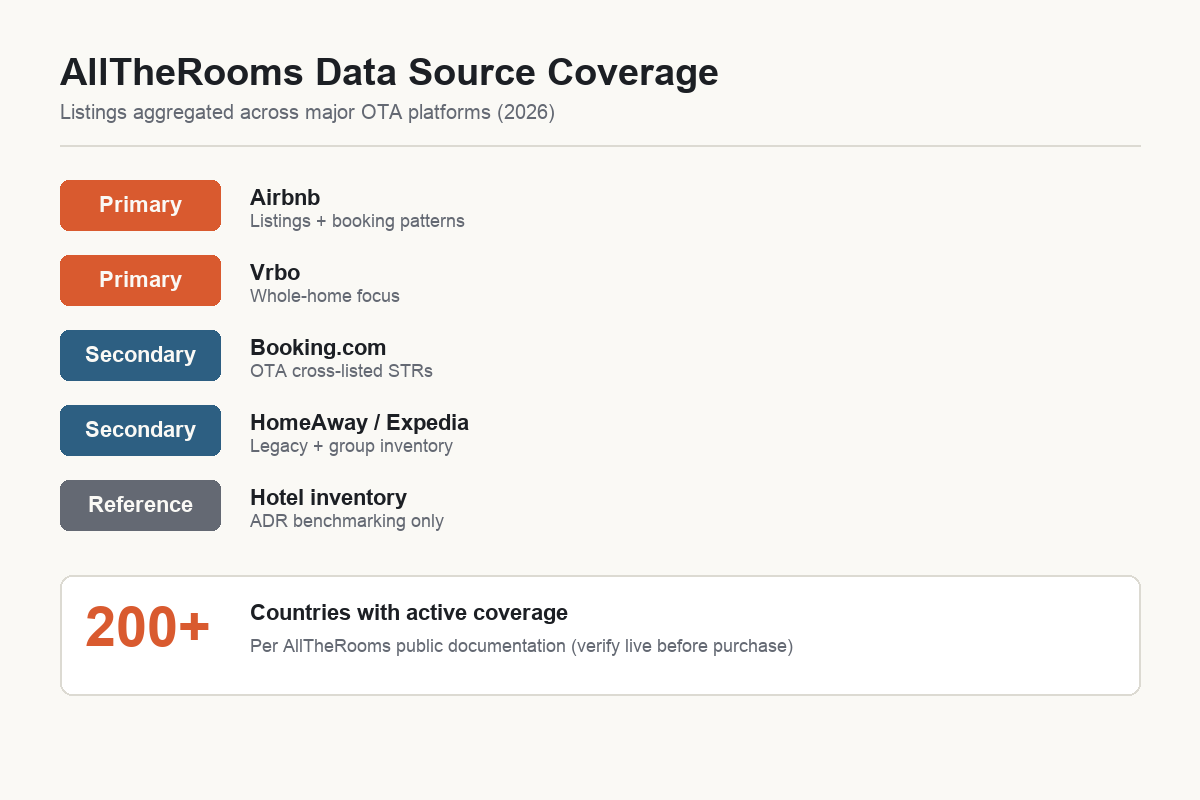
AllTheRooms started life as a vacation rental search engine, the kind of meta-site where a traveler could compare Airbnb, Vrbo, Booking.com, and HomeAway listings in one place. Somewhere along the way the founders noticed something more valuable than ad revenue: the aggregation engine they built was producing one of the largest cross-platform short-term rental datasets in existence. So they pivoted. The consumer site quietly stepped back and AllTheRooms Analytics, the B2B data product, became the company’s main play.
Then the bigger move. On August 7, 2025, Deckard Technologies announced its acquisition of AllTheRooms. Deckard is a GovTech company best known for Rentalscape, the compliance platform that municipalities use to identify and tax short-term rentals operating outside local regulation. The acquisition transferred a portfolio of six U.S. patents, including a Bayesian matching algorithm that deduplicates the same listing across Airbnb, Vrbo, and Booking.com. Will Pearson, the former AllTheRooms CEO, stayed on as Director of Operations at the new parent.
Why does the ownership change matter for you as an operator? Two reasons. First, Deckard’s primary customer is not you; it is the city or county trying to enforce STR rules. That tension does not necessarily hurt the data product, but it changes the roadmap incentive. Second, Deckard reported 60% year-over-year revenue growth in 2025, which means the company has resources to invest in the analytics product if it wants to. Whether it will is the open question I am watching through 2026.
The product itself is a market intelligence dashboard. You pick a market, you get occupancy rate, average daily rate (ADR), RevPAR, available supply, and trend curves. You can compare a private room against an entire home, filter by bedroom count, and pull historical data going back as far as seven years on the higher tiers. There is a proprietary Vacation Rental Score and a six-month forward-looking demand projection based on actual bookings rather than pure modeling.
Features that actually matter for operators
Most reviews list every feature on the marketing page. I’ll cut that down to the ones I have seen students actually use.
Market analytics dashboard
This is the core product. You search a market, AllTheRooms pulls aggregate occupancy, ADR, and RevPAR, and you can slice by property type, bedroom count, and time period. The international coverage is the genuine differentiator here. If you are looking at a market in Portugal, Mexico, or Thailand, AllTheRooms typically has data where AirDNA’s coverage thins out or stops entirely.
Competitive intelligence
You can pick a target listing, or a set of listings inside a market, and watch their occupancy and ADR over time. The Bayesian dedup is the secret sauce here. When the same property shows up on Airbnb, Vrbo, and Booking.com under slightly different names, AllTheRooms collapses them into one entity. That matters because naive aggregators double-count and inflate the local supply number, which then deflates the calculated occupancy rate. The six patents are worth something on paper, and in practice the dedup quality is the single biggest reason to choose this tool over a cheaper alternative.
Historical depth
The Pro tier publicly advertises up to seven years of historical data. That is longer than AirDNA’s standard offering and considerably longer than Mashvisor or Airbtics. If you are stress-testing a market against COVID-era occupancy crashes or the 2024 rebound, the depth helps.
Vacation Rental Score
A proprietary monthly score that blends occupancy, ADR trend, and booking pace into a single 0-100 number. I am skeptical of single-number scores in general because they collapse a lot of judgment into a black box. But as a quick first-pass filter when you are comparing 30 markets, it is genuinely useful. Just do not make a buying decision on the score alone.
Forward-looking booking projections
AllTheRooms surfaces a six-month forward window based on actual bookings already on the calendar across the listings they track. This is different from forecast models, which extrapolate from historical patterns. The forward-booking signal is more useful for short-horizon decisions (should I list now, should I push for May?) than for long-horizon underwriting.
What you will not find
There is no address-level revenue estimator inside AllTheRooms. AirDNA’s Rentalizer lets you paste a specific street address and get an estimated annual revenue figure. AllTheRooms operates at the market level, not the property level. There is also no built-in cap rate, cash-on-cash, or mortgage scenario modeling. If you want underwriting, you need a separate tool or a spreadsheet.
AllTheRooms pricing in 2026 (read this carefully)
Pricing has shifted since the Deckard acquisition. Here is what the public-facing tiers look like as of May 2026. Always verify on the official AllTheRooms site before subscribing because the company adjusts the tier structure quietly and the per-market model can stack up.
| Tier | Price (May 2026) | What you get |
|---|---|---|
| Free | $0 | 3 months of history, 5 tracked competitors, 100 property limit. Genuinely useful for one-off market checks. |
| Basic | From ~$19/month per market | 1 year of history, 3 months forward data, deeper competitor tracking. |
| Professional | From ~$49/month per market | 7 years of history, 6 months forward data, full competitive intelligence, data exports. |
| Enterprise | Custom (sales call required) | API access, white-label options, multi-market bundling, agency tooling. |
Here is the part the marketing page does not lead with: AllTheRooms paid plans are priced per market, not as a flat subscription. If you research three markets, you pay three subscription slots. If you research ten, you pay ten. The economics work cleanly if you are deep in one or two markets, and they stop working fast if you are a market-research generalist comparing fifteen cities. Run the math against your actual workflow before you upgrade past the free tier.
The free tier, on the other hand, is a real gift. Three months of history and 100 property tracking is enough for an honest first look at any market on earth. I have students who never upgrade past free because they only need it for the occasional check.
Is AllTheRooms accurate? A straight answer.
This is the question every operator asks, and the answer is messier than the marketing pages on either side admit.
AllTheRooms publishes a 95.5% accuracy claim for its cross-platform listing match. That is the deduplication number, not a revenue accuracy number, and it is a defensible claim because the underlying Bayesian matching is patent-protected and well documented. AirDNA’s own marketing separately cites a CBRE study finding their active supply data 97.5% accurate and revenue data 96.2% accurate. Both numbers are vendor-claimed, both are within a defensible range, and neither is independently audited at a level I would call definitive.
In practice, here is what I have watched students experience across both tools:
- In top-100 U.S. markets, AirDNA and AllTheRooms give materially similar occupancy and ADR numbers, usually within 5-8% of each other and within ~10% of what the operator’s actual property earns.
- In top-30 international markets, AllTheRooms has the edge because its source coverage is wider. AirDNA’s international numbers can be thin or stale outside the major European capitals.
- In small or emerging markets (under 200 active listings), both tools degrade. AllTheRooms is typically a bit more honest about the degradation by surfacing the underlying sample size; AirDNA tends to extrapolate more aggressively.
- For address-level revenue estimates, AllTheRooms does not really compete because the product is market-level by design.
My honest take: treat any data tool’s revenue projection as a starting point, not a forecast. Pair it with one direct conversation with a host operating in your target market. The combination is what produces real underwriting, and that judgment layer is the part no tool can give you.
AllTheRooms vs AirDNA: the head-to-head
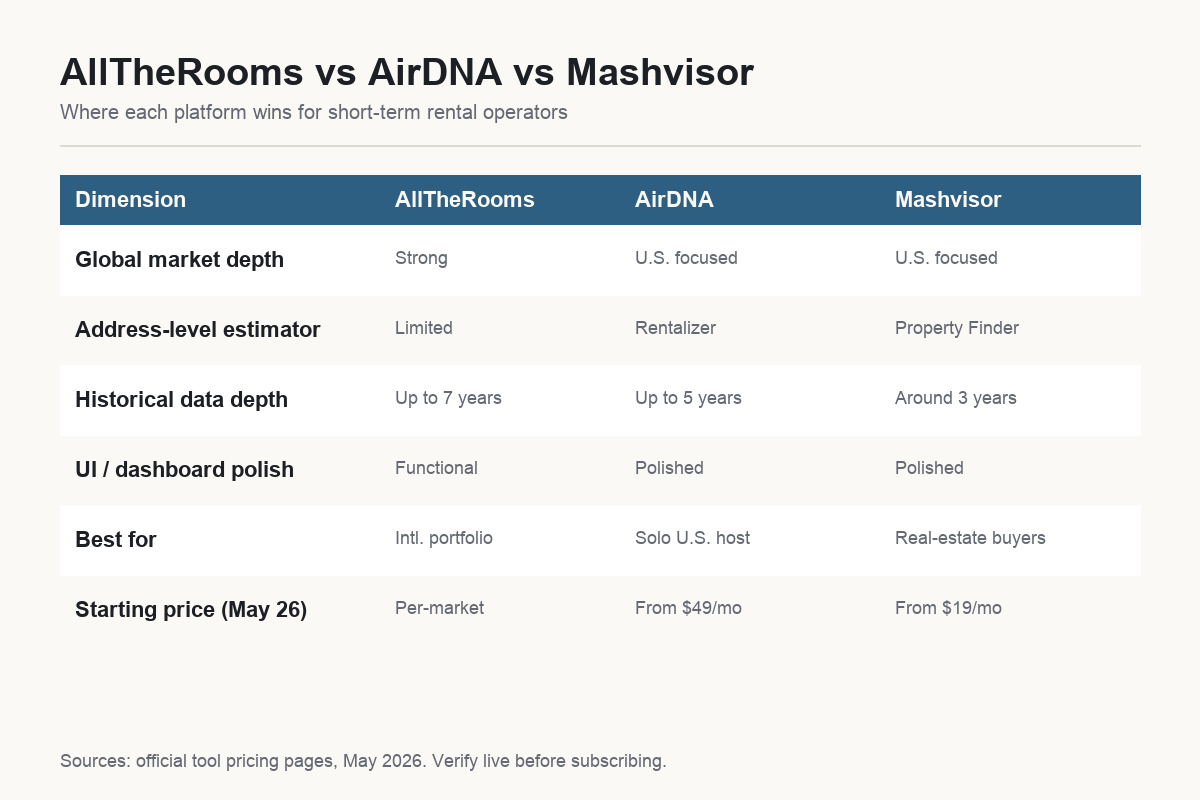
The AllTheRooms vs AirDNA question is the one I get most often, so let me lay it out cleanly.
Where AllTheRooms beats AirDNA
- International market depth. Portugal, Mexico, Costa Rica, Greece, Thailand, Indonesia, most of Latin America. If your portfolio crosses borders, AllTheRooms wins on coverage almost every time.
- Historical depth. Seven years of history on the Pro tier is longer than AirDNA’s standard offering.
- Listing deduplication. The Bayesian match across Airbnb + Vrbo + Booking.com produces a cleaner supply count, especially in markets where cross-listing is common (Caribbean, Mediterranean, U.S. mountain towns).
- Free tier value. AllTheRooms’ free plan is more useful than AirDNA’s free preview.
Where AirDNA beats AllTheRooms
- Address-level revenue estimates. AirDNA’s Rentalizer is genuinely useful for evaluating a specific property you are about to buy. AllTheRooms does not have a real equivalent.
- UI polish. AirDNA’s dashboard is cleaner and faster to read. AllTheRooms’ interface works, but it feels like a product built by engineers for analysts, not by designers for operators.
- U.S. market depth. In small U.S. cities and exurbs, AirDNA’s local penetration is deeper.
- Dynamic pricing integration. AirDNA pushes data into Pricelabs and Wheelhouse pipelines more cleanly. AllTheRooms is more of a standalone tool.
- Long-term company commitment. AirDNA is independent and STR-focused. AllTheRooms is now a subsidiary of a GovTech parent whose largest customer is local government. That is not automatically bad, but the alignment is different.
The pricing trade-off
AirDNA starts around $49 per month for a single market (verify live), with multi-market bundling above that. AllTheRooms also starts in the ~$49 range on Pro but scales per market, so a five-market subscription costs five times the headline price. For a single-market U.S. host, AirDNA is usually cheaper. For an international portfolio operator, AllTheRooms can actually win on cost-per-data-point because the international coverage replaces several smaller regional tools.
Where AllTheRooms falls short
Three honest weaknesses worth naming.
The interface feels dated. The dashboard loads slowly compared to AirDNA, and some of the filter combinations require more clicks than they should. This is the single most common complaint I hear from new users, and it is a fair one. The data is there, but the path to getting it is bumpier.
Customer support response times have slipped. Trustpilot reviews from late 2025 and early 2026 show a meaningful drop in support satisfaction, with multi-day response times on basic tickets. Some of that is acquisition-transition noise, and some of it is genuine. If you need responsive account management, this is a known friction point.
Data refresh cadence is opaque. AllTheRooms updates its dashboards regularly but does not publish a clear refresh schedule. Booking pace can lag the real world by anywhere from a few days to a couple of weeks depending on the market. For long-horizon underwriting that is fine. For short-horizon pricing decisions, it can be a problem.
AllTheRooms alternatives worth considering
If AllTheRooms is not the right fit, here is the honest shortlist of STR analytics tools worth comparing.
| Tool | Best for | Starting price (May 2026) |
|---|---|---|
| AirDNA | U.S. operators, address-level estimates, dynamic pricing pipeline | From ~$49/month |
| Mashvisor | Real-estate buyers blending traditional + STR | From ~$19/month |
| Airbtics | Budget-conscious operators, decent international coverage | From ~$19/month |
| Lighthouse (formerly Transparent) | Property managers + multi-unit operators | Custom enterprise pricing |
| Rabbu | Quick U.S. revenue estimates, free entry point | Free with paid upgrades |
I cover the full landscape in our best Airbnb analytics tools roundup, including the pricing model differences that are easy to miss.
Who should use AllTheRooms (and who shouldn’t)
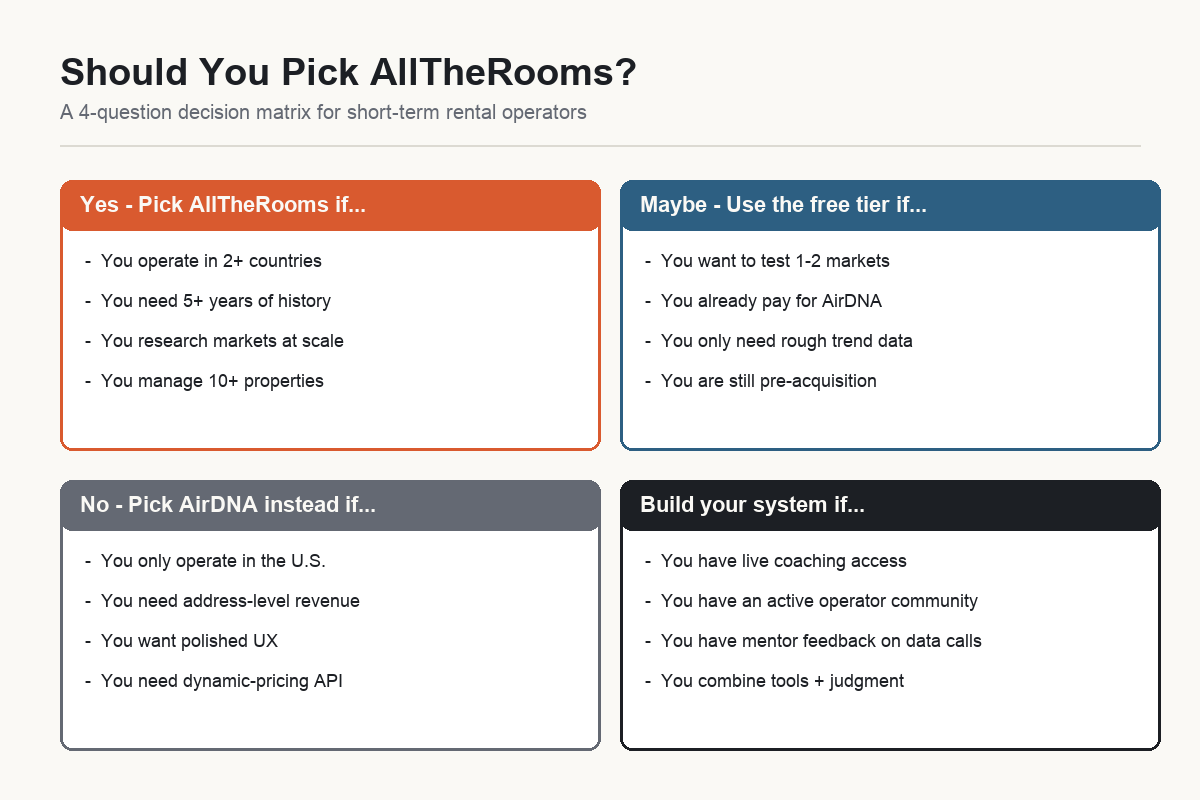
AllTheRooms is a good fit if:
- You operate properties (or are about to) in two or more countries.
- You are a portfolio investor evaluating multiple international markets.
- You need historical data going back five or more years.
- You manage ten or more properties and want a deeper view of cross-platform supply.
- You want a serious free tier to do quick market checks without a credit card.
AllTheRooms is a bad fit if:
- You only operate in the United States and you need address-level revenue estimates. (AirDNA wins.)
- You want a polished dashboard with minimal training. (AirDNA or Mashvisor wins.)
- You research more than three markets a month and the per-market pricing model will sting.
- You need real-time data refresh for pricing decisions. (Use a dynamic pricing tool like Pricelabs or Wheelhouse instead.)
- You want strong human support. (Worth checking current Trustpilot reviews first.)
How 10XBNB students actually use this tool
This is the part most reviews skip, and it is the part that matters most. A data tool is a flashlight. It tells you what is in front of you. It does not tell you whether to take the step.
Inside 10XBNB, we coach operators through the actual decision-making process around any analytics platform. The students I have watched make real money with AllTheRooms do four things consistently:
- They triangulate. No serious operator I know underwrites a market on one tool’s numbers. They pull AllTheRooms, cross-check against AirDNA or Mashvisor, then verify against actual listings in the market. The data tool is one of three or four inputs, never the only one.
- They use the free tier first. The free plan is good enough for the first pass. We tell students to live there for at least two markets before paying for anything.
- They ask the community. When the data says a market looks good but no one in our active operator community has actually run a property there, that is a yellow flag. When the data looks weak but a mentor has been operating successfully in that market for two years, the data is probably missing context. Live human input around the data is the real edge.
- They run the numbers through a live coaching call. Our coaches have collectively managed close to a thousand short-term rental doors. When a student brings AllTheRooms market data to a call, the coach can usually spot within five minutes whether the projection is realistic, optimistic, or wildly off. That feedback loop is what no SaaS tool can replicate.
The system we teach inside 10XBNB is not “buy AllTheRooms.” The system is the framework that goes around whichever analytics tool you choose. Live coaching, an active operator community, and mentor feedback are what turn raw data into actual underwriting judgment.
If you want to talk that through with an operator before you commit to any tool, book a free coaching call here.
How AllTheRooms fits into broader market selection
Most of the operators we coach do not start with a tool. They start with a question: where should I put my next door? That question lives upstream of any analytics platform, and the answer requires more than dashboard data. We cover the full framework in our guide to the best Airbnb markets for 2026, including how to weigh regulatory risk, seasonality, and competition density alongside the raw revenue numbers.
If you are early in the process, the right move is to first identify two or three candidate markets using a free tier (AllTheRooms is a strong pick here), then deepen the analysis on those specific markets. Trying to compare 30 cities at once is almost always a sign that the search has not been narrowed enough. Our breakdown of the most profitable Airbnb cities walks through the filtering logic in detail.
For U.S. operators specifically, regulatory environment matters as much as raw revenue potential. A market with great occupancy and ADR but pending STR restrictions can vaporize in six months. Our state-level review of the best states for Airbnb covers the regulatory layer in plain English so you can layer it on top of whatever data your analytics tool surfaces.
Frequently Asked Questions
Is AllTheRooms free?
Yes, there is a genuine free tier that includes three months of historical data, five tracked competitors, and a 100-property limit. It is enough for one-off market checks. Paid plans start around $19 per month per market on Basic and around $49 per month per market on Professional, billed per market rather than as a flat subscription.
Is AllTheRooms accurate?
AllTheRooms publishes a 95.5% accuracy claim on its cross-platform listing deduplication, which is the area where its patent portfolio gives it a real edge. Revenue and occupancy estimates are typically within 5-10% of actual operator results in larger markets, and degrade in markets with fewer than 200 active listings. Treat any vendor accuracy claim as a starting point, not a guarantee.
Who owns AllTheRooms?
Deckard Technologies acquired AllTheRooms on August 7, 2025. Deckard is a GovTech company that builds the Rentalscape compliance platform for municipalities. The acquisition transferred a portfolio of six U.S. patents and the AllTheRooms data team to Deckard. Will Pearson, the former CEO, stayed on as Director of Operations.
AllTheRooms vs AirDNA, which is better?
It depends on where you operate. AllTheRooms beats AirDNA for international markets, historical depth, and cross-platform listing deduplication. AirDNA beats AllTheRooms for U.S. address-level revenue estimates, dashboard polish, dynamic pricing integration, and small U.S. city coverage. Many serious operators use both.
Does AllTheRooms cover international markets?
Yes, this is the platform’s strongest selling point. AllTheRooms publicly cites coverage across more than 200 countries and pulls from Airbnb, Vrbo, Booking.com, HomeAway, and Expedia. International coverage is materially deeper than AirDNA in most markets outside the United States and the major European capitals.
Can I use AllTheRooms to estimate revenue on a specific property?
Not really. AllTheRooms is a market-level analytics tool, not an address-level estimator. If you need a revenue projection for a specific property you are about to buy, AirDNA’s Rentalizer is the better tool. Use AllTheRooms to evaluate the market itself and a different tool to underwrite the individual address.
Has the Deckard acquisition changed the product?
Not dramatically, as of May 2026. The core analytics product remains the same. The biggest visible change has been slower customer support response times and some integration noise during the transition. The longer-term question is whether Deckard prioritizes the operator-facing analytics product or pulls resources toward its government compliance business. Worth watching through the rest of 2026.
Final verdict
AllTheRooms earns a 3.5 out of 5 from me. The data is real, the international coverage is genuinely better than AirDNA in most non-U.S. markets, and the free tier is useful enough to recommend to any operator who wants a quick market check. The product loses points for a dated interface, slipping customer support, and a per-market pricing model that gets expensive fast if you are a generalist researcher rather than a depth-focused operator.
If you operate internationally, or manage a portfolio of ten or more doors, AllTheRooms deserves a serious look. If you are a single-market U.S. host evaluating a specific property, AirDNA is probably still the better fit. The honest answer for most operators is: use AllTheRooms’ free tier alongside AirDNA’s free preview, triangulate against actual listings, and put the savings toward the human layer (coaching, community, mentorship) that turns raw data into real decisions.
If you want to walk through your specific market with a coach who has operated short-term rentals at scale, grab a free 30-minute strategy call. We will look at the data with you and tell you honestly whether the deal makes sense.
Related Operator Deep Dives
Other reviews and comparisons in this cluster operators have found useful: