

A handshake deal between an Airbnb host and a co-host works great, until it doesn’t. One missed cleaning, one disputed commission check, one liability nightmare, and suddenly you’re in a legal grey zone with no paperwork to back you up. Our Airbnb co-hosting course breaks down the top programs.
This agreement template is the legitimate route: avoid dangerous shortcuts like purchasing verified Airbnb accounts, which carry permanent ban and fraud charge risks.
After signing the agreement, optimize for rankings. See our vacation rental SEO guide for 2026.
Once your agreement is signed, sync your listings with our top-ranked channel manager picks for 2026.
I’ve seen co-hosting partnerships implode over a $200 cleaning fee dispute that could’ve been settled in 30 seconds with a written agreement. That’s why every serious co-host needs a bulletproof contract before managing a single listing.
Below you’ll find a complete Airbnb co-hosting agreement template you can copy and customize, plus a legal breakdown of every clause that matters in 2026. Whether you’re a host hiring help or a co-host building a co-hosting business from scratch, this guide covers what your contract needs to hold up. For context on what successful co-hosting partnerships look like in practice, see results real students have achieved.
What Is an Airbnb Co-Hosting Agreement?
An Airbnb co-hosting agreement is a legally binding contract between a property owner (the host) and the person or company managing their short-term rental (the co-host). It defines who does what, who gets paid how much, and what happens when things go sideways. See our guide on finding property owners who need co-listing help.
Need a lease? Download our free mid term rental lease agreement template with all 12 clauses explained.
Think of it as the operating manual for your partnership. Without one, both parties are guessing about expectations. With one, every scenario, from a guest breaking a TV to a co-host wanting to exit, has a clear resolution path.
Why You Can’t Skip This Document
Airbnb’s built-in co-host feature lets you add someone to your listing and assign permissions. But Airbnb’s platform does not create a legal contract between you and your co-host. Their terms of service explicitly state that the relationship between hosts and co-hosts is independent of Airbnb. See our guide on co-listing agreement template you can download.
That means if your co-host mishandles a guest situation, damages your property, or disappears mid-booking season, Airbnb won’t mediate your dispute. You need your own agreement.
Three reasons this document is non-negotiable:
- Financial clarity. Commission percentages, payment timing, and expense responsibilities are spelled out. No awkward conversations later.
- Liability protection. If a guest gets injured, who’s responsible? If a co-host causes property damage, who pays? The agreement answers these questions before they become lawsuits.
- Exit strategy. Every partnership ends eventually. A termination clause prevents a messy breakup from tanking your rental income.
Key Sections Every Co-Hosting Agreement Must Include
After reviewing dozens of co-hosting contracts and working with attorneys who specialize in short-term rental law, here are the sections that separate a solid agreement from a liability trap.
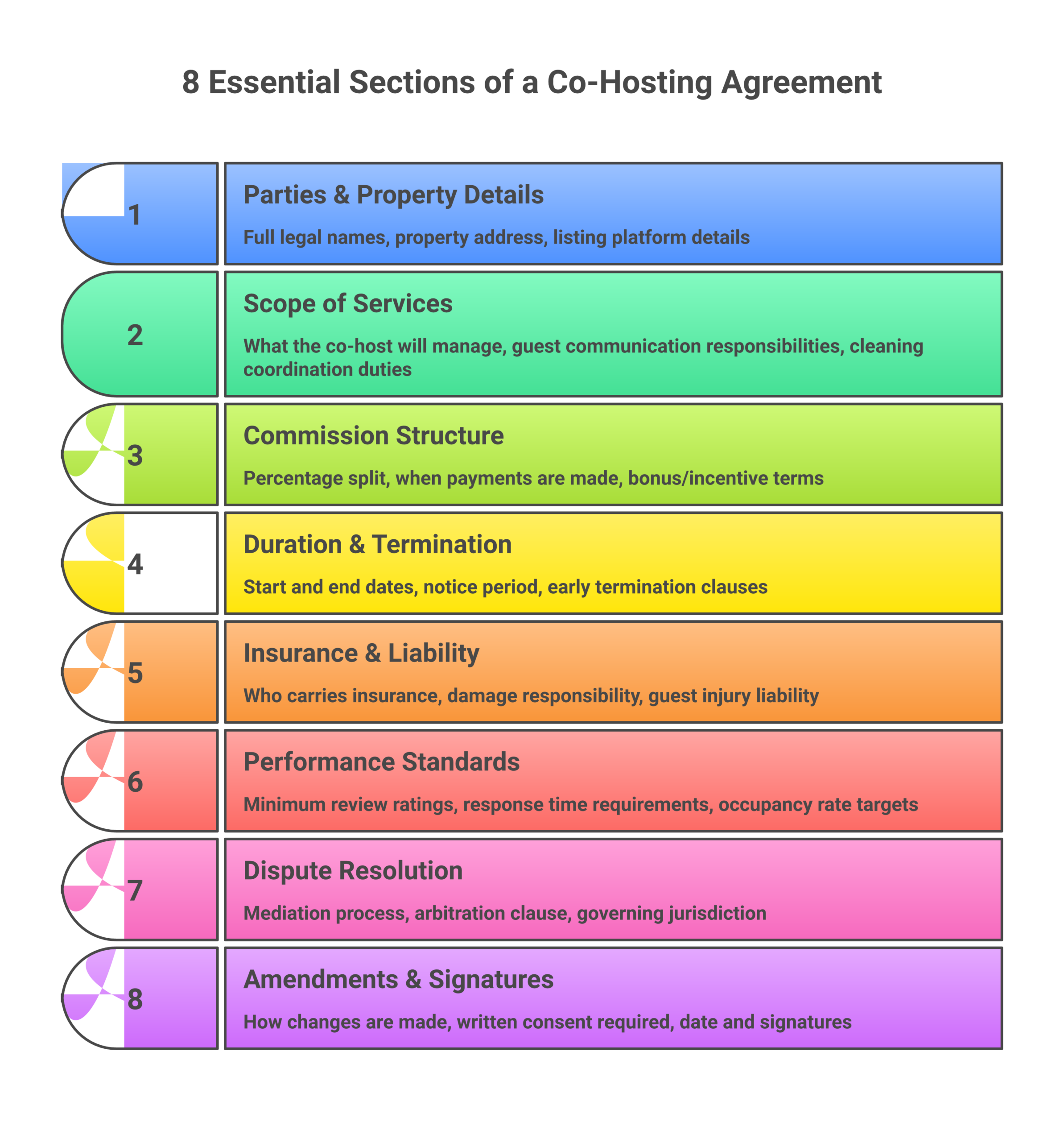
1. Parties and Property Identification
Start with the basics. Full legal names, addresses, and contact information for both the host and co-host. Then identify every property covered by the agreement, street address, Airbnb listing URL, and any platform-specific listing IDs.
If you’re managing multiple properties for one owner, list each one. A single vague reference like “all properties owned by Host” creates ambiguity you don’t want in court.
2. Scope of Services
This is where most agreements either shine or fail. Be exhaustive. Spell out every task the co-host is responsible for:
- Guest communication: response time expectations, check-in/check-out procedures, handling complaints and reviews
- Listing management: pricing optimization, calendar management, photo updates, description writing
- Cleaning coordination: scheduling turnover cleaners, quality inspections, supply restocking
- Maintenance: handling minor repairs, coordinating with contractors, emergency response protocols
- Financial reporting: monthly revenue reports, expense tracking, tax document preparation
Also define what’s not included. If the co-host isn’t handling deep cleaning, landscaping, or capital improvements, say so explicitly. Vague scope creates scope creep, and scope creep creates resentment.
3. Commission and Payment Structure
The money section. Define these precisely:
- Commission rate: typically 10-25% of gross booking revenue for co-hosts. Specify whether this is calculated on gross revenue, net revenue (after Airbnb fees), or net revenue after expenses.
- Payment schedule: weekly, bi-weekly, or monthly. Tie it to when Airbnb actually disburses funds.
- Expense handling: who pays for cleaning supplies, guest amenities, minor repairs? Set a dollar threshold (e.g., co-host can approve expenses under $150 without host approval).
- Bonus structure: optional, but performance bonuses for maintaining a 4.8+ rating or hitting occupancy targets align incentives.
If you want to understand how co-host earnings actually break down across markets, check out this analysis of Airbnb co-host income by city.
4. Duration and Termination Clauses
Every agreement needs a defined term. Most co-hosting contracts run 6 to 12 months with auto-renewal provisions. Include:
- Start and end dates
- Auto-renewal terms: does it renew monthly or annually after the initial term?
- Termination notice period: 30 days is standard, 60 days for larger portfolios
- Termination for cause: specific triggers like breach of contract, sustained low performance, or criminal activity that allow immediate termination
- Transition obligations: the co-host must hand over all passwords, guest communications, and vendor contacts within a defined window
The transition clause is one people forget. Without it, a terminated co-host can hold your listing access hostage. Specify that all platform credentials and operational assets transfer back to the host within 7 days of termination.
5. Insurance and Liability
This section protects both parties from financial ruin. Cover these scenarios:
- General liability insurance: require the co-host to carry their own policy (minimum $1M is common)
- Property damage: who’s responsible for damage caused by guest negligence vs. Co-host negligence vs. Normal wear?
- Guest injury: liability allocation when a guest is injured on the property
- Indemnification clause: each party agrees to hold the other harmless for claims arising from their own actions or negligence
- Airbnb Host Protection: acknowledge the limits of Airbnb’s coverage and require supplemental insurance where needed
If you’re dealing with landlord-tenant complexities in your rental market, you should also understand how short-term rental eviction rules intersect with your co-hosting arrangement.
6. Performance Benchmarks
Hold your co-host to measurable standards. Without benchmarks, “good performance” is subjective. Define:
- Minimum guest rating: e.g., maintain 4.7+ overall rating
- Response time: e.g., all guest messages answered within 1 hour during business hours, 2 hours after hours
- Occupancy targets: e.g., achieve 70%+ occupancy during peak season
- Review frequency: quarterly performance reviews with documented metrics
- Consequences for underperformance: commission reduction, probation period, or termination triggers
7. Dispute Resolution
Going to court over a co-hosting dispute is expensive and slow. Build a resolution ladder into the agreement:
- Direct negotiation: parties attempt to resolve the dispute themselves within 14 days
- Mediation: if negotiation fails, a neutral third-party mediator is brought in (split cost 50/50)
- Binding arbitration: if mediation fails, an arbitrator makes a final decision. This is faster and cheaper than litigation.
- Governing law: specify which state’s laws govern the agreement
Complete Airbnb Co-Hosting Agreement Template
Here’s a complete template you can copy and customize for your situation. Replace all bracketed fields with your specific information. Have an attorney in your state review the final version before signing.
AIRBNB CO-HOSTING SERVICES AGREEMENT
Effective Date: [Date]
PARTIES
Host (Property Owner): [Full Legal Name], residing at [Address], Email: [Email], Phone: [Phone]
Co-Host (Service Provider): [Full Legal Name / Business Entity], residing/located at [Address], Email: [Email], Phone: [Phone]PROPERTY/PROPERTIES COVERED
Property 1: [Street Address, City, State, ZIP], Airbnb Listing URL: [URL]
Property 2: [Street Address, City, State, ZIP], Airbnb Listing URL: [URL]
[Add additional properties as needed]SECTION 1: SCOPE OF SERVICES
The Co-Host shall perform the following services for each Property listed above:
a) Guest Communication: Respond to all guest inquiries, booking requests, and messages within [1 hour] during [8AM-10PM local time] and within [2 hours] outside those times.
b) Check-In/Check-Out Management: Coordinate guest arrivals and departures, provide access instructions, and handle lockbox/smart lock codes.
c) Listing Optimization: Manage pricing using [dynamic pricing tool or manual strategy], update listing descriptions, and manage calendar availability.
d) Cleaning Coordination: Schedule and oversee turnover cleaning, conduct quality inspections, and manage cleaning supply inventory.
e) Maintenance Coordination: Address minor maintenance issues (under $[150] per incident without prior Host approval). Issues exceeding this threshold require Host written approval.
f) Review Management: Respond to all guest reviews within [48 hours] of posting.
g) Financial Reporting: Provide monthly revenue and expense reports by the [5th] of each month for the prior month’s activity.Services Excluded: [List any excluded services, e.g., capital improvements, landscaping, HOA communication, property tax management]
SECTION 2: COMPENSATION
a) Commission: Co-Host shall receive [XX]% of Gross Booking Revenue (defined as total guest payment minus Airbnb service fees and applicable taxes) for each Property.
b) Payment Schedule: Commission payments shall be made [monthly/bi-weekly] within [5 business days] of Host receiving Airbnb disbursement.
c) Expense Reimbursement: Host shall reimburse Co-Host for pre-approved expenses. Co-Host may authorize individual expenses up to $[150] without prior approval. Receipts required for all expenses.
d) Performance Bonus: [Optional, e.g., If Property maintains a 4.9+ average rating and 80%+ occupancy for a calendar quarter, Co-Host receives a bonus of $X or an additional X% commission for that quarter.]SECTION 3: TERM AND TERMINATION
a) Initial Term: This Agreement begins on [Start Date] and continues for [6/12] months.
b) Auto-Renewal: After the Initial Term, this Agreement automatically renews on a [month-to-month/annual] basis.
c) Termination Without Cause: Either party may terminate with [30/60] days written notice.
d) Termination For Cause: Either party may terminate immediately upon written notice if the other party: (i) materially breaches this Agreement and fails to cure within [14 days] of written notice; (ii) engages in fraud, criminal activity, or gross negligence; (iii) fails to meet Performance Benchmarks for [2 consecutive quarters].
e) Transition Obligations: Upon termination, Co-Host shall within [7 days]: transfer all platform login credentials, provide complete guest communication records, return all property keys/access devices, deliver final financial accounting, and transfer all vendor/contractor contacts.SECTION 4: INSURANCE AND LIABILITY
a) Co-Host Insurance: Co-Host shall maintain general liability insurance with minimum coverage of $[1,000,000] per occurrence and provide proof of coverage upon request.
b) Property Damage: Damage caused by Co-Host negligence shall be the financial responsibility of Co-Host. Damage caused by guests shall be pursued through Airbnb’s resolution process and/or Host’s property insurance.
c) Indemnification: Each party agrees to indemnify, defend, and hold harmless the other party from claims, damages, or expenses arising from their own negligence, willful misconduct, or breach of this Agreement.
d) Limitation of Liability: Neither party’s total liability under this Agreement shall exceed the total commissions paid in the preceding [12 months].SECTION 5: PERFORMANCE BENCHMARKS
Co-Host agrees to meet or exceed the following standards:
a) Maintain a minimum average guest rating of [4.7] stars across all managed Properties.
b) Achieve minimum [70]% occupancy during peak season and [50]% during off-season (adjusted for market conditions).
c) Respond to all guest messages within the timeframes specified in Section 1(a).
d) Complete monthly financial reports by the deadline in Section 1(g).
e) Performance reviews shall be conducted [quarterly] using Airbnb’s host dashboard data and agreed-upon KPIs.SECTION 6: CONFIDENTIALITY
Both parties agree to keep confidential all financial information, guest data, business strategies, and proprietary processes disclosed during the term of this Agreement. This obligation survives termination for [2 years].SECTION 7: DISPUTE RESOLUTION
a) Negotiation: The parties shall first attempt to resolve disputes through direct negotiation within [14 days] of written notice of the dispute.
b) Mediation: If negotiation fails, the parties shall submit the dispute to mediation administered by [mediation service or local bar association]. Costs split equally.
c) Binding Arbitration: If mediation fails, disputes shall be resolved by binding arbitration in [City, State] under the rules of the American Arbitration Association. The arbitrator’s decision shall be final.
d) Governing Law: This Agreement is governed by the laws of the State of [State].SECTION 8: GENERAL PROVISIONS
a) Independent Contractor: Co-Host is an independent contractor, not an employee, partner, or agent of Host.
b) Entire Agreement: This document constitutes the entire agreement and supersedes all prior negotiations or agreements.
c) Amendments: Modifications require written consent signed by both parties.
d) Severability: If any provision is found unenforceable, the remaining provisions continue in full effect.
e) Notices: All notices shall be delivered via email to the addresses listed above with confirmation of receipt.SIGNATURES
Host: _________________________ Date: _________
Print Name: [Full Legal Name]Co-Host: _________________________ Date: _________
Print Name: [Full Legal Name]
Want the Complete Co-Hosting Business Blueprint?
Learn the exact system top co-hosts use to land clients and scale.
5 Common Mistakes Hosts Make With Co-Hosting Agreements
Even with a template, people botch the execution. Here are the mistakes I see most often.
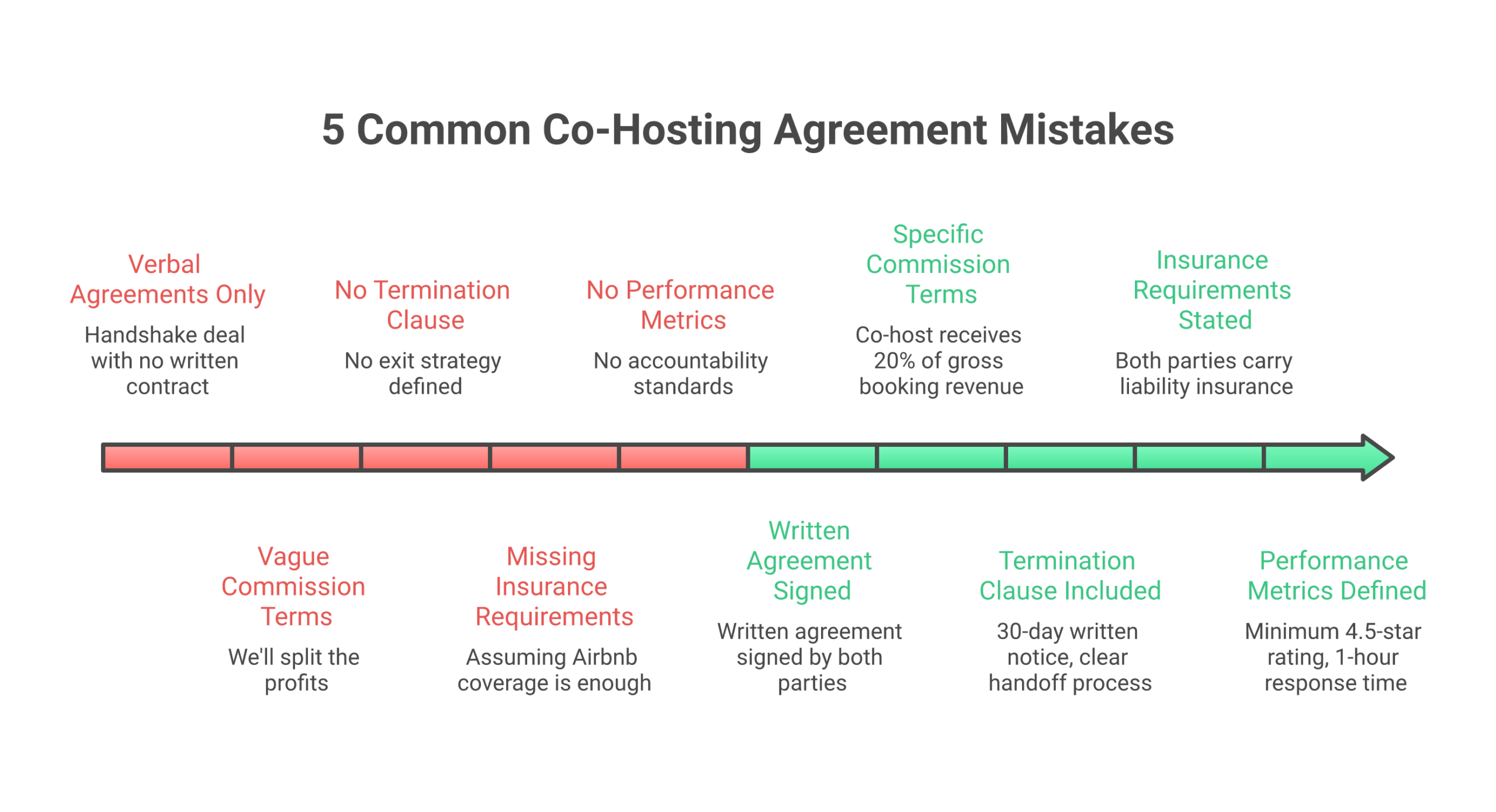
1. Using a Generic Freelancer Contract
A general independent contractor agreement doesn’t address short-term rental specifics. It won’t cover Airbnb platform permissions, guest data handling, dynamic pricing responsibilities, or cleaning coordination protocols. You need a contract designed for this industry.
2. Vague Commission Calculations
“20% of revenue” means different things to different people. Does that include cleaning fees charged to guests? What about Airbnb’s service fee deduction? What about sales tax collected? Define the exact formula. Gross booking revenue minus Airbnb service fees minus applicable taxes is the clearest baseline.
3. No Termination Transition Plan
The agreement says “30 days notice” but doesn’t specify what happens during those 30 days. Does the co-host keep managing bookings already on the calendar? Who handles guests checking in after the termination date but who booked before it? Spell out the transition logistics.
4. Missing Platform Access Protocols
Your co-host needs access to your Airbnb account, your dynamic pricing tool, your smart lock system, and maybe your cleaning team’s scheduling app. The agreement should list every platform, specify the access level granted, and require credential return upon termination.
5. Skipping the Insurance Requirement
If your co-host doesn’t carry their own liability insurance and a guest gets hurt due to something the co-host was responsible for, you’re exposed. Requiring a $1M general liability policy is standard. Verify the policy exists. Don’t just take their word for it.
Legal Considerations: What Varies by State
Short-term rental law is a patchwork across the United States. Your co-hosting agreement needs to account for local rules that directly impact how you structure the partnership.
State-by-State Variations That Affect Your Agreement
- Independent contractor classification: States like California (AB5), Massachusetts, and New Jersey have strict tests for independent contractor vs. Employee status. If your co-host works exclusively for you, sets scheduled hours, and uses your equipment, some states may reclassify them as an employee. Structure the agreement to preserve the independent contractor relationship.
- Short-term rental licensing: Many cities require a business license or STR permit. Your agreement should specify which party is responsible for maintaining required permits. In some jurisdictions, the co-host may also need their own property management license.
- Tax collection obligations: Some states require the person managing the rental (not just the owner) to register for tax collection. Clarify who handles occupancy tax, sales tax, and tourism assessments in your agreement.
- Arbitration enforceability: While most states honor arbitration clauses, some have limitations. For example, certain consumer protection disputes may not be arbitrable in some jurisdictions.
The U.S. Small Business Administration provides state-specific guidance on independent contractor relationships and tax obligations that’s worth reviewing before finalizing your agreement.
When to Hire an Attorney
Use the template above as your starting framework, but invest in a legal review when:
- You’re managing 3+ properties (higher stakes, more complexity)
- Your state has strict contractor classification rules
- The agreement involves revenue sharing above simple commission
- You’re setting up a co-hosting LLC or partnership entity
- Local STR regulations are evolving (which they are in most markets right now)
Disclaimer: This template and guide are for informational purposes only and do not constitute legal advice. Short-term rental regulations vary significantly by jurisdiction. Consult a licensed attorney in your state before executing any co-hosting agreement.
How to Set Up a Co-Hosting Partnership the Right Way
The agreement is the foundation, but execution matters just as much. Here’s the sequence that works.
- Define roles before discussing money. Agree on exactly what the co-host will handle. Use the Scope of Services section as your checklist. Only then negotiate commission rates, because the rate should reflect the actual workload.
- Start with one property. Even if the host has five listings, pilot the partnership with a single property for 60-90 days. This proves the working relationship before scaling.
- Set up shared systems. Use a co-listing setup on Airbnb so both parties have appropriate platform access. Configure shared calendars, cleaning schedules, and communication channels before the first guest arrives.
- Schedule monthly check-ins. Don’t wait for quarterly performance reviews to surface issues. A 20-minute monthly call keeps both parties aligned and catches small problems before they compound.
- Document everything. Keep records of expenses, guest incidents, maintenance requests, and performance metrics. If a dispute ever reaches mediation, documentation wins the argument.
Want the Complete Co-Hosting Business Blueprint?
Learn the exact system top co-hosts use to land clients and scale.
Frequently Asked Questions
Do I need a written co-hosting agreement if Airbnb already has a co-host feature?
Yes, absolutely. Airbnb’s co-host feature only manages platform permissions. It lets someone access your listing, respond to messages, and adjust pricing. It does not create a legal contract between you and your co-host. Airbnb explicitly states they’re not a party to the host/co-host relationship. If a payment dispute, liability issue, or termination conflict arises, you need your own signed agreement to have any legal standing.
What’s the standard commission rate for an Airbnb co-host?
Commission rates typically range from 10% to 25% of booking revenue, depending on the scope of services. A co-host who only handles guest communication might charge 10-15%. A full-service co-host managing everything from pricing to cleaning to maintenance coordination typically earns 20-25%. The rate should directly reflect the workload defined in your Scope of Services section.
Can I use the same agreement for multiple properties?
You can, as long as each property is individually listed in the agreement with its specific address and listing URL. Some hosts prefer a single master agreement covering all properties with an attached schedule (Exhibit A) listing each property. Others prefer separate agreements per property for cleaner accounting. For portfolios of 5+ properties, the master agreement with attached schedule approach is more practical.
What happens to existing bookings when a co-hosting agreement is terminated?
Your agreement should address this directly. The most common approach: the co-host continues to manage any bookings that were confirmed before the termination notice date, earning their standard commission on those stays. New bookings after the notice date go to the host or new co-host. This prevents guest experience disruptions and gives both parties a clean financial cutoff.
Does my co-host need their own business insurance?
Strongly recommended and increasingly expected. A general liability policy ($1M minimum per occurrence) protects the co-host from personal liability and protects the host from being the sole target in a lawsuit. Some property owners now require proof of insurance before signing. If your co-host operates as an LLC, the business entity should hold the policy.
Should I have a lawyer review the agreement even if I use a template?
For your first co-hosting agreement, yes. An attorney familiar with short-term rental law in your state can identify local requirements you might miss, like property management licensing, specific independent contractor rules, or municipal STR regulations that affect the contract terms. Once you have a vetted agreement, you can reuse it for additional co-hosting partnerships with minor modifications.
How do I handle disputes about guest damage or cleaning quality?
Build specific escalation procedures into the agreement. For guest damage: specify that the co-host initiates Airbnb’s resolution process within 24 hours, documents damage with photos, and reports to the host immediately. For cleaning quality: define the inspection standard (a checklist works best), require photo documentation of turnovers, and outline consequences for repeated failures. The dispute resolution ladder in the agreement (negotiation, mediation, arbitration) serves as the backstop for unresolved issues.