Power outages can disrupt even the best-laid vacation plans and leave Airbnb hosts and guests scrambling to adapt. Any host running a rental arbitrage portfolio or guest on a much-needed getaway needs to understand the Airbnb power outage policy. Here’s what you need to know: a power loss can count as a covered event under Airbnb’s Major Disruptive Events Policy, which can entitle guests to full refunds and protect hosts from cancellation penalties when an outage makes a vacation rental uninhabitable.
In this guide, we’ll break down exactly how Airbnb handles a power outage on your reservation, how to file a claim through the Resolution Center, what documentation you need, and the critical 72-hour reporting window that most people miss.
How Airbnb’s Major Disruptive Events Policy Covers Power Outages
Airbnb’s Major Disruptive Events Policy (formerly the Extenuating Circumstances Policy) is the official framework that governs power outages. The revised policy took effect for trips on or after June 6, 2024, and it explains when guests and hosts can cancel without penalties and when refunds are issued.
Power Outages as a Covered Event
Under the policy, a large-scale outage of essential utilities counts as a covered event. Airbnb defines this as a prolonged outage of electricity, heat, or water that affects the vast majority of homes in a given location. A single tripped breaker does not count. A regional grid failure that leaves a whole neighborhood without power for days does.
When Does the Policy Apply?
The policy activates for events beyond anyone’s control. Covered events include:
- Natural disaster-related outages: hurricanes, wildfires, ice storms, or earthquakes that knock out regional power
- Government-mandated utility shutoffs: Public Safety Power Shutoffs (PSPS) in California, for example
- Large-scale infrastructure failures: grid failures that affect entire neighborhoods or regions for extended periods
The policy does not automatically cover brief, localized outages caused by a tripped breaker or a single downed power line. The threshold is whether the power loss makes the property fundamentally uninhabitable.
Refunds and Cancellations Under the Policy
- Guests: if the policy applies, guests can cancel the reservation and receive a full refund or Airbnb travel credit, regardless of the host’s cancellation policy. A guest staying in Florida during hurricane season whose rental loses power for 3+ days would qualify.
- Hosts: hosts can cancel the reservation without fees or penalties if the property becomes uninhabitable due to a power outage. The listing’s calendar is blocked for those dates.
Important: not every outage triggers this policy. A two-hour blackout from a utility company glitch probably will not qualify unless it renders the stay impossible. The distinction hinges on how long the outage lasts and how severe it is.
A separate rule took effect on October 1, 2025: Airbnb now gives a mandatory 24-hour free cancellation window for bookings made at least 7 days before check-in. That window is not part of the Major Disruptive Events Policy.
What Happens When the Power Goes Out at an Airbnb
When the power goes out during a guest’s stay, the situation can range from a minor inconvenience to a full-blown crisis. Imagine arriving at a vacation rental expecting a hot shower and functional Wi-Fi, only to find the lights dead and the water heater offline.
If the outage lasts a few hours and the home stays habitable (gas heating still works, cell service is fine), guests may simply need to wait it out. But if power stays off for 24+ hours and guests lose heat in winter or air conditioning during a summer heatwave, the situation escalates fast.
Host Responsibilities During an Outage
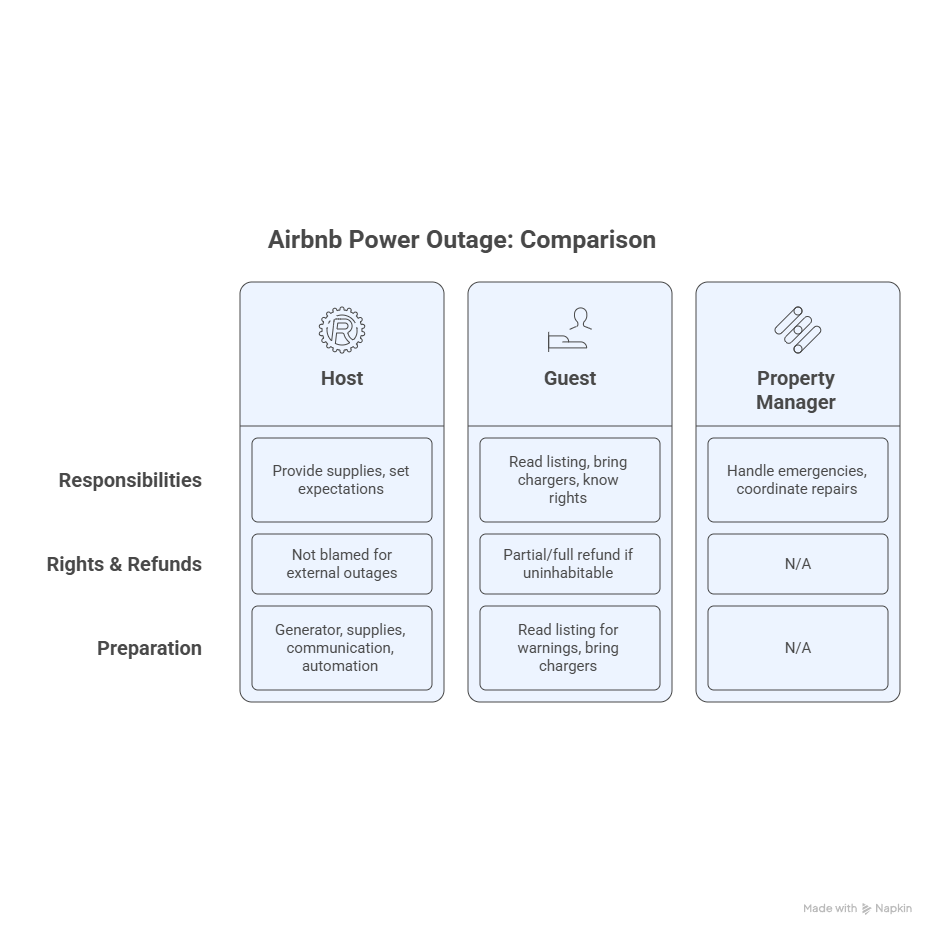
Hosts can’t control the utility company, but they are responsible for how they respond. Here’s what Airbnb expects:
- Communicate immediately: message your guest as soon as you are aware of the outage. Explain what happened, the expected duration, and what you are doing about it.
- Provide emergency supplies: battery-powered lanterns, flashlights, bottled water, phone chargers, and candles should be stored at every property.
- Offer alternatives: if the outage will last more than 12 hours, proactively offer a partial refund, an alternative property, or help the guest find nearby accommodations.
- Document everything: keep records of your communication with the guest and the utility company. This protects you if a dispute goes to the Resolution Center.
For high-value properties, a backup generator helps keep guests comfortable and reduces refund requests.
Guest Options When Power Fails
For guests, a power outage might mean spoiled food in the fridge, dead phone batteries, or missing amenities like Wi-Fi and air conditioning. If the outage significantly disrupts the reservation, guests can contact Airbnb support to request a partial or full refund.
The key question is whether the property remains safe and functional. A general rule: if the outage lasts under 4-6 hours during daytime and does not affect heating or cooling, it is unlikely to warrant a refund. But a multi-day blackout with no heat in January is a clear claim.
Critical detail most guests miss: you must report the issue to Airbnb within 72 hours of discovering the power outage. Airbnb’s Rebooking and Refund Policy sets that 72-hour window, and after it passes your refund options shrink fast.
How to File a Power Outage Claim on Airbnb (Step-by-Step)
Whether you are a guest requesting a refund or a host documenting a cancellation, here is exactly how to work through Airbnb’s Resolution Center:
For Guests
- Document the outage immediately: take photos of the dark property, screenshot your phone’s clock showing timestamps, and save any text messages with the host about the outage.
- Contact the host first: message the host through the Airbnb app, which creates a documented record. Describe the issue and ask what they plan to do about it.
- Open a case in the Resolution Center: go to Trips, open the reservation, tap Get Help, then Help with your reservation. Choose the issue category that best fits (property not as described, safety concern, or amenities missing).
- Upload your documentation: attach all photos, screenshots, utility company outage reports, and communication records.
- Request your preferred resolution: you can request a partial refund for affected nights, a full refund if you left early, or Airbnb travel credit for a future reservation.
- Follow up within 72 hours: Airbnb requires the issue to be reported within 72 hours of discovery. File the claim the same day if you can.
For Hosts
- Notify Airbnb immediately: contact Airbnb support through the app or website and explain the outage situation.
- Document the outage cause: get a confirmation from your utility company. Many utilities have online outage maps or can provide written statements. Save screenshots of the outage tracker.
- Offer a proactive resolution: hosts who voluntarily offer partial refunds or alternative arrangements before the guest files a complaint tend to get better reviews and avoid escalation.
- File through the Resolution Center: if you need to cancel, go to Your Listings, open Reservations, select the booking, then Cancel reservation. Choose “Major Disruptive Event” as the reason.
- Submit supporting evidence: utility company reports, local news coverage of the outage, or government emergency declarations all strengthen your case.
Documentation Checklist: What Evidence to Gather
Strong documentation often decides whether a claim succeeds. Gather this evidence as soon as the outage begins:
- Utility company outage report: most utilities have online outage maps. Screenshot the map of your affected area, or request written confirmation of the outage with start time, estimated restoration, and cause.
- Photos of the dark property: take timestamped photos showing the property without power. Include shots of dark rooms, non-functioning appliances, and any safety hazards.
- Screenshots of utility outage maps: services like PowerOutage.us track outages in real time. Screenshot the map with the property location visible.
- Timestamps of all communication: every message between host and guest through the Airbnb app is automatically timestamped and recorded. Keep all communication on-platform.
- Communication with the utility company: save call logs, emails, or chat transcripts that show when you reported the outage and what they said.
- Local news or weather reports: if the outage was caused by a storm or natural disaster, save links to news coverage that confirm the event.
- Temperature readings: if the outage affects heating or cooling, document indoor temperatures with a photo of a thermometer. Extreme indoor temps strengthen uninhabitability claims.
Can You Get a Refund on Airbnb Due to Weather?
Weather-related power outages tie directly into the Major Disruptive Events Policy, but the coverage depends on whether the weather event was foreseeable:
- Foreseeable weather: hurricanes during hurricane season (June-November in the Atlantic) are not covered on their own. But the revised policy does apply when a foreseeable weather event leads to another covered event, such as a large-scale outage of essential utilities or a government evacuation order. In that case guests can cancel for a full refund.
- Unexpected disasters: a freak ice storm, wildfire, or tornado that cuts power often qualifies for refunds because these events are not foreseeable in the same way seasonal storms are.
For example, a guest staying in California during wildfire season might not get a refund for a brief, localized outage. But if Public Safety Power Shutoffs cut electricity for 3 days across the region, that is a clear qualifying event.
Grounds for a Refund: What Airbnb Actually Considers
Beyond the Major Disruptive Events Policy, guests can request refunds based on these specific grounds:
- Uninhabitable conditions: no power for 24+ hours, no heat in freezing temperatures, or no air conditioning during a heatwave. Guests can request a partial refund for affected nights or a full refund if they leave early.
- Missing advertised amenities: if a listing promises a hot tub, a working kitchen, or in-unit laundry and a power outage disables them, guests can claim a partial refund for the specific missing amenities.
- Safety hazards: non-functioning smoke detectors, no lighting in stairways, or inoperable security systems during an extended outage can prompt a refund if guest safety is compromised.
Hosts are not obligated to refund for every outage, particularly brief ones where they have communicated proactively and provided emergency supplies. Disclosing potential power risks in your listing description (for example, “this rural area may experience occasional outages during storm season”) helps set expectations and protects you from unreasonable claims.
Travel Insurance as a Safety Net
Guests should consider travel insurance that covers trip interruptions caused by utility failures. Airbnb’s policy does not cover every scenario, and travel insurance fills the gaps, especially when an outage is too brief to qualify. Hosts should also review their own insurance to confirm coverage for power-related disruptions and lost rental income, especially if managing multiple properties.
Preparing for Power Outages: Host Strategies
Power outages don’t have to wreck your Airbnb business. Here’s how to stay prepared:
Backup Power Solutions
Invest in a portable generator or whole-house battery system (like a Tesla Powerwall) for critical equipment: heating, water heater, refrigerator, and Wi-Fi router. Properties with backup power command higher nightly rates and get fewer refund requests. At minimum, keep a portable power station (like a Jackery or EcoFlow) that can charge phones and run small appliances for 8-12 hours.
Clear Communication Templates
Have pre-written messages ready to send guests the moment an outage hits. Include what happened, the expected restoration time, what supplies are available at the property, and your phone number for direct contact. Transparency during a crisis is what separates a 5-star review from a 1-star complaint.
Emergency Supply Kit
Stock every property with flashlights and extra batteries, battery-powered phone chargers, bottled water, candles and matches, a manual can opener, and a printed list of local emergency contacts (utility company, nearest hospital, fire department). This small investment keeps most minor outage complaints from escalating.
Automation and Monitoring
Use smart home devices that alert you when power drops at a property. Wi-Fi-connected power monitors or smart plugs can send push notifications to your phone the moment electricity cuts out, so you can contact guests before they even reach out. Pair this with a PMS channel manager to keep messaging streamlined across your Airbnb and Vrbo bookings. You can also explore hands-free automation tools to handle guest messaging during disruptions.
Guest Tips for Handling Power Outages
Guests aren’t powerless (pun intended) when the lights go out:
- Check the listing before booking: look for mentions of backup power, outage risks, or rural locations prone to disruptions.
- Pack a portable charger: a fully charged power bank keeps your phone alive for 2-3 days. It is essential for communication and accessing the Airbnb app.
- Report within 72 hours: this is non-negotiable. File your claim through the Resolution Center within 72 hours or risk losing your right to a refund.
- Keep communication on the Airbnb app: messages sent through the app are timestamped and admissible in disputes. Text messages and phone calls are harder to verify.
- Know when to leave: if the host cannot resolve the outage within a reasonable time and the property is uninhabitable, you have the right to leave and request a refund for the remaining nights.
The Role of Property Managers in Outage Scenarios
A skilled property manager can handle the chaos of a power outage so hosts don’t have to. They can coordinate with the utility company, deploy a portable generator, assist guests on-site, or arrange alternative accommodations at a nearby property. If you are managing multiple units or operating through rental arbitrage, a property manager who knows your emergency protocols is essential.
Real-World Power Outage Scenarios
- Rural retreat, fallen tree: a host in a forested area faced a two-day outage from a fallen tree on power lines. No generator was on-site, so guests left early and secured a partial refund through the Resolution Center. The host later installed a portable generator and added an outage disclosure to the listing, and has not had a refund request since.
- Florida hurricane, 4-day blackout: during a major Florida storm, power went out across the region for four days. Airbnb activated the Major Disruptive Events Policy, and affected guests received full refunds. Hosts who proactively contacted guests and offered cancellations before the policy activated kept guests happy and earned positive reviews despite the disruption.
- California PSPS, planned shutoff: a host in a wildfire-prone area lost power for 48 hours during a Public Safety Power Shutoff. Because the host had a Tesla Powerwall backup, the property kept basic electricity. Guests stayed, left a 5-star review, and praised the host’s preparation.
These cases show why preparation, with tools like a short-term rental inspection checklist, separates professional hosts from those who scramble during emergencies.
Pros and Cons of Airbnb’s Power Outage Approach
Pros
- Protects both guests and hosts from events outside their control
- Provides a clear process through the Resolution Center for filing claims
- Encourages hosts to invest in preparation (generators, emergency kits, communication plans)
- Offers flexibility with full refunds, partial refunds, or travel credits
Cons
- The threshold for “uninhabitable” is subjective and can lead to disputes
- Foreseeable outages during storm seasons may leave guests without recourse unless conditions are severe
- Hosts bear the upfront cost of backup power and emergency supplies
- The 72-hour reporting window is strict and not well-publicized to guests
Final Thoughts
Power outages are an inevitable risk in the short-term rental business, but they don’t have to wreck your operation or your guest’s vacation. The hosts who come out ahead are the ones who prepare before the lights go out: backup power, emergency kits, pre-written communication templates, and a clear understanding of how Airbnb’s Major Disruptive Events Policy treats a power loss as a covered event.
For guests, the single most important thing to remember is the 72-hour reporting window. Document everything, file through the Resolution Center promptly, and keep all communication on the Airbnb platform.
An understanding of the Airbnb power outage policy keeps you in control when the power grid is not, whether you are a host scaling a portfolio through rental arbitrage or a guest who booked your next getaway.
Frequently Asked Questions About Airbnb Power Outages
Does Airbnb refund guests for a power outage?
Yes, when the outage qualifies under Airbnb’s Major Disruptive Events Policy, such as a prolonged power loss that makes the property uninhabitable. In that case guests can cancel and receive a full refund or travel credit regardless of the host’s cancellation policy. Brief, localized outages like a tripped breaker usually do not qualify.
Who pays for the refund when the power goes out, the host or Airbnb?
When the policy applies, the refund obligation generally falls on the host. Many hosts handle it proactively with a partial refund or a rebooking rather than waiting for Airbnb to step in.
When does Airbnb’s power outage policy apply?
It applies to events beyond anyone’s control, such as natural-disaster outages from hurricanes, wildfires, and ice storms, plus government-mandated utility shutoffs. It does not automatically cover short or foreseeable outages.
Can you get a refund for a weather-related power outage?
It depends on whether the weather was foreseeable. Severe, unforeseeable events are more likely to be covered. The revised policy also applies when a foreseeable storm triggers a qualifying event, such as a regional utility outage. Outages during a known storm season may otherwise leave guests without recourse unless the property becomes uninhabitable.
Build Systems That Handle Disruptions Automatically
Managing power outages is just one operational challenge you’ll face at scale. The hosts who grow past 5, 10, or 50+ properties don’t handle every emergency personally. They build systems: backup power protocols, automated guest communication, and clear SOPs for every scenario. Our students learn how to build those systems from day one.