
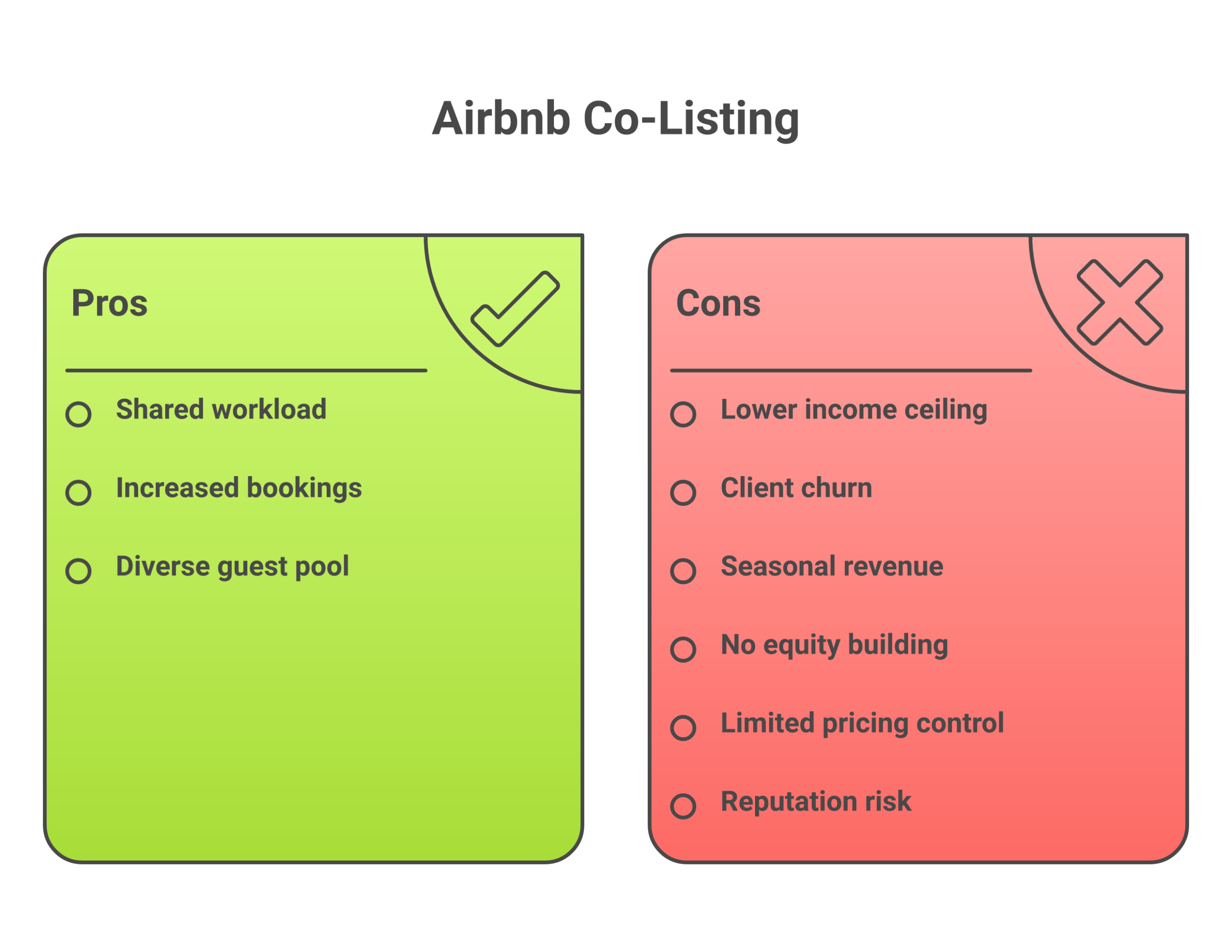
Co-listing on Airbnb has real advantages: zero startup capital, no lease liability, and income from day one. It also has real downsides: client churn, seasonal revenue swings, and an income ceiling that caps without ownership equity. Most content about co-listing online reads like a sales pitch. This article isn’t that. I’ve watched hundreds of students go through the 10XBNB program, and the ones who succeed long-term are the ones who walked in with eyes open. Here’s an honest breakdown of both sides so you can decide if Airbnb co-listing fits your situation. To see the full financial comparison, check out our article on how to compare co-listing to real estate investing.
What Airbnb Co-Listing Actually Means (Quick Context)
Before we get into the pros and cons, a quick clarification. Co-listing means you manage someone else’s short-term rental property on Airbnb in exchange for a percentage of the booking revenue. You don’t own the property. You don’t sign a lease. You handle the day-to-day operations: guest communication, pricing, turnover coordination, listing optimization.
Airbnb’s own Co-Host Network, launched in late 2024, now connects property owners with experienced managers across 10 countries. Over 100,000 Airbnb listings already use co-hosts, and 73% of co-hosts on the platform are Superhosts with an average rating of 4.86 out of 5 (per Airbnb’s 2024 Winter Release data). That tells you the model works. But “works” and “works for you” are two different things.
One important distinction: at 10XBNB, we call this “co-listing” because it centers on the listing itself, not just the hosting tasks. The Airbnb platform uses “co-host” as its feature name. Same concept, different terminology.
The 7 Pros of Airbnb Co-Listing
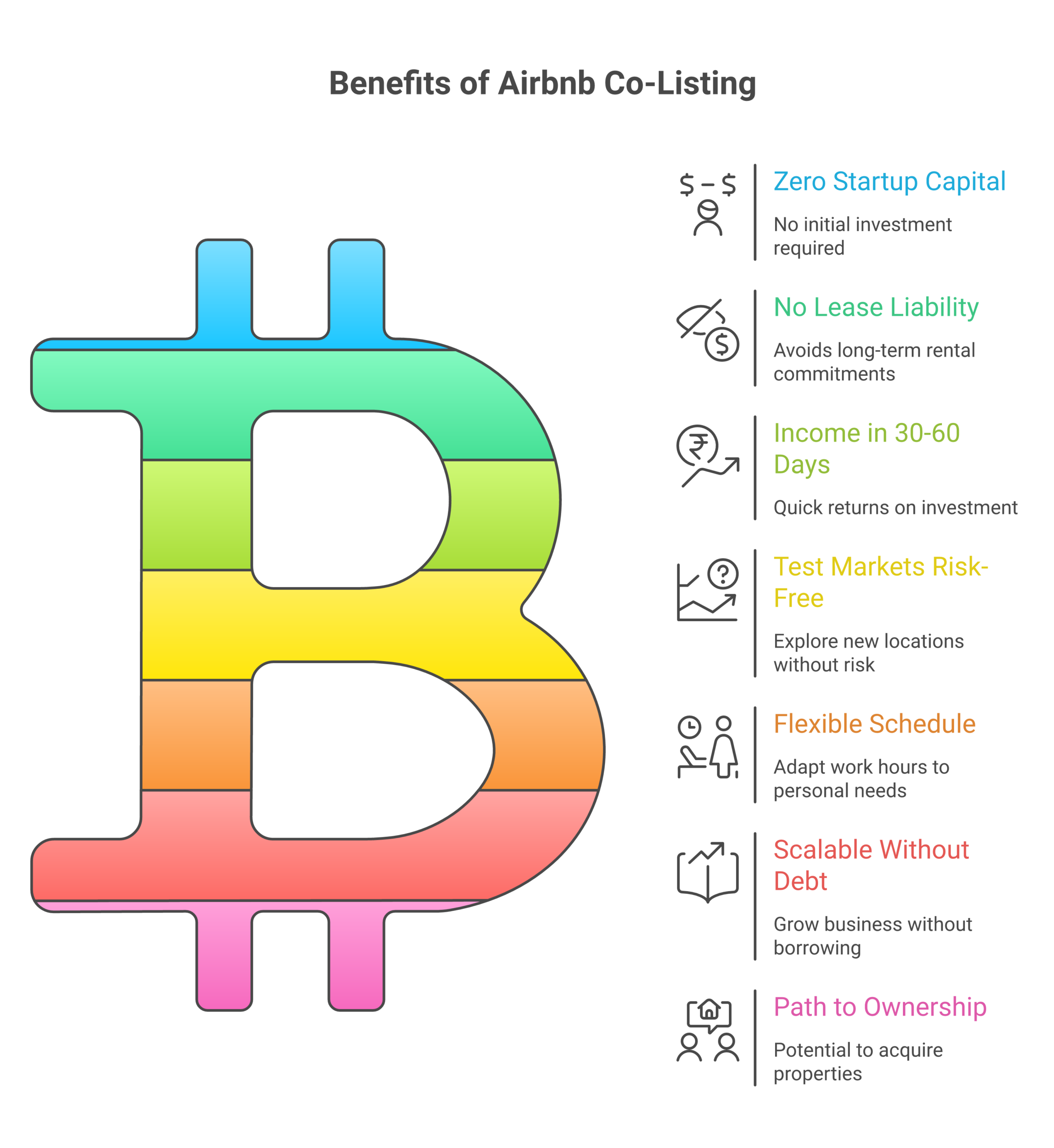
1. Zero Startup Capital Required
This is the single biggest draw. Rental arbitrage requires $5,000 to $15,000 upfront per property (first month, last month, security deposit, furnishing). Buying an investment property? You’re looking at $30,000 to $80,000 for a down payment alone. Co-listing requires $0. Your investment is time, not money.
That’s not a minor detail. It means a 22-year-old college graduate and a 55-year-old career changer can both start on the same day with the same resources. No bank approval. No credit check. No personal guarantee on a lease. If you want to understand the financial comparison in more detail, I wrote a full breakdown on co-listing vs. rental arbitrage.
2. No Lease Liability or Credit Risk
With rental arbitrage, you sign a 12-month lease. If occupancy drops, if the city passes new short-term rental regulations, if a pipe bursts and you lose two months of bookings, you still owe that rent. Every month. On time.
Co-listing carries none of that risk. If a property underperforms, you can walk away. You lose the time you invested, but you don’t owe $2,500 a month on a lease you can’t escape. For people testing the short-term rental space for the first time, this matters more than most realize.
3. Income Starts Within 30 to 60 Days
A typical co-listing timeline looks like this: Week 1, find a property owner. Week 2-3, sign a co-listing agreement, optimize the listing, take professional photos. Week 3-4, go live on Airbnb. Week 4-8, first bookings come in, first payout hits your account.
Compare that to arbitrage (3 to 6 months to break even after furnishing costs) or property ownership (12+ months to recoup closing costs and renovation). Co-listing has the shortest path from “I want to do this” to “I just got paid.”
4. Test Markets Without Financial Commitment
Not sure if your city’s short-term rental market is strong enough? Co-listing lets you find out without risking $10,000. Manage one or two properties for 90 days. Track the occupancy rates, average daily rates, and seasonal patterns. If the numbers work, scale up. If they don’t, you’ve spent nothing but time, and you’ve gained real market data you can use later.
This is especially valuable in markets with uncertain regulation. If your city council is debating STR restrictions, co-listing lets you participate in the market without being locked into a lease if the rules change.
5. Flexible Schedule (Manage From Anywhere)
Guest communication happens through Airbnb’s app. Pricing adjustments happen through tools like PriceLabs or Wheelhouse. Cleaning coordination happens through Turno or a local cleaning team. None of this requires you to be physically present at the property.
I’ve seen 10XBNB students manage 5+ properties while traveling, while working a W2 job, or while raising young kids. The work is real (expect 5 to 10 hours per week per property when you’re starting out), but it bends around your life instead of the other way around.
6. Scalable Without Proportional Capital
Adding a second arbitrage property means another $5,000 to $15,000 in startup costs. Adding a second co-listing means another conversation with a property owner. The capital requirement for growth is close to zero.
This is why some co-listers manage 10, 20, or even 50+ properties within 18 months. The bottleneck isn’t money. It’s your ability to find property owners and deliver results consistently. Systems and processes become your growth engine, not your bank account.
7. Natural Path to Ownership or Arbitrage
Here’s what most people miss: co-listing isn’t just a business model. It’s an apprenticeship. You learn pricing, guest management, market dynamics, and property optimization with zero financial risk. After 12 to 18 months, you’ll have real data, real relationships with property owners, and real operational skills.
Many successful 10XBNB students started with co-listing, then used their track record to negotiate arbitrage deals or even purchase investment properties. The property owners they managed for became their referral network. That transition from co-listing to ownership is one of the most underrated career paths in real estate.
The 6 Cons of Airbnb Co-Listing (The Honest Part)
If you’ve read this far expecting a sales pitch, this is where it changes. These are real downsides. They won’t disappear because you work hard or follow a system perfectly. You need to walk into co-listing knowing these exist.
1. Lower Income Ceiling Per Property
Co-listers typically earn 10% to 25% of the gross booking revenue. On a property generating $3,000 per month in bookings, that’s $300 to $750 for you. An arbitrageur on the same property, after paying $1,500 in rent and $400 in expenses, keeps $1,100. An owner keeps even more.
The math is simple: you trade upside for safety. Co-listing gives you lower returns per property in exchange for zero risk. To match the income of someone who owns or leases properties, you need to manage more units. A co-lister managing 5 properties at $500 each earns $2,500 per month. An arbitrageur with 2 properties earning $1,100 each earns $2,200. The co-lister needs volume to compete. That’s a structural reality, not a flaw you can optimize away. For a deeper look at the actual numbers, see our co-host income guide.
2. Client Churn Is Real
Property owners sell. They move back into their property. They decide to self-manage after watching what you do for a year. They hire a property management company that bundles services you don’t offer. The average co-listing relationship lasts 18 to 24 months based on patterns we’ve observed across 1,600+ 10XBNB students.
That means if you manage 5 properties today, expect to lose 2 or 3 of them within two years. You need a constant pipeline of new property owners just to maintain your current income, let alone grow it. This is the part that catches people off guard. Co-listing is not “set it and forget it.” It requires ongoing business development, every single month.
3. Seasonal Revenue Swings Hit You Directly
Your income is a percentage of the property’s revenue. When occupancy drops in the off-season (and it will, in virtually every market), your income drops with it. A property earning $4,000 in July might earn $1,500 in January. Your 20% cut goes from $800 to $300.
You can’t smooth this out with a fixed management fee the way traditional property managers do. Most co-listing agreements are percentage-based, which means your cash flow mirrors the property’s seasonality. If you’re budgeting based on your best month, you’ll be short by your worst month. Plan for 60% to 70% of your peak income as your annual average.
4. You’re Building Someone Else’s Asset
After two years of managing a property, optimizing the listing, earning 200 five-star reviews, and building a repeat guest base, all of that value belongs to the property owner. If the relationship ends, you walk away with experience and skills but zero equity. The listing stays with the owner. The reviews stay with the owner. The guest relationships stay with the owner.
Compare that to arbitrage, where you build your own listing history, or ownership, where you build actual real estate equity. This is the most fundamental trade-off of co-listing, and no amount of positive thinking changes it. You are a service provider, not a business owner in the traditional sense.
5. Limited Control Over Pricing and Property Decisions
You might know that dropping the nightly rate by $15 would increase occupancy enough to boost total revenue. But the property owner doesn’t want their “premium property” listed below $200 a night. You might know that investing $500 in better linens would improve reviews. But the owner doesn’t want to spend the money.
As a co-lister, you advise. You don’t decide. Some owners are collaborative. Others micromanage. And you won’t always know which type you’re working with until you’re already in the relationship. This friction is one of the top reasons co-listing relationships end early.
6. Reputation Risk Cuts Both Ways
A bad guest trashes the property. The owner blames you for approving the booking. A guest leaves a 2-star review because the AC broke at 2 AM. The owner blames you for not having a backup plan. A guest gets injured on the property. The legal questions get complicated fast.
Your reputation as a co-lister depends on outcomes you don’t fully control. The property’s condition, the neighbor’s noise complaints, the city’s sudden enforcement of STR regulations. All of these can damage your track record even when you did everything right. A solid co-listing agreement helps, but it doesn’t eliminate this risk.
Who Should NOT Try Co-Listing
Honest content means honest disqualification. Co-listing is not for everyone. If any of these describe you, this isn’t your path:
- You want purely passive income. Co-listing requires active work. Guest messages at 11 PM. Cleaning emergencies on a Saturday morning. Pricing adjustments every week. If you’re looking for a “set it and forget it” income stream, buy index funds.
- You can’t handle direct guest communication. Guests complain. They ask unreasonable things. They leave messes. If confrontation or customer service stresses you out, co-listing will burn you out within 6 months.
- You expect $10,000 per month from one property. That’s not how the math works. At a 20% commission on a property earning $4,000 per month, you make $800. You need 12 to 15 high-performing properties to hit $10,000 monthly, and building to that level takes 12 to 24 months of consistent effort.
- You’re unwilling to do sales and outreach. Finding property owners is a sales process. Cold emails, networking events, real estate meetups, door knocking. If you won’t do the outreach, you won’t get the properties.
- You need income stability above all else. Between seasonal swings and client churn, co-listing income fluctuates. If you need a predictable paycheck to cover your mortgage, keep your W2 and start co-listing as a side income first.
Who Co-Listing Is Perfect For
Now the other side. These are the people who tend to thrive with co-listing:
- W2 workers wanting a side income. You already have stable income covering your bills. Co-listing adds $1,500 to $3,000 per month on top of that without requiring you to quit your job or sign a lease. The flexible schedule works around a 9-to-5.
- Career changers testing the waters. You’re curious about real estate or hospitality but not ready to invest $50,000 to find out. Co-listing lets you spend 90 days in the industry with zero financial risk. If you love it, scale up. If you don’t, you’ve learned something valuable for free.
- People with no capital but strong hustle. You can’t qualify for a mortgage or sign a lease right now. That doesn’t mean you can’t build a real estate business. Co-listing turns your time and effort into income without requiring credit, savings, or collateral.
- Parents wanting schedule flexibility. School pickup at 3 PM. Sick days. Summer breaks. Co-listing bends around family life in a way that a traditional job or even arbitrage doesn’t. You work when the kids are at school or asleep, and the business keeps running.
- Real estate investors building skills first. Before you buy a short-term rental property, managing someone else’s teaches you everything you need to know: pricing, guest management, market selection, vendor relationships. Think of it as getting paid to earn your MBA in short-term rentals.
The Bottom Line: Is Airbnb Co-Listing Worth It?
Here are the real numbers. According to 10XBNB’s 2026 student survey, 73% of students who completed the program and took action became profitable within 90 days. The median monthly income at the 6-month mark, with 3 to 5 properties under management, was $1,500 to $3,000. Not $20,000. Not “replace your income in 30 days.” Real, meaningful side income that grows as you add properties.
Is that worth it? Depends on your starting point.
If you’re earning $60,000 a year at your W2 and you add $2,000 per month in co-listing income, you just gave yourself a 40% raise with no boss, no commute, and no permission required. That’s significant.
If you’re expecting to quit your job in 60 days and live off co-listing income alone, you’re setting yourself up for disappointment. It can get there, but it takes 12 to 18 months of consistent work to build a portfolio large enough to replace a full-time salary.
The students I’ve seen succeed share three traits: they treat co-listing like a real business (not a side hustle they dabble in), they stay consistent with outreach even when they already have properties, and they set realistic timelines. The ones who fail almost always overestimated how fast the money would come and underestimated the work required to keep it coming.
Co-listing won’t make you rich overnight. But it’s one of the lowest-risk, highest-education entry points into real estate that exists. You learn by doing. You earn while learning. And if you decide to move into arbitrage or ownership later, every month of co-listing experience makes that transition easier, safer, and more profitable.
If you want to see the full model, including how to find owners, structure agreements, and scale from 0 to 10+ properties, our free training walks through the entire process step by step.
Frequently Asked Questions
How much do Airbnb co-listers actually make?
Most co-listers earn 10% to 25% of each property’s gross booking revenue. With 3 to 5 properties, that typically translates to $1,500 to $3,000 per month. Higher-volume co-listers managing 10+ properties can earn $5,000 to $8,000 monthly. The exact amount depends on your market’s average daily rate, occupancy, and your commission percentage. See our full income breakdown for detailed calculations.
Do I need experience to start co-listing on Airbnb?
No prior hosting experience is required. Airbnb’s Co-Host Network does favor experienced Superhosts (73% of network co-hosts are Superhosts), but you can start co-listing independently by approaching property owners directly. What matters more than experience is your ability to learn fast, communicate clearly, and deliver results. Most new co-hosts find their first property within 30 to 45 days of starting outreach.
What’s the difference between co-listing and co-hosting?
“Co-hosting” is the term Airbnb uses on its platform for the feature that lets someone manage another person’s listing. “Co-listing” is the business model term used by 10XBNB and others in the industry. The practical difference is small. Both involve managing someone else’s short-term rental for a percentage of revenue. Our complete guide to co-listing explains the full model.
Is co-listing legal?
Co-listing itself is legal in most jurisdictions. However, short-term rental regulations vary by city and state. Some cities require the property owner to hold the STR permit. Others require anyone managing the listing to be registered. Before you start, check your local STR regulations. Your tax obligations as a co-host also depend on your location and business structure.
Can I co-list while working a full-time job?
Yes. Most 10XBNB students start co-listing while employed full-time. Expect 5 to 10 hours per week per property during the first 60 days as you set up systems. After that, well-automated properties take 2 to 4 hours per week each. The work is asynchronous (guest messages, pricing updates, cleaning coordination), so you can handle it during lunch breaks, evenings, and weekends.
What happens if the property owner fires me?
This happens. It’s one of the cons covered above. A strong co-listing agreement should include a 30 to 60 day termination notice period, clear terms for final payouts on existing bookings, and a transition plan. You lose the property and its income, but you keep your skills, your systems, and your reputation. The best protection against client loss is always having a pipeline of new owners in development.
How is co-listing different from property management?
Traditional property managers typically charge a flat percentage (8% to 12%) and handle long-term rentals. Co-listers focus specifically on short-term rentals on platforms like Airbnb, charge 10% to 25%, and are more involved in dynamic pricing, listing optimization, and guest experience. Some states require a property management license for co-listing. Check your local requirements before starting.
Do I need a co-listing agreement?
Absolutely. Never manage someone’s property on a handshake. A written agreement protects both you and the property owner by defining commission rates, responsibilities, termination terms, liability, and dispute resolution. We have a full co-listing agreement template you can customize.