
How much can you actually earn as an Airbnb co-listing partner? This free calculator gives you a real answer in seconds. Plug in the number of properties you manage, your average nightly rate, local occupancy rate, and your commission percentage. The calculator updates instantly as you adjust each input, so you can model different scenarios (3 properties at 15% commission vs. 10 properties at 25%) and see exactly how the numbers shift.
A few assumptions to keep in mind: the calculator uses a 30-day month, estimates 15 hours of work per property per month (a common benchmark for co-listing partners who handle guest communication, check-ins, and listing optimization), and subtracts your monthly expenses like cleaning supplies or mileage. The “time to replace salary” metric assumes a $5,000/month baseline. Your actual results will vary based on your market, the quality of listings you manage, and how efficiently you run operations.
Already familiar with how Airbnb co-listing works? Jump straight to the calculator below.
Airbnb Co-Listing Income Calculator
Adjust the sliders and inputs below. Results update in real time.
Supplies, mileage, software, etc.
Your Estimated Earnings
Understanding Your Co-Listing Income Potential
The math behind co-listing income is straightforward. You earn a percentage of each booking's revenue, minus your operating costs. But the numbers can vary significantly depending on three factors: your market's average daily rate (ADR), seasonal occupancy patterns, and the commission you negotiate with property owners. For the full financial picture, see our guide on how co-listing income compares to rental property returns.
Commission rates for co-listing partners typically fall between 10% and 25%. New co-listers often start at 15% to build their portfolio and track record. Once you can show owners measurable results (higher occupancy, better reviews, increased revenue), moving to 20-25% becomes a reasonable ask. Some co-listing partners in high-demand markets charge up to 30-40% when they provide full-service management including pricing optimization, guest screening, and turnover coordination.
Occupancy rates swing based on location and season. According to Airbnb co-host income data, urban markets like Austin and Nashville average 65-75% annual occupancy, while beach and ski destinations can hit 80-90% in peak season but drop to 40-50% off-season. When you're projecting annual income, use a blended rate rather than peak-season numbers.
The hourly rate metric in the calculator assumes 15 hours per property per month. That covers guest messaging, coordinating cleaners, restocking supplies, handling reviews, and occasional check-ins. If you streamline operations with automated messaging tools and a reliable cleaning crew, you can bring that closer to 8-10 hours. That makes the effective hourly rate even higher.
Real-World Co-Listing Income Examples
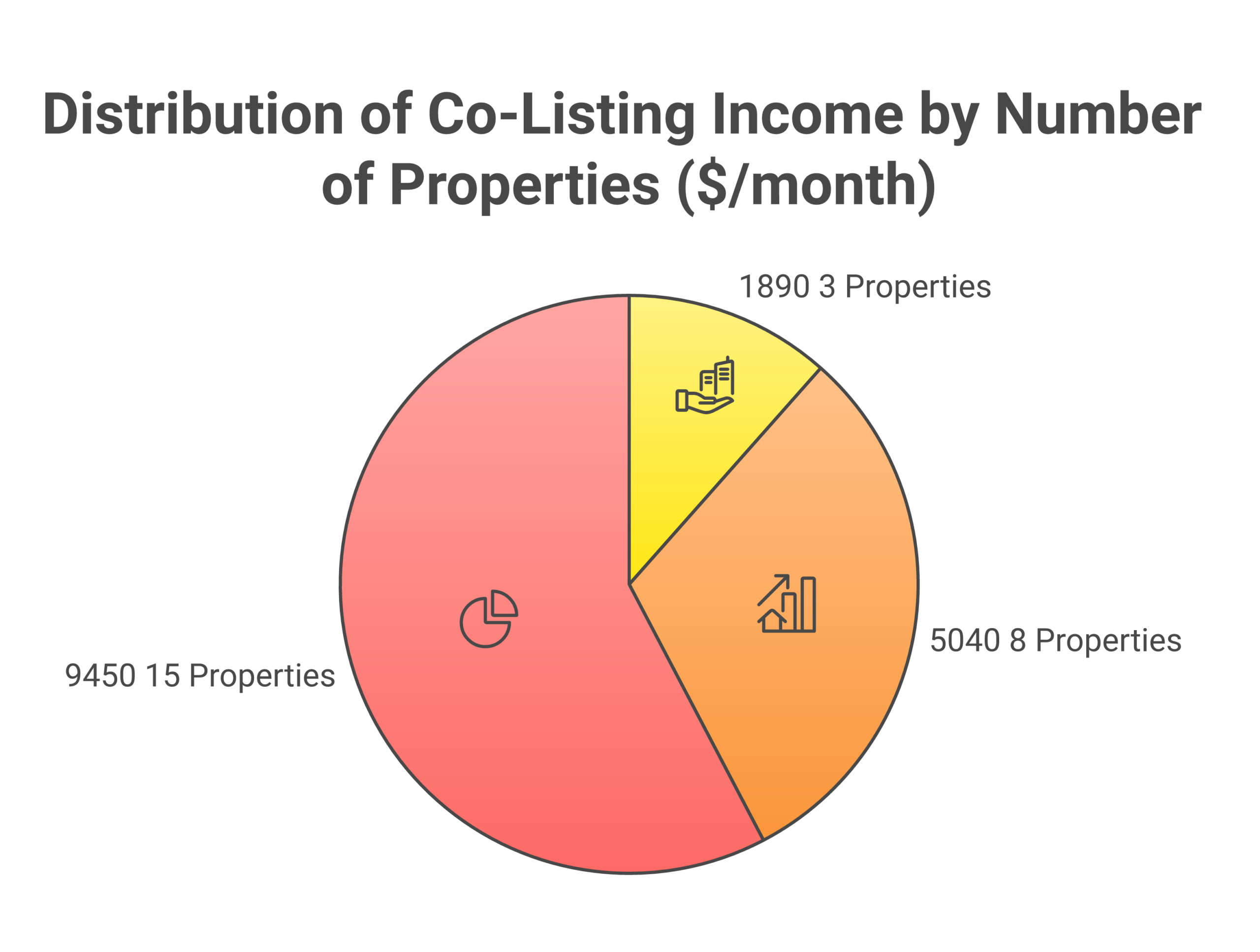
Here are three scenarios based on common co-listing setups. All figures assume a 30-day month and $50/month in per-property expenses.
| Scenario | Properties | Nightly Rate | Occupancy | Commission | Monthly | Annual |
|---|---|---|---|---|---|---|
| Beginner | 3 | $120 | 65% | 15% | $903 | $10,836 |
| Intermediate | 8 | $175 | 70% | 20% | $5,480 | $65,760 |
| Advanced | 15 | $200 | 75% | 25% | $16,125 | $193,500 |
How the math works for the beginner scenario: $120 nightly rate x 30 days x 0.65 occupancy = $2,340 in gross booking revenue per property. At 15% commission, that's $351 per property, minus $50 expenses = $301 net per property. Multiply by 3 properties = $903/month.
The jump from beginner to intermediate is where most co-listing partners see the biggest lifestyle change. Going from 3 to 8 properties while also negotiating a higher commission rate and targeting better-performing listings can take you from side income to full-time earnings in 6-12 months.
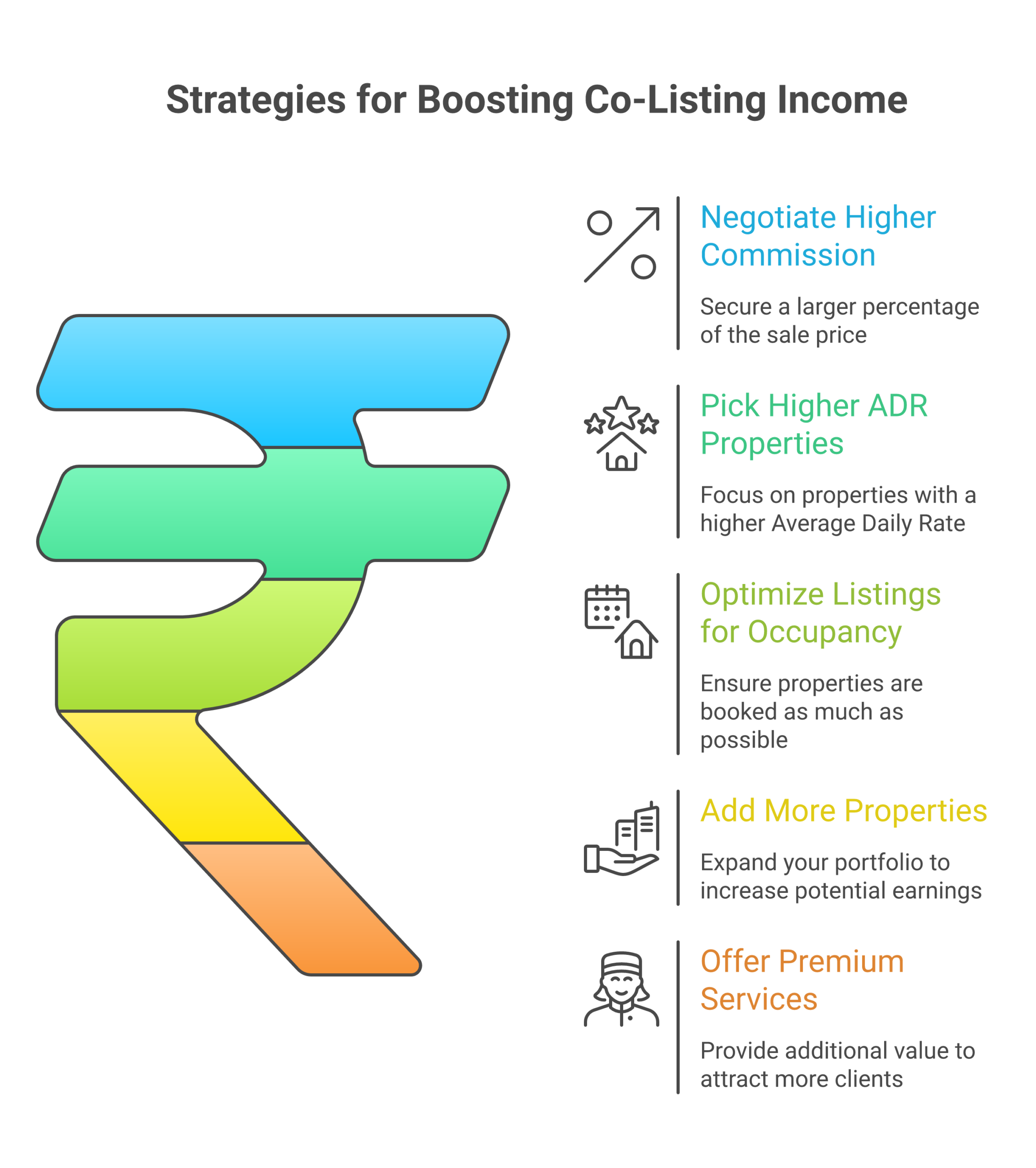
5 Ways to Increase Your Co-Listing Income
1. Negotiate Higher Commission Rates
Start by tracking the revenue increase you deliver for each owner. If you boosted a property's monthly revenue from $2,800 to $3,900 through better listing optimization and pricing, you have a concrete case for moving from 15% to 20-25%. Owners care about their net income. Show them that even at a higher commission, they're still earning more than they were before you took over. Learn more about how co-listing compares to rental arbitrage from an earnings perspective.
2. Target Higher-ADR Properties
The work involved in managing a $120/night studio is nearly identical to managing a $250/night two-bedroom. Guest messages, cleaning coordination, and review management take roughly the same time regardless of price point. But your commission on the $250 property is more than double. When you're looking for new property owners to partner with, prioritize listings with higher nightly rates or multi-bedroom properties in strong markets.
3. Optimize Listings for Better Occupancy
Small improvements to listing photos, titles, and descriptions can push occupancy up 10-15 percentage points. Professional photography alone has been shown to increase bookings by up to 24%, according to Airbnb's own host education materials. Write detailed house manuals, respond to inquiries within an hour, and maintain Superhost-level review scores. Every percentage point of occupancy flows directly to your bottom line.
4. Scale Your Property Count Strategically
Adding properties is the most direct way to increase income, but do it in clusters. Taking on 3 properties in the same neighborhood means one cleaning crew covers all of them, your drive time drops, and you can buy supplies in bulk. Scattered properties across a metro area eat into your margins with windshield time. Aim to add 2-3 properties per quarter once your systems are solid.
5. Offer Premium Services for Higher Fees
Some co-listing partners charge a flat monthly fee on top of their commission for services like professional photography, interior staging, dynamic pricing management, or handling minor maintenance. A $200/month premium services fee across 10 properties adds $2,000/month to your income with minimal extra effort if you've already built vendor relationships. Read about the full pros and cons of the co-listing model to decide which services fit your business.
Frequently Asked Questions About Co-Listing Income
How much do Airbnb co-listing partners make per month?
Monthly income varies widely based on property count, nightly rates, and commission percentage. A co-listing partner managing 5 properties at $150/night with 70% occupancy and a 20% commission earns roughly $2,800/month after expenses. Partners managing 10+ properties in high-ADR markets regularly earn $6,000-$12,000/month. Use the calculator above to model your specific situation.
What commission percentage should I charge as a co-listing partner?
Most co-listing partners charge between 15% and 25% of gross booking revenue. New partners often start at 15% to attract their first few owners, then increase to 20-25% as they build a track record. Full-service partners who handle everything from pricing to maintenance sometimes charge 30% or more. The right rate depends on your market and the scope of services you provide.
How many properties do I need to replace a full-time income?
At typical rates ($150/night, 70% occupancy, 20% commission), you'd need about 8-10 properties to replace a $5,000/month salary. In higher-ADR markets or at higher commission rates, you might hit that number with 5-6 properties. The calculator's "time to replace salary" feature shows you the exact number based on your inputs.
Is co-listing income passive?
Not entirely. Co-listing requires active work: guest communication, coordinating cleaners, handling issues, and optimizing listings. Budget about 10-15 hours per property per month when you're starting out. As you build systems (automated messaging, reliable cleaning crews, digital guidebooks), that can drop to 5-8 hours per property. It's semi-passive once your operations are dialed in, but it's not "set and forget."
Do I need money upfront to start co-listing?
One of the biggest advantages of co-listing versus buying or renting properties is the low startup cost. You don't sign leases or take on mortgage debt. Your main costs are professional photography ($150-$300 per listing), a property management software subscription ($20-$50/month), and basic supplies. Most co-listing partners start with under $500 in total investment.
How do taxes work for co-listing income?
Co-listing income is typically reported as self-employment income on Schedule C. You can deduct business expenses including mileage, supplies, software subscriptions, phone costs, and a portion of your home office. Quarterly estimated tax payments are required once you're earning consistently. Consult a CPA familiar with short-term rental businesses for your specific tax situation. We cover this in more detail in our co-host income guide.
Ready to Hit Your Income Target?
Now that you've seen what's possible with the calculator, the question is: how do you actually get there? Finding property owners, pitching your services, setting up your systems, and scaling from 1 property to 10+ takes a clear plan.
Our free co-listing training walks you through the exact steps to land your first property, optimize it for maximum revenue, and build a co-listing business that matches (or beats) your calculator results. No lease signings. No mortgage risk. Just a proven system for earning income from properties you don't own.