
People ask me all the time, “Shaun, what do I charge?” They’re terrified of getting it wrong. I get it. When I started renting my spare bedroom for $65 a night, I was just guessing. Now I manage a $100M+ portfolio of properties I don’t own. The answer is simple: Airbnb co-hosts charge 10% to 25% of gross booking revenue. But the real money isn’t in knowing the average. It’s in knowing exactly what to charge for the value you provide, so you can build a real business, not a side hustle that burns you out.
Your Fee Depends on the Work. Period.
Stop guessing. Your fee is based on the work you do. Simple as that. Don’t charge 25% if you’re just answering a few messages. You’ll lose the deal. And don’t you dare charge 10% for full-service management. You’ll be answering 2 AM calls about a broken toilet for pennies. Am I right?
Here’s the breakdown. No fluff.
| Service Level | Typical Fee Range | What’s Included |
|---|---|---|
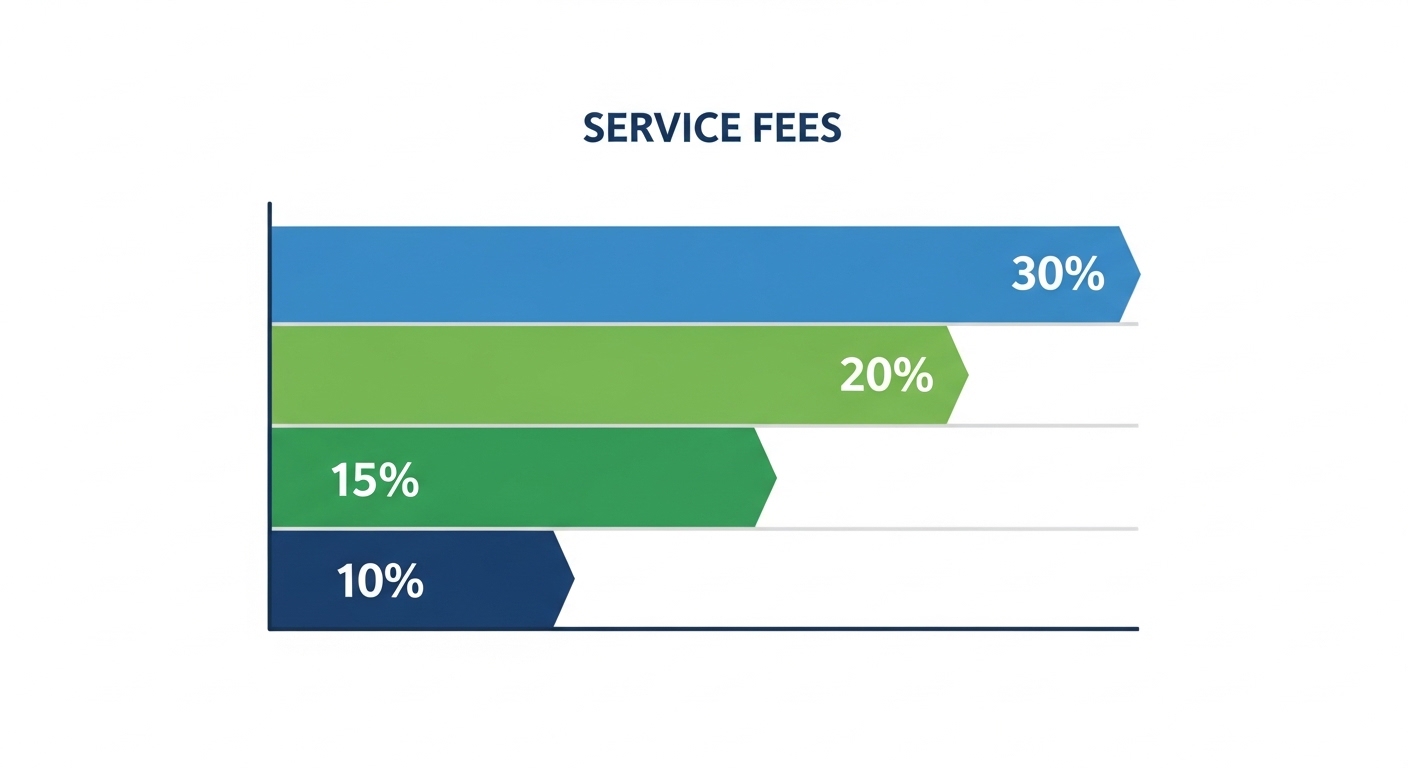
| Guest communication only | 10-15% | Responding to inquiries, sending check-in instructions, handling guest questions, writing reviews |
| Communication + cleaning coordination | 15-20% | Everything above plus scheduling cleaners, quality inspections, supply restocking |
| Full-service management | 20-25% | Everything above plus pricing optimization, listing updates, maintenance coordination, emergency handling |
| Full-service + marketing/growth | 25-30% | Everything above plus professional photography, listing SEO, multi-platform distribution, revenue growth strategy |
Here’s the thing. Most new co-hosts should live in that 15-20% range. It’s the sweet spot. Anything under 15% is a race to the bottom, and you can’t build a real business on scraps. If you try to charge over 25% without a proven track record, owners will compare you to the big, slow property management companies. Find the middle ground and prove your worth first.
Let’s Talk Numbers. This is a Business.
This is where my banking background kicks in. You have to know your numbers. It’s not magic. It’s math. Your income comes from three things: how much the property makes, what your cut is, and how many properties you manage. That’s it.
One Property. Your Starting Point.
| Metric | Amount |
|---|---|
| Average nightly rate | $150 |
| Occupancy rate | 70% (21 nights/month) |
| Monthly gross revenue | $3,150 |
| Co-host commission (20%) | $630/month |
| Annual co-host income | $7,560 |
Now, Let’s Scale It.
| Listings Managed | Monthly Revenue (at $3,150/listing) | Co-Host Income (20%) | Annual Income |
|---|---|---|---|
| 1 | $3,150 | $630 | $7,560 |
| 3 | $9,450 | $1,890 | $22,680 |
| 5 | $15,750 | $3,150 | $37,800 |
| 10 | $31,500 | $6,300 | $75,600 |
Look at that 10-listing number. Over $75,000 a year. I quit my $200K banking job at 33 because I saw this potential. The math works if you work the system. These numbers are just averages. My students manage properties in Nashville and Miami that do way more. The point is, this scales.
Don’t guess what a property can make. Use data. Plug the address into our co-listing income calculator to get a real estimate.
How You Get Paid (The Easy Way)
Forget about chasing owners for checks. Airbnb handles the money. This is a huge deal. The owner sets you up in their system one time, and the money hits your account automatically. No awkward conversations. No “the check is in the mail.”
According to Airbnb’s official rules, the owner can set you up in four ways:
- Cleaning fee only: You get the cleaning fee. That’s it. (Don’t do this.)
- Cleaning fee plus a percentage: Better. You get the cleaning fee plus a cut of the booking.
- Percentage of booking revenue: This is the standard. A clean percentage of the owner’s payout.
- Fixed amount per booking: A flat dollar amount. Predictable, but limits your upside.
When the Money Hits Your Account
Airbnb pays fast. It’s not a 30-day corporate cycle.
- The standard: The money is on its way the business day after the guest checks in.
- For new hosts: If the owner is brand new, Airbnb holds the money until after checkout for the first couple of stays. A small delay for security.
- For long stays (28+ nights): You get paid in monthly chunks.
Listen Up. This is Important.
Your cut comes from the host’s earnings. Not the total price the guest pays. Airbnb takes its service fee first, then pays the host. Your percentage is calculated on what the host actually pockets. So if you see a booking for $500 and your 20% payout is a little less than $100, that’s why. It’s fair, you just need to know how it works.
Percentage vs. Flat Fee? It’s Not a Debate.
People love to ask this. Percentage or flat fee? Here’s the no-BS answer: go with percentage. Always. Why? Because your incentives are aligned. When the owner makes more money, you make more money. It pushes you to get better reviews, optimize pricing for holidays, and increase the nightly rate. A flat fee makes you lazy. It’s just a paycheck. This is a business.
| Factor | Percentage-Based | Flat Fee |
|---|---|---|
| Best for | Properties with consistent bookings and higher nightly rates | Properties with variable income or new listings still building reviews |
| Revenue alignment | You earn more when the property earns more, which motivates you to optimize | Predictable income regardless of booking volume |
| Owner appeal | Owners like it because they pay nothing during vacancies | Owners may resist paying during slow months |
| Risk | Your income drops during low season | You earn the same whether occupancy is 30% or 90% |
| Scaling | Income grows automatically as you optimize the listing | Need to renegotiate to increase earnings |
The choice is obvious. Choose the model that pays you for performance. That’s the percentage model.
What Justifies a Higher Rate?
Your Market
Of course location matters. 20% in Miami is a lot more money than 20% in a small town. Don’t just copy a rate you saw someone post in a Facebook group. Know your market’s average nightly rate and occupancy. That’s your foundation.
Your Track Record
When you’re new, you have no proof. No results. You might have to take a lower rate, say 18%, to get your first “yes.” But once you have data,5-star reviews, screenshots of increased revenue, happy owner testimonials,you have use. That’s when you can command 20-25%. Results justify higher fees.
The Property’s Demands
A one-bedroom condo is not a 5-bedroom mansion with a pool and a hot tub. Stop charging the same rate for both. More work, more complexity, more things that can break equals more pay. It’s that simple. Price your services based on the headache factor.
The Owner’s Portfolio
An owner with five properties is a goldmine. You land one client, but get five listings. Give them a volume discount. Drop from 20% to 18%. It’s worth it. You lock in a huge chunk of business and skip the hassle of finding five different owners.
Your Game Plan for Setting Rates (First 90 Days)
Okay, you’re just starting out. No clients. No experience. No problem. Here’s exactly what you do. No theory. Just four steps.
- Do your homework: Go on CoHostMarket. Search local Facebook groups. See what other co-hosts in your city are charging. Don’t copy them, just get a baseline.
- Know your minimum: Figure out how many hours a week a property will take you. 5? 10? What’s your time worth? Don’t work for less than you’re worth. Calculate the minimum percentage you need to make it a win.
- Start at 15-20%: This is the strike zone. It’s competitive enough to get an owner’s attention but high enough to be worth your time.
- Build in a review clause: This is key. Put a 90-day review period in your co-host agreement. It lets you say, “Hey, this property is taking more work than we thought, we need to adjust the rate to 22%.” It avoids a difficult renegotiation from scratch.
You vs. a Property Manager (It’s Not a Fair Fight)
You are not a traditional property manager. And that’s your biggest weapon. They are slow, expensive, and lock owners into 12-month contracts. You are nimble, more affordable, and flexible. You work inside the owner’s account, giving them full transparency. This is how you win deals.
| Factor | Co-Host | Property Manager |
|---|---|---|
| Typical fee | 10-25% | 20-40% |
| Setup fees | Usually none | $200-$500 common |
| Minimum contract | Flexible, often month-to-month | 6-12 month contracts common |
| Platform | Works within owner’s Airbnb account | May list under their own account |
| Licensing | Usually not required for 1-2 listings | Often requires property management license |
| Liability | Limited, owner retains most liability | May carry errors and omissions insurance |
You are the solution for the 90% of owners who are too small for the big guys but too busy to do it themselves. That’s your market.
Don’t Forget About Taxes
This is a real business. Don’t mess with the IRS. That 1099 form from Airbnb is coming. The good news? You’re a business owner now. You get to write stuff off.
Here’s what you should be tracking:
- Mileage for driving to your properties
- A percentage of your cell phone and internet bill
- Software you use for pricing or messaging
- Cleaning supplies you buy for the units
- Courses or training you buy to get better at this
Get an accountant. Track everything. For the full breakdown, read our Airbnb co-host tax guide.
Frequently Asked Questions
How much does an Airbnb co-host charge per month?
It’s not a fixed monthly fee. You charge a percentage, usually 10-25%, of whatever the property earns. If a place makes $3,000 in a month, your cut is $300-$750. Your income changes with the seasons, just like the owner’s.
Does Airbnb charge a fee for adding a co-host?
No. It’s free. Airbnb wants good co-hosts on the platform. They don’t charge you or the owner anything extra to use the feature. The standard host fees still apply to the booking, that’s it.
Can I negotiate co-host fees?
Of course. Everything is a negotiation. You can negotiate based on how many properties they have, the scope of work, or even offer performance bonuses. If you can get them to a 90% occupancy rate, you get a 2% bonus. Get creative.
Is co-hosting worth it financially?
Is it worth it? I built a business that made $1.9M in 2022 from this exact model. You tell me. At just 5 properties, you could be making nearly $40,000 a year. At 10, you’re at $75,000. It’s worth it if you treat it like a real business, not a hobby.
How does the co-host get paid through Airbnb?
It’s all automated. The owner adds you as a co-host and sets your percentage. After a guest checks in, Airbnb splits the money and sends your share directly to your bank account. You don’t have to send invoices or chase anyone down.
Stop Thinking. Start Doing.
You have the numbers. You know what to charge. The time for excuses is over. If you’re ready to actually start, here are your next steps.
First, read the step-by-step guide to becoming an Airbnb co-host. It covers everything from finding your first client to getting added to a listing.
Then, understand how this model stacks up against others. Read the co-listing vs. rental arbitrage comparison. Now go get your first property.