

The game is changing. I see it every day. I manage over $100M in properties I don’t own, and the data doesn’t lie. Nightly rentals are getting squeezed. Regulations are choking out operators in major cities. So what do you do? You adapt. You get smarter. That’s why I’m telling my 1,600+ students to pivot to mid-term rental arbitrage. This is how you lease a property, furnish it, and rent it for 30+ days at a time. You get 70-85% of the short-term revenue with less than half the headaches. It’s the single best way to build a cash-flowing portfolio in 2026. No property needed.
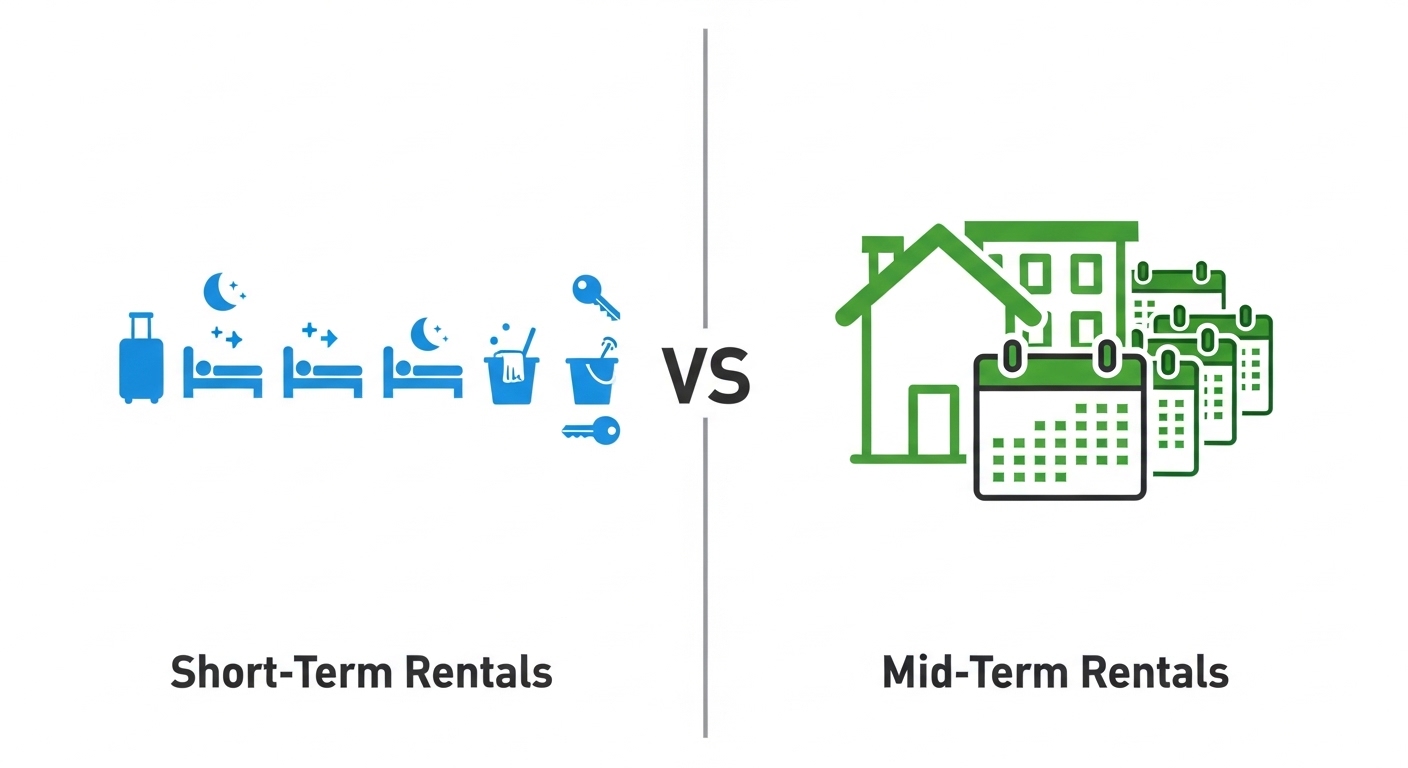
What Is Mid-Term Rental Arbitrage?
Let’s cut the jargon. It’s simple. You find a landlord. You sign a one or two-year lease on their apartment or house. You furnish it. Then you rent it out to people who need a place for one to twelve months. Your profit is the difference between the rent you collect and the rent you pay the landlord. That’s it. You’re the middleman.
I started with a spare bedroom in my apartment, renting it for $65 a night. I know what it’s like to start with nothing. This model is how you scale without buying a single property. Now, who are your customers? They aren’t tourists. They are professionals.
- Travel nurses and medical pros: The demand here is huge. The Bureau of Labor Statistics says we’ll need almost 200,000 new nurses every year for the next decade. Their contracts are usually 13 weeks. They need a clean, furnished place to live near the hospital. You provide it.
- Corporate relocations: Big companies move people around all the time. Their employees need housing for a few months while they look for a permanent home. You can be their solution.
- Insurance displacement: A pipe bursts. A fire happens. Insurance companies pay top dollar to house families while their homes are being repaired. These are high-quality, long-stay tenants.
- Remote workers and digital nomads: The world has changed. People can work from anywhere. They want to try out a city for a few months before committing. You give them that flexibility.
- Students and interns: Every college town has a need for semester-long furnished housing for visiting professors, grad students, or interns.
Mid-Term vs. Short-Term Arbitrage: The Numbers Don’t Lie
I left a $200K banking job because I saw a better system. I think in spreadsheets. Let’s look at the facts. Here’s a side-by-side breakdown. No fluff.
| Factor | Short-Term (Nightly) | Mid-Term (30+ Days) |
|---|---|---|
| Average stay length | 2-4 nights | 30-90 days |
| Monthly turnovers | 8-15 per month | 0-1 per month |
| Cleaning costs | $75-150 per turnover x 8-15 = $600-$2,250/month | $75-150 per turnover x 0-1 = $0-$150/month |
| Guest screening | Limited (Airbnb reviews only) | Background checks, employer verification common |
| Wear and tear | High (frequent guest traffic) | Lower (single occupant treats it more like home) |
| Revenue per night | Higher ($150-$300+) | Lower ($80-$150, roughly 46% discount) |
| Occupancy rate | 55-75% typical | 85-95% typical |
| Net operating income | Higher ceiling, more variable | Lower ceiling, more consistent |
| Regulation risk | High (many cities restrict or ban STRs) | Low (most cities exempt 30+ day stays from STR rules) |
| Management time | 15-20 hours/week per 5 listings | 3-5 hours/week per 5 listings |
Here’s the thing. You trade a little bit of top-line revenue for massive savings on your biggest costs: cleaning and turnover. You get higher occupancy, better guests, and way less time spent managing. The net profit is often the same or better. It’s a business, not a hobby. You want consistency, not chaos.
Why the Smart Money Is Moving to Mid-Term in 2026
Short-Term Rental Regulations Are a Bloodbath
The party is over for a lot of nightly rental hosts. I see it constantly. New York City basically nuked its short-term rental market. LA, Denver, Nashville, you name it. They’re all adding rules that can kill your business overnight. One day you’re making money, the next day a new city ordinance makes your arbitrage lease worthless.
Need a lease? Download our free mid term rental agreement template with all 12 clauses explained.
See our ranked list of the top mid term rental markets in 2026 with demand drivers and income data for each market.
Mid-term is different. A 30-day stay is just a standard furnished rental in most cities. It flies right under the radar of all those short-term rental bans. You’re playing a different, safer game.
See our full breakdown of real income numbers for mid term rentals with city-by-city earnings and tenant demand analysis.
Nightly Rental Profits Are Shrinking
Look at the AirDNA data. Supply is through the roof. Everyone and their mom thinks they can be an Airbnb host. More supply means you have to lower your prices to compete. In markets like Austin and San Antonio, costs are actually higher than revenue for many operators. The margins are gone. You can’t build a real business on razor-thin profits.
Landlords Actually Prefer This Model
Pitching a landlord on nightly arbitrage is tough. They hear “Airbnb” and they picture parties, noise complaints, and trashed apartments. Am I right? But when you pitch them on mid-term, the conversation changes. You say “I have a corporate client, a traveling nurse, who needs housing for three months.” Now the landlord sees a responsible professional, not a weekend partier. It’s an easier yes. They get guaranteed rent from you, and you place a high-quality tenant. Everybody wins.
For a complete setup walkthrough, see our guide to renting to travel nurses with platform comparisons and pricing data.
Your System for Finding Mid-Term Tenants
You need a system. Don’t just throw it on Airbnb and pray. You have to go where the tenants are.
Step 1: Master the Platforms
- Furnished Finder: This is your #1. It’s built for travel nurses. It’s a flat fee of $99 a year. No commissions. If you’re serious about mid-term rentals, you have to be on this site. No excuses.
- Airbnb (monthly stays): Yes, still use Airbnb. Just set your minimum stay to 28 or 30 nights. This automatically puts you in front of people searching for longer stays. You’ll pay their fee, but the volume is there.
- Corporate Housing by Owner (CHBO): This platform connects you directly with the corporate housing world. It’s a smaller niche, but the clients pay well.
- Zillow and Apartments.com: Don’t forget the big guys. List your unit as a “furnished, short-term lease available.” A lot of people start their search here before they even know about the specialty sites.
Step 2: Go Direct (The Pro Move)
- Hospital staffing agencies: Stop waiting for tenants to find you. Call the agencies that place travel nurses like Aya Healthcare or Medical Solutions. Tell them you have housing available near their partner hospitals. Build a relationship.
- Insurance adjusters: Find local insurance agents and restoration companies. Take them to lunch. When they have a family displaced by a flood, you want to be the first person they call.
- Corporate relocation firms: Look up firms like Cartus or BGRS. They are always looking for quality furnished housing for their clients. Get on their list.
- University housing offices: Call the local university. Ask who handles housing for visiting faculty or grad students. Offer them a solution.
How to Price Your Mid-Term Rental
People overcomplicate this. It’s not magic. There’s a simple formula.
The Rule: Find the average nightly Airbnb rate for a similar property. Cut it by 40-50%. That’s your new daily rate. Multiply by 30. That’s your monthly rent.
Let’s run the numbers:
- A similar unit on Airbnb gets $150/night.
- Your mid-term rate: $150 x 0.55 (a 45% discount) = $82.50/night.
- Your monthly rent: $82.50 x 30 = $2,475/month.
- Your lease on the apartment is $1,200/month.
- Utilities and internet cost you $200/month.
- Your cleaning fee, spread out over the month, is maybe $50.
- Your monthly profit: $1,025. Per unit.
- Annual profit: $12,300. Again, per unit.
Now, let’s look at the same property with nightly rentals:
- Revenue at 65% occupancy: $150 x 19.5 nights = $2,925/month. Looks good, right? Wrong.
- Cleaning (8 turnovers at $100 each): $800/month. Ouch.
- Lease + utilities: $1,400/month.
- Supplies, coffee, toilet paper: $100/month.
- Monthly profit: $625.
The math doesn’t lie. In this real-world example, the mid-term model makes you $400 more per month with about 80% less work. Which business would you rather have?
If you want to plug in your own numbers, use our rental arbitrage calculator.
Setting Up Your Property the Right Way
Your tenant isn’t on a two-day vacation. They are living here for months. They have different needs. Get this wrong, and you’ll get bad reviews and vacancies.
Your Must-Have Checklist
- A real kitchen: I’m talking pots, pans, silverware, a good coffee maker, a toaster. Everything they need to cook actual meals. They aren’t eating out every night.
- A dedicated workspace: This is non-negotiable. A real desk, a comfortable office chair, and fast Wi-Fi. Your tenants are working professionals. They need to be able to work from home.
- Laundry: In-unit laundry is a massive selling point. If you can’t get it, make sure you’re very close to a clean, safe laundromat.
- Storage: People staying for 3 months bring suitcases. They need empty closet space and drawers in a dresser. Don’t fill the closets with your own junk.
- Fast, reliable internet: Get the best package you can. 100+ Mbps minimum. If the Wi-Fi goes down, your corporate tenant can’t work. This is a deal-breaker.
Your Lease Agreement
This is critical. When you sign the lease with the property owner, you need a corporate leasing addendum that specifically allows you to sublet the property as a furnished rental for stays of 30 days or more. Be upfront. Explain the model. A landlord who says no to “Airbnb” will often say yes to “housing for corporate clients.”
For the exact words to use, check out our landlord pitch script for rental arbitrage. Don’t wing it.
Let’s Talk About the Risks. No BS.
People get scared. I get it. This isn’t a get-rich-quick scheme. It’s a real business with real risks. But you can manage them.
Objection 1: “What about long vacancies?” Look, if a 3-month tenant leaves and you have a two-week gap, you still have to pay the rent. That’s a risk. The solution? You build a pipeline. You are always marketing. You list on multiple platforms. You build direct relationships. You should have your next tenant lined up before the current one even moves out.
Objection 2: “What if I get a bad tenant?” It happens. A tenant who stops paying rent after 45 days is a bigger problem than a bad Airbnb guest who leaves in two days. This is why you screen. You run background checks. You verify their employment. You call their references. Don’t get lazy on the front end. Protect yourself.
Objection 3: “Is demand consistent?” It can fluctuate. Nurse demand might dip in the summer. Corporate moves slow down in December. The answer is diversification. Don’t rely on just one source of tenants. Market to nurses, corporate clients, and insurance companies all at the same time.
Objection 4: “But I’ll make less per night!” You’re looking at the wrong number. Who cares about revenue per night? I care about profit in my bank account at the end of the month. You make less on the top line but keep way more on the bottom line because your costs are a fraction of nightly rentals. I’ll take that trade every single day.
Frequently Asked Questions
Is mid-term rental arbitrage legal?
In most places, yes. A 30+ day stay is usually just a standard landlord-tenant relationship, not a “short-term rental” that falls under hotel laws. But don’t be an idiot. I’m not your lawyer. Go read your city’s specific housing codes. And make sure your lease with the landlord allows it.
How much can I actually make?
A good target is $800 to $1,500 per month in net profit, per unit. It depends on your market and your rent. Once you have a system, you can scale. Get five units doing $1,000 a month each. That’s $5,000 a month in cash flow. No property owned.
Do I need special insurance?
Your standard renter’s policy might not cover you. You’re running a business. Call your insurance agent and tell them exactly what you’re doing. They may require a commercial policy or a specific rider for furnished rentals. Look at companies like Proper Insurance. They specialize in this stuff.
What’s the single best platform to use?
Furnished Finder. Start there. But don’t stop there. The pros are on multiple platforms. You need to be on Furnished Finder, Airbnb (30-day minimum), CHBO, and Zillow. Cover all your bases.
Can I mix short-term and mid-term?
Absolutely. This is a great strategy. Run it as a nightly rental during your city’s peak season to maximize revenue. Then, switch to a 30-day minimum during the slower months to keep your occupancy high. This hybrid model gives you the best of both worlds.
Your Next Steps. Right Now.
Stop analyzing. Start doing. Information alone is worthless. Action is what gets you paid. If you’re already doing nightly arbitrage, it’s time to evolve. If you’re new, this is your entry point.
Here is your assignment. Pick one property. Just one. List it on Furnished Finder and set a 28-night minimum on Airbnb. Track every dollar in and every dollar out for the next 90 days. Track the hours you spend managing it. Then compare the profit and the lifestyle to the nightly rental model. The numbers will speak for themselves.
For the complete playbook on how to start from scratch, read our complete rental arbitrage guide. To see how this compares to managing other people’s properties, check out our co-listing vs. rental arbitrage comparison.