
Finding property owners who will let you co-list their home on Airbnb is the single biggest challenge new co-listers face. You can learn every pricing strategy, guest communication trick, and listing optimization hack in existence. But none of it matters if you don’t have a property to manage.
I’ve spent years testing different approaches to owner acquisition. Some methods produced zero results after weeks of effort. Others landed me three signed co-listing agreements in a single month. The difference came down to targeting the right owners through the right channels with the right message.
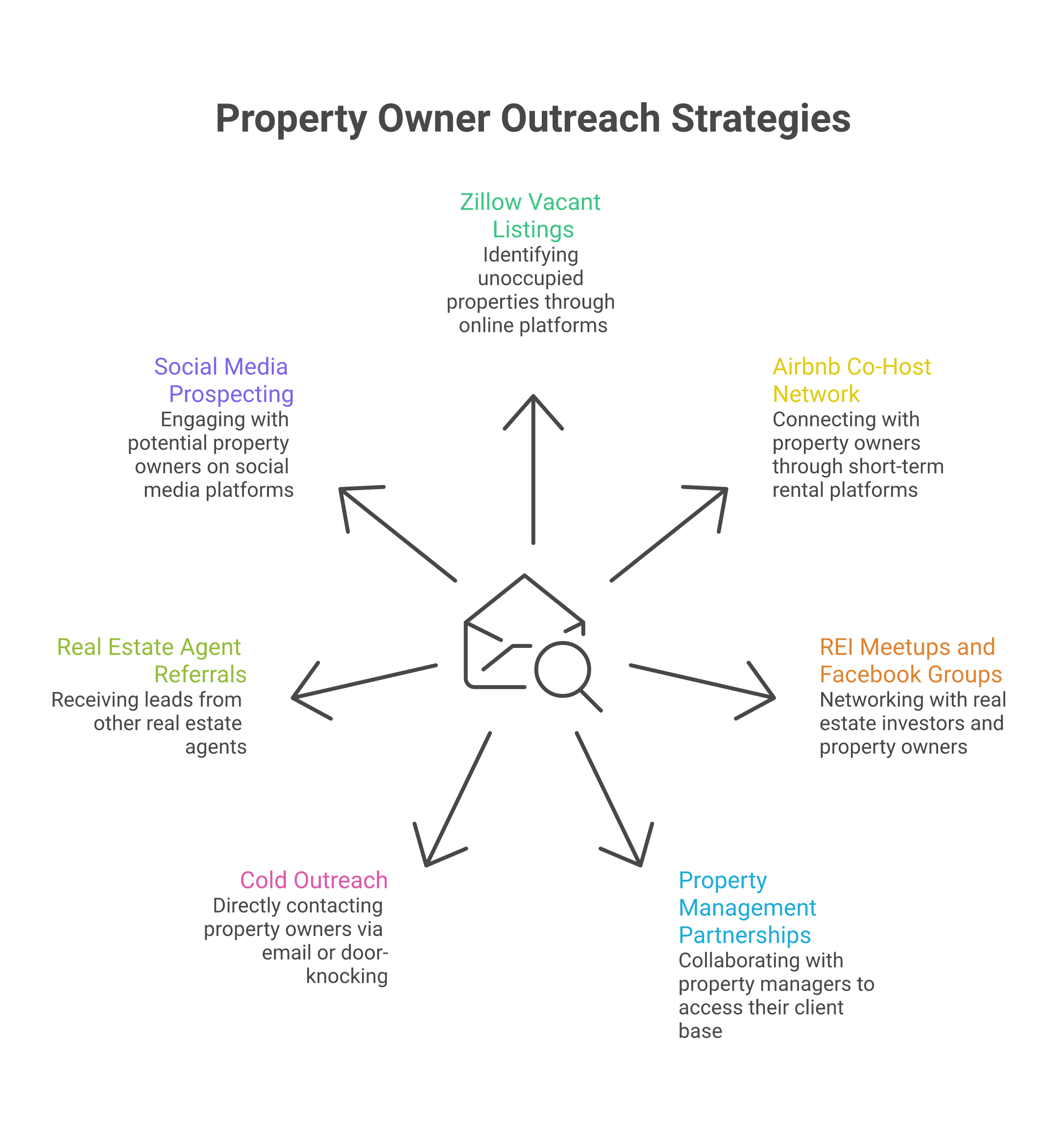
Here are 7 methods that actually work in 2026, ranked by effectiveness and accessibility for people at different stages of their co-listing journey.
Why Finding Property Owners Is the Hardest Part of Co-Listing
Most people who want to start an Airbnb co-listing business get stuck at the same point: finding owners. The irony is painful. Co-listing requires zero property ownership, zero capital investment, and zero mortgage qualification. But it does require one thing you can’t buy: trust from a property owner.
Here’s why this step trips people up:
- Property owners don’t know co-listing exists. The average homeowner has never heard the term. They know about property managers. They know about Airbnb. They don’t know there’s a middle option where someone manages their listing for a percentage split. Your first job isn’t selling. It’s educating.
- The pitch feels awkward. Approaching a stranger and saying “let me manage your home on Airbnb” sounds weird if you’ve never done it before. Most new co-listers overthink this and never send the first message.
- You need credibility before you have a track record. Owners want proof you can deliver. But you can’t prove results without managing a property first. This chicken-and-egg problem kills most co-listing businesses before they start.
- Competition from traditional property managers. Companies like Vacasa, Evolve, and local PMs already have relationships with owners. You’re competing against established brands with hundreds of reviews.
The good news: every successful co-lister solved this exact problem. And the methods below have been tested by thousands of people, including 10XBNB students who’ve built portfolios of 5, 10, even 30+ properties using these approaches.
Method 1: Zillow and Realtor.com Vacant or Stale Listings
This is one of the most underrated methods for finding property owners who need help. The idea is simple: look for properties that are sitting empty or have been listed for sale for months without selling.
What to Look For
Go to Zillow or Realtor.com and search for properties in your target market. Filter for:
- Properties on the market 90+ days. These sellers are frustrated. They’ve been paying a mortgage, taxes, and insurance on a home that won’t sell. They’re open to alternative income streams while they wait.
- Vacant properties. Look for listing photos with no furniture, empty rooms, or descriptions that say “vacant” or “immediate possession.” An empty property is costing the owner money every single day.
- Price reductions. Multiple price cuts signal a motivated seller. If they’ve dropped the price three times in six months, they’re bleeding cash and receptive to creative solutions.
- Second homes or investment properties. Listings described as “great investment opportunity” or “vacation home” indicate owners who already think about their property as an income asset.
How to Find the Owner’s Contact Information
Once you identify a target property, you need the owner’s name and contact details:
- County tax assessor records. Every county maintains public records showing property ownership. Search “[your county] property tax records” and enter the address. You’ll get the owner’s name and often their mailing address.
- Contact the listing agent. Call the real estate agent on the listing. Say: “I run a short-term rental management company, and I’d like to speak with the property owner about an alternative income opportunity while the property is on the market.” Agents are often happy to connect you because a furnished, income-producing property is easier to sell.
- Skip tracing tools. Services like BatchLeads, PropStream, or BeenVerified let you look up owner contact information from just an address. Costs $0.10-0.50 per lookup.
The Approach Script for Stale Listings
Email Template: Vacant Property Owner
Subject: Your [Address] property, a way to cover costs while it’s on the market
Hi [Owner Name],
I noticed your property at [Address] has been on the market for a few months. I manage short-term rental listings in [City] and wanted to reach out with an idea.
I help property owners earn income on Airbnb while their home is for sale (or while it sits between tenants). I handle everything: listing creation, pricing, guest communication, cleaning coordination, and maintenance. You keep full ownership, and we split the revenue.
Properties like yours in [Neighborhood] typically earn $[X] per month on Airbnb based on comparable listings. That’s money that could cover your mortgage, HOA, and utilities while you wait for the right buyer.
Would you be open to a 15-minute call this week to discuss?
Best,
[Your Name]
[Phone Number]
I’ve seen this method work particularly well in markets where home sales have slowed. According to the National Association of Realtors, the median days on market hit 62 in January 2026, up from 55 a year earlier. That means more frustrated sellers, more opportunity for you.
Method 2: Airbnb Co-Host Network
In late 2024, Airbnb launched its official Co-Host Network, a marketplace that connects property owners with experienced local co-hosts. It’s now available in 13 countries including the United States, Canada, Australia, the UK, France, Germany, Italy, Spain, Mexico, Japan, South Korea, Brazil, and Puerto Rico.
How It Works
Property owners browse co-host profiles, review ratings and experience, and reach out directly through the platform. As a co-host on the network, you set your own service offerings and pricing. Airbnb handles the matchmaking.
Eligibility Requirements (Verified March 2026)
To join the Co-Host Network, you need:
- 10+ completed stays OR 3+ stays totaling 100+ nights in the past 12 months
- Average guest rating of 4.8 or higher
- Cancellation rate below 3%
- Response rate above 90% within 24 hours over the past 90 days
- Verified identity with a clear profile photo showing your face
- Account in good standing with no policy violations
The Catch for Beginners
If you’re brand new to Airbnb with zero hosting experience, you can’t join the network yet. You need those 10 stays first. That’s the classic chicken-and-egg problem. Here’s how to solve it:
- Rent a room in your own home. List a spare bedroom, guest suite, or even a couch on Airbnb. Get your 10 stays as quickly as possible. Some people accomplish this in 2-3 months.
- Co-host for a friend or family member. If someone you know has a property, offer to manage it for free or minimal cost. Those stays count toward your eligibility.
- Use the other 6 methods in this guide first. Build your portfolio outside the network, then join once you qualify. The network becomes a lead generation channel on top of your existing business.
Once you’re on the network, your profile rating of 4.7+ keeps you visible in search results. Drop below 4.5, and Airbnb may remove you from the platform entirely.
Method 3: Local Real Estate Investor Meetups and Facebook Groups
Real estate investors are the single best target audience for co-listing pitches. They already think about properties as income-producing assets. They understand ROI. They speak your language.
Where to Find Them
- BiggerPockets local meetups. BiggerPockets.com hosts a meetup directory organized by city. These events draw 20-100 investors, many of whom own rental properties. Search “BiggerPockets events [your city].”
- Facebook Groups. Search for “[City] Real Estate Investors,” “[City] Landlords,” or “[City] Short Term Rental.” Join 3-5 groups and observe for a week before posting. Learn the culture.
- Local REI associations. Most metro areas have a Real Estate Investors Association (REIA). Annual membership runs $100-300. The networking access alone is worth 10x that.
- Meetup.com. Search “real estate investing” in your area. Smaller meetups (10-30 people) often produce better connections than large events because you get more face time.
What to Say at Investor Meetups
Do not walk in and pitch. Nobody wants to be sold at a networking event. Instead:
- Ask questions first. “What kind of properties do you invest in?” “Are any of your rentals underperforming?” “Have you considered short-term rentals?” Genuine curiosity builds rapport faster than any sales script.
- Offer value before asking for anything. Share a data point: “I pulled AirDNA numbers for [neighborhood], and 2-bedroom units are averaging $185 per night at 72% occupancy. That’s about $4,000 per month.” Free information positions you as someone worth talking to.
- Exchange contact info and follow up within 48 hours. Send a brief message referencing your conversation. Attach a one-page PDF showing short-term rental revenue potential for their type of property.
Networking Script: Real Estate Investor Meetup
“Hey, I’m [Name]. I run Airbnb co-listings in [City]. I basically manage the entire short-term rental operation for property owners, and they keep full ownership while we split the revenue. I’m always looking to connect with investors who have properties that might perform better as short-term rentals than long-term. What kind of portfolio do you have?”
The co-listing market is growing fast, and real estate investors are increasingly aware of short-term rental revenue potential. Your timing matters. Show up consistently to the same meetup 3-4 times, and people will remember your name.
Method 4: Property Management Companies Looking to Partner
This one surprises people, but it works. Property management companies are often overwhelmed. A mid-size PM company might manage 200 long-term rentals and have 10-15 owners asking about short-term rental conversions. Most PMs don’t have the systems, pricing tools, or guest communication setup for Airbnb. That gap is your opportunity.
How to Approach Property Managers
- Identify local PMs. Google “[your city] property management company” and make a list of 15-20 companies. Check their Google reviews and portfolio size.
- Call or email the owner/manager. Skip the front desk. Use LinkedIn to find the decision-maker’s name.
- Position yourself as a specialist, not a competitor. You’re not trying to steal their long-term rental clients. You’re offering to handle the short-term rental side they don’t want to deal with.
Email Template: Property Management Partnership
Subject: Handling your STR overflow
Hi [PM Name],
I manage Airbnb co-listings in [City] and work exclusively with property owners who want short-term rental income. I noticed your company focuses on long-term rentals, and I wanted to see if you ever get owners asking about Airbnb.
If that’s something you’ve been turning away, I’d love to set up a referral arrangement. I handle the entire STR operation (listing, pricing, guests, cleaning, maintenance), and I’m happy to send a referral fee your way for every owner you connect me with.
Would a quick call this week make sense?
[Your Name]
The referral fee model is powerful here. Offer 5-10% of your first three months’ management fee for every owner they refer. That turns the PM company into a motivated lead source. I’ve seen co-listers pick up 4-6 properties in a single quarter through one PM partnership.
Method 5: Cold Outreach to Property Owners
Cold outreach gets a bad reputation, but it’s a numbers game that works when done right. The key is volume plus personalization. Generic mass emails get deleted. Personalized messages to the right owners get responses.
Three Cold Outreach Channels
Email Outreach
Build a list of property owners in your target market using county tax records, PropStream, or BatchLeads. Focus on owners who:
- Own 2+ properties (indicates investment mindset)
- Have out-of-state mailing addresses (absentee owners)
- Own properties in vacation or tourist areas
- Recently inherited property (probate records are public)
Send personalized emails referencing the specific property address and neighborhood. Include 2-3 data points about short-term rental income in their area. Expect a 3-5% response rate on well-targeted, personalized cold emails.
Door Knocking
This sounds old-school, but face-to-face contact converts at 5-10x the rate of email. Drive through neighborhoods with vacation-style homes and knock on doors. Look for homes that appear vacant (no cars, overgrown landscaping, accumulated mail).
Door-Knock Script
“Hi, I’m [Name]. I live in the area and manage Airbnb properties for homeowners in [Neighborhood]. I noticed your property looks like it might be sitting empty, and I wanted to see if you’d be interested in earning short-term rental income without any effort on your part. I handle everything from listing to guest checkout, and you keep full ownership. Can I leave you my card with some numbers on what similar homes in the area are earning?”
Leave a professional one-page flyer with your name, phone number, a QR code to your website, and 3 bullet points about what co-listing is. Keep it under 60 seconds at the door unless they invite conversation.
Direct Mail
Send physical letters or postcards to absentee owners. Physical mail stands out because most of your competitors are sending emails or Instagram DMs. A handwritten-looking envelope with a personal letter inside gets opened at rates above 80%, according to direct mail industry data from the Data and Marketing Association.
Send 50-100 pieces per month to a targeted list. Expect 1-3% response rate, but those responses tend to be high-quality, warm leads.
Method 6: Real Estate Agents as Referral Partners
Real estate agents sit on a goldmine of property owner relationships. They know who just bought a second home, who has a property sitting vacant, who’s thinking about renting out their place, and who’s frustrated with their current property manager.
Why Agents Will Work With You
Most agents don’t offer short-term rental management. When a client asks about Airbnb income, the agent has nothing to offer. You solve that problem. And you can make it financially attractive:
- Referral fee. Offer $500-1,000 per signed co-listing agreement that comes through their referral. Or a percentage of monthly revenue for the first 6 months.
- Reciprocal referrals. When your co-listing clients want to buy or sell property, send them to your agent partner. This is a relationship, not a transaction.
- Market data sharing. Provide agents with short-term rental revenue data they can use in their listings. “This property could earn $4,200/month on Airbnb” is a powerful selling point for agents marketing investment properties.
How to Find the Right Agents
- Look for agents who specialize in investment properties. Search Zillow or Realtor.com for agents listing multi-family homes, vacation properties, or properties marketed as “income-producing.”
- Attend open houses. This is free, face-to-face time with agents. Bring business cards. Mention you manage Airbnb co-listings and are looking for referral partners.
- Join your local real estate board’s affiliate program. Many boards allow non-agent affiliates to attend events and access the member directory.
One strong agent partnership can produce 2-3 referrals per quarter. Build relationships with 5 agents, and you may never need another lead source.
Method 7: Social Media Prospecting
Social media lets you attract property owners instead of chasing them. The shift from outbound (cold emails, door knocking) to inbound (owners coming to you) changes your entire business dynamic.
Search location tags and hashtags for your target market: #[City]RealEstate, #VacationRentalOwner, #AirbnbHost. Find accounts belonging to property owners and engage with their content for 1-2 weeks before sending a DM.
When you DM, keep it short:
Instagram DM Template
“Hey [Name], love the property! I manage Airbnb listings in [City] for property owners who want hands-off income. I handle everything from listing to checkout. Would you be open to chatting about what your place could earn as a short-term rental?”
TikTok and YouTube Shorts
Create short-form content showing your process: how you style a listing, how you handle a guest issue, a before/after of a property’s monthly revenue. Content like “How this homeowner went from $0 to $3,800/month on Airbnb” attracts property owners who self-select into your funnel.
You don’t need millions of views. A video with 500 views in your local market can produce 2-3 DMs from interested owners. Local relevance beats viral reach for co-listing lead generation.
LinkedIn is underused for co-listing prospecting, and that’s exactly why it works. Property owners, real estate investors, and second-home buyers are all on the platform. Search for people with “real estate investor,” “property owner,” or “landlord” in their profiles.
Post content about short-term rental performance data, co-hosting income potential, and market trends in your area. LinkedIn organic reach is still strong compared to other platforms. A post with good engagement can reach 5,000+ people even with a small following.
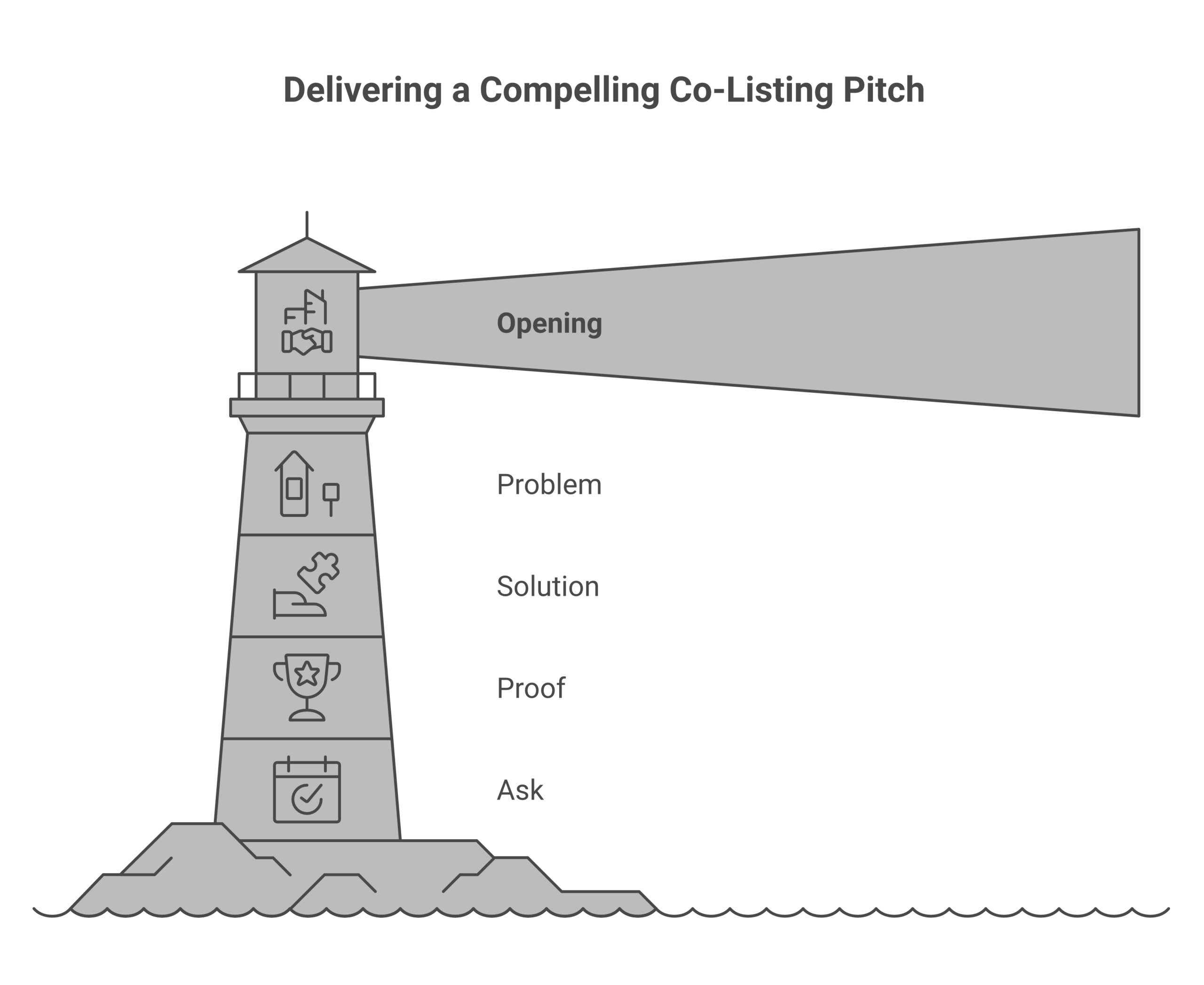
The Co-Listing Pitch: What to Say to Property Owners
Every method above eventually leads to the same moment: you’re talking to a property owner, and you need to explain what co-listing is and why they should trust you. This pitch framework has been refined through hundreds of conversations.
The Core Pitch (Under 60 Seconds)
The 60-Second Co-Listing Pitch
“I help property owners earn income on Airbnb without doing any of the work. Here’s how it works: I create and manage the Airbnb listing for your property. I handle all guest communication, pricing, cleaning coordination, and maintenance issues. You keep full ownership of your home and your Airbnb account. We split the revenue, typically [X]% to you and [Y]% to me. There’s no upfront cost to you, and we sign a simple agreement that either of us can exit with 30 days’ notice. Similar properties in your neighborhood are earning $[amount] per month on Airbnb right now.”
Handling the 4 Most Common Objections
“Why should I trust you with my property?”
This is the biggest concern, and it’s completely valid. Address it head-on:
- Show reviews from your existing Airbnb listings (even if it’s just a spare room you managed)
- Offer a 30-day trial period. “Let’s try it for one month. If you’re not happy with the results or the process, we part ways. No hard feelings, no penalties.”
- Provide references from other property owners you work with
- Mention Airbnb’s $3 million Host Protection Insurance (AirCover for Hosts) that covers property damage
- Sign a clear co-listing agreement that spells out responsibilities, insurance, and termination terms
“I can do it myself.”
They can. And some should. But most won’t do it well or consistently. Your response:
- “You absolutely can. Many owners start that way. The owners I work with usually tried self-managing first and realized it takes 15-20 hours per week to do it right: responding to messages within 5 minutes, coordinating cleaners, adjusting pricing daily, handling guest issues at 2 AM.”
- Frame the math: “If your property earns $5,000 per month, my 20% fee is $1,000. But most owners who self-manage leave 20-30% of potential revenue on the table through poor pricing and slower response times. You might actually net more money with me managing it.”
“What’s your cut?”
Be transparent. Never dodge this question.
- “I typically charge [15-25]% of gross booking revenue. That covers all my time and expertise: listing optimization, dynamic pricing, 24/7 guest support, cleaning coordination, supply restocking, and maintenance oversight.”
- Compare to traditional property managers who charge 25-50% for vacation rentals, plus extra fees for onboarding, maintenance markup, and early termination
- Emphasize: no upfront costs, no hidden fees, you only earn when they earn
“What if guests damage my property?”
- Airbnb’s AirCover for Hosts provides up to $3 million in damage protection
- You screen all guests before accepting bookings (check reviews, response patterns, booking purpose)
- Security deposits and damage waivers add another layer
- Your cleaning team inspects the property after every checkout and documents any issues immediately
- Offer to carry additional short-term rental insurance through providers like Proper or CBIZ
Common Mistakes When Approaching Property Owners
I’ve watched new co-listers make these errors repeatedly. Each one kills deals that should have closed.
1. Leading With Your Needs Instead of Theirs
“I’m looking for properties to manage” centers the conversation on you. Owners don’t care about your business goals. Flip it: “I help property owners earn $3,000-5,000 per month on Airbnb without lifting a finger.” Now it’s about them.
2. Being Vague About Numbers
If you can’t tell a property owner what their specific property could earn, you’re not ready to pitch. Run the numbers before every conversation. Use AirDNA, Mashvisor, or Rabbu to pull comparable revenue data. Show them: “Three-bedroom homes within a mile of your property averaged $4,100 per month at 68% occupancy over the past 12 months.”
3. Skipping the Agreement
A handshake deal is a lawsuit waiting to happen. Always use a written co-listing agreement that covers revenue split, responsibilities, insurance, termination terms, and dispute resolution. This protects both parties and signals professionalism.
4. Pitching Before Building Rapport
Cold pitching without any relationship building produces terrible conversion rates. At networking events, spend 80% of your time asking questions and 20% talking about yourself. On social media, engage with someone’s content for 1-2 weeks before sending a pitch DM. People do business with people they like.
5. Not Following Up
80% of deals close after the fifth follow-up, but most people stop after one. Set a follow-up cadence: Day 1 (initial contact), Day 3 (follow-up), Day 7 (value-add, share a relevant article or market data), Day 14 (final check-in). Use a simple CRM or spreadsheet to track every conversation.
6. Targeting the Wrong Owners
Owner-occupied primary residences are almost never good co-listing targets. Focus on: absentee owners, second-home owners, inherited property owners, investors with underperforming rentals, and owners with stale real estate listings. These people have a problem you can solve.
Putting It All Together: Your 30-Day Action Plan
Here’s a practical timeline for landing your first co-listing agreement:
Week 1: Research your market. Pull AirDNA data for your target area. Identify 50 potential properties using Zillow stale listings and county tax records. Join 3 local Facebook groups and 1 BiggerPockets meetup.
Week 2: Send 25 personalized emails to absentee owners and stale listing owners. Attend one networking event. Start posting content on one social media platform.
Week 3: Follow up on all Week 2 outreach. Send 25 more emails. Contact 5 local property management companies about referral partnerships. Reach out to 3 real estate agents who focus on investment properties.
Week 4: Follow up again on all leads. Schedule property walk-throughs with any interested owners. Prepare your co-listing agreement and revenue projections for each specific property.
If you execute this plan consistently, you should have 2-5 serious conversations with property owners by the end of month one. The co-listing market is growing, and owners are increasingly open to this model. But they won’t find you. You have to find them.
For a complete training program that walks you through every step, from finding your first property owner to building a full co-listing portfolio, check out the free Airbnb co-listing training. It covers the exact systems and scripts that have helped 1,600+ students become successful co-hosts.
Frequently Asked Questions
How many property owners do I need to contact before getting a co-listing agreement?
Plan on reaching out to 50-100 owners to land your first agreement. Cold email converts at 3-5%, networking converts at 10-15%, and referrals convert at 20-30%. The more channels you use simultaneously, the faster you’ll sign your first deal. Most 10XBNB students report landing their first property within 30-60 days of consistent outreach.
Do I need a real estate license to co-list on Airbnb?
In most U.S. states, co-listing (also called co-hosting) does not require a real estate license because you’re managing a short-term rental, not brokering a sale or lease. However, some states and cities have specific property management licensing requirements. Check your local regulations before starting. A few states like Florida and Oregon have stricter rules around short-term rental management.
What percentage should I charge property owners for co-listing?
The standard range is 15-25% of gross booking revenue. Newer co-listers often start at 20% to be competitive. As you build a track record and can demonstrate higher occupancy and revenue, you can move toward 25%. Full-service traditional property managers charge 25-50%, so co-listing fees are significantly lower, which is a strong selling point. Learn more about co-hosting income potential.
Can I co-list properties in a different city or state from where I live?
Yes, remote co-listing is possible, but it requires strong local systems: a reliable cleaning team, a handyman on call, and possibly a local boots-on-the-ground contact. Most successful remote co-listers start with properties within a 2-hour drive, then expand as their systems mature. The best co-hosting courses teach specific remote management frameworks.
What if a property owner wants to cancel our agreement?
Build a 30-day termination clause into every co-listing agreement. This protects both parties. If an owner wants out, honor the agreement terms, complete any active guest bookings, and leave the listing in good shape. A professional exit can lead to referrals. Owners talk to each other, and your reputation matters more than any single deal.
How do I co-list without any Airbnb experience?
Start by listing a room in your own home, even temporarily. This gives you actual hosting experience, guest reviews, and Superhost progress. Once you have 10+ stays, you’ll qualify for the Airbnb Co-Host Network and have real data to show property owners. Alternatively, offer to manage a friend or family member’s property for free to build your first case study.
Should I focus on one method or try all seven at once?
Start with 2-3 methods that match your strengths. If you’re comfortable with face-to-face conversations, prioritize networking events and door knocking. If you prefer digital outreach, focus on cold email and social media prospecting. Once you’re consistently executing 2-3 methods, add more channels. Spreading yourself across all 7 from day one usually means doing all of them poorly.
What tools do I need to research property revenue potential before pitching owners?
AirDNA ($20-50/month) is the most popular tool for short-term rental market data, including average daily rates, occupancy, and revenue by property type. Mashvisor and Rabbu offer similar data at different price points. At minimum, search active Airbnb listings in the area and manually calculate average nightly rates multiplied by estimated occupancy. Free options include checking PriceLabs market reports and browsing comparable listings directly on Airbnb.