



Looking to start or scale a profitable Airbnb business? Location isn’t just important—it’s everything. The difference between a property that generates $3,000 per month and one that barely covers your mortgage often comes down to the state for short term rental you choose. In 2026, the gap between high-performing and struggling markets has never been wider. States like Florida and Tennessee are seeing average daily rates (ADR) of $200-350 with 70%+ occupancy rates, while overly regulated markets like certain California cities struggle to break even after compliance costs. This guide analyzes all 50 states based on real market data, regulatory environments, tax structures, and profitability potential to help you make the smartest decision for your short-term rental business.
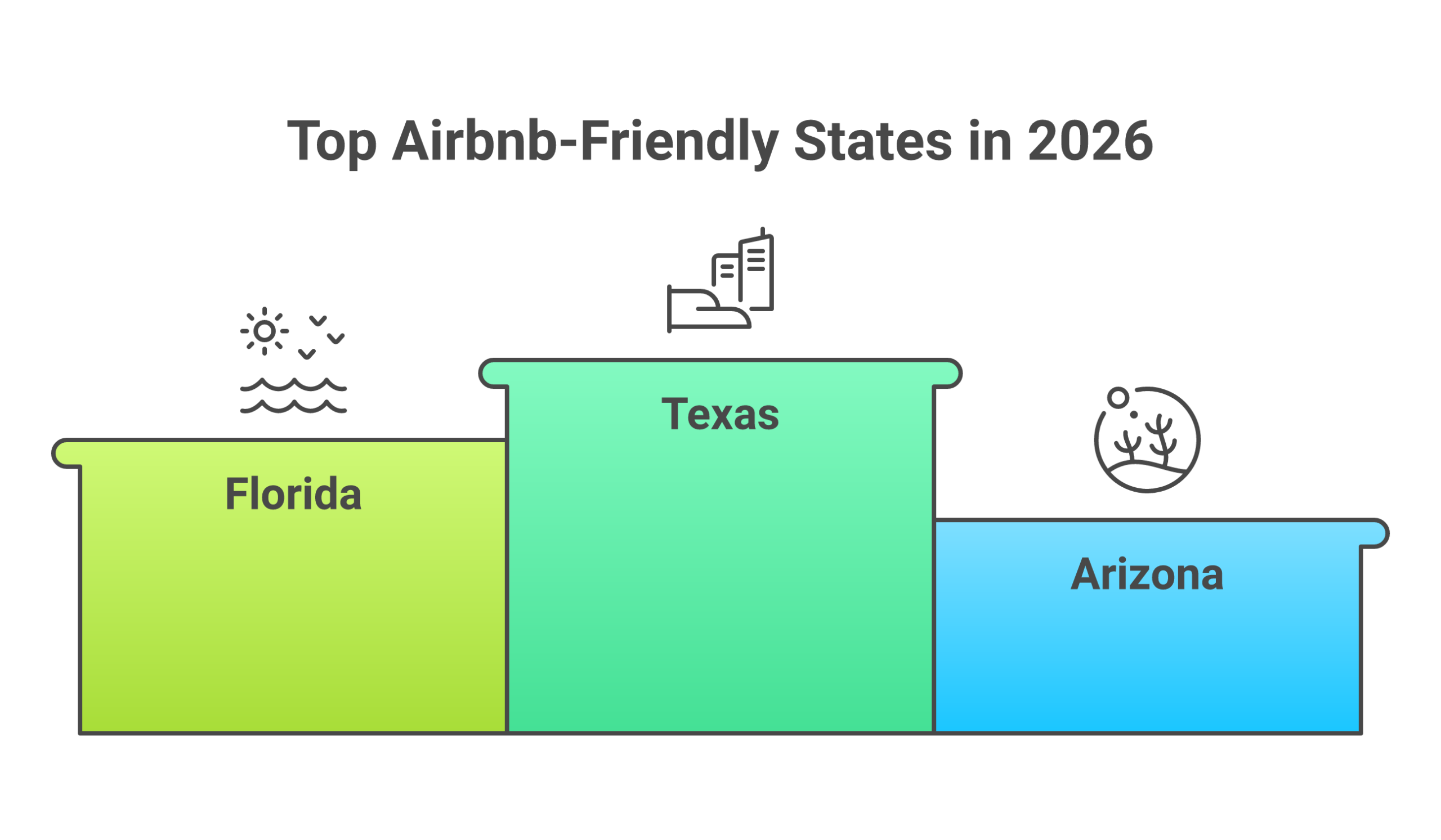
How We Ranked the Best States for Airbnb
We didn’t rank these states based on gut feeling or random listicles. Our methodology combines five critical factors that directly impact your bottom line. First, regulatory environment—states with clear, reasonable short-term rental laws and regulations make it easier to operate legally without drowning in permit fees and compliance costs. Second, average daily rates (ADR)—higher ADRs mean more revenue per booking. Third, occupancy rates—consistent demand keeps your calendar full year-round. Fourth, tax burden—state income tax, occupancy taxes, and lodging fees can eat 15-25% of your gross revenue in some markets. Finally, startup costs—whether you’re doing rental arbitrage or buying property, some states let you get started with $5,000-10,000 while others require $50,000+ just to meet minimum standards.
We pulled data from AirDNA, AllTheRooms, state tourism boards, and real hosts operating in these markets. The rankings reflect what’s actually working in 2026, not what worked three years ago. Markets shift. Regulations change. What matters is where the opportunity exists right now.
The 10 Best States for Airbnb in 2026
1. Florida
Florida dominates the short-term rental landscape for a reason. The state has no income tax, which means you keep more of your profits. Tourist demand is relentless—Orlando pulls 75 million visitors annually, Miami draws international travelers year-round, and Gulf Coast beach towns like Destin and Clearwater maintain 75-80% occupancy even in shoulder seasons. Average daily rates range from $180 in smaller markets to $400+ in luxury Miami and Sarasota properties. The regulatory environment is relatively friendly compared to states like California or New York. Most cities require a business tax receipt and vacation rental license, but the process is straightforward and affordable ($50-300 in most cases).
Orlando is the undisputed king for rental arbitrage—thousands of hosts are running profitable arbitrage operations near Disney, Universal, and the theme park corridor. Tampa, Jacksonville, Fort Lauderdale, and the Keys all offer strong markets with different niches. If you want consistent, year-round cash flow with minimal seasonal dips, Florida is hard to beat. Learn more on our dedicated Florida page.
2. Tennessee
Tennessee has emerged as one of the hottest Airbnb markets in the country, and it’s not slowing down. Nashville and the Smoky Mountains drive most of the action. Nashville’s tourism industry grew 40% between 2019 and 2024, fueled by bachelorette parties, music festivals, and corporate events. ADRs in downtown Nashville regularly hit $250-400, and properties near Broadway or The Gulch stay booked 25+ nights per month. Gatlinburg and Pigeon Forge—gateway cities to Great Smoky Mountains National Park—are absolute cash cows for cabin rentals. Three-bedroom cabins with hot tubs and mountain views pull $300-500 per night with 70-85% annual occupancy.
Tennessee has no state income tax, and while some cities charge higher occupancy taxes (Nashville’s combined lodging tax is around 15.25%), the revenue more than compensates. Chattanooga, Knoxville, and Memphis are emerging secondary markets worth watching. Regulations vary by city but are generally manageable—most require a short-term rental permit and business license. Check out our full breakdown on the Tennessee page.
3. Texas
Texas offers something most states can’t: massive cities with explosive growth and no state income tax. Austin, San Antonio, Dallas, and Houston are all top-tier Airbnb markets with distinct advantages. Austin’s tech boom and festival culture (SXSW, ACL) drive premium ADRs ($200-350) and year-round demand. San Antonio benefits from the River Walk, the Alamo, and strong convention business. Dallas and Houston both have corporate travel demand that keeps occupancy steady during weekdays, while weekend leisure travel fills gaps.
The regulatory landscape in Texas is mostly friendly. Austin tightened rules in recent years—requiring a license and limiting certain types of short-term rentals in residential zones—but most hosts adapt without issue. San Antonio and Dallas have simpler requirements. Smaller Texas markets like Fredericksburg, Marfa, and South Padre Island are niche goldmines for the right property type. If you’re looking for a state where you can scale to multiple properties without getting crushed by taxes, Texas delivers. More details on our Texas page.
4. Arizona
Arizona is a year-round powerhouse, especially for seasonal arbitrage strategies. Phoenix and Scottsdale become winter havens for snowbirds from November through April, driving ADRs to $200-400 for well-furnished homes with pools. Tucson and Sedona offer similar seasonal spikes. Sedona’s red rock tourism keeps properties booked 70-80% of the year with ADRs often exceeding $350. Flagstaff attracts summer travelers escaping the desert heat and winter snow sports enthusiasts.
Arizona passed a state law in 2016 (SB 1350) that protects short-term rental rights, preventing cities from outright bans. Some municipalities still impose restrictions (like Sedona’s lottery system for new permits), but overall the state for short term rental is more permissive than most. There’s no state income tax, and property costs—while rising—are still more affordable than California or Hawaii. If you know how to market to seasonal demand and optimize pricing, Arizona is incredibly profitable. See our Arizona page for city-by-city analysis.
5. Colorado
Colorado is a four-season market with two major revenue drivers: ski season and summer tourism. Denver is a strong urban Airbnb market with convention traffic, Broncos games, and Red Rocks concerts keeping properties full year-round. But the real money is in the mountains. Breckenridge, Vail, Aspen, Telluride, and Steamboat Springs see ADRs of $400-800+ during peak ski season (December-March). Even smaller ski towns like Crested Butte and Winter Park pull $300-500 per night. Summer brings hikers, mountain bikers, and families escaping heat, maintaining 60-70% occupancy June through September.
Colorado regulations vary significantly by county and municipality. Summit County (Breckenridge, Keystone, Frisco) requires licenses and caps the number of permits in some areas. Denver has a licensing process but it’s relatively straightforward. Short-term rental taxes and fees can add up—expect to pay occupancy taxes, lodging taxes, and in some cases, county-specific fees. Despite the regulatory complexity, the revenue potential justifies the effort. Our Colorado page covers the licensing process for major markets.
6. California
California is a tale of two markets. On one hand, it has some of the strictest short-term rental regulations in the country—Los Angeles limits hosts to primary residences only, San Francisco has a 90-day annual cap for non-primary residences, and coastal cities impose hefty TOT (transient occupancy taxes) of 10-15%. On the other hand, California also has unmatched demand. San Diego, Lake Tahoe, Big Sur, Palm Springs, Santa Barbara, and Napa Valley all command ADRs of $300-600+ with strong occupancy when you can legally operate.
If you’re willing to navigate the regulations—and many successful hosts do—California offers premium revenue. Palm Springs and Joshua Tree are particularly hot for unique, design-forward properties. Wine country (Napa, Sonoma, Paso Robles) attracts high-spending guests year-round. Lake Tahoe is a ski and summer lake destination with incredible ADR potential. The key is doing your homework on local ordinances before you commit to a property. Our California page breaks down which cities are friendly and which are minefields.
7. Hawaii
Hawaii is one of the most profitable—and most regulated—Airbnb markets in the United States. Maui, Oahu, Kauai, and the Big Island all have massive tourism demand, with ADRs ranging from $250 to $600+ depending on location and property type. Beachfront properties and luxury homes in resort areas can easily exceed $1,000 per night during peak season. Occupancy rates stay high year-round thanks to consistent domestic and international travel.
The catch? Hawaii has some of the toughest short-term rental laws and regulations in the nation. Honolulu effectively banned new short-term rental permits in most residential zones, and existing permits are grandfathered and incredibly valuable. Maui recently passed stricter regulations limiting short-term rentals in certain areas. If you already own property in Hawaii or can acquire one with an existing permit, it’s a goldmine. Starting from scratch in 2026 is much harder. Check our Hawaii page for county-by-county rules.
8. New York
New York is a complicated but lucrative market. New York City has strict short-term rental laws—Local Law 18 requires hosts to be present during stays, and most apartments cannot be rented for less than 30 days. That said, the law applies specifically to NYC. Upstate New York, the Catskills, Hudson Valley, the Finger Lakes, and Long Island are thriving short-term rental markets with far fewer restrictions.
The Catskills and Hudson Valley have become weekend escape havens for NYC residents, driving ADRs of $250-450 for charming farmhouses, cabins, and renovated properties. Saratoga Springs, Lake George, and the Adirondacks see strong summer and fall tourism. Buffalo and Rochester offer affordable entry points for arbitrage with steady corporate and university demand. If you avoid NYC proper and focus on the rest of the state, New York offers serious profitability. Our New York page details which regions are open for business.
9. Georgia
Georgia is anchored by Atlanta, one of the most underrated Airbnb markets in the South. Atlanta has year-round corporate travel, convention business, concerts, and sporting events that keep occupancy above 65% with ADRs around $150-250. The city’s short-term rental regulations require a license and limit rentals to primary residences in some zones, but enforcement is inconsistent and many hosts operate successfully.
Beyond Atlanta, Savannah is a boutique tourism powerhouse. Historic homes and properties near Forsyth Park and River Street command $200-400 per night, especially during peak tourist seasons (spring and fall). The Georgia mountains—Blue Ridge, Helen, Dahlonega—are rising cabin rental markets with strong weekend demand from Atlanta and Charlotte residents. Georgia has a relatively low cost of living, reasonable property prices, and growing tourism infrastructure. See our Georgia page for market-specific insights.
10. North Carolina
North Carolina rounds out the top 10 with diverse markets spanning the coast, mountains, and cities. The Outer Banks are a legendary summer vacation destination with beach houses pulling $300-600 per night and 80-90% occupancy from Memorial Day through Labor Day. Asheville has exploded as a year-round destination—its artsy vibe, craft breweries, and proximity to the Blue Ridge Parkway drive ADRs of $200-350 with solid occupancy. Charlotte offers corporate and event-driven demand, while Wilmington’s coastal charm attracts beach-goers and film industry professionals.
North Carolina regulations are generally reasonable. Asheville requires a permit, and some mountain counties have zoning restrictions, but most areas are manageable. The state’s mix of affordable property costs, tourism diversity, and business-friendly environment makes it a smart choice for hosts looking to avoid regulatory headaches while still capturing strong returns. Learn more on our North Carolina page.
Not Sure Which State Fits Your Budget and Goals?
Choosing the right state depends on your capital, risk tolerance, and whether you’re doing arbitrage or ownership. Our team has helped students launch in all 50 states and can match you with a market that fits your situation.
States to Watch in 2026
Not every market is mature. Some states are just beginning to unlock their short-term rental potential, and early movers can capture outsized returns before competition heats up. Here are five emerging markets worth serious attention:
Alabama – Gulf Shores and Orange Beach are underrated coastal markets with growing ADRs ($180-300) and occupancy rivaling Florida’s Panhandle. Birmingham is seeing an uptick in urban Airbnb demand tied to UAB medical tourism and business travel. Alabama has minimal short-term rental regulations and low startup costs.
Mississippi – The Mississippi Gulf Coast (Biloxi, Gulfport) is quietly thriving with casino tourism, fishing charters, and beach access. ADRs are lower ($120-200) but so are property costs and competition. Oxford (home of Ole Miss) has strong football weekend demand with potential for year-round student and parent bookings.
Arkansas – Hot Springs, Eureka Springs, and the Buffalo National River area are gaining traction as outdoor recreation and wellness destinations. ADRs are climbing ($150-250), and regulations remain relaxed. Little Rock offers affordable urban arbitrage opportunities.
Montana – Glacier National Park, Yellowstone’s northern gateway (Bozeman, West Yellowstone), and Missoula are all seeing surging tourism demand. Summer ADRs hit $250-400, and ski towns like Whitefish are developing winter markets. Montana has wide-open regulatory space in most counties.
Idaho – Boise’s tech-driven growth has created urban Airbnb demand, while Sun Valley, McCall, and Coeur d’Alene attract outdoor enthusiasts year-round. ADRs are rising ($180-350 depending on market), and Idaho’s low cost of living and property prices make entry accessible. Regulations are still forming, giving early operators an advantage.
States with the Strictest Airbnb Regulations
Not every state makes it easy to run a short-term rental. Some have imposed regulations so restrictive that profitability becomes nearly impossible—or at least, requires serious legal maneuvering. If you’re considering these states, proceed with caution and do your homework before signing any leases or purchasing property.
New York (New York City) – Local Law 18 effectively killed most short-term rentals under 30 days unless the host is present. Enforcement is aggressive, fines are steep, and the risk isn’t worth it for most operators. Upstate New York is fine; NYC is a no-go for traditional Airbnb models.
Hawaii (Honolulu) – Honolulu banned new short-term rental permits in most residential zones. Existing permits are grandfathered but non-transferable. Maui and other counties have tightened rules significantly. If you don’t already have a legal permit, starting fresh in Hawaii is incredibly difficult.
California (Los Angeles, San Francisco, Santa Monica) – Los Angeles limits short-term rentals to primary residences and caps annual rental days. San Francisco has a 90-day annual cap for non-primary residences and hefty registration requirements. Santa Monica essentially banned vacation rentals except for hosted stays. Other California cities (San Diego, Palm Springs) are more permissive, but you must research city-by-city.
These markets aren’t impossible, but they require legal compliance, higher risk tolerance, and often, property ownership rather than arbitrage. For most hosts, especially beginners, there are far easier states to build a profitable business. Check each state for Airbnb’s dedicated page for full regulatory breakdowns.
Tax Implications by State
Taxes can make or break your Airbnb profitability. A property generating $50,000 in gross revenue might net you $35,000 in Florida (no state income tax) but only $28,000 in California (state income tax up to 13.3%) after factoring in all tax obligations. Here’s what you need to know:
| State | State Income Tax | Typical Occupancy/Lodging Tax | Overall Tax Burden |
|---|---|---|---|
| Florida | 0% | 6-13% (state + local) | Low |
| Tennessee | 0% | 8-15.25% (Nashville higher) | Low-Medium |
| Texas | 0% | 6-17% (varies by city) | Low-Medium |
| California | 1-13.3% (progressive) | 10-15% TOT | High |
| Colorado | 4.4% flat | 8-12% (mountain towns higher) | Medium |
| New York | 4-10.9% (progressive) | 4-14.75% (NYC higher) | High |
Occupancy and lodging taxes are collected by the platform (Airbnb, Vrbo) in most states and remitted on your behalf. However, you’re still responsible for understanding your obligations and ensuring compliance. Some cities require you to register separately and file quarterly or annual reports.
State income tax applies to your net Airbnb income (revenue minus expenses). States like Florida, Texas, Tennessee, Nevada, and Washington have no state income tax, which significantly boosts your take-home profit. States like California, New York, and Hawaii take a substantial cut—factor this into your projections before choosing a market.
You’ll also owe federal income tax on your Airbnb earnings. The benefit? You can deduct mortgage interest (if you own), property management fees, cleaning costs, furniture, utilities, and depreciation. Work with a tax professional who understands short-term rental accounting to maximize deductions and avoid surprises. For more on costs and planning, see our guide on rental arbitrage startup costs.
How to Choose the Right State for Your Airbnb Business
Picking a state isn’t just about which one ranks highest on a list. You need to match the market to your strategy, budget, and goals. Here’s a decision framework to guide you:
Are you doing rental arbitrage or buying property? If you’re doing rental arbitrage, you need landlord-friendly states with clear lease laws and minimal regulatory barriers. Florida, Tennessee, and Texas are top choices. If you’re buying property, you can afford to enter tougher regulatory markets (California, Colorado, Hawaii) because you own the asset and can wait out policy shifts or pivots to medium-term rentals.
What’s your budget? Startup costs vary wildly. You can launch a rental arbitrage operation in Orlando or Nashville for $5,000-10,000 (first month, last month, security deposit, furnishings). Buying a property in Aspen or Honolulu requires $500,000-2,000,000+. Be realistic about what you can afford and choose states where your capital can actually compete.
Do you want seasonal or year-round demand? Beach and ski markets are seasonal cash cows but require smart pricing and marketing to fill shoulder seasons. Year-round markets (Orlando, Austin, Nashville, Denver) offer more predictable revenue but often have higher competition. Decide whether you want to manage seasonality or prefer steadier cash flow.
Are you managing remotely or locally? If you’re managing remotely, you need a market with reliable co-hosting services, cleaning crews, and maintenance vendors. Established markets (Florida, Tennessee, Colorado) have robust service ecosystems. Emerging markets (Mississippi, Arkansas, Montana) might require you to build vendor relationships from scratch or manage more hands-on.
What’s your risk tolerance? High-regulation states (California, Hawaii, New York City) carry more legal risk—fines, shutdowns, permit denials. Low-regulation states (Florida, Texas, Arizona) are safer but may have more competition. Match your risk tolerance to the regulatory environment.
Complete State-by-State Directory
Below is a full directory of all 50 states, organized by region. Each state links to a dedicated page with in-depth analysis of regulations, best cities, ADRs, occupancy data, and profitability strategies. Use this as your roadmap to explore markets that fit your goals.
Southeast
Alabama – Gulf Shores and Orange Beach offer affordable coastal markets with rising demand. Birmingham is developing urban Airbnb potential.
Arkansas – Hot Springs, Eureka Springs, and Buffalo National River attract outdoor and wellness tourists. Low competition, relaxed regulations.
Florida – The undisputed king of short-term rentals. Orlando, Miami, Tampa, Destin, and the Keys dominate with year-round tourism and no state income tax.
Georgia – Atlanta offers urban demand, Savannah delivers boutique tourism, and the North Georgia mountains are rising cabin rental markets.
Kentucky – Louisville (Derby season), Lexington (horse country), and Red River Gorge (outdoor recreation) are niche opportunities with growing demand.
Louisiana – New Orleans is a festival and tourism powerhouse with premium ADRs. Baton Rouge and Lafayette offer secondary markets.
Mississippi – Biloxi and Gulfport benefit from casino tourism and beach access. Oxford thrives during football season.
North Carolina – Outer Banks, Asheville, Charlotte, and Wilmington offer diverse coastal, mountain, and urban markets with strong performance.
South Carolina – Myrtle Beach, Charleston, and Hilton Head are established vacation rental markets with high summer occupancy.
Tennessee – Nashville and the Smoky Mountains lead the charge. Chattanooga and Memphis are emerging. No state income tax.
Virginia – Virginia Beach, Richmond, and Shenandoah offer coastal and mountain tourism. Charlottesville is a boutique market near wineries.
West Virginia – New River Gorge National Park and ski resorts are driving outdoor recreation demand in previously overlooked markets.
Northeast
Connecticut – Mystic, New Haven, and the Litchfield Hills attract weekend travelers from NYC and Boston. Strict regulations in some towns.
Delaware – Rehoboth Beach and Dewey Beach are popular summer coastal destinations. Dover offers corporate and NASCAR event demand.
Maine – Portland, Bar Harbor, and Acadia National Park drive strong summer and fall tourism. Seasonal but highly profitable.
Maryland – Ocean City is a major beach rental market. Baltimore and Annapolis offer urban and waterfront opportunities.
Massachusetts – Boston has strict regulations, but Cape Cod, Martha’s Vineyard, and the Berkshires are thriving seasonal markets.
New Hampshire – White Mountains and Lake Winnipesaukee attract outdoor enthusiasts. Portsmouth offers coastal charm. No state income tax.
New Jersey – Jersey Shore (Seaside Heights, Cape May) is a major summer rental market. Proximity to NYC drives weekend demand.
New York – NYC is heavily restricted, but the Catskills, Hudson Valley, Finger Lakes, and Adirondacks are thriving short-term rental markets.
Pennsylvania – Philadelphia, Pittsburgh, and the Pocono Mountains offer urban and outdoor rental opportunities. Gettysburg attracts history tourists.
Rhode Island – Newport, Block Island, and Providence offer coastal and urban markets with seasonal summer peaks.
Vermont – Stowe, Killington, and Burlington are ski and fall foliage destinations with premium ADRs during peak seasons.
Midwest
Illinois – Chicago dominates with urban Airbnb demand. Galena and Starved Rock are weekend getaway markets.
Indiana – Indianapolis offers event-driven demand (Indy 500, conventions). Bloomington and Brown County attract outdoor tourists.
Iowa – Des Moines and Iowa City have modest urban demand. The Loess Hills and Amana Colonies are niche rural markets.
Kansas – Wichita and Kansas City offer affordable urban arbitrage opportunities. Flint Hills attract nature tourists.
Michigan – Traverse City, Mackinac Island, and the Upper Peninsula are strong seasonal markets. Detroit is developing urban potential.
Minnesota – Minneapolis offers urban demand. Duluth and the North Shore attract summer tourists. Brainerd Lakes is a cabin rental hub.
Missouri – Kansas City, St. Louis, and Branson offer diverse urban and entertainment tourism markets.
Nebraska – Omaha and Lincoln have modest demand. The Sandhills are emerging for rural and outdoor rentals.
North Dakota – Fargo and Bismarck have limited but steady corporate and event demand. Theodore Roosevelt National Park is a niche opportunity.
Ohio – Cleveland, Columbus, and Cincinnati offer affordable urban markets. Hocking Hills attracts outdoor and cabin rental tourists.
South Dakota – Rapid City and the Black Hills (Mount Rushmore, Badlands) drive strong summer tourism. Deadwood offers casino demand.
Wisconsin – Milwaukee and Madison offer urban markets. Wisconsin Dells, Door County, and the Northwoods are seasonal vacation rental hubs.
West
Alaska – Anchorage, Juneau, and Denali attract summer cruise ship and adventure tourists. High ADRs but short season.
California – Strict regulations in LA, SF, and Santa Monica, but San Diego, Palm Springs, Lake Tahoe, and Napa Valley offer premium profitability.
Colorado – Denver, Boulder, and mountain ski towns (Breckenridge, Vail, Aspen) are four-season powerhouses with high ADRs.
Hawaii – Maui, Oahu, Kauai, and the Big Island offer incredible ADRs but strict regulations. Existing permits are valuable; new entrants face barriers.
Idaho – Boise, Sun Valley, McCall, and Coeur d’Alene are rising markets with outdoor recreation and tech-driven demand.
Montana – Bozeman, Whitefish, and Glacier/Yellowstone gateways attract outdoor tourists. Strong summer ADRs, emerging winter markets.
Nevada – Las Vegas dominates with event and convention tourism. Reno and Lake Tahoe offer secondary markets. No state income tax.
Oregon – Portland, Bend, and the Oregon Coast attract urban and outdoor tourists. Stricter regulations in Portland, more relaxed elsewhere.
Utah – Salt Lake City, Park City, and southern Utah (Moab, Zion, Bryce Canyon) are year-round destinations with ski and outdoor tourism.
Washington – Seattle has restrictive rules, but the San Juan Islands, Leavenworth, and eastern Washington offer strong markets. No state income tax.
Wyoming – Jackson Hole and Yellowstone gateways command premium ADRs. Seasonal but incredibly profitable for the right properties.
Southwest
Arizona – Phoenix, Scottsdale, Sedona, and Flagstaff are year-round markets with strong seasonal demand and favorable regulations.
New Mexico – Santa Fe, Albuquerque, and Taos attract cultural and outdoor tourists. Affordable entry points with rising demand.
Oklahoma – Oklahoma City and Tulsa offer affordable urban arbitrage. Turner Falls and Medicine Park are emerging weekend getaway markets.
Texas – Austin, San Antonio, Dallas, and Houston lead. No state income tax. Strong growth, diverse markets, manageable regulations.
City-Level Rental Arbitrage Guides
For detailed market analysis at the city level, explore our complete rental arbitrage guides. Each covers local regulations, top neighborhoods, revenue benchmarks, and landlord pitch strategies.
Southeast: Nashville | Atlanta | Charlotte | Asheville | Raleigh | Myrtle Beach | Gulf Shores
Florida: Tampa | Miami | Orlando | Jacksonville | Destin
Texas: Austin | San Antonio | Dallas | Houston
West: Phoenix | Scottsdale | Denver | San Diego | Portland | Seattle
Tennessee: Gatlinburg | Pigeon Forge
Midwest: Columbus
Use our free rental arbitrage calculator to run the numbers for any market, and see the full city rankings for an overview of all 25 markets.
Frequently Asked Questions
Which state is most profitable for Airbnb?
Florida consistently ranks as the most profitable state for Airbnb due to year-round tourism, no state income tax, relatively friendly regulations, and high average daily rates in markets like Orlando, Miami, and Destin. Tennessee is a close second, especially in Nashville and the Smoky Mountains, where ADRs and occupancy rates rival or exceed Florida’s top markets.
What states have no restrictions on short-term rentals?
No state is completely restriction-free, but some have minimal statewide regulations and leave decisions to local municipalities. Arizona, Texas, Florida, and Tennessee are among the most permissive states overall. Always check city and county ordinances—even in permissive states, individual cities may impose licensing requirements or zoning restrictions.
Is Airbnb arbitrage legal in all states?
Airbnb arbitrage (renting a property and subletting it as a short-term rental) is legal in most states, but legality depends on local regulations and your lease agreement. Some cities ban or heavily restrict short-term rentals in residential zones, and many landlords prohibit subleasing. Always get written permission from your landlord and verify local STR laws before starting arbitrage. For more details, check out our full guide on rental arbitrage.
How much do Airbnbs make per month on average?
Average monthly revenue varies dramatically by state and city. High-performing markets like Orlando, Nashville, and Scottsdale can generate $3,000-6,000+ per month for well-managed properties. Lower-demand markets might average $1,500-2,500 per month. Your revenue depends on ADR, occupancy rate, seasonality, and operating costs. Properties in premium locations with strong marketing and dynamic pricing consistently outperform average benchmarks.
What’s the cheapest state to start an Airbnb business?
States with low property costs and minimal regulatory barriers are the cheapest to enter. Alabama, Mississippi, Arkansas, and Oklahoma offer affordable real estate and low startup costs for arbitrage. In more competitive markets, Florida and Tennessee allow you to start arbitrage operations for $5,000-10,000 in initial capital if you choose the right neighborhoods and negotiate favorable lease terms.
Do I need insurance for my Airbnb?
Yes. Standard homeowners or renters insurance typically excludes short-term rental activity. You need either a dedicated short-term rental insurance policy or a commercial policy that covers STR operations. Airbnb provides Host Protection Insurance (liability coverage up to $1 million), but it doesn’t cover property damage or lost income. For full protection, invest in proper STR insurance. Learn more in our guide: Does Insurance Cover Airbnb?
Ready to Pick Your State and Launch?
Watch the free training to see how students choose their market, analyze deals, and secure their first property in 30-60 days. You’ll get a clear action plan for whatever state you pick.
Final Thoughts: Choose Your State Strategically
The state you choose for your Airbnb business is the single most important decision you’ll make. It determines your revenue potential, regulatory headaches, tax burden, and long-term scalability. Florida, Tennessee, Texas, Arizona, and Colorado consistently deliver strong returns with manageable risk. California, Hawaii, and New York offer premium revenue but require more sophistication and often property ownership rather than arbitrage.
Hundreds of hosts have already made the leap and built profitable Airbnb businesses across multiple states. See real student results from program members who turned market research into actual revenue.
Don’t just chase the highest ADRs or the trendiest markets. Match the state to your strategy, budget, and goals. Do your homework on local regulations. Run the numbers on taxes. Build relationships with vendors. And most importantly, start. The hosts who win are the ones who stop researching and start executing.
Explore the state-by-state pages linked throughout this guide to dive deeper into specific markets. And if you’re ready to accelerate your Airbnb business with proven systems and expert coaching, check out the 10XBNB program—we’ve helped hundreds of hosts build profitable short-term rental businesses across all 50 states.
For additional resources, explore our guides on most profitable Airbnb cities and rental arbitrage startup costs to refine your market selection and budget planning.