
The best Airbnb co-hosting course gets you managing real properties and earning commission within 90 days, not just watching videos about it. After reviewing dozens of co-hosting and co-listing programs since 2020, I built this buyer’s guide to score the top options on the five things that actually predict whether you make money: an instructor who still hosts, live coaching, legal templates, an active community, and verified student results.
This is a comparison, not a sales page. I’ll show you what each course teaches, what it costs, where it falls short, and how to learn co-hosting in a way that holds up in 2026. If you already know you want hands-on training, the 10XBNB co-hosting hub is the fastest place to start.
Quick answer: The best Airbnb co-hosting course teaches you to manage properties you do not own for a 10 to 25 percent cut of revenue, and to land your first paying owner within weeks. Prioritize a program with an instructor who still manages listings, live coaching, contract templates, verified student results, and an active community. 10XBNB’s co-listing program leads on all five.
What Is Airbnb Co-Hosting?
An Airbnb co-host runs another person’s short-term rental for a share of the income. The owner keeps the property and the listing; you handle the day-to-day work: nightly pricing, guest messaging, cleaner scheduling, restocking, and solving problems when they come up. In exchange you earn a percentage of each booking, usually 10 to 25 percent depending on how much you take on.
Because you never buy or lease the property, co-hosting has almost no startup cost, which makes it the fastest way into the short-term rental business. Airbnb supports the model directly: owners can add co-hosts to a listing and set exactly what each co-host can access. Some hosts find co-hosts through Airbnb’s Co-Host Network; most professional co-hosts win clients by reaching out to owners with weak listings and pitching specific improvements.
What Makes a Great Airbnb Co-Hosting Course
A good airbnb co-hosting course should do one thing well: get you from zero to your first managed listing fast, without filling your head with theory you could find free on YouTube. Most programs fall into two buckets. Cheap courses teach surface-level basics. Expensive ones promise the world, then go quiet the moment your payment clears. If you are starting from scratch, our Airbnb course for beginners covers the groundwork.
The best co-hosting courses share five traits:
- A curriculum built by someone who still actively manages short-term rental properties, not someone who quit hosting to sell courses
- Live coaching access, not just pre-recorded videos
- A co-hosting contract template and a real legal framework
- A community of active co-hosts for deal flow and troubleshooting
- Verified student results with specific numbers, not vague testimonials
This guide breaks down the top airbnb co-hosting courses available in 2026, scores each one on those five criteria, and explains why the co-listing model (a specific, higher-control type of co-hosting) has become the path most new operators choose when building a short-term rental management business. Want to see what graduates actually earn first? Read our Airbnb co-host income breakdown.
Co-Hosting vs. Co-Listing: What’s the Difference?
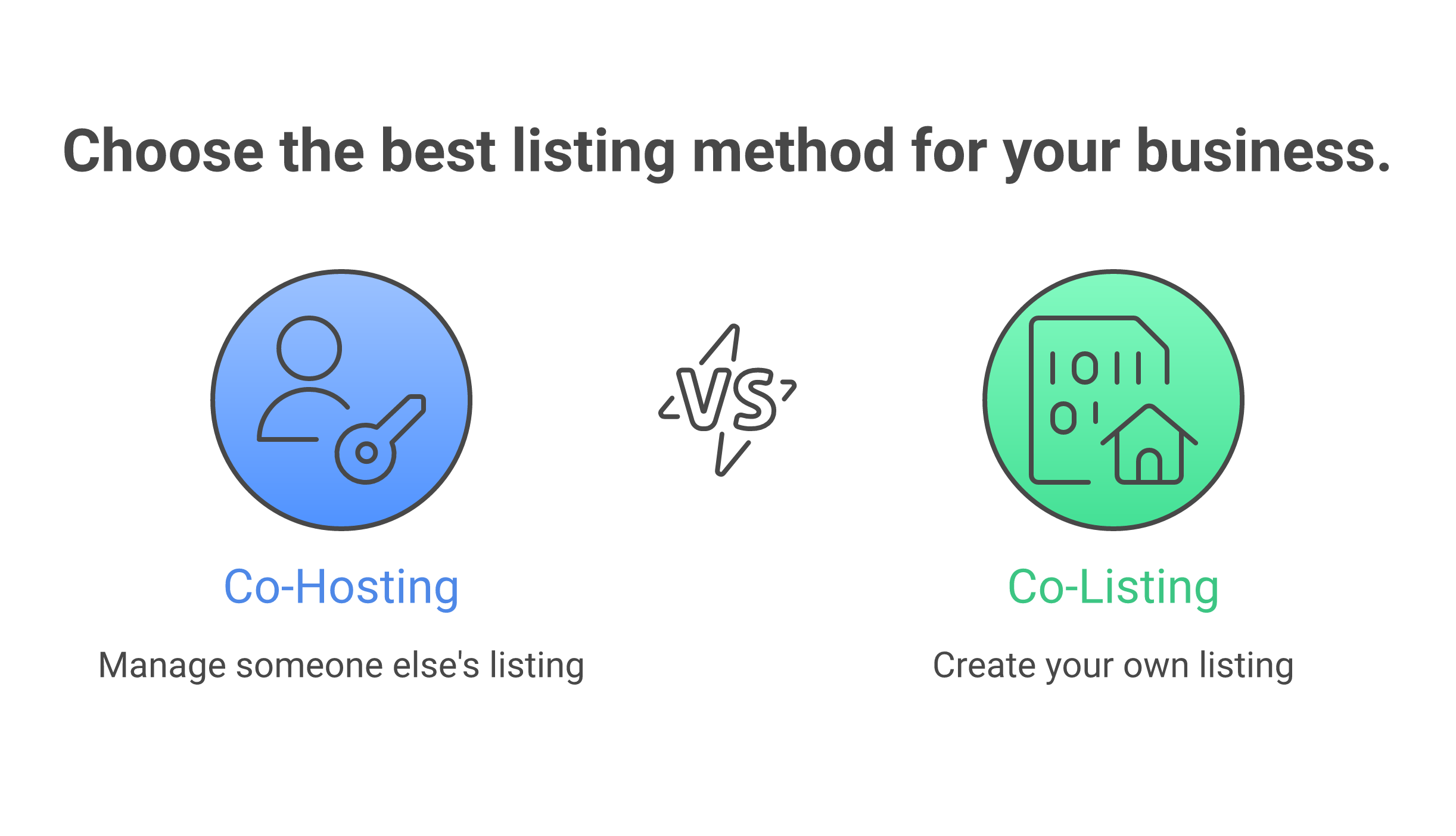
Before comparing courses, you need to understand the two main ways to manage other people’s Airbnb properties. The distinction shapes your earning potential, your level of control, and which course is worth your time.
Traditional co-hosting means a property owner adds you as a co-host on their existing listing. You help with guest communication, cleaning coordination, pricing tweaks, and check-in logistics. The owner keeps the listing in their name. You typically earn 10 to 15% of booking revenue. For the practical steps, read our guide on how to become an Airbnb co-host.
Co-listing goes further. You create and control the listing yourself, while the property owner signs an agreement granting you management rights. You handle everything: listing creation, photography, pricing strategy, guest screening, maintenance coordination, and owner reporting. Co-listers usually earn 20 to 25% because they take on full operational responsibility. See our deeper guide on co-host fees and commission rates by service level.
Why does this matter when choosing a course? Programs that teach co-listing prepare you to run a standalone business. Programs that only teach basic co-hosting prepare you for a side gig. Both are valid, but the earning ceiling and the skills you build are very different.
Here’s a practical example. Say you co-host a property that earns $4,000 a month in bookings. As a traditional co-host at 15%, you earn $600. As a co-lister at 25%, you earn $1,000, and because you also optimized the listing, the property might pull $4,000 instead of the owner’s original $2,800. The owner is happier, you earn more, and the guest experience improves because a professional runs the whole operation.
Top 6 Airbnb Co-Hosting Courses Compared (2026)
I scored each program from 1 to 5 on five criteria:
- Curriculum Depth: Does it cover client acquisition, operations, pricing, legal, and scaling?
- Coaching Access: Live calls and mentorship, or just pre-recorded content?
- Community Quality: Active members who share deals and help troubleshoot?
- Verified Results: Can students point to real income and property counts?
- Value for Investment: Does what you pay match what you receive?
1. 10XBNB Co-Listing Program
Instructor: Shaun Ghavami
Format: Online modules plus live group coaching plus 1-on-1 mentorship
Price: Book a strategy call for current program options
Shaun Ghavami built 10XBNB after generating millions in booking fees across a large co-listed portfolio. He studied finance at UBC’s Sauder School of Business, worked at BMO and RBC before going full-time into short-term rentals, and holds Airbnb Superhost status with 1,000+ five-star reviews.
The program teaches his co-listing method, where students build their own co-hosting business by managing properties for owners without buying real estate. Unlike basic training that stops at guest messaging and check-ins, the 10XBNB curriculum walks the full lifecycle: picking a market, pitching owners, structuring agreements, building optimized listings, setting pricing, and creating systems that scale past 10 properties. He co-founded the program with Ari Rahmanian, and both run live coaching directly.
What separates this program is coaching frequency and depth. Live group coaching plus 1-on-1 mentorship means you get real answers during the critical first 90 days, when most new co-hosts make their biggest mistakes. The student community has grown past 1,600 members. According to a 10XBNB 2026 internal student survey, 73% of active students reported becoming profitable within their first 90 days (results not typical; outcomes depend on market, effort, and execution).
| Criteria | Score (1-5) |
|---|---|
| Curriculum Depth | 5 |
| Coaching Access | 5 |
| Community Quality | 5 |
| Verified Results | 5 |
| Value for Investment | 4 |
| Total | 24/25 |
2. BNB Mastery Program (James Svetec)
Instructor: James Svetec
Format: Multi-week online course plus twice-weekly Q&A calls plus a Facebook community
Price: $1,997 (or 5 installments of $597)
James Svetec co-authored Airbnb for Dummies and, within 12 months of starting, managed 40 Toronto properties, several of which ranked in the top 1% of 14,000 local listings. His program spans dozens of modules across 16+ hours of video, organized into weekly units covering foundations, client conversion, client attraction, performance optimization, and automation.
The program includes twice-weekly Q&A coaching calls and a private community. It teaches strong co-hosting fundamentals and carries a 14-day money-back guarantee, which gives you time to evaluate before committing. The trade-off: the curriculum focuses on basic co-hosting rather than the co-listing model, so students typically earn lower commissions (10 to 15% vs 20 to 25%) and hold less control over the listings they manage.
| Criteria | Score (1-5) |
|---|---|
| Curriculum Depth | 4 |
| Coaching Access | 3 |
| Community Quality | 3 |
| Verified Results | 3 |
| Value for Investment | 4 |
| Total | 17/25 |
3. The Cohost Accelerator (Lauren Meeks)
Instructor: Lauren Meeks
Format: Self-paced modules plus a couple of coaching calls plus checklists and templates
Price: Not publicly listed (apply for access)
Lauren Meeks has hosted thousands of guests, authored a book on Airbnb hosting, and given a TEDx talk. Her program covers client conversation scripts, co-hosting contracts, property automation tools, direct booking website setup, remote management, and guest screening. The included coaching calls are scheduled on demand, and a 30-day money-back guarantee applies once you complete the first modules and show proof of effort.
It’s a solid structured introduction with hands-on templates. The limited coaching (a couple of calls, not ongoing) makes it less ideal for someone who wants continued mentorship while scaling.
| Criteria | Score (1-5) |
|---|---|
| Curriculum Depth | 3 |
| Coaching Access | 2 |
| Community Quality | 2 |
| Verified Results | 2 |
| Value for Investment | 3 |
| Total | 12/25 |
4. BNB Formula (Brian Page)
Instructor: Brian Page
Format: Online course with community access and a year of live coaching calls
Price: Around $2,997 (tiers and discounted resale prices vary widely across sources)
BNB Formula reports 25,000+ students across 47 countries, making it one of the largest short-term rental programs by enrollment. It focuses primarily on rental arbitrage rather than co-hosting, with some modules on property management and working with owners. The large community helps with networking, but coaching attention per student is thin given the volume. For the bigger picture on demand, see our look at the Airbnb co-host market.
If arbitrage is your goal, this is a strong option. If co-hosting is your focus, the curriculum won’t go deep enough on client acquisition, agreements, and owner relationship management. Worth noting: reported prices range from under $1,000 to five figures depending on the tier and the reseller, so confirm the current offer directly before buying.
| Criteria | Score (1-5) |
|---|---|
| Curriculum Depth | 3 |
| Coaching Access | 2 |
| Community Quality | 4 |
| Verified Results | 3 |
| Value for Investment | 3 |
| Total | 15/25 |
5. Udemy Airbnb Co-Hosting Courses
Instructors: Various
Format: Pre-recorded video, self-paced
Price: $14.99 to $49.99 (frequent sales)
Udemy hosts several budget airbnb co-hosting courses, usually a few hours of video covering platform basics, co-hosting contracts, property management software, and AI-assisted listing tools. At under $50, these free courses and cheap ones are fine for absolute beginners who want vocabulary and basic processes before committing to a premium program. The trade-offs are real: no live coaching, no community, no mentorship, no accountability, and content that’s often a year or two behind current market conditions.
Use a Udemy course as a starting point, not a destination. It’s a cheap way to decide whether co-hosting interests you before you invest in something with real support.
| Criteria | Score (1-5) |
|---|---|
| Curriculum Depth | 2 |
| Coaching Access | 1 |
| Community Quality | 1 |
| Verified Results | 1 |
| Value for Investment | 3 |
| Total | 8/25 |
6. Airbnb Academy and the Co-Host Network (Free)
Provider: Airbnb’s hosting team plus experienced Superhosts
Format: Online modules and community forums
Price: Free
Airbnb’s free education pairs new hosts with experienced co-hosts and Superhosts and covers listing optimization, guest communication, pricing basics, and platform tools. Separately, Airbnb launched the Co-Host Network in its Winter 2024 release, a marketplace that connects property owners with verified local co-hosts. It’s now available in 12 countries including the US, UK, Canada, and Australia. To appear in its search results you generally need 10+ stays (or 3+ stays totaling 100+ nights) in the past 12 months, a 4.8+ average rating, and a cancellation rate under 3% (you can read the full requirements in Airbnb’s Co-Host Network help center).
This is excellent for owners who want to host their own property better, and the Co-Host Network is a genuine lead source once you qualify. But none of it teaches co-hosting as a business: there’s no instruction on client acquisition, agreement structuring, revenue splits, or scaling a portfolio. Pair the free platform knowledge with a co-hosting-specific training program.
| Criteria | Score (1-5) |
|---|---|
| Curriculum Depth | 2 |
| Coaching Access | 1 |
| Community Quality | 2 |
| Verified Results | 1 |
| Value for Investment | 4 |
| Total | 10/25 |
Side-by-Side Comparison: All 6 Programs
| Program | Price | Coaching | Community Size | Focus | Score |
|---|---|---|---|---|---|
| 10XBNB | Book a call | Live group + 1-on-1 | 1,600+ | Co-listing | 24/25 |
| BNB Mastery | $1,997 | 2x/week Q&A | Private group | Co-hosting | 17/25 |
| BNB Formula | ~$2,997 | Limited | 25,000+ | Arbitrage | 15/25 |
| Cohost Accelerator | Apply | A few calls | Unknown | Co-hosting | 12/25 |
| Airbnb (free) | Free | None | Large | Self-hosting | 10/25 |
| Udemy Courses | $15-$50 | None | None | Basics | 8/25 |
What to Look for in a Co-Hosting Course (Buyer’s Guide)
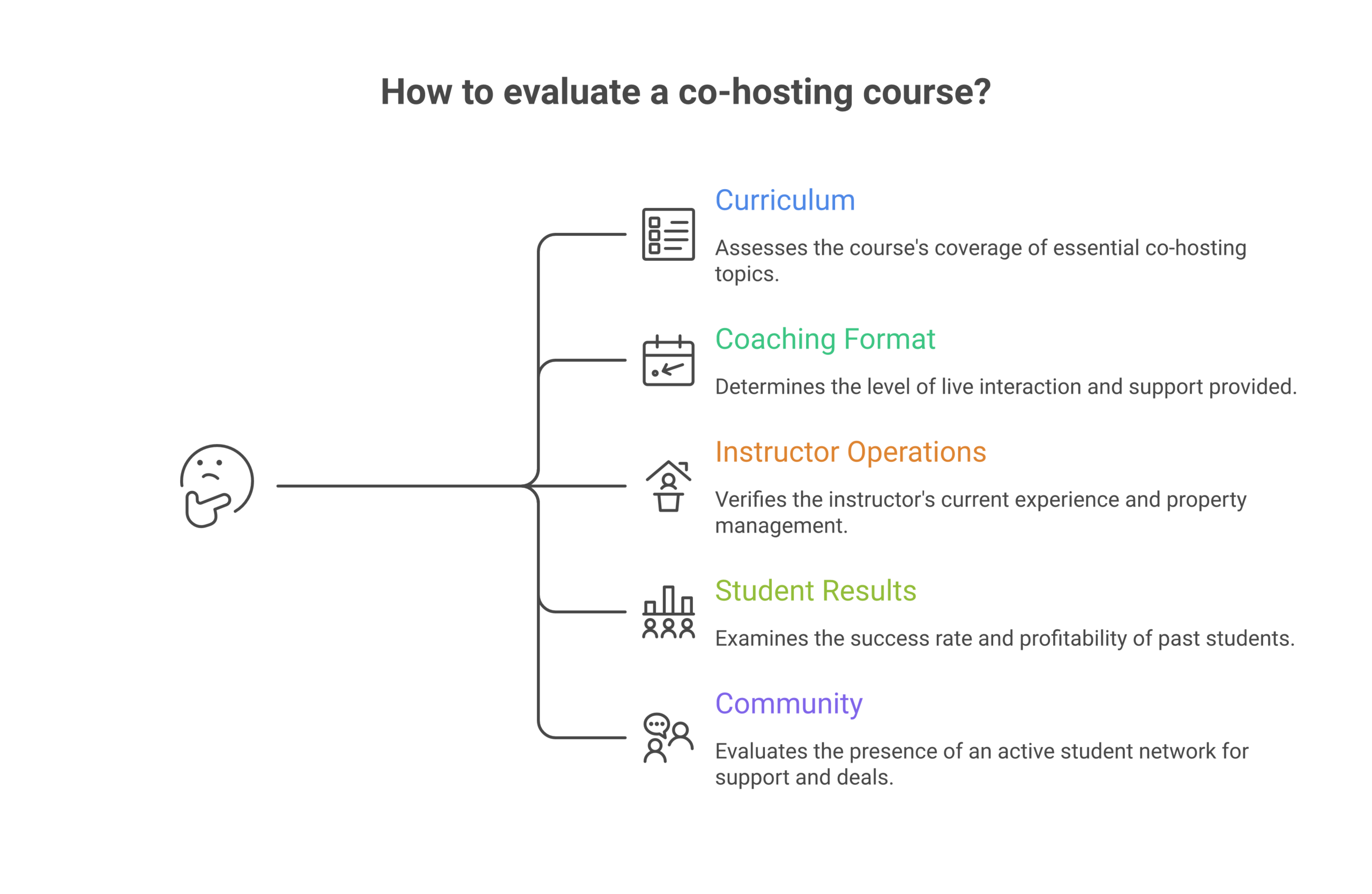
Before you invest in any co-hosting training, run every program through these seven filters. This is the part most “best airbnb co-hosting course” roundups skip.
1. Does the Instructor Still Actively Manage Properties?
This is the single most important question. Airbnb’s algorithm, pricing dynamics, guest expectations, and local regulations shift every quarter. An instructor who stopped hosting two or three years ago is teaching outdated strategies. Ask directly: how many properties do you currently manage? If the answer is zero, walk away. Shaun Ghavami still runs a large co-listed portfolio. James Svetec still owns a Toronto property management business. Their income depends on operational performance, not just course sales.
2. Is Coaching Live and Ongoing?
Pre-recorded videos have their place, but co-hosting on airbnb is a relationship business. You’ll hit situations no video can prepare you for: an owner who wants to change terms mid-contract, a guest who causes damage, a slow season that cuts bookings 30%. Live coaching gives you real-time answers from someone who’s handled the exact problem. Two coaching calls a week is the floor for a premium program; more is better during your first 90 days.
3. Are Student Results Verified?
Testimonials are easy to fake. Look for specific numbers: how many properties students manage, monthly revenue, timeline to profitability. “This course changed my life” means nothing without data. The 10XBNB 2026 internal student survey reports 73% of active students profitable within 90 days (results not typical). Treat every program’s numbers as claims you can probe, not gospel.
4. Does the Course Include Legal Templates?
A co-hosting business runs on contracts. You need a solid co-hosting contract that protects both you and the owner. Look for programs that include at least a base agreement, an LLC formation guide, and insurance recommendations. A course that hands you a battle-tested template saves you a lawyer’s fee and a lot of risk.
5. Is There a Community With Active Deal Flow?
The best co-hosting courses build communities where members share leads, refer properties to each other, and collaborate across markets. A community of 1,600+ active co-hosts, fellow hosts who are at every stage of building a business, creates real opportunities beyond the curriculum itself. Community members who share what’s working in their markets are often where the sharpest, most current learning happens.
6. Does the Course Teach Client Acquisition?
Many courses spend 90% of their time on operations (how to manage a listing) and 10% on client acquisition (how to find owners who need help). That ratio should be closer to 50/50. Finding clients is the hardest part of the business, especially in your first six months. If a program can’t show you exact scripts for outreach and a pitch framework, it’s teaching you half a business.
7. What’s the Refund Policy?
Programs that stand behind their content offer clear refund windows. BNB Mastery offers 14 days. Cohost Accelerator offers 30 days with effort requirements. If a program has no refund policy at all, ask why before you pay.
Course vs. Training vs. Mentorship: Which Fits You?
People use “course,” “training,” and “mentorship” interchangeably, but they’re different products, and the right one depends on where you are.
A course is structured lessons you work through at your own pace. It’s the foundation: how to find owners, how to pitch, how to set up a listing, how to manage guests, how to price, how to scale. Most students complete a solid core curriculum in two to three weeks. A course alone is enough if you’re self-directed, learn well from material, and just need the roadmap.
Training adds structure and accountability on top of the lessons: live sessions where you bring your specific situation, feedback on your actual listings and pitches, and templates you adapt rather than build from scratch. This is where co-hosting on airbnb gets real, because every market is different and every owner negotiation is unique. The questions you’ll face (how to price a new listing in an unfamiliar market, what to do when a guest causes damage, how to negotiate better contract terms) are answered fastest by someone who’s living the same problems weekly.
Mentorship is the most hands-on layer: 1-on-1 guidance tailored to your market, your goals, and your specific deals. It’s the right fit when you’ve got momentum and want personalized strategy rather than general principles. If you’re weighing standalone 1-on-1 options, our 10XBNB reviews page shows how students describe the coaching experience in their own words.
The strongest programs bundle all three. The 10XBNB model layers a self-paced curriculum, live group coaching, and 1-on-1 mentorship so you’re never stuck between “watch a video alone at midnight” and “figure it out yourself.”
What the Curriculum Actually Covers
A complete co-listing curriculum runs in phases, and this is the structure to look for in any program:
- Market analysis: identifying profitable markets with high demand, low competition, and owners who are underperforming on the platform.
- Client acquisition: outreach scripts, the exact pitch framework, and follow-up systems for approaching property owners. This is the make-or-break phase.
- Agreement structuring: building a co-listing contract that protects your business while giving owners confidence. Revenue splits, liability, insurance, termination clauses.
- Listing optimization: creating listings that rank in airbnb search. Photography standards, title formulas, description copywriting, pricing fundamentals.
- Operations at scale: guest communication templates, cleaning coordination, maintenance protocols, dynamic pricing, and owner reporting that lets you manage 20+ properties without burning out.
- Growth and team building: hiring your first virtual assistant, training cleaners, building referral networks, and shifting from operator to business owner.
Alongside the lessons, a strong program hands you the assets you’d otherwise spend weeks building: a co-hosting contract template, landlord pitch and email scripts, listing optimization templates, guest communication sequences, and financial tracking spreadsheets. The templates matter as much as the videos, because they’re what you actually use the day you sign your first client.
Free vs. Paid Co-Hosting Training: What Each Actually Teaches
Free co-hosting training gets you the concepts. Airbnb Academy covers hosting basics at no cost, and operators on YouTube walk through real listings, pricing, and guest messaging. Start there to decide whether the business fits you.
Paid co-hosting training gets you clients. The gap between free and paid is not information, it is execution support: outreach scripts that book owner calls, live coaching when a deal stalls, contract templates a lawyer would approve, and a community posting real client wins each week. If your goal is a paying co-hosting business rather than a hobby listing, that support is what closes the distance. Free teaches you to host. Paid training teaches you to get hired and scale.
What Does a Co-Hosting Course Cost, and Is It Worth It?
Price is where most people get stuck, so let’s be straight about it. Co-hosting courses span a huge range. Free platform education and sub-$50 Udemy courses sit at the bottom. Mid-tier programs like BNB Mastery run around $1,997. Premium programs with live coaching, mentorship, and done-with-you support sit higher, and many (10XBNB included) don’t publish a single sticker price at all. Instead, they run a strategy-call model: you book a free call, talk through your market and goals, and find the program tier that fits, rather than picking blind from a checkout page.
That model exists for a reason. A self-paced course, a done-with-you coaching track, and a fully done-for-you setup are genuinely different products with different price points, and the right one depends on how much you want handled for you. A 15-minute conversation sorts that out better than a pricing table ever could. The honest way to evaluate cost is to compare it against what the program returns, not against the number alone.
Here’s the math that matters. If a program helps you land even three co-listing clients, each paying roughly $1,500 a month in management fees, that’s $4,500 a month. At that rate, almost any tuition pays for itself inside a couple of months, and everything after is profit on a business you’ll keep running for years. The real cost of a cheap course isn’t the price tag; it’s the six months you lose to trial and error because nobody showed you the pitch, the contract, or the pricing strategy.
So what are you actually paying for in a premium program? Live coaching with people who still host. Mentorship tailored to your market. A community of 1,600+ active co-hosts trading real leads. Proven legal templates. And the specific co-listing plus co-hosting model that lets you control listings and earn 20 to 25% instead of 10 to 15%. To see exactly how the tiers are structured and what’s included at each level, the cleanest next step is to review the program options and book a free strategy call. There’s no hard sell; it’s a conversation about whether the model fits your situation.
Not Sure Which Program Fits Your Goals?
The best way to decide is to talk to someone who has built a co-hosting business from zero. Book a free call to ask honest questions about co-hosting, your market, and whether the co-listing model fits where you want to go. No pressure, no sticker shock.
Why Co-Listing Outperforms Basic Co-Hosting
Across a community of 1,600+ students, the co-listing approach consistently produces better results than traditional co-hosting, for three reasons.
Higher Revenue Per Property
Co-listers control the listing. They set pricing, write the description, choose the photos, and optimize for airbnb search. That control typically translates to 20 to 40% higher nightly rates than listings where an owner just adds a co-host as a helper. Higher rates mean higher commissions at the same percentage split.
Stronger Owner Retention
When you run the entire guest experience as a co-lister, owners see clear ROI from day one. You handle everything; they receive monthly checks. The relationship is simple: you produce results, they keep renewing. Traditional co-hosts who only handle messaging and check-ins are easier to replace because their value is less visible.
Scalable Systems
Co-listers build their own operations: standard cleaning procedures, automated guest messaging, dynamic pricing, maintenance workflows. These systems scale across 5, 10, or 50 properties without a matching jump in your hours. Basic co-hosts adapt to each owner’s existing setup, so every new property feels like starting over.
How to Learn Co-Hosting and Land Your First Client
A co-hosting course compresses your learning curve by months. But whether you take a program or bootstrap it yourself, the steps to manage properties for owners are the same. The course just gives you proven scripts and templates and helps you skip the costly mistakes.
Step 1: Choose Your Market
Start within about a 30-minute drive of where you live, so you can handle problems in person early on. Use AirDNA or Mashvisor to find areas where the average daily rate is over $100 and occupancy sits in the 50 to 70% range. That gap between current and potential performance is your opening.
Step 2: Build a Property Owner Hit List
Find owners with vacant or underperforming units. Zillow and Realtor.com “for rent” listings sitting empty 30+ days, Craigslist rentals with weak photos, Facebook Marketplace listings with no engagement, and local real estate investor Facebook groups are all good sources. Aim for 50 targets in your first week. Most will say no. One or two yeses get you off the ground, and momentum beats perfection.
Step 3: Make the Pitch
Owners with empty units lose money every day. When you frame yourself as the person who fixes that at zero cost to them, the conversation shifts. A simple framework: lead with their pain (“your unit’s been listed 28 days”), show the opportunity (“comparable Airbnbs here average X per month”), remove the risk (“I handle setup, photos, guests, cleaning; my fee is 20% of bookings”), and offer proof (screenshots, data, a mock listing). You can land your first client with no track record using exact scripts and clean market data alone.
Step 4: Sign Your First Agreement
Get it in writing immediately. A proper co-host contract covers commission, who pays for what, minimum term, cancellation notice, and insurance. Never manage a property on a handshake.
Step 5: Launch and Optimize the Listing
Spend $150 to $200 on a photographer for the first listing; it pays for itself fast. Write a title with the city name and the property’s best features, a description that sells the experience, and set up dynamic pricing through PriceLabs (which now powers 600,000+ listings globally) plus automated guest messaging through Hospitable. In the first 30 days, price aggressively to bank five-star reviews; those reviews compound for years.
Step 6: Scale Systematically
After your first three to five properties, document everything: onboarding checklists, guest message templates, cleaning inspection standards. Most co-hosts hit a wall around 5 to 8 properties because they do everything themselves. The ones who scale hire a virtual assistant around property 5 and a cleaning coordinator around property 10, shifting from doing the work to running the system that does it.
Airbnb Co-Host Access Levels Explained
When an owner adds you to a listing, Airbnb lets them choose exactly how much access you get. There are three levels:
- Full access: manage the calendar, pricing, and listing details, message guests, handle reimbursement requests, view co-host payouts, and set permissions for other co-hosts.
- Calendar and messaging access: message guests and view the calendar, without editing pricing or listing content.
- Calendar access: view the calendar plus check-in and checkout details only.
A professional co-host running the full operation usually needs full access. A cleaner or a backup contact may only need calendar access. Owners keep control of payouts. Knowing these tiers helps you ask for the right permissions in your co-hosting agreement.
Common Mistakes New Co-Hosts Make
After working with 1,600+ students, these patterns show up most often in the first six months.
Underpricing to Win Clients
New co-hosts offer rock-bottom fees (5 to 10%) to land their first owners, then can’t sustain the business and can’t raise rates later. Start at 15 to 20% and prove the value through results.
Skipping the Contract
Verbal deals fall apart the moment something goes wrong, and something always does: a broken TV, a noise complaint, an owner who wants to sell. Without a written agreement, you have zero protection.
Choosing the Wrong Market
Strict regulations, low tourist demand, or saturated supply can make a profitable portfolio nearly impossible. Check occupancy rates, the regulatory environment, average daily rates, and new-listing supply before you commit.
Trying to Do Everything Yourself
Managing 10+ properties with no team is the fastest path to burnout. Build your support system early: a reliable cleaning crew, a handyman on call, and eventually a VA for guest messaging.
Ignoring Guest Reviews
Your review score drives search ranking, pricing power, and owner retention. One bad review can cost thousands in lost bookings. Respond to every review, positive or negative, within 24 hours.
Pricing Too Low During Off-Season
Panicking and slashing rates in slow months trains the airbnb search algorithm to show your listing to budget travelers and drags down your average rate long-term. Use dynamic pricing tools, keep minimum rate floors, and focus on longer stays during shoulder seasons. A property booked at $120 a night for 20 nights beats $80 a night for 25 nights, and attracts better guests.
Red Flags When Evaluating a Co-Hosting Course
Not every course is worth your money. Watch for these warning signs.
- No verifiable instructor track record: if they can’t name how many properties they currently manage, walk away. Teaching co-hosting without doing it is like learning surgery from someone who watched videos.
- Income claims without methodology: “students earn $10,000 a month” means nothing without context. How many properties? What market? What timeframe? Legitimate programs show the math.
- No community or coaching access: pre-recorded videos alone are a product, not a course. Real training needs live interaction because every market and every owner negotiation is different.
- Pressure to enroll immediately: “the price goes up tomorrow” is a sales tactic. Good programs let their results do the selling.
- No refund policy: if a program won’t let you try it and get your money back within 14 to 30 days, that’s information.
Frequently Asked Questions About Airbnb Co-Hosting Courses
How much does an airbnb co-hosting course cost?
Prices range from free (Airbnb’s own education) to $14.99-$49.99 (Udemy) to around $1,997-$2,997 (BNB Mastery, BNB Formula) to premium programs with live coaching and mentorship that use a strategy-call model rather than a published price. Cost generally reflects the depth of instruction, coaching access, and ongoing support. Budget courses teach basics; premium programs add live coaching, community, legal templates, and personalized mentorship.
Can I start co-hosting with no money?
Largely, yes. Co-hosting requires no property ownership and no lease. Your startup costs are limited to an optional course, business registration ($50 to $200 depending on your state), and professional photos for your first listing ($150 to $300). Total initial investment can stay under $500 if you use a budget course.
How much can I earn as an Airbnb co-host?
Earnings depend on your market, property count, and commission. A single property earning $3,000 a month at a 20% fee generates $600 a month. Most full-time co-hosts manage 5 to 15 properties, putting monthly income roughly between $3,000 and $12,000. These are illustrative ranges, not guarantees; actual results vary widely by market and effort.
How is co-listing different from Airbnb’s Co-Host Network?
The Co-Host Network is Airbnb’s own marketplace that connects owners with verified co-hosts, available in 12 countries. To appear in its search results you generally need 10+ stays (or 3+ stays totaling 100+ nights) in the past year, a 4.8+ rating, and a sub-3% cancellation rate. It’s one lead source, but it won’t teach you listing optimization, pricing, agreements, or how to build systems. Co-listing is the full business model; the Co-Host Network is just one channel for finding clients within it.
How long does it take to get your first co-hosting client?
Students following a structured outreach system typically land their first client within 2 to 6 weeks. Self-taught co-hosts often take 3 to 6 months because they spend longer figuring out their pitch, contract, and approach through trial and error. More outreach means faster results.
Is co-hosting better than rental arbitrage?
They’re different risk profiles. Rental arbitrage means signing leases, paying monthly rent, and furnishing properties, with startup costs of $3,000 to $10,000 per unit. Co-hosting needs no upfront capital beyond your time. Arbitrage offers higher per-property profit but carries more financial risk; co-hosting is lower risk and easier to scale from zero, which is why many people start with co-hosting and add arbitrage later. Our 10XBNB vs Rental Arbitrage Academy comparison goes deeper on choosing a path.
Do I need a license to be a co-host?
Requirements vary by location. Some cities require a business license and a short-term rental permit; a few states require a property management license for anyone managing properties professionally. Forming an LLC for liability protection (typically $50 to $500 depending on the state) is common. Check your local regulations and get legal advice for your specific situation before starting.
What should a co-hosting agreement include?
Every co-hosting agreement should cover the parties, the property address, management responsibilities, the revenue split, the payment schedule, insurance requirements, liability allocation, a termination notice period (usually 30 to 60 days), performance benchmarks, and a dispute resolution process. Never manage a property without a written, signed agreement.
What is Airbnb co-hosting, in simple terms?
Co-hosting means you run someone else’s Airbnb listing for a percentage of the revenue, usually 10 to 25 percent. You handle pricing, guest messages, cleaner scheduling, and problem-solving. You do not own or lease the property, so you can start with little money and no real estate.
Is there a free Airbnb co-hosting course or class?
Yes. Airbnb Academy offers free official training on hosting basics, and YouTube has full walkthroughs from working operators. Free classes teach the concepts. A paid co-hosting course adds client acquisition scripts, live coaching, contract templates, and a community with real deal flow, which is what actually gets you paying clients.
Are Udemy Airbnb co-hosting courses any good?
Udemy courses (usually $15 to $50) are a low-cost way to learn the fundamentals, and many have thousands of students. They work as an introduction. They rarely include live coaching, updated 2026 strategies, contract templates, or client-acquisition support, so most people outgrow them once they take on real properties.
What does co-listing training cover that a basic co-hosting course doesn’t?
Basic co-hosting training teaches you to operate one listing well. Co-listing training teaches the full business: finding property owners, pitching and closing them, negotiating a 20 to 25 percent split, onboarding listings, and building repeatable systems so you can manage many properties instead of trading hours for a small fee.
Do I need Airbnb hosting experience before taking a co-hosting course?
No. A good co-hosting course starts from zero and gives you the systems to manage professionally from your first client. Airbnb’s own Co-Host Network does require experience to list there (10+ stays, or 3+ stays totaling 100+ nights in the past 12 months, plus a 4.8+ rating), but reaching out to owners directly has no such requirement.
Which Co-Hosting Course Should You Choose?
Your best option depends on budget, learning style, and goals.
If you want the most coaching and fastest results: the 10XBNB co-listing program offers the highest coaching frequency, 1-on-1 mentorship, and the largest active community. Book a strategy call to learn about current program options.
If you want a solid mid-range program: BNB Mastery at $1,997 offers a proven curriculum, twice-weekly coaching, and a 14-day refund window that lowers your risk.
If you’re testing the waters: start with Airbnb’s free education or a Udemy course ($15 to $50) to learn the basics, then invest in a program with live coaching and community once you decide co-hosting is your path.
One last thing: the best co-hosting course is the one you actually finish and act on. The common thread among people who succeed isn’t which program they chose. It’s that they did the outreach, signed their first owner, and delivered results. The course gives you the roadmap. You still have to drive. For a broader look at every short-term rental program, including arbitrage and pricing-strategy courses, read our guide to the best rental arbitrage courses, the sibling pillar to this one.